Title insurance and your home's title: what they protect
What your home's title is, the difference between the lender's and the owner's title insurance, where they appear on the Loan Estimate and how to compare.
Verified against official sources on October 17, 2026 14 official sources

Show contents
In short
What you need to know
Quick answer
Title is your legal ownership of the home; the deed is the document showing the seller transferred it to you. Title insurance protects you if someone later claims something against the home from before you bought it, such as taxes a previous owner did not pay. There are two policies: the lender's, which is almost always required and protects only the lender, and the owner's, which is usually optional and protects your investment. Title services appear in section B or C of your Loan Estimate; you can shop for those in section C, and the seller cannot make you use a particular title company.
What matters most
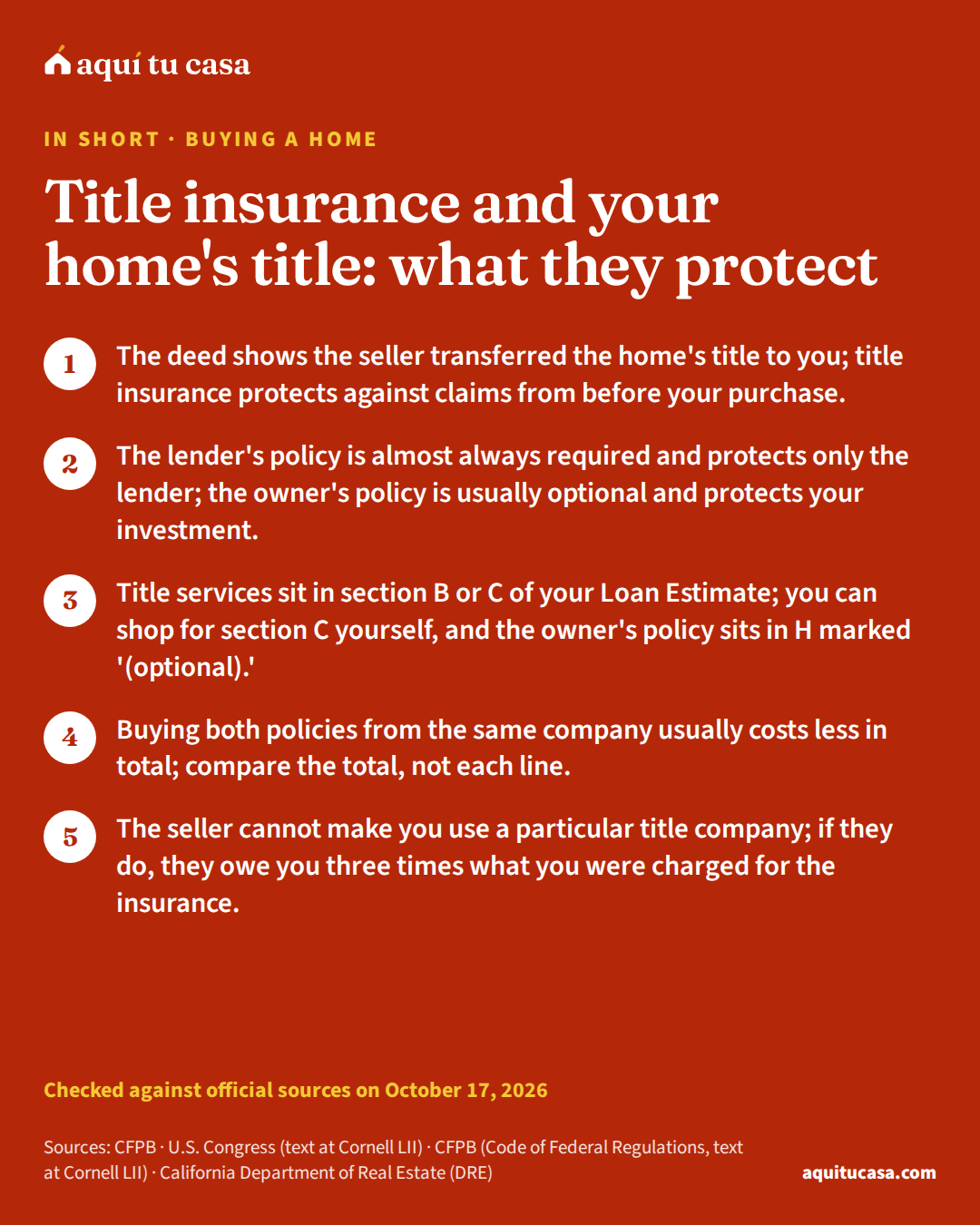
- The deed shows the seller transferred the home's title to you; title insurance protects against claims from before your purchase.
- The lender's policy is almost always required and protects only the lender; the owner's policy is usually optional and protects your investment.
- Title services sit in section B or C of your Loan Estimate; you can shop for section C yourself, and the owner's policy sits in H marked '(optional).'
- Buying both policies from the same company usually costs less in total; compare the total, not each line.
Is this for you?
This guide is for you if…
- You are buying a home and see title charges on your Loan Estimate that you do not understand.
- You want to decide whether to buy owner's title insurance, which is almost always optional.
- The seller or your agent is telling you which title company to use and you want to know whether you can choose another.
Get direct help first if…
- You want to know how to put the home in several relatives' names: that is a different topic.
- You are in a dispute over who owns a property: look for legal aid for your case.
When you buy a home with a loan, your Loan Estimate includes title charges. This guide is for anyone who is not sure what they are: it explains what title is, what each policy protects, where each charge appears, how to compare and how to look after your home after closing. Other closing costs have their own guide.
What title and the deed are
TitletitleTitle is your legal right to own and possess a property. The deed is the document showing that the seller transferred that right to you, and legal title is the title that can be documented in public records. As part of the purchase, a title search is done to see whether anyone else has a claim against the home; common claims come from a previous owner's unpaid taxes or from contractors who say they were not paid for work on the home. Title insurance protects you if such a claim shows up later.See the full definition is your legal ownership of the home. According to the CFPB, when you buy you receive a document usually called a deeddeedA deed is the legal document the seller uses to transfer ownership of the home to you. The seller signs it at closing, it lists the names of all the buyers and you receive a copy. Afterward, the settlement agent records it with the county records office; that recording puts the public on notice that you are now the owner. There are several types: a warranty deed gives the most promises about the title, and a quitclaim deed promises nothing. Do not confuse it with a deed of trust, which is the mortgage document.See the full definition, which shows the seller transferred that legal ownership to you.1
The risk is that someone shows up later with a claim against the home from before you bought it. The CFPB gives two examples: taxes a previous owner did not pay, and contractors who say they were not paid for work done on the home before your purchase.1 That is what title insurancetitle insuranceTitle is the legal right of ownership of the home, and title insurance protects you if, after closing, someone claims a right to it: an old debt, an heir, an error in the records. There are two policies. Most lenders require a lender's policy, which protects the amount they lent. The owner's policy is optional, paid once at closing, and protects you for as long as you own the home, including the legal costs of defending your right. You can shop for a title company; the price varies by state.See the full definition is for.
Among the title services you pay for is the title search.3 Separate from those are recording feesrecording feesRecording fees are what state and local government agencies charge to officially record your deed, your mortgage and other loan documents. They are based on the type of document or its features, such as the number of pages, not on the home price or the loan amount; that is what sets them apart from transfer taxes. Either the buyer or the seller may pay them. They appear in section E on page 2 of your Loan Estimate and your Closing Disclosure, on the “Recording Fees and Other Taxes” line.See the full definition, which are paid to state and local governments.9
The two policies: the lender’s and the owner’s
There are two title insurance policies, and they protect different people.
Lender's and owner's title insurance
Almost always required
Lender's policy
If you buy both, the total cost is usually lower if you use the same company.1
The lender’s policy protects only what you were lent. The CFPB says it plainly: it does not protect your investment in the home, your equityhome equityHome equity (or equity) is what your home is worth today minus what you still owe on the mortgages on it. You can borrow against that equity: with a home equity loan, which you receive as a lump sum and which usually has a fixed rate; with a HELOC; or with a cash-out refinance. In all of these the home is the collateral and, if you do not repay, the lender could take it. With a reverse mortgage, the balance grows each month and your equity goes down.See the full definition, and if someone sues with a claim against your home, you are the first person responsible. To protect your equity, you may want to buy the owner’s policy.2
Some companies offer an “enhanced” owner’s policy, with additional coverage that may grow as the home’s value rises.4 If you are offered one, ask for a written explanation of what extra it covers and what it costs.

Where they appear on your Loan Estimate
According to the CFPB, title service fees are part of your closing costsclosing costsClosing costs are all of the costs you pay on closing day on top of the down payment: lender fees, the appraisal, the credit report, title insurance, the closing agent's fees, any transfer taxes your state or county charges and the first deposits into the escrow account. The lender must itemize them on the Loan Estimate within days of your application and confirm them on the Closing Disclosure before you sign. Some can be paid by the seller, and several state programs help cover them.See the full definition. They include the title search, the lender’s title insurance premium and other costs of issuing that policy; in most states, also the fee for conducting your closing. They appear in section B or C of page 2 of your Loan EstimateLoan EstimateThe Loan Estimate is a three-page form you receive from the lender within days of applying for a mortgage. In the same format at every bank, it sums up the terms of the loan being offered: amount, interest rate, whether the payment can change, the estimated monthly payment with taxes and insurance, the itemized closing costs and how much cash you need at closing. Because every lender uses the same form, it lets you compare offers side by side. It commits you to nothing: requesting one is not accepting the loan.See the full definition: if they are in section C, you can shop for them yourself. The owner’s policy, if you buy it, goes in section H.3
The owner’s policy appears in the “Other Costs” table with a label that begins with “Title -” and, when the lender does not require it, ends with “(optional).” If the seller pays for it, your Closing DisclosureClosing DisclosureThe Closing Disclosure is a required five-page form with the final details of the mortgage you selected: the loan terms, your monthly payment, every closing cost and how much cash you must bring on signing day. The lender must give it to you at least three business days before closing, so you can compare it with your Loan Estimate and ask about any change. If an important number changes, the three-day period starts again. Keep it: you will need it for your taxes.See the full definition does not have to say “(optional).”4 Recording fees appear separately, under “Taxes and Other Government Fees.”9
Why the figures may not match the quote. Title companies often offer a “simultaneous” rate if you buy both policies from them. The Loan Estimate does not show that rate as is: it uses a CFPB formula.4
Example with real numbers
The owner's policy formula, in words
How the Loan Estimate calculates each policy when you buy both from the same company, according to the CFPB.
- Lender's policy on your Loan Estimate
- Its full premium, not the simultaneous rate4
- Owner's policy on your Loan Estimate
- Full owner's premium + simultaneous lender's premium − full lender's premium4
- The title company's quote
- May show each policy with different figures, under your state's law or practice4
- Total for both policies
- The same on the Loan Estimate as what you pay4
That is why you compare the total for both policies, not each line.5 At closing, depending on your state, you may get an itemized list that differs from your Loan Estimate; that does not necessarily mean you are being charged the wrong amount.1
Run it with your numbersClosing costsThe closing costs guide explains the rest of section C and which charges can go up before you sign.
Who conducts your closing: the closing agent
Title services and the closing usually go together: in most of the country, title services include the fee for the agent who conducts your closing.5 According to the CFPB, the closing agentsettlement agentThe settlement agent (also called a closing agent) is the person or company that coordinates the closing so that everything the contract requires is accounted for. Depending on the location, it may be a title company, an escrow company (in most western states) or a closing attorney (in some eastern states). It collects the money from the lender and from you, pays the seller, distributes the closing costs and records the documents with the county. It works for all the parties; it is not your personal representative. Ask it how to pay the money you need to bring to closing.See the full definition gathers all the legal documents, closes the loan and handles the money in your purchase. In most of the country this person is called a settlement agent; in several Western states, an escrow agent; and in some states, particularly in the Northeast and South, an attorney might be required.13
When comparing, the CFPB suggests looking at both cost and customer service. Ask your real estate professional and your friends how each company handled problems and whether it has a good reputation, and ask for references from people who recently bought a home.13 Also remember that your Loan Estimate lists the owner’s policy as optional if your lender does not require it.13
How to compare and choose a title company
It pays to compare. According to the CFPB, title services are the largest cost among the services you can shop for, and in most cases you can shop for them. They include the insurance, the title search and, in most of the country, the fee for the agent who conducts your closing.5
From contract to deed, with the title company
1. You get the list of providers
With your Loan Estimate
The lender must give it to you; you can use another provider if the lender agrees to work with them.6
2. You get quotes and references
As soon as you have the Loan Estimate
Ask for the price and references from recent customers, and compare the total.5
3. You decide on the owner's policy
Before choosing a company
If you buy it, using the same company for both policies usually costs less.1
4. The title search is done
As part of the title services
It is one of the title services you pay for.3
5. You confirm payment instructions
Before wiring money
Never follow instructions that arrive by email; confirm them with two trusted people.11
6. You sign and receive the deed
When the purchase closes
It shows the seller transferred the home's title to you.1
What the law says:
- You can go off the list. The lender must give you a written list of providers with your Loan Estimate, and you can use one that is not on it if the lender agrees to work with them.6
- The seller cannot pick your company. Under RESPA section 9, the seller cannot require, as a condition of selling to you, that you buy title insurance from a particular company. If they do, they owe you three times all the charges for that insurance.7
- Recommendations may come with an interest. Lenders or agents might recommend providers they have a relationship with, who might not offer the best deal.5 If the person referring you owns part of that company or is affiliated with it, Regulation X calls for telling you in writing, on a separate piece of paper, with an estimate of the charges, and not requiring you to use it.8
Who pays? According to the CFPB, the buyer generally pays the costs of the purchase, including title insurance, although depending on the contract or state law the seller may pay some.10 Ask your agent what is customary in your area and what your contract says.

Closing and after: protect your money and your title
During closing, be careful how you send money.
After closing, keep your copy of the deed. In California, for example, the DRE consumer page links to “County Recorder Alerts” so you can be notified of recorded activity on your home.12 Ask your county whether it offers something similar. More warning signs are in the housing scams guide.
If this is you
You are buying for the first time
The owner's policy is usually optional, but the lender's policy does not protect your investment.2 Decide calmly before choosing a company.
You are buying with relatives
The deed shows who the title passed to.1 Before signing, check how the names appear; for questions about your case, free legal aid is an option.
You have owned your home for years
Check whether your county offers recording alerts; in California, the DRE links to the county recorder's.12
Costly mistakes
Mistake: Thinking the lender's policy protects you too.
Instead: It protects only the lender; the owner's policy is the one that protects your investment.2
Mistake: Taking the recommended title company without asking.
Instead: Get quotes and compare the total: it may not be the best deal.5
Mistake: Letting the seller impose their title company.
Instead: RESPA prohibits it; you can choose another.7
Mistake: Comparing the Loan Estimate and the quote policy by policy.
Instead: Compare the total for both policies: the Loan Estimate uses a different formula.4
Mistake: Wiring closing money with instructions from an email.
Instead: Confirm them with your two trusted people before sending anything.11

What to do this week
- Find the title charges on your Loan Estimate in sections B, C and H.3
- Using the list of providers, get two or three quotes and references, and compare the total.5
- Decide whether you want the owner’s policy, and ask for the price of both policies from the same company.1
- If you are referred to an affiliated company, ask for the written disclosure of that relationship.8
- Choose your two trusted people for confirming payment instructions.11
- Estimate your cash to close with the closing costs tool, and if you want help with your numbers, find a HUD-approved housing counselorHUD-approved housing counselorA HUD-approved housing counselor works at an agency HUD has approved to provide housing counseling: independent, expert advice customized to your situation about buying a home, renting, a missed mortgage payment, a foreclosure or credit problems. The agencies usually charge little or nothing; many serve in Spanish and offer the homebuyer education course several assistance programs require. They are not lenders or real estate agents and sell you nothing. Your county page lists the official agencies with phone numbers.See the full definition, who gives independent advice, often for free or at low cost.14
Ready to see the numbers? Find your county here
See how this applies in your county: its loan limits, prices and rents, from the official data.
Printable checklist
Frequently asked questions
Is title insurance required?
The lender's policy usually is: the CFPB says it is usually required to get a mortgage. The owner's policy, in most cases, is not required by the lender and is optional; your Loan Estimate marks it '(optional).'
What does owner's title insurance cover?
It protects you if someone sues claiming something against the home from before you bought it. The CFPB gives as examples a previous owner's unpaid taxes and contractors who say they were not paid for work done before your purchase.
If I already pay for the lender's policy, why buy the owner's?
Because the lender's policy protects only the lender, not your equity. According to the CFPB, if someone sues with a claim against your home, you are the first person responsible; the owner's policy is the one that protects your investment.
Can I choose my title company?
If the title services are in section C of your Loan Estimate, yes: the lender must give you a list of providers and you can use another one if the lender agrees to work with them. And under RESPA, the seller cannot make you use a particular title company.
Why does the owner's policy look cheaper on my Loan Estimate than on the quote?
Because of the formula the Loan Estimate uses when you buy both policies from the same company: the lender's policy shows its full premium and the owner's policy is calculated by subtraction. The lines may not match the quote, but the total of both policies is the same as what you pay.
Who pays for title insurance, the buyer or the seller?
According to the CFPB, the buyer generally pays the costs of the purchase, although depending on the contract or state law the seller may pay some. If the seller pays for the owner's policy, your Closing Disclosure does not have to say '(optional).'
How much does title insurance cost?
It depends on the company and the state. The CFPB says title services are the largest cost among the services you can shop for, and recommends getting quotes and comparing the total. Your figure appears in sections B, C and H of your Loan Estimate.
What do I do if the title company sends me new wiring instructions?
Do not follow them without confirming. The CFPB warns that scammers send fake emails posing as the settlement agent, and recommends never following instructions in an email and confirming with two trusted people.
Sources
Every figure in this guide comes from one of these official sources. The number next to a sentence leads to the source behind it.
Each source on one line: who publishes it, its title, its address and the date we read it.
- 1. CFPB · What is owner's title insurance? · consumerfinance.gov · Accessed October 17, 2026
- 2. CFPB · What is lender's title insurance? · consumerfinance.gov · Accessed October 17, 2026
- 3. CFPB · What are title service fees? · consumerfinance.gov · Accessed October 17, 2026
- 4. CFPB · Factsheet: TRID Title Insurance Disclosures · files.consumerfinance.gov · Accessed October 17, 2026
- 5. CFPB · Shop for title insurance and other closing services · consumerfinance.gov · Accessed October 17, 2026
- 6. CFPB · What required mortgage closing services can I shop for? · consumerfinance.gov · Accessed October 17, 2026
- 7. U.S. Congress (text at Cornell LII) · 12 U.S.C. §2608, Title companies; liability of seller (RESPA section 9) · law.cornell.edu · Accessed October 17, 2026
- 8. CFPB (Code of Federal Regulations, text at Cornell LII) · Regulation X, 12 CFR §1024.15, Affiliated business arrangements · law.cornell.edu · Accessed October 17, 2026
See the other 6 sources
- 9. CFPB (Code of Federal Regulations, text at Cornell LII) · Regulation Z, 12 CFR §1026.37, Content of disclosures for certain mortgage transactions (Loan Estimate) · law.cornell.edu · Accessed October 17, 2026
- 10. CFPB · What fees or charges are paid when closing on a mortgage and who pays them? · consumerfinance.gov · Accessed October 17, 2026
- 11. CFPB · Mortgage closing scams: How to protect yourself and your closing funds · consumerfinance.gov · Accessed October 17, 2026
- 12. California Department of Real Estate (DRE) · Consumers · dre.ca.gov · Accessed October 17, 2026
- 13. CFPB · Your home loan toolkit: A step-by-step guide · files.consumerfinance.gov · Accessed October 17, 2026
- 14. CFPB · Find a Housing Counselor · consumerfinance.gov · Accessed October 17, 2026
Keep reading
Related guides
If this guide helped, these follow the same path.

Buying a home 18 minute read
Closing Disclosure explained: what to check before signing
What the Closing Disclosure is, when it must reach you, what to check on each of its five pages and which closing costs are not allowed to go up.
- Five pages, at least three business days before closing; Sundays and federal holidays do not count, Saturdays do.
- Compare it with your latest Loan Estimate: rate, APR, monthly payment, prepayment penalty, balloon payment and cash to close.
- The lender's charges cannot rise above the Loan Estimate; recording fees and services from the lender's list can rise up to 10 percent in total; any excess is refunded.
- Buying a home How to choose a real estate agent to buy a home What a real estate agent does, who they represent, how to check their license in your state, what to ask them and your fair housing rights. 10 minute read
- Protect yourself from scams Housing scams: the complete guide to spotting them The rental, mortgage, title, contractor, credit and moving scams families run into most: how to spot them, what to do and where to report them. 17 minute read
Tools for this topic
Was this guide useful?
Thank you. Your answer stays in your browser; nothing is sent.