How to choose a real estate agent to buy a home
What a real estate agent does, who they represent, how to check their license in your state, what to ask them and your fair housing rights.
Verified against official sources on October 17, 2026 14 official sources

Show contents
In short
What you need to know
Quick answer
The CFPB recommends choosing an agent with experience in the neighborhoods, prices and type of home you want, asking for references and checking your state's licensing agency for disciplinary actions. Ask who they represent, whether they keep your conversations confidential and how they are paid: an agent can represent the buyer, the seller or both. If the agent is an NAR member who uses the MLS, you will sign a written agreement before touring homes, and their pay is negotiable. The Fair Housing Act prohibits an agent from treating you differently or steering you away from a neighborhood because of your national origin, race or other protected characteristics.
What matters most
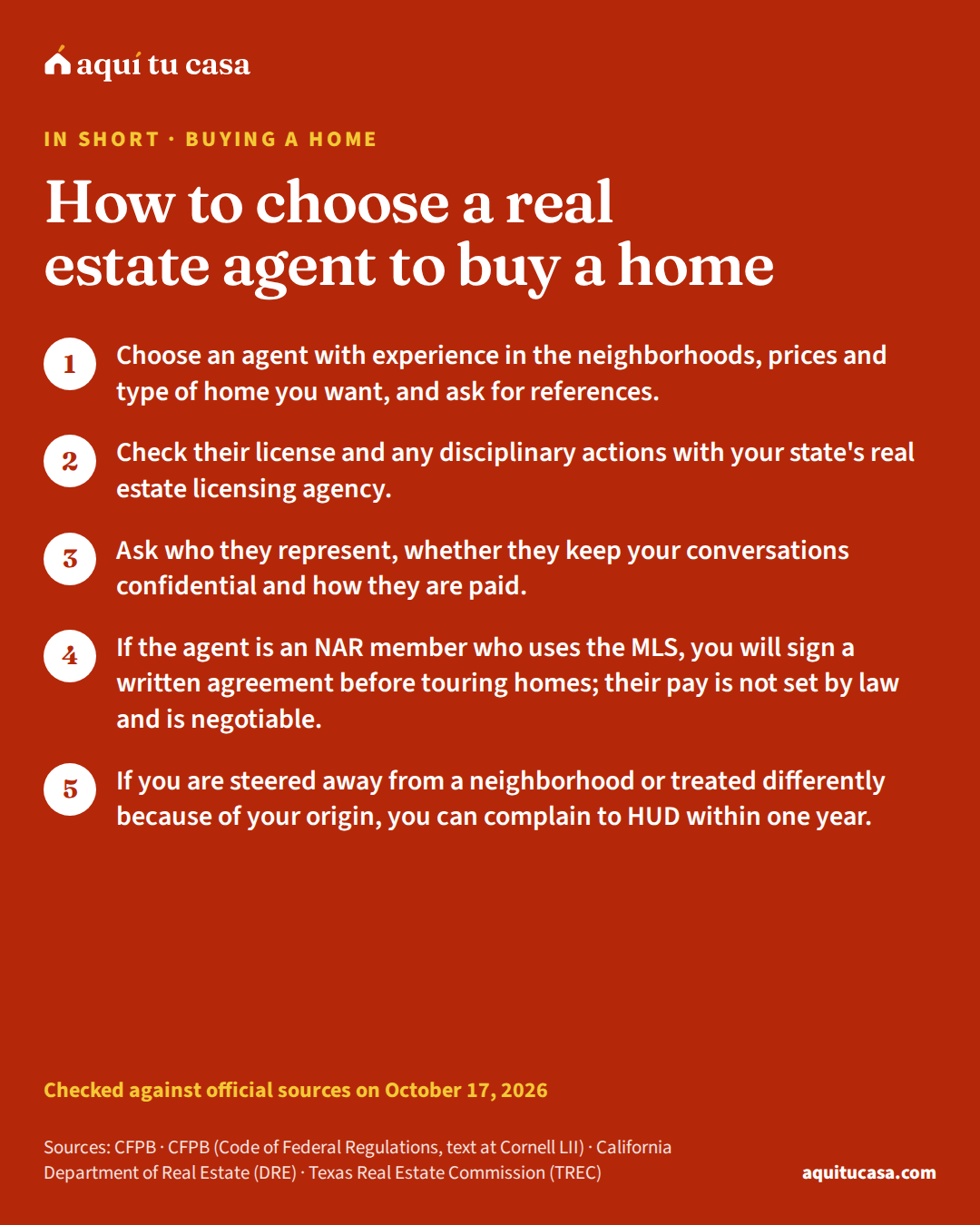
- Choose an agent with experience in the neighborhoods, prices and type of home you want, and ask for references.
- Check their license and any disciplinary actions with your state's real estate licensing agency.
- Ask who they represent, whether they keep your conversations confidential and how they are paid.
- If the agent is an NAR member who uses the MLS, you will sign a written agreement before touring homes; their pay is not set by law and is negotiable.
Is this for you?
This guide is for you if…
- You are about to start looking for a home and want to choose the agent who will guide you.
- A relative or friend is an agent and you are not sure whether to work with them.
- You want to know how to check an agent's license and what to do if you are treated differently because of where you come from.
Get direct help first if…
- You already have an agent who asked you to sign an agreement: the buyer-agent agreement guide explains it point by point.
- You are selling your home: many rules are similar, but this guide is about buying.
A real estate agent guides you through the search for and purchase of your home. This guide is for anyone about to start looking: it explains what an agent does and does not do, who they represent, how to check their license, what to ask, how they are paid and what your rights are if you are treated differently.
What a real estate agent does (and does not do)
According to the CFPB, many people work with a real estate agentreal estate agentA real estate agent (often called a realtor) is the professional who helps you buy or sell a home. There are buyer's agents and seller's agents (listing agents). A buyer's agent helps you find homes that fit your needs and budget, gives you information about neighborhoods and property taxes, prepares and presents your offer, negotiates with the seller and guides you to closing. Their commission is negotiable and not set by law; it is written into the agreement you sign with your agent. On the Closing Disclosure, the agent appears in the contact table, usually with a state license number.See the full definition to shop for homes.1 The exact services are agreed in writing: according to NAR, the buyer agreement should clearly spell out what the agent will do, such as showing homes, negotiating and presenting your purchase offerpurchase offerA purchase offer is the formal proposal you make to a seller to buy their home. Your real estate agent writes it up and sends it to the seller's agent. It includes the price you offer and the terms of the purchase: your target closing date, who pays certain fees, a deadline for the seller to respond and any contingencies, which are conditions that must be met before you buy. The seller can accept it or answer with a counteroffer, and you can accept, reject or counter again. Once both parties sign the written offer, it becomes a contract.See the full definition.10 One thing to go over with your agent is the contingencycontingencyA contingency is a condition you add to your offer or purchase contract to protect yourself: if it is not met, you can change or end the contract and, in general, get your earnest money back. The most common are the inspection contingency, if the inspection finds problems; the appraisal contingency, if the appraisal comes in below the price; the financing or mortgage contingency, if you cannot get the loan within the agreed time; and the home sale contingency, tied to selling your current home. Contingencies are a normal part of buying, but too many can make your offer less attractive to the seller.See the full definition in your purchase contractpurchase agreementA purchase agreement is the written contract between you and the seller that is final once the seller accepts your offer and both of you sign it. It gathers the details of the sale: the names of the buyers and sellers, the total price, the real estate agent's commission, the requested closing date and the contingencies. You use it to get your loan, and it is submitted with the closing paperwork. The settlement agent pays out the money according to the contract and the loan, and whether the seller pays some closing costs is also set by the contract.See the full definition: the CFPB suggests making your offer contingent on getting financing and on a satisfactory inspection, so you are not required to buy if you cannot get the loan or the inspection finds serious flaws.1
Some jobs are not the agent’s:
- The inspection. It is done by an inspector who works for you.2 The home inspection guide explains how to choose one.
- The appraisal. It is done by an independent appraiser, whose job is to give the lender an estimate of the home’s value.2 If it comes in low, read what if the appraisal comes in low.
- The loan. Your agent may have a preferred lenderlenderThe lender is the financial institution that lends you the money for your mortgage. The mortgage is the agreement that gives the lender the right to take your home if you do not repay what it lent you. After closing, it is common for another company, the loan servicer, to collect your payments and keep track of the loan; it may be the same company that lent you the money or a different one. On the Loan Estimate, the lender's name appears on the first page, and the last page lists it as "Lender" with its NMLS or license number.See the full definition, but the CFPB says to keep comparing.3
- The closing. In most of the country, a settlement agentsettlement agentThe settlement agent (also called a closing agent) is the person or company that coordinates the closing so that everything the contract requires is accounted for. Depending on the location, it may be a title company, an escrow company (in most western states) or a closing attorney (in some eastern states). It collects the money from the lender and from you, pays the seller, distributes the closing costs and records the documents with the county. It works for all the parties; it is not your personal representative. Ask it how to pay the money you need to bring to closing.See the full definition does it.2 The CFPB says one who is independent from the other professionals in the deal might offer lower costs and objective advice.1
Who your agent represents
Ask this from the start. According to the CFPB, an agent can represent the buyer, the seller and sometimes both. State laws can require your agent to tell you who they represent and on what terms.1
Three ways to work with an agent
Represents you
Buyer's agent
Represents the seller
Seller's agent
Before you share your budget, ask who they represent and whether they keep your conversations confidential.1
That is why the CFPB suggests asking your agent, for example, whether they keep your conversations confidential and how they are paid. Also, how the agent or brokerage would handle it if you like a home whose seller they also represent.1
How to find and interview agents
The CFPB recommends choosing an agent with strong experience in the neighborhoods, price range and type of home you prefer, and in other factors that matter to you.1 If being served in Spanish matters to you or your family, that is one of those factors: ask about it from the start.
Real estate websites can connect you with an agent, but the CFPB warns that many make money through advertisements from agents. Ask the agent you are considering for references.1

What if your cousin or your best friend is an agent? The CFPB recognizes that many buyers feel obliged to work with a relative or friend. Its advice: buying a home is one of the most important investments you will make, and you need someone with the experience to do the best job, who may or may not be that person.1
At the interview, bring these questions:
- How much experience do you have in the neighborhoods and prices I am looking at?1
- Who do you represent in this purchase? Do you keep my conversations confidential?1
- How are you paid, and how much? What will our written agreement say?8
- What happens if I like a home your own brokerage is selling?1
- Can you give me references from past clients?1
To see prices in your area before the interview, look up your state or county in places, and use the how much house can I afford tool to know your range.

Check the license in your state
An agent’s license is checked in your state. The CFPB suggests checking your state’s licensing agency, sometimes called the Department of Real Estate, for disciplinary actions on the agent’s record.1 Two examples of what that looks like:
- California. The Department of Real Estate (DRE) consumer page lets you verify a license (“Verify a License”), view disciplinary actions against licensees and learn how to file a complaint.6
- Texas. The Texas Real Estate Commission (TREC) has a “License Holder Search” that covers brokers and sales agents, and a way to complain if you believe someone violated the license act or its rules.7
In other states, look for your state’s real estate licensing agency.
How to choose and check your agent
1. Make a short list
Before you start looking at homes
Look for experience in the neighborhoods, prices and type of home you want.1
3. Check the license
Before you sign anything
With your state's real estate agency, also check for disciplinary actions.1
4. Ask who they represent
At the interview
And whether they keep your conversations confidential and how they are paid.1
5. Read the written agreement
Before touring homes
It must state the amount or rate of their pay, or how it is determined.8
How agents are paid: the written agreement
In its settlement agreement, the National Association of REALTORS (NAR) agreed to require that its agents who participate in an MLS and work with a buyer sign a written agreementbuyer-broker agreementA buyer-broker agreement is a legal document you sign with the real estate agent who helps you buy, and it formalizes your working relationship. According to the VA, after a court settlement with the National Association of Realtors (NAR), its agents must sign one with you before you tour a home. The agreement must state clearly how much the agent will be paid or how that is determined, without leaving it open-ended; bar the agent from receiving more than the agreed amount from any source; and say that commissions are fully negotiable and not set by law. You can negotiate before signing and ask the seller to pay your agent.See the full definition with that buyer before the buyer tours any home. If the agent will be paid from any source, the agreement must state the amount or rate, or how it will be determined. It cannot be open-ended, and the agent cannot receive more than what you agreed to.8
The same settlement requires those agents to tell you, in conspicuous language, that commissions are not set by law and are fully negotiable.8 According to NAR, an MLS is a local marketplace where buyer and listing brokers share information about homes for sale. The seller can offer to pay your agent, but that offer is not posted on the MLS, and you can still accept seller concessions, such as paying your closing costs. You do not need a written agreement just to talk with an agent at an open house or ask about their services.9
The buyer-agent agreement guide explains what that document should say, point by point.
Your fair housing rights
The Fair Housing ActFair Housing ActThe Fair Housing Act is the federal law that makes it illegal to refuse to sell or rent a dwelling, or to discriminate in its terms, because of race, color, religion, sex, familial status (having children), national origin or disability. It applies to landlords, real estate agents and managers, and also to banks and lenders when their practices make housing or credit unavailable for those reasons. National origin covers your language and the country you come from, regardless of immigration status. If you believe you were discriminated against, you can file a complaint with HUD at no cost; many states add protections.See the full definition prohibits discrimination in the sale of housing. It is illegal, because of your race, color, religion, sex, familial status or national origin:11
- to refuse to sell to you after a bona fide offer, or refuse to negotiate;
- to treat you differently in the terms, conditions or services;
- to tell you a home is not available to see or buy when it is.
The law also prohibits discrimination in a sale because of a disability.11
If you believe you were discriminated against, the law gives you a deadline: you can file a complaint with HUD no later than one year after what happened.13 HUD’s complaint line is (800) 669-9777.2 If you want help with your case, free legal aidlegal aidLegal aid is the free civil legal help that nonprofit organizations and their lawyers provide to low-income people in civil, not criminal, matters. In housing, that includes representing families facing eviction or foreclosure, alongside matters such as custody, child support, protection from domestic violence and access to benefits. In the United States, the Legal Services Corporation, created by Congress, funds a nationwide network of these organizations; its finder points you to the one in your area. Each sets its own income limits.See the full definition is an option, and a HUD-approved housing counselorHUD-approved housing counselorA HUD-approved housing counselor works at an agency HUD has approved to provide housing counseling: independent, expert advice customized to your situation about buying a home, renting, a missed mortgage payment, a foreclosure or credit problems. The agencies usually charge little or nothing; many serve in Spanish and offer the homebuyer education course several assistance programs require. They are not lenders or real estate agents and sell you nothing. Your county page lists the official agencies with phone numbers.See the full definition can guide you through the rest of the purchase, often for free or at low cost.14

When your agent recommends other providers
Your agent may recommend a lender, a title company or an inspector. You can listen to their recommendations; the CFPB even suggests asking your real estate professional which closing agents they recommend.2 But it also warns that lenders or agents might recommend providers they have a relationship with, who might not offer the best deal. You can often save by comparing.4
If your agent or their brokerage owns part of, or is affiliated with, the provider they recommend, that is an “affiliated business arrangement.” Under Regulation X, for it to be legal, the person referring you must give you, in writing and on a separate piece of paper, their relationship with that provider and an estimate of its charges, and cannot require you to use it.5
If this is you
A relative is an agent
You need someone with the experience to do the best job, who may or may not be your relative.1
You prefer to be served in Spanish
The CFPB says to choose based on the factors that matter to you.1 Ask on the first call.
You are buying for the first time
A HUD-approved housing counselor can walk you through the process, often for free or at low cost.14
Mistake: Choosing the first agent who shows up on a website.
Instead: Many sites make money from agent ads: compare and ask for references.1
Mistake: Telling the agent your top budget before you know who they represent.
Instead: First ask who they represent and whether they keep your conversations confidential.1
Mistake: Signing the agreement without reading how much and how they are paid.
Instead: The agreement must state the amount or rate, or how it is determined, and it is negotiable.8
Mistake: Using recommended providers without asking.
Instead: Compare: recommended providers might not offer the best deal.4
Mistake: Letting time pass after being treated differently because of your origin.
Instead: You have one year to complain to HUD.13

What to do this week
- List two or three agents with experience in the neighborhoods and prices you are looking at.1
- Check their license and disciplinary history with your state’s real estate agency.1
- Interview them: ask who they represent, whether they keep your conversations confidential and how they are paid.1
- Before touring homes, read the written agreement: the amount or rate of their pay and how it is determined.8
- Start comparing lenders at the same time; the guide on how to choose a mortgage lender shows how.3
- If you want guidance on the whole purchase, find a HUD-approved housing counselor through the housing counselors guide.14
Your numbers
The minimum for this loan is 3.5%. More down lowers the monthly payment.
Adjust advanced details
First number: share of income for housing. Second: housing plus debts. Lender references, not fixed rules.
Let's do the math
Estimated top price
National figure$227,000
Limited by the housing payment: at that price it would be about $1,883 a month, 28% of your income.
- By the housing payment (28% of income)Limits you$227,000
- By your total debts (36% of income)$292,000
- By your cash (down payment + closing)$330,500
- Typical home in the United States
- $332,700
- Your cap is 68% of the typical home.
What changes if…?
- …you save $10,000 more$227,000
- …you cut $200 a month in debts$227,000
Your maximum price with four loans
Same income, debts and savings; only the down payment and the loan type change. ITIN uses an example down payment and rate.
| FHA 3.5% | Conventional 5% | Conventional 20% | ITIN 15% (example) | |
|---|---|---|---|---|
| Maximum price | $227,000 | $232,000 | $93,000 | $119,000 |
| Payment per month | $1,883 | $1,882 | $616 | $898 |
Educational estimate, not a pre-approval. Uses example insurance (0.5% of value per year) and example closing costs (3% of price); the tax is the place’s typical rate.
Ready to see the numbers? Find your county here
See how this applies in your county: its loan limits, prices and rents, from the official data.
Printable checklist
Frequently asked questions
Do I need a real estate agent to buy a home?
The CFPB says many people work with an agent to shop for homes, but presents it as an option to consider. If you choose one, look for experience in the neighborhoods, prices and type of home you are interested in.
How do I check a real estate agent's license?
With your state's real estate licensing agency, sometimes called the Department of Real Estate. There you can also see whether they have disciplinary actions. For example, California's DRE has 'Verify a License' and the Texas TREC has a 'License Holder Search.'
Can the seller's agent represent me too?
According to the CFPB, an agent can represent the buyer, the seller or sometimes both, and state laws can require them to tell you who they represent and on what terms. Ask how they would handle it if you like a home their brokerage is selling.
How much does a buyer's agent charge and who pays them?
There is no set figure: the NAR settlement requires its agents to say that commissions are not set by law and are fully negotiable. The written agreement must state the amount or rate, or how it is determined. The seller may offer to pay your agent, but that offer is not posted on the MLS.
Do I have to sign something before touring homes with an agent?
If the agent is an NAR member who participates in an MLS, yes: the NAR settlement requires a written agreement before you tour any home. According to NAR, you do not need one just to talk to an agent at an open house or ask about their services.
Should I work with a relative who is an agent?
The CFPB says many buyers feel obliged to, but you need someone with the experience to do the best job, who may or may not be your relative or friend.
What do I do if an agent treats me differently because of my origin?
The Fair Housing Act prohibits discrimination based on national origin, race and other characteristics, including steering you away from a neighborhood for those reasons. You can complain to HUD at (800) 669-9777, no later than one year after what happened. Free legal aid is an option for your case.
Do I have to use the lender or title company my agent recommends?
No. The CFPB says that even if your agent has a preferred lender you should compare, and that recommended providers might not offer the best deal. If your agent has an ownership interest in the provider, Regulation X calls for telling you in writing and not requiring you to use it.
Sources
Every figure in this guide comes from one of these official sources. The number next to a sentence leads to the source behind it.
Each source on one line: who publishes it, its title, its address and the date we read it.
- 1. CFPB · Find the right home · consumerfinance.gov · Accessed October 17, 2026
- 2. CFPB · Your home loan toolkit: A step-by-step guide · files.consumerfinance.gov · Accessed October 17, 2026
- 3. CFPB · Contact multiple lenders · consumerfinance.gov · Accessed October 17, 2026
- 4. CFPB · Shop for title insurance and other closing services · consumerfinance.gov · Accessed October 17, 2026
- 5. CFPB (Code of Federal Regulations, text at Cornell LII) · Regulation X, 12 CFR §1024.15, Affiliated business arrangements · law.cornell.edu · Accessed October 17, 2026
- 6. California Department of Real Estate (DRE) · Consumers · dre.ca.gov · Accessed October 17, 2026
- 7. Texas Real Estate Commission (TREC) · License Holder Search · trec.texas.gov · Accessed October 17, 2026
- 8. National Association of REALTORS (document filed with the court) · Corrected Settlement Agreement, Burnett v. National Association of REALTORS, No. 4:19-cv-00332-SRB (W.D. Mo.), Document 1458-1 · nar.realtor · Accessed October 17, 2026
See the other 6 sources
- 9. National Association of REALTORS · Homebuyers: What the NAR Settlement Means for You · nar.realtor · Accessed October 17, 2026
- 10. National Association of REALTORS · Written Buyer Agreements 101 · nar.realtor · Accessed October 17, 2026
- 11. U.S. Congress (text at Cornell LII) · 42 U.S.C. §3604, Discrimination in the sale or rental of housing (Fair Housing Act) · law.cornell.edu · Accessed October 17, 2026
- 12. HUD (Code of Federal Regulations, text at Cornell LII) · 24 CFR §100.70, Other prohibited sale and rental conduct · law.cornell.edu · Accessed October 17, 2026
- 13. U.S. Congress (text at Cornell LII) · 42 U.S.C. §3610, Administrative enforcement; preliminary matters · law.cornell.edu · Accessed October 17, 2026
- 14. CFPB · Find a Housing Counselor · consumerfinance.gov · Accessed October 17, 2026
Keep reading
Related guides
If this guide helped, these follow the same path.

Buying a home 13 minute read
How to choose a mortgage lender: compare, verify, ask
How to find and compare mortgage lenders, check their license on NMLS, what to ask the loan officer and which warning signs to watch for.
- Contact at least three lenders, including some you find on your own, even if your agent or builder recommends one.
- Check on NMLS Consumer Access that the company and the loan officer are licensed in your state; their NMLS ID must appear on your documents.
- Compare Loan Estimates for the same kind of loan: fees in Sections A and B, credits in J, the APR and the five-year table.
- Buying a home How to buy a home in the United States, step by step The nine steps to buying a home: paperwork, credit, budget, assistance, preapproval, offer, inspection, closing and the first year, with official sources. 15 minute read
- Buying a home Home inspection: what it covers and when to get it What a home inspection is, how it differs from the appraisal, when to get it under a contingency, radon and lead tests, and what to do with the report. 12 minute read
Tools for this topic
Was this guide useful?
Thank you. Your answer stays in your browser; nothing is sent.