Buyer-agent agreement: what it must say
What the written agreement with your agent is, what it must say about pay, who pays your agent, what to read before signing and what you can negotiate.
Verified against official sources on October 17, 2026 8 official sources

Show contents
In short
What you need to know
Quick answer
It is the written contract between you and your agent that says what services they will provide and how they will be paid. Under the NAR settlement, NAR agents who use the MLS must sign it with you before you tour any home, and it must state the amount or rate of their pay, or how it is determined, without leaving it open-ended. The agent cannot collect more than agreed from any source, and the agreement must say that commissions are not set by law and are negotiable. The seller can offer to pay your agent, but that offer is not posted on the MLS.
What matters most
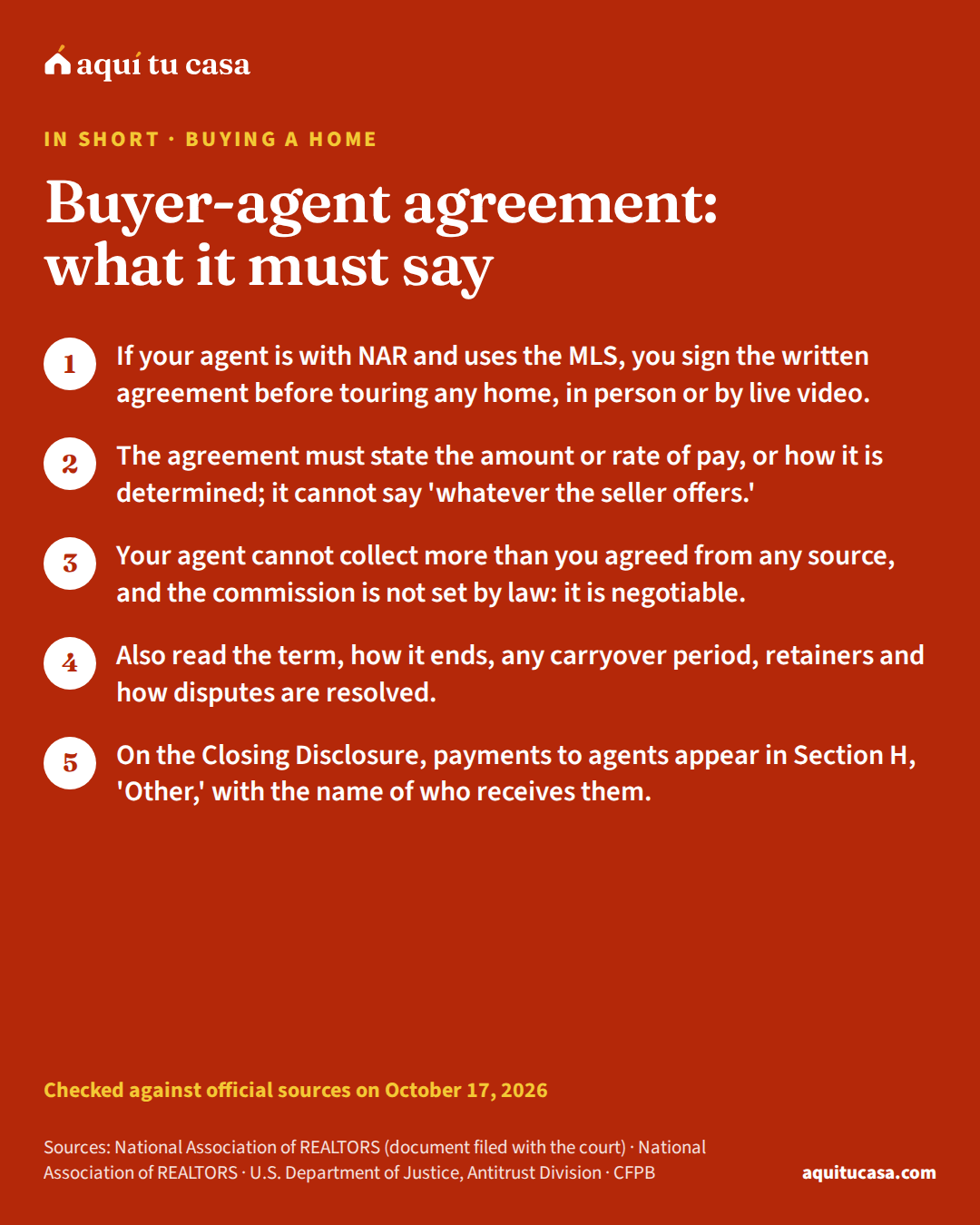
- If your agent is with NAR and uses the MLS, you sign the written agreement before touring any home, in person or by live video.
- The agreement must state the amount or rate of pay, or how it is determined; it cannot say 'whatever the seller offers.'
- Your agent cannot collect more than you agreed from any source, and the commission is not set by law: it is negotiable.
- Also read the term, how it ends, any carryover period, retainers and how disputes are resolved.
Is this for you?
This guide is for you if…
- You are going to look for a home with an agent and were asked to sign an agreement before touring homes.
- You already signed an agreement and want to understand what it says about pay, length and how to end it.
- You want to know whether the seller can pay your agent and where that payment shows up at closing.
Get direct help first if…
- You have not chosen an agent yet: start with the guide on how to choose a real estate agent.
- You are selling your home: the seller's listing agreement has different rules.
If you look for a home with an agent, they may ask you to sign an agreement before you tour homes. This guide is for anyone about to sign one or who already did: it explains what it is, what it must say about pay, who pays your agent, what else to read and what you can negotiate. It is a contract: read every part before you sign.
What the buyer-agent agreement is
The buyer-agent agreementbuyer-broker agreementA buyer-broker agreement is a legal document you sign with the real estate agent who helps you buy, and it formalizes your working relationship. According to the VA, after a court settlement with the National Association of Realtors (NAR), its agents must sign one with you before you tour a home. The agreement must state clearly how much the agent will be paid or how that is determined, without leaving it open-ended; bar the agent from receiving more than the agreed amount from any source; and say that commissions are fully negotiable and not set by law. You can negotiate before signing and ask the seller to pay your agent.See the full definition (also called a buyer representation agreement) is a written contract between you and the real estate agentreal estate agentA real estate agent (often called a realtor) is the professional who helps you buy or sell a home. There are buyer's agents and seller's agents (listing agents). A buyer's agent helps you find homes that fit your needs and budget, gives you information about neighborhoods and property taxes, prepares and presents your offer, negotiates with the seller and guides you to closing. Their commission is negotiable and not set by law; it is written into the agreement you sign with your agent. On the Closing Disclosure, the agent appears in the contact table, usually with a state license number.See the full definition helping you buy. It says what services they will provide and how they will be paid.3
Why are you being asked to sign one? In its settlement in the Burnett case, the National Association of REALTORS (NAR) agreed to require that its agents who participate in an MLS and work with a buyer sign a written agreement with that buyer before the buyer tours any home, unless that conflicts with a state or federal law or regulation.1 According to NAR, this applies to both in-person and live virtual tours, and these changes are already in effect. You do not need an agreement just to talk with an agent at an open house or ask about their services.2
Your state may have rules too. According to the CFPB, state laws can require your agent to tell you who they represent and on what terms.5
What the agreement must say about pay
The NAR settlement sets what the written agreement must say about your agent’s pay.1 NAR sums it up in four components:2
| What it must say | What is not allowed |
|---|---|
| The amount or rate of pay, or how it will be determined, clearly and conspicuously | Leaving the pay unstated |
| Pay that can be determined objectively | Open-ended pay, such as “whatever the seller offers the buyer” |
| That the agent will not collect more than agreed from any source | Collecting more because the seller offered more |
| That commissions are not set by law and are fully negotiable | Presenting the commission as a fee set by law |
According to NAR, objective pay can be, for example, $0, a flat fee, a percent or an hourly rate.2 The same settlement prohibits NAR agents from saying their services are free unless they will receive no compensation from any source for them.1
Example with real numbers
Four ways to write the pay, in words
Examples of how pay could appear in your agreement, under the rules of the NAR settlement.
- A flat fee in dollars
- Allowed: it is objective2
- A percent
- Allowed: it is objective2
- An hourly rate
- Allowed: it is objective2
- Whatever the seller offers the buyer
- Not allowed: it is open-ended1
Whatever the form, your agent cannot collect more from any source than the agreement says.1 To see how much cash you will need at closing, use the calculator.
Run it with your numbersClosing costsWho pays your agent
The agreement says how much your agent charges; who pays depends on what is negotiated. According to NAR, the seller may agree to offer compensation to your agent, and that practice is permitted. What is not allowed is posting the offer on an MLS, the local marketplace where buyer and listing brokers share information about homes for sale. You can also accept seller concessions, such as paying your closing costsclosing costsClosing costs are all of the costs you pay on closing day on top of the down payment: lender fees, the appraisal, the credit report, title insurance, the closing agent's fees, any transfer taxes your state or county charges and the first deposits into the escrow account. The lender must itemize them on the Loan Estimate within days of your application and confirm them on the Closing Disclosure before you sign. Some can be paid by the seller, and several state programs help cover them.See the full definition.2
The Department of Justice describes it the same way: the settlement allows offers of compensation to buyer brokers to continue and to be posted publicly, but prohibits making them on the MLS.4 And there is a cap: whoever pays, your agent cannot receive more from any source than what you agreed.1
Before you sign, ask your agent what happens if the seller does not offer to pay them or pays less than agreed, and what part you would pay. The CFPB suggests always asking how an agent is paid.5 The closing costs guide explains how to estimate your cash to close.
Where to see it at closing. Under Regulation Z, the Closing DisclosureClosing DisclosureThe Closing Disclosure is a required five-page form with the final details of the mortgage you selected: the loan terms, your monthly payment, every closing cost and how much cash you must bring on signing day. The lender must give it to you at least three business days before closing, so you can compare it with your Loan Estimate and ask about any change. If an important number changes, the three-day period starts again. Keep it: you will need it for your taxes.See the full definition itemizes under “Other” each charge in the transaction for services obtained by the buyer, the seller or another party, with the name of who receives the payment and in the column of who pays it. Its contact table lists the buyer’s and the seller’s brokers, with their license number or other identifier.6 On the CFPB’s sample, broker commissions appear in Section H, “Other.”7 Compare them with your agreement; the Closing Disclosure guide helps you read it.
Other points to read before you sign

Pay is not the only thing. NAR’s guide to these agreements says they should be written in terms everyone understands and clearly spell out the agent’s services, your obligations, their duties of confidentiality to you and the Equal Housing Opportunity statement.3 It also mentions several points that may appear:
- The term. You and the agent can negotiate how long the agreement lasts, and whether it is extended until closing once you sign a purchase contract.3
- How it ends. The agreement may say how either side can end it, with or without cause.3
- The carryover period. It may say you would owe the agent if you end the agreement and then sign a purchase contract within an agreed time.3
- A retainer. You may agree to a retainer fee and whether it is added to the pay, credited against it or refunded.3
- Conflicts of interest. For example, what happens if the agent represents other buyers making offers on the same home, or if there is dual agency.3
- Disputes. It may include mandatory or optional mediation or arbitration, and a waiver of jury trial and class actions.3
NAR does not dictate the type of relationship, the term (it can be one day, one month, one house or one zip code), the services or the type or amount of pay: all of that is agreed between you and the agent.3
Before you sign, point by point
1. Ask for the agreement before the first tour
Before touring homes
If your agent is with NAR and uses the MLS, you sign it before touring any home.1
2. Check the pay
While reading it
Amount or rate, or how it is determined; nothing open-ended; and no more than agreed.1
4. Check how disputes are resolved
While reading it
See whether there is mandatory arbitration or a jury trial waiver.3
5. Negotiate what does not work for you
Before signing
Commissions are not set by law and are fully negotiable.1

How to negotiate the agreement
The commission can be negotiated. According to NAR, your agent’s pay remains fully negotiable,2 and the settlement requires the written agreement to say, in conspicuous language, that commissions are not set by law.1 Before signing, NAR recommends making sure the agreement reflects what you negotiated and that you understand what services you will get and for how much.2
Some questions for the conversation:
- Who do you represent in this purchase, and do you keep my conversations confidential?5
- Which services exactly does your pay cover?3
- How much do you charge and how is it calculated? Who pays if the seller offers nothing?1
- How long does the agreement last and how can I end it?3
- Is there a carryover period, a retainer or mandatory arbitration?3
If this is you
You are buying for the first time
A HUD-approved housing counselor can walk you through the buying process, often for free or at low cost.8
You would rather read it in Spanish
According to NAR, the agreement should be written in terms everyone understands.3 Ask for each part to be explained before you sign.
You are worried about paying the agent
You can accept seller concessions, such as paying your closing costs, and the seller can offer to pay your agent.2
What the agreement does not change
NAR’s guide says the agreement should include the Equal Housing Opportunity statement.3 Your rights under the Fair Housing ActFair Housing ActThe Fair Housing Act is the federal law that makes it illegal to refuse to sell or rent a dwelling, or to discriminate in its terms, because of race, color, religion, sex, familial status (having children), national origin or disability. It applies to landlords, real estate agents and managers, and also to banks and lenders when their practices make housing or credit unavailable for those reasons. National origin covers your language and the country you come from, regardless of immigration status. If you believe you were discriminated against, you can file a complaint with HUD at no cost; many states add protections.See the full definition are covered in the guide on how to choose a real estate agent.
NAR also suggests these agreements include warnings about wire fraudwire fraud at closingThis is a scam aimed at people about to close on a home. Days before closing, the scammer sends an email that looks like it comes from your real estate agent or settlement agent with "new" instructions to wire or electronically transfer your down payment or closing costs to a different account. If it works, getting the money back can be very hard. The CFPB recommends writing down two trusted contacts ahead of time, confirming any instructions with them using only those numbers, and not using phone numbers or links in the email. If it happens to you, call your bank right away to stop or reverse the transfer.See the full definition.3 The closing costs guide explains how to confirm wiring instructions before sending closing money.
If anything in the agreement is unclear, ask your agent in writing before you sign. For questions about the contract in your own case, free legal aidlegal aidLegal aid is the free civil legal help that nonprofit organizations and their lawyers provide to low-income people in civil, not criminal, matters. In housing, that includes representing families facing eviction or foreclosure, alongside matters such as custody, child support, protection from domestic violence and access to benefits. In the United States, the Legal Services Corporation, created by Congress, funds a nationwide network of these organizations; its finder points you to the one in your area. Each sets its own income limits.See the full definition is an option, and a HUD-approved housing counselorHUD-approved housing counselorA HUD-approved housing counselor works at an agency HUD has approved to provide housing counseling: independent, expert advice customized to your situation about buying a home, renting, a missed mortgage payment, a foreclosure or credit problems. The agencies usually charge little or nothing; many serve in Spanish and offer the homebuyer education course several assistance programs require. They are not lenders or real estate agents and sell you nothing. Your county page lists the official agencies with phone numbers.See the full definition can guide you through the rest of the purchase.8
Mistake: Signing the agreement at the door of the first home, without reading it.
Instead: Ask for it ahead of time and read it calmly: it should reflect what you negotiated.2
Mistake: Accepting pay written as 'whatever the seller offers.'
Instead: Pay must be objective: an amount, a rate or how it is calculated.1
Mistake: Believing the commission is set by law.
Instead: It is not set by law and is fully negotiable.1
Mistake: Skipping the term and the carryover period.
Instead: Check how it ends and whether you could owe the agent after ending it.3
Mistake: Not checking agent payments on the Closing Disclosure.
Instead: Find them in Section H, 'Other,' and compare them with your agreement.7

What to do this week
- Ask your agent for the written agreement before touring homes.1
- Check the four components about pay: amount or rate, that it is objective, the cap and that it is negotiable.2
- Read the term, how it ends, the carryover period, any retainer and how disputes are handled.3
- Ask what happens if the seller does not offer to pay your agent, and estimate your cash to close with the closing costs tool.2
- Keep your signed copy to compare with the Closing Disclosure.6
- If you want guidance on the whole purchase, find a counselor through the housing counselors guide.8
Your numbers
The minimum for this loan is 3.5%. More down lowers the monthly payment.
Adjust advanced details
First number: share of income for housing. Second: housing plus debts. Lender references, not fixed rules.
Let's do the math
Estimated top price
National figure$227,000
Limited by the housing payment: at that price it would be about $1,883 a month, 28% of your income.
- By the housing payment (28% of income)Limits you$227,000
- By your total debts (36% of income)$292,000
- By your cash (down payment + closing)$330,500
- Typical home in the United States
- $332,700
- Your cap is 68% of the typical home.
What changes if…?
- …you save $10,000 more$227,000
- …you cut $200 a month in debts$227,000
Your maximum price with four loans
Same income, debts and savings; only the down payment and the loan type change. ITIN uses an example down payment and rate.
| FHA 3.5% | Conventional 5% | Conventional 20% | ITIN 15% (example) | |
|---|---|---|---|---|
| Maximum price | $227,000 | $232,000 | $93,000 | $119,000 |
| Payment per month | $1,883 | $1,882 | $616 | $898 |
Educational estimate, not a pre-approval. Uses example insurance (0.5% of value per year) and example closing costs (3% of price); the tax is the place’s typical rate.
Ready to see the numbers? Find your county here
See how this applies in your county: its loan limits, prices and rents, from the official data.
Printable checklist
Frequently asked questions
Do I have to sign an agreement before touring homes with an agent?
If the agent is an NAR member who participates in an MLS, yes: the NAR settlement requires a written agreement before you tour any home, and according to NAR it applies to in-person and live virtual tours. Your state's laws may also have their own rules.
Do I need to sign something to walk into an open house?
According to NAR, you do not need a written agreement just to talk to an agent at an open house or ask about their services.
How much does a buyer's agent charge?
There is no set figure. The NAR settlement requires its agents to say that commissions are not set by law and are fully negotiable. Your agreement must state the amount or rate, or how it is determined: according to NAR, it can be $0, a flat fee, a percent or an hourly rate.
Who pays my agent, me or the seller?
It depends on what is negotiated. According to NAR, the seller can offer to pay your agent, although that offer is not posted on the MLS. Either way, your agent cannot receive more from any source than your agreement says. Ask what happens if the seller offers nothing or pays less.
Can I negotiate my agent's commission?
Yes. According to NAR, your agent's pay remains fully negotiable, and the settlement requires the written agreement to say so in conspicuous language. Before signing, NAR recommends making sure the agreement reflects what you negotiated.
Can I cancel my agreement with my agent?
It depends on what your agreement says. According to NAR, it may cover how to end it, with or without cause, and a carryover period in which you could owe the agent if you buy a home shortly after ending it. Read it before signing and ask about anything you do not understand.
Can my agent say their services are free?
The NAR settlement prohibits its agents from saying their services are free unless they will receive no compensation from any source for them.
Where can I see how much my agent was paid?
On the Closing Disclosure. Section H, 'Other,' itemizes each charge with the name of who receives it, in the column of who pays it; on the CFPB's sample, broker commissions appear there.
Sources
Every figure in this guide comes from one of these official sources. The number next to a sentence leads to the source behind it.
Each source on one line: who publishes it, its title, its address and the date we read it.
- 1. National Association of REALTORS (document filed with the court) · Corrected Settlement Agreement, Burnett v. National Association of REALTORS, No. 4:19-cv-00332-SRB (W.D. Mo.), Document 1458-1 · nar.realtor · Accessed October 17, 2026
- 2. National Association of REALTORS · Homebuyers: What the NAR Settlement Means for You · nar.realtor · Accessed October 17, 2026
- 3. National Association of REALTORS · Written Buyer Agreements 101 · nar.realtor · Accessed October 17, 2026
- 4. U.S. Department of Justice, Antitrust Division · Statement of Interest of the United States, Burnett v. National Association of REALTORS, No. 4:19-cv-00332-SRB (W.D. Mo.), Document 1603 · justice.gov · Accessed October 17, 2026
- 5. CFPB · Find the right home · consumerfinance.gov · Accessed October 17, 2026
- 6. CFPB (Code of Federal Regulations, text at Cornell LII) · Regulation Z, 12 CFR §1026.38, Content of disclosures for certain mortgage transactions (Closing Disclosure) · law.cornell.edu · Accessed October 17, 2026
- 7. CFPB · Sample Closing Disclosure · files.consumerfinance.gov · Accessed October 17, 2026
- 8. CFPB · Find a Housing Counselor · consumerfinance.gov · Accessed October 17, 2026
Keep reading
Related guides
If this guide helped, these follow the same path.

Buying a home 18 minute read
Closing Disclosure explained: what to check before signing
What the Closing Disclosure is, when it must reach you, what to check on each of its five pages and which closing costs are not allowed to go up.
- Five pages, at least three business days before closing; Sundays and federal holidays do not count, Saturdays do.
- Compare it with your latest Loan Estimate: rate, APR, monthly payment, prepayment penalty, balloon payment and cash to close.
- The lender's charges cannot rise above the Loan Estimate; recording fees and services from the lender's list can rise up to 10 percent in total; any excess is refunded.
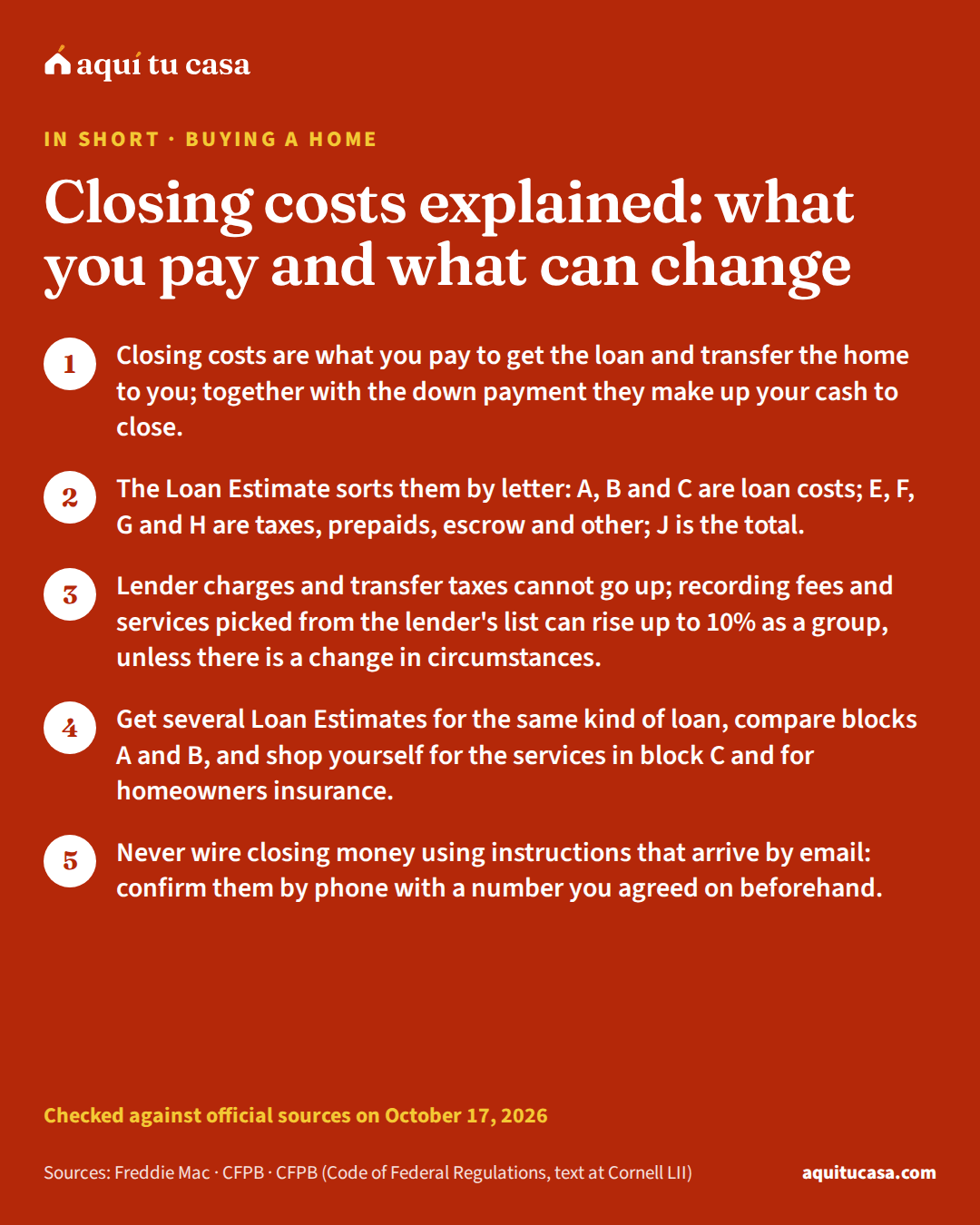
- Buying a home Closing costs explained: what you pay and what can change What closing costs are, how to read them on your Loan Estimate, which charges cannot go up before closing and how to compare offers to pay less. 14 minute read
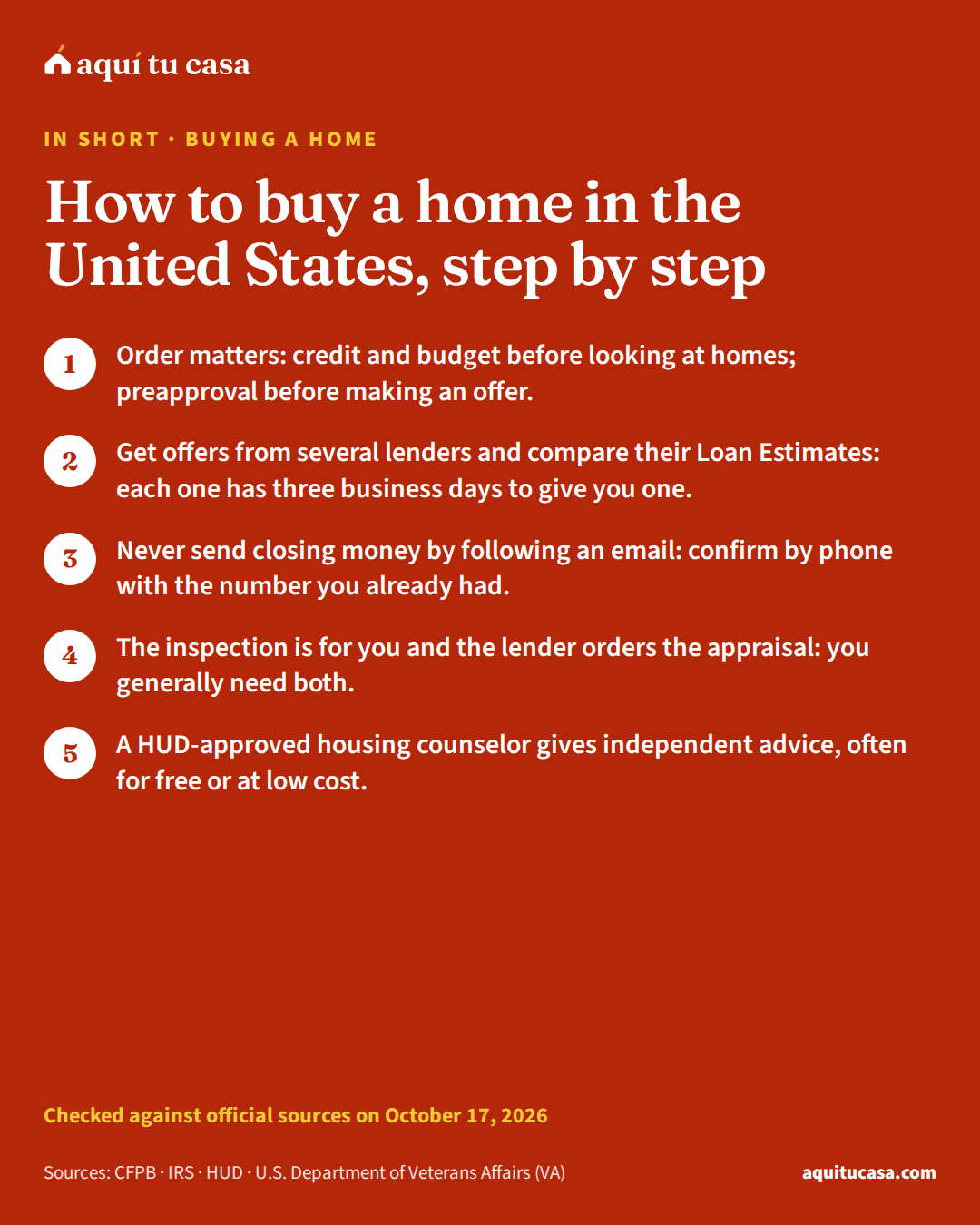
- Buying a home How to buy a home in the United States, step by step The nine steps to buying a home: paperwork, credit, budget, assistance, preapproval, offer, inspection, closing and the first year, with official sources. 15 minute read
Tools for this topic
Was this guide useful?
Thank you. Your answer stays in your browser; nothing is sent.