Contractor scams after a disaster
How to spot a fake FEMA inspector or a contractor taking advantage of a storm, what the law says about price gouging and where to report it.
Verified against official sources on November 6, 2026 7 official sources

Show contents
In short
What you need to know
Quick answer
After a disaster, repair offers arrive, and some are scams. FEMA says its inspectors never charge, never ask for bank details and don't climb on roofs, and that no federal agency charges for help or for filling out the application. Use licensed local contractors, don't pay more than half up front, get everything in writing and don't pay cash or by wire. If you signed at home, the Cooling-Off Rule may give you three days to cancel. If you're charged gouging prices, report it to your state attorney general.
What matters most
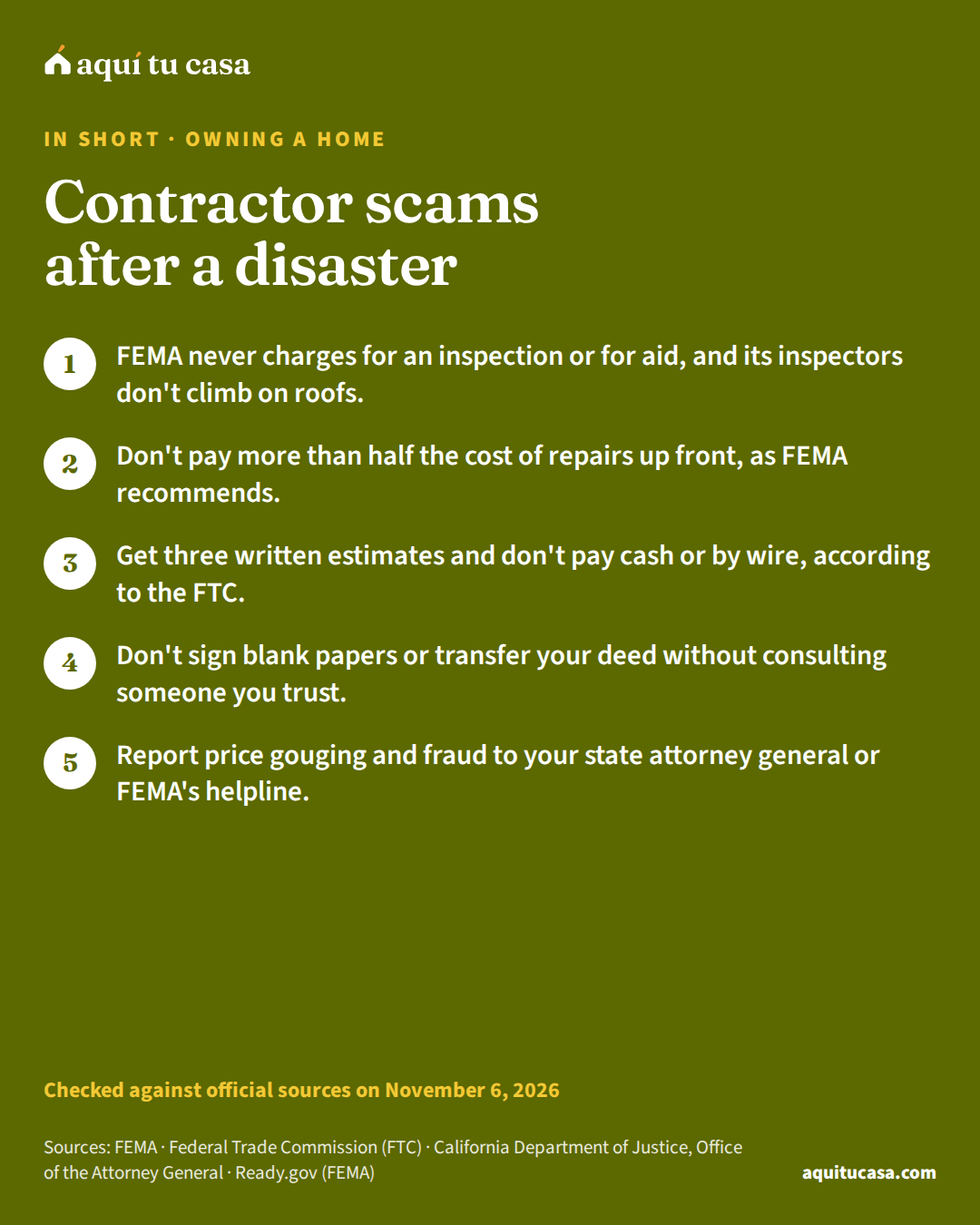
- FEMA never charges for an inspection or for aid, and its inspectors don't climb on roofs.
- Don't pay more than half the cost of repairs up front, as FEMA recommends.
- Get three written estimates and don't pay cash or by wire, according to the FTC.
- Don't sign blank papers or transfer your deed without consulting someone you trust.
Is this for you?
This guide is for you if…
- A hurricane, flood, fire or tornado damaged your home and repair offers are starting to arrive.
- Someone says they're from FEMA or the government and asks you for money or information.
- You think a contractor overcharged you or left with your deposit.
Get direct help first if…
- You want to apply for FEMA help: the FEMA disaster assistance guide explains how.
- You want to review an ordinary repair contract, with no disaster: the contractor scams guide covers every case.
After a hurricane, flood or fire, the house needs fixing fast and offers pour in. Most come from people who want to help, but some take advantage of fear and haste. This guide is for you if a disaster damaged your home and you want to hire someone without losing your money, or if someone says they’re from FEMA and asks you for something. It explains how to recognize the scams, how to pay carefully, what rights you have to cancel and where to report.
How scammers work after a disaster
The Federal Trade Commission (FTC) describes the pattern: someone knocks on your door or calls saying they can fix your leaky roof, put in new windows or install solar panels. They may find you right after a flood, windstorm or other disaster. They pressure you to decide quickly and ask for cash or offer to get you financing. Then they run off with your money, do a poor repair that makes things worse or get you to sign a bad financing agreement that puts your house at risk.2
The FTC also lists the most common tactics: they say they’re “in the area” or have materials left over from another job, push you to decide immediately, ask for everything up front or only cash, ask you to get the permits and suggest you borrow from a lender they know.3
Fake inspectors and fake government help
After a disaster, FEMA may send an inspector to your home if you applied for help. FEMA says its housing inspector never asks for your nine-digit registration number, because they already have it; always wears an official badge you can ask to see; doesn’t ask for bank information; doesn’t climb on roofs or enter crawl spaces; and FEMA never charges for an inspection.1
You don’t pay for the help either. FEMA says DHS, FEMA, the SBA and other federal agencies never charge for disaster assistance or for help filling out the application, and that you shouldn’t believe anyone who promises a disaster grant in exchange for a large cash deposit or full payment up front.1 The FEMA disaster assistance guide explains how to apply yourself, for free.
Real FEMA inspector or impostor
Real
FEMA inspector
If in doubt, give no information or money, and call FEMA.1
There is identity theft too. FEMA warns that some criminals apply for help with stolen names, addresses and Social Security numbers. If a FEMA inspector shows up and you didn’t apply, tell them you didn’t apply. If you get a FEMA letter without applying, call its Helpline at 800-621-3362, 7 a.m. to 11 p.m. ET, every day.1 The identity theft guide explains how to protect your credit.
Before you hire and before you pay
FEMA recommends using licensed or verified local contractors with reliable references, not paying more than half the cost of repairs in advance and demanding that they detail the job with guarantees in writing.1 The FTC adds: ask people you trust for recommendations, check license and insurance, get three written estimates, don’t start until you have reviewed and signed a contract, and don’t pay by cash or wire.2
How to hire after a disaster
1. Photograph the damage
Before any repair
And contact your insurance company, as Ready.gov recommends.6
2. Ask for recommendations and check the license
Before calling
Licensed or verified local contractors with reliable references.1
4. Sign a complete contract
Before work starts
With the job detailed and the guarantees in writing, no blank spaces.1
Watch out for financing and your deed
One of the worst scams uses your house as collateral. The FTC describes it: a contractor offers to install a new roof or remodel your kitchen and says he can arrange financing through a lender he knows. After work starts, he asks you to sign papers, which may be blank. Later you find out you agreed to a home equity loan with a high interest rate, points and fees, and the work is poor or unfinished.3
The FTC advises never agreeing to contractor financing without comparing other lenders; not signing a document you haven’t read, that’s in a language you don’t understand or that has blank spaces; and never transferring your deed to anyone without consulting an attorney, a knowledgeable family member or someone else you trust. If you talk with the seller in Spanish, depending on where you live and what you’re buying, you may be entitled to a copy of the contract in Spanish.3
Your right to cancel
The FTC’s Cooling-Off RuleFTC Cooling-Off RuleThe Cooling-Off Rule is a federal FTC rule that gives you the right to cancel certain sales a seller makes to you in person away from its place of business, for example in your home, even if you invited the seller. You can cancel before midnight of the third business day after the purchase. The seller must give you a contract in the same language used in the sales pitch, such as Spanish, with two copies of a cancellation notice, and tell you out loud that you can cancel. It does not cover, among others, sales of real estate or insurance, or purchases below a certain price.See the full definition gives you three days to cancel certain sales made at your home, including when you invited the seller. Your right to cancel for a full refund lasts until midnight of the third business day after the sale; Saturday counts as a business day, Sundays and federal holidays don’t. The seller must give you two copies of a cancellation form and a copy of the contract, and if you cancel, has 10 days to refund all your money.4
After a disaster, read the exceptions. The Rule doesn’t cover sales under $25 at your home, sales needed to meet an emergency, or repairs you asked the seller to come do; things you buy beyond that repair are covered.4 If you signed something you didn’t expect, read the contractor scams guide, which explains the full rule.
Example with real numbers
A seller after the hurricane
An example in words of how the rules apply.
- Monday
- A seller shows up uninvited and offers a new roof; you sign at home
- What the FTC says
- You have until midnight Thursday to cancel, if there's no holiday
- How to cancel
- Sign one copy of the cancellation form and mail it before the deadline
- If you cancel
- The seller has 10 days to refund your money
- If you called them for an emergency repair
- The Rule may not cover that sale: read the contract before signing
The dates follow the FTC's example for a Monday sale.4 Plan the repair costs in your family budget.
Run it with your numbersFamily budget
Price gouging: what attorneys general say
Many states have laws against price gouging after a disaster. California’s Attorney General explains that Penal Code section 396 prohibits raising the price of many goods and services by more than 10% after an emergency is declared, including building materials and repair and reconstruction services. Protections generally last 30 days after the declaration, but 180 days for reconstruction and emergency cleanup services. You can report on its website or at (800) 952-5225.5
In Texas, the Attorney General asks people to be on the lookout for price gouging, flood-damaged vehicles and other post-emergency scams.7 The rules change from state to state: look up your state attorney general’s page, and keep the estimates and receipts that show the prices you were charged.
If you were already scammed
The FTC recommends first trying to resolve it with the contractor; following each call with a letter sent by certified mail with a return receipt; and keeping notes and copies. If it isn’t resolved, get help from your state attorney general or local consumer protection office, your local home builders association or a dispute resolution program.3 For FEMA-related fraud, you can email StopFEMAFraud@fema.dhs.gov or contact your state consumer protection office.1 Free legal aidlegal aidLegal aid is the free civil legal help that nonprofit organizations and their lawyers provide to low-income people in civil, not criminal, matters. In housing, that includes representing families facing eviction or foreclosure, alongside matters such as custody, child support, protection from domestic violence and access to benefits. In the United States, the Legal Services Corporation, created by Congress, funds a nationwide network of these organizations; its finder points you to the one in your area. Each sets its own income limits.See the full definition in your area can help with your case.
If this is you
Someone says they're from FEMA and asks for money
FEMA never charges for inspections or aid; don't pay, and call FEMA.11
A seller pushes you to sign today
Don't sign blank papers or papers in a language you don't understand.3
The sale was in Spanish
Depending on where you live and what you buy, you may be entitled to a copy of the contract in Spanish.3
You're asked to sign your deed over to someone
Never do it without consulting an attorney or someone you trust.3

Costly mistakes
Mistake: Paying someone who says they're from FEMA.
Mistake: Paying for the whole repair up front.
Instead: Don't pay more than half before the work is done.1
Mistake: Paying cash or by wire.
Instead: Pay in a way that leaves a record, and get a receipt.2
Mistake: Accepting the loan the contractor brings.
Instead: Compare other lenders before signing.3
Mistake: Assuming you can always cancel within three days.
Instead: The Rule doesn't cover emergencies or repairs you asked for; read the contract.4
What to do this week
- Photograph the damage before any repair and notify your insurer.6
- If someone says they’re from FEMA, ask for the badge and don’t give bank details.1
- Get three written estimates from licensed local contractors.21
- Check the guide to what a repair quote must include before you sign.
- Don’t pay more than half up front, and never cash or wire.12
- If you’re charged gouging prices or scammed, report it to your state attorney general.53
Your household this month
Let's do the math
Left each month
Enter what at least one person takes home to see the result.
What helps
- Pay savings first: set the goal aside the day the money arrives, before flexible spending.
- Add up the bills that come every few months (car insurance, school) and divide by twelve.
- If income changes, plan on a low month and save the extra from good months.
- A HUD-approved housing counselor can go over the budget with you, often for free.
This is a planning tool with your numbers, not a credit evaluation or an approval. The split reference is only a guide.
Ready to see the numbers? Find your county here
See how this applies in your county: its loan limits, prices and rents, from the official data.
Printable checklist
Frequently asked questions
How do I know a FEMA inspector is real?
FEMA says its inspector always wears an official government badge and you can ask to see it. They won't ask for your nine-digit registration number (they already have it), won't ask for bank details, won't charge and won't climb on the roof.
Can someone charge me for help applying for FEMA aid?
FEMA says DHS, FEMA, the SBA and other federal agencies never charge for disaster assistance or for help filling out the application. Don't believe anyone who promises a grant in exchange for a deposit.
How much should I pay a contractor up front?
FEMA recommends not paying more than half the cost of repairs in advance. The FTC adds: don't pay by cash or wire, and don't start without a signed contract.
I signed a contract at home with a salesperson. Can I cancel?
Possibly. The FTC's Cooling-Off Rule gives you until midnight of the third business day to cancel certain sales made at your home. But it doesn't cover sales needed to meet an emergency or repairs you asked for; things you buy beyond that repair are covered.
I'm being charged double for materials after the hurricane. Is that legal?
It depends on your state. In California, the law prohibits raising the price of many goods and services, including building materials and repair services, by more than 10% after an emergency is declared. Report it to your state attorney general.
I got a FEMA letter and I never applied. What do I do?
Someone may have used your information. FEMA asks you to call its Helpline at 800-621-3362, 7 a.m. to 11 p.m. ET, every day. The identity theft guide explains the other steps.
The contractor left with my deposit. Where do I complain?
The FTC recommends trying to resolve it with them first and sending a letter by certified mail. If it isn't resolved, go to your state attorney general or consumer protection office. Free legal aid in your area may help with the case.
Sources
Every figure in this guide comes from one of these official sources. The number next to a sentence leads to the source behind it.
Each source on one line: who publishes it, its title, its address and the date we read it.
- 1. FEMA · Disaster Fraud · fema.gov · Accessed November 6, 2026
- 2. Federal Trade Commission (FTC) · Home Repair Scams · consumer.ftc.gov · Accessed November 6, 2026
- 3. Federal Trade Commission (FTC) · How To Avoid a Home Improvement Scam · consumer.ftc.gov · Accessed November 6, 2026
- 4. Federal Trade Commission (FTC) · Buyer’s Remorse: The FTC’s Cooling-Off Rule May Help · consumer.ftc.gov · Accessed November 6, 2026
- 5. California Department of Justice, Office of the Attorney General · FAQs on Price Gouging · oag.ca.gov · Accessed November 6, 2026
- 6. Ready.gov (FEMA) · Hurricanes · ready.gov · Accessed November 6, 2026
- 7. Office of the Attorney General of Texas · Disaster and Emergency Scams · texasattorneygeneral.gov · Accessed November 6, 2026
Keep reading
Related guides
If this guide helped, these follow the same path.

Protect yourself from scams 11 minute read
Contractor and home repair scams: how to protect yourself
How to spot a dishonest contractor, check a license, sign a solid contract, pay safely and cancel a sale made at your home.
- Be wary of anyone who knocks on your door, pressures you to decide today or scares you with a 'free inspection'.
- Ask for the license number and look it up on your state contracting board or agency's website; if it isn't listed, it's not a good option.
- Sign a complete contract, never a blank one: work, materials, permits, dates, total price and payment schedule.
- Money problems FEMA disaster assistance for renters and homeowners What FEMA assistance for individuals and households covers, how to apply, deadlines to register and appeal, and what mixed-status families can ask for. 10 minute read
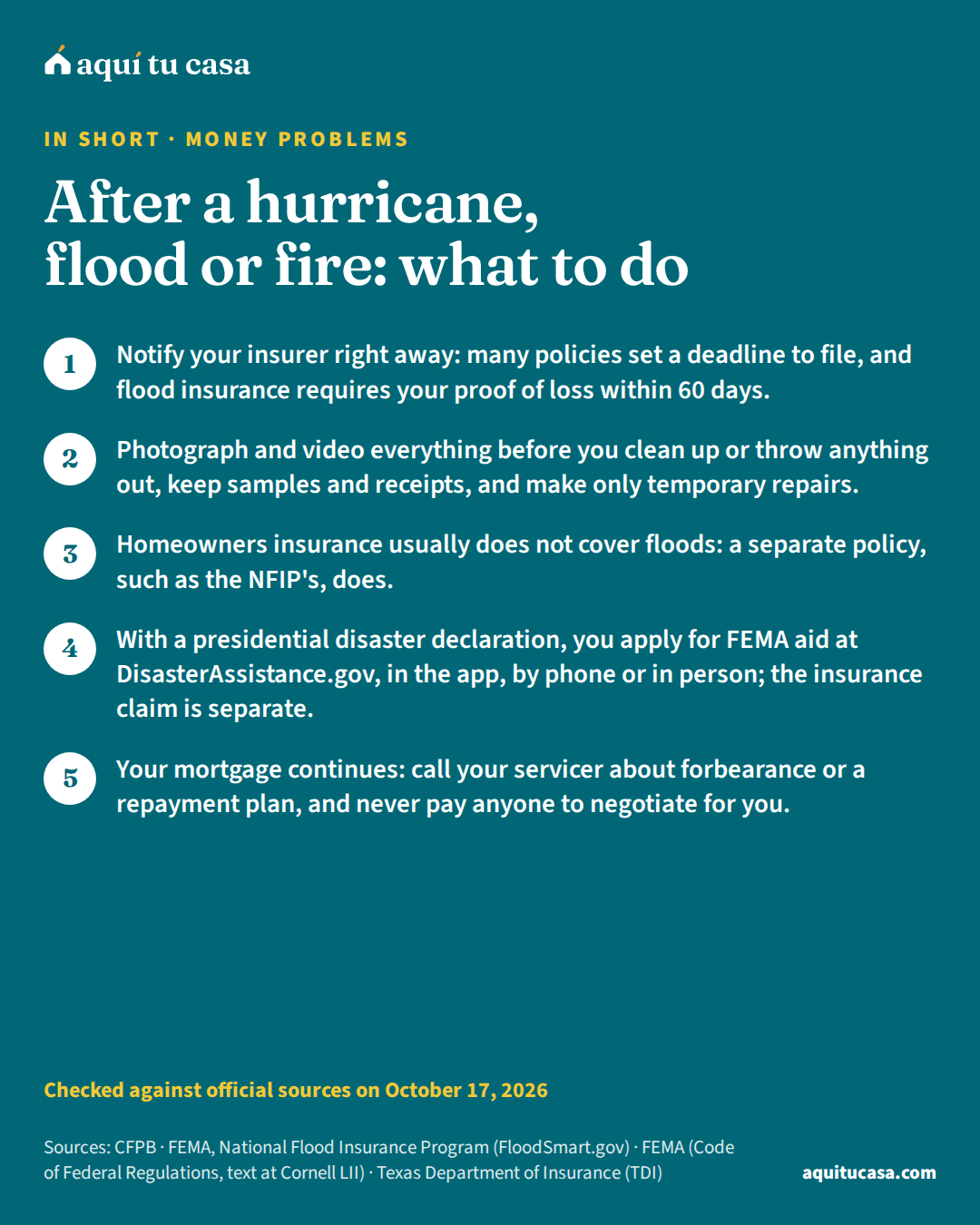
- Money problems After a hurricane, flood or fire: what to do What to do after a disaster: your home, flood or renters insurance claim, federal disaster aid, your mortgage and how to avoid scams. 16 minute read
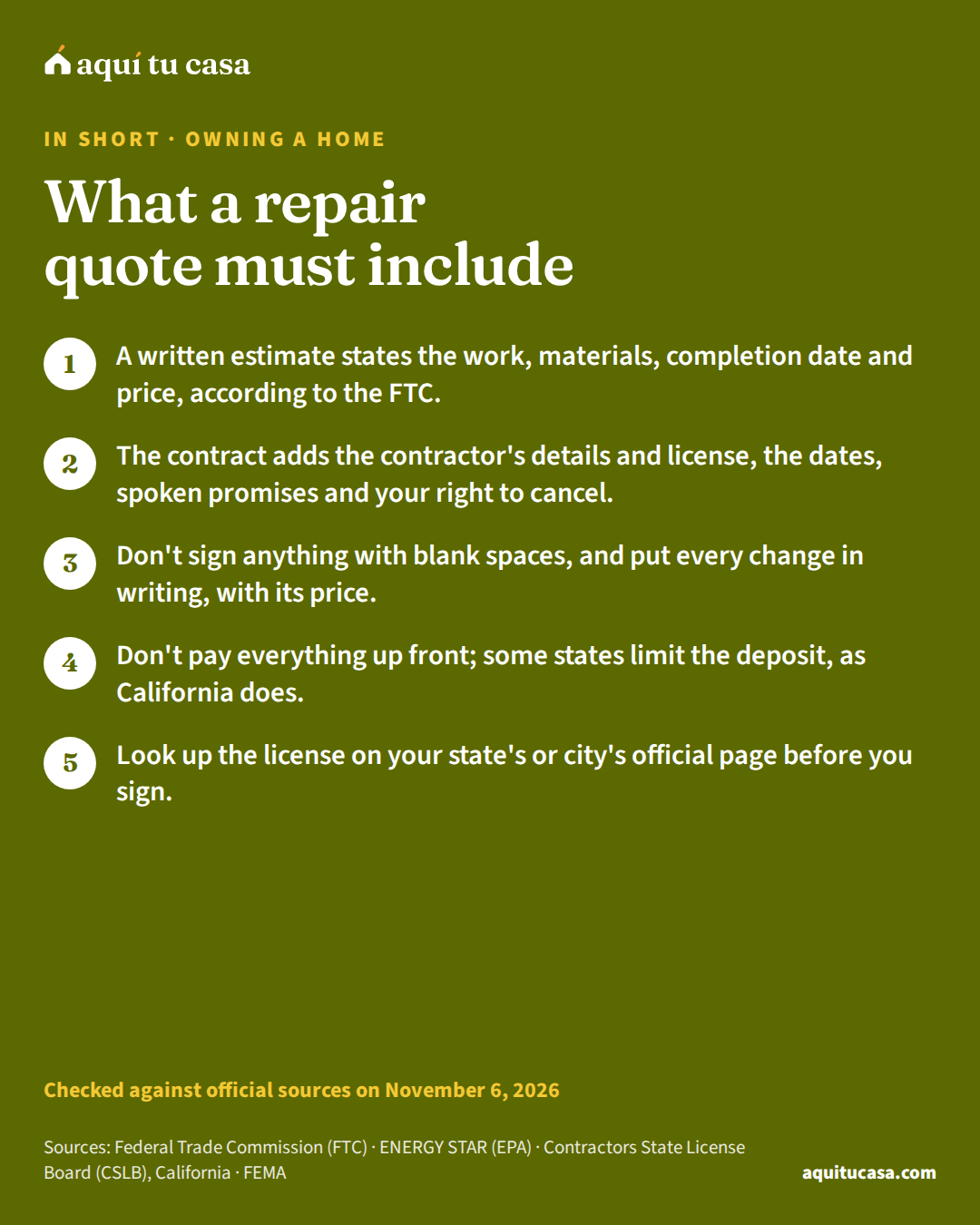
- Owning a home What a repair quote must include What a repair estimate and contract should say according to the FTC and ENERGY STAR, and where to look up a contractor's license in your state. 10 minute read
Tools for this topic
Was this guide useful?
Thank you. Your answer stays in your browser; nothing is sent.