After a hurricane, flood or fire: what to do
What to do after a disaster: your home, flood or renters insurance claim, federal disaster aid, your mortgage and how to avoid scams.
Verified against official sources on October 17, 2026 20 official sources

Show contents
In short
What you need to know
Quick answer
First, get safe. Then notify your insurer as soon as you can, take photos and videos of the damage before you clean up, and make only temporary repairs. If the president declared a disaster, you can apply for FEMA aid at DisasterAssistance.gov, with the FEMA app, by phone or in person, on top of your insurance claim. Your mortgage still has to be paid: call your servicer and ask about forbearance or a repayment plan.
What matters most
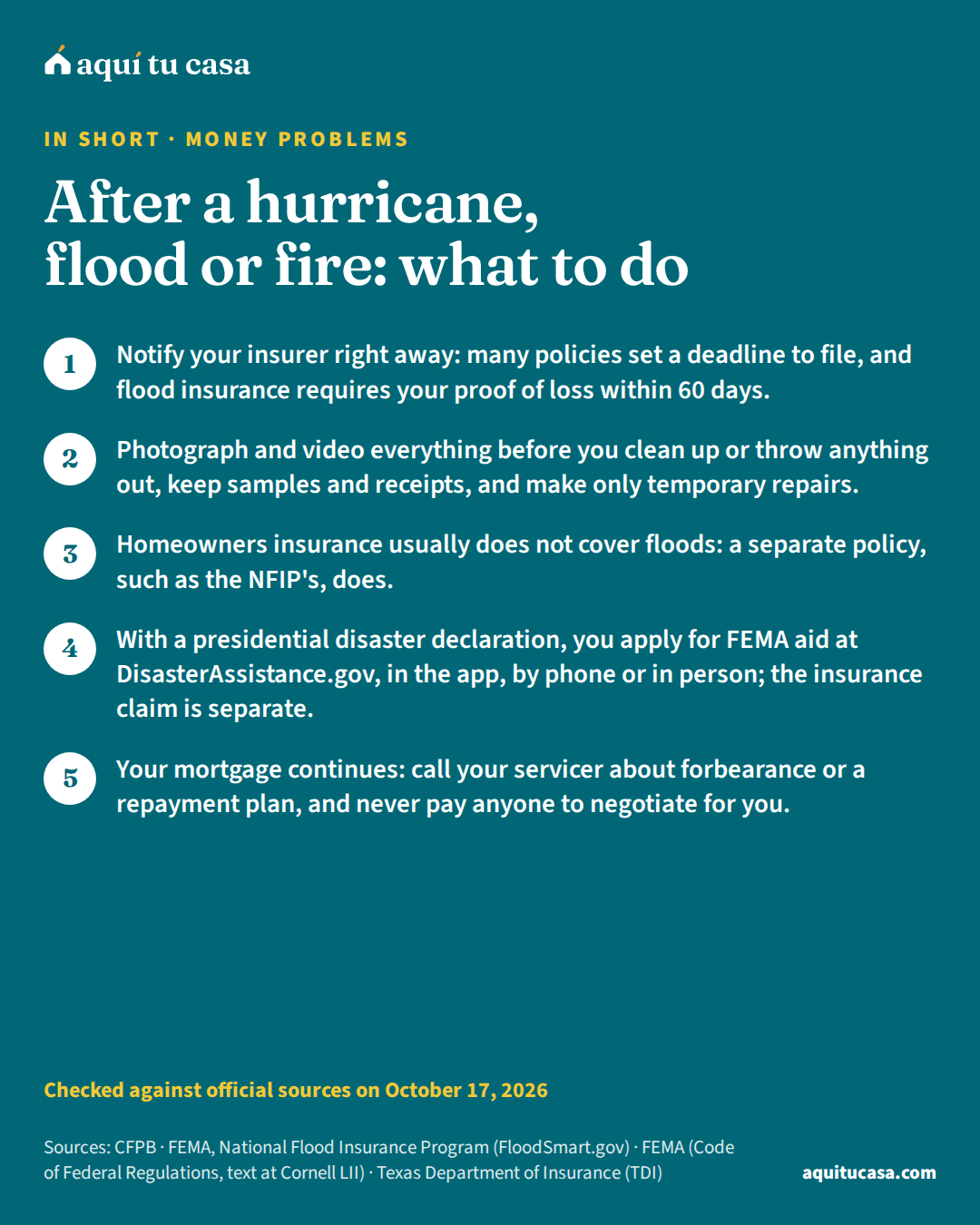
- Notify your insurer right away: many policies set a deadline to file, and flood insurance requires your proof of loss within 60 days.
- Photograph and video everything before you clean up or throw anything out, keep samples and receipts, and make only temporary repairs.
- Homeowners insurance usually does not cover floods: a separate policy, such as the NFIP's, does.
- With a presidential disaster declaration, you apply for FEMA aid at DisasterAssistance.gov, in the app, by phone or in person; the insurance claim is separate.
Is this for you?
This guide is for you if…
- A hurricane, flood or fire damaged the home you live in, whether you own it or rent it.
- You have homeowners, flood or renters insurance and do not know how to start the claim.
- You have a mortgage and are not sure you can make the next payment.
Get direct help first if…
- You are in danger right now: get safe first and follow the authorities' instructions; this guide is for the days after.
- You cannot pay your mortgage for another reason, with no disaster involved: start with the guide on what to do if you can't pay your mortgage.
- You want to choose insurance before anything happens: the home insurance and flood insurance guides cover that.
This guide is for you if a hurricane, flood or fire damaged the home you live in, whether you own or rent. You will see what to do in the first days, how to file your insurance claim, where federal disaster aid is requested, what happens with your mortgage and how to avoid the scammers who show up after a tragedy. We report what official sources say, and free help is available for your own case.
First: your safety and the first days
After a disaster, your safety and your family’s come first. Do not go back into the house until it is safe. You can start a flood insurance claim before you return.6
According to the CFPB (the Consumer Financial Protection Bureau), when your home is damaged there are three things to do first: call your insurer to file a claim, apply for aid from government programs and let your mortgage servicer know what happened.1 Here is the order for the first days:
The first days, step by step
1. Get safe
Before going back in
Do not go in until it is safe. You can report a flood claim before you return.6
2. Notify your insurer
As soon as you can
Your policy may set a deadline to file. Notify every policy that covers something damaged and ask for a copy if you lack one.2
3. Document the damage
Before cleaning up or throwing anything out
Clear photos and videos, appliance serial numbers and small samples of carpet or flooring.7
4. Make only temporary repairs
While you wait for the adjuster
Board up a broken window or put a tarp on the roof. A permanent repair before the damage is seen can cost you the claim.11
5. Apply for federal aid, if declared
As soon as you can
At DisasterAssistance.gov, in the FEMA app, by phone or in person at a Disaster Recovery Center.12
6. Call your mortgage servicer
Before your next payment
Ask what help it offers disaster victims, such as forbearance or a repayment plan.2
Try it with your numbersFamily budget7. Review the adjuster's estimate
When you receive it
Read it carefully. If you find more damage, you can ask for an additional payment even if the claim seems closed.6
If you had to leave home, set up mail forwarding and update your contact details with your bank, your insurer and your utilities. That way checks and notices reach you on time.4
Your homeowners insurance claim
Notify your insurer right away. According to the CFPB, your policy may require you to file a claim within a certain period after the disaster. You may have several policies, such as homeowners insurancehomeowners insuranceHomeowners insurance pays for losses and damage to your property if something unexpected happens, like a fire or a burglary, and usually includes liability coverage if someone is hurt at your home. Lenders require it as long as you have a mortgage, because the home is their collateral, and almost always collect it inside your monthly payment through the escrow account. The price depends on the location, the rebuilding cost, the deductible and your history. A standard policy does not cover floods or, in many states, earthquakes: those risks are insured separately.See the full definition, flood or auto: notify each one that covers something damaged.2 Most companies set deadlines for filing.11
Document everything. Take photos or videos of the damage before and after any repair you make yourself. The insurer may send an adjuster to inspect it.2 The Texas Department of Insurance recommends making only temporary repairs, such as boarding up broken windows or putting a tarp on a damaged roof, and no permanent ones: the insurer might deny the claim if you repair before it sees the damage.11
How you get paid. Depending on your policy, the insurer pays based on replacement cost or actual cash value. Replacement costreplacement costReplacement cost is a way a home insurance policy pays for damage: it gives you the money to repair or rebuild your home, or replace your belongings, with materials of similar quality at today's prices, without subtracting what they lost in value from age or use (depreciation). It is different from actual cash value, which does subtract depreciation. Many insurers pay these claims in two checks: the first one minus depreciation, and the second, for the amount held back, when you finish the repair. Your policy says which of the two methods it uses.See the full definition gives you money to rebuild or repair with similar materials at today’s prices. Actual cash valueactual cash value (ACV)Actual cash value (ACV) is a way a homeowners or renters insurance policy pays for damage: it gives you what it costs to repair or replace what was damaged minus depreciation, meaning the value it lost from age, use or wear. That is why it usually pays less than replacement cost, and you cover the difference. Many policies pay for your personal belongings this way unless you buy replacement cost coverage. And if you have that coverage, the first check on your claim is often for the actual cash value.See the full definition takes the age and condition of your home into account, so it can fall short.3 On every claim, you pay your deductibledeductibleA deductible is the part of an insurance claim you pay yourself. When you have a covered loss, the insurance company subtracts the deductible from the claim amount and pays you the rest. You may have a different deductible for each type of coverage. You will find it on the first page of your policy, called the declarations page, along with your coverages and limits. In taxes, the word "deductible" means something else: an expense that can lower the taxes you owe.See the full definition.11
If you are paid less or denied. Ask for the reasons in writing and whether there is an appeals process. If you believe the claim was wrongfully denied, you can file a complaint with your state’s department of insurance. Your state law may also set deadlines for the insurer to act.2
If you cannot live at home. Additional living expenses (ALE) coverage pays if you have to move while damage your policy covers is repaired: rent, food and other costs you would not have at home. It pays only up to your policy’s limit, so track your spending to make it last the whole time you are away.11
Three policies, three different claims
If you own
Homeowners insurance
A separate policy
Flood insurance (NFIP)
Check which policies you have and notify each one: the clock to file may start on the day of the disaster.2
Example with real numbers
How insurance money arrives if you have a mortgage
An example in words of what the CFPB describes; your servicer will tell you its own steps.
- The insurance check
- Made out to you and to your servicer or lender
- Before work begins
- The servicer releases part of it so you can hire someone to repair
- As the work progresses
- It releases more money, in stages
- With each payment to the contractor
- You get a receipt and a lien waiver
- When the work is done
- It releases the rest once the home passes inspection
That is how the CFPB explains it, and your mortgage continues while the claim is paid out.3 A lien waiver says the contractor has been paid.4 Use the budget tool to organize your spending in these months.
Run it with your numbersFamily budget
If it was a flood: your NFIP claim
Homeowners insurance usually does not cover floods.4 Flood insuranceflood insuranceFlood insurance is a separate policy that can cover a building, its contents, or both, when flood water causes damage. Most homeowners insurance policies do not cover that damage. Most of these policies are backed by FEMA's National Flood Insurance Program (NFIP) and bought through insurers and agents. If your home is in a high-risk flood area and your mortgage is backed by the federal government, the lender is required to demand it; outside those areas it is optional, but floods happen there too.See the full definition from the NFIP (the National Flood Insurance Program) covers only physical damage directly caused by a flood: water that enters your home from the ground up. It does not cover, for example, rain blown into your home by wind.5

Report the flood to your insurer right away. It assigns an adjuster who should contact you within 48 hours. Do not throw anything out before the adjuster sees it, unless it is a health hazard or local law requires you to discard it, and keep samples of carpet or flooring.6 Take clear photos and videos before cleaning, write down appliance serial numbers and keep receipts for repairs and anything you buy new. Mold can start forming within 24 to 48 hours.7 And the policy does not cover mold damage.5
When the adjuster arrives, ask for their Flood Control Number (FCN) card and a government-issued photo ID.6 Talk to your agent or adjuster before you sign with a cleanup company.5
Payments. During major floods, FEMA allows advance payments: your insurer may offer up to $5,000 without an adjuster’s visit, and up to $20,000 with authorization and documentation. The advance is deducted from the final payment.5 A claim can take 4 to 8 weeks to be paid, and if you have a mortgage the check is written to you and your mortgage company.5 If you find more damage later, you can request an additional payment at any time.6
Rebuilding with less risk. You may qualify for up to an additional $30,000 to rebuild in a way that lowers your flood risk. It is called Increased Cost of Compliance (ICC) coverage; ask your adjuster or agent.8
If you are denied. You have 60 days from the date on the letter to appeal to FEMA, counted in calendar days. There is no fee and you do not need anyone to represent you. If you choose an appraisal, you can no longer appeal to FEMA. And if you decide to sue, the deadline is one year from the denial; an appeal does not extend it.9 The flood insurance and NFIP guide explains what each part of the policy covers.
If you rent your home
According to the CFPB, if you can keep living in your rental, even with damage, you generally need to keep paying rent. Notify your landlord in writing about the damage.4
Even if you cannot live there, for example because there is no water or power, the lease does not end on its own: generally, you or the landlord must end it in writing. And your landlord can’t use your security deposit to pay for damage caused by a natural disaster.4
Your belongings are covered by renters insurancerenters insuranceRenters insurance, also called tenants insurance, protects your belongings and protects you when you rent. The landlord's insurance covers the building, but not your furniture, clothes or electronics. It usually includes three coverages: your personal property, even if it is stolen away from home; additional living expenses if a covered loss forces you to move out for a while; and personal liability if someone is hurt in your home. A standard policy does not cover floods, which are insured separately. Some landlords require it.See the full definition, not by your landlord. Sometimes that policy also pays the cost of living elsewhere if you cannot stay home, so check your policy.4 The renters insurance guide explains what it covers, and if you fall behind on rent, the guide on what to do if you can’t pay your rent shows where to start.
Federal disaster aid: where to apply
FEMA (the Federal Emergency Management Agency) gives financial assistance to people who live in a presidentially declared disaster area, and not everyone qualifies for every program.12 There are four ways to apply: online at DisasterAssistance.gov, with the FEMA app, by phone at 1-800-621-3362 or in person at a Disaster Recovery Center (DRC).12 The CFPB notes that the application is available in English and Spanish.2
To apply, USA.gov says you will need your Social Security number, your insurance information, a description of the damage, your annual household income, your contact information and a bank account for direct deposit.12
This aid does not replace insurance: you apply for it on top of your claim, and it can help with costs insurance does not cover, such as temporary housing.5 According to the CFPB, FEMA may help with a hotel for a short time, with the first month’s rent and deposit for a new place, and with rent for up to 18 months for those who qualify while their home is repaired.1 After you register with FEMA, you will learn whether you qualify for the hotel program (TSA).14
SBA loans. The Small Business Administration (SBA) lends to homeowners and renters whose homes were damaged in a disaster, even if they do not own a business. Your home must be in a presidentially declared disaster area, the loan must be for your primary home and cannot duplicate what insurance or other programs already pay. Before you apply, you must register with FEMA.13
Other help. Disaster Legal Services gives free legal help to people with low income in federally declared areas, for example with repair contracts or landlord problems. The IRS may offer tax relief, such as more time to file.12 Your state emergency management agency may have resources even without a presidential declaration.2 Without a federal declaration, the Red Cross and state and local governments may help with food and shelter.12 In most of the country, 211 connects you with local services and emergency housing.14

Your mortgage after the disaster
Damage to your home does not end your obligation to pay your mortgage.2 Call your loan servicerloan servicerThe loan servicer is the company that sends you your mortgage statements and handles the day-to-day tasks of the loan: it processes your payments, answers your questions, keeps track of principal and interest paid and manages your escrow account, if you have one. It can also offer options if you fall behind and, in certain cases, start a foreclosure. It may be the same company that lent you the money or a different one, and it is common for another company to take over the loan after closing.See the full definition, tell them what happened and ask what help they offer disaster victims, such as forbearanceforbearanceForbearance is an agreement with your loan servicer to pause your mortgage payments, or make smaller payments, for a while when you face a hardship such as losing your job, a natural disaster or unexpected medical costs. It does not erase or reduce what you owe: you have to repay the missed or reduced amounts later. Depending on the agreement, you may repay it all at once at the end, add it to the end of the loan, repay it with a new loan or spread it out through higher payments for a time. You have to request it from your servicer.See the full definition or a repayment plan. The options depend on who owns or guarantees your loan.2
According to the CFPB, federal rules allow, but do not require, a loan’s owner or servicer to help you after a disaster. Government-backed loans have guidelines that allow stopping or delaying a foreclosure. With an FHA loan, if you are at risk of losing your home because of the disaster, your lender may stop or delay the start of foreclosure for 90 days.1
Lenders generally evaluate your options with a complete application. But the CFPB recognizes that completing one can be hard after a disaster and that the lender should be able to offer options anyway.4 Regulation X allows a servicer to offer short-term forbearance or a short-term repayment plan based on an incomplete application. If it does, it must send you the payment terms and duration in writing, tell you other options may be available and that you can send a complete application to be evaluated for all of them. While you keep to those terms, it may not start foreclosure or hold a sale.15
Also ask them to add a natural disaster code to your credit report, so other lenders understand why you fell behind.4 A HUD-approved housing counselorHUD-approved housing counselorA HUD-approved housing counselor works at an agency HUD has approved to provide housing counseling: independent, expert advice customized to your situation about buying a home, renting, a missed mortgage payment, a foreclosure or credit problems. The agencies usually charge little or nothing; many serve in Spanish and offer the homebuyer education course several assistance programs require. They are not lenders or real estate agents and sell you nothing. Your county page lists the official agencies with phone numbers.See the full definition can go over your options with you, often for free or at low cost.19 The guide on what to do if you can’t pay your mortgage explains each option and the federal timeline.
If your insurer does not renew your policy after the damage, most states have FAIR plans, which offer basic protection although the coverage typically costs more than a standard policy.4
If this is you
You cannot live in your home
Check whether your policy pays additional living expenses11 and, with a presidential declaration, register with FEMA to see if you qualify for a hotel.14
You have a mortgage
Call your servicer before your next payment and ask about forbearance or a repayment plan.2
You rent your home
Report the damage in writing; your lease does not end on its own and your deposit does not pay for disaster damage.4
Contractors and scams: be careful who knocks on your door
Before hiring anyone, ask your insurer and your servicer how and when the insurance money will be paid out.18 The CFPB recommends:
- Getting written estimates from two or three contractors to compare.
- Looking up the contractor’s license or registration with your state’s contracting board or agency.
- Asking whether the job needs a building permit and who will get it.
- Not hiring someone going door to door, not paying upfront without a signed contract, not paying in cash and not making the final payment until the work is finished to your satisfaction.18
At each stage, ask for a lien waiver: a paper saying the contractor has been paid and cannot put a lienlienA lien is a legal right a creditor holds in your property to make sure you repay a debt. It usually prevents the property from being sold until the debt is paid, and if you do not pay, the creditor may be able to take the property. Your mortgage is a lien on your home: when you pay it off, the lien is released and that shows up in your county's property records. There are other kinds, such as a federal tax lien, which is the government's legal claim against all your property when you do not pay a tax debt.See the full definition on your home over that bill.4 If a company demands full payment before starting, it may be a scam.7
If you have already been scammed, call the National Center for Disaster Fraud hotline at (866) 720-5721.17 You can also complain to the agency that licenses contractors in your state.18 The contractor and home repair scams guide has more warning signs.

Costly mistakes
Mistake: Throwing out damaged items before photographing them.
Instead: Document everything before cleaning up and keep samples, unless something is a health hazard.6
Mistake: Making permanent repairs before the insurer sees the damage.
Instead: Make only temporary repairs, such as a tarp on the roof.11
Mistake: Waiting for the adjuster to hand you the proof of loss form.
Instead: Send it within 60 days even if no one helps you fill it out.10
Mistake: Stopping your mortgage payments without talking to your servicer.
Instead: Call and ask about forbearance or a repayment plan.2
Mistake: Paying someone who says they are from FEMA, or a contractor who knocks on your door.
Instead: FEMA does not charge; hire with a written estimate and no upfront payment.1718
Mistake: Spending all your living-expense money in the first weeks.
Instead: Additional living expenses coverage has a limit: keep track.11
What to do this week
- Make sure your family is safe and do not go into the house until it is safe.6
- Notify every insurer that covers something damaged and ask for a copy of your policy.2
- Photograph and video everything, write down serial numbers and keep samples and receipts.7
- If there is a presidential declaration, apply for FEMA aid at DisasterAssistance.gov, in the app, by phone or in person.12
- Call your mortgage servicer and ask about help for disaster victims.2
- Before hiring, get two or three written estimates and check the contractor’s license.18
- If you want help with your options, look for a HUD-approved housing counselor or a legal aid office.1920
Your household this month
Let's do the math
Left each month
Enter what at least one person takes home to see the result.
What helps
- Pay savings first: set the goal aside the day the money arrives, before flexible spending.
- Add up the bills that come every few months (car insurance, school) and divide by twelve.
- If income changes, plan on a low month and save the extra from good months.
- A HUD-approved housing counselor can go over the budget with you, often for free.
This is a planning tool with your numbers, not a credit evaluation or an approval. The split reference is only a guide.
Ready to see the numbers? Find your county here
See how this applies in your county: its loan limits, prices and rents, from the official data.
Printable checklist
Frequently asked questions
Do I have to keep paying my mortgage if my home was destroyed?
Yes. According to the CFPB, you still have to pay your mortgage after a disaster, including while your insurance claim is paid out. Call your servicer, explain what happened and ask about forbearance or a repayment plan; the options depend on who owns or guarantees your loan.
Does homeowners insurance pay for flood damage?
Usually not. The CFPB says flood damage is usually not covered by homeowners insurance. A flood policy, such as the NFIP's, covers it, and it pays only for physical damage directly caused by water rising from the ground up.
How long do I have to file a claim?
It depends on your policy, and many set a deadline. For NFIP flood insurance, the standard policy requires your proof of loss within 60 days after the loss. Notify your insurer right away and ask in writing which deadlines apply to you.
Who pays for a hotel if I can't live in my home?
If your policy includes additional living expenses (ALE) coverage, it can pay for rent, food and other extra costs while your home is repaired, up to its limit. If the disaster has a presidential declaration, FEMA may help qualified applicants with a hotel or rent.
Why is the insurance check made out to me and my lender?
Because many mortgage agreements require it. Typically, your servicer releases part of the money before work begins, more as the work progresses and the rest once the job is finished and the home passes inspection.
How do I know someone really works for FEMA?
According to the CFPB, all FEMA representatives, including inspectors, have a laminated photo ID, and no FEMA, federal or state worker will ask for or accept money. If in doubt, call FEMA at (800) 621-3362.
I rent my home. Is there help for me?
Yes, some help is for renters too. Renters insurance covers your belongings and sometimes the cost of living elsewhere, and the SBA lends to homeowners and renters whose homes were damaged in a declared disaster. Notify your landlord about the damage in writing.
What can I do if my flood claim is denied?
You can talk to your adjuster or insurer, appeal to FEMA within 60 days of the date on the denial letter, at no cost and without a representative, or sue within one year of the denial. If you choose an appraisal, you can no longer appeal to FEMA.
Sources
Every figure in this guide comes from one of these official sources. The number next to a sentence leads to the source behind it.
Each source on one line: who publishes it, its title, its address and the date we read it.
- 1. CFPB · What do I do if my house was damaged or destroyed, or if I'm unable to make my payment after a disaster? · consumerfinance.gov · Accessed October 17, 2026
- 2. CFPB · What should I do after a disaster to protect my finances and property? · consumerfinance.gov · Accessed October 17, 2026
- 3. CFPB · How do home insurance companies pay out claims? · consumerfinance.gov · Accessed October 17, 2026
- 4. CFPB · Start recovering and rebuilding your financial life · consumerfinance.gov · Accessed October 17, 2026
- 5. FEMA, National Flood Insurance Program (FloodSmart.gov) · Start a Claim · floodsmart.gov · Accessed October 17, 2026
- 6. FEMA, National Flood Insurance Program (FloodSmart.gov) · NFIP Claims Checklist for Policyholders · floodsmart.gov · Accessed October 17, 2026
- 7. FEMA, National Flood Insurance Program (FloodSmart.gov) · Document Flood Damage · floodsmart.gov · Accessed October 17, 2026
- 8. FEMA, National Flood Insurance Program (FloodSmart.gov) · Flood Recovery Checklist · floodsmart.gov · Accessed October 17, 2026
See the other 12 sources
- 9. FEMA, National Flood Insurance Program (FloodSmart.gov) · Appeal a Claim · floodsmart.gov · Accessed October 17, 2026
- 10. FEMA (Code of Federal Regulations, text at Cornell LII) · 44 CFR Part 61, Appendix A(1): Standard Flood Insurance Policy, Dwelling Form · law.cornell.edu · Accessed October 17, 2026
- 11. Texas Department of Insurance (TDI) · Home insurance guide · tdi.texas.gov · Accessed October 17, 2026
- 12. USA.gov · How to apply for disaster assistance · usa.gov · Accessed October 17, 2026
- 13. USA.gov · Mortgage help and home repair loans after a disaster · usa.gov · Accessed October 17, 2026
- 14. USA.gov · How to find housing after a disaster · usa.gov · Accessed October 17, 2026
- 15. CFPB (Code of Federal Regulations, text at Cornell LII) · Regulation X, 12 CFR §1024.41, Loss mitigation procedures · law.cornell.edu · Accessed October 17, 2026
- 16. U.S. Congress (U.S. Code, text at Cornell LII) · 8 U.S.C. §1611, Aliens who are not qualified aliens ineligible for Federal public benefits · law.cornell.edu · Accessed October 17, 2026
- 17. CFPB · How do I avoid scams and fraud after a disaster? · consumerfinance.gov · Accessed October 17, 2026
- 18. CFPB · How can I find and work with contractors to rebuild after a disaster? · consumerfinance.gov · Accessed October 17, 2026
- 19. CFPB · Find a Housing Counselor · consumerfinance.gov · Accessed October 17, 2026
- 20. Legal Services Corporation (LSC) · I Need Legal Help · lsc.gov · Accessed October 17, 2026
Keep reading
Related guides
If this guide helped, these follow the same path.

Money problems 14 minute read
Can't pay your mortgage? What to do in the first week
Can't pay your mortgage? Call your servicer, learn the options that exist, the federal rules that protect you and the rescue scams to avoid.
- Call your loan servicer as soon as you know you cannot pay; answer its calls and ask about your options.
- Under federal regulation, foreclosure generally cannot start until you are more than 120 days behind, with some exceptions.
- A complete application sent in time triggers protections: a written evaluation, a pause in the process and, if a modification is denied, the reason and sometimes an appeal.
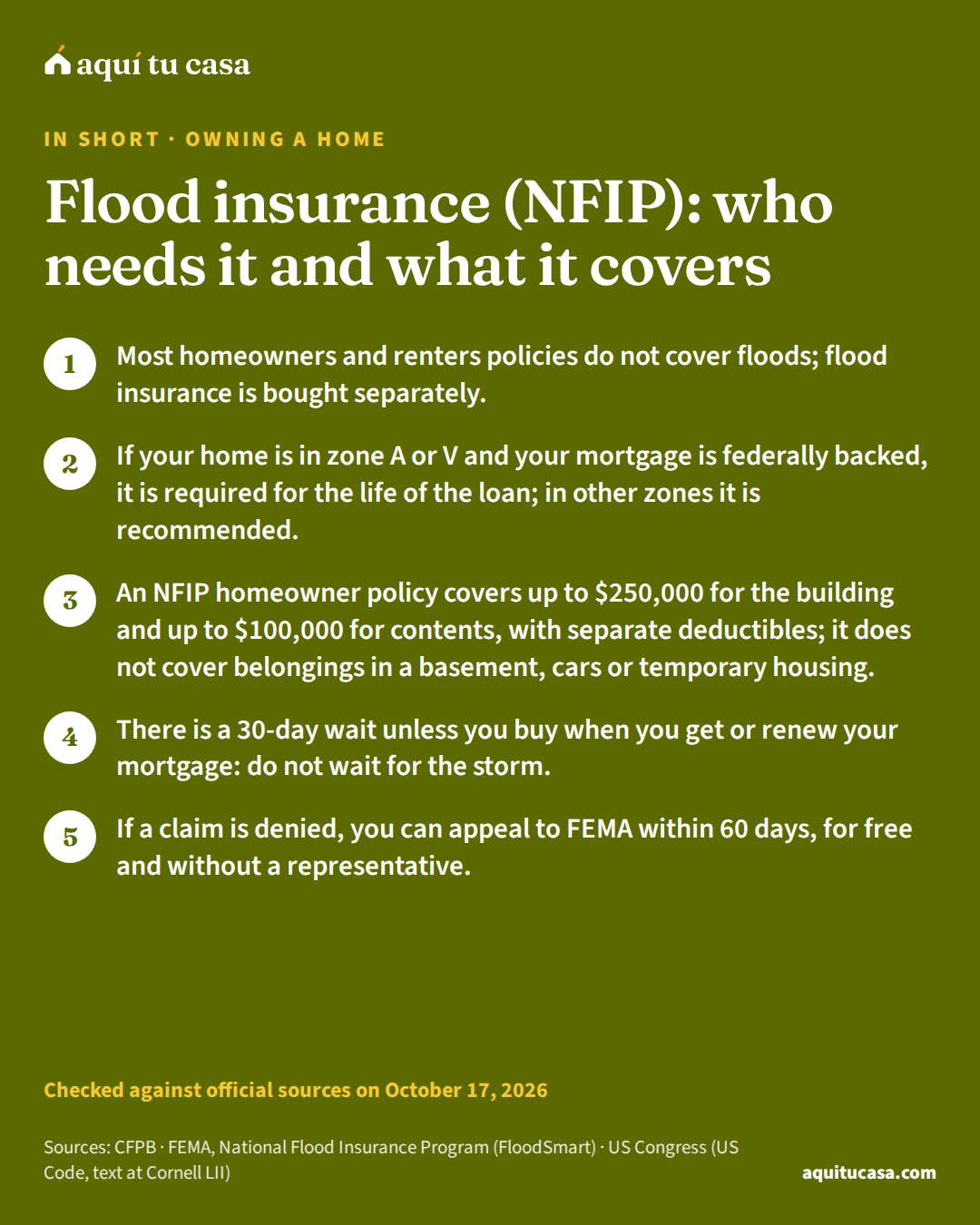
- Owning a home Flood insurance (NFIP): who needs it and what it covers Why home insurance does not cover floods, when you must buy NFIP coverage, what it covers, the 30-day wait, flood zones and how to file a claim. 13 minute read
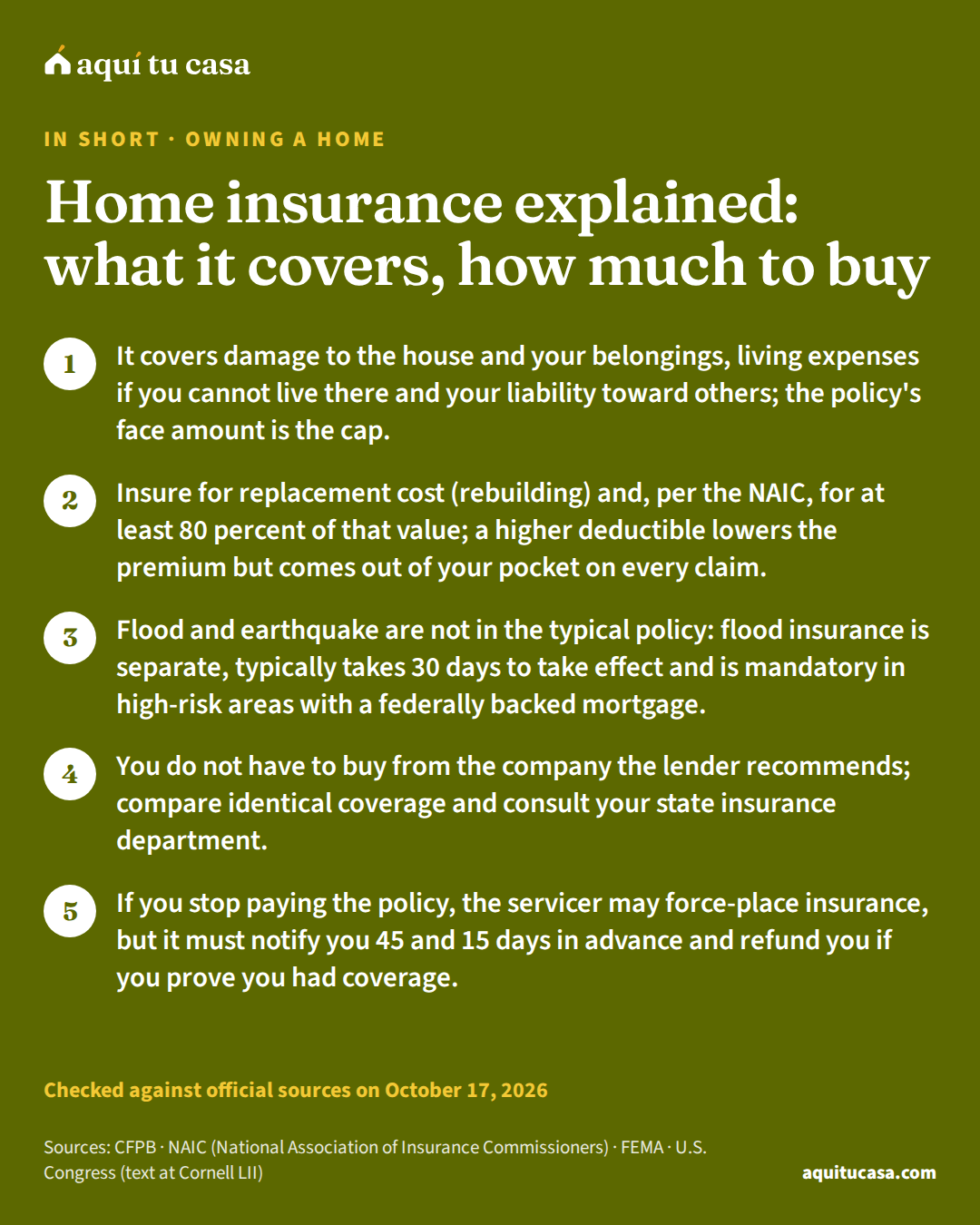
- Owning a home Home insurance explained: what it covers, how much to buy What home insurance covers, why the lender requires it, how to choose the amount and the deductible, why flood is separate and what happens if it lapses. 13 minute read
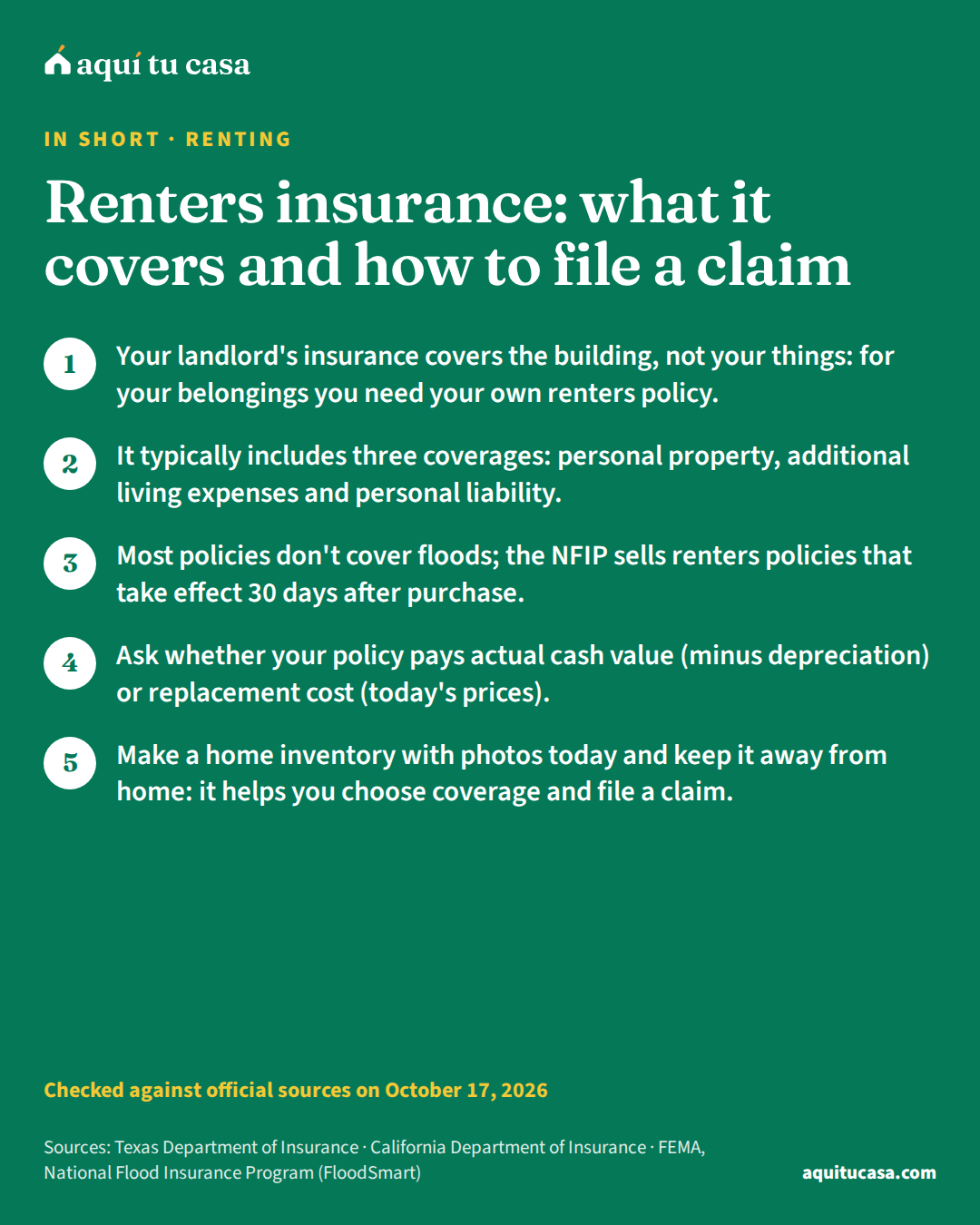
- Renting Renters insurance: what it covers and how to file a claim What renters insurance covers, why it leaves out floods, actual cash value vs. replacement cost, liability coverage and how to file a claim. 13 minute read
Tools for this topic
Was this guide useful?
Thank you. Your answer stays in your browser; nothing is sent.