
Family budget
How much is left for housing each month.
What you get → what is left
Someone shared this page with you.
Questions and answers
Every question our 29 guides about owning a home answer, grouped by guide. Each answer is the guide's own and leads to it, with its sources.
Open a question to read its answer. Each group ends with the full guide, its sources and, when it has one, its calculator.
We found no questions with those words. Try another word or open a topic.
From the guide
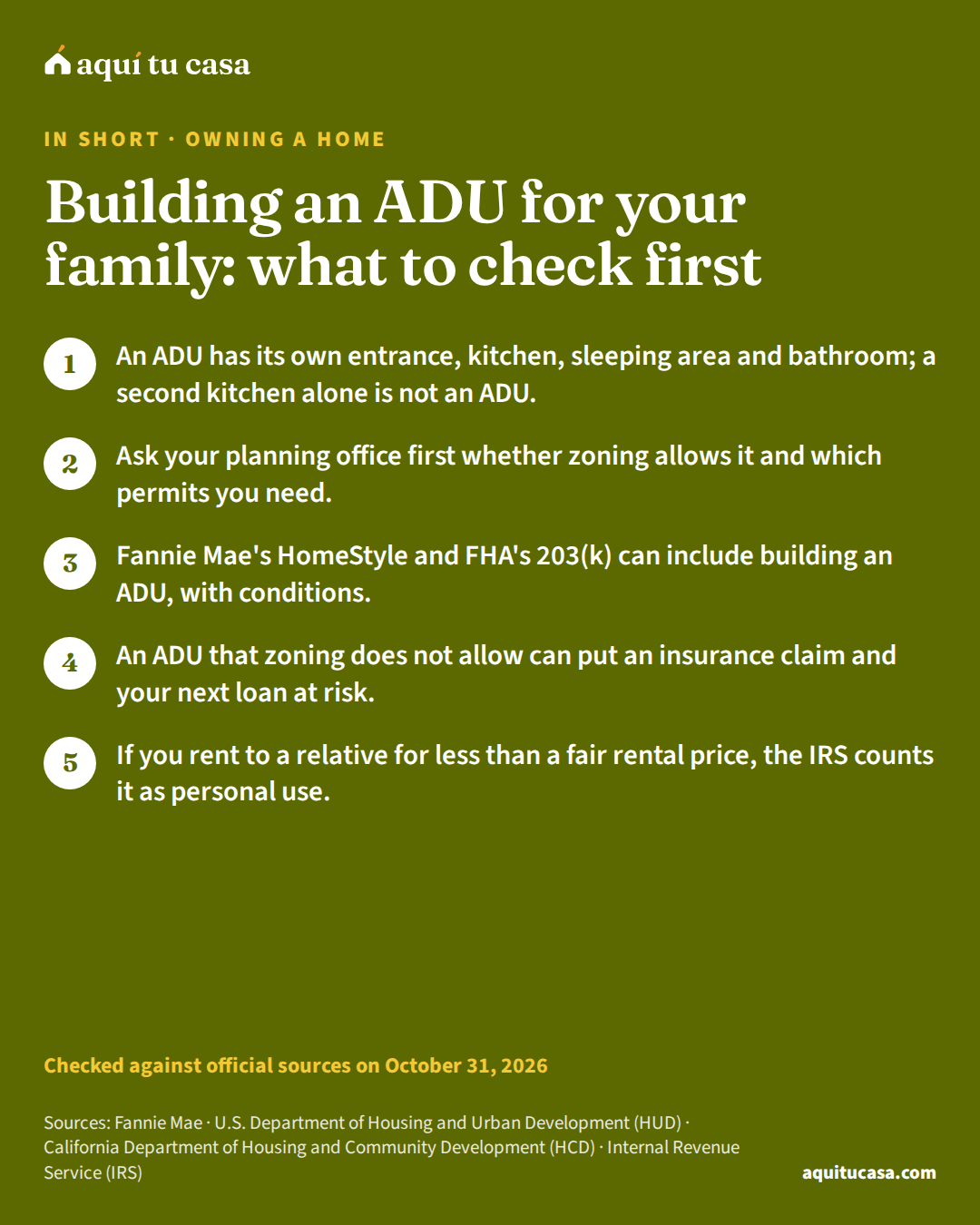
Before you build an ADU for your parents or children: permits, your city's rules, how to pay for it, taxes and what FHA and Fannie Mae require.
Verified on October 31, 2026 6 official sources
For Fannie Mae, a living space with its own entrance, kitchen, sleeping area and bathroom, smaller than the primary home and on the same lot. It can be over the garage, in the basement or in an addition. A second kitchen alone is not an ADU.
Read the full guideGenerally yes. Ask your city's or county's planning or building office. In California, the agency must approve or deny your complete application within 60 days if there is already a home on the lot.
Read the full guideThere are options. Fannie Mae's HomeStyle Renovation loan can be used to build accessory units if zoning allows. FHA's Standard 203(k) includes adding or renovating an ADU, with at least $5,000 in improvements.
Read the full guideIt can affect your next loan and your insurance. Fannie Mae only accepts an ADU that zoning does not allow if the lender confirms it does not jeopardize a future insurance claim. Ask your city whether you can legalize it.
Read the full guideNot for an ADU: the local government cannot require it, except in one case of separate sale. For a JADU that shares a bathroom with the home, owner occupancy is required.
Read the full guideIf you receive no rent, there is no rent to report. But for the IRS, if a relative uses the unit and does not pay a fair rental price, those days are personal use, which changes what you can deduct. Ask at a VITA site.
Read the full guideYes. The IRS says that in most cases everything you receive as rent goes in your gross income. If the rent is below a fair rental price, the IRS treats it as personal use.
Read the full guideThe data behind these guides
The guides on Owning a home cite these figures. They update when their sources publish new ones; what you see here is current.
See all the dataSources: U.S. Census Bureau (Average 2020–2024) · FHFA (2025 data)

From the guide
What happens if you do not pay your property tax: penalties, interest, a lien, tax certificate or home sales, and how to catch up with your county.
Verified on October 31, 2026 8 official sources
Yes, if the debt stays unpaid. In Texas, for example, the tax lien gives the courts the power to seize and auction the property. In Florida, a tax certificate buyer can apply for a tax deed after 2 years. That is why acting early matters.
Read the full guideIn some states, such as Florida, the county sells your tax debt to an investor. The investor pays the taxes and you now owe the investor, with interest. If you do not pay, after a while the investor can apply for a tax deed and the home can go to auction.
Read the full guideMany counties allow it. In Texas, some collectors let you pay delinquent taxes in installments for up to 36 months, and they must offer it on a residence homestead. Before signing, remember that in Texas the agreement counts as an admission that you owe those taxes.
Read the full guideIf your mortgage payment is not more than 30 days late, the servicer must pay the taxes on time from your escrow. If you got a notice, call the servicer and the tax office, and ask in writing for it to be fixed.
Read the full guideUsually not: in Texas, not receiving the bill does not change what you owe or the delinquency date. But penalties are waived in some cases, for example when the error was the county's. In Texas you must ask in writing before the 181st day after the delinquency date.
Read the full guideThe Supreme Court said in the Tyler case, in 2023, that a taxpayer is entitled to the surplus beyond the debt and that the government cannot take more than it is owed. Ask legal aid how to claim that surplus in your state.
Read the full guideIn several states, yes. In Texas, people 65 or older or with a disability can defer the tax on their homestead, with 5% annual interest, or pay it in four installments without penalty if they ask before the delinquency date. Also read the guide on property tax relief for older homeowners.
Read the full guide
From the guide
If you put a family member on your home's deed: the gift tax and Form 709, the tax basis, your mortgage, Medicaid and other risks to weigh first.
Verified on October 31, 2026 7 official sources
Generally yes, if they do not pay you the value of the share they get. The IRS defines a gift as any transfer where you do not receive full value in return. Gifts to your spouse, on the other hand, generally are not taxable gifts.
Read the full guideGenerally not right away, but you may have to file Form 709. You file it if the gift to one person exceeds the annual exclusion, which is $19,000 in 2026. Tax is paid only after you use up the basic exclusion, which is $15,000,000 for 2026.
Read the full guideAccording to the IRS, it is generally filed no earlier than January 1 and no later than April 15 of the year after the gift.
Read the full guideIt depends on your case, but the taxes change. If you give it, the recipient takes your basis, and if they sell they may owe tax on a bigger gain. For an inheritance, the IRS says the rules are different. Ask at a VITA site or legal aid before you decide.
Read the full guideIf your home has fewer than five units, the Garn-St Germain law does not let it use the due-on-sale clause when your spouse or children become owners. For other relatives while you are alive, that exception is not on the law's list; ask your servicer first.
Read the full guideIt can. Medicaid looks at assets you gave away for less than their value in the 60 months before you apply for institutional care. There are exceptions for the home, such as transferring it to your spouse or certain children and siblings.
Read the full guideIt may not be easy, because the other person already owns their share. That is why it pays to think it through and get legal advice before you sign.
Read the full guide
From the guide
When you owe no tax on the gain from selling your home (the $250,000 exclusion), Form 1099-S, forgiven mortgage debt and FIRPTA withholding.
Verified on October 29, 2026 14 official sources
Read the full guide Do the math: How much will I keep when I sell?
According to the IRS, only on gain above the exclusion. If you owned and lived in the home for at least 24 months of the last 5 years, you can exclude up to $250,000 of gain, or up to $500,000 on a joint return. Gain is the price minus selling expenses and minus your adjusted basis.
Read the full guideYou may qualify for a partial exclusion if the main reason for the sale was a change in workplace location, a health issue or an unforeseeable event, such as becoming eligible for unemployment compensation. It is figured as the share of the 24 months you did meet.
Read the full guideIf you received a Form 1099-S, yes: the IRS asks you to report it on Form 8949 even with no taxable gain. If you did not receive a 1099-S, have no taxable gain and do not choose to report it, Publication 523 says you do not need to report the sale.
Read the full guideIt is the information return the settlement agent uses to report the sale to the IRS, with a copy to you. The agent may skip it if the home sells for $250,000 or less ($500,000 if you are married) and you sign a certification, under penalties of perjury, that it is your principal residence and that the full gain is excludable.
Read the full guideGenerally yes: the IRS treats canceled debt as income in the year it was canceled, and the creditor may send you a Form 1099-C. The exclusion for principal residence debt does not cover cancellations or agreements after December 31, 2025, but the insolvency exclusion still exists and is claimed on Form 982.
Read the full guideIt depends on whether you are a foreign person for the IRS. FIRPTA applies to nonresident aliens, not to resident aliens for tax purposes. An ITIN does not decide your tax residency. If you are not a foreign person, you can give a certification under penalties of perjury with your name, TIN and home address so that nothing is withheld.
Read the full guideYou can ask the IRS for a withholding certificate on Form 8288-B before closing; the IRS usually decides within 90 days and you must notify the buyer in writing. If tax is withheld anyway, you file your return with the stamped copy B of Form 8288-A to receive credit for the amount withheld.
Read the full guideIRS VITA sites prepare basic returns for free for people who qualify; find one with the IRS locator tool or at 800-906-9887. If you already have a dispute with the IRS, a Low Income Taxpayer Clinic (LITC) can represent you for free or for a small fee.
Read the full guide
From the guide
Refinance, assume the loan or request a release of liability: what FHA, VA, Fannie Mae and federal law say in divorce, separation and death.
Verified on October 29, 2026 18 official sources
Yes. The CFPB says taking your name off the home's title does not take your name off the mortgage. You remain responsible until the lender releases you by contract or your former spouse refinances and removes your name.
Read the full guideNot by itself. According to the CFPB, the decree can assign the debt to one of you, but the creditor can still collect from anyone whose name is on the loan. Sending the decree to the creditor does not end your responsibility.
Read the full guideAssuming means keeping the current loan, with its rate and balance, and having the lender accept you in writing as the primary obligor. Refinancing means taking out a new loan that pays off the old one. The CFPB says that to remove the original borrower's name you generally do not need to refinance if you are willing to assume and pass the investor's review.
Read the full guideYes. According to HUD, all FHA mortgages are assumable. In a divorce where the person remaining on title keeps living in the home, the lender may process the assumption without a credit review if that person shows they made the payments for at least six months before applying.
Read the full guideVA says that if the divorce decree awards the home to the Veteran whose entitlement backs the loan, the servicer may release the other spouse without an assumption, with a copy of the decree and the recorded deed. If the home goes to the spouse who is not the Veteran, that shortcut does not apply: the circular says whoever wants to become liable for the loan goes through VA's credit review and completes an assumption.
Read the full guideFor a home with fewer than five units, the federal Garn-St Germain Act bars the due-on-sale clause when the spouse becomes an owner or the transfer is to a relative because of the borrower's death. Tell the servicer: it must tell you which documents it needs to confirm you as a successor.
Read the full guideIt depends. If you already have title, for example through inheritance, the CFPB says its rules do not require an ability-to-repay evaluation to let you assume. But if the other borrower asks to be released, Fannie Mae requires a review of your credit and financial capacity, and FHA and VA have their own review.
Read the full guideThe CFPB reports homeowners who were incorrectly told that. Successors have a right to keep paying, get information and be evaluated for a modification without refinancing. If you get the runaround or pressure to refinance, the CFPB says to file a complaint.
Read the full guide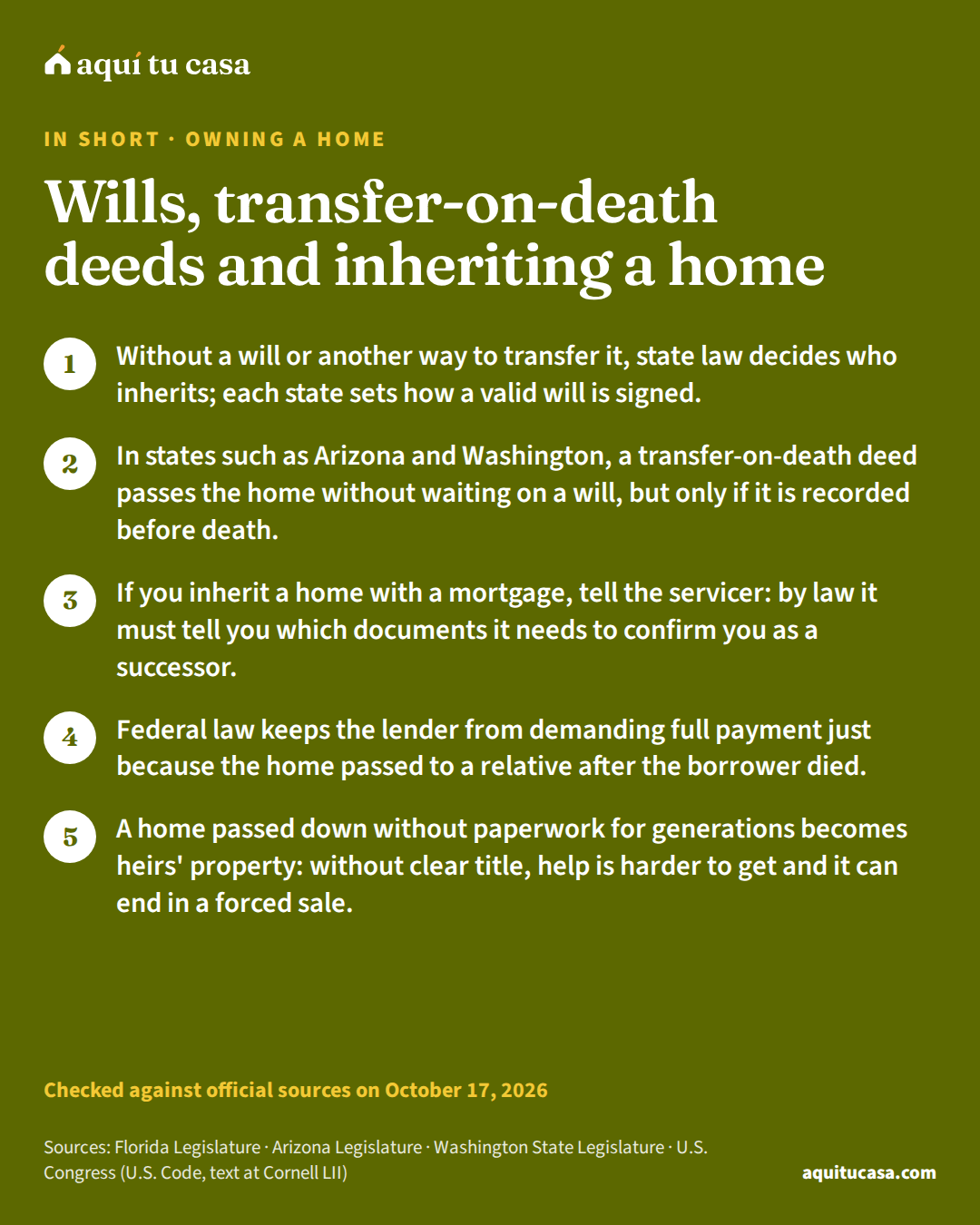
From the guide
What a will requires, how a transfer-on-death deed works, what happens to the mortgage when you inherit a home and what heirs' property is.
Verified on October 17, 2026 23 official sources
It is a deed the owner signs and records during their life that passes the home to the person they chose only when they die. Arizona calls it a beneficiary deed and Washington a transfer on death deed. In both states it can be revoked and must be recorded with the county before death.
Read the full guideIt depends on the state: this guide shows the laws of Arizona and Washington, which do. Check your state's law or ask a free legal aid office; that is an option, never a requirement.
Read the full guideThe debt stays with the home. Tell the loan servicer; under Regulation X, if you write saying you may be a successor, it must answer in writing with the documents it needs. Once confirmed, you are treated as a borrower under the servicing rules, and you can ask how to keep paying or seek a loan modification.
Read the full guideFor a home with fewer than five units, the federal Garn-St Germain Act does not let the lender use the due-on-sale clause because of a transfer to a relative resulting from the borrower's death, or when the spouse or children become owners. The debt and the payments continue.
Read the full guideThe CFPB says that in an inheritance, proof might include a copy of the executed will and the death certificate, or a letter from the executor. The servicer should tell you what it needs, and what you can get varies from state to state.
Read the full guideNot necessarily. The CFPB says that if you already have title to the home, for example through inheritance, its rules do not require the lender or servicer to evaluate your ability to repay before letting you take over the loan.
Read the full guideState law decides who inherits. In Florida, for example, anything not left in a valid will passes to the heirs the code names. If the home is never put in anyone's name, it can become heirs' property, without clear title.
Read the full guideAccording to the IRS, it is generally the home's fair market value on the date of death. If the home is given to you during the owner's life, basis is figured differently: it depends on the giver's basis. Basis is used to figure your gain if you ever sell.
Read the full guide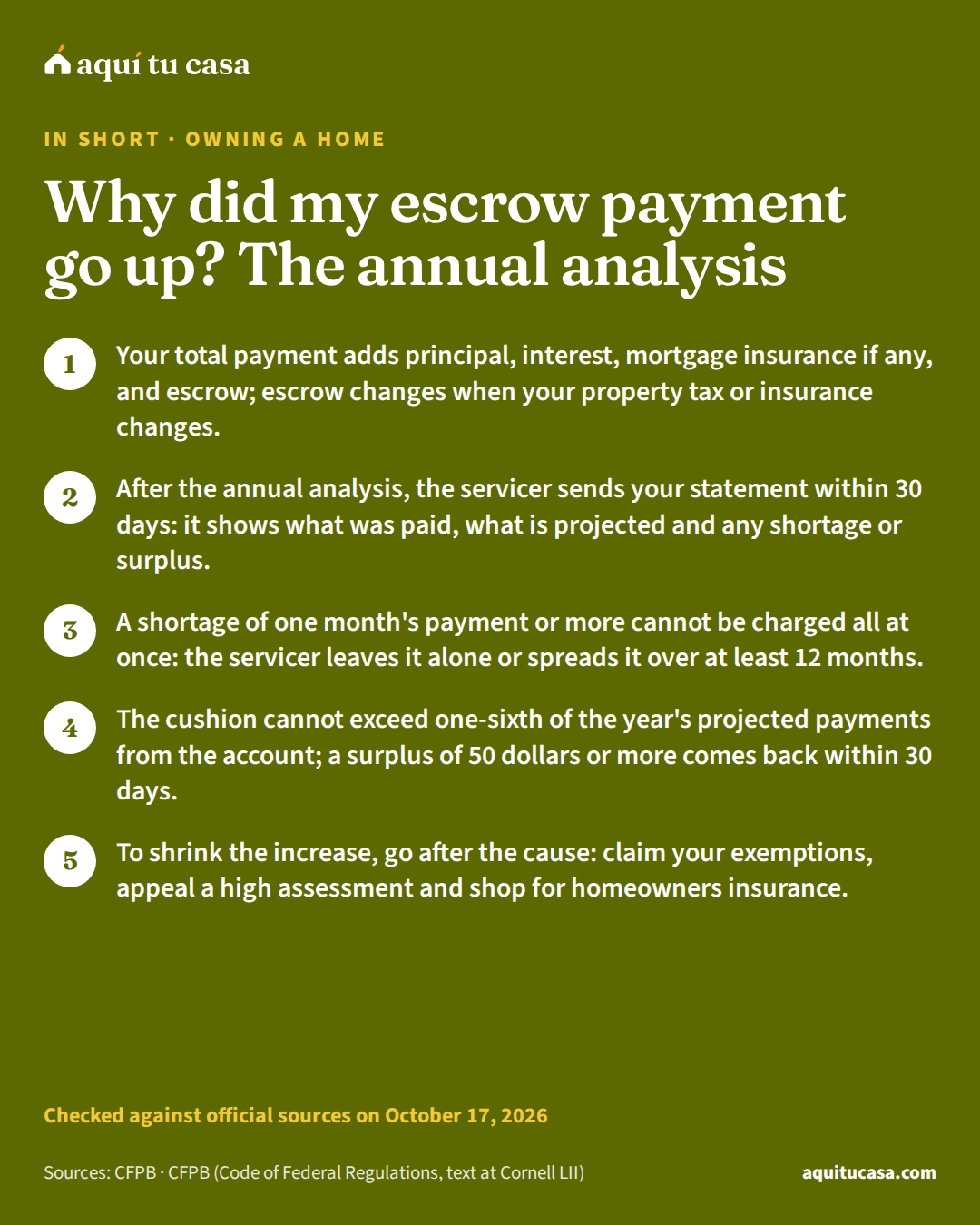
From the guide
Why your payment changes with escrow even at a fixed rate: the annual analysis, shortages, deficiencies, the cushion and how to dispute an error.
Verified on October 17, 2026 10 official sources
Because your total payment includes escrow, which pays your property tax and insurance. According to the CFPB, principal and interest generally stay the same, but escrow changes when those bills go up. Your annual escrow statement explains what increased.
Read the full guideIt is the amount your account is short of the balance it needs at the time of the annual analysis. It happens, for example, when your tax or insurance cost more than the servicer estimated the year before.
Read the full guideA shortage means the account has less than it needs but is not negative. A deficiency is a negative balance: the servicer had to advance money to pay a bill. The rules for collecting each one are different.
Read the full guideIf the shortage is one month's escrow payment or more, the servicer can only leave it alone or spread it into equal monthly payments over at least 12 months. If it is smaller, it can also ask you to pay it within 30 days.
Read the full guideIt is extra money the servicer may keep in the account to cover unexpected bills. Regulation X does not allow it to exceed one-sixth of the year's projected payments from the account, and if your loan documents set a lower cushion, those documents apply.
Read the full guideIf the analysis shows a surplus of 50 dollars or more and you are current, the servicer must refund it within 30 days. If it is less, it may refund it or credit it against next year's payments.
Read the full guideCall, ask for a corrected statement and note a reference number. If it is not fixed, send a written notice of error to the special address the servicer uses for errors, not on your payment coupon, and keep paying while you wait. The servicer must acknowledge it within five business days and generally respond within 30 business days.
Read the full guideWhen you pay off the loan in full, the servicer must return whatever is left in escrow within 20 business days, unless you agree to have it moved to the escrow account of a new loan in certain cases.
Read the full guide
From the guide
Before you rent out a room, half of a duplex or a separate unit: fair housing, your ad, the lease, the deposit, taxes and insurance.
Verified on October 17, 2026 15 official sources
Federal law exempts rooms or units in a building of up to four families if you live in one, but the advertising rule always applies. Your state may be stricter: in California, only an owner renting a single room in the home they live in is outside the law, and even then may not discriminate based on age, citizenship, language or immigration status.
Read the full guideUnder federal law, no ad may indicate preferences by race, color, religion, sex, disability, familial status or national origin. In California, someone looking for a roommate in their own home may state a preference by sex if the kitchen, living room or bathroom will be shared; but no law allows advertising a preference about whether the person has children.
Read the full guideIn most cases, yes: the IRS says you must include in income everything you receive as rent, generally reported on Schedule E of Form 1040. The exception is renting out your own home for less than 15 days in the year: then you do not include that rent. You can deduct expenses such as repairs and depreciation.
Read the full guideNot if you plan to return it at the end of the lease. If you keep part or all of it because the tenant did not live up to the lease, you include what you kept in that year's income. And if the deposit will be used as the last month's rent, the IRS treats it as advance rent, reported when you receive it.
Read the full guideDo not assume so. The Texas Department of Insurance says most homeowners insurance won't cover damage to a rental property or might limit what it pays, and that landlord insurance is mainly for long-term leases. Ask your insurer before you sign a lease with a tenant.
Read the full guideIt depends on the state. In Texas, the Attorney General says you must return it, minus damages, within 30 days of the tenant moving out, with an itemized list of deductions, and you may not charge for normal wear and tear. The table in this guide and the security deposit guide show the cap and deadline for each verified state.
Read the full guideFor the IRS, if a family member uses the home and it is not their main home or they do not pay a fair rental price, it counts as your personal use, which changes how you report. A fair rental price is what someone unrelated to you would pay.
Read the full guideCalifornia's official guide says many landlords require it, specifically liability coverage, and set minimum terms. Your policy does not protect the tenant's belongings, and each roommate needs a separate policy.
Read the full guideTools
The calculators these guides use. Each one leaves you with a result you can use today.
How much is left for housing each month.
What you get → what is left
Your monthly payment with taxes and insurance.
What you get → monthly payment
Your home's estimated tax per year and per month.
What you get → tax per year
The price your income can carry.
What you get → maximum price
From the guide
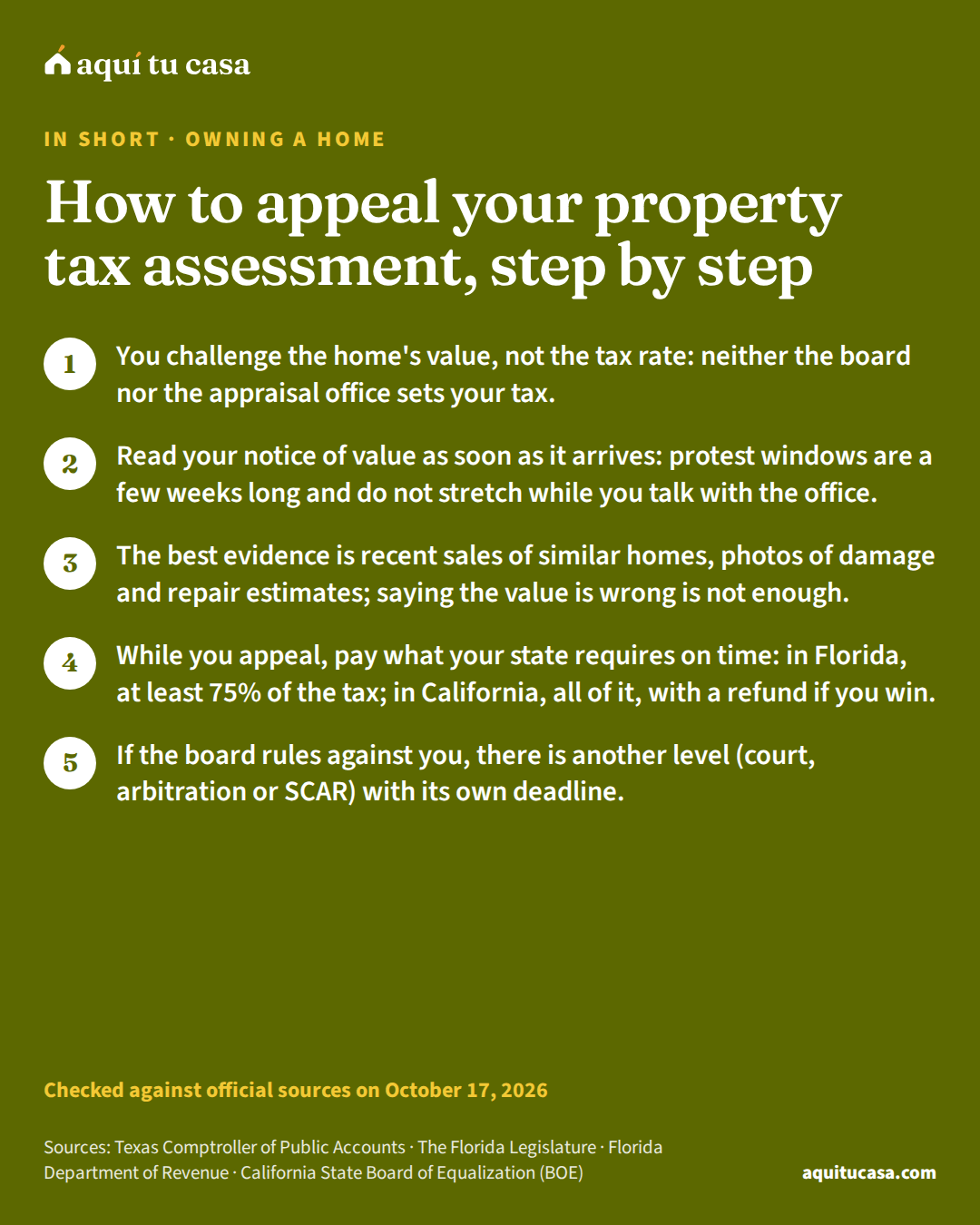
How to read your notice of value, what evidence works, how the informal review and hearing work, and protest deadlines in Texas, Florida and California.
Verified on October 17, 2026 10 official sources
It can happen. In California, the State Board of Equalization says the appeals board can leave the value the same, lower it or raise it, because it is not bound by the value you or the assessor present. That is why it pays to bring solid evidence about similar homes.
Read the full guideEach state sets it. In Texas it is May 15 or 30 days after the district mails the notice, whichever is later. In Florida, 25 days after the TRIM notice is mailed, usually in mid-August. In California, July 2 to September 15 or November 30, depending on the county. In Arizona, 60 days from the Notice of Value.
Read the full guideFor a home, the best evidence is recent sales of comparable homes, according to California's Board of Equalization. The Texas Comptroller adds photos of your home and the comparables, receipts or estimates for repairs and your purchase documents. Saying the value is wrong is not enough.
Read the full guideIt is not required. In California and Florida you may represent yourself, and in Florida a family member or friend can also help. In Texas you can appoint someone with Form 50-162 if you want. If your case goes to court, free legal aid can guide you.
Read the full guideIt depends on the state. In California you must pay on time even while you appeal, and if you win you get the overpayment back with interest. In Florida, for the board to review value, you pay at least 75% of the tax before it becomes delinquent. In Texas, to go to district court you pay the undisputed taxes before the delinquency date.
Read the full guideIt depends on the state and the county. In Florida, the value adjustment board may charge up to $50 per parcel, but not for an appeal of a denied homestead exemption, and it must waive the fee for people receiving temporary assistance. In California, some counties charge a fee. Ask your appraisal office before you file.
Read the full guideIn Texas, the board can grant a late hearing if you show good cause, and if your homestead was appraised at least one-fourth above its correct value you can ask for a correction before the delinquency date. In other states, ask the appraisal office; if there is no late window, get ready for the next notice.
Read the full guideIn Texas you can go to district court within 60 days of receiving the order, or request binding arbitration, available for any residence homestead. In Florida you can file a lawsuit in circuit court. In California, a challenge goes to superior court within six months. In New York, SCAR is a low-cost option for most homeowners.
Read the full guide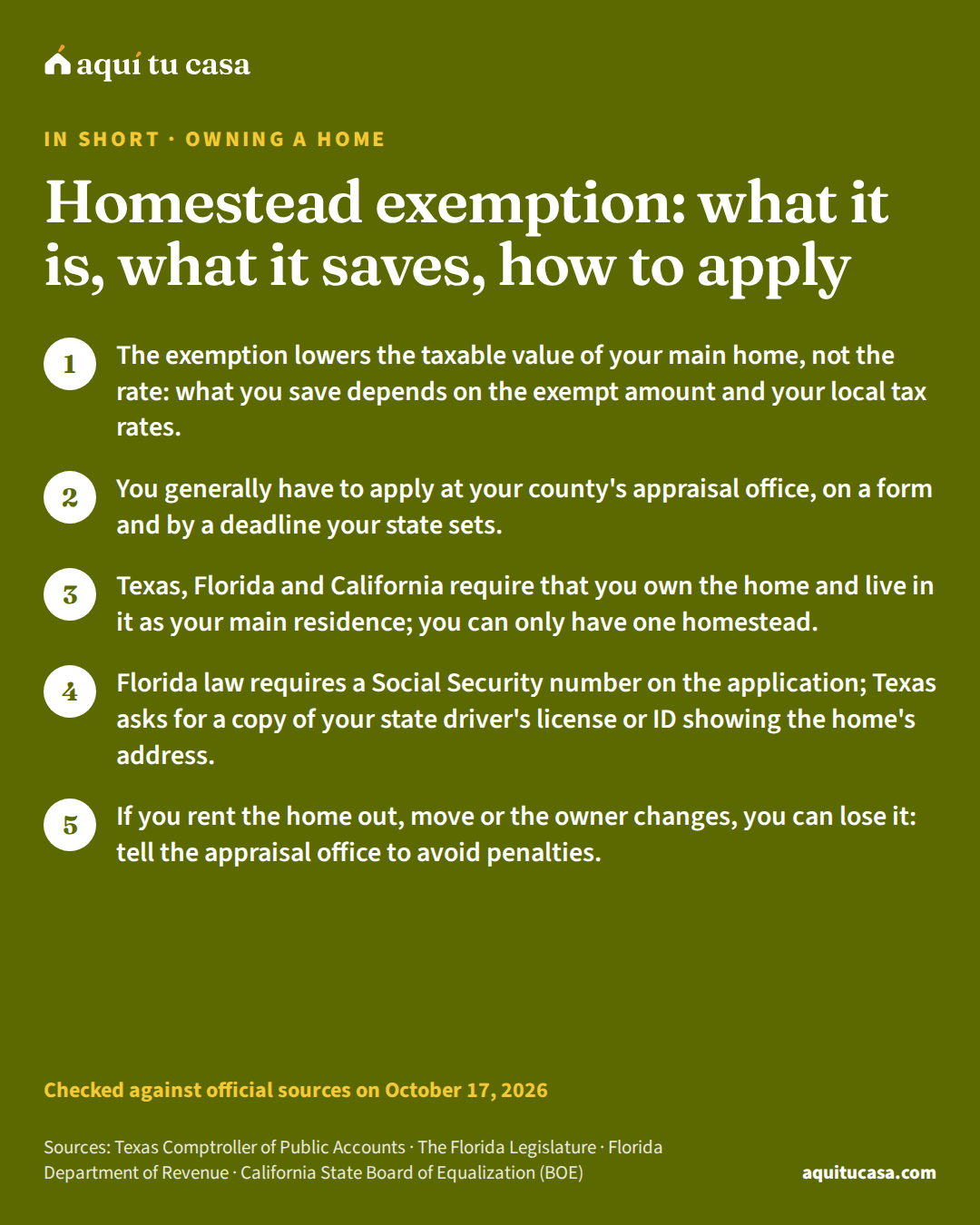
From the guide
What the homestead exemption is, who qualifies, how much it lowers your home's value in Texas, Florida and California, how to apply and which dates matter.
Verified on October 17, 2026 14 official sources
Generally no. The Texas Comptroller says an owner must apply in most circumstances; in California you file once with the county assessor; and in Florida the application goes to the property appraiser by March 1. Check your first bill: if the exemption is not there, apply.
Read the full guideIt lowers the value your tax is calculated on, not the rate. The Texas Comptroller gives an example: a home appraised at $300,000 with the $140,000 school exemption pays school taxes as if it were worth $160,000. What you save is the exempt value times your local tax rates.
Read the full guideIt depends on the state. In Texas, a buyer who acquires the home after January 1 may get it right away for the rest of the year if the previous owner did not receive it that year. In Florida you must own and live in the home on January 1; meanwhile the previous owner's exemption stays with the home for the rest of the year.
Read the full guideIn Texas, no, unless the chief appraiser requires it. In California you file once. In Florida the property appraiser mails you a renewal every year by February 1. In Texas and California you must also tell the office when you stop qualifying.
Read the full guideNot always. In Texas you can file a late application up to two years after the deadline. In Florida you can file until the 25th day after the property appraiser mails the assessment notice, and the appraiser decides whether there are extenuating circumstances; if not, you can petition the value adjustment board for a $15 fee.
Read the full guideNot as your main home. In Texas you must state that you do not claim another homestead in or outside the state. In Florida, a person receiving an exemption or credit in another state that requires permanent residency is not entitled to it.
Read the full guideIn Florida, yes: the Department of Revenue says you are no longer eligible if the unit is rented or is no longer your permanent home. In Texas and California the exemption is for the owner's principal residence. Tell the appraisal office when your situation changes.
Read the full guide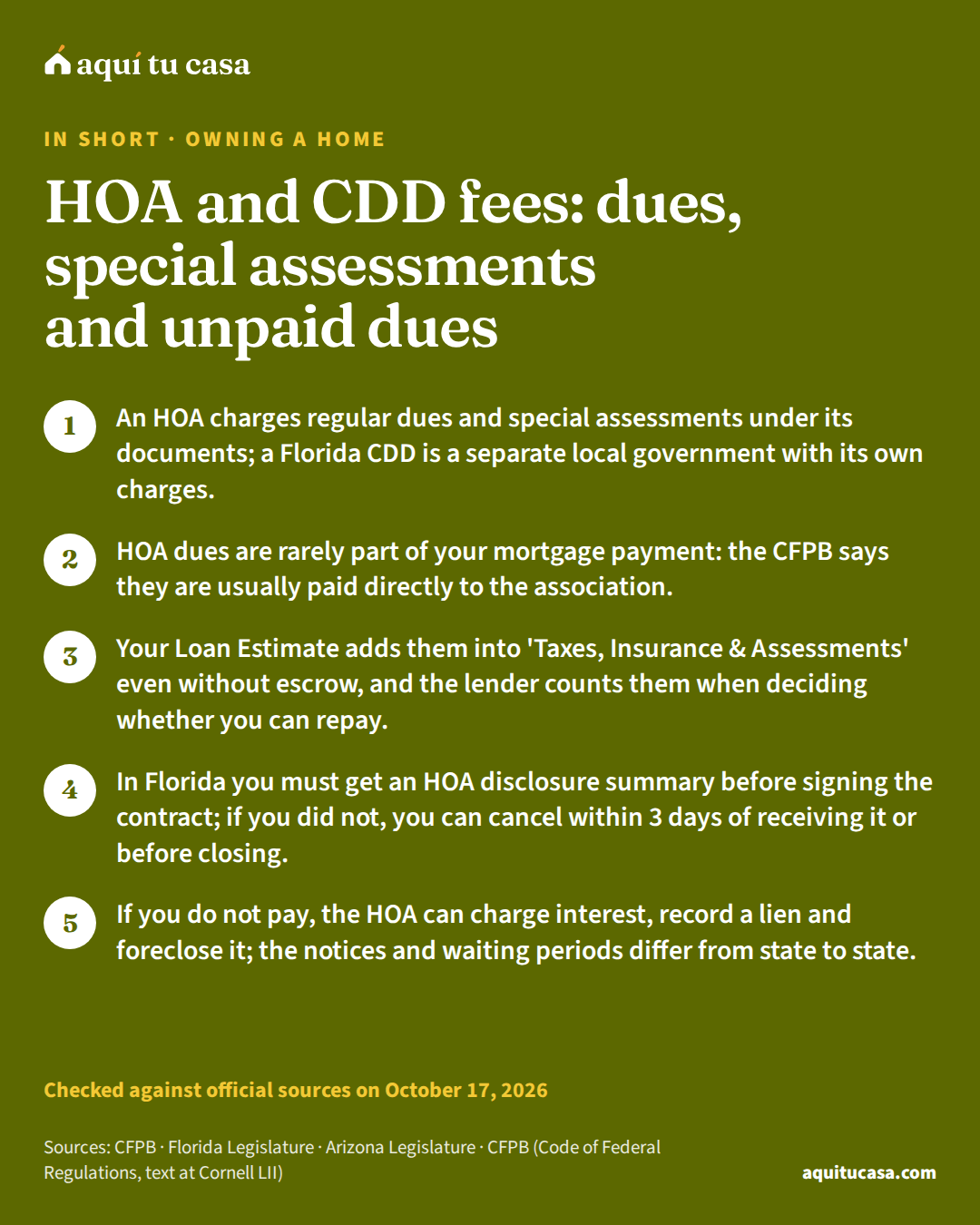
From the guide
What an HOA and a Florida CDD are, what they charge, how they show up on your Loan Estimate and what happens if you fall behind, depending on your state.
Verified on October 17, 2026 24 official sources
Usually not. The CFPB says association dues are usually paid directly to the HOA, outside your payment to the servicer. Although it is not common, your servicer may agree to include them in escrow if you ask.
Read the full guideIt depends on the community. The CFPB says dues can range from a few hundred dollars a month to more than one thousand, and that you should factor them in when deciding whether you can afford the mortgage. The real figure is in the association's budget and in the documents you get before you buy.
Read the full guideIt is a charge on top of regular dues that the association can impose, for example for major work. In Florida, the disclosure summary warns buyers that they will also have to pay special assessments, and if the budget does not fully fund reserves, the financial report must warn that this may result in special assessments.
Read the full guideA community development district is a local unit of special-purpose government. It levies assessments to pay for the district's facilities and their upkeep, and it can have them entered on the county tax roll so the tax collector collects them along with property taxes. If the facilities were financed with bonds, the bond installment is collected every year.
Read the full guideIt can happen. In Florida and Arizona, the association can foreclose its lien like a mortgage, but the law requires notices and waiting periods first. In Arizona it may only foreclose once you are eighteen months or $10,000 or more behind, and the board must first try to offer you a reasonable payment plan. If you get collection notices, look for help early.
Read the full guideIn Florida, the law makes a new owner jointly liable with the previous owner for unpaid assessments that came due up to the sale, although the new owner can recover what they pay from the previous owner. That is why an estoppel certificate, showing the date dues are paid through, is requested before closing.
Read the full guideYes. Under Regulation Z, association dues and special assessments are mortgage-related obligations, and the lender must consider your monthly payment for them when deciding whether you can repay the loan.
Read the full guideIn Florida, the association must give you a copy of the annual budget or tell you that you can request one at no charge, and it must let you inspect its official records within 10 business days of a written request. The declaration of covenants is recorded with the county. In other states, check your state's law and your community's documents.
Read the full guide
From the guide
Why home insurance does not cover floods, when you must buy NFIP coverage, what it covers, the 30-day wait, flood zones and how to file a claim.
Verified on October 17, 2026 14 official sources
Generally no. The CFPB says standard homeowners insurance does not cover floods, and FloodSmart, the website of FEMA's NFIP, says the same about most homeowners and renters policies. For that you need a separate flood insurance policy.
Read the full guideIf your home is in a special flood hazard area (zones A or V) and you have a government-backed mortgage, yes, for the life of the loan. Some banks require it even outside high-risk areas, and if your home received federal disaster assistance before, it is required too.
Read the full guideUsually 30 days after you buy. There is no wait if you buy when making, increasing, extending or renewing your mortgage, or if you change coverage at renewal; there is a one-day wait if your zone was just remapped to high risk and you buy within 12 months.
Read the full guideFor a home, the building policy covers up to $250,000 and the contents policy up to $100,000. They are bought separately and have separate deductibles. Renters can buy contents coverage.
Read the full guideIt depends on where your home is, how it is built and what it would cost to replace. With the NFIP, every company offers the same rates, so a quote from an agent gives you your number. An elevation certificate can identify discounts.
Read the full guideYes. The law requires regulated lenders to accept private flood insurance that meets the same coverage requirements, and the flood hazard notice must say coverage is available through the NFIP and from private insurers.
Read the full guideYes. FloodSmart says the NFIP has renters policies that protect your belongings, such as furniture, clothing and electronics, up to $100,000.
Read the full guideTalk to your adjuster or insurer. If that does not resolve it, you can appeal to FEMA within 60 calendar days of the date on the denial letter, at no cost and without a representative. To sue your insurer you have one year from the denial, and an appeal does not extend that deadline.
Read the full guide
From the guide
What your homeowners policy leaves out, how earthquake policies work, what the FAIR Plan is and what to do if your insurer drops you over wildfire risk.
Verified on October 17, 2026 11 official sources
In most cases, no. The California Earthquake Authority and the California and Texas Departments of Insurance explain that earthquake and earth movement are usually excluded and that a separate policy is needed. In California, your insurer must offer it when it sells you homeowners coverage.
Read the full guideFire is usually covered by home policies, and so is smoke, according to the California Department of Insurance. The most common problem after past fires was being insured for less than it cost to rebuild, so check your limit and whether your policy pays replacement cost.
Read the full guideIt is an insurer of last resort for people who cannot get insurance in the traditional market. It offers a basic fire policy for the house and contents, with no liability or theft coverage. For what is missing, you buy a supplemental policy called Difference in Conditions. A licensed broker helps you apply.
Read the full guideAfter the Governor declares a state of emergency for a fire, the law gives one year of protection from cancellations and non-renewals in certain areas within or next to the fire perimeter. The Department of Insurance publishes the ZIP codes included. If you got a notice and your area is included, ask your insurer to reinstate the policy.
Read the full guideIt depends on your home. The CEA says its price depends on the home's age, foundation, construction and roof type, and location risk such as proximity to a fault. It has a calculator on its site and deductibles from 5% to 25%. Ask your insurer for a quote.
Read the full guideSometimes. The CEA gives discounts of up to 25% to retrofitted older homes, and grants help pay for retrofits. In California, every action under Safer from Wildfires qualifies for a discount, and the FAIR Plan also discounts the wildfire portion if you harden your home.
Read the full guideThe Texas Department of Insurance says you can buy separate earthquake and flood policies through your agent. If no company will insure you and at least two turned you down, the Texas FAIR Plan sells basic home insurance, which costs more than a standard company's.
Read the full guideIn California, the CEA says it works with homeowners, condo-unit owners and renters, and sells its policies through participating companies. Ask the company that carries your renters insurance.
Read the full guide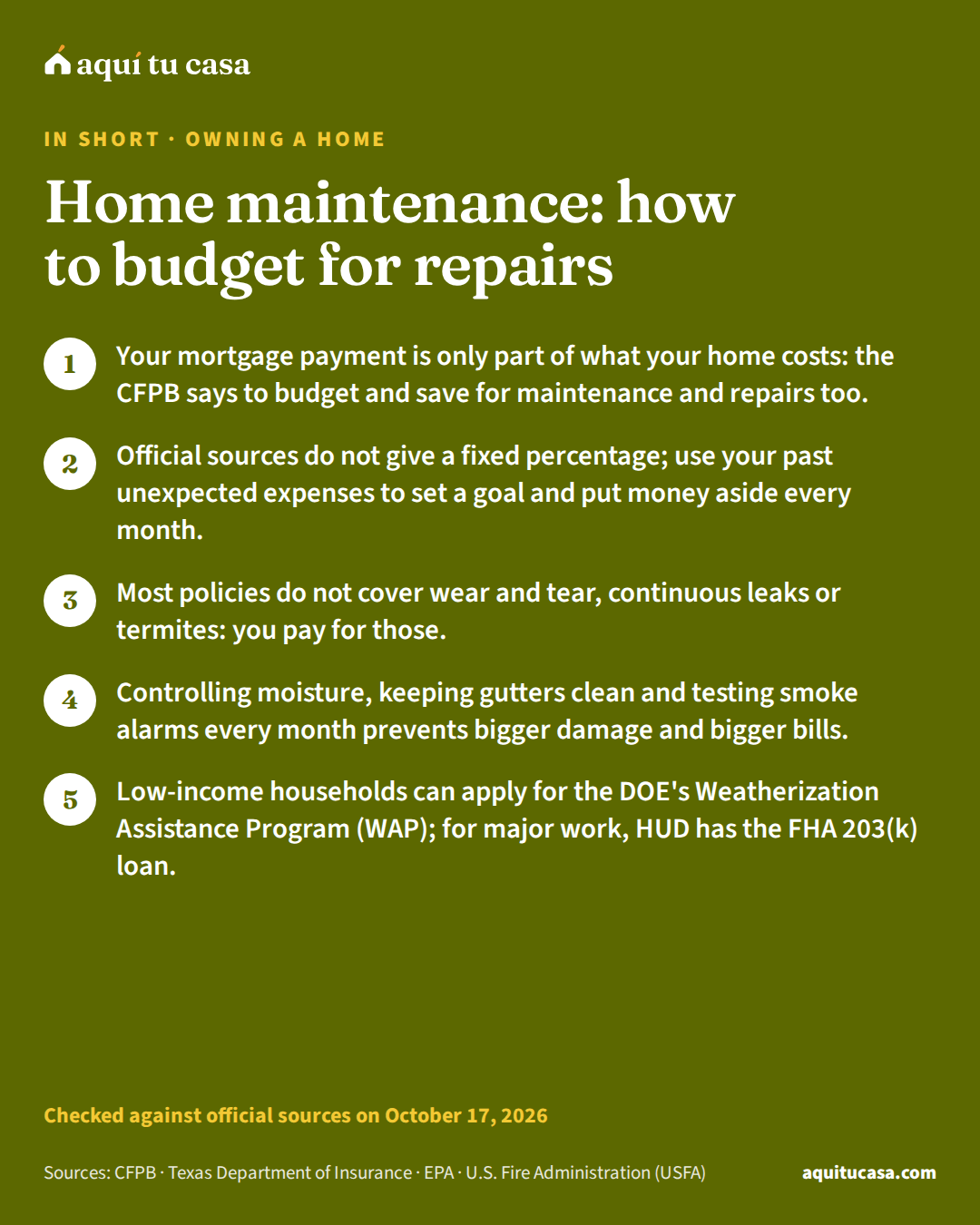
From the guide
How to plan and save for home maintenance and repairs: what insurance does not cover, what the IRS says and what help exists to fix up your home.
Verified on October 17, 2026 12 official sources
The official sources we checked do not set a percentage. The CFPB says your home needs maintenance and repairs and that you should budget and save for them, and it suggests setting a goal based on the unexpected expenses you have had and what they cost. Our family budget tool helps you see how much you can set aside each month.
Read the full guideIt pays for damage from the risks your policy covers. The Texas Department of Insurance explains that most policies cover fire or a sudden and accidental release of water, but not a continuous leak, termites or rodents, or wear and tear. Coverage varies by company: read your policy or ask your agent.
Read the full guideNo. The IRS says you cannot deduct repair costs and generally cannot add them to your home's basis either. Improvements, such as a new roof, are not deductible, but their cost is added to your basis; keep those receipts as long as they matter for figuring it.
Read the full guideYes, there are programs. The Department of Energy's Weatherization Assistance Program (WAP) makes low-income households' homes more energy efficient. According to the DOE, LIHEAP helps pay utility bills, and the USDA offers loans to very low-income rural homeowners to repair their homes and grants to elderly homeowners to remove health or safety hazards.
Read the full guideFind your state's weatherization administrator and then the local provider for your county. Under DOE guidelines, households at or below 200% of the poverty guidelines or receiving SSI are eligible, and your state may use another criterion. You will be asked for proof of income for the prior year and, if eligible, placed on a waitlist.
Read the full guideWith an FHA 203(k) loan you can, when buying or refinancing. According to HUD, the Limited 203(k) finances up to $75,000 to repair or improve, and the Standard 203(k) is for major work of at least $5,000. You apply through FHA-approved lenders.
Read the full guideAccording to the IRS, you cannot claim the residential clean energy credit for expenditures made after December 31, 2025, or the energy efficient home improvement credit for property placed in service after that date. If a seller promises you that credit for new work, check what the IRS says.
Read the full guideThe U.S. Fire Administration says to test them every month, replace a 9-volt or backup battery at least once a year, and replace the whole alarm every 10 years. Some fire departments give out or install alarms at no cost.
Read the full guideChange topic without leaving the questions.

These answers explain the rules but do not know your situation. These organizations go over it with you, free.