Adding a family member to your deed: gift tax and risks
If you put a family member on your home's deed: the gift tax and Form 709, the tax basis, your mortgage, Medicaid and other risks to weigh first.
Verified against official sources on October 31, 2026 7 official sources

Show contents
In short
What you need to know
Quick answer
If you add a family member to your deed without being paid, the IRS generally treats it as a gift. If their share is worth more than the annual exclusion ($19,000 per person in 2026), you must file Form 709, though you rarely owe tax right away because of the lifetime basic exclusion. The person who gets the home while you are alive also takes your tax basis, which can cost them more when they sell than if they inherited it. On a home with fewer than five units, adding your spouse or children does not let the lender demand the mortgage be paid at once. And if you ever need Medicaid for nursing home care, a gift in the last 60 months can affect you.
What matters most
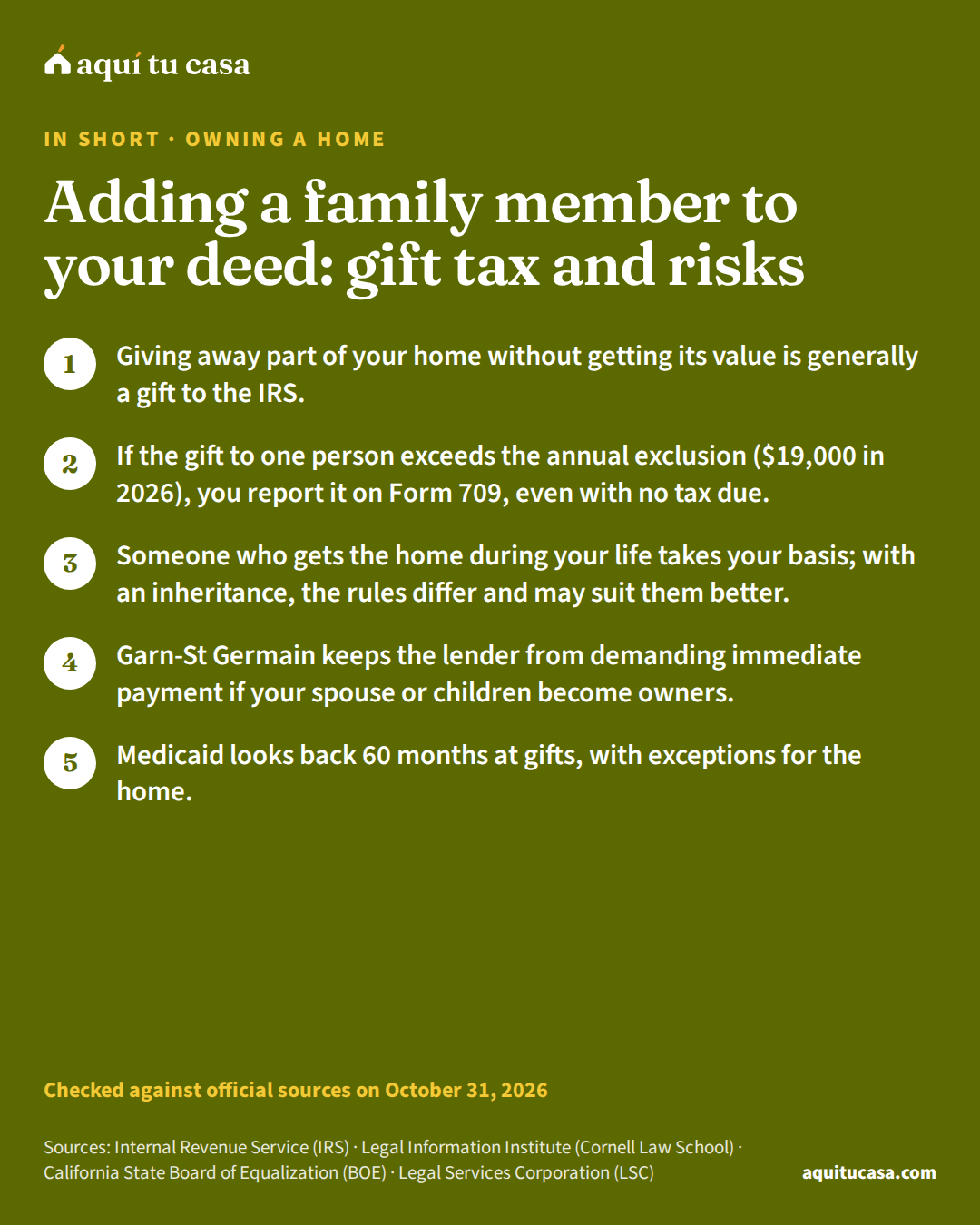
- Giving away part of your home without getting its value is generally a gift to the IRS.
- If the gift to one person exceeds the annual exclusion ($19,000 in 2026), you report it on Form 709, even with no tax due.
- Someone who gets the home during your life takes your basis; with an inheritance, the rules differ and may suit them better.
- Garn-St Germain keeps the lender from demanding immediate payment if your spouse or children become owners.
Is this for you?
This guide is for you if…
- You own your home and are thinking of putting a child, your partner or another relative on the deed.
- Someone told you that way your family keeps the home without paperwork if something happens to you.
- You already added someone and want to know whether you had to report a gift to the IRS.
Get direct help first if…
- You are buying with family and want to choose how to hold title: read «How to hold title with family».
- You want to leave the home to someone when you die: read «Wills, transfer-on-death deeds and inheriting a home».
Many families think about putting a son, a daughter or another relative on the home’s deed. Sometimes it is so the home “stays in the family” if something happens, and sometimes it is to help someone have something of their own. It looks like simple paperwork, but it changes who owns the home, can count as a gift to the IRS and can affect your mortgage, Medicaid and your family’s taxes. This guide explains what the rules say so you can think it through before you sign; it does not decide your case.1
Adding someone is generally a gift
To the IRS, a gift is any transfer to a person where you do not receive full value in money or its equivalent in return.1 If you put your son on the deed and he does not pay you for his share, you are generally giving him that share.
Some things generally are not taxable gifts: gifts no larger than the annual exclusion, tuition or medical expenses you pay directly for someone, and gifts to your spouse.1
A case that surprises people. The Form 709 instructions say that if you buy property with your own money and title it in your name and another person’s as joint tenants with right of survivorshipjoint tenancy with right of survivorshipJoint tenancy with right of survivorship is a way for two or more people to own property, each with an equal, undivided interest in the whole. When one owner dies, that share passes to the surviving owners, not to the owner's heirs; that is the main difference from a tenancy in common. Generally the deed has to say so; if it does not, the ownership is presumed to be a tenancy in common. That is the case, for example, in Arizona and Florida, where the law requires the deed to state the right of survivorship expressly.See the full definition, and either of you can sever your share, you have given that person half the value.2 The guide How to hold title with family explains the ways several people can own a home.
The annual exclusion and Form 709
The annual exclusion. It counts per person who receives a gift. For 2026 gifts it is $19,000 per person. If you and your spouse give something you own together, each of you uses your exclusion: $38,000 per person receiving it.1
When Form 709 is filed. If you are a citizen or resident, you must file Form 709 even if you owe no tax, in cases including when your gifts to someone other than your spouse exceed the annual exclusion, or when you give a “future interest” gift, which has no exclusion. A gift is a present interest if the person can use and enjoy the property right away. If spouses give away property they held as joint tenants, each spouse files a return. It is generally filed between January 1 and April 15 of the year after the gift.2
Is there tax to pay? Generally not right away. The donor generally pays the tax, and only after using up the lifetime basic exclusion, which the law raised to $15,000,000 for 2026 gifts.11 But the form is still filed, because it keeps track of how much you have used.
Example with real numbers
A mother who adds her daughter to the deed
An example in words, not a real case, of what the gift looks like.
- What she does
- Makes her daughter owner of half, without the daughter paying
- To the IRS
- Generally, a gift of the value of that half
- The annual exclusion
- $19,000 in 2026; half a home is almost always worth more
- Form 709
- The mother files it, even though she owes no tax
- The tax
- Generally she does not pay it, because she uses part of her basic exclusion
The rules come from the IRS.12 See what your family would net from a sale with the seller net sheet.
Run it with your numbersHow much will I keep when I sell?Basis: the hidden cost of giving during your life
Basis is the starting point for figuring the gain when property is sold. If you are given property, the general rule is that your basis is the same as the donor’s. The IRS gives an example: stock bought at $10 and sold at $100 owes tax on a $90 gain.1
A home works the same way. If you bought your home many years ago and give it to your son during your life, he takes your old basis. If he sells it someday, he may owe tax on a large gain. The IRS notes that the rules are different for inherited property.1 The guide Wills, transfer-on-death deeds and inheriting a home explains how basis works on an inherited home and what a transfer-on-death deedtransfer on death deed (TOD deed)A transfer on death (TOD) deed is a deed in which an owner names one or more people to receive the home when the owner dies. It is not a will. While the owner is alive, they remain the owner: they can sell or mortgage the home and can revoke the deed. To be valid, it must be recorded with the county before the owner's death, and the beneficiary does not have to sign or be told. The beneficiary takes the home subject to its mortgages and liens. Each state has its own rules and name: Washington calls it a transfer on death deed, and Arizona a beneficiary deed.See the full definition is, an option some states offer.
Giving now or leaving it as an inheritance
Gift during your life
Adding a relative today
- The person owns their share right away
- You may need to file Form 709
- They take your tax basis
- It counts in Medicaid's 60-month look-back
Inheritance
Leaving the home at death
- You stay the sole owner while you live
- Basis on an inheritance is figured differently
- Done with a will or other tools your state allows
- Read the guide on wills and TOD deeds
Before you sign, ask how the taxes change on each path.

Your mortgage and the due-on-sale clause
If your mortgage has a due-on-sale clausedue-on-sale clauseA due-on-sale clause is a part of the mortgage contract that lets the lender demand the full balance if you sell or transfer the home, or part of it, without its written consent. A federal law, the Garn-St Germain Act, allows these clauses, but for homes with fewer than five units it bars using them for certain transfers: for example, to a relative on the borrower's death, when the borrower's spouse or children become owners, in a divorce, on the death of a joint tenant, or into the borrower's living trust.See the full definition, the lender can demand the whole balance if you transfer the home without its permission. But the federal Garn-St Germain law says that, on a home with fewer than five units, the lender may not use that clause because of, among others:3
- A transfer in which your spouse or children become owners.
- A transfer to a relative because of your death.
- A transfer on the death of a joint tenant.
- A transfer to your spouse from a divorce or separation.
- A transfer into a living trust in which you remain a beneficiary.
Notice what it leaves out. For transfers during your life, the law’s list names spouses and children, not siblings, nephews or other relatives; the law also lets regulations add other cases.3 If you plan to add someone who is not your spouse or child, ask your servicer first. And if you later want to take someone off the loan, the guide How to remove a co-borrower from a mortgage explains the options.
Medicaid and property tax
Medicaid. If you or your spouse ever need Medicaid for care in a nursing home or other institution, the law looks at assets you gave away for less than their value. For transfers since February 8, 2006, it looks back 60 months, and a gift in that time can leave you a period without coverage for certain services.4
The law has exceptions for the home. There is no penalty if you transferred it to your spouse; to a child under 21, or blind or disabled; to a sibling who already had an equity interest and lived there at least one year before; or to a son or daughter who lived there at least two years before and cared for you so you could stay home.4 Each state runs its own program; get advice before transferring.
Property tax. A change in ownership can change your property taxproperty taxProperty tax is the tax the county, city, school district and other local bodies charge real property owners every year to pay for schools, police, fire and other public services. It is computed on the value the assessor's office assigns to your home, at each body's rate, minus the exemptions you qualify for, such as the primary-residence exemption in many states. If you have a mortgage you normally pay it month by month inside your payment, through the escrow account. It is generally deductible on your federal return if you itemize.See the full definition or your exemptions, depending on the state. In California, for example, Proposition 19 changed the exclusion for parent-child transfers: the home must be the principal residence of both the giver and the recipient, with a limit of the current taxable value plus $1,000,000 (adjusted every two years), since February 16, 2021.5 Ask your county assessor’s office before you sign, and see the homestead exemption guide.
Before you sign a new deed
1. Write down why you want to add this person
First
Keeping the home in the family, helping someone or sharing costs: each goal has a different path.
2. Estimate the value of the share you are giving
Before you decide
If it exceeds the annual exclusion, Form 709 comes into play.1
3. Ask your loan servicer
Before you sign
The federal exception covers spouses and children, not every relative.3
4. Check Medicaid and property tax
Before you sign
Medicaid looks back 60 months; your county may change your assessment or exemptions.4
If this is you
You want your daughter to inherit the home
Giving it now passes on your basis; an inheritance has other rules. Compare first.1
You want to add the nephew who lives with you
Garn-St Germain's exception names spouses and children; ask your servicer.3
You married and want to add your husband
Gifts to a spouse generally are not taxable gifts.1
Your disabled son lives with you
Medicaid does not penalize transferring the home to a blind or disabled child.4
You need help with Form 709
Ask at a VITA site; each site decides which returns it prepares.6

Costly mistakes
Mistake: Adding someone to the deed without thinking about the IRS.
Instead: It is generally a gift; if it exceeds the annual exclusion, Form 709 is required.2
Mistake: Believing you do not have to report because you owe no tax.
Instead: Form 709 is filed even when no tax is due.2
Mistake: Giving the home during your life without figuring the basis.
Instead: The recipient takes your basis; an inheritance is figured differently.1
Mistake: Adding a relative who is not your spouse or child without telling the lender.
Instead: The federal due-on-sale exception does not name them; ask first.3
Mistake: Transferring the home shortly before applying for Medicaid.
Instead: Medicaid looks back 60 months, with limited exceptions for the home.4
Where to get free help
For taxes, the IRS VITA and TCE programs prepare basic returns for free for people who qualify; each site decides what it handles, so ask whether it prepares Form 709.6 The guide Free tax filing explains how to find one.
For the deed, free legal aidlegal aidLegal aid is the free civil legal help that nonprofit organizations and their lawyers provide to low-income people in civil, not criminal, matters. In housing, that includes representing families facing eviction or foreclosure, alongside matters such as custody, child support, protection from domestic violence and access to benefits. In the United States, the Legal Services Corporation, created by Congress, funds a nationwide network of these organizations; its finder points you to the one in your area. Each sets its own income limits.See the full definition is an option, not a requirement. The Legal Services Corporation funds civil legal aid for people with low incomes; on its site you search for an office by your address, and LawHelp.org has free information and forms.7 And protect your deed: the guide on deed theft explains how to guard against fraud.

What to do this week
- Ask for a copy of your current deed at your county recorder’s office.
- Find what you paid for the home and for improvements, to know your basis.1
- Call your loan servicer and ask how a deed change would affect you.3
- Ask the assessor’s office whether the change affects your tax or exemptions.5
- Make an appointment at a VITA site or with legal aid before you sign.67
Your home and your county
We use the typical rate and value of the place you pick.
Typical home value in the United States (Census, ACS 2024). Enter your assessed value.
Let's do the math
Estimated tax per year
$3,127
About $261 a month, at a rate of 0.94% on $332,700.
Per month
$261
If you pay through escrow, your lender adds about this much to your payment.
The math
- Your home's value
- $332,700
- Taxable value
- $332,700
- Rate
- × 0.94%
- Tax per year
- $3,127
The rate changes within the county
Each home pays the districts it sits in (city, schools, services), and each sets its own rate. This rate is a county average, not your home's.
Your county's tax or assessor's office publishes your assessment, each district's rate and how to apply for an exemption or appeal.
This is an educational estimate from county averages, not your tax bill. Your bill depends on your home's districts, your assessment and your exemptions.
Ready to see the numbers? Find your county here
See how this applies in your county: its loan limits, prices and rents, from the official data.
Printable checklist
Frequently asked questions
Is adding my child to the deed a gift?
Generally yes, if they do not pay you the value of the share they get. The IRS defines a gift as any transfer where you do not receive full value in return. Gifts to your spouse, on the other hand, generally are not taxable gifts.
Do I have to pay gift tax?
Generally not right away, but you may have to file Form 709. You file it if the gift to one person exceeds the annual exclusion, which is $19,000 in 2026. Tax is paid only after you use up the basic exclusion, which is $15,000,000 for 2026.
When is Form 709 due?
According to the IRS, it is generally filed no earlier than January 1 and no later than April 15 of the year after the gift.
Is it better to give the home now or leave it as an inheritance?
It depends on your case, but the taxes change. If you give it, the recipient takes your basis, and if they sell they may owe tax on a bigger gain. For an inheritance, the IRS says the rules are different. Ask at a VITA site or legal aid before you decide.
Can the bank demand I pay off the mortgage if I add my child?
If your home has fewer than five units, the Garn-St Germain law does not let it use the due-on-sale clause when your spouse or children become owners. For other relatives while you are alive, that exception is not on the law's list; ask your servicer first.
Does adding someone affect Medicaid?
It can. Medicaid looks at assets you gave away for less than their value in the 60 months before you apply for institutional care. There are exceptions for the home, such as transferring it to your spouse or certain children and siblings.
Can I undo the change later?
It may not be easy, because the other person already owns their share. That is why it pays to think it through and get legal advice before you sign.
Sources
Every figure in this guide comes from one of these official sources. The number next to a sentence leads to the source behind it.
Each source on one line: who publishes it, its title, its address and the date we read it.
- 1. Internal Revenue Service (IRS) · Frequently asked questions on gift taxes · irs.gov · Accessed October 31, 2026
- 2. Internal Revenue Service (IRS) · Instructions for Form 709 (2025) · irs.gov · Accessed October 31, 2026
- 3. Legal Information Institute (Cornell Law School) · 12 U.S.C. §1701j-3, Preemption of due-on-sale prohibitions (Garn-St Germain) · law.cornell.edu · Accessed October 31, 2026
- 4. Legal Information Institute (Cornell Law School) · 42 U.S.C. §1396p, Liens, adjustments and recoveries, and transfers of assets · law.cornell.edu · Accessed October 31, 2026
- 5. California State Board of Equalization (BOE) · Proposition 19 · boe.ca.gov · Accessed October 31, 2026
- 6. Internal Revenue Service (IRS) · Free tax return preparation for qualifying taxpayers · irs.gov · Accessed October 31, 2026
- 7. Legal Services Corporation (LSC) · I Need Legal Help · lsc.gov · Accessed October 31, 2026
Keep reading
Related guides
If this guide helped, these follow the same path.

Buying a home 10 minute read
How to hold title to a home with your family
Joint tenancy, tenancy in common and community property: what some state laws say, what loans require and where to find free legal help.
- Title is legal ownership of the home; the deed is the document that shows it, and it states how you own it.
- In a joint tenancy with right of survivorship, the share of an owner who dies passes to the others; in a tenancy in common there is no such right.
- In Arizona, Florida and Washington, without express words in the deed, two or more owners hold as tenants in common, with special rules for spouses.
- Owning a home Wills, transfer-on-death deeds and inheriting a home What a will requires, how a transfer-on-death deed works, what happens to the mortgage when you inherit a home and what heirs' property is. 14 minute read
- Protect yourself from scams Deed theft and title fraud: how to protect your home What deed theft is, who is most at risk, the warning signs, your county's property alerts and what to do if someone records a fake deed. 10 minute read
- Owning a home Taxes when you sell your home and FIRPTA withholding When you owe no tax on the gain from selling your home (the $250,000 exclusion), Form 1099-S, forgiven mortgage debt and FIRPTA withholding. 21 minute read

Tools for this topic
Was this guide useful?
Thank you. Your answer stays in your browser; nothing is sent.