How to remove a co-borrower from a mortgage
Refinance, assume the loan or request a release of liability: what FHA, VA, Fannie Mae and federal law say in divorce, separation and death.
Verified against official sources on October 29, 2026 18 official sources

Show contents
In short
What you need to know
Quick answer
There are two ways to take someone off a mortgage: refinance the loan in the name of the person who is staying, or have that person assume the current loan and get the lender to release the other in writing. Signing a quitclaim deed or sending the divorce decree takes no one off the loan: it changes who owns, not who owes. FHA and VA loans are assumable under their own rules, Fannie Mae has its own assumption-and-release process, and in a divorce or a death federal law keeps the lender from calling the whole balance just because the home passed to the spouse, the children or a relative. Regulation X gives you the right to have the servicer tell you which documents it needs.
What matters most
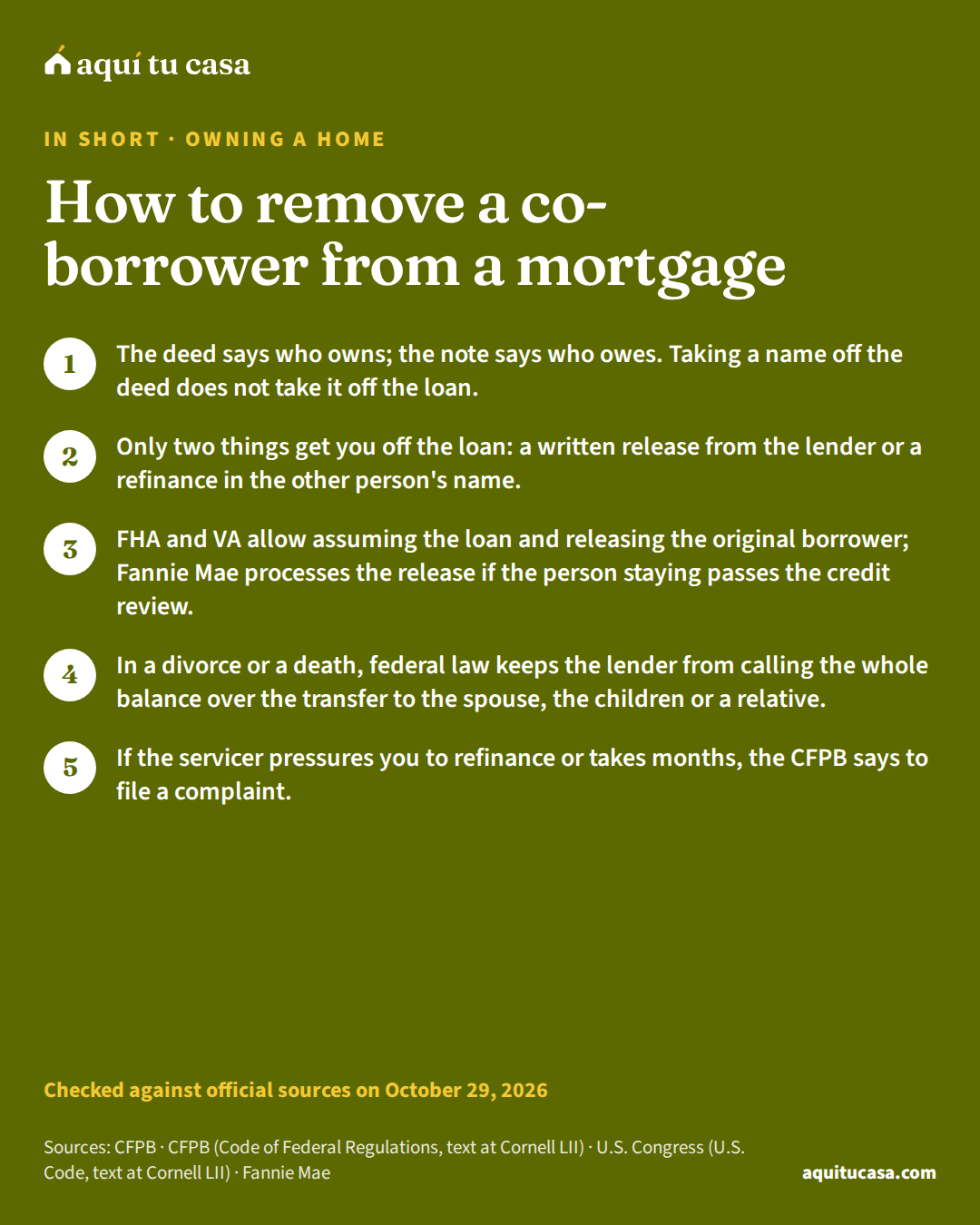
- The deed says who owns; the note says who owes. Taking a name off the deed does not take it off the loan.
- Only two things get you off the loan: a written release from the lender or a refinance in the other person's name.
- FHA and VA allow assuming the loan and releasing the original borrower; Fannie Mae processes the release if the person staying passes the credit review.
- In a divorce or a death, federal law keeps the lender from calling the whole balance over the transfer to the spouse, the children or a relative.
Is this for you?
This guide is for you if…
- You divorced or separated, one of you is keeping the home and you want the other off the loan.
- The person you signed the mortgage with has died, or the owner died and you inherited the home with the loan on it.
- You bought with a relative or a friend and now you want a single person to be responsible for the loan.
Get direct help first if…
- There is already a court case (divorce, probate or foreclosure): this guide only explains the general rules; a free legal aid office can guide you on your situation.
- You want to know whether refinancing or assuming the loan is better for you: that depends on your situation and we do not give individual advice here.
- The loan is a reverse mortgage: the rules are different and have their own guide.
This guide is for anyone who signed a mortgage with someone else and now needs a single person on the loan: after a divorce or separation, when the person you signed with dies, or when you bought with a relative and plans changed. It explains, from what federal law, HUD, VA, Fannie Mae and the CFPB publish, which paths exist and what rights you have with the loan servicerloan servicerThe loan servicer is the company that sends you your mortgage statements and handles the day-to-day tasks of the loan: it processes your payments, answers your questions, keeps track of principal and interest paid and manages your escrow account, if you have one. It can also offer options if you fall behind and, in certain cases, start a foreclosure. It may be the same company that lent you the money or a different one, and it is common for another company to take over the loan after closing.See the full definition. It is not legal or financial advice: for your situation, a HUD-approved housing counselor or a free legal aid office is an option.
- Homes where federal law bars calling the whole balance over a transfer to the spouse or the children, or to a relative after the borrower's death
- Up to 4 units3
- Of payments made by the person staying for FHA to allow an assumption without a credit review in a divorce or inheritance
- 6 months10
- VA funding fee for assuming a loan, on the unpaid balance
- 0.50%12
- Of joint ownership for Fannie Mae to treat buying out the other owner as a limited cash-out refinance
- 12 months9
The deed and the loan are two different papers
When you bought the home you signed two things. The deeddeedA deed is the legal document the seller uses to transfer ownership of the home to you. The seller signs it at closing, it lists the names of all the buyers and you receive a copy. Afterward, the settlement agent records it with the county records office; that recording puts the public on notice that you are now the owner. There are several types: a warranty deed gives the most promises about the title, and a quitclaim deed promises nothing. Do not confuse it with a deed of trust, which is the mortgage document.See the full definition says who owns. The notepromissory noteThe promissory note (or simply the note) is the document you sign at closing to promise you will repay the loan to the lender. It describes what you are agreeing to: how much you owe, the interest rate, the payment dates, the total you will pay, the length of the loan, whether the payments can change and where to send them. It is separate from the mortgage or deed of trust, the document that gives the lender the right to take the home if you do not pay. Some terms, such as a prepayment penalty, may be in an addendum to the note. You can ask for copies of the documents before closing to review them.See the full definition says who owes the money. Taking someone off the deed does not take them off the note. The CFPB says it plainly: taking your name off the home’s title does not take your name off the mortgage, and sending the creditor a copy of the divorce decree does not end your responsibility on a joint account. You generally remain responsible unless the creditor releases you by contract or your former spouse refinances the loan and removes your name.1
That is why the quitclaim deed many people sign at divorce solves only half the problem. Whoever signed the note is still a co-borrowerco-borrowerA co-borrower is a person who applies for the mortgage with you, signs the note and is responsible for the debt just as you are. On an FHA loan, all borrowers and co-borrowers, whether or not they will live in the home, must take title in their own name or a living trust, be obligated on the note and sign the security documents. It is not the same as a co-signer: according to Fannie Mae, a co-signer signs the note and is liable for the debt but has no ownership interest on the title. Co-borrowers who will not live in the home have their own rules.See the full definition even after they stop being an owner. If the person who kept the home stops paying, the creditor can collect from anyone whose name appears as a borrower.1 Our guide on how to hold title with family explains the ways to hold title.
Example with real numbers
You signed the quitclaim deed, but the loan is still in both names
What changed and what did not, based on what the CFPB says about debts after divorce.
- What changed
- The deed: now one person owns the home
- What did not change
- The note: both of you still owe the loan
- If the person who stayed stops paying
- The creditor can collect from anyone whose name is on the loan
- What does get you off the loan
- A written release from the lender, or a refinance in the other person's name
The CFPB says taking your name off the title does not take your name off the mortgage.1 The lender accepting you in writing as the new primary obligor is what Regulation Z calls an assumption.2
The two real exits: refinance or assume the loan
Only two things take a person off the loan. The first is a refinancerefinanceTo refinance is to take out a new mortgage loan to pay off and replace the one you have. According to the CFPB, common reasons are to lower the interest rate, lower the monthly payment or borrow additional money. When you refinance you usually pay closing costs again. If your payment goes down, the CFPB says to understand how much of the drop comes from a lower rate and how much from a longer loan term. In many refinances you have a right to cancel (right of rescission) until midnight of the third business day, but not if you refinance with the same lender without borrowing more.See the full definition: the person staying takes out a new loan, in their name only, that pays off the old one. The second is an assumption with a release of liability: the person staying keeps the current loan, with its rate and balance, and the lender agrees in writing that this person is the only one obligated. Regulation Z defines an assumption as the creditor’s express written agreement to accept a new consumer as the primary obligor on an existing mortgage, and requires new disclosures before it happens.2
The CFPB explains the difference that matters for your wallet. Successor homeowners have a right to keep paying, get information about the loan and be evaluated for a modificationloan modificationA loan modification is a change in the terms of your mortgage that you agree on with your loan servicer when you have trouble paying. It is a type of loss mitigation, meaning one of the options to avoid foreclosure. It can extend the time you have to repay, lower the interest rate, or defer or reduce part of the principal balance, which can lower your monthly payment. Often you start with a trial modification for a few months; if you make those payments on time, the change becomes permanent.See the full definition without assuming or refinancing. To remove the original borrower’s name, they generally do not need to refinance, provided they are willing to assume liability and pass the investor’s credit review for assumptions. And if they want the other person released, as courts often order in divorces, they will generally need to assume the loan after meeting the lender’s or investor’s standards.8
Three papers people confuse
New loan
Refinance
- The person staying takes out a new loan in their name and pays off the old one; the other gets out because the old debt disappears.1
- If you buy out the other owner because of a divorce, Fannie Mae treats it as a limited cash-out refinance if you owned the home together for at least 12 months.9
- It has closing costs and today's rate; the CFPB reports homeowners who were incorrectly told it was the only option.8
Same loan
Assume with release
Before signing any paper, ask the servicer in writing what the assumption-and-release process is for your loan; the CFPB says that if you are pressured to refinance, file a complaint.8
If you are thinking about refinancing anyway, our guide on refinancing your mortgage explains the costs and when they pay back. For a refinance that buys out the other owner after a divorce, Fannie Mae requires all parties to sign a written agreement with the terms of the transfer and where the money goes, and at least one borrower on the new loan to be an owner on title at application, with exceptions if the home was legally awarded in the divorce or separation.9

Assuming and releasing, loan by loan
The rules change depending on who backs your loan. Look at your statement or ask the servicer whether the loan is FHA, VA, or was bought by Fannie Mae or Freddie MacFannie Mae and Freddie MacFannie Mae and Freddie Mac are two companies created by Congress that buy mortgages from lenders. They hold them or package them into mortgage-backed securities (MBS) that may be sold to investors, and they guarantee those investors timely payment of principal and interest. Lenders use the cash from those sales to keep making home loans. They are not federal agencies: they are shareholder-owned companies that operate under a congressional charter. The Federal Housing Finance Agency (FHFA) supervises them and runs them under conservatorship.See the full definition. Here are the rules for FHA, VA and Fannie Mae, from what each one publishes.
FHA loans
According to HUD Handbook 4000.1, all FHA mortgages are assumable, and the person assuming must have a valid Social Security number or EIN, or meet the eligibility exception for that number.10 An assumption is the transfer of the obligation from the current borrower to the one assuming. The lender notifies HUD of the change of borrower, but that notice does not release the original borrower: to release them, the lender prepares form HUD-92210.1, Approval of Purchaser and Release of Seller, when the person assuming signs the agreement to assume the mortgage and pay the debt.10 If the original mortgage closed on or after December 15, 1989, the person assuming must intend to live in the home as a principal or HUD-approved secondary residence.10
The person assuming goes through a credit underwriting, reviewed manually by the underwriter, and does not have to put in money of their own. There is an exception designed for divorces and inheritances: the lender may process the assumption without a credit review if the transfer is by will or inheritance, or for another reason where the law does not allow the due-on-sale clause, such as a divorce in which the person remaining on title keeps living in the home, and the person assuming shows they made the payments for at least six months before applying.10 The processing fee may not exceed $1,800, and if the assumption does not happen for reasons beyond the control of the person who was going to assume, with credit approved, the lender refunds half.10 Our FHA loan guide explains the rest of the program.
VA loans
The federal VA loan statute says how the release works. If you notify the loan holder in writing before transferring the home, and the holder determines that the loan is current and that the person assuming is obligated by contract to pay the balance and qualifies on credit, the assumption is approved and you are relieved of all further liability to VA, including for any default by the buyer. If the holder denies it, it must tell you that you may appeal to VA. If you transfer without notice, the holder may demand full payment.11 The VA funding feeVA funding feeThe VA funding fee is a one-time payment the Veteran, service member or surviving spouse makes on a VA loan. It helps lower the loan's cost to taxpayers, because the VA loan does not require a down payment or monthly mortgage insurance. It is a percentage of the loan amount that depends on the loan type, the down payment and whether you have used the benefit before. You can pay it at closing or add it to the loan. Among others, people who receive VA compensation for a service-connected disability do not pay it.See the full definition for assuming is 0.50 percent of the unpaid balance on the date of the transfer.12
VA Circular 26-23-10 spells out the process: the assumption may be done with or without a substitution of entitlement. Without substitution, the original Veteran’s entitlement stays encumbered by the loan until it is paid in full. With substitution, if the person assuming is an eligible Veteran who will occupy the home and has enough entitlement, the seller’s entitlement is restored. Servicers with automatic authority decide within 45 calendar days, a denial is appealed to VA within 30 calendar days, and the processing fee may not exceed $300, or $250 if VA approves first.13 Our VA loan guide explains entitlement and the fee.
Fannie Mae loans
The Fannie Mae Servicing Guide tells the servicer to process certain exempt transfers without reviewing or approving their terms, unless the previous borrower requests a release of liability. Among them: the transfer to the surviving co-owner when a joint tenant dies; to one of the borrowers when unrelated co-borrowers bought together, if the one staying keeps living in the home and at least 12 months have passed since closing; and, if the person receiving the home occupies it, to a relative of the deceased borrower, to the borrower’s spouse, children, parents, siblings, grandparents or grandchildren, or to the spouse under a divorce decree, legal separation agreement or property settlement agreement. For loans Fannie Mae bought or securitized on or after June 1, 2016, in those transfers to relatives or a spouse the person receiving the property does not have to occupy it.14
The release is another step. If the previous borrower asks for it, the servicer must determine that the credit and financial capacity of the person staying are acceptable. If the loan is behind and the person staying cannot bring it current, the servicer must evaluate them for all workout options, and if a modification is appropriate, it has them sign an assumption agreement along with the modification agreement.14
| FHA | VA | Fannie Mae | |
|---|---|---|---|
| Can it be assumed? | Yes, all of them10 | Yes, with the holder’s or VA’s approval11 | Exempt transfers without review; release with review1414 |
| Who reviews credit? | The underwriter, manually; may be no review in a divorce or inheritance with 6 months of payments10 | The holder; a denial is appealed to VA11 | The servicer, if a release is requested14 |
| Fee | Up to $1,80010 | Up to $300 or $250, plus a 0.50% VA fee1312 | Ask the servicer |
| Paper that releases | Form HUD-92210.110 | The holder’s approval of the assumption11 | Assumption and release agreement14 |
Divorce and separation
In a divorce, the court decides who keeps the home, but that does not by itself change your relationship with the creditor.1 Two federal rules help you order the steps. The Garn-St Germain Act says that, for a home with fewer than five units, the lender may not use the due-on-sale clausedue-on-sale clauseA due-on-sale clause is a part of the mortgage contract that lets the lender demand the full balance if you sell or transfer the home, or part of it, without its written consent. A federal law, the Garn-St Germain Act, allows these clauses, but for homes with fewer than five units it bars using them for certain transfers: for example, to a relative on the borrower's death, when the borrower's spouse or children become owners, in a divorce, on the death of a joint tenant, or into the borrower's living trust.See the full definition over a transfer resulting from a divorce decree, a legal separation agreement or a property settlement agreement by which the spouse becomes an owner.3 In other words, passing the home to the spouse who stays does not give the bank the right to demand the whole balance.
And Regulation X says the spouse who receives the home under that decree or agreement is a successor in interestsuccessor in interestA successor in interest is, under Regulation X, a person who receives ownership of a mortgaged home from the borrower in certain cases: on the death of a joint tenant, when it passes to a relative on the borrower's death, when the borrower's spouse or children become owners, through a divorce or legal separation, or by transfer into the borrower's living trust. When the loan servicer learns of a potential successor, it must say which documents it needs to confirm that person. A confirmed successor in interest counts as a borrower under the mortgage servicing rules.See the full definition.4 That brings rights with the servicer, explained below. But neither rule takes the departing spouse off the loan. That takes an assumption with release, or a refinance.1
If the loan is VA, there is a shortcut. VA does not require an assumption to release a spouse whose entitlement is not tied to the loan, when the divorce decree or separation agreement awards the home to the Veteran whose entitlement is. The servicer may do the release with a copy of the decree or agreement and a recorded copy of the document transferring the home, such as a quitclaim deed.13 That shortcut applies only when the home is awarded to the Veteran whose entitlement backs the loan. In other cases, the circular says the ownership transfers allowed without approval convey ownership but not liability, and whoever wants to become liable for the loan goes through VA’s credit review and completes an assumption.13

When the co-borrower or the owner dies
If the person you signed with dies, or the owner you inherit from does, the debt does not disappear, but the law protects you. The Garn-St Germain Act bars the due-on-sale clause over a transfer by will, inheritance or operation of law on the death of a joint tenant, over a transfer to a relative resulting from the borrower’s death, and when the spouse or children become owners.3 HUD adds that the lender may not accelerate an FHA mortgage when the transfer is by will or inheritance, with or without a will.10 And Fannie Mae directs servicers to process without review the transfer to the surviving co-owner or to a relative of the deceased borrower.14
The CFPB says that if you inherited, tell the servicer, the company that sends the statement. It may ask for proof of your right to the home, such as a copy of the executed will and the death certificate, or a letter from the executor, and it should tell you what proof it needs.15 If you already have title, for example through inheritance or because you were a co-owner with right of survivorship, the CFPB’s rules do not require an ability-to-repay evaluation before letting you assume the loan.16 Our guide on wills, TOD deeds and inheriting a home explains how a home passes to family.
One detail that protects the person who already left the loan: if an assumed FHA mortgage goes into default, the lender must not report it to the credit bureaus for former borrowers, and must notify those who remain liable.10

Your rights with the servicer
Regulation X sets obligations for the servicer from the first contact. If you write saying you may be a successor in interest, with the name of the borrower you received the home from and information to identify the account, it must answer in writing with the documents it needs and a contact phone number.6 It must have policies so that, on learning of a borrower’s death or a transfer, it promptly makes it easy to communicate with you, promptly tells you which documents it needs and promptly decides, telling you whether you are confirmed, something is missing or it has determined you are not a successor.7 Once confirmed, it treats you as a borrower under the escrow and loan servicing rules.5
To keep the loan in your name alone, step by step
1. Write to the servicer as a potential successor
As soon as the deed changes or the borrower dies
Include the name of the borrower you received the home from and the account number. It must answer in writing with the list of documents and a phone number.6
2. Gather proof of your right to the home
Depending on your case
In an inheritance: the executed will and the death certificate, or the executor's letter. In a divorce: the decree and the recorded deed.15
3. Find out who backs the loan
Before requesting the assumption
FHA, VA and Fannie Mae have different rules; Fannie Mae, for example, processes transfers to a spouse or relative without review.14
4. Request the assumption with release of liability
Once you have a few months of payments in your name
This is the step that takes the other person off the loan. If the previous borrower requests the release, Fannie Mae requires a review of your credit and financial capacity.14
5. Keep the paper that releases
When the assumption closes
For FHA it is form HUD-92210.1; without it, the notice of the change of borrower does not release the original one.10
6. If you are pressured to refinance or it takes months, complain
At any time
The CFPB says anyone who gets the runaround or pressure to refinance should file a complaint with the CFPB.8
The CFPB documented what goes wrong: homeowners incorrectly told they had to refinance at today’s higher rates, and waits of months or years to process the request.8 If you cannot manage the payment in the meantime, our guide on what to do if you can’t pay your mortgage explains the relief options, and remember that Fannie Mae directs servicers to evaluate the person staying for all options if the loan is behind.14
If this is you
You are divorcing and keeping the home and the kids
Federal law protects the change of owner under the divorce decree.3 To get your ex off the loan, request the assumption with release; with FHA, six months of payments in your name may mean no credit review.10
You are a Veteran and the home stays with you
VA allows releasing your ex-spouse without an assumption, with the decree and the recorded deed, if your entitlement is the one backing the loan.13
Your spouse died and the loan was in their name
They cannot demand the whole balance because you became an owner.3 Write to the servicer as a successor: it must tell you which documents it needs.6
Where to get free help
A HUD-approved housing counselorHUD-approved housing counselorA HUD-approved housing counselor works at an agency HUD has approved to provide housing counseling: independent, expert advice customized to your situation about buying a home, renting, a missed mortgage payment, a foreclosure or credit problems. The agencies usually charge little or nothing; many serve in Spanish and offer the homebuyer education course several assistance programs require. They are not lenders or real estate agents and sell you nothing. Your county page lists the official agencies with phone numbers.See the full definition gives advice on defaults, forbearances, foreclosures and credit, often at little or no cost,17 and the CFPB mentions the HOPE Hotline, open 24 hours a day, at (888) 995-4673.15 Our guide on HUD-approved housing counselors explains how to find one who speaks Spanish.
For the divorce decree, probate or an agreement between co-owners, free legal aidlegal aidLegal aid is the free civil legal help that nonprofit organizations and their lawyers provide to low-income people in civil, not criminal, matters. In housing, that includes representing families facing eviction or foreclosure, alongside matters such as custody, child support, protection from domestic violence and access to benefits. In the United States, the Legal Services Corporation, created by Congress, funds a nationwide network of these organizations; its finder points you to the one in your area. Each sets its own income limits.See the full definition is an option, never a requirement. The Legal Services Corporation funds civil legal aid offices for low-income people; on its site you find the nearest one with your address or city, and LawHelp.org has free information and forms.18 Our free legal aid guide explains how they work. And if you are thinking about signing as a co-borrower for someone else, our guide on the risks of cosigning explains what you are committing to before anyone needs to get out.

Mistakes that leave someone tied to the loan
Mistake: Signing the quitclaim deed and believing you are off the loan.
Instead: Taking your name off the title does not take it off the mortgage; request the written release or the refinance.1
Mistake: Sending the divorce decree to the bank and considering the matter closed.
Instead: The decree does not end your responsibility on a joint account.1
Mistake: Accepting that the only way out is refinancing at today's rate.
Instead: To remove a name, you generally do not need to refinance if you assume and pass the review; if you are pressured, complain to the CFPB.88
Mistake: Transferring a home with a VA loan without notifying the holder in writing.
Instead: The law allows demanding full payment if you transfer without notice; with prior notice and an approved assumption, you are released.11
Mistake: Confusing the notice of the change of borrower with the release on an FHA loan.
Instead: What releases is form HUD-92210.1; the notice to HUD does not.10
Mistake: Requesting the FHA assumption before you have payments in your name.
Instead: With six months of payments made by you, in a divorce or inheritance, it may be processed without a credit review.10
Mistake: Waiting until you have every paper before writing to the servicer.
Instead: Write now as a potential successor: it must answer in writing with the list of documents.6
What to do this week
- Find the note and the deed and confirm who signed each one; that difference decides everything else.1
- Check the statement and ask the servicer whether the loan is FHA, VA or Fannie Mae; each has its own process.101114
- Write to the servicer as a potential successor in interest, with the borrower’s name and the account number, and keep a copy.6
- If you already make the payments, gather the bank statements that prove it; with FHA, six months of payments may open the no-credit-review exception.10
- Request the assumption with release of liability in writing and, if it is a VA loan with a divorce, ask about the spousal release without an assumption.1413
- If you are told you can only refinance or months pass with no answer, file a complaint with the CFPB and talk to a HUD-approved housing counselor.817
Your two loans
Today's loan
The new loan
Adjust advanced details
Your plans
Let's do the math
Your payment would drop by
Enter what you owe, your rate and the time left on today's loan to see the comparison.
This is an educational estimate, not a loan offer. Taxes, insurance and mortgage insurance are not included. Your Loan Estimate has the real figures.
Ready to see the numbers? Find your county here
See how this applies in your county: its loan limits, prices and rents, from the official data.
Printable checklist
Frequently asked questions
If I signed a quitclaim deed, do I still owe the mortgage?
Yes. The CFPB says taking your name off the home's title does not take your name off the mortgage. You remain responsible until the lender releases you by contract or your former spouse refinances and removes your name.
Does the divorce decree take me off the loan?
Not by itself. According to the CFPB, the decree can assign the debt to one of you, but the creditor can still collect from anyone whose name is on the loan. Sending the decree to the creditor does not end your responsibility.
What is assuming the loan, and how is it different from refinancing?
Assuming means keeping the current loan, with its rate and balance, and having the lender accept you in writing as the primary obligor. Refinancing means taking out a new loan that pays off the old one. The CFPB says that to remove the original borrower's name you generally do not need to refinance if you are willing to assume and pass the investor's review.
Can an FHA loan be assumed after a divorce?
Yes. According to HUD, all FHA mortgages are assumable. In a divorce where the person remaining on title keeps living in the home, the lender may process the assumption without a credit review if that person shows they made the payments for at least six months before applying.
How does an ex-spouse get off a VA loan?
VA says that if the divorce decree awards the home to the Veteran whose entitlement backs the loan, the servicer may release the other spouse without an assumption, with a copy of the decree and the recorded deed. If the home goes to the spouse who is not the Veteran, that shortcut does not apply: the circular says whoever wants to become liable for the loan goes through VA's credit review and completes an assumption.
My husband died and the loan was only in his name. Can they demand the whole balance?
For a home with fewer than five units, the federal Garn-St Germain Act bars the due-on-sale clause when the spouse becomes an owner or the transfer is to a relative because of the borrower's death. Tell the servicer: it must tell you which documents it needs to confirm you as a successor.
Do I have to be approved as if I were applying for a new loan?
It depends. If you already have title, for example through inheritance, the CFPB says its rules do not require an ability-to-repay evaluation to let you assume. But if the other borrower asks to be released, Fannie Mae requires a review of your credit and financial capacity, and FHA and VA have their own review.
The servicer says my only option is to refinance. Is that true?
The CFPB reports homeowners who were incorrectly told that. Successors have a right to keep paying, get information and be evaluated for a modification without refinancing. If you get the runaround or pressure to refinance, the CFPB says to file a complaint.
Sources
Every figure in this guide comes from one of these official sources. The number next to a sentence leads to the source behind it.
Each source on one line: who publishes it, its title, its address and the date we read it.
- 1. CFPB · Can a debt collector contact me about a debt after a divorce? · consumerfinance.gov · Accessed October 29, 2026
- 2. CFPB (Code of Federal Regulations, text at Cornell LII) · Regulation Z, 12 CFR §1026.20, Disclosure requirements regarding post-consummation events · law.cornell.edu · Accessed October 29, 2026
- 3. U.S. Congress (U.S. Code, text at Cornell LII) · 12 U.S.C. §1701j-3, Preemption of due-on-sale prohibitions (Garn-St Germain Act) · law.cornell.edu · Accessed October 29, 2026
- 4. CFPB (Code of Federal Regulations, text at Cornell LII) · Regulation X, 12 CFR §1024.31, Definitions · law.cornell.edu · Accessed October 29, 2026
- 5. CFPB (Code of Federal Regulations, text at Cornell LII) · Regulation X, 12 CFR §1024.30, Scope · law.cornell.edu · Accessed October 29, 2026
- 6. CFPB (Code of Federal Regulations, text at Cornell LII) · Regulation X, 12 CFR §1024.36, Requests for information · law.cornell.edu · Accessed October 29, 2026
- 7. CFPB (Code of Federal Regulations, text at Cornell LII) · Regulation X, 12 CFR §1024.38, General servicing policies, procedures, and requirements · law.cornell.edu · Accessed October 29, 2026
- 8. CFPB · Issue Spotlight: Homeowners face problems with mortgage companies after divorce or death of a loved one · consumerfinance.gov · Accessed October 29, 2026
See the other 10 sources
- 9. Fannie Mae · Selling Guide B2-1.3-02, Limited Cash-Out Refinance Transactions · selling-guide.fanniemae.com · Accessed October 29, 2026
- 10. HUD · Handbook 4000.1, FHA Single Family Housing Policy Handbook (Update 18, August 12, 2026), sections II.A.8.n and III.A.3.b · hud.gov · Accessed October 29, 2026
- 11. U.S. Congress (U.S. Code, text at Cornell LII) · 38 U.S.C. §3714, Assumptions; release from liability · law.cornell.edu · Accessed October 29, 2026
- 12. U.S. Congress (U.S. Code, text at Cornell LII) · 38 U.S.C. §3729, Loan fee · law.cornell.edu · Accessed October 29, 2026
- 13. VA (Veterans Benefits Administration) · Circular 26-23-10, VA Assumption Updates · benefits.va.gov · Accessed October 29, 2026
- 14. Fannie Mae · Servicing Guide D1-4.1-02, Allowable Exemptions Due to the Type of Transfer · servicing-guide.fanniemae.com · Accessed October 29, 2026
- 15. CFPB · How do I get mortgage information about a home I inherited? · consumerfinance.gov · Accessed October 29, 2026
- 16. CFPB · I recently inherited a house. The mortgage lender said it's required to determine my 'ability to repay' before it will let me take over the mortgage loan. Is this true? · consumerfinance.gov · Accessed October 29, 2026
- 17. CFPB · Find a Housing Counselor · consumerfinance.gov · Accessed October 29, 2026
- 18. Legal Services Corporation · Get Legal Help · lsc.gov · Accessed October 29, 2026
Keep reading
Related guides
If this guide helped, these follow the same path.

Mortgage loans 12 minute read
Refinancing your mortgage: types, costs and break-even
Refinancing explained: rate-and-term vs cash-out, closing costs, the break-even point and FHA and VA streamline refinances.
- Refinancing replaces your loan with a new one: rate-and-term pays off the old loan; cash-out gives you money and your debt grows.
- You pay closing costs again; divide them by your monthly savings to see how many months it takes to earn them back.
- FHA and VA have streamline refinances with less paperwork, but with minimum waiting periods and a net benefit rule.
- Buying a home Buying a home with family: co-borrowers and co-signers Who in your family can sign the loan with you, how incomes and debts add up, and what changes if your relative will not live in the home or has an ITIN. 11 minute read
- Owning a home Wills, transfer-on-death deeds and inheriting a home What a will requires, how a transfer-on-death deed works, what happens to the mortgage when you inherit a home and what heirs' property is. 14 minute read
- Buying a home How to hold title to a home with your family Joint tenancy, tenancy in common and community property: what some state laws say, what loans require and where to find free legal help. 10 minute read
Tools for this topic
Was this guide useful?
Thank you. Your answer stays in your browser; nothing is sent.