HOA and CDD fees: dues, special assessments and unpaid dues
What an HOA and a Florida CDD are, what they charge, how they show up on your Loan Estimate and what happens if you fall behind, depending on your state.
Verified against official sources on October 17, 2026 24 official sources

Show contents
In short
What you need to know
Quick answer
A homeowners association (HOA) charges the owners in a community dues and assessments under its governing documents; if you do not pay, in states such as Florida and Arizona it can place a lien on your home and, after the notices and waiting periods the law requires, foreclose it like a mortgage. A Florida CDD is something else: a local special-purpose government that can collect its assessments on the county property tax bill. The CFPB says HOA dues are usually not part of your mortgage payment, so add them to your budget. The rules change from state to state.
What matters most
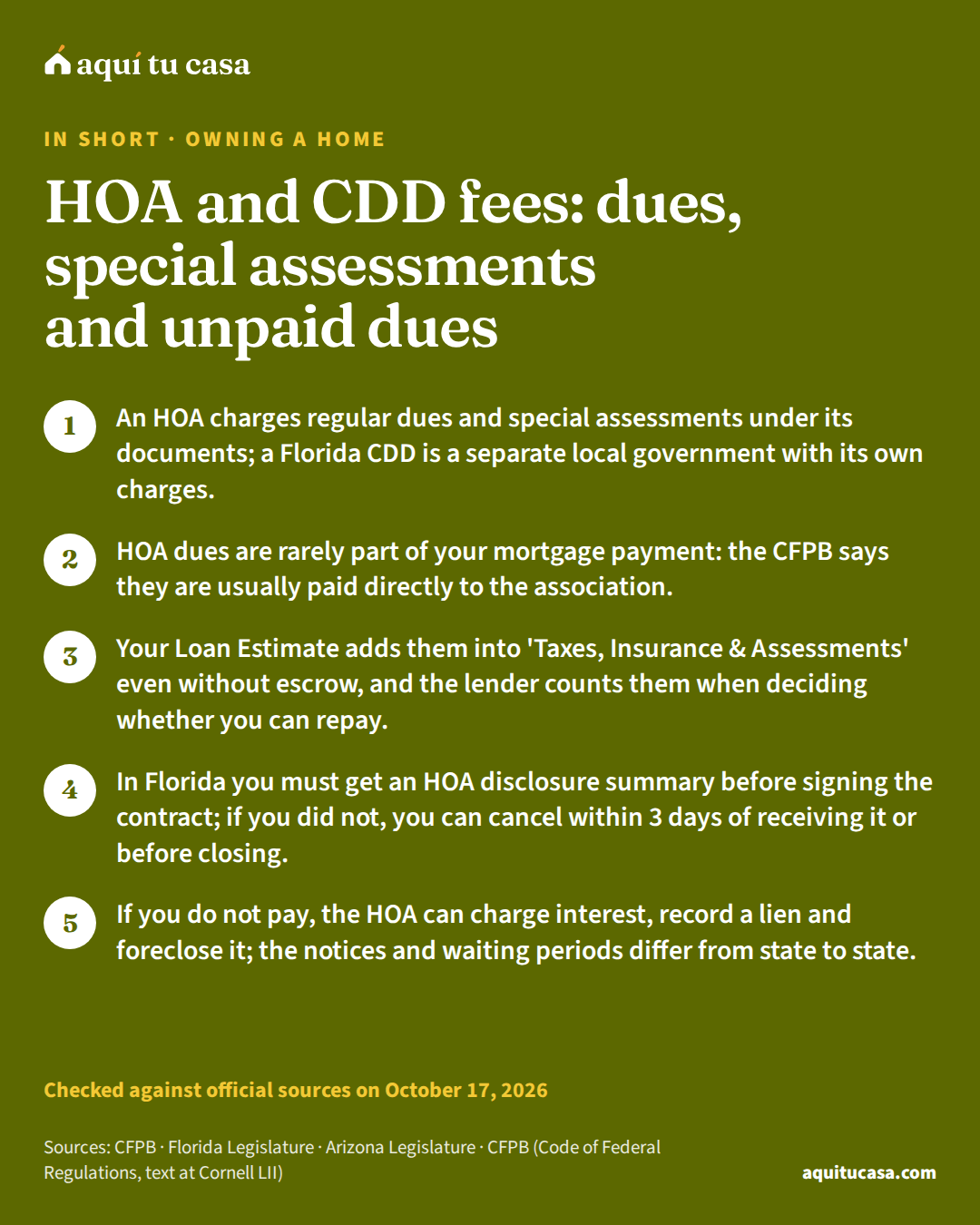
- An HOA charges regular dues and special assessments under its documents; a Florida CDD is a separate local government with its own charges.
- HOA dues are rarely part of your mortgage payment: the CFPB says they are usually paid directly to the association.
- Your Loan Estimate adds them into 'Taxes, Insurance & Assessments' even without escrow, and the lender counts them when deciding whether you can repay.
- In Florida you must get an HOA disclosure summary before signing the contract; if you did not, you can cancel within 3 days of receiving it or before closing.
Is this for you?
This guide is for you if…
- You are buying a house, townhouse or condo in a community with a homeowners association (HOA) and want to know what you will be charged.
- You are buying in Florida and the contract mentions a community development district (CDD).
- You already own, you got a special assessment or a collection notice from the HOA, and you want to understand what the law says.
Get direct help first if…
- The HOA or your lender has already filed a foreclosure lawsuit: look for free legal aid as soon as you can; this guide only explains the general rules.
- Your question is about the rules for a Florida condominium: condominiums have their own law (chapter 718) and we only mention it here.
- You want to challenge your home's assessed value: that is property tax, not the HOA.
If you are buying or already own a home in a community with a homeowners association (HOA)homeowners association (HOA)A homeowners association (HOA) is the organization formed in many subdivisions and condominium buildings to manage shared expenses such as landscaping, a pool, maintenance of common areas and, in condos, the roof and exteriors. Each owner pays dues, normally monthly, and must follow its rules, which can cover anything from the color of your door to renting the home out. If you do not pay, the association can add charges and, in several states, place a lien on your home. The dues count toward your monthly payment when lenders judge whether you can afford the mortgage.See the full definition, or in Florida inside a community development district (CDD), you will pay more than the mortgage. This guide explains what they charge, which documents set the rules, how those charges show up in your mortgage paperwork and what happens if you fall behind. We use the CFPB and the laws of Florida and Arizona as examples: the rules change from state to state.
- In Florida, to cancel the contract if you did not get the HOA disclosure summary first
- 3 days6
- In Florida, for the HOA to let you inspect its official records after a written request
- 10 business days5
- In Florida, of written notice before the HOA can record a lien for unpaid dues
- 45 days22
- In Arizona, the minimum delinquency before the HOA can foreclose its lien
- 18 months or $10,00021
What an HOA is and what a CDD is
A homeowners association runs a community’s common areas and charges owners dues to pay for them. According to the CFPB, condominiums, co-ops and some neighborhoods may require you to join the association and pay dues (HOA dues).1
Florida law defines an HOA as a corporation that operates a community where membership is mandatory for owners, and that may impose assessments that, if unpaid, can become a lienlienA lien is a legal right a creditor holds in your property to make sure you repay a debt. It usually prevents the property from being sold until the debt is paid, and if you do not pay, the creditor may be able to take the property. Your mortgage is a lien on your home: when you pay it off, the lien is released and that shows up in your county's property records. There are other kinds, such as a federal tax lien, which is the government's legal claim against all your property when you do not pay a tax debt.See the full definition on the home. Common area is the property the association owns or leases, or that is dedicated to its use or maintenance.3 An assessment is the money you owe under the community’s documents.3
A community development district (CDD) is something else. Florida law defines it as a local unit of special-purpose government,8 and the HOA law itself says a CDD is not a homeowners association.3 A CDD can levy taxes and assessments to pay for the construction, operation and maintenance of certain public facilities and services in the district. Its board sets them every year, and they come on top of county taxes.9
HOA and CDD, side by side
Private
Homeowners association (HOA)
You can have both at once: Florida's HOA disclosure summary warns that you may also owe special assessments to a special district.6
The documents that run your community
What the HOA can charge and the rules you must follow are written in its documents. In Florida, the governing documents are the declaration of covenants recorded with the county, with its amendments, plus the association’s articles of incorporation and bylaws.3 In Arizona, the community documents are the declaration, the bylaws, the articles of incorporation and any rules.4
The declaration is public. Florida’s disclosure summary says these documents are available from the record office of the county where the home is, or from the developer if they were not recorded. It also warns that the summary is only a summary, and that you should read the covenants and the association’s governing documents before you buy.6
The budget tells you where your dues go. In Florida, the association must prepare an annual budget of its operating expenses and give you a copy, or tell you that you can request one at no charge. The budget can include reserves: money set aside for major work and maintenance that has been put off. If the association is responsible for repairing those items and its reserves are not fully funded, its financial report must warn, in conspicuous type, that this may lead to special assessments.5
You can also see the records. In Florida, official records are kept for at least 7 years, and the association must let you inspect or copy them within 10 business days after the board receives your written request.5
What it costs and how you pay it
Regular dues follow the schedule your association sets; in Florida, the estoppel certificate shows the amount and how often it is paid.13 The CFPB says HOA dues can range from a few hundred dollars a month to more than one thousand, and that you should factor them in when deciding whether you can afford the mortgage. They are usually not part of the payment you make to your loan servicer: you pay the association directly.1
Dues can also go up. Florida’s disclosure summary says assessments may change from time to time, and that you will also have to pay any special assessments the association imposes.6 Some states set limits. In Arizona, unless the documents set a lower cap, the association may not raise the regular assessment by more than twenty percent over the prior year without approval from a majority of members.20

Example with real numbers
The payment on a typical home, plus HOA dues
An example with the typical US home value, an FHA loan with the minimum down payment and this week's rate.
- Principal and interest
- $2,213
- Property tax, at the typical effective rate
- $261
- Homeowners insurance, at the calculator's example rate
- $139
- FHA mortgage insurance
- $147
- HOA dues
- Separate: whatever your association sets
- Monthly payment to the servicer, without the HOA
- $2,759
This is an example with national numbers. According to the CFPB, HOA dues can run from a few hundred dollars to more than one thousand a month, and they are usually paid separately.1 Enter your community's real dues in the calculator to see your total.
Run it with your numbersMortgage calculatorThe lender counts them too. Under Regulation Z, dues and special assessments imposed by a condominium, co-op or homeowners association are mortgage-related obligations, and the lender must consider your monthly payment for them when deciding whether you can repay the loan. Those obligations go into the total monthly debts used for your debt-to-income ratiodebt-to-income ratio (DTI)Your debt-to-income ratio (DTI) is all your monthly debt payments divided by your gross monthly income, that is, income before taxes. If you pay a certain amount each month across a car, cards, student loans and the mortgage you are asking for, and you earn three times that, your DTI is one third. Lenders use it to measure whether you can manage the payment; each loan type and lender sets its own limit, and assistance programs usually publish theirs. Paying down debt before applying improves your DTI.See the full definition.15 Our debt-to-income guide walks through that math. The CFPB suggests asking the association for an estimate of its dues when you work out what you can afford.2
If your home is in a Florida CDD, there can be two charges. One is the benefit special assessment, which pays each year’s share of the bonds that financed the district’s facilities. The other is the maintenance special assessment, which keeps those facilities up. Both can be entered on the county tax roll, and then the tax collector collects them at the same time as county taxes, although the district may use another method.11 The law allows district special assessments to be spread over no more than 30 yearly installments.12 Our property tax guide explains how to read that bill, and our guide on why your escrow payment went up explains what happens to your payment when the tax bill rises.

Before you buy: what you must receive and what to check
Buying in a community with an HOA or a CDD has its own steps. These are Florida’s and Arizona’s; in other states, check your state law.
Buying in a community with an HOA or a CDD
1. Get the HOA disclosure summary
Before signing the contract (Florida)
It says you will be a member, pay dues that can change and special assessments, and that not paying can lead to a lien.6
2. Look for the CDD statement in the contract
On the first sale of a home in a CDD (Florida)
It sits right before your signature, in bold type larger than the rest of the contract.9
3. Receive the association's documents
Within 10 days after notice of the accepted offer (Arizona)
Bylaws, rules, declaration, budget, dues and approved special assessments, and the reserve study, if any.19
4. If you did not get the summary, decide
3 days after receiving it, or before closing (Florida)
You can cancel the contract with written notice; the right ends at closing.6
5. Check the taxes, insurance and assessments line
When your Loan Estimate arrives
On page 1, see what it includes and whether it is escrowed.14
Try it with your numbersMortgage calculator6. Ask for a statement of what is owed
The HOA issues it within 10 business days (Florida)
The estoppel certificate shows the dues, the date they are paid through and when the next one is due.13
7. Check the HOA charges on your Closing Disclosure
Before you sign
You may see a capital contribution, a processing fee and an adjustment for dues the seller already paid.18
In Florida, the HOA disclosure summary must be presented to the buyer before signing the purchase contractpurchase agreementA purchase agreement is the written contract between you and the seller that is final once the seller accepts your offer and both of you sign it. It gathers the details of the sale: the names of the buyers and sellers, the total price, the real estate agent's commission, the requested closing date and the contingencies. You use it to get your loan, and it is submitted with the closing paperwork. The settlement agent pays out the money according to the contract and the loan, and whether the seller pays some closing costs is also set by the contract.See the full definition. If you did not get it, you can void the contract with written notice within 3 days after receiving the summary, or before closing, whichever comes first. No one can make you waive that right, but it ends at closing.6
On the first sale of a home inside a CDD, the contract must include a statement that the district may levy taxes and assessments on the property, that its board sets them every year and that they come on top of county taxes.9 The district must also disclose how its improvements were financed and are maintained, and record that information with the county.10
In Arizona, the law lists what the buyer must receive: the bylaws and rules, the declaration, the amount and schedule of regular dues, special assessments approved but not yet assessed, any amount owed to the association on the home, the operating budget and the reserve study, if there is one. At closing, the buyer signs a statement acknowledging they must pay the assessments and that, if they do not, they could face collection up to foreclosure without the equity protection of the homestead act.19
Before closing, it also matters whether any dues are past due. In Florida, a new owner is jointly liable with the previous owner for dues that came due up to the sale, although they can recover what they pay from the previous owner.22 That is what the estoppel certificate is for: the association issues it within 10 business days after the owner, the lender or someone they designate asks, and it shows the date dues are paid through.13 In Arizona, the association must provide a statement of what is owed within 10 days of a written request.21
The HOA on your Loan Estimate and Closing Disclosure
Page 1 of the Loan EstimateLoan EstimateThe Loan Estimate is a three-page form you receive from the lender within days of applying for a mortgage. In the same format at every bank, it sums up the terms of the loan being offered: amount, interest rate, whether the payment can change, the estimated monthly payment with taxes and insurance, the itemized closing costs and how much cash you need at closing. Because every lender uses the same form, it lets you compare offers side by side. It commits you to nothing: requesting one is not accepting the loan.See the full definition has a line called “Taxes, Insurance & Assessments.” Under Regulation Z, it adds up your monthly mortgage-related obligations even if you have no escrow accountescrow accountAn escrow account is an account set up by your mortgage lender to pay certain property-related expenses on your behalf, mainly property taxes and homeowners insurance. The money comes from a portion of your monthly mortgage payment: each month you contribute a share and the loan servicer pays the bills when they come due. That is why your payment is higher than principal and interest alone, and why it can change when taxes or the insurance premium go up. In some states the word also names the period between the offer and the closing.See the full definition. It must say that the amount can increase, what it includes, whether it is paid from escrow and that you pay separately whatever is not escrowed.14 The CFPB warns that items outside escrow are paid directly, often in large lump sums, so make sure you can pay them and know how often they come due.16
The Closing DisclosureClosing DisclosureThe Closing Disclosure is a required five-page form with the final details of the mortgage you selected: the loan terms, your monthly payment, every closing cost and how much cash you must bring on signing day. The lender must give it to you at least three business days before closing, so you can compare it with your Loan Estimate and ask about any change. If an important number changes, the three-day period starts again. Keep it: you will need it for your taxes.See the full definition shows the same with final numbers. On the CFPB’s sample, the HOA shows up in four places:18
| Page | Where | What you see |
|---|---|---|
| 1 | Estimated Taxes, Insurance & Assessments | “Other: Homeowner’s Association Dues,” marked as not escrowed |
| 2 | H. Other | A capital contribution (“HOA Capital Contribution”) and a processing fee (“HOA Processing Fee”) |
| 3 | Adjustments for Items Paid by Seller in Advance | “HOA Dues”: the share of dues the seller already paid (a prorationprorationProration is the split, as of the closing date, of home expenses that cover a period of time, such as property taxes, homeowners association (HOA) dues or utilities the seller used. If the seller already prepaid part of a period when you will be the owner, you reimburse the seller at closing. If the seller owes taxes for their time that you will pay later, the seller gives you a credit at closing. The Closing Disclosure shows each prorated amount along with the dates it covers.See the full definition) |
| 4 | Escrow Account | HOA dues listed as non-escrowed property costs (“Non-Escrowed”) |
The CFPB’s explainer says it plainly: association fees are often not included in escrow, and page 4 shows which expenses the account covers and which it does not.17 Our closing costs and Closing Disclosure guides cover the rest of those pages.
If you do not pay: interest, liens and foreclosure
Falling behind with the HOA has serious consequences, but in these two states the law requires notices and waiting periods before the most serious steps. Here is how Florida and Arizona compare:
| Florida | Arizona | |
|---|---|---|
| Lien | If the documents authorize it, the HOA has a lien for dues, plus interest, late charges and collection fees | The HOA has a lien for each assessment from the date it is due |
| Interest and late fees | The documents’ rate; if none, 18% simple interest a year. Late fee up to the greater of $25 or 5% of the installment, if the documents allow it | Late after 15 days. Late fee up to the greater of $15 or 10% of the assessment |
| Before collection | Notice of late assessment before attorney fees; 45 days’ notice before recording a lien | 30 days’ notice before turning the account over to an attorney or collection agency |
| Foreclosure | Like a mortgage, 45 days after notice | Like a mortgage, only after 18 months or $10,000 or more past due, and after trying to offer a payment plan |
In Florida, the association can foreclose its lien the same way a mortgage is foreclosed, and it can also sue for the money without giving up the lien.22 If the documents set no rate, the debt accrues 18% simple interest a year, and what you pay goes first to interest and late fees, then to collection costs and attorney fees, and only then to the dues.22 Before charging attorney fees, the association must send a notice of late assessment; before recording a lien, a notice giving you 45 days to pay; and it cannot file to foreclose until 45 days after telling you it intends to.22 Not using the common areas or abandoning the home does not end your obligation.22
In Arizona, the association may foreclose only if you are eighteen months or $10,000 or more behind, whichever comes first, and it must first make reasonable efforts to reach you and offer a reasonable payment plan.21 Late fees are capped.20
A CDD works differently: its assessments are a lien with the same priority as state and county taxes. Unpaid, they become delinquent the same way county taxes do, and the same rules apply, including tax certificates and tax deeds.11
Mistake: Looking only at the mortgage payment.
Instead: Add the HOA dues: they are usually paid separately and can top one thousand dollars a month.1
Mistake: Signing the contract without reading the summary or the documents.
Instead: Ask for the declaration, bylaws, rules and budget; the summary only summarizes.6
Mistake: Buying without knowing whether dues are past due.
Instead: Get the estoppel certificate: in Florida you are jointly liable with the previous owner.2213
Mistake: Thinking the CDD is part of the HOA.
Instead: It is a separate local government, with its own board and its own charges.8
Mistake: Assuming the HOA is in your escrow.
Instead: Check page 4 of your Closing Disclosure: HOA dues are often left out.17
Mistake: Ignoring collection letters from the HOA.
Instead: Each notice starts a clock; answer it and ask about a payment plan.2221
If you are struggling to pay: free help

If you fall behind, do not let the letters pile up. In Florida and Arizona, the law requires written notices with deadlines before the most serious collection steps: that is your time to pay, ask for a payment plan or get help.2221
A HUD-approved housing counselorHUD-approved housing counselorA HUD-approved housing counselor works at an agency HUD has approved to provide housing counseling: independent, expert advice customized to your situation about buying a home, renting, a missed mortgage payment, a foreclosure or credit problems. The agencies usually charge little or nothing; many serve in Spanish and offer the homebuyer education course several assistance programs require. They are not lenders or real estate agents and sell you nothing. Your county page lists the official agencies with phone numbers.See the full definition gives independent advice on defaults, foreclosures and credit, often at little or no cost.23 If the HOA has already sent your account to an attorney or filed a foreclosure, free legal aidlegal aidLegal aid is the free civil legal help that nonprofit organizations and their lawyers provide to low-income people in civil, not criminal, matters. In housing, that includes representing families facing eviction or foreclosure, alongside matters such as custody, child support, protection from domestic violence and access to benefits. In the United States, the Legal Services Corporation, created by Congress, funds a nationwide network of these organizations; its finder points you to the one in your area. Each sets its own income limits.See the full definition is an option, never a requirement: the Legal Services Corporation funds civil legal aid offices for low-income people, and on its site you find the nearest one by entering your address or city.24 Our free legal aid guide explains who qualifies, and the can’t pay my mortgage guide covers the loan side.
If this is you
You are moving from Puerto Rico to Florida
On the first sale of a home inside a CDD, the contract must include the district's statement.9 The Puerto Rico to Florida guide covers the move.
You are buying for the first time
The CFPB suggests asking the association for an estimate of its dues when you work out what you can afford.2

What to do this week
- Find the “Taxes, Insurance & Assessments” line on your Loan Estimate or Closing Disclosure and check whether your HOA dues are escrowed.14
- Ask your HOA for its annual budget; in Florida it must be provided at no charge, and you can ask in writing to inspect its records.5
- If you are buying, ask for the HOA disclosure summary and the documents before you sign the contract.619
- If you are buying in Florida, look for the CDD statement in the contract and the district’s information recorded with the county.10
- Add your HOA dues to your family budget and the mortgage calculator. Our first year as a homeowner guide helps with the other bills.
- If you fell behind, talk to a HUD-approved housing counselor or free legal aid; they are an option, never a requirement.2324
Your numbers
Starts at the typical home value in the United States. Change it to the price you have in mind.
That is $11,645 (3.5% of the price). The usual minimum for this loan is 3.5%.
This week's average ± a quarter or half point.
National average as of November 5, 2026 (Freddie Mac); your rate may be different.
Adjust advanced details
Let's do the math
Estimated monthly payment
National figure$2,759
at 7.18% · 30 years
- Loan amount
- $326,673
- Total interest
- $470,006
- Paid off in
- November 2056
Includes $5,618 FHA upfront mortgage insurance premium.
Does it fit the income?
Comfortable
up to $1,884 a month
Tight
$1,884 to $2,422 a month
Hard
more than $2,422 a month
Your payment · 41%
Compared with the typical household income in the United States ($80,734 a year). Reference: HUD calls paying more than 30% of income for housing a cost burden.
| Principal & interest | $2,213 |
|---|---|
| Property tax | $261 |
| Home insurance | $139 |
| FHA mortgage insurance (MIP) | $147 |
How does it compare with incomes?
For this payment to be 28% of your income, you'd need to earn about $118,260 a year. With your other debts, to stay under 36%: about $91,980 a year.
You need at least $11,645 for the down payment, plus closing costs.
This is an estimate to give you an idea, not a loan offer. Your real payment depends on your rate, your credit, and the insurance and taxes on the home you buy.
Total monthly payment $2,759; principal and interest $2,213.
Ready to see the numbers? Find your county here
See how this applies in your county: its loan limits, prices and rents, from the official data.
Printable checklist
Frequently asked questions
Are HOA dues included in my mortgage payment?
Usually not. The CFPB says association dues are usually paid directly to the HOA, outside your payment to the servicer. Although it is not common, your servicer may agree to include them in escrow if you ask.
How much does an HOA cost?
It depends on the community. The CFPB says dues can range from a few hundred dollars a month to more than one thousand, and that you should factor them in when deciding whether you can afford the mortgage. The real figure is in the association's budget and in the documents you get before you buy.
What is a special assessment?
It is a charge on top of regular dues that the association can impose, for example for major work. In Florida, the disclosure summary warns buyers that they will also have to pay special assessments, and if the budget does not fully fund reserves, the financial report must warn that this may result in special assessments.
What is a CDD in Florida and how is it paid?
A community development district is a local unit of special-purpose government. It levies assessments to pay for the district's facilities and their upkeep, and it can have them entered on the county tax roll so the tax collector collects them along with property taxes. If the facilities were financed with bonds, the bond installment is collected every year.
Can I lose my home for not paying the HOA?
It can happen. In Florida and Arizona, the association can foreclose its lien like a mortgage, but the law requires notices and waiting periods first. In Arizona it may only foreclose once you are eighteen months or $10,000 or more behind, and the board must first try to offer you a reasonable payment plan. If you get collection notices, look for help early.
If I buy a home with unpaid dues, do I owe them?
In Florida, the law makes a new owner jointly liable with the previous owner for unpaid assessments that came due up to the sale, although the new owner can recover what they pay from the previous owner. That is why an estoppel certificate, showing the date dues are paid through, is requested before closing.
Does the lender count HOA dues when approving my loan?
Yes. Under Regulation Z, association dues and special assessments are mortgage-related obligations, and the lender must consider your monthly payment for them when deciding whether you can repay the loan.
How do I see my HOA's budget and records?
In Florida, the association must give you a copy of the annual budget or tell you that you can request one at no charge, and it must let you inspect its official records within 10 business days of a written request. The declaration of covenants is recorded with the county. In other states, check your state's law and your community's documents.
Sources
Every figure in this guide comes from one of these official sources. The number next to a sentence leads to the source behind it.
Each source on one line: who publishes it, its title, its address and the date we read it.
- 1. CFPB · Are condo/co-op fees or homeowners' association dues included in my monthly mortgage payment? · consumerfinance.gov · Accessed October 17, 2026
- 2. CFPB · How can I figure out if I can afford to buy a home and take out a mortgage? · consumerfinance.gov · Accessed October 17, 2026
- 3. Florida Legislature · Florida Statutes §720.301, Definitions (Homeowners' Associations) · leg.state.fl.us · Accessed October 17, 2026
- 4. Arizona Legislature · Arizona Revised Statutes §33-1802, Definitions (Planned Communities) · azleg.gov · Accessed October 17, 2026
- 5. Florida Legislature · Florida Statutes §720.303, Association powers and duties; meetings of board; official records; budgets; financial reporting · leg.state.fl.us · Accessed October 17, 2026
- 6. Florida Legislature · Florida Statutes §720.401, Prospective purchasers subject to association membership requirement; disclosure required · leg.state.fl.us · Accessed October 17, 2026
- 7. Florida Legislature · Florida Statutes §718.101, Short title (Condominium Act) · leg.state.fl.us · Accessed October 17, 2026
- 8. Florida Legislature · Florida Statutes §190.003, Definitions (Community Development Districts) · leg.state.fl.us · Accessed October 17, 2026
See the other 16 sources
- 9. Florida Legislature · Florida Statutes §190.048, Sale of real estate within a district; required disclosure to purchaser · leg.state.fl.us · Accessed October 17, 2026
- 10. Florida Legislature · Florida Statutes §190.009, Disclosure of public financing · leg.state.fl.us · Accessed October 17, 2026
- 11. Florida Legislature · Florida Statutes §190.021, Taxes; non-ad valorem assessments · leg.state.fl.us · Accessed October 17, 2026
- 12. Florida Legislature · Florida Statutes §190.022, Special assessments · leg.state.fl.us · Accessed October 17, 2026
- 13. Florida Legislature · Florida Statutes §720.30851, Estoppel certificates · leg.state.fl.us · Accessed October 17, 2026
- 14. CFPB (Code of Federal Regulations, text at Cornell LII) · Regulation Z, 12 CFR §1026.37, Content of disclosures for certain mortgage transactions (Loan Estimate) · law.cornell.edu · Accessed October 17, 2026
- 15. CFPB (Code of Federal Regulations, text at Cornell LII) · Regulation Z, 12 CFR §1026.43, Minimum standards for transactions secured by a dwelling · law.cornell.edu · Accessed October 17, 2026
- 16. CFPB · Loan Estimate Explainer · consumerfinance.gov · Accessed October 17, 2026
- 17. CFPB · Closing Disclosure Explainer · consumerfinance.gov · Accessed October 17, 2026
- 18. CFPB · Sample Closing Disclosure · files.consumerfinance.gov · Accessed October 17, 2026
- 19. Arizona Legislature · Arizona Revised Statutes §33-1806, Sale of properties; information required · azleg.gov · Accessed October 17, 2026
- 20. Arizona Legislature · Arizona Revised Statutes §33-1803, Assessment limitation; penalties · azleg.gov · Accessed October 17, 2026
- 21. Arizona Legislature · Arizona Revised Statutes §33-1807, Common expense liens; priority · azleg.gov · Accessed October 17, 2026
- 22. Florida Legislature · Florida Statutes §720.3085, Payment for assessments; lien claims · leg.state.fl.us · Accessed October 17, 2026
- 23. CFPB · Find a Housing Counselor · consumerfinance.gov · Accessed October 17, 2026
- 24. Legal Services Corporation · Get Legal Help · lsc.gov · Accessed October 17, 2026
Keep reading
Related guides
If this guide helped, these follow the same path.

Owning a home 13 minute read
Property tax explained: how it is calculated and paid
Who charges property tax, how it is calculated, how it is paid through escrow, which exemptions and appeals exist and what part is deductible.
- It is a local tax: assessed value of the home × the rates of the county, city and school district, minus exemptions. Your county sets the bill.
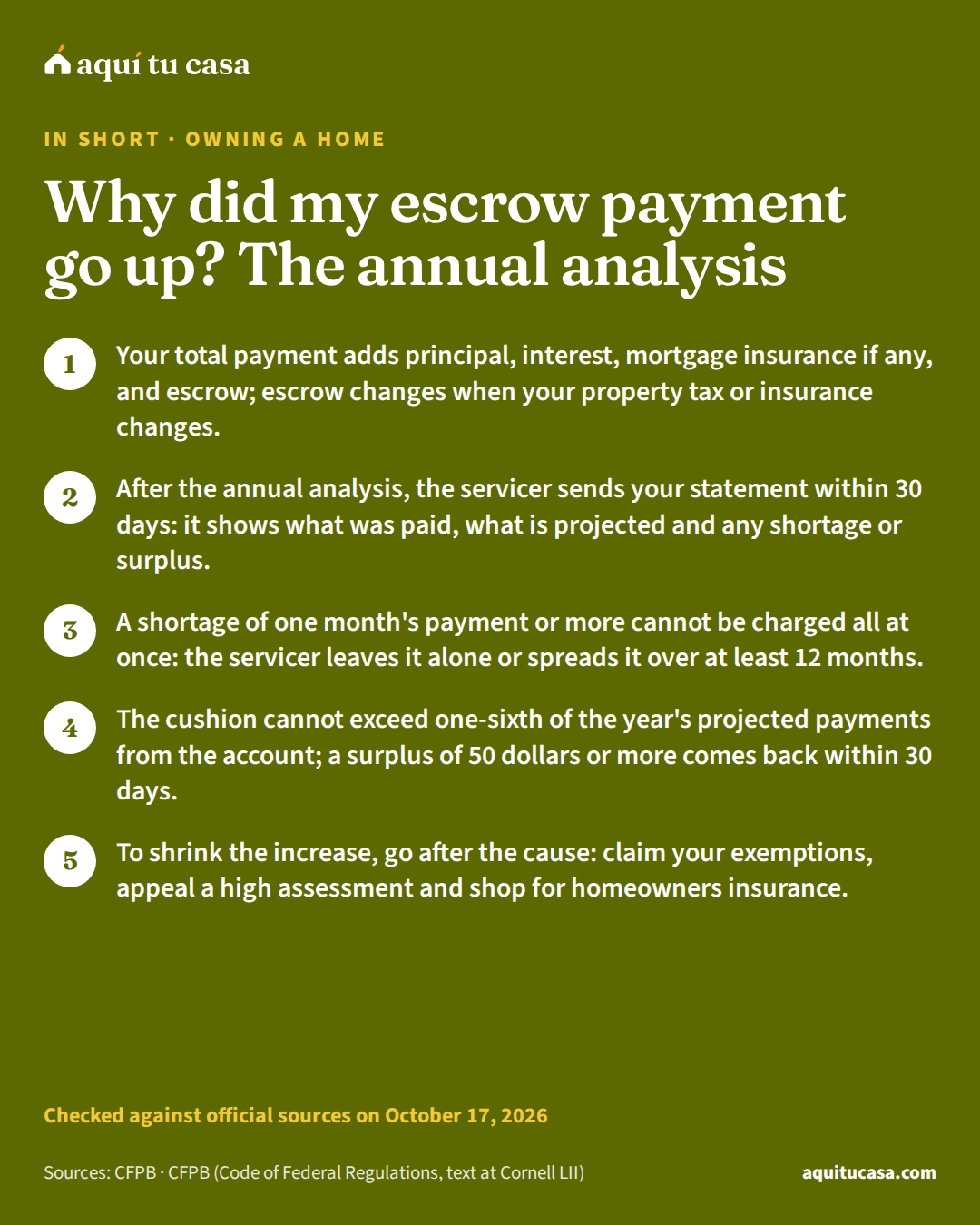
- With a mortgage you pay it through escrow: the servicer collects it in your monthly payment, pays it for you and reviews the account every year; a shortage is repaid over at least 12 months.
- Exemptions (such as the primary residence one) and the appeal of the assessed value have deadlines; they are on your state's page with their source.
- Owning a home Why did my escrow payment go up? The annual analysis Why your payment changes with escrow even at a fixed rate: the annual analysis, shortages, deficiencies, the cushion and how to dispute an error. 12 minute read
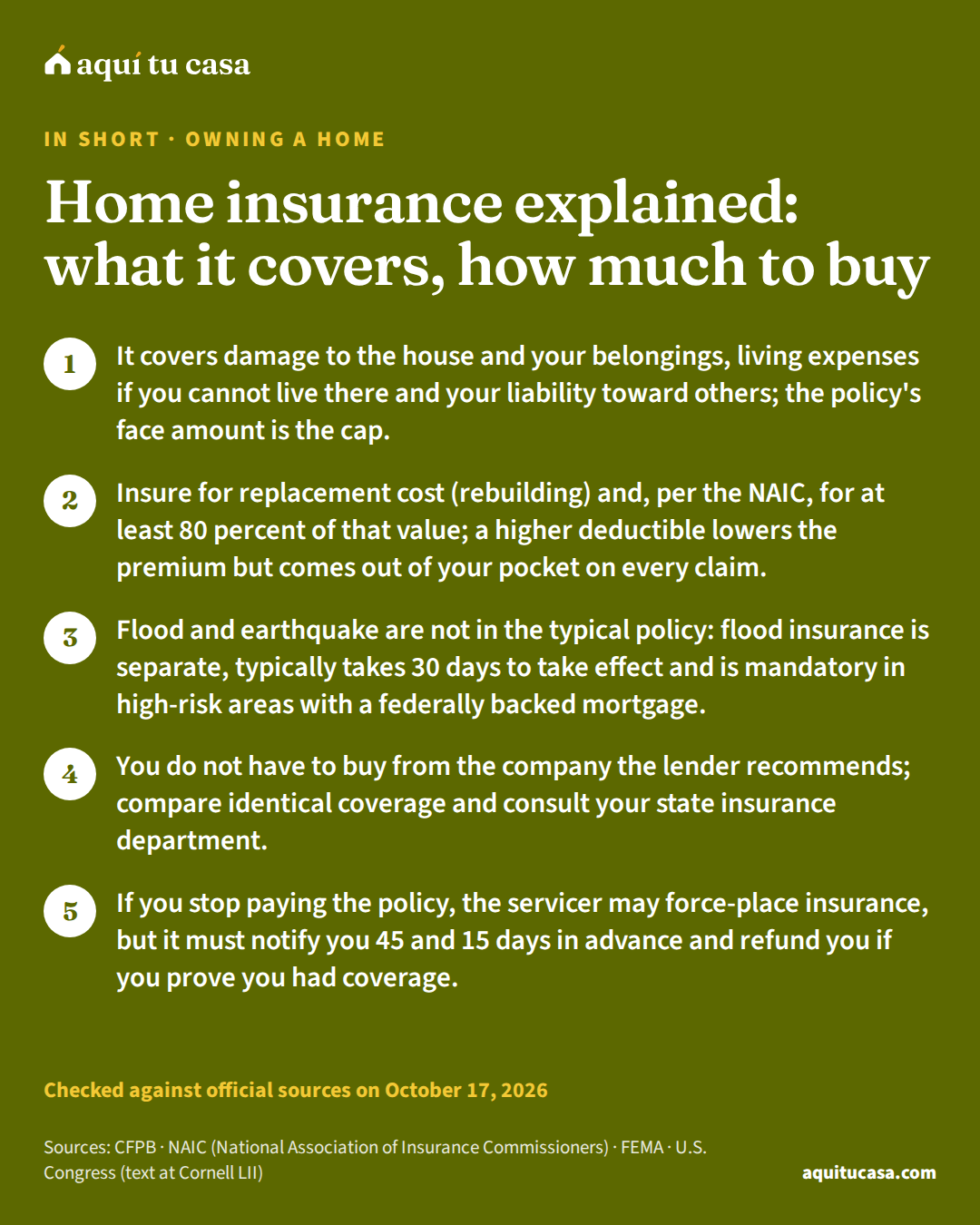
- Owning a home Home insurance explained: what it covers, how much to buy What home insurance covers, why the lender requires it, how to choose the amount and the deductible, why flood is separate and what happens if it lapses. 13 minute read
Tools for this topic
Was this guide useful?
Thank you. Your answer stays in your browser; nothing is sent.