Moving Essential guide
From Puerto Rico to Florida: what changes when you move
What changes when you move from Puerto Rico to Florida: credit, birth certificate, license, homestead, home and hurricane insurance, flood and taxes.
Verified against official sources on October 17, 2026 23 official sources

Show contents
In short
What you need to know
Quick answer
Moving from Puerto Rico to Florida does not change your citizenship or your credit, but it does change rules that touch housing. Before you leave, order a new birth certificate if yours was issued before July 1, 2010. In Florida you have 30 days for the license and 10 to register the car. Pull your three free credit reports and check that your island accounts appear. If you buy, apply for the homestead exemption before March 1. Home insurance comes with a percentage hurricane deductible and almost never covers flood, which is bought separately and, for most Citizens policies with wind, will be required by January 1, 2027. And the year of the move has its own tax rules: a VITA site can help for free if you qualify.
What matters most
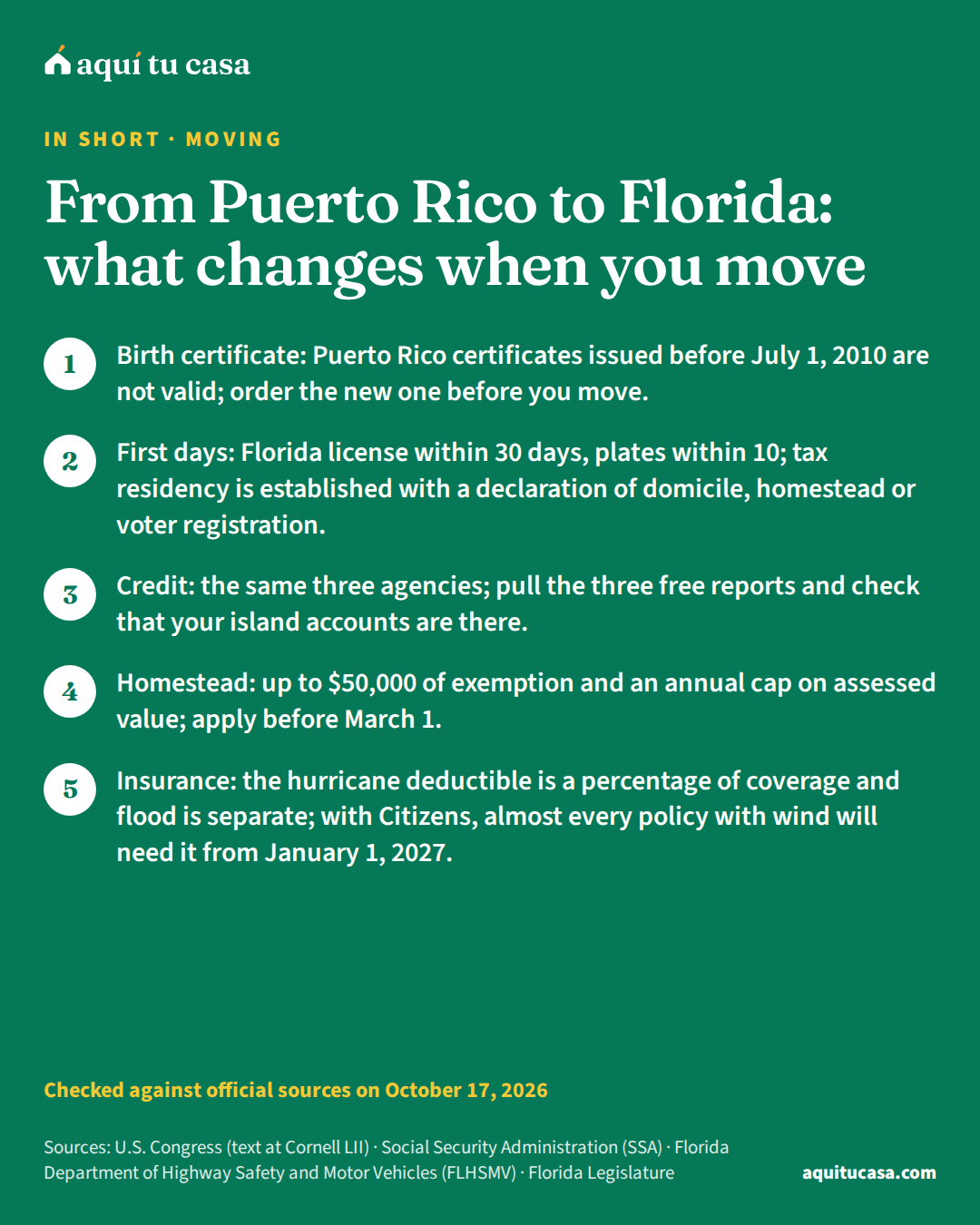
- Birth certificate: Puerto Rico certificates issued before July 1, 2010 are not valid; order the new one before you move.
- First days: Florida license within 30 days, plates within 10; tax residency is established with a declaration of domicile, homestead or voter registration.
- Credit: the same three agencies; pull the three free reports and check that your island accounts are there.
- Homestead: up to $50,000 of exemption and an annual cap on assessed value; apply before March 1.
Is this for you?
This guide is for you if…
- You are moving (or just moved) from Puerto Rico to Florida and want to know which housing-related filings, deadlines and costs change.
- You are about to rent or buy in Florida and hear about homestead, hurricane deductibles and flood insurance without knowing what they mean.
- You want your credit history and your documents from the island to work for you from day one.
Get direct help first if…
- You are moving to another state: the logic is similar, but license, homestead and insurance rules belong to each state; find your state's page under Places.
- You want someone to review your return for the year of the move: we summarize what the IRS says, and a VITA site can help for free if you qualify.
If you were born in Puerto Rico, you are a U.S. citizen by birth,1 and moving to Florida is moving within the country: it does not change your citizenship, your Social Security number or your credit history. What changes are rules that touch housing directly: which documents are accepted, how long you have for the license and plates, how the homestead exemption works, what home insurance brings in a hurricane state, when you have to carry flood coverage and what happens with taxes in the year of the move. This guide gathers them with their sources; prices and rents for each Florida county are under Places.
- To get a Florida driver license after establishing residency
- 30 days3
- To title and register your car in Florida, with Florida insurance
- 10 days3
- Deadline to apply for the homestead exemption with the county property appraiser
- March 19
- Maximum homestead exemption on the assessed value of your main home
- $50,0006
Before you leave: the birth certificate and the papers
The filing most families discover late: certified copies of birth certificates issued in Puerto Rico before July 1, 2010, became invalid under Puerto Rico law, and since October 31, 2010, Social Security only accepts island certificates issued on or after July 1, 2010; the new one is requested from Puerto Rico’s Demographic Registry.2 You will need it for the license, for the children’s school and for almost any filing with a photo. Order it before you move, one for each family member, and keep your Puerto Rico tax returns for the last two years: the year of the move will need them.
Your move, step by step
Florida’s deadlines are short and start counting when you establish residency. This is the order the official sources follow, from packing your bags to your first tax return as a Florida resident.
From Puerto Rico to Florida, in order
1. Order the new birth certificates
Before you move
Certificates issued before July 1, 2010 are no longer valid; the new one comes from the Demographic Registry.2
4. Register to vote in Florida
At least 29 days before an election
If you are a citizen, you register online at RegisterToVoteFlorida.gov or at a tax collector's office that issues licenses.5
5. If you bought, apply for homestead
By March 1
You file with the county property appraiser; after that, they mail you a renewal every year.9
If you hire a moving company, the housing scams guide explains what to check before you hire and how much they can charge you at delivery.
The first weeks: license, plates and residency
Florida sets short deadlines. Florida’s motor vehicle department tells new residents to obtain the Florida driver license within 30 days of establishing residency, and to title and register vehicles within 10 days, with insurance bought from an agent licensed in Florida; the official page has a Spanish version and the list of documents depends on your status.3 The law sets that 30-day deadline for anyone who accepts a job or enrolls children in a public school, and extends it to the spouse and dependent children.4
When do you become a resident for the motor vehicle office? Its page mentions, for example, starting work in Florida, enrolling your children in a public school, registering to vote, filing for homestead or living in the state for more than six consecutive months. You apply for the license in person: you will take a vision test, and you may be able to get it without a written or road test. The same page lists the fee for an initial Class E license ($48.00) and the $6.25 service fee most tax collector offices charge.3
For the car, if it has no lien, the page asks for proof of identity for all owners, proof of Florida insurance, the original title and form HSMV 82040 signed by all of them. The VIN is inspected in person; among others, a law enforcement officer, a licensed Florida dealer or a county tax collector employee can verify it. If you still owe on the car and the lender holds the title, ask them to transfer it to Florida: you have to register it either way.3
“Residency” for tax purposes is something else, and it pays to understand it from the start: according to the Florida Department of Revenue, you are a resident when your true, fixed and permanent home is in Florida; filing a declaration of domicile, qualifying for homestead or registering to vote can establish residency, while getting the license only indicates intent.6 If you bring a car, the 6% use tax applies to vehicles brought into the state within six months of purchase, with credit for a similar tax paid to another state or territory; vehicles used six months or longer elsewhere are presumed not purchased for Florida, and that use has to be documented.6
To vote in Florida you must be a U.S. citizen, a Florida resident and at least 18 years old. You register online or at a tax collector’s office that issues licenses, no later than 29 days before the election. If you get a new Florida license number after registering, let your Supervisor of Elections know.5

Puerto Rico and Florida: what changes
Some things you took for granted on the island work differently in Florida. This comparison gathers the ones that touch your home and your money the most.
Puerto Rico and Florida, side by side
The island
In Puerto Rico
Your new state
In Florida
- There is no state personal income tax, but there is a 6% sales tax plus the county surtax.6
- A notary who is not an attorney cannot give legal advice, and must say so when advertising in Spanish.22
- You have 30 days for the license and 10 to register the car.3
- If you own and live in your home, you can apply for homestead by March 1.9
What changes most is the calendar: write down the license, car and homestead dates from day one.3
The notary part matters more than it seems. If you look for help with paperwork in Florida, the “notario” in the ad is not the attorney you knew on the island. The guide Notario is not a lawyer explains who can actually give you legal advice.
What housing costs in Florida
Before deciding where to live, compare. The two charts show the typical home value and the typical rent in Florida next to other states. The data come from the Census Bureau’s American Community Survey, and each chart names its source.


Within Florida, prices change a lot from county to county. Buying a home in Florida and renting in Florida have the numbers for each county. With those numbers, the how much rent can I afford and how much house can I afford calculators help you see what fits your budget.
Your credit travels with you: check it
Your credit history does not stay on the island, but it pays to check. Request your free credit reportcredit reportA credit report is a statement that has information about your credit activity and current credit situation: your loans and cards, the balances, whether you have paid on time, accounts in collection and who has checked your credit. Credit reporting companies, also called credit bureaus, compile it from what banks and creditors report; your credit score is computed from it. When you apply for a mortgage, the lender pulls your report from the three bureaus. You have the right to see it for free and to dispute anything that is wrong.See the full definition from each of the three agencies (Equifax, Experian and TransUnion), which you can do once a week at AnnualCreditReport.com or by calling (877) 322-8228,7 and check that your Puerto Rico accounts appear and that your new address is on file. If a landlord or a lender says they “see no history”, those reports are your proof; if something is missing or wrong, the credit from zero guide explains how to keep building, and how to dispute credit report errors how to fix them.
Homestead: the exemption you have to claim
If you buy a home in Florida, the homestead exemptionhomestead exemptionA homestead exemption is a legal protection for the home where you and your family live. It can keep certain creditors from collecting your debts out of your main home, and it can also lower the property tax on that home. In Texas, for example, the residence homestead exemption removes part of your home's value from the tax calculation; to get it you must own the home, live there as your principal residence and apply. State laws vary widely: some cap the amount protected and others depend on the size of the property or the owner's age.See the full definition is the difference between a reasonable property tax bill and one that surprises you. By law, a person who on January 1 holds title to real property in Florida and in good faith makes it their permanent residence is entitled to an exemption of up to $25,000 of assessed value, and to an additional one of up to $25,000 on the value above $50,000, except for school levies;8 the Department of Revenue sums it up as an exemption of up to $50,000 that also limits how much the assessment can rise each year.6 It does not apply on its own: the application is filed with the county property appraiser by March 1, and the appraiser then mails you a renewal every year.9 The annual cap is the lower of 3 percent or inflation, and the home is reassessed at just value on the January 1 after a change of ownership: that is why the seller’s bill does not tell you what you will pay.10
The property tax guide explains how it is calculated and paid through escrow; your county’s figures are under property tax in Florida.
Home insurance in Florida: hurricanes and deductibles
Home insurance in Florida has two words that did not exist in your island policy in the same way: hurricane deductibledeductibleA deductible is the part of an insurance claim you pay yourself. When you have a covered loss, the insurance company subtracts the deductible from the claim amount and pays you the rest. You may have a different deductible for each type of coverage. You will find it on the first page of your policy, called the declarations page, along with your coverages and limits. In taxes, the word "deductible" means something else: an expense that can lower the taxes you owe.See the full definition and mitigation. By law, the insurer must offer you hurricane deductibles equal to $500, 2, 5 or 10 percent of the dwelling coverage limit, and that deductible applies on an annual basis: if a hurricane loss already happened in the year, a second hurricane is subject only to the remaining deductible.11 A “hurricane”, for the policy, is a storm system declared a hurricane by the National Hurricane Center, from the moment a hurricane warning is issued for any part of Florida until 72 hours after the last watch or warning ends.12
The good news is mitigation: rates must include actuarially reasonable discounts or deductible reductions for homes with features that reduce wind losses, such as roof strength, roof covering, roof-to-wall attachment and opening protection.13 Ask about the wind mitigation inspection before you buy. And remember what the NAIC notes: you are not required to buy the insurance your lender recommends, and the state insurance department is an unbiased source for comparing prices.14 The basics of any policy are in Home insurance explained.

Flood: almost always separate, and sometimes required
The typical homeowners policyhomeowners insuranceHomeowners insurance pays for losses and damage to your property if something unexpected happens, like a fire or a burglary, and usually includes liability coverage if someone is hurt at your home. Lenders require it as long as you have a mortgage, because the home is their collateral, and almost always collect it inside your monthly payment through the escrow account. The price depends on the location, the rebuilding cost, the deductible and your history. A standard policy does not cover floods or, in many states, earthquakes: those risks are insured separately.See the full definition does not cover flood, and in Florida that matters at almost any address. FEMA’s National Flood Insurance Program provides that insurance; most homeowners insurance does not cover flood damage, homes in high-risk areas with a government-backed mortgage must have it and the policy typically takes 30 days to go into effect.15 The official map for your address is at FEMA’s Flood Map Service Center.16 The federal requirement is clear: a regulated lender cannot give you a loan on a home in a special flood hazard area unless it has flood insuranceflood insuranceFlood insurance is a separate policy that can cover a building, its contents, or both, when flood water causes damage. Most homeowners insurance policies do not cover that damage. Most of these policies are backed by FEMA's National Flood Insurance Program (NFIP) and bought through insurers and agents. If your home is in a high-risk flood area and your mortgage is backed by the federal government, the lender is required to demand it; outside those areas it is optional, but floods happen there too.See the full definition for the loan balance or the maximum available.17
Florida added a rule of its own. Citizens, the insurer created by the state, explains that the law requires most of its residential policies with wind coverage to have flood insurance by January 1, 2027. It comes in stages: homes in a special flood hazard area must have it; outside that area, homes with dwelling coverage of $600,000 or more since 2024, $500,000 since 2025, $400,000 since 2026 and all of them from January 1, 2027, regardless of value. Condo unit-owner policies, renters’ contents policies and policies without wind coverage are not required to carry it.18 If your wind policy ends up with Citizens, count flood as part of the cost from the start.
Taxes: what changes when you stop being an island resident
While you were a bona fide resident of Puerto Rico, you paid tax to Puerto Rico and could exclude island-source income from the federal return; if all your income was from Puerto Rico, you did not have to file a federal return (U.S. Government wages are the exception). The year of the move has its own rule: a person who was a bona fide resident for at least 2 years before moving can exclude Puerto Rico source income earned before the date they changed residence, and Form 8898 is filed when you stop being a bona fide resident of a territory and your worldwide gross income for the year is more than $75,000.19
Publication 570 spells out who counts as a bona fide resident for the part of the year before the move: citizens who were residents for at least the 2 prior tax years, who stop having their tax home on the island that year and who, until the move, kept a closer connection to Puerto Rico. If you have to file Form 8898 and do not, you may owe a $1,000 penalty unless there is reasonable cause.19 After the move you file with the IRS like any Florida resident, and Florida imposes no personal income tax, though it does charge a 6% sales tax plus the county surtax and documentary stamp tax on deeds and mortgages when you buy.6
You do not have to do it alone: the VITAVITA (free tax preparation)VITA (Volunteer Income Tax Assistance) and TCE (Tax Counseling for the Elderly) are IRS programs that offer free basic tax return preparation by IRS-certified volunteers. They are meant for people with moderate income, people with disabilities and limited-English speakers; TCE focuses on people sixty and older. The IRS sets no program-wide income limit, but individual sites may set their own. Many sites serve in Spanish and help with ITIN applications and renewals. Filing taxes every year builds the record lenders ask for.See the full definition and TCE programs prepare basic tax returnstax returnA tax return is the yearly form you use to report your income to the IRS and figure the tax you owe, so you can pay what is due or get a refund. The federal return for individuals is Form 1040. In general you must file if your gross income is above the minimum the IRS sets for your filing status, or if you had a certain amount of net earnings from self-employment; even when you do not have to, filing can pay off. You need your SSN or ITIN, and those of everyone else on the return, plus documents such as your W-2s and 1099s.See the full definition for free for people who generally make about $70,244 or less, persons with disabilities and limited English speakers; find a site with the IRS locator or by calling 800-906-9887.20 Bring your island returns and ask whether the site has volunteers who know the Puerto Rico rules.
If this is you
The move is not the same for everyone. These are the most common situations and what the official sources say for each.
What matters most for your situation
You are moving with your family
Order a new certificate for each person,2 and remember the 30-day license deadline also covers your spouse and dependent children who drive.4
You will rent when you arrive
Bring your three credit reports to show the landlord.7 If your renters policy is with Citizens, that contents policy is not required to carry flood.18

Costly mistakes
The mistake and what you do instead
Mistake: Arriving in Florida with the old birth certificate.
Instead: Before you leave, order the certificate issued on or after July 1, 2010.2
Mistake: Leaving the car registration until after you get the license.
Instead: The car comes first: you have 10 days to insure it in Florida, title it and register it.3
Mistake: Buying a home and not applying for homestead.
Instead: It does not apply on its own: file with the county property appraiser by March 1.9
Mistake: Comparing insurance by the monthly premium alone.
Instead: Also look at the hurricane deductible, which is a percentage of coverage.11
Mistake: Assuming home insurance covers flood.
Instead: Most does not; look your address up on FEMA's map and quote flood separately.15
What to do this week
- Order the new birth certificates (issued on or after July 1, 2010) for the whole family before you move.2
- On arrival, book the license within 30 days and the car registration within 10, with Florida insurance.3
- Download the three free credit reports and check that your Puerto Rico accounts appear.7
- If you buy, mark March 1 for homestead and ask the county what the home would pay with the reset value.9
- Get insurance quotes with the hurricane deductible in dollars and the mitigation inspection, and look your address up on FEMA’s map.11
- For the year of the move, find a VITA site and bring your island returns.20 If you are going to buy or rent and want to sort it all out with someone, a HUD-approved housing counselorHUD-approved housing counselorA HUD-approved housing counselor works at an agency HUD has approved to provide housing counseling: independent, expert advice customized to your situation about buying a home, renting, a missed mortgage payment, a foreclosure or credit problems. The agencies usually charge little or nothing; many serve in Spanish and offer the homebuyer education course several assistance programs require. They are not lenders or real estate agents and sell you nothing. Your county page lists the official agencies with phone numbers.See the full definition will do it with you, often for free.23
Your home and your county
We use the typical rate and value of the place you pick.
Typical home value in the United States (Census, ACS 2024). Enter your assessed value.
Let's do the math
Estimated tax per year
$3,127
About $261 a month, at a rate of 0.94% on $332,700.
Per month
$261
If you pay through escrow, your lender adds about this much to your payment.
The math
- Your home's value
- $332,700
- Taxable value
- $332,700
- Rate
- × 0.94%
- Tax per year
- $3,127
The rate changes within the county
Each home pays the districts it sits in (city, schools, services), and each sets its own rate. This rate is a county average, not your home's.
Your county's tax or assessor's office publishes your assessment, each district's rate and how to apply for an exemption or appeal.
This is an educational estimate from county averages, not your tax bill. Your bill depends on your home's districts, your assessment and your exemptions.
Ready to see the numbers? Find your county here
See how this applies in your county: its loan limits, prices and rents, from the official data.
Printable checklist
Frequently asked questions
Does my Puerto Rico credit history work in Florida?
Your credit report does not stay on the island: pull the three free ones at AnnualCreditReport.com as soon as you arrive and check that your Puerto Rico accounts appear with your new address. If a lender says they see no history, show them the reports. If there are errors, dispute them in writing; the credit guide explains how.
Can I claim homestead the same year I buy?
The exemption goes to the person who owns and lives in the home as a permanent residence on January 1, and the application is due by March 1. If you buy after January 1, your first full year with the exemption is usually the next one; in the meantime you pay the tax the seller had, which can rise when the value resets.
Do I need flood insurance if I am not in a flood zone?
Federal law requires it in special flood hazard areas with a government-backed mortgage. Outside them it is not required by federal law, but if your wind policy is with Citizens, Florida is phasing it in: from January 1, 2027, for almost every policy with wind, regardless of value. FEMA reminds you that most homeowners insurance does not cover flood. Check your address on FEMA's map before deciding.
What happens with my taxes in the year of the move?
If you were a bona fide resident of Puerto Rico for at least the 2 years before you moved, the Puerto Rico source income you earned before changing residence can be excluded from the federal return. After the move you file with the IRS like any Florida resident, and Florida has no state income tax. If your worldwide gross income for the year is more than $75,000, you may have to file Form 8898. A VITA site helps for free if you qualify.
When do I have to swap my Puerto Rico license for a Florida one?
Florida tells new residents to get a Florida license within 30 days of establishing residency. You apply in person at a local office; you will take a vision test, and you may not need a written or road test. The official page lists the fee: $48.00 for an initial Class E license, plus a $6.25 service fee at most tax collector offices.
How do I register to vote in Florida?
You must be a U.S. citizen, a Florida resident and at least 18 years old. You can register online at RegisterToVoteFlorida.gov or at a tax collector's office that issues licenses. The deadline is 29 days before each election. Registering to vote in Florida is also one of the actions that can establish your residency.
Do I need a new birth certificate?
If your Puerto Rico certificate was issued before July 1, 2010, yes: those copies lost their validity under Puerto Rico law, and Social Security only accepts ones issued on or after that date. The new one is requested from Puerto Rico's Demographic Registry. Order one for each family member before you move.
Sources
Every figure in this guide comes from one of these official sources. The number next to a sentence leads to the source behind it.
Each source on one line: who publishes it, its title, its address and the date we read it.
- 1. U.S. Congress (text at Cornell LII) · 8 U.S.C. §1402, Persons born in Puerto Rico on or after April 11, 1899 · law.cornell.edu · Accessed October 17, 2026
- 2. Social Security Administration (SSA) · POMS GN 00301.065, Acceptance of Puerto Rico Birth Certificates · secure.ssa.gov · Accessed October 17, 2026
- 3. Florida Department of Highway Safety and Motor Vehicles (FLHSMV) · New Resident - Welcome to Florida! · flhsmv.gov · Accessed October 17, 2026
- 4. Florida Legislature · Florida Statutes §322.031, Nonresident; when license required · leg.state.fl.us · Accessed October 17, 2026
- 5. Florida Department of State, Division of Elections · Register to Vote or Update your Information · dos.fl.gov · Accessed October 17, 2026
- 6. Florida Department of Revenue · Tax Information for New Residents (GT-800025, R. 08/25) · floridarevenue.com · Accessed October 17, 2026
- 7. CFPB · How do I get a free copy of my credit reports? · consumerfinance.gov · Accessed October 17, 2026
- 8. Florida Legislature · Florida Statutes §196.031, Exemption of homesteads · leg.state.fl.us · Accessed October 17, 2026
See the other 15 sources
- 9. Florida Legislature · Florida Statutes §196.011, Annual application required for exemption · leg.state.fl.us · Accessed October 17, 2026
- 10. Florida Legislature · Florida Statutes §193.155, Homestead assessments · leg.state.fl.us · Accessed October 17, 2026
- 11. Florida Legislature · Florida Statutes §627.701, Liability of insureds; coinsurance; deductibles · leg.state.fl.us · Accessed October 17, 2026
- 12. Florida Legislature · Florida Statutes §627.4025, Residential coverage and hurricane coverage defined · leg.state.fl.us · Accessed October 17, 2026
- 13. Florida Legislature · Florida Statutes §627.0629, Residential property insurance; rate filings · leg.state.fl.us · Accessed October 17, 2026
- 14. NAIC (National Association of Insurance Commissioners) · Homeowners Insurance (consumer guide) · content.naic.org · Accessed October 17, 2026
- 15. FEMA · Flood Insurance (National Flood Insurance Program) · fema.gov · Accessed October 17, 2026
- 16. FEMA · FEMA Flood Map Service Center · msc.fema.gov · Accessed October 17, 2026
- 17. U.S. Congress (text at Cornell LII) · Flood Disaster Protection Act, 42 U.S.C. §4012a, Flood insurance purchase and compliance requirements · law.cornell.edu · Accessed October 17, 2026
- 18. Citizens Property Insurance Corporation (Florida) · Flood (flood insurance requirement) · citizensfla.com · Accessed October 17, 2026
- 19. IRS · Publication 570 (2025), Tax Guide for Individuals With Income From U.S. Territories · irs.gov · Accessed October 17, 2026
- 20. IRS · Free tax return preparation for qualifying taxpayers (VITA and TCE) · irs.gov · Accessed October 17, 2026
- 21. Government of Puerto Rico, Office of Management and Budget (Virtual Library) · Ley Notarial de Puerto Rico (Ley Núm. 75 de 2 de julio de 1987, según enmendada) · bvirtualogp.pr.gov · Accessed October 17, 2026
- 22. Florida Legislature · Florida Statutes §117.05, Use of notary commission; unlawful use; notary fee; seal; duties; advertising · leg.state.fl.us · Accessed October 17, 2026
- 23. CFPB · Find a Housing Counselor · consumerfinance.gov · Accessed October 17, 2026
Keep reading
Related guides
If this guide helped, these follow the same path.

Owning a home 13 minute read
Property tax explained: how it is calculated and paid
Who charges property tax, how it is calculated, how it is paid through escrow, which exemptions and appeals exist and what part is deductible.
- It is a local tax: assessed value of the home × the rates of the county, city and school district, minus exemptions. Your county sets the bill.
- With a mortgage you pay it through escrow: the servicer collects it in your monthly payment, pays it for you and reviews the account every year; a shortage is repaid over at least 12 months.
- Exemptions (such as the primary residence one) and the appeal of the assessed value have deadlines; they are on your state's page with their source.
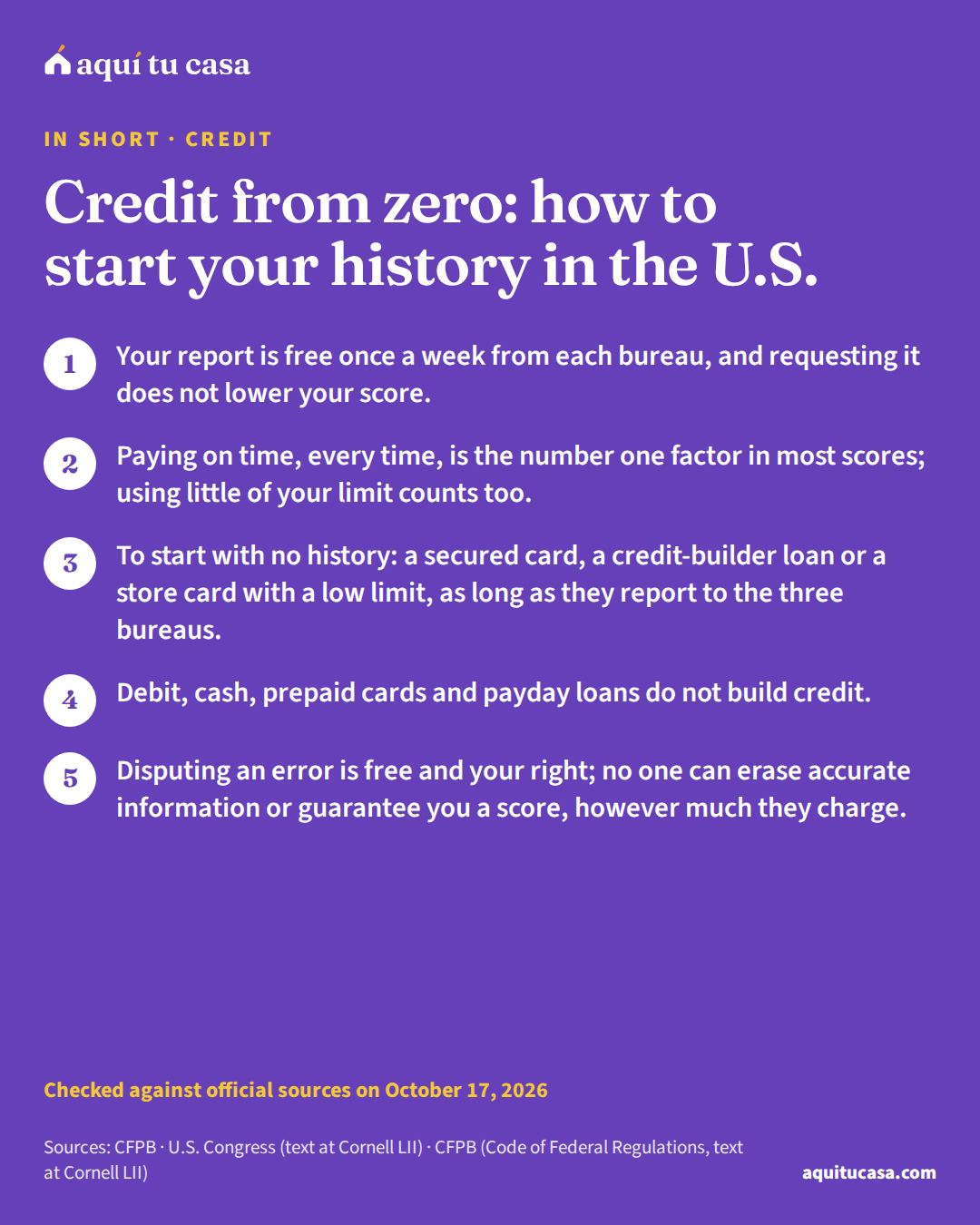
- Credit Credit from zero: how to start your history in the U.S. What credit reports and scores are, how to get them for free, and how to start a history from nothing with a secured card or a credit-builder loan. 16 minute read
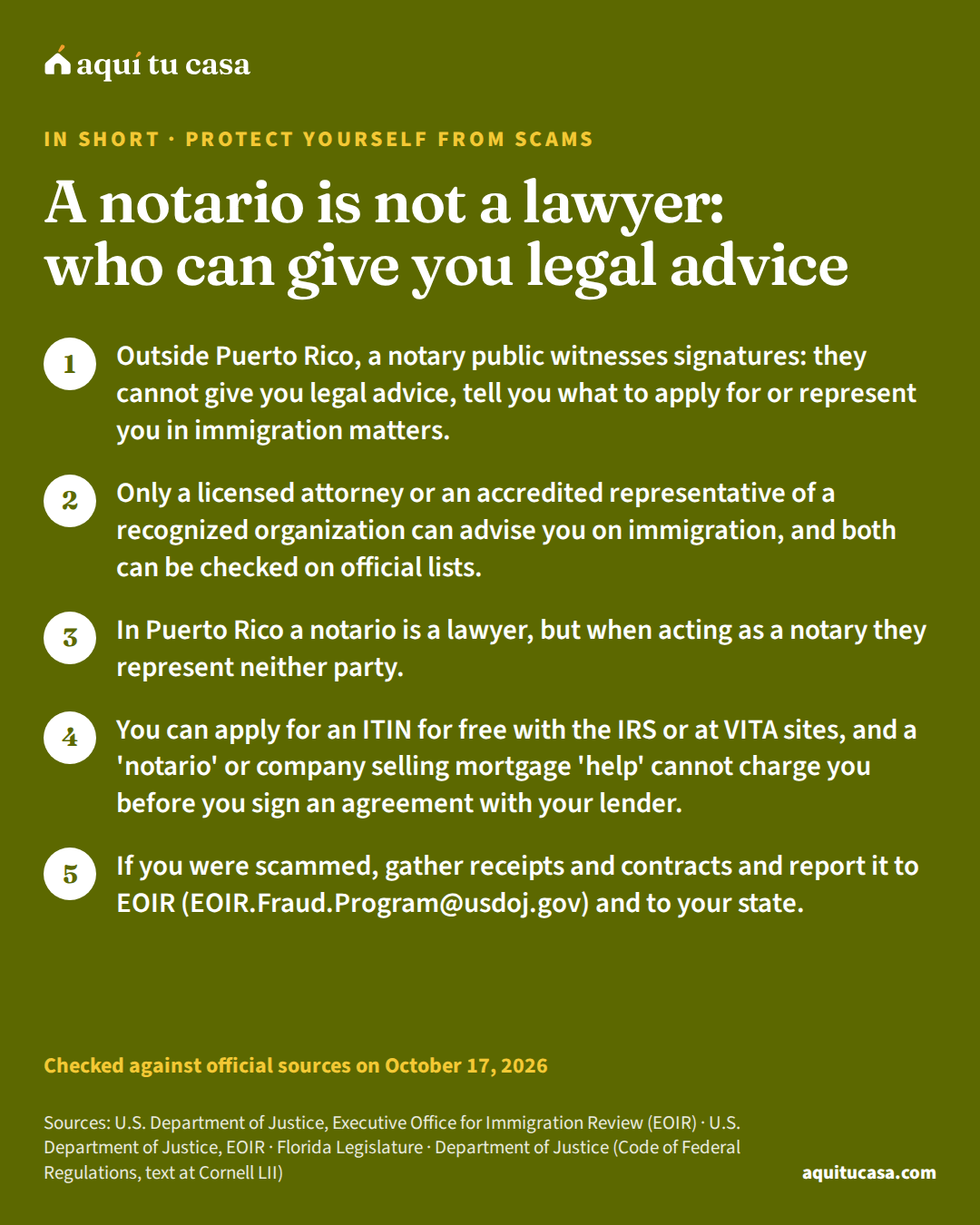
- Protect yourself from scams A notario is not a lawyer: who can give you legal advice Outside Puerto Rico, a notary public is not a lawyer. What a notary can do, who can advise you for free or at low cost, warning signs and how to report it. 12 minute read
Tools for this topic
Was this guide useful?
Thank you. Your answer stays in your browser; nothing is sent.