
Family budget
How much is left for housing each month.
What you get → what is left
Someone shared this page with you.
Questions and answers
Every question our 7 guides about moving answer, grouped by guide. Each answer is the guide's own and leads to it, with its sources.
Open a question to read its answer. Each group ends with the full guide, its sources and, when it has one, its calculator.
We found no questions with those words. Try another word or open a topic.
From the guide
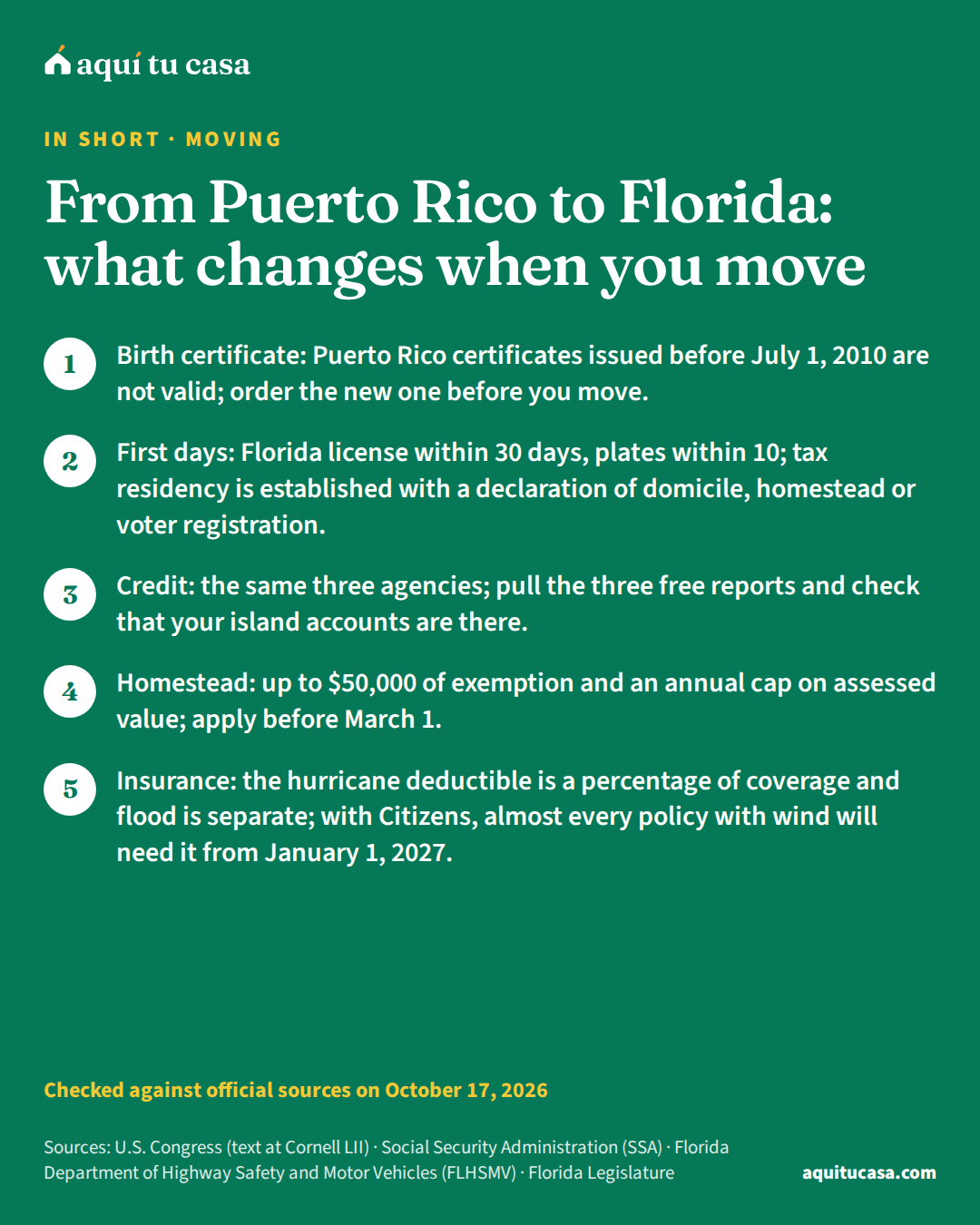
What changes when you move from Puerto Rico to Florida: credit, birth certificate, license, homestead, home and hurricane insurance, flood and taxes.
Verified on October 17, 2026 23 official sources
Your credit report does not stay on the island: pull the three free ones at AnnualCreditReport.com as soon as you arrive and check that your Puerto Rico accounts appear with your new address. If a lender says they see no history, show them the reports. If there are errors, dispute them in writing; the credit guide explains how.
Read the full guideThe exemption goes to the person who owns and lives in the home as a permanent residence on January 1, and the application is due by March 1. If you buy after January 1, your first full year with the exemption is usually the next one; in the meantime you pay the tax the seller had, which can rise when the value resets.
Read the full guideFederal law requires it in special flood hazard areas with a government-backed mortgage. Outside them it is not required by federal law, but if your wind policy is with Citizens, Florida is phasing it in: from January 1, 2027, for almost every policy with wind, regardless of value. FEMA reminds you that most homeowners insurance does not cover flood. Check your address on FEMA's map before deciding.
Read the full guideIf you were a bona fide resident of Puerto Rico for at least the 2 years before you moved, the Puerto Rico source income you earned before changing residence can be excluded from the federal return. After the move you file with the IRS like any Florida resident, and Florida has no state income tax. If your worldwide gross income for the year is more than $75,000, you may have to file Form 8898. A VITA site helps for free if you qualify.
Read the full guideFlorida tells new residents to get a Florida license within 30 days of establishing residency. You apply in person at a local office; you will take a vision test, and you may not need a written or road test. The official page lists the fee: $48.00 for an initial Class E license, plus a $6.25 service fee at most tax collector offices.
Read the full guideYou must be a U.S. citizen, a Florida resident and at least 18 years old. You can register online at RegisterToVoteFlorida.gov or at a tax collector's office that issues licenses. The deadline is 29 days before each election. Registering to vote in Florida is also one of the actions that can establish your residency.
Read the full guideIf your Puerto Rico certificate was issued before July 1, 2010, yes: those copies lost their validity under Puerto Rico law, and Social Security only accepts ones issued on or after that date. The new one is requested from Puerto Rico's Demographic Registry. Order one for each family member before you move.
Read the full guideThe data behind these guides
The guides on Moving cite these figures. They update when their sources publish new ones; what you see here is current.
See all the dataSources: U.S. Census Bureau (Average 2020–2024) · HUD (Fiscal year 2027)
From the guide
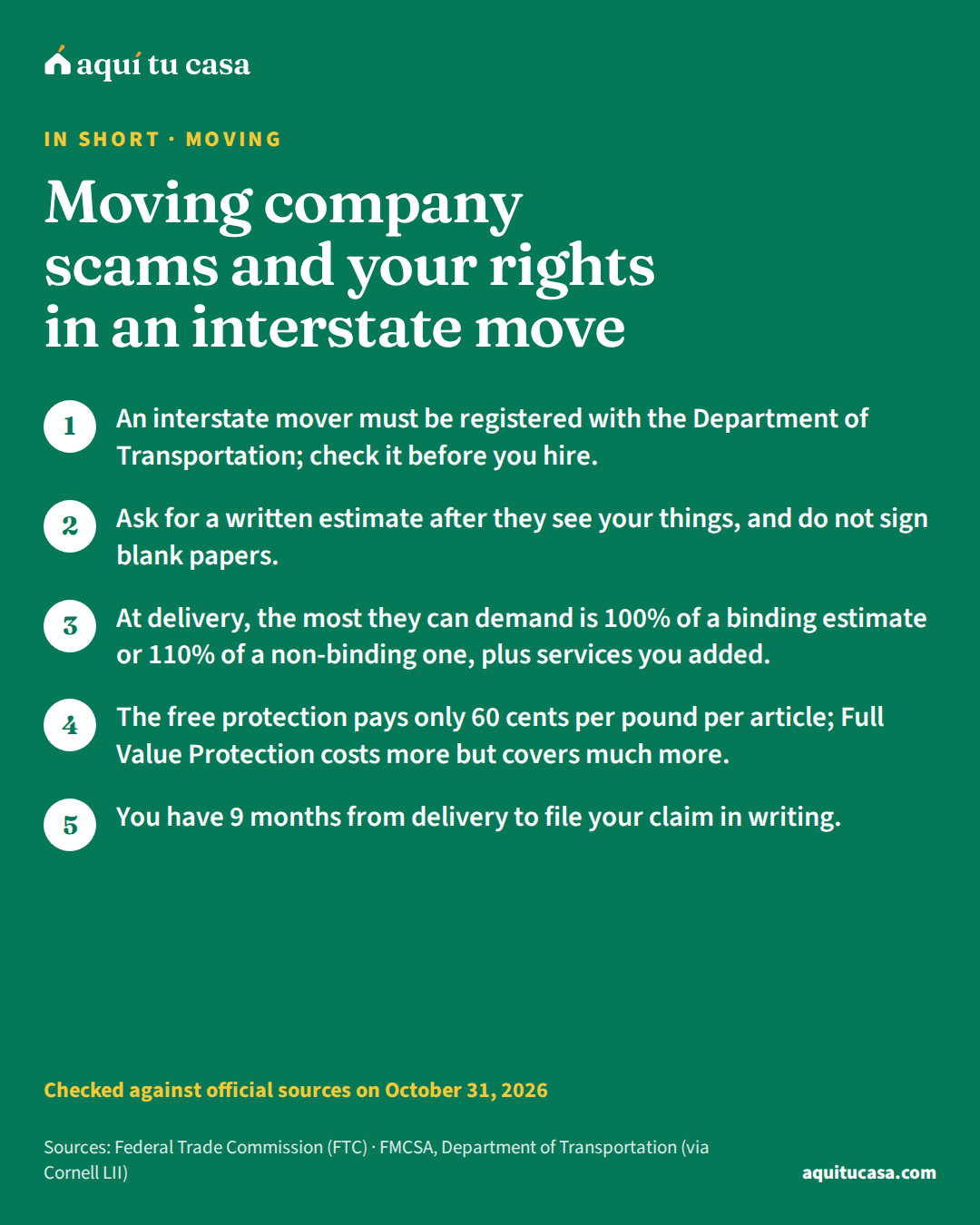
How to choose a registered mover, which estimate to ask for, how much you can be charged at delivery, how to protect your things and file a claim.
Verified on October 31, 2026 6 official sources
The FTC says movers that cross state lines must be registered with the Department of Transportation and that you can check registrations on DOT's website. If the move is within your state, ask your state consumer protection office.
Read the full guideA binding estimate guarantees the total cost for the items and services listed, and the mover may charge for it. A non-binding estimate is what the mover believes it will cost; the final bill is based on the actual weight, and you cannot be charged for the estimate.
Read the full guideAt delivery, the mover cannot demand more than 100% of a binding estimate or 110% of a non-binding one, plus services you requested later and up to 15% for impracticable operations. If you pay that and it does not deliver, it is holding your goods in violation of federal law. Report it to the Department of Transportation.
Read the full guideA company that arranges your move with a registered mover but does not move your things. It can give you an estimate on a mover's behalf only with a written agreement and using that mover's tariff. Ask who will actually carry your things.
Read the full guideFull Value Protection is included in the estimate unless you waive it in writing; it costs more and the mover repairs or replaces damaged items. The free option pays only up to 60 cents per pound per article: a 10-pound item worth $1,000 would be paid no more than $6.00.
Read the full guideYou have 9 months from delivery. The claim must be in writing. The mover has 30 days to acknowledge it and 120 days to give you an answer, with extensions if it notifies you in writing.
Read the full guideYou can request arbitration: every interstate mover must have an arbitration program, and it cannot charge you more than half of the cost of starting it. You are not required to use arbitration; you can also look for legal aid.
Read the full guide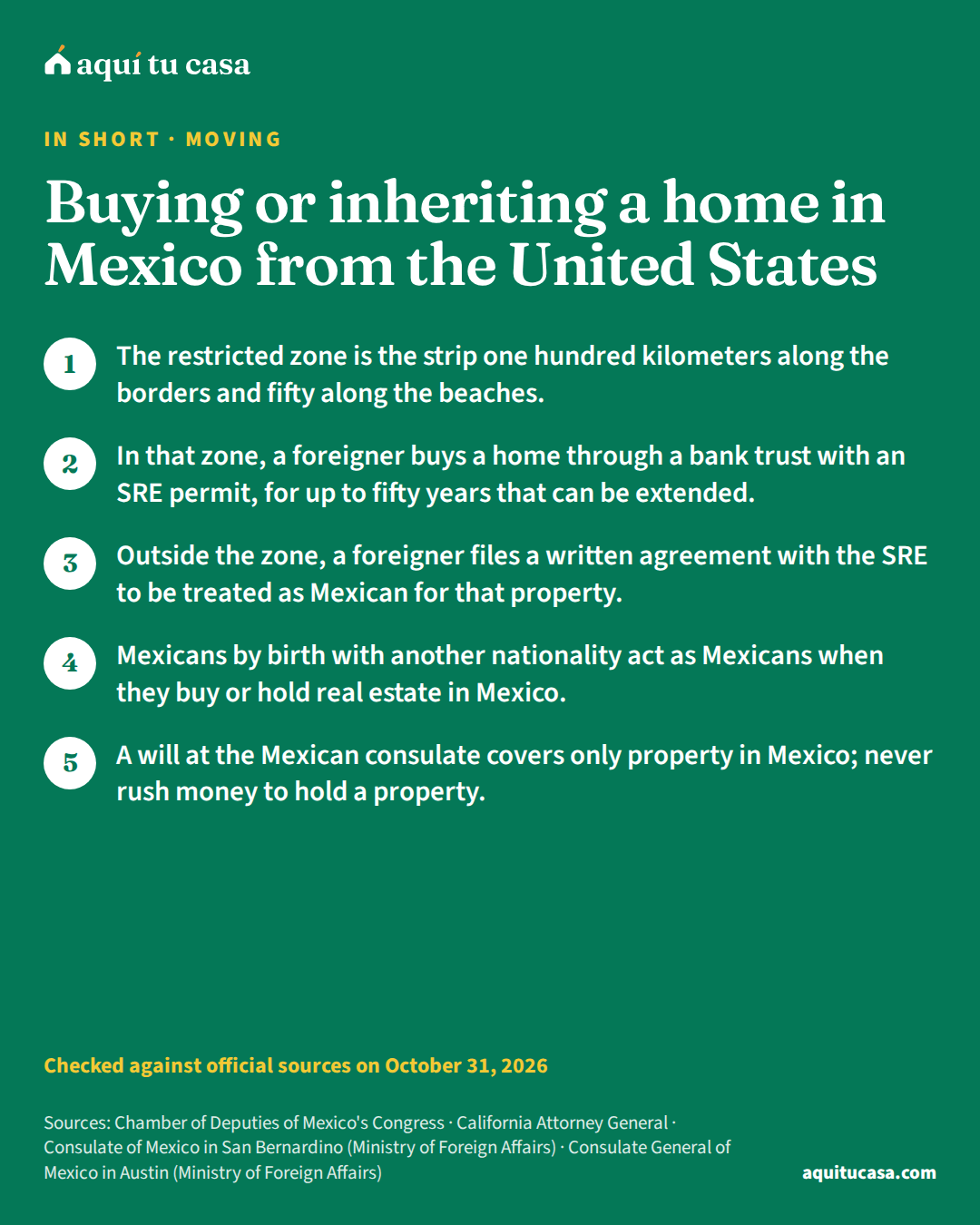
From the guide
Buying or inheriting a home in Mexico from the U.S.: the restricted zone, the bank trust, the SRE filing, Mexican notaries, inheritance and scams.
Verified on October 31, 2026 9 official sources
Yes, with rules. The Constitution says that in the restricted zone (one hundred kilometers from the borders and fifty from the beaches) foreigners cannot hold direct ownership. There a bank trust is used, with an SRE permit. Outside that zone, the foreigner files a written agreement with the SRE accepting to be treated as Mexican for that property.
Read the full guideThe Constitution says no Mexican by birth may be deprived of their nationality, and the Nationality Law says Mexicans by birth with another nationality act as Mexicans when holding real estate in Mexico. Ask the notary in Mexico which documents you need to prove your Mexican nationality.
Read the full guideIt is a contract in which a bank, as trustee, holds the rights over the property with an SRE permit, and you, as beneficiary, have the right to use it, enjoy it and get its returns. By law it lasts up to fifty years and can be extended if you ask.
Read the full guideIn the U.S., a notary public is a person authorized by the state to witness signatures and is not necessarily authorized to provide legal services. For a power of attorney or a will to be valid in Mexico, the Mexican consulate can do it: consuls act as notaries for acts that take effect in Mexico.
Read the full guideThe Mexican consulate can do an open public will before the consul, who acts as a notary, only for property located in Mexico. People who are not Mexican can also do it if the property is in Mexico. Witnesses cannot be close relatives or heirs.
Read the full guideMexico's Constitution says real estate is governed by the law of the place where it is, and the Federal Civil Code says rights over real estate are governed by the law of the place where it is, even if the holders are foreigners. Talk to a notary or a lawyer in the Mexican state where the house is; if you cannot travel, the consulate can do a power of attorney so someone can represent you there.
Read the full guideStop. The FTC says scammers pressure you to act immediately and tell you to pay in a specific way. Talk to someone you trust and have a notary in Mexico review the property before paying. If you send money, the CFPB explains that you can generally cancel within 30 minutes.
Read the full guide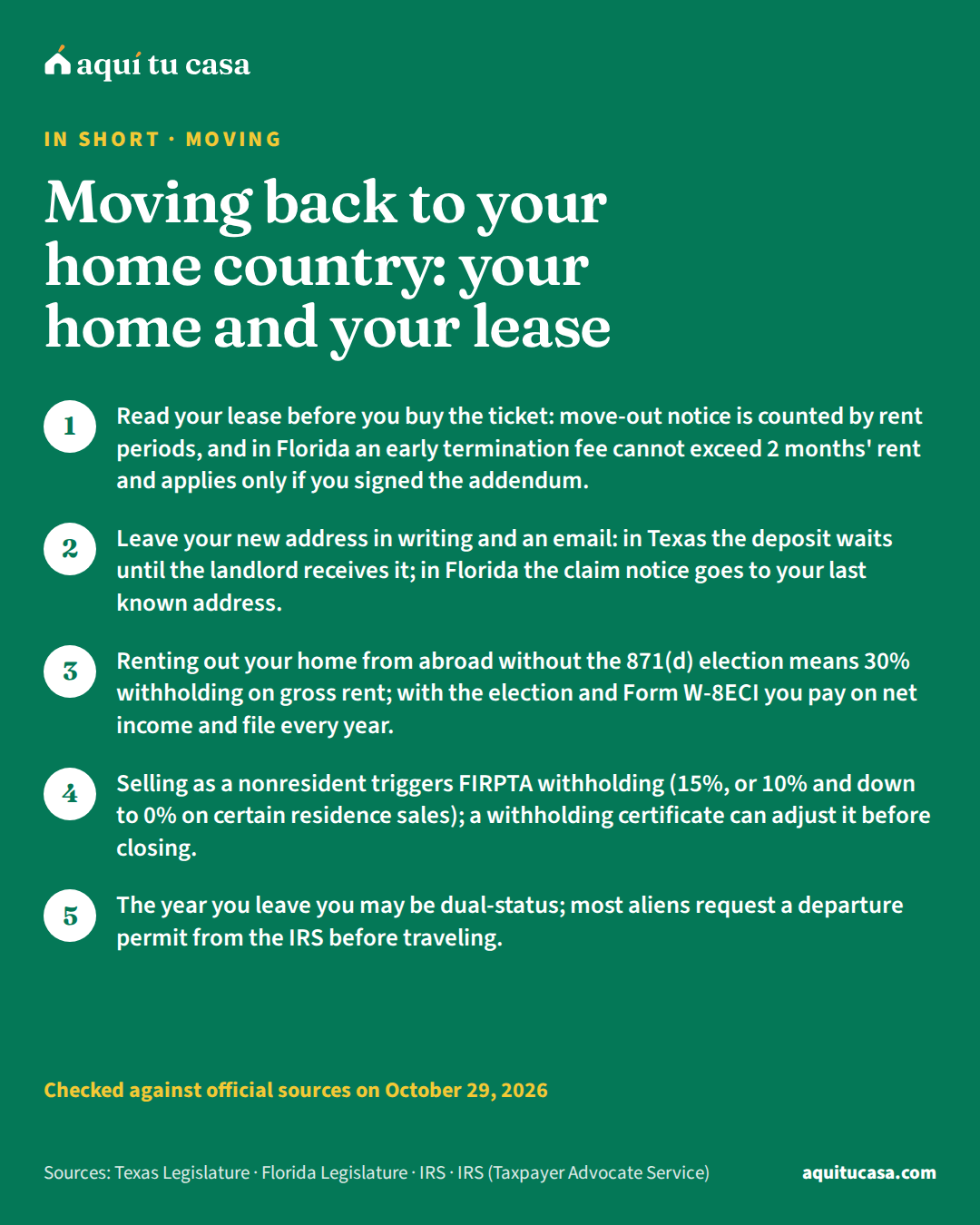
From the guide
How to end your lease in Texas or Florida, get your deposit back from abroad, and what the IRS says if you sell or rent out your home as a nonresident.
Verified on October 29, 2026 25 official sources
Read the full guide Do the math: How much will I keep when I sell?
It depends on your lease and your state. In Texas, a month-to-month tenancy ends on the day in the notice or one month after it is given, whichever is later, unless the signed lease sets a different period. In Florida, month to month is at least 30 days before the end of the monthly period, and a fixed-term lease may require between 30 and 60 days' notice of non-renewal.
Read the full guideIn Florida, the law lets the landlord re-rent and charge you the difference, with a duty to try in good faith, or charge an early termination fee of up to 2 months' rent only if you accepted it by signing a separate addendum. Read your lease and, if you like, a legal aid organization will review it with you for free.
Read the full guideTexas law requires the landlord to refund it by the 30th day after you surrender the unit, but not until you give your new address in writing. Florida law lets the claim notice go by certified mail to your last known address or, if both parties signed the electronic-notices addendum, by email. It helps to leave a U.S. address of someone you trust and an email you check.
Read the full guideThe IRS explains that income from U.S. real property owned by a nonresident alien is taxed at 30% of gross rent if it is not effectively connected with a U.S. trade or business. If you make the section 871(d) election and give Form W-8ECI to whoever pays you, you report net income on Form 1040-NR at graduated rates and can take deductions.
Read the full guideIt is the withholding the buyer makes when the seller is a foreign person: generally 15% of the amount realized. It drops to 10% if the buyer will live in the home and the price is $1 million or less, and generally nothing is withheld if the buyer will live there and the price is not more than $300,000. It is an advance payment: it is credited on your return with the stamped Form 8288-A.
Read the full guideThe IRS issues withholding certificates that adjust the amount, for example when the amount withheld would be more than your maximum tax. You or the buyer apply with the taxpayer identification numbers of all parties, and the IRS generally responds within 90 days. If you apply, notify the buyer in writing no later than the day before closing.
Read the full guideIf you were a resident for tax purposes part of the year and a nonresident the rest, you are dual-status. If you are no longer a resident on the last day of the year, you file Form 1040-NR with Dual-Status Return written across the top and a statement showing the income for the part when you were a resident. A VITA site or a Low Income Taxpayer Clinic can guide you for free.
Read the full guideIf you do not have a Social Security number, the ITIN is your taxpayer identification number: the withholding certificate application asks for the numbers of all parties, and Form 1040-NR needs it too. The IRS says you can apply regardless of immigration status and that from overseas it takes 9 to 11 weeks.
Read the full guideTools
The calculators these guides use. Each one leaves you with a result you can use today.
How much is left for housing each month.
What you get → what is left
The rent that fits your budget.
What you get → rent that fits
How many months until your down payment.
What you get → months of saving
Your home's estimated tax per year and per month.
What you get → tax per year
From the guide
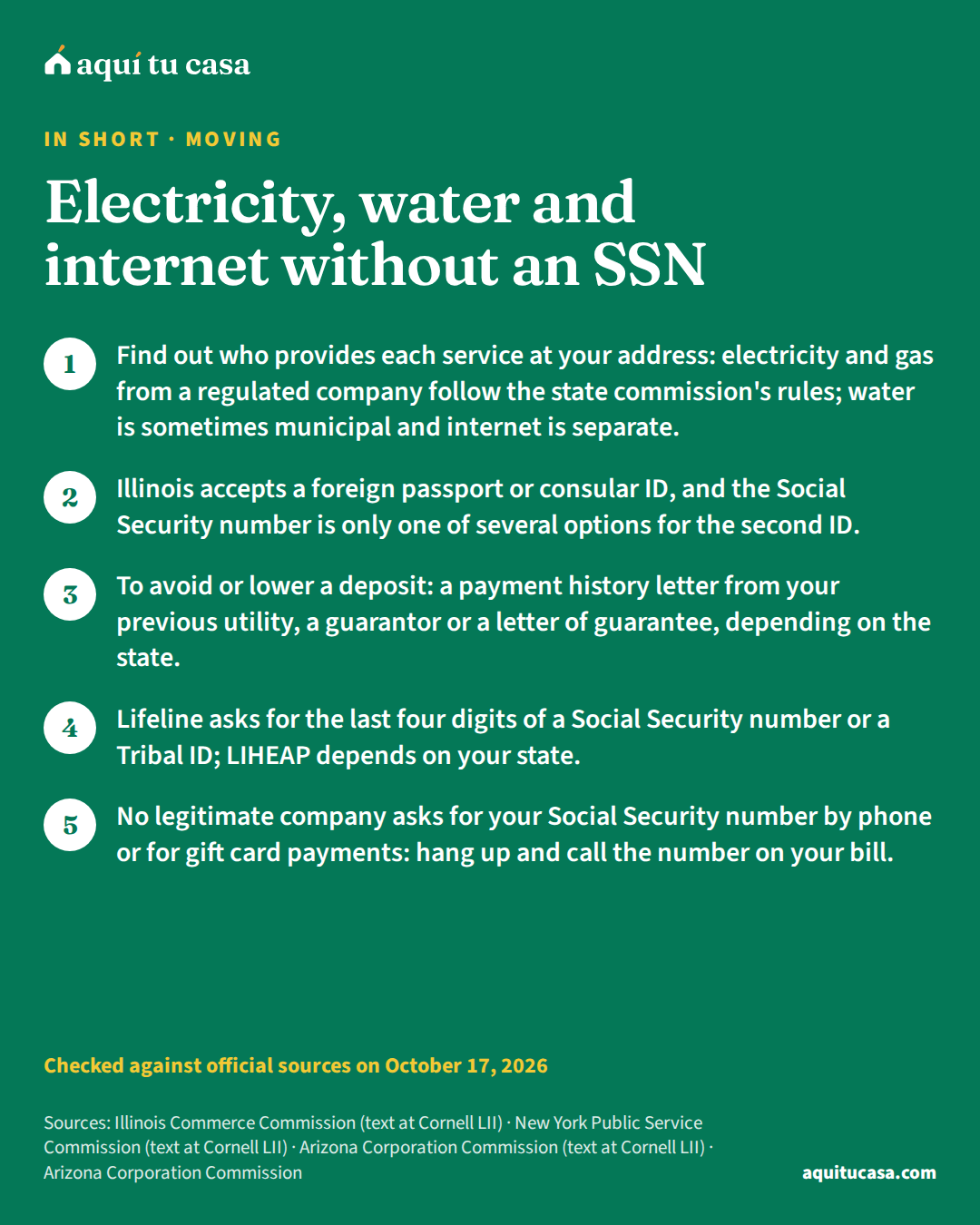
How to set up electricity, gas, water and internet without a Social Security number: accepted ID, when deposits apply, how to avoid them, Lifeline, scams.
Verified on October 17, 2026 21 official sources
It depends on the state. In Texas, if you cannot show satisfactory credit, the provider may require a deposit, and in Florida a deposit is one of the ways to establish credit. In New York, a new residential customer generally cannot be required to post a deposit. Always ask about alternatives before you pay.
Read the full guideThe rules we checked offer several ways out. In Arizona, a letter from your previous electric utility stating that you paid on time avoids the deposit, and so does a letter of guarantee from a government or nonprofit entity. In Florida, a guarantor who is a customer of the utility with a good payment record works. In Texas, an affiliated provider or provider of last resort must offer you a letter of guarantee instead of a cash deposit.
Read the full guideYes, under each state's rules. In Arizona it is refunded with interest after 12 months if you were not late more than twice; in Florida, after 23 months of continuous service with a good payment record. Texas, Arizona and Florida require interest on deposits, and in New Jersey you must be given a receipt.
Read the full guideTo your state's public utility commission, if the company is regulated. In Arizona, for example, the commission investigates disputes about deposits and refusals of service, but not those about municipal utilities or internet providers. In Illinois, the deposit notice must give you the contact for the commission's consumer services division.
Read the full guide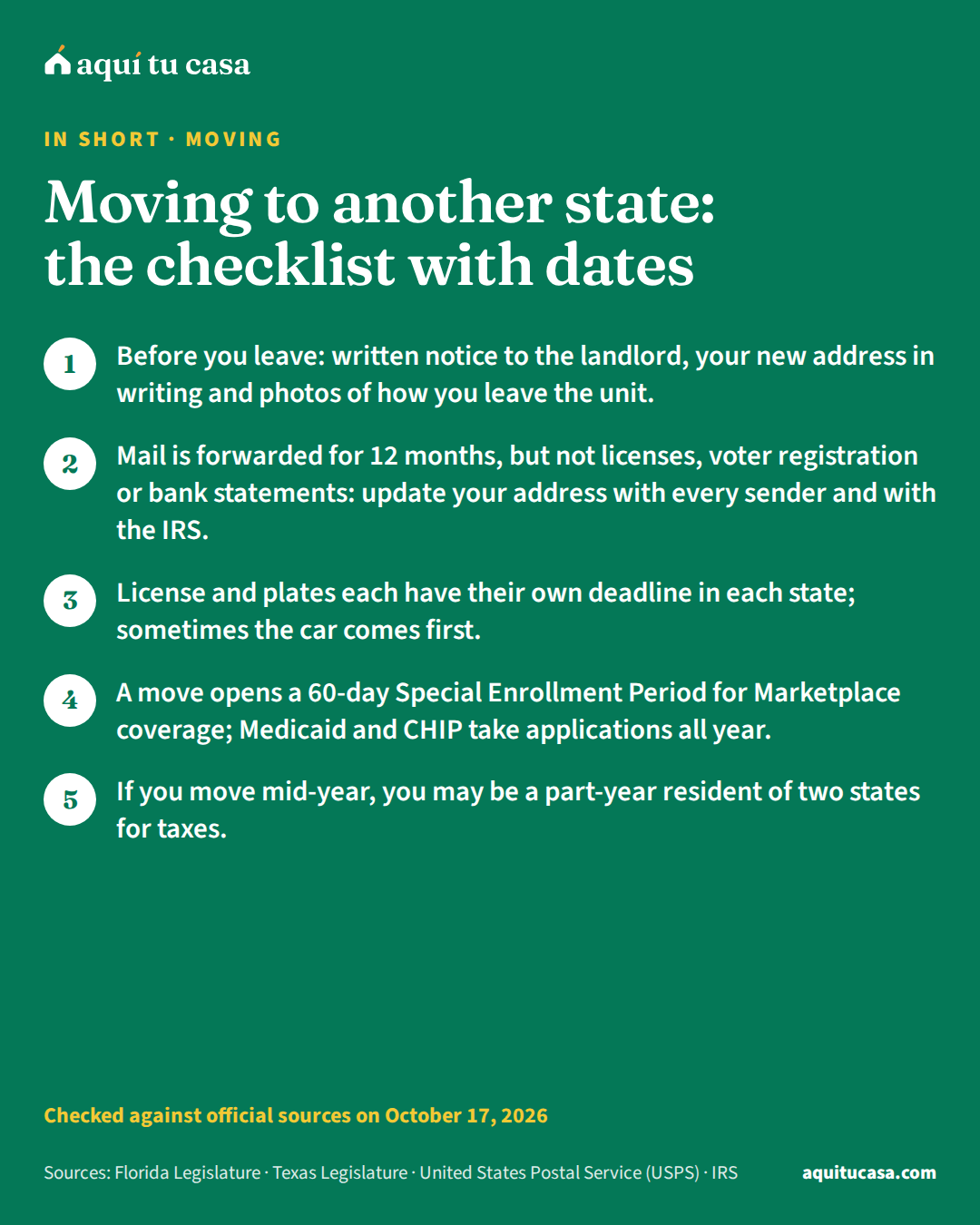
From the guide
A dated checklist for moving to another state: notice to your landlord, deposit, mail, voting, license, plates, health coverage, school and taxes.
Verified on October 17, 2026 25 official sources
It depends on the state you move to. Florida and New York give you 30 days; North Carolina, 60; in Texas you can drive on your other-state license for up to 90 days. The driver's license by state guide compares the states with their sources.
Read the full guideYes, if you request a permanent change of address with USPS: standard forwarding lasts 12 months. But driver's licenses, voter registration, credit cards and bank statements are not forwarded, so you have to tell each agency and company yourself.
Read the full guideGive the landlord your new address in writing. In Texas, the landlord does not have to return it until you do; in Florida, the claim notice goes to your last known address and you have 15 days to object in writing. If it is not returned, a legal aid organization can guide you for free.
Read the full guideYes. Moving to a new ZIP code or county opens a Special Enrollment Period on the Marketplace, and you generally have 60 days to pick a plan. Many people need to have had coverage for at least one day in the 60 days before the move, unless they lived in a foreign country or a territory. Medicaid and CHIP take applications any time.
Read the full guidePossibly. California and New York explain that someone who lives part of the year in the state may be a part-year resident and file there for that part of the year. Florida has no personal income tax. A VITA site can help you with a basic return for free if you qualify.
Read the full guideThe same way as with a Social Security number: put the new address on your next return, or send Form 8822, write or call with your name, both addresses and your ITIN. The IRS says the change generally takes 45 days to process.
Read the full guideIf you are a U.S. citizen, yes: when you move to another state you must register there. On vote.gov you choose your state and see the deadline, which can be as much as a month before the election. Non-citizens, including permanent residents, cannot vote in federal or state elections.
Read the full guide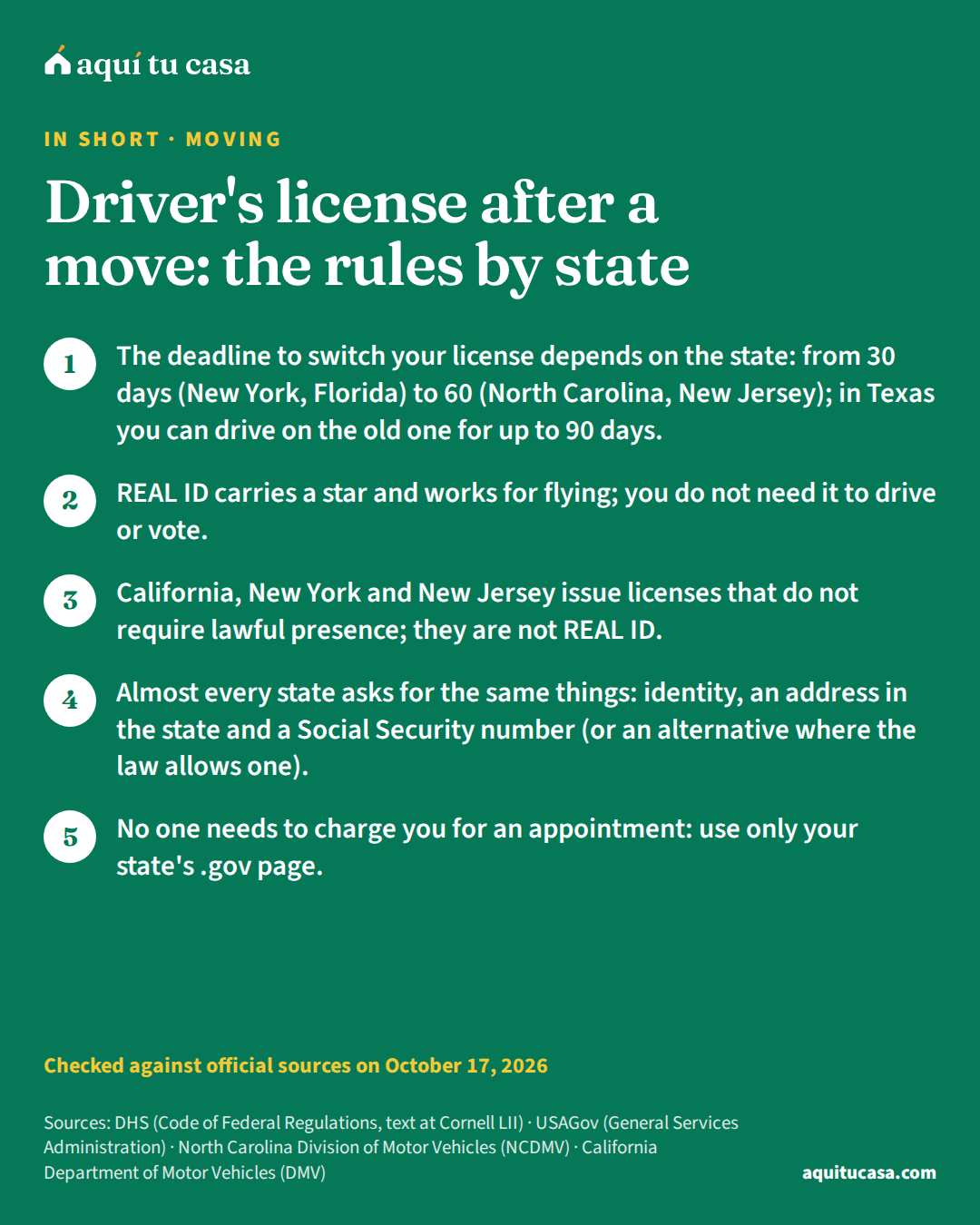
From the guide
How long you have to switch your license after a move, what REAL ID is, which states license people without lawful presence and what they ask for.
Verified on October 17, 2026 27 official sources
It is a license or ID that meets federal standards; you can tell by a star in the upper right corner. You do not need it to drive or vote: the North Carolina DMV calls it completely optional. It is required, or another accepted document such as a passport, to fly within the country and enter certain federal buildings.
Read the full guideYes, with a passport or another document the TSA accepts. If you are 18 or older and have none of them, USAGov explains you can pay $45 for TSA ConfirmID to have your identity verified; it is valid for 10 days from the departure date. Children under 18 flying with an adult do not have to show ID.
Read the full guideOf the states we checked, California issues the AB 60 license, New York issues the Green Light Law standard license and New Jersey issues its basic license regardless of immigration status. Texas does not issue a license until DHS verifies lawful presence. Rules change, so confirm on your state's official page.
Read the full guideOften not, if your out-of-state license is valid. Texas does not require the exams if you surrender a valid license from another state; in North Carolina and New Jersey they can be waived; Florida says you may not need them. There is almost always a vision test. In California, people arriving with another state's license take the knowledge tests.
Read the full guideThe New York DMV says the Green Light Law only concerns driving in New York, does not provide a pathway to citizenship and does not change who can vote. This guide cannot tell you what a filing means for your case. A Justice Department accredited representative or a legal aid organization can guide you.
Read the full guideYou usually surrender it. New York, Texas and New Jersey ask you to surrender it when you get the new one, and in North Carolina applying for a license cancels licenses from other states. If you still need it for something, make a copy first.
Read the full guideChange topic without leaving the questions.

These answers explain the rules but do not know your situation. These organizations go over it with you, free.