Moving back to your home country: your home and your lease
How to end your lease in Texas or Florida, get your deposit back from abroad, and what the IRS says if you sell or rent out your home as a nonresident.
Verified against official sources on October 29, 2026 25 official sources

Show contents
In short
What you need to know
Quick answer
Moving back to your home country starts two clocks at once: the one on the home you leave behind and the IRS's. If you rent, your state's law sets the notice (in Florida, at least 30 days for a month-to-month tenancy; in Texas, one month, unless your signed lease says otherwise) and your deposit depends on leaving an address in writing. If you own, you can keep the home, rent it out or sell it: renting it out as a nonresident brings a 30% withholding on gross rent unless you make the 871(d) election with Form W-8ECI, and selling brings FIRPTA withholding of 15% of the price, credited later on your Form 1040-NR. None of this requires paying anyone: housing counselors, VITA, taxpayer clinics and legal aid are free or low cost.
What matters most
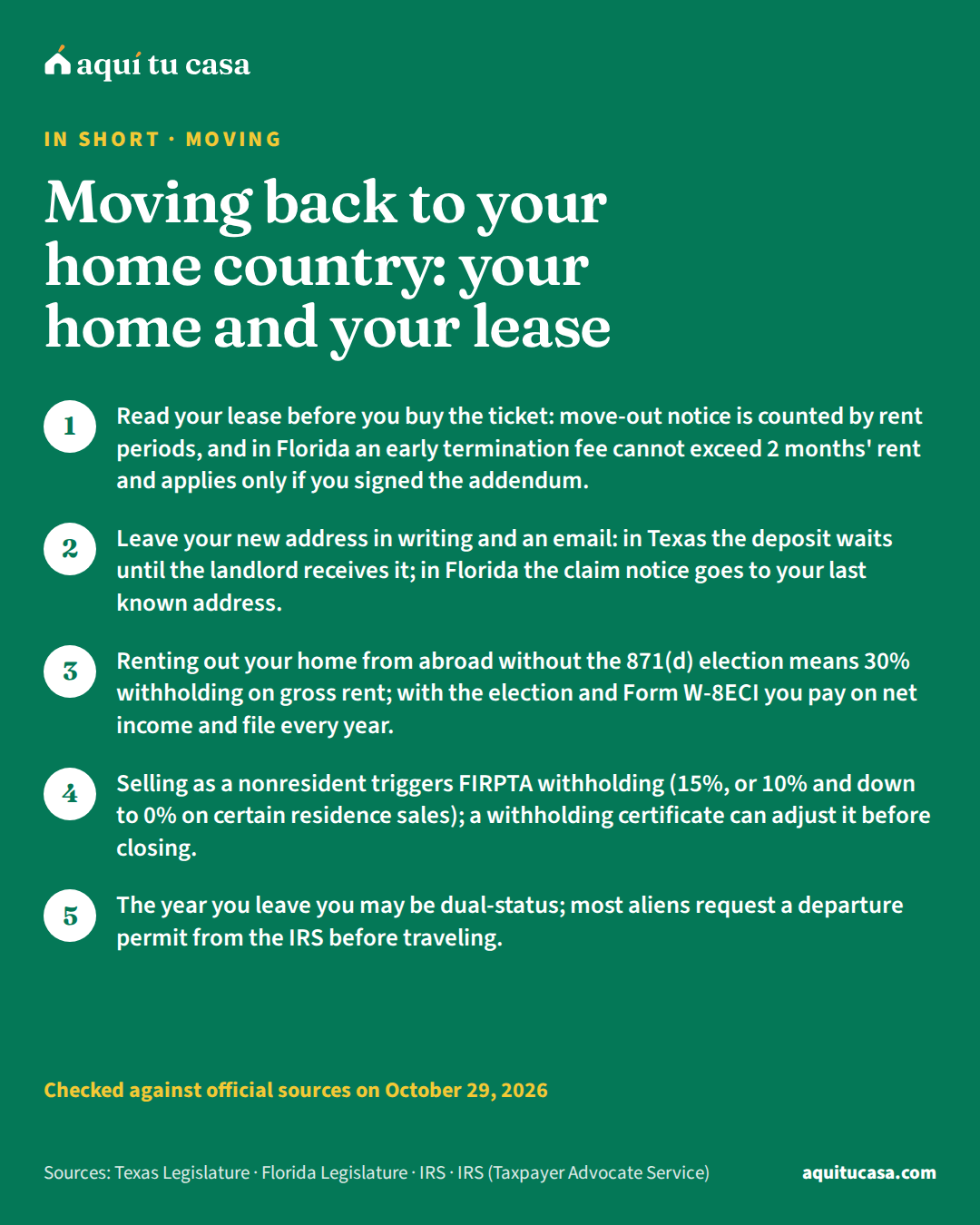
- Read your lease before you buy the ticket: move-out notice is counted by rent periods, and in Florida an early termination fee cannot exceed 2 months' rent and applies only if you signed the addendum.
- Leave your new address in writing and an email: in Texas the deposit waits until the landlord receives it; in Florida the claim notice goes to your last known address.
- Renting out your home from abroad without the 871(d) election means 30% withholding on gross rent; with the election and Form W-8ECI you pay on net income and file every year.
- Selling as a nonresident triggers FIRPTA withholding (15%, or 10% and down to 0% on certain residence sales); a withholding certificate can adjust it before closing.
Is this for you?
This guide is for you if…
- You are moving back to your home country and rent in the United States: you want to know how much notice to give and how to get your deposit back from far away.
- You own a home here and are not sure whether to keep it, rent it out or sell it before you leave.
- You will stop being a resident for tax purposes and want to understand which return you file and which withholding will apply to you.
Get direct help first if…
- You are moving to another state within the United States: read the dated checklist for moving to another state.
- You are leaving because of a detention or a removal order: read the guide on a housing plan when a family member is detained first, and a legal aid organization or a Justice Department accredited representative can guide you.
- You have an open dispute with the IRS: a Low Income Taxpayer Clinic can represent you for free or for a small fee.
Moving back to your home country is a move with two clocks. One is the home you leave behind: the notice to your landlord, the deposit, or the house you own. The other is the IRS’s, which treats someone who stops being a resident for tax purposes differently. This guide brings together what Texas and Florida law and the IRS’s official pages say, in the order they will come up, and tells you where to get free help at each step. It is not advice for your case: it is the map so you know what to ask and whom.
- Minimum notice in Florida to end a month-to-month tenancy
- 30 days3
- Notice in Texas for a month-to-month tenancy, unless the signed lease sets another period
- 1 month1
- FIRPTA withholding on the sale amount when the seller is a foreign person
- 15%10
- Tax on the gross rent of your home rented out as a nonresident, if you do not make the election
- 30%16
Your departure, in order
Almost everything that follows has a date. Some things happen months ahead (deciding what happens to your home, applying for the ITIN); others, the week of the flight. This is the list in the order things come due.
Moving back to your home country, step by step
3. Apply for the ITIN if you have no Social Security number
Before you sell or rent it out
You will need it for the withholding certificate and for Form 1040-NR. From overseas, the answer takes 9 to 11 weeks.21
4. If you sell, apply for the withholding certificate before closing
When you sign the sales contract
The IRS generally responds within 90 days; notify the buyer in writing no later than the day before closing.14
6. Leave your new address with the landlord in writing
The day you hand in the keys
In Texas, the landlord does not have to return the deposit until receiving it;2 in Florida, the claim notice goes by certified mail to your last known address (or by email, if you both signed the electronic-notices addendum7).6
7. Request the departure permit from the IRS
Between 30 and 14 days before the flight
Most aliens must obtain it with Form 1040-C or Form 2063, by appointment at the local IRS office.20
8. File for the year you leave
The next tax season
If you stopped being a resident during the year, you file Form 1040-NR as a dual-status return.19
If your move is within the United States, the dated checklist for moving to another state is the guide for you. To know how much money you arrive with, build your family budget with the deposit, the sale or the rent already counted.
Ending your lease: what Texas and Florida say
Your leaseleaseA lease, or rental agreement, is the contract in which the owner or landlord gives you the right to live in and use a property for a set period of time in exchange for payment, usually rent. While the lease lasts you have possession, but the landlord still owns the property. The lease says how much you pay and when, who handles maintenance and how the agreement can end. Your rights as a tenant are usually spelled out in the lease and in your state and local laws. Before complaining to the landlord, it helps to read the lease and make sure you are also following the rules you agreed to.See the full definition comes first. If it has a fixed term (12 months, for example), leaving early means breaking it, and your state’s law says what the landlord can charge you. If you rent month to month (a month-to-month tenancymonth-to-month tenancyA month-to-month tenancy is a rental arrangement with no end date: it continues month after month as long as you pay the rent, until you or the landlord give notice to end it. It can be in writing, but it can also start without a contract, for example if you stay after your lease ends and the landlord accepts your payment. To end it, you must give the notice your state's law requires. In New York, for example, the notice alone does not let the landlord remove you: if you do not leave, the landlord has to go to court.See the full definition), the law sets how much notice you give.
In Texas, the Property Code says a month-to-month tenancy is ended by the tenant or the landlord giving notice to the other. If you pay rent monthly, the tenancy ends on the day your notice says or one month after you give it, whichever is later. That rule does not apply if you and the landlord signed an instrument with a different notice period, or one that says no notice is required.1 In other words: if your lease asks for 60 days, it is 60 days.
In Florida, the law separates two cases. A tenancy without a fixed term is ended by either party with written notice: month to month, at least 30 days before the end of any monthly period; week to week, at least 7 days.3 A fixed-term lease may require you to give advance notice that you will not stay on when it expires, as long as it also requires the landlord to notify you if the lease will not be renewed; that notice may not be less than 30 or more than 60 days for either party. And if you stay with permission after the lease expired and do not give the notice the law requires, you owe one additional month’s rent.4
Breaking a Florida lease early has its own rule. The landlord may retake the unit for your account and charge you the difference between the agreed rent and what the landlord recovers by re-renting it, with a duty to try to re-rent in good faith. Or the landlord may charge an early termination fee or liquidated damages of up to 2 months’ rent, but only if you accepted that by signing a separate addendum, and if the fee requires no more than 60 days’ notice.5 Look for that addendum in your lease: if you signed it, you already know the cap on that fee.
Move-out notice in the two states
Property Code
Texas
- Month to month: ends on the day of the notice or one month later, whichever is later.1
- If you signed a different period (or that no notice is needed), what you signed applies.1
- The deposit comes back by the 30th day after you surrender the unit.2
- Without your new address in writing, the landlord is not obligated to return it yet.2
Chapter 83
Florida
- Month to month: at least 30 days before the end of the monthly period; week to week, 7 days.3
- Fixed term: the lease may require between 30 and 60 days' notice of non-renewal.4
- Leaving early: good-faith rent difference, or a fee of up to 2 months if you signed the addendum.5
- 7 days' move-out notice with your address, by certified mail or in person.6
In both states, the notice is given in writing and dated. Keep a copy and proof of delivery: that is what you will need from far away.
Your deposit when you already live in another country
The security depositsecurity depositA security deposit is money you pay the landlord when you start renting as security that you will follow the lease: pay the rent and take care of the home. The money still belongs to you. The landlord holds it and, when you move out, must return it minus the charges the law allows, such as past-due rent or damage beyond normal wear and tear. You should not be charged for damage that was already there when you moved in. The maximum amount and the deadline to return it depend on your state's law and sometimes your city's.See the full definition is the easiest money to lose in an international move, not because the law allows it, but because nobody stays behind to claim it. Both laws give you tools to collect it from far away.
In Texas, the landlord must refund your deposit by the 30th day after you surrender the unit, and a clause requiring advance notice as a condition of the refund only counts if it is underlined or in conspicuous bold print in the lease.2 The landlord may not keep anything for normal wear and tear, and if anything is deducted must give you the balance with a written description and an itemized list of each deduction.2 But there is a condition: the landlord is not obligated to return it or give you that list until you provide your new address in writing for the refund. You do not lose the right by not giving it, but the money waits.2
In Florida, unless your written lease says otherwise, a tenant who leaves before the end of the term or rents by the period must give written notice at least 7 days before leaving, by certified mail or in person, and the notice must say where you can be reached. Without that notice you keep the deposit, but the landlord is relieved of sending you the claim notice.6 A landlord who claims nothing has 15 days to return it; one who claims part of it has 30 days to send the notice by certified mail to your last known address, or by email if both parties signed an addendum to the lease agreeing to electronic notices,7 and you have 15 days after receiving it to object in writing.6
Two practical points come out of that. First: leave a U.S. address of someone you trust, in addition to your address in your country, so certified mail has somewhere to arrive and someone tells you the same day. Second: ask in writing that the refund be made by transfer or by check in that trusted person’s name, so a dollar check does not get lost on the way. If it is not returned, a legal aidlegal aidLegal aid is the free civil legal help that nonprofit organizations and their lawyers provide to low-income people in civil, not criminal, matters. In housing, that includes representing families facing eviction or foreclosure, alongside matters such as custody, child support, protection from domestic violence and access to benefits. In the United States, the Legal Services Corporation, created by Congress, funds a nationwide network of these organizations; its finder points you to the one in your area. Each sets its own income limits.See the full definition organization can guide you for free if you qualify by income,25 and the security deposits guide explains how to write the demand letter.
Deposit, home values and counseling in each state
| State | Time to return the deposit | Typical home value | HUD-approved counselors |
|---|---|---|---|
| Alabama | 60 calendar days | $209,900 | 25 |
| Alaska | — | $352,900 | 1 |
| Arizona | 14 business days | $394,500 | 21 |
| Arkansas | 60 days | $188,000 | 14 |
| California | 21 days | $734,700 | 81 |
| Colorado | 1 day | $539,400 | 26 |
| Connecticut | — | $366,900 | 13 |
| Delaware | — | $352,000 | 12 |
| District of Columbia | — | $737,100 | 17 |
| Florida | 15 days | $359,000 | 98 |
| Georgia | 30 days | $303,300 | 42 |
| Hawaii | 14 days | $839,100 | 17 |
| Idaho | 21 days | $418,600 | 10 |
| Illinois | 45 days | $263,300 | 81 |
| Indiana | 45 days | $218,200 | 21 |
| Iowa | 30 days | $208,000 | 11 |
| Kansas | 30 days | $217,200 | 3 |
| Kentucky | — | $205,600 | 19 |
| Louisiana | 1 day | $216,500 | 26 |
| Maine | — | $296,600 | 7 |
| Maryland | 45 days | $419,900 | 41 |
| Massachusetts | 30 days | $562,100 | 37 |
| Michigan | 30 days | $231,600 | 59 |
| Minnesota | 21 days | $329,300 | 33 |
| Mississippi | 45 days | $169,800 | 16 |
| Missouri | 30 days | $230,300 | 18 |
| Montana | — | $375,800 | 11 |
| Nebraska | 14 days | $238,600 | 8 |
| Nevada | 30 days | $435,400 | 8 |
| New Hampshire | 30 days | $402,500 | 5 |
| New Jersey | 30 days | $454,400 | 34 |
| New Mexico | — | $248,100 | 7 |
| New York | 14 days | $423,800 | 93 |
| North Carolina | 30 days | $288,900 | 52 |
| North Dakota | 30 days | $249,900 | 3 |
| Ohio | 30 days | $214,800 | 54 |
| Oklahoma | 45 days | $199,800 | 6 |
| Oregon | 31 days | $477,600 | 25 |
| Pennsylvania | 30 days | $254,500 | 75 |
| Puerto Rico | — | $131,500 | 9 |
| Rhode Island | 20 days | $404,200 | 5 |
| South Carolina | 30 days | $259,000 | 13 |
| South Dakota | 21 days | $257,400 | 13 |
| Tennessee | — | $286,700 | 32 |
| Texas | 30 days | $283,800 | 51 |
| Utah | 30 days | $489,400 | 7 |
| Vermont | 14 days | $316,600 | 7 |
| Virginia | 45 days | $383,700 | 49 |
| Washington | 30 days | $564,600 | 15 |
| West Virginia | — | $162,600 | 8 |
| Wisconsin | 21 days | $266,500 | 26 |
| Wyoming | 30 days | $309,700 | 1 |
The deposit deadline comes from each state's law; the typical home value, from the American Community Survey; agencies, from HUD's list. Source: each state's laws · Census Bureau (ACS) · HUD

If you own: keeping the home, renting it out or selling
Owning a home here while living there opens three paths, and each has its rule. Keeping it empty preserves it, but it keeps costing taxes, insurance and upkeep. Renting it out produces income, but the IRS treats you as a nonresident landlord. Selling closes the chapter, but triggers withholding at closing. The next two sections explain the taxes of renting out and selling; here is what changes with the homestead exemptionhomestead exemptionA homestead exemption is a legal protection for the home where you and your family live. It can keep certain creditors from collecting your debts out of your main home, and it can also lower the property tax on that home. In Texas, for example, the residence homestead exemption removes part of your home's value from the tax calculation; to get it you must own the home, live there as your principal residence and apply. State laws vary widely: some cap the amount protected and others depend on the size of the property or the owner's age.See the full definition, which is the first thing to move when you leave.
In Florida, renting all or substantially all of a dwelling claimed as a homestead constitutes abandonment of the homestead, and the abandonment lasts until the owner physically occupies it again. If you abandon it after January 1, that year’s exemption is not affected, unless you rent it for more than 30 days per calendar year for 2 consecutive years.8 In Texas, the home does not lose its character as a residence homestead if you temporarily stop occupying it, do not establish another principal residenceprincipal residenceYour principal residence is the home where you live permanently and spend most of the year. According to FHA, a person can have only one principal residence at a time. Lenders tell it apart from a second home, which you occupy in addition to your principal residence but for less than most of the year, and from an investment property, which you own but do not live in. Fannie Mae buys loans on all three, but it applies a loan-level price adjustment (LLPA) to loans on investment properties.See the full definition, the absence lasts less than two years and you intend to return to live there.9 Each state and county applies its own rules: the homestead exemption guide explains how it is claimed and how it is lost in the states we have verified.
If you decide to rent it out, the guide to renting out a room or unit covers the lease, fair housing and maintenance from the landlord’s side. What follows is what changes because you no longer live in the United States.

Renting out your home from abroad: the 30% withholding
The IRS states the general rule plainly: income from U.S. real property owned by a nonresident alien is taxed at 30% (or a lower treaty rate) if it is not effectively connected with a U.S. trade or business. That means 30% of gross rent, without subtracting the mortgage, insurance, property tax or repairs.1618
The same page explains the way out: you can elect, under section 871(d) of the Code, to treat all income from your real property as effectively connected income. With that election you claim the property’s deductions and your net income is taxed at graduated rates, the same ones residents pay.17 The election is made with a statement attached to your Form 1040-NR and stays in effect for later years until you revoke it.16
So that whoever pays you does not withhold 30%, the IRS says Form W-8ECI is given to the withholding agent or payer (your tenant or the property manager) in the first year of the election and in later years when required. In exchange, you commit to filing Form 1040-NR for the year of the election and every year after while it stays in effect. And there is a deadline that hurts: someone who does not file within 16 months of the original due date loses the deductions and certain credits, unless the IRS grants a waiver.16 The W-8ECI instructions confirm it: if you made or will make the section 871(d) election, that is the form you provide; for sale proceeds, on the other hand, you do not use Form W-8ECI but Form 8288-B.17
Selling as a nonresident: FIRPTA withholding
When a foreign person sells U.S. real property, the law called FIRPTA requires part of the price to be withheld at closing. The IRS explains that whoever buys from a foreign person, certain purchasers’ agents and settlement officers must withhold 15% of the amount realized, and that in most cases the buyer is the withholding agent. The amount realized is not your gain: it is the sum of the cash paid, the fair market value of other property transferred and any liability the buyer assumes or to which the property is subject.10
There are two exceptions for homes the buyer will live in. Generally no withholding is required when the buyer acquires the property as a residence and the price is not more than $300,000, as long as the buyer or a family member has definite plans to live there at least 50% of the days anyone uses the home during each of the first two years, and the buyer is an individual.11 And the withholding drops to 10% when the buyer acquires it as a residence and the amount realized is $1 million or less.12
Example with real numbers
A $400,000 sale to a buyer who will live in the home
Illustrative numbers to see the size of the withholding; they do not describe your case.
- Sales price (amount realized)
- $400,000
- General FIRPTA withholding (15%)
- $60,000
- Reduced withholding if the buyer will live there and the price is $1 million or less (10%)
- $40,000
- Withholding if the price were not more than $300,000 and the buyer were going to live there
- $0
The amount withheld is an advance payment, not the final tax: it is credited on your Form 1040-NR with the stamped Form 8288-A.13 A withholding certificate can adjust it before closing.14
Run it with your numbersHow much will I keep when I sell?The withholding is not the tax: it is an advance. The buyer reports and pays it with Form 8288, generally by the 20th day after the sale, and prepares a Form 8288-A for each seller. The IRS stamps copy B of Form 8288-A and sends it to you; you file your U.S. return with that stamped Form 8288-A to receive credit for the tax withheld.13 Without that return there is no credit; that is why the ITIN and Form 1040-NR matter so much for someone who has already left.
If you think 15% is far more than your tax, the IRS issues withholding certificates that adjust the amount. The buyer, the buyer’s agent or you apply; the complete application carries the taxpayer identification numbers of all parties, and the IRS generally responds within 90 days. If you apply, you must notify the buyer in writing on the day of the sale or the day before. One of the grounds for issuing it is that the amount withheld would be more than your maximum tax.14 A common reason for the tax to be low is the exclusion for the sale of a main home: the IRS explains that you may exclude up to $250,000 of the gainhome appreciationHome appreciation is the increase in your home's value over time. It is one of the two ways your home equity grows, equity being the difference between what the home is worth and what you owe; the other is paying down your mortgage principal. A home's value can go up or down: it can fall because of economic conditions, lack of upkeep or a drop in neighborhood home values, and some markets appreciate faster than others. The FHFA House Price Index (HPI) measures how single-family home values change.See the full definition, or up to $500,000 on a joint return, if you owned the home and used it as a residence for at least 24 months of the last 5 years before the sale.15 The seller net sheet calculator helps you estimate what you receive after the mortgage and closing costs.
Taxes the year you leave: nonresident or dual-status
The year of departure is usually a dual-status year. The IRS explains that you are dual-status when in the same tax year you were both a resident and a nonresident for tax purposes, and that the most common dual-status years are the years of arrival and departure. If you give up residence during the year and are not a resident on the last day, you file Form 1040-NR, write Dual-Status Return across the top and attach a statement with the income for the part of the year you were a resident. In such a year you cannot use the standard deduction or file a joint return, unless you are married to a U.S. citizen or resident and you both elect to file jointly. Income from U.S. sources is taxed whether you receive it as a resident or a nonresident.19
From the following year on, if you only have income from here (the rent from your home, for example), you file as a nonresident. The IRS says a nonresident who must file uses Form 1040-NR; that effectively connected income is taxed at graduated rates after deductions, and FDAP income at a flat 30 percent with no deductions; that if you are an employee with wages subject to withholding, or you have an office or place of business in the United States, you generally file by April 15 and, if not, by June 15; that Form 4868 requests an extension; and that only a timely filed return gives you the right to deductions and credits.18 If you filed with an ITIN while living here, the guide to filing taxes with an ITIN explains how to request your transcripts, which you will want to have before you leave.
There is one more step that is easy to overlook. The IRS explains that the departure permit (sailing permit or departure permit) is a document most aliens must obtain from the IRS before leaving the United States, as proof that they settled their taxes before a long-term or permanent departure. It is received after filing Form 1040-C or Form 2063 at the local IRS office, by appointment. You should get it at least 2 weeks before you travel and cannot apply earlier than 30 days before the departure date; the same page lists who does not need it.20 Read it with your most recent tax returntax returnA tax return is the yearly form you use to report your income to the IRS and figure the tax you owe, so you can pay what is due or get a refund. The federal return for individuals is Form 1040. In general you must file if your gross income is above the minimum the IRS sets for your filing status, or if you had a certain amount of net earnings from self-employment; even when you do not have to, filing can pay off. You need your SSN or ITIN, and those of everyone else on the return, plus documents such as your W-2s and 1099s.See the full definition at hand.
Free help, here and from there
None of this requires paying a middleman. The IRS VITAVITA (free tax preparation)VITA (Volunteer Income Tax Assistance) and TCE (Tax Counseling for the Elderly) are IRS programs that offer free basic tax return preparation by IRS-certified volunteers. They are meant for people with moderate income, people with disabilities and limited-English speakers; TCE focuses on people sixty and older. The IRS sets no program-wide income limit, but individual sites may set their own. Many sites serve in Spanish and help with ITIN applications and renewals. Filing taxes every year builds the record lenders ask for.See the full definition and TCE programs prepare basic returns for free for people who qualify, including limited English speakers; the nearest site is found with the VITA Locator Tool or by calling 800-906-9887.23 If you already have a dispute with the IRS (a collection letter, a withholding you are not credited for), a Low Income Taxpayer ClinicLow Income Taxpayer Clinic (LITC)A Low Income Taxpayer Clinic (LITC) is an organization that helps low-income people who have a dispute with the IRS, such as an audit, an appeal or a tax collection matter, for free or for a small fee. It can represent you before the IRS or in court. It also teaches taxpayer rights and responsibilities to people who speak English as a second language. To qualify, your income generally must be below a certain level. The clinics get part of their funding from the IRS but are independent of it.See the full definition can represent you before the IRS or in court; the service is free or for a small fee, generally when the amount in dispute is less than $50,000, and the clinics are independent of the IRS.22
For the home, a HUD-approved housing counselor guides you on renting out, selling or keeping it, often for free, and is found by ZIP code.24 For the lease or the deposit, an LSC-funded legal aid organization serves low-income people; you search by address or city.25 The guides to HUD-approved housing counselors and free legal aid explain what to expect from each.

If this is you
What matters most for your situation
You rent and are leaving the country
Count the notice by rent periods1 and leave your new address and an email in writing: in Florida the claim notice can arrive by email if you both signed the electronic-notices addendum.7
You own and will rent out the home
Make the 871(d) election and give Form W-8ECI to whoever pays you;16 otherwise 30% of gross rent is withheld.17 Check what happens to your homestead.8

Costly mistakes
The mistake and what to do instead
Mistake: Giving notice by text message the week of the flight.
Instead: Give the notice in writing and dated, counting the days by rent period: in Florida it is at least 30 days month to month.3
Mistake: Leaving without giving an address in writing.
Instead: In Texas, the landlord is not obligated to return the deposit until receiving it.2 Also leave a trusted address in the United States.
Mistake: Renting out your home from abroad without making the 871(d) election.
Instead: Give Form W-8ECI and file Form 1040-NR every year;16 without the election, the tax is 30% of gross rent.16
Mistake: Applying for the withholding certificate after closing.
Instead: Apply when you sign the sales contract and notify the buyer in writing no later than the day before: the IRS generally takes 90 days.14
Mistake: Not filing Form 1040-NR because tax was already withheld at closing.
Instead: The withholding is an advance; the credit comes by filing the return with the stamped Form 8288-A.13
Mistake: Leaving the country without the IRS departure permit.
Instead: Book the appointment and file Form 1040-C or Form 2063 between 30 and 14 days before the trip.20
What to do this week
- Read the notice clause and the early termination clause in your lease, and mark on the calendar the last day to deliver the notice according to the rent periods.1
- Write the notice with the move-out date, your new address and your email, and decide how you will prove you delivered it.6
- If you own, ask your insurer and your loan servicer in writing what changes if the home is left empty or rented out, and search by ZIP code for a HUD-approved housing counselor.24
- If you have no Social Security number, start the ITIN application: from overseas it takes 9 to 11 weeks.21
- If you will sell, ask the settlement agent about the withholding certificate before you sign the sales contract.14
- Call the IRS for the departure permit appointment and note the window: no earlier than 30 days and no later than 2 weeks before the trip.20
Your household this month
Let's do the math
Left each month
Enter what at least one person takes home to see the result.
What helps
- Pay savings first: set the goal aside the day the money arrives, before flexible spending.
- Add up the bills that come every few months (car insurance, school) and divide by twelve.
- If income changes, plan on a low month and save the extra from good months.
- A HUD-approved housing counselor can go over the budget with you, often for free.
This is a planning tool with your numbers, not a credit evaluation or an approval. The split reference is only a guide.
Ready to see the numbers? Find your county here
See how this applies in your county: its loan limits, prices and rents, from the official data.
Printable checklist
Frequently asked questions
How much notice do I have to give to end my lease if I move back to my country?
It depends on your lease and your state. In Texas, a month-to-month tenancy ends on the day in the notice or one month after it is given, whichever is later, unless the signed lease sets a different period. In Florida, month to month is at least 30 days before the end of the monthly period, and a fixed-term lease may require between 30 and 60 days' notice of non-renewal.
What happens if I break my lease early because I am leaving the country?
In Florida, the law lets the landlord re-rent and charge you the difference, with a duty to try in good faith, or charge an early termination fee of up to 2 months' rent only if you accepted it by signing a separate addendum. Read your lease and, if you like, a legal aid organization will review it with you for free.
Can my deposit be returned to me in another country?
Texas law requires the landlord to refund it by the 30th day after you surrender the unit, but not until you give your new address in writing. Florida law lets the claim notice go by certified mail to your last known address or, if both parties signed the electronic-notices addendum, by email. It helps to leave a U.S. address of someone you trust and an email you check.
If I rent out my home from abroad, is 30% of the rent withheld?
The IRS explains that income from U.S. real property owned by a nonresident alien is taxed at 30% of gross rent if it is not effectively connected with a U.S. trade or business. If you make the section 871(d) election and give Form W-8ECI to whoever pays you, you report net income on Form 1040-NR at graduated rates and can take deductions.
What is FIRPTA withholding and how much is it?
It is the withholding the buyer makes when the seller is a foreign person: generally 15% of the amount realized. It drops to 10% if the buyer will live in the home and the price is $1 million or less, and generally nothing is withheld if the buyer will live there and the price is not more than $300,000. It is an advance payment: it is credited on your return with the stamped Form 8288-A.
Can I avoid having so much withheld when I sell?
The IRS issues withholding certificates that adjust the amount, for example when the amount withheld would be more than your maximum tax. You or the buyer apply with the taxpayer identification numbers of all parties, and the IRS generally responds within 90 days. If you apply, notify the buyer in writing no later than the day before closing.
Which return do I file the year I leave?
If you were a resident for tax purposes part of the year and a nonresident the rest, you are dual-status. If you are no longer a resident on the last day of the year, you file Form 1040-NR with Dual-Status Return written across the top and a statement showing the income for the part when you were a resident. A VITA site or a Low Income Taxpayer Clinic can guide you for free.
Do I need an ITIN to sell or rent out my home from abroad?
If you do not have a Social Security number, the ITIN is your taxpayer identification number: the withholding certificate application asks for the numbers of all parties, and Form 1040-NR needs it too. The IRS says you can apply regardless of immigration status and that from overseas it takes 9 to 11 weeks.
Sources
Every figure in this guide comes from one of these official sources. The number next to a sentence leads to the source behind it.
Each source on one line: who publishes it, its title, its address and the date we read it.
- 1. Texas Legislature · Texas Property Code, Chapter 91 (Provisions Generally Applicable to Landlords and Tenants), §91.001 · tcss.legis.texas.gov · Accessed October 29, 2026
- 2. Texas Legislature · Texas Property Code, Chapter 92 (Residential Tenancies), §§92.103, 92.104 and 92.107 · tcss.legis.texas.gov · Accessed October 29, 2026
- 3. Florida Legislature · Florida Statutes §83.57, Termination of tenancy without specific term · leg.state.fl.us · Accessed October 29, 2026
- 4. Florida Legislature · Florida Statutes §83.575, Termination of tenancy with specific duration · leg.state.fl.us · Accessed October 29, 2026
- 5. Florida Legislature · Florida Statutes §83.595, Choice of remedies upon breach or early termination by tenant · leg.state.fl.us · Accessed October 29, 2026
- 6. Florida Legislature · Florida Statutes §83.49, Deposit money or advance rent; duty of landlord and tenant · leg.state.fl.us · Accessed October 29, 2026
- 7. Florida Legislature · Florida Statutes §83.505, Electronic delivery of notices · leg.state.fl.us · Accessed October 29, 2026
- 8. Florida Legislature · Florida Statutes §196.061, Rental of homestead to constitute abandonment · leg.state.fl.us · Accessed October 29, 2026
See the other 17 sources
- 9. Texas Legislature · Texas Tax Code, Chapter 11 (Taxable Property and Exemptions), §11.13 Residence Homestead · tcss.legis.texas.gov · Accessed October 29, 2026
- 10. IRS · FIRPTA withholding (Withholding of tax on dispositions of U.S. real property interests) · irs.gov · Accessed October 29, 2026
- 11. IRS · Exceptions from FIRPTA withholding · irs.gov · Accessed October 29, 2026
- 12. IRS · Instructions for Form 8288, U.S. Withholding Tax Return for Certain Dispositions by Foreign Persons · irs.gov · Accessed October 29, 2026
- 13. IRS · Reporting and paying tax on U.S. real property interests (Forms 8288 and 8288-A) · irs.gov · Accessed October 29, 2026
- 14. IRS · Withholding certificates (FIRPTA) · irs.gov · Accessed October 29, 2026
- 15. IRS · Topic no. 701, Sale of your home · irs.gov · Accessed October 29, 2026
- 16. IRS · Nonresident aliens - Real property located in the U.S. · irs.gov · Accessed October 29, 2026
- 17. IRS · Instructions for Form W-8ECI, Certificate of Foreign Person's Claim That Income Is Effectively Connected · irs.gov · Accessed October 29, 2026
- 18. IRS · Taxation of nonresident aliens · irs.gov · Accessed October 29, 2026
- 19. IRS · Taxation of dual-status individuals · irs.gov · Accessed October 29, 2026
- 20. IRS · Departing alien clearance (Sailing permit) · irs.gov · Accessed October 29, 2026
- 21. IRS · Individual taxpayer identification number (ITIN) · irs.gov · Accessed October 29, 2026
- 22. IRS (Taxpayer Advocate Service) · Low Income Taxpayer Clinics (LITC) · irs.gov · Accessed October 29, 2026
- 23. IRS · Free tax return preparation for qualifying taxpayers (VITA and TCE) · irs.gov · Accessed October 29, 2026
- 24. CFPB · Find a housing counselor · consumerfinance.gov · Accessed October 29, 2026
- 25. Legal Services Corporation (LSC) · I Need Legal Help · lsc.gov · Accessed October 29, 2026
Keep reading
Related guides
If this guide helped, these follow the same path.

Renting 14 minute read
Security deposits: how much and how to get yours back
What a security deposit is, how much a landlord may charge in your state, what can be deducted, when it must be returned and where to complain if it isn't.
- The deposit is yours: the landlord only holds it and, when you move out, returns it minus the deductions the law allows.
- In California (since July 1, 2024) and New York the general cap is one month's rent; the Texas and Florida laws we cite govern the return, not the amount.
- In California, New York and Texas you cannot be charged for normal wear and tear; date-stamped photos from move-in day help you prove the condition you received.
- Renting Your lease explained: what to check before you sign What a lease is, which clauses to read before you sign, the lead paint disclosure, your fair housing rights and where to get free help. 15 minute read
- Owning a home Renting out a room or unit in your home: the basics Before you rent out a room, half of a duplex or a separate unit: fair housing, your ad, the lease, the deposit, taxes and insurance. 12 minute read
Tools for this topic
Was this guide useful?
Thank you. Your answer stays in your browser; nothing is sent.