Moving to another state: the checklist with dates
A dated checklist for moving to another state: notice to your landlord, deposit, mail, voting, license, plates, health coverage, school and taxes.
Verified against official sources on October 17, 2026 25 official sources

Show contents
In short
What you need to know
Quick answer
Moving to another state starts several clocks at once, and most of them start the day you arrive. Before you leave, give your landlord written notice and your new address so you can get your deposit back, and request a USPS change of address, which takes 7-10 business days to take effect. Once you arrive, each state sets its own deadline for the license and plates: Florida gives you 30 days for the license and 10 for the car; North Carolina gives you 60. If you are a citizen, register to vote in your new state, and if you need Marketplace health coverage, the move opens a 60-day Special Enrollment Period.
What matters most
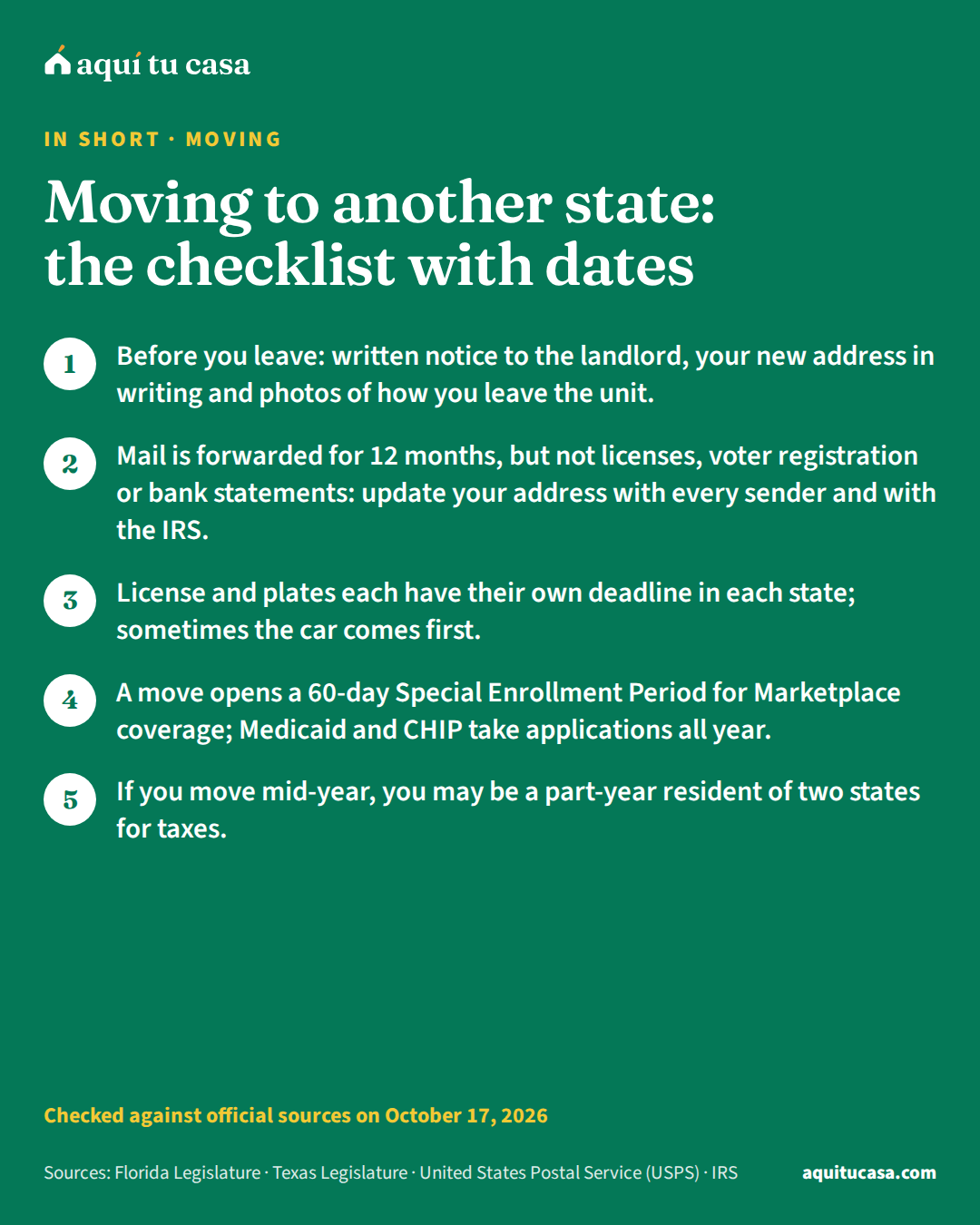
- Before you leave: written notice to the landlord, your new address in writing and photos of how you leave the unit.
- Mail is forwarded for 12 months, but not licenses, voter registration or bank statements: update your address with every sender and with the IRS.
- License and plates each have their own deadline in each state; sometimes the car comes first.
- A move opens a 60-day Special Enrollment Period for Marketplace coverage; Medicaid and CHIP take applications all year.
Is this for you?
This guide is for you if…
- You are about to move to another state (or just arrived) and want an ordered list of what comes before, during and after the move.
- You rent now and want your deposit back even after you no longer live in the same state.
- You have children in school, a car or Marketplace health coverage, and want to know which deadlines start with the move.
Get direct help first if…
- You are moving from Puerto Rico to Florida: that move has its own rules (birth certificates, island taxes); read the Puerto Rico to Florida guide.
- You have a question about your immigration case: this guide does not answer it; a Justice Department accredited representative or a legal aid organization can guide you.
- You received an eviction notice: read the guide on what to do if you get an eviction notice first.
Moving to another state is much more than packing: once you arrive, deadlines start running for the license, the plates, health coverage and voting, and when you leave you need to close out your lease properly to get your deposit back. This guide is for families moving from one state to another, renting or owning. We give you the list in order, with the dates official agencies publish, and point you to the full guide for each topic. You can do all of it yourself, without a middleman.
Your calendar: before, during and the first 90 days
Not everything happens on the same day. This is the list in the order things come due, from the day you decide to move until your first tax return in the new state. Car and license deadlines change by state: here we give sourced examples, and the table further down compares them.
Moving to another state, in order
1. Check your lease and give written notice
Before you move
Your lease says how much notice you give. In Florida, if you leave early or rent month to month, it is at least 7 days in writing, with the address where you can be reached.1
2. Request a change of address for your mail
One or two weeks before
Once approved, it takes 7-10 business days to take effect. Online it costs $1.25 to verify your identity; at the Post Office you bring acceptable ID.3
7. Pick a health plan if you need one
First 60 days
A permanent move opens a Marketplace Special Enrollment Period; you generally have 60 days to pick a plan.10
If you hire a moving company, the housing scams guide explains what to check before you sign. To see whether the first month’s money stretches far enough, build your family budget with the moving costs included.
Before you leave: notice to your landlord and your deposit
Start with your leaseleaseA lease, or rental agreement, is the contract in which the owner or landlord gives you the right to live in and use a property for a set period of time in exchange for payment, usually rent. While the lease lasts you have possession, but the landlord still owns the property. The lease says how much you pay and when, who handles maintenance and how the agreement can end. Your rights as a tenant are usually spelled out in the lease and in your state and local laws. Before complaining to the landlord, it helps to read the lease and make sure you are also following the rules you agreed to.See the full definition. It says how much notice you have to give and how. If your lease does not say, or you rent month to month (a month-to-month tenancymonth-to-month tenancyA month-to-month tenancy is a rental arrangement with no end date: it continues month after month as long as you pay the rent, until you or the landlord give notice to end it. It can be in writing, but it can also start without a contract, for example if you stay after your lease ends and the landlord accepts your payment. To end it, you must give the notice your state's law requires. In New York, for example, the notice alone does not let the landlord remove you: if you do not leave, the landlord has to go to court.See the full definition), state law sets the rules. In Florida, unless the written agreement says otherwise, a tenant who leaves before the term ends or rents month to month must give at least 7 days’ written notice, by certified mail or in person, and the notice must say where you can be reached. Without that notice you keep your right to the deposit, but the landlord is relieved of sending you its claim notice.1
Your new address is the key to your security depositsecurity depositA security deposit is money you pay the landlord when you start renting as security that you will follow the lease: pay the rent and take care of the home. The money still belongs to you. The landlord holds it and, when you move out, must return it minus the charges the law allows, such as past-due rent or damage beyond normal wear and tear. You should not be charged for damage that was already there when you moved in. The maximum amount and the deadline to return it depend on your state's law and sometimes your city's.See the full definition. In Texas, the landlord is not obligated to return it or explain the deductions until you give your new address in writing; you do not lose the right by not giving it, but the money waits.2 There, the landlord must refund it by the 30th day after you surrender the unit, and a clause requiring advance notice as a condition of the refund only counts if it is underlined or in conspicuous bold print in the lease.2 In Florida, a landlord who claims nothing has 15 days to return it; one who claims part of it has 30 days to send a notice by certified mail to your last known address (or by email), and you have 15 days after receiving it to object in writing.1 That is why your move-out notice should already include the new address.
Each state sets its own deadline to return the deposit. The table shows the deadline in the states we have verified, along with the typical rent and how many HUD-approved housing counseling agencies each one has.
Deposit, rent and counseling in each state
| State | Time to return the deposit | Typical rent | HUD-approved counselors |
|---|---|---|---|
| Alabama | 60 calendar days | $1,007 | 25 |
| Alaska | — | $1,419 | 1 |
| Arizona | 14 business days | $1,543 | 21 |
| Arkansas | 60 days | $947 | 14 |
| California | 21 days | $2,036 | 81 |
| Colorado | 1 day | $1,761 | 26 |
| Connecticut | — | $1,488 | 13 |
| Delaware | — | $1,401 | 12 |
| District of Columbia | — | $1,954 | 17 |
| Florida | 15 days | $1,669 | 98 |
| Georgia | 30 days | $1,393 | 42 |
| Hawaii | 14 days | $1,971 | 17 |
| Idaho | 21 days | $1,238 | 10 |
| Illinois | 45 days | $1,274 | 81 |
| Indiana | 45 days | $1,062 | 21 |
| Iowa | 30 days | $972 | 11 |
| Kansas | 30 days | $1,060 | 3 |
| Kentucky | — | $967 | 19 |
| Louisiana | 1 day | $1,064 | 26 |
| Maine | — | $1,139 | 7 |
| Maryland | 45 days | $1,705 | 41 |
| Massachusetts | 30 days | $1,762 | 37 |
| Michigan | 30 days | $1,129 | 59 |
| Minnesota | 21 days | $1,280 | 33 |
| Mississippi | 45 days | $954 | 16 |
| Missouri | 30 days | $1,033 | 18 |
| Montana | — | $1,081 | 11 |
| Nebraska | 14 days | $1,072 | 8 |
| Nevada | 30 days | $1,597 | 8 |
| New Hampshire | 30 days | $1,491 | 5 |
| New Jersey | 30 days | $1,720 | 34 |
| New Mexico | — | $1,067 | 7 |
| New York | 14 days | $1,621 | 93 |
| North Carolina | 30 days | $1,228 | 52 |
| North Dakota | 30 days | $954 | 3 |
| Ohio | 30 days | $1,034 | 54 |
| Oklahoma | 45 days | $1,014 | 6 |
| Oregon | 31 days | $1,525 | 25 |
| Pennsylvania | 30 days | $1,209 | 75 |
| Puerto Rico | — | $578 | 9 |
| Rhode Island | 20 days | $1,342 | 5 |
| South Carolina | 30 days | $1,180 | 13 |
| South Dakota | 21 days | $946 | 13 |
| Tennessee | — | $1,189 | 32 |
| Texas | 30 days | $1,403 | 51 |
| Utah | 30 days | $1,496 | 7 |
| Vermont | 14 days | $1,234 | 7 |
| Virginia | 45 days | $1,579 | 49 |
| Washington | 30 days | $1,760 | 15 |
| West Virginia | — | $872 | 8 |
| Wisconsin | 21 days | $1,087 | 26 |
| Wyoming | 30 days | $992 | 1 |
The deposit deadline comes from each state's law; typical rent, from the American Community Survey; agencies, from HUD's list. Source: each state's laws · Census Bureau (ACS) · HUD
Mail, the IRS and your new address
The Postal Service asks you to submit a permanent change of address when you move. You must submit the request and verify your identity; once it is approved, it takes at least 7-10 business days to take effect. Online you pay $1.25 to verify your identity with a card whose billing address is your old or new address. If you cannot verify it online, you go to a Post Office with acceptable ID and fill out PS Form 3575 from the free Mover’s Guide packet.3
Standard forwarding lasts 12 months, but it does not forward everything. Government agencies and banks do not allow sensitive documents to be forwarded: identity documents (especially licenses and voter registration), credit cards, bank statements and insurance or medical information. And the change of address only covers the mail: you have to tell every agency, company and person who writes to you.3
The IRS is one of those senders. If you move before filing your tax returntax returnA tax return is the yearly form you use to report your income to the IRS and figure the tax you owe, so you can pay what is due or get a refund. The federal return for individuals is Form 1040. In general you must file if your gross income is above the minimum the IRS sets for your filing status, or if you had a certain amount of net earnings from self-employment; even when you do not have to, filing can pay off. You need your SSN or ITIN, and those of everyone else on the return, plus documents such as your W-2s and 1099s.See the full definition, put the new address on it. If you already filed, you can send Form 8822, write or call with your name, both addresses and your Social Security number, ITIN or EIN. The IRS notes that not all post offices forward government checks and that the change generally takes 45 days to process.4
The car: license, plates and insurance in your new state
This is the task with the shortest deadlines, and sometimes the order matters. In Texas, for example, your vehicles must be registered before you apply for the license;15 in North Carolina it is the other way around: license first, then registration.18 This is what the official pages we checked say:
| State | Register the car | License | Insurance |
|---|---|---|---|
| Florida | Within 10 days of establishing residency14 | Within 30 days14 | From an agent licensed in Florida, before registering14 |
| Texas | 30 days from the time you move16 | You can drive on your old license for up to 90 days; register the car first15 | Minimums of $30,000 per injured person, $60,000 per accident and $25,000 for property damage16 |
| New York | With New York insurance17 | Within 30 days of becoming a resident17 | Out-of-state insurance is not accepted for a car registered in New York17 |
| North Carolina | When you take a job or the reciprocity period ends (usually 30 days), whichever comes first18 | Within 60 days of establishing a permanent residence18 | North Carolina insurance; out-of-state policies are not accepted18 |
| California | Within 20 days of becoming a resident or getting a job19 | See the driver’s license by state guide | See the driver’s license by state guide |
If you are leaving New York, the order is different: surrender the registration and plates to the DMV before you cancel your New York insurance. If the insurance lapses while the plates are active, the registration is suspended and the license may be too, even after you live in another state.17 The driver’s license by state guide explains the documents each state asks for, what REAL ID is and which states license people who cannot show lawful presence.

Voting in your new state
If you are a citizen, your registration does not travel with you. USAGov says that if you move outside your state, you must register in the new one. On vote.gov you choose your state and see the deadline and how to register; every state except New Hampshire, Wyoming and North Dakota accepts the national mail-in form. Most counties and states do not require you to cancel the old registration.5 Each state has its own deadline, which can be as much as a month before the election.6
Health coverage: a move opens a Special Enrollment Period
Outside Open Enrollment (November 1 to January 15), you can only enroll in or change a Marketplace plan if you qualify for a Special Enrollment Period. Moving to a home in a new ZIP code or county can give you one; moving only for medical treatment or staying somewhere on vacation does not.8 You generally have 60 days from the move to pick a plan. For a permanent move, the rule asks that you had coverage for at least one day in the 60 days before, unless you lived in a foreign country or a U.S. territory.10 Medicaid and CHIP take applications any time.9
Mixed-status families should know one rule: citizens, nationals and lawfully present immigrants can get Marketplace coverage if they are eligible; undocumented immigrants cannot, but they can apply for family members who have documents, such as their children.11
Your children’s school
Apply at the new school as early as you can. Under the federal school records privacy rule (FERPA), the old school may send the records, without asking your permission, to the school where your child is enrolling.12 The old school must try to notify you at your last known address, unless you made the request, and give you a copy of what it sent if you ask.13 Ask for that copy: if something gets lost along the way, you have the backup. Keep it with the vaccination records and report cards.
State taxes in the year of the move
Each state decides its own income taxes. If you move mid-year, you may owe a return in each state. California explains that someone who lived inside and outside the state during the year may be a part-year resident, paying tax on everything received while living there and on California-source income afterward.20 New York says something similar: if you were a resident for only part of the year, your income is split between resident and nonresident rules.21 Florida does not impose a personal income tax.22
You do not have to sort this out alone. The IRS VITAVITA (free tax preparation)VITA (Volunteer Income Tax Assistance) and TCE (Tax Counseling for the Elderly) are IRS programs that offer free basic tax return preparation by IRS-certified volunteers. They are meant for people with moderate income, people with disabilities and limited-English speakers; TCE focuses on people sixty and older. The IRS sets no program-wide income limit, but individual sites may set their own. Many sites serve in Spanish and help with ITIN applications and renewals. Filing taxes every year builds the record lenders ask for.See the full definition and TCE programs prepare basic returns for free for people who qualify, including limited English speakers; you find the nearest site with the VITA Locator Tool or by calling 800-906-9887.23 Bring the W-2s from both states and the dates of the move.
What it costs to live in your new state
Before you sign a new lease, compare. The chart shows each state’s typical rent according to the Census Bureau; county numbers are under Places.

With your new county’s rent, the how much rent can I afford calculator shows what fits your income, and the guide to a family budget with several incomes helps you split the first month’s costs. If you will open electricity, gas or internet accounts in your new home without a Social Security number, read setting up utilities without an SSN before you call the company.

If this is you
What matters most for your situation
You rent and are moving out
Give written notice with your new address1 and keep proof that you delivered it. In Texas, without that address in writing the deposit can sit and wait.2
You are moving with children
Ask the school for a copy of the records it sends13 and check the Marketplace Special Enrollment Period; Medicaid and CHIP take applications all year.9
Your family has mixed status
You give the IRS your new address with your ITIN.4 On the Marketplace, an undocumented parent can apply for coverage for children who have documents.11
You want free help
A HUD-approved housing counselor can guide you on renting in your new state,24 and legal aid can help if your deposit is not returned.25

Costly mistakes
The mistake and what to do instead
Mistake: Leaving without giving your new address in writing.
Instead: Give it to the landlord in writing: in Texas, without it the landlord does not have to return your deposit yet.2
Mistake: Counting on the mail to forward everything.
Instead: Licenses, voter registration and bank statements are not forwarded; update your address with every sender.3
Mistake: Canceling New York insurance before surrendering the plates.
Instead: Surrender the registration and plates first; otherwise the registration is suspended and maybe the license.17
Mistake: Waiting for Open Enrollment to get health coverage.
Instead: A move opens a Special Enrollment Period: you generally have 60 days to pick a plan.10
Mistake: Assuming you only file in one state.
Instead: If you moved mid-year, you may be a part-year resident of both.20
What to do this week
- Read the notice clause in your lease and give written notice, with your new address and a copy for yourself.1
- Request a permanent USPS change of address one or two weeks before the move.3
- Make a list of senders (bank, employer, IRS, insurance, school) and notify them yourself, because the mail does not forward everything.3
- On your new state’s official motor vehicle page, look up how many days you have for the car and the license, and put them on your calendar.14
- If you need health coverage, mark 60 days from the move on your calendar.10
- If you want help renting or buying in your new state, search by ZIP code for a HUD-approved housing counselor; it is often free.24 The HUD-approved housing counselors guide explains what to expect, and free legal aid explains how to ask for help with a deposit problem.
Your household this month
Let's do the math
Left each month
Enter what at least one person takes home to see the result.
What helps
- Pay savings first: set the goal aside the day the money arrives, before flexible spending.
- Add up the bills that come every few months (car insurance, school) and divide by twelve.
- If income changes, plan on a low month and save the extra from good months.
- A HUD-approved housing counselor can go over the budget with you, often for free.
This is a planning tool with your numbers, not a credit evaluation or an approval. The split reference is only a guide.
Ready to see the numbers? Find your county here
See how this applies in your county: its loan limits, prices and rents, from the official data.
Printable checklist
Frequently asked questions
How long do I have to switch my driver's license after moving to another state?
It depends on the state you move to. Florida and New York give you 30 days; North Carolina, 60; in Texas you can drive on your other-state license for up to 90 days. The driver's license by state guide compares the states with their sources.
Will my mail follow me to my new home?
Yes, if you request a permanent change of address with USPS: standard forwarding lasts 12 months. But driver's licenses, voter registration, credit cards and bank statements are not forwarded, so you have to tell each agency and company yourself.
How do I get my deposit back after I've left the state?
Give the landlord your new address in writing. In Texas, the landlord does not have to return it until you do; in Florida, the claim notice goes to your last known address and you have 15 days to object in writing. If it is not returned, a legal aid organization can guide you for free.
Can I change my health plan if I move to another state?
Yes. Moving to a new ZIP code or county opens a Special Enrollment Period on the Marketplace, and you generally have 60 days to pick a plan. Many people need to have had coverage for at least one day in the 60 days before the move, unless they lived in a foreign country or a territory. Medicaid and CHIP take applications any time.
Do I have to file taxes in both states the year I move?
Possibly. California and New York explain that someone who lives part of the year in the state may be a part-year resident and file there for that part of the year. Florida has no personal income tax. A VITA site can help you with a basic return for free if you qualify.
How do I give the IRS my new address if I have an ITIN?
The same way as with a Social Security number: put the new address on your next return, or send Form 8822, write or call with your name, both addresses and your ITIN. The IRS says the change generally takes 45 days to process.
Do I register to vote in my new state?
If you are a U.S. citizen, yes: when you move to another state you must register there. On vote.gov you choose your state and see the deadline, which can be as much as a month before the election. Non-citizens, including permanent residents, cannot vote in federal or state elections.
Sources
Every figure in this guide comes from one of these official sources. The number next to a sentence leads to the source behind it.
Each source on one line: who publishes it, its title, its address and the date we read it.
- 1. Florida Legislature · Florida Statutes §83.49, Deposit money or advance rent; duty of landlord and tenant · leg.state.fl.us · Accessed October 17, 2026
- 2. Texas Legislature · Texas Property Code, Chapter 92 (Residential Tenancies), §§92.103 and 92.107 · tcss.legis.texas.gov · Accessed October 17, 2026
- 3. United States Postal Service (USPS) · Standard Forward Mail & Change of Address · usps.com · Accessed October 17, 2026
- 4. IRS · Topic no. 157, Change your address – How to notify the IRS · irs.gov · Accessed October 17, 2026
- 5. USAGov (General Services Administration) · How to update or change your voter registration · usa.gov · Accessed October 17, 2026
- 6. USAGov (General Services Administration) · Voter registration deadlines · usa.gov · Accessed October 17, 2026
- 7. USAGov (General Services Administration) · Who can and cannot vote · usa.gov · Accessed October 17, 2026
- 8. HealthCare.gov (Centers for Medicare & Medicaid Services) · Getting health coverage outside Open Enrollment (Special Enrollment Periods) · healthcare.gov · Accessed October 17, 2026
See the other 17 sources
- 9. HealthCare.gov (Centers for Medicare & Medicaid Services) · Special Enrollment Period (SEP) - Glossary · healthcare.gov · Accessed October 17, 2026
- 10. HHS (Code of Federal Regulations, text at Cornell LII) · 45 CFR §155.420, Special enrollment periods · law.cornell.edu · Accessed October 17, 2026
- 11. HealthCare.gov (Centers for Medicare & Medicaid Services) · Health coverage for immigrants · healthcare.gov · Accessed October 17, 2026
- 12. Department of Education (Code of Federal Regulations, text at Cornell LII) · 34 CFR §99.31, Under what conditions is prior consent not required to disclose information? (FERPA) · law.cornell.edu · Accessed October 17, 2026
- 13. Department of Education (Code of Federal Regulations, text at Cornell LII) · 34 CFR §99.34, What conditions apply to disclosure of information to other educational agencies or institutions? (FERPA) · law.cornell.edu · Accessed October 17, 2026
- 14. Florida Department of Highway Safety and Motor Vehicles (FLHSMV) · New Resident - Welcome to Florida! · flhsmv.gov · Accessed October 17, 2026
- 15. Texas Department of Public Safety (DPS) · Moving to Texas: A Guide to Driver Licenses and IDs · dps.texas.gov · Accessed October 17, 2026
- 16. Texas Department of Motor Vehicles (TxDMV) · New to Texas · txdmv.gov · Accessed October 17, 2026
- 17. New York State Department of Motor Vehicles (DMV) · Moving To Or From New York State · dmv.ny.gov · Accessed October 17, 2026
- 18. North Carolina Division of Motor Vehicles (NCDMV) · Moving to N.C. (new residents) · ncdot.gov · Accessed October 17, 2026
- 19. California Department of Motor Vehicles (DMV) · California Driver's Handbook, Section 11: Vehicle Registration Requirements · dmv.ca.gov · Accessed October 17, 2026
- 20. California Franchise Tax Board (FTB) · Part-year resident and nonresident · ftb.ca.gov · Accessed October 17, 2026
- 21. New York State Department of Taxation and Finance · Nonresidents and part-year residents (frequently asked questions) · tax.ny.gov · Accessed October 17, 2026
- 22. Florida Department of Revenue · Tax Information for New Residents (GT-800025) · floridarevenue.com · Accessed October 17, 2026
- 23. IRS · Free tax return preparation for qualifying taxpayers (VITA and TCE) · irs.gov · Accessed October 17, 2026
- 24. CFPB · Find a housing counselor · consumerfinance.gov · Accessed October 17, 2026
- 25. Legal Services Corporation (LSC) · I Need Legal Help · lsc.gov · Accessed October 17, 2026
Keep reading
Related guides
If this guide helped, these follow the same path.

Moving 13 minute read
Electricity, water and internet without an SSN
How to set up electricity, gas, water and internet without a Social Security number: accepted ID, when deposits apply, how to avoid them, Lifeline, scams.
- Find out who provides each service at your address: electricity and gas from a regulated company follow the state commission's rules; water is sometimes municipal and internet is separate.
- Illinois accepts a foreign passport or consular ID, and the Social Security number is only one of several options for the second ID.
- To avoid or lower a deposit: a payment history letter from your previous utility, a guarantor or a letter of guarantee, depending on the state.
- Renting Security deposits: how much and how to get yours back What a security deposit is, how much a landlord may charge in your state, what can be deducted, when it must be returned and where to complain if it isn't. 14 minute read
- Renting Your lease explained: what to check before you sign What a lease is, which clauses to read before you sign, the lead paint disclosure, your fair housing rights and where to get free help. 15 minute read
Tools for this topic
Was this guide useful?
Thank you. Your answer stays in your browser; nothing is sent.