Electricity, water and internet without an SSN
How to set up electricity, gas, water and internet without a Social Security number: accepted ID, when deposits apply, how to avoid them, Lifeline, scams.
Verified against official sources on October 17, 2026 21 official sources

Show contents
In short
What you need to know
Quick answer
In many states you can set up electricity and gas without a Social Security number, but each state sets its own rules. In Illinois, the utility may ask for a government photo ID, which can be your country's passport or a consular ID, and you choose the second ID from a list where the Social Security number is just one option. In New York, an oral application is complete with your name, address and phone number, and in general a new customer cannot be charged a deposit. Where deposits do apply, the rules offer alternatives: a letter from your previous utility, a guarantor or a letter of guarantee. For internet, the federal help is Lifeline, although its application asks for the last four digits of a Social Security number or a Tribal ID.
What matters most
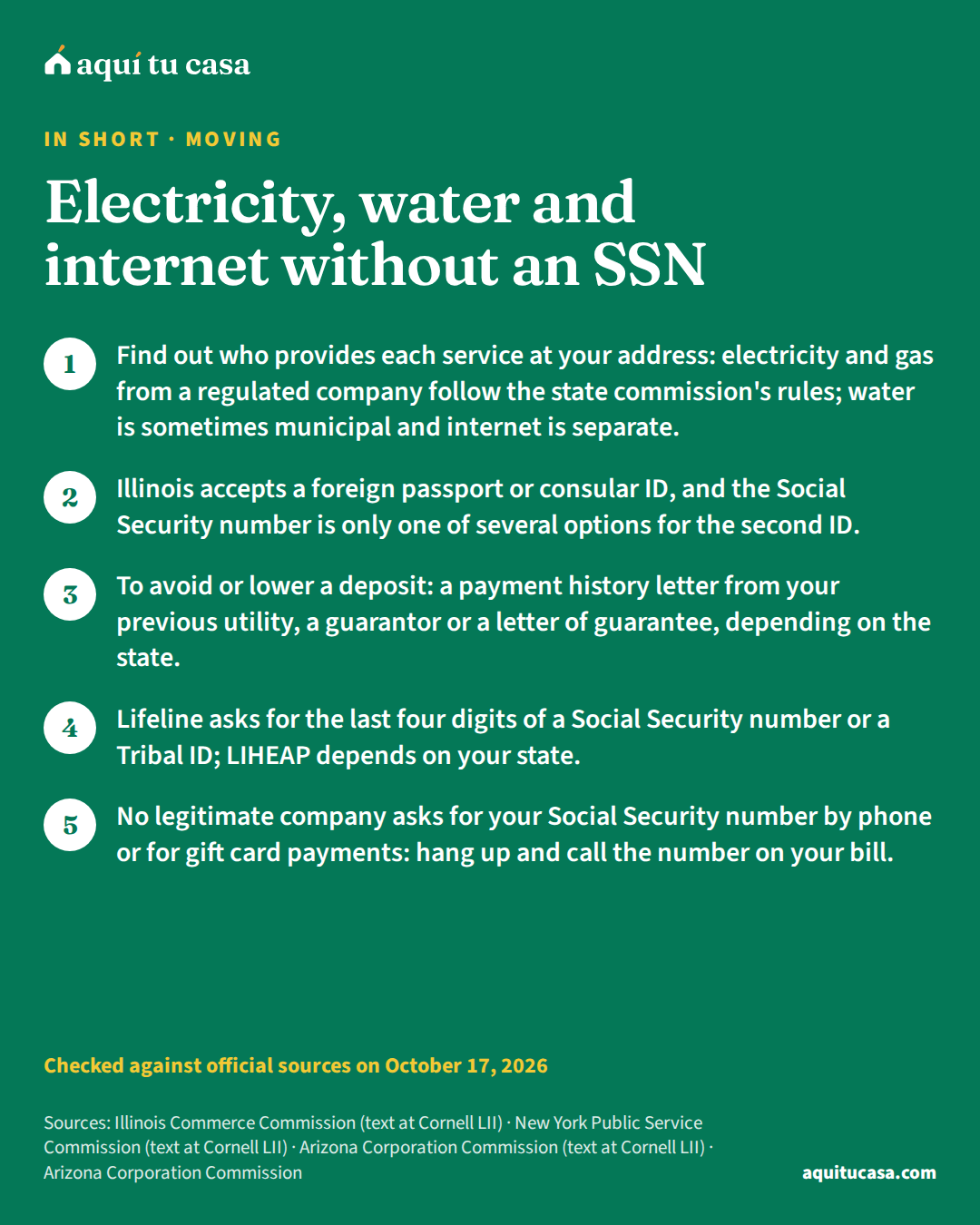
- Find out who provides each service at your address: electricity and gas from a regulated company follow the state commission's rules; water is sometimes municipal and internet is separate.
- Illinois accepts a foreign passport or consular ID, and the Social Security number is only one of several options for the second ID.
- To avoid or lower a deposit: a payment history letter from your previous utility, a guarantor or a letter of guarantee, depending on the state.
- Lifeline asks for the last four digits of a Social Security number or a Tribal ID; LIHEAP depends on your state.
Is this for you?
This guide is for you if…
- You are setting up electricity, gas, water or internet in your new home and do not have a Social Security number, or prefer not to give it.
- You were asked for a deposit because you have no credit history and want to know what alternatives your state's rules offer.
- Someone called claiming to be from the power company and asked for information or a payment, and you are not sure it is real.
Get direct help first if…
- You already have a shutoff notice for nonpayment: the utility shutoffs guide explains the deadlines and protections.
- You have questions about your immigration situation: this guide does not answer them; a Justice Department accredited representative or a legal aid organization can guide you.
Setting up electricity, gas, water and internet is one of the first things you do in a new home. If you do not have a Social Security number, or prefer not to give it, this guide explains what the official rules say: what ID you can be asked for, when you can be charged a deposit, how to avoid it, what help exists to pay and how to recognize scams. We checked the rules of six states, each with its source. This guide does not cover your immigration situation; if you have questions about your case, an accredited representative can guide you.21
- For an Illinois utility to approve or reject your completed application
- 2 business days1
- For a New York utility to provide service after a completed application
- 5 business days5
- Cap on an Arizona residential deposit: twice the estimated average monthly bill
- 2 times7
- Maximum monthly Lifeline discount on phone or internet
- $9.2512
First: who provides each service and who oversees it
Not every service follows the same rules. Electricity and gas companies regulated by your state’s public utility commission follow the ID and deposit rules you will see below. In Illinois, those rules also cover water and sewer utilities.1 But not everything goes through the commission: in Arizona, for example, its staff investigates disputes about deposits and refusals of service, but does not handle complaints about municipal utilities or about internet or cable TV.8
Three services, three paths
Regulated company
Electricity and gas
Sometimes municipal
Water and sewer
Before you call, find out who provides the service at your address: your landlord, the city or the previous tenant's bill can tell you.
What ID you can be asked for
This is where states differ the most. Illinois has the most detailed rule we found: the utility may require up to two forms of ID. One must be a government-issued photo ID, and the rule expressly includes a foreign passport and consular identification documents, such as the matrícula consularconsular ID cardA Matricula Consular is an official Mexican government ID document issued by Mexico's consulates in the United States. Other countries offer similar IDs, sometimes called consular identification (CID) cards. According to the CFPB, many banks require a U.S. or state government-issued photo ID; if you do not have one, some banks and credit unions accept foreign passports and consular IDs such as the Matricula, but not all, and the CFPB suggests asking first. You usually also need another document, such as a bill with your name and address, and an interest-bearing account requires an SSN or ITIN.See the full definition. You choose the second from a list where the Social Security number is only one option, along with a birth certificate, immigration documents, banking information, employment records or a tax ID number such as an ITINITIN (Individual Taxpayer Identification Number)An ITIN is a nine-digit number the IRS, the federal tax agency, issues to people who need a U.S. taxpayer identification number to file taxes and are not eligible for a Social Security number. It is for tax purposes only: it does not authorize you to work in the United States, does not qualify you for Social Security benefits or the Earned Income Tax Credit, and says nothing about your immigration status. You apply with Form W-7, and it expires if it goes unused for several years. Some lenders accept an ITIN for a mortgage.See the full definition. The utility may not oblige you to provide one instead of another and must post the IDs it accepts on its website.1
In New York, the utility must provide service when you ask by phone or in writing, and an oral application is complete with your name, address, phone number and your prior account address, if you had one. It may ask for reasonable proof of identity through non-discriminatory procedures, and deny service if you do not provide it.5 In Arizona, the minimum information a utility may ask for includes your name, the service address, your phone number and where you had service before, and the utility may ask you to come to its office with proof of identity to sign the application.7
The deposit: when you can be charged one, state by state
If the utility cannot check your credit historycredit historyYour credit history is the record of your credit accounts and of whether you paid them on time, as shown in your credit report. Credit reporting companies collect and update this information and provide it to other businesses, which use it to make decisions about you. A good history helps you get housing, bank accounts, cards and loans, and lowers the interest you pay. If you have no history, or very little (a thin file), there may not be enough information to produce a score. Paying with a debit card, cash or a prepaid card usually does not build it.See the full definition, several of the rules we checked allow it to ask you for a deposit; in Texas, for example, the provider may require one before providing service.9 This is what each rule says:
| State | Deposit for a new customer? | Cap or calculation | Alternatives the rule offers |
|---|---|---|---|
| New York | Generally no, except seasonal or short-term customers, or as the commission authorizes6 | Where allowed, no more than twice the average monthly bill for the year (or the heating season)6 | No deposit for people receiving public assistance or SSI, or for people 62 and older without recent shutoffs6 |
| Illinois | Only in certain cases: a past shutoff for nonpayment, an unpaid final bill or a credit scorecredit scoreA credit score is a number that predicts how likely you are to pay back a loan on time. It is computed from the information in your credit report: whether you pay on time, how much you owe relative to your limits, how long you have used credit and how many new accounts you opened. FICO is one brand of score; VantageScore is another, and each lender decides which one it uses. A higher score usually brings a lower interest rate and more loan options; each program publishes the minimum it accepts. You can check your report for free and dispute errors.See the full definition below the utility’s minimum2 | One third on the first bill and the rest over the next two2 | Low-income customers are not charged a deposit based on credit scoring3 |
| Texas (electricity) | Yes, if you cannot show satisfactory credit9 | The greater of one-fifth of the estimated annual bill or the estimated bills for the next two months9 | With any provider: age 65 or older, or a family violence victim; with an affiliated provider or provider of last resort, also history with another provider9 or a letter of guarantee instead of the deposit9 |
| Florida (electricity) | A deposit is one way to establish credit10 | Each utility’s tariff states how it is calculated10 | A guarantor who is a customer of the utility with a good payment record, or an irrevocable bank letter of credit or surety bond10 |
| Arizona (electricity) | No, if you have history with that utility or a letter from your previous one7 | Up to twice the estimated average monthly bill7 | A letter of guarantee from a government or nonprofit entity, or a surety bond7 |
| New Jersey | May require a reasonable deposit11 | Two times the average monthly bill for the previous 12 months11 | The utility posts its credit and deposit requirements on its website11 |
Deposits are not lost money. In Arizona they earn interest and are refunded after 12 months of service if you were not late more than twice.7 In Florida, the utility refunds them after 23 months of continuous service with a good record and pays at least 2 percent interest a year.10 In Texas the provider also pays interest,9 and in New Jersey it must tell you the interest rate and give you a receipt.11
Example with real numbers
Example: how the Texas deposit cap is calculated
A Texas electricity provider asks you for a deposit because you cannot show satisfactory credit. The rule sets the cap like this:
- First amount
- One-fifth of your estimated annual billing9
- Second amount
- The sum of the estimated bills for the next two months9
- What goes into the estimate
- Only the electricity charges disclosed in the provider's terms of service9
- Deposit cap
- The greater of the two amounts9
This is an example of the rule, without figures: ask the provider for the calculation in writing and add the deposit to your first month's budget.
Run it with your numbersFamily budget
How to avoid or lower the deposit
The rules we checked offer several ways out; ask about them on the first call:
- A letter from your previous utility. In Arizona, a letter from the electric utility where you last had service stating that you paid on time avoids the deposit.7 In Texas, the provider keeps your payment history for two years to give you a letter if you ask, and having been a customer of another provider in the prior two years, with no delinquency and at most one late payment in the last 12 months, counts as good credit with an affiliated provider or provider of last resort.9
- A guarantor or a letter of guarantee. In Florida, a guarantor who is a customer of the utility with a good payment record establishes your credit.10 In Arizona, a letter of guarantee from a government or nonprofit entity works,7 and in Texas an affiliated provider or provider of last resort must offer you a letter of guarantee instead of a cash deposit.9
- Your age or circumstances. In Texas, being 65 or older with no delinquent electric account, or being certified as a family violence victim, counts as good credit, and the deposit notice must mention these options.9 In New York, utilities may not require a deposit from people receiving public assistance or SSI, or from people 62 and older without recent shutoffs.6
- Your income. In Illinois, if you qualify as a low-income customer through LIHEAP,4 you cannot be charged a deposit based on your credit score.3

Internet and phone: Lifeline
For internet and cell service we did not find state deposit rules like those for electricity. The federal help is Lifeline: a program that lowers the monthly cost of phone or internet service, with a discount of up to $9.25 a month. Only one discount is allowed per household, meaning people who live together and share income and expenses, and if you change your address you must tell your company within 30 days.12 You qualify if you or someone in your household participates in programs such as Medicaid, SNAP, SSI, public housing or Section 8, if your income is at or below 135% of the Federal Poverty Guidelines, or if your child or dependent participates in a qualifying program.13
There is an important point for families without a Social Security number: the application asks for the last four digits of your Social Security number or your Tribal ID number, and the address can be temporary.14 The federal rule requires that information from the subscriber, except for members of a Tribal nation without a Social Security number, who give their Tribal ID.16 You apply online, through a participating company or by mail, with an application in Spanish available; in Texas and Oregon, on the state’s website.15 If you have questions about who in your household can apply, call the Lifeline Support Center at (800) 234-9473.14
LIHEAP: help paying for electricity and gas
LIHEAPLIHEAP (Low Income Home Energy Assistance Program)LIHEAP (the Low Income Home Energy Assistance Program) is a federally funded program that helps with home energy costs, such as heating and cooling. According to the Administration for Children and Families (ACF), it can help with bills, energy crises, preventing shutoffs or reconnecting service, weatherization and minor energy-related repairs. It targets low-income households with a high energy burden or with members who are elderly, disabled or young children. You apply through your local LIHEAP office, and the program does not charge a fee for help.See the full definition can help you pay heating or cooling bills or get emergency services during an energy crisis; depending on where you live, it also helps with the electric bill. Eligibility depends on your income, but each state and territory sets its own requirements.17 The guide LIHEAP: help with utility bills explains how to apply in your state, and utility shutoffs what to do if you already have a shutoff notice. To organize the first month, a HUD-approved housing counselor can help you with a budget, often for free.19
Scams: no legitimate company asks for your number by phone
When you move, you get calls and emails from new companies, and it is easy to mistake a fake one for the real thing. The New York Department of Public Service explains that scammers impersonate utility companies or government agencies, demand payment by gift card, cryptocurrency, wire transfer or payment app, and sometimes claim the federal government is providing bill credits and ask for Social Security numbers. Genuine utilities do not contact you to ask for passwords, Social Security numbers or bank details by phone or email, and they typically send several disconnection notices by mail before a shutoff.18
If you are denied service or overcharged
Always ask for the reasons and the terms in writing. In Illinois, the utility must give you the specific reasons if it rejects your application,1 and the deposit notice must be in writing and explain the reason and the amount.2 If the company is regulated, you can turn to your state’s public utility commission; in Arizona, for example, its staff investigates disputes about deposits and refusals of service.8 If the problem gets complicated, a legal aidlegal aidLegal aid is the free civil legal help that nonprofit organizations and their lawyers provide to low-income people in civil, not criminal, matters. In housing, that includes representing families facing eviction or foreclosure, alongside matters such as custody, child support, protection from domestic violence and access to benefits. In the United States, the Legal Services Corporation, created by Congress, funds a nationwide network of these organizations; its finder points you to the one in your area. Each sets its own income limits.See the full definition organization can guide you; the LSC has a search tool by address or city.20
If this is you
What matters most for your situation
You have a passport or ITIN, but no Social Security number
In Illinois your country's passport or a consular ID works, and the Social Security number is only one option for the second ID.1
You have no U.S. credit history
Ask your previous utility for a payment history letter: in Arizona it avoids the deposit.7 In Florida, a guarantor with a good record also works.10

Costly mistakes
The mistake and what to do instead
Mistake: Giving your Social Security number to someone who calls from 'the company'.
Instead: Hang up and call the number on your bill or the official website yourself.18
Mistake: Paying with a gift card or wire transfer because they demand it.
Instead: Legitimate utilities do not demand those payment methods.18
Mistake: Paying the deposit without asking about alternatives.
Instead: In Texas, the deposit notice must include the options to show credit;9 in Arizona, a letter from your previous utility can avoid it.7
Mistake: Losing the deposit receipt.
Instead: In New Jersey the utility must give you a receipt and tell you the interest rate; keep them.11
Mistake: Forgetting the deposit after a year or more of on-time payments.
Instead: In Arizona it is refunded after 12 months with no more than two late payments;7 in Florida, after 23 months with a good record.10
What to do this week
- Ask your landlord or the city which company provides each service at your address, and whether electricity and gas come from a regulated company.8
- Before you call, check the company’s website for the IDs it accepts and its deposit requirements.1
- Ask your previous utility for a payment history letter today.7
- If you are asked for a deposit, ask about alternatives and get the calculation and receipt in writing.11
- If your income is low, check LIHEAP in your state17 and, for internet, whether someone in your household qualifies for Lifeline.13
- Save each company’s official numbers, copied from the bill, in your phone to check any call.18 For the rest of the move, use the checklist for moving to another state, and for the license, the driver’s license by state guide.
Your household this month
Let's do the math
Left each month
Enter what at least one person takes home to see the result.
What helps
- Pay savings first: set the goal aside the day the money arrives, before flexible spending.
- Add up the bills that come every few months (car insurance, school) and divide by twelve.
- If income changes, plan on a low month and save the extra from good months.
- A HUD-approved housing counselor can go over the budget with you, often for free.
This is a planning tool with your numbers, not a credit evaluation or an approval. The split reference is only a guide.
Ready to see the numbers? Find your county here
See how this applies in your county: its loan limits, prices and rents, from the official data.
Printable checklist
Frequently asked questions
Can I set up electricity without a Social Security number?
In many cases yes, but it depends on the state and the company. In Illinois, the utility may ask for a government photo ID, which can be your country's passport or a consular ID, and you choose the second from a list where the Social Security number is just one option. In New York, an oral application is complete with your name, address and phone number, although you may be asked for proof of identity.
Will I be charged a deposit if I have no credit history?
It depends on the state. In Texas, if you cannot show satisfactory credit, the provider may require a deposit, and in Florida a deposit is one of the ways to establish credit. In New York, a new residential customer generally cannot be required to post a deposit. Always ask about alternatives before you pay.
How do I avoid an electricity deposit?
The rules we checked offer several ways out. In Arizona, a letter from your previous electric utility stating that you paid on time avoids the deposit, and so does a letter of guarantee from a government or nonprofit entity. In Florida, a guarantor who is a customer of the utility with a good payment record works. In Texas, an affiliated provider or provider of last resort must offer you a letter of guarantee instead of a cash deposit.
Do I get my utility deposit back?
Yes, under each state's rules. In Arizona it is refunded with interest after 12 months if you were not late more than twice; in Florida, after 23 months of continuous service with a good payment record. Texas, Arizona and Florida require interest on deposits, and in New Jersey you must be given a receipt.
Can I get Lifeline for internet without a Social Security number?
The Lifeline application asks for the last four digits of your Social Security number or a Tribal ID number, and the federal rule requires that information. Only one discount is allowed per household. If you have questions about your situation, call the Lifeline Support Center at (800) 234-9473.
Can the power company ask for my Social Security number by phone?
The New York Department of Public Service says genuine utilities do not contact you to ask for your Social Security number, passwords or bank details by phone or email. If you get a call, hang up and call the number on your bill or the official website yourself.
Who do I complain to if I am denied service or charged an unfair deposit?
To your state's public utility commission, if the company is regulated. In Arizona, for example, the commission investigates disputes about deposits and refusals of service, but not those about municipal utilities or internet providers. In Illinois, the deposit notice must give you the contact for the commission's consumer services division.
Sources
Every figure in this guide comes from one of these official sources. The number next to a sentence leads to the source behind it.
Each source on one line: who publishes it, its title, its address and the date we read it.
- 1. Illinois Commerce Commission (text at Cornell LII) · 83 Ill. Adm. Code 280.30, Application for Service · law.cornell.edu · Accessed October 17, 2026
- 2. Illinois Commerce Commission (text at Cornell LII) · 83 Ill. Adm. Code 280.40, Deposits · law.cornell.edu · Accessed October 17, 2026
- 3. Illinois Commerce Commission (text at Cornell LII) · 83 Ill. Adm. Code 280.45, Deposits for Low Income Customers · law.cornell.edu · Accessed October 17, 2026
- 4. Illinois Commerce Commission (text at Cornell LII) · 83 Ill. Adm. Code 280.20, Definitions · law.cornell.edu · Accessed October 17, 2026
- 5. New York Public Service Commission (text at Cornell LII) · 16 NYCRR §11.3, Applications for residential service · law.cornell.edu · Accessed October 17, 2026
- 6. New York Public Service Commission (text at Cornell LII) · 16 NYCRR §11.12, Deposits · law.cornell.edu · Accessed October 17, 2026
- 7. Arizona Corporation Commission (text at Cornell LII) · Ariz. Admin. Code R14-2-203, Establishment of service (electric utilities) · law.cornell.edu · Accessed October 17, 2026
- 8. Arizona Corporation Commission · Consumer Services · azcc.gov · Accessed October 17, 2026
See the other 13 sources
- 9. Public Utility Commission of Texas (text at Cornell LII) · 16 Tex. Admin. Code §25.478, Credit Requirements and Deposits · law.cornell.edu · Accessed October 17, 2026
- 10. Florida Public Service Commission (text at Cornell LII) · Fla. Admin. Code R. 25-6.097, Customer Deposits · law.cornell.edu · Accessed October 17, 2026
- 11. New Jersey Board of Public Utilities (text at Cornell LII) · N.J. Admin. Code §14:3-3.4, Deposits · law.cornell.edu · Accessed October 17, 2026
- 12. Universal Service Administrative Company (USAC), Lifeline Support · About Lifeline · lifelinesupport.org · Accessed October 17, 2026
- 13. Universal Service Administrative Company (USAC), Lifeline Support · How to Qualify · lifelinesupport.org · Accessed October 17, 2026
- 14. Universal Service Administrative Company (USAC), Lifeline Support · Frequently Asked Questions · lifelinesupport.org · Accessed October 17, 2026
- 15. Universal Service Administrative Company (USAC), Lifeline Support · How to Apply · lifelinesupport.org · Accessed October 17, 2026
- 16. FCC (Code of Federal Regulations, text at Cornell LII) · 47 CFR §54.410, Subscriber eligibility determination and certification (Lifeline) · law.cornell.edu · Accessed October 17, 2026
- 17. USAGov (General Services Administration) · Get help with energy bills · usa.gov · Accessed October 17, 2026
- 18. New York State Department of Public Service · Utility Scams · dps.ny.gov · Accessed October 17, 2026
- 19. CFPB · Find a housing counselor · consumerfinance.gov · Accessed October 17, 2026
- 20. Legal Services Corporation (LSC) · I Need Legal Help · lsc.gov · Accessed October 17, 2026
- 21. Department of Justice, Executive Office for Immigration Review (EOIR) · Can someone represent you at EOIR? · justice.gov · Accessed October 17, 2026
Keep reading
Related guides
If this guide helped, these follow the same path.

Help and programs 10 minute read
LIHEAP: help paying for power, gas and heat
What LIHEAP is, who qualifies, how to apply in your state, crisis help when a shutoff is coming and free weatherization (WAP) to lower your bills.
- LIHEAP helps with heating, cooling, energy crises and weatherization; each state decides the details.
- Federal law sets the income limit at the greater of 150% of the poverty level or 60% of state median income, and anyone receiving SNAP, SSI or TANF can qualify through that.
- If a shutoff is coming, ask for crisis help: the law requires help within 48 hours, or 18 if life is in danger.
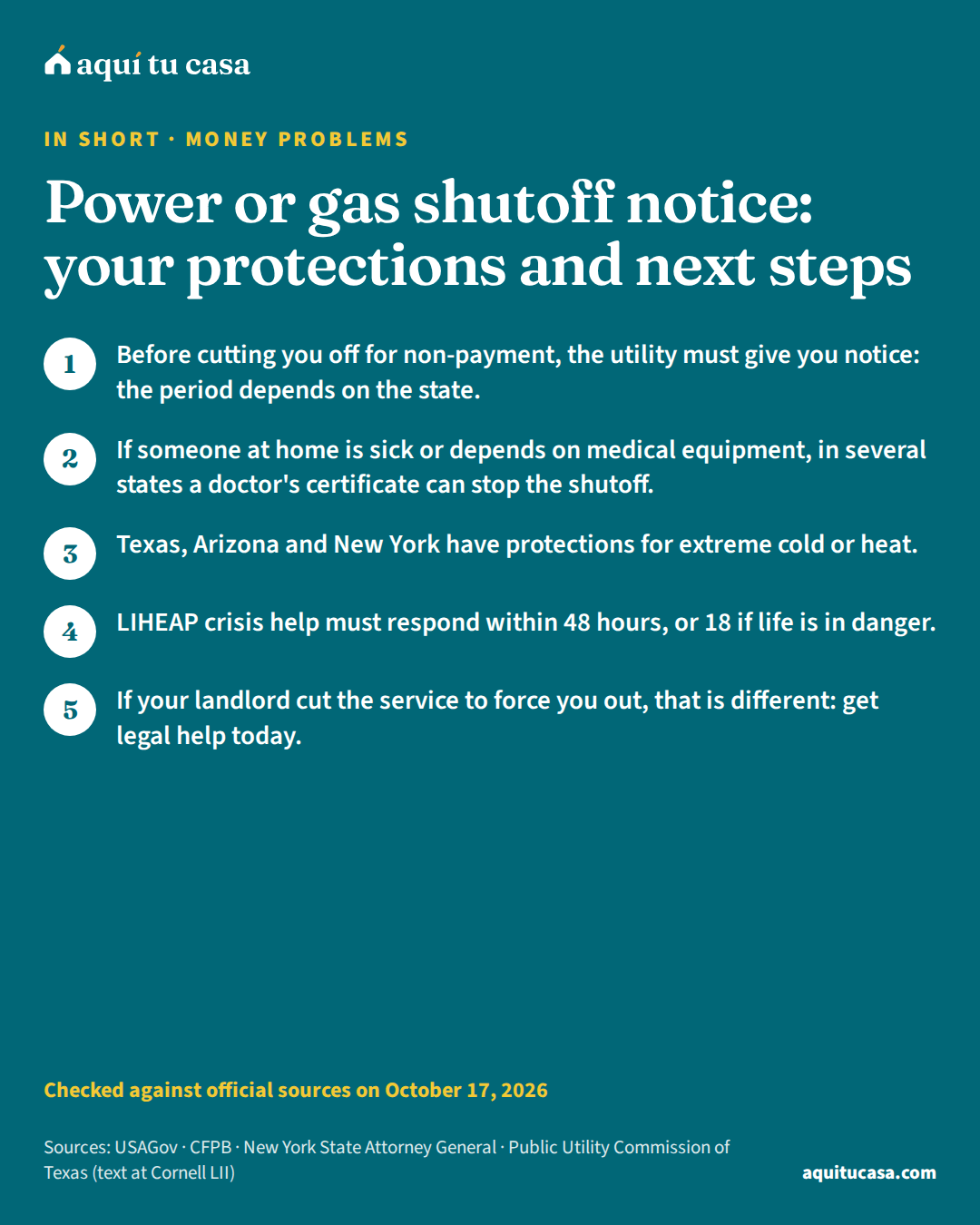
- Money problems Power or gas shutoff notice: your protections and next steps If your power or gas is about to be shut off for non-payment: notice periods, health and extreme-weather protections, crisis help and how to complain. 11 minute read
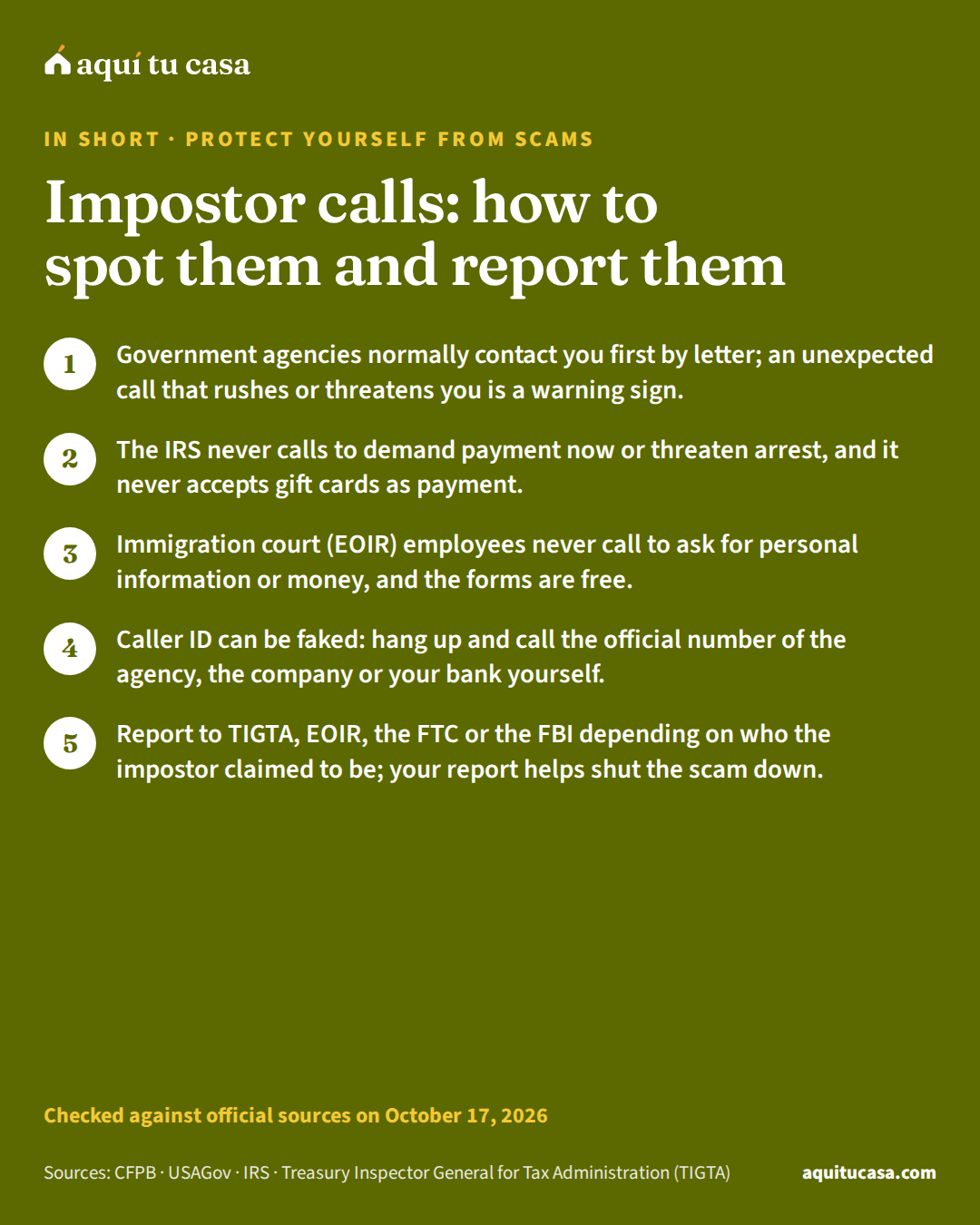
- Protect yourself from scams Impostor calls: how to spot them and report them How to tell whether a call or message from the IRS, immigration court, the power company or your bank is real, and where to report impostors. 14 minute read
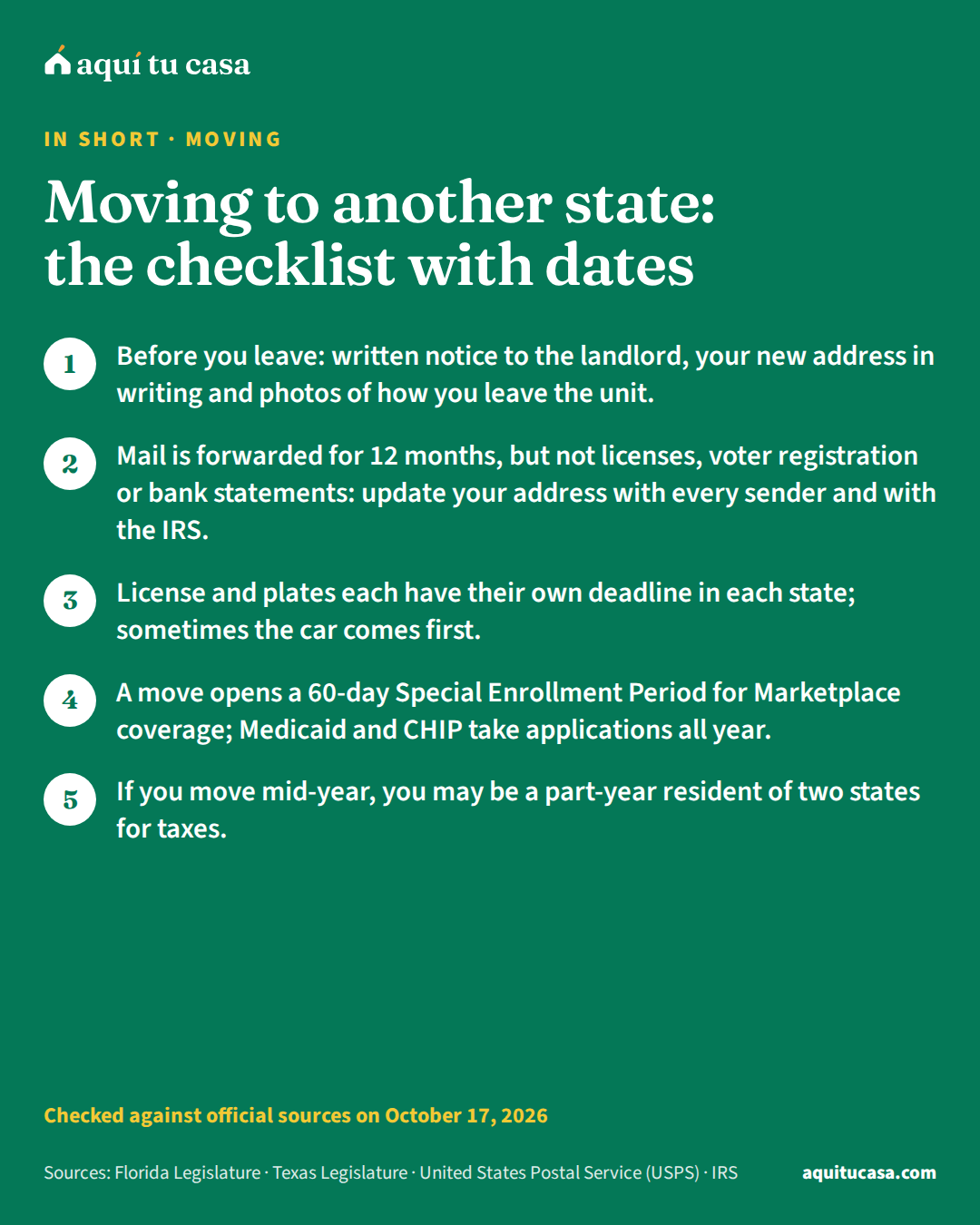
- Moving Moving to another state: the checklist with dates A dated checklist for moving to another state: notice to your landlord, deposit, mail, voting, license, plates, health coverage, school and taxes. 14 minute read
Tools for this topic
Was this guide useful?
Thank you. Your answer stays in your browser; nothing is sent.