Renting out a room or unit in your home: the basics
Before you rent out a room, half of a duplex or a separate unit: fair housing, your ad, the lease, the deposit, taxes and insurance.
Verified against official sources on October 17, 2026 15 official sources

Show contents
In short
What you need to know
Quick answer
When you rent out a room or unit in your home, you become a landlord, with duties. Federal law bars nearly all landlords from discriminating because of race, color, national origin, religion, sex, familial status or disability; if you live in a building with up to four units there are exemptions, but no ad may show those preferences. You also have to report the rent to the IRS (generally on Schedule E), follow your state's rules on leases and deposits, and check with your insurer, because most homeowners policies do not fully cover a rented property.
What matters most
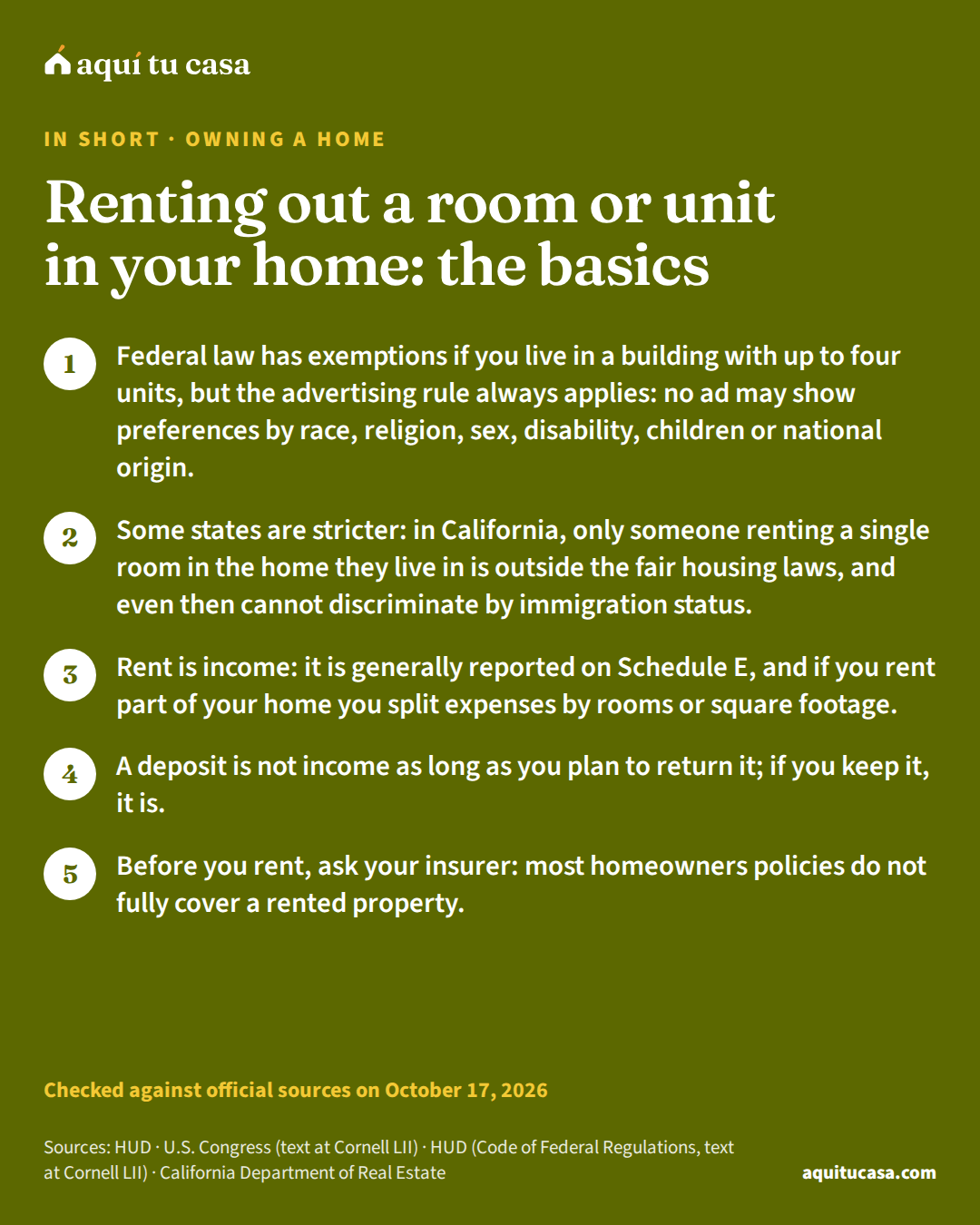
- Federal law has exemptions if you live in a building with up to four units, but the advertising rule always applies: no ad may show preferences by race, religion, sex, disability, children or national origin.
- Some states are stricter: in California, only someone renting a single room in the home they live in is outside the fair housing laws, and even then cannot discriminate by immigration status.
- Rent is income: it is generally reported on Schedule E, and if you rent part of your home you split expenses by rooms or square footage.
- A deposit is not income as long as you plan to return it; if you keep it, it is.
Is this for you?
This guide is for you if…
- You own a home and want to rent out a room to help with the bills.
- You bought a duplex or have a separate unit (a back or basement apartment) and will rent out the other part.
- You are moving and thinking about renting out the house instead of selling it.
Get direct help first if…
- You are a tenant who wants to share your home or sublet: start with the guide on sharing a home and occupancy limits, and check your lease.
- You want to rent to tourists by the night or weekend: this guide is about monthly rentals; insurance and local rules for short-term rentals are different.
- You own many properties or run a rental business: here we cover only the basics for a family renting out part of its home.
Renting out a room, the other half of a duplex or a separate unit can help you pay for your home. But from your first ad you become a landlord, with duties. This guide is for a family renting out part of its home for the first time: it explains what fair housing law says, how to advertise and pick a tenant, what to put in the lease, how rent is reported to the IRS and what to ask your insurer.
- Maximum size of the building you live in for the federal exemption (ads not covered)
- 4 families3
- Rent out your home for less than that in a year and you do not report that rent
- 15 days11
- Typical monthly gross rent in the US (Census median)
- $1,413
- Homes that require the federal lead-based paint notice
- Before 19788
A room, a unit or the whole house: what changes
Renting a room inside your home is not the same as renting the other half of a duplex or a whole house. The fair housing rules, the way you split expenses and the lead notice all change.
Three ways to rent
You live there
A room in your home
You live next door
A separate unit or duplex
In all three cases, no ad may show prohibited preferences.2
The Fair Housing Act applies to you too
HUD explains that housing discrimination is illegal in nearly all housing, including private housing. The Fair Housing ActFair Housing ActThe Fair Housing Act is the federal law that makes it illegal to refuse to sell or rent a dwelling, or to discriminate in its terms, because of race, color, religion, sex, familial status (having children), national origin or disability. It applies to landlords, real estate agents and managers, and also to banks and lenders when their practices make housing or credit unavailable for those reasons. National origin covers your language and the country you come from, regardless of immigration status. If you believe you were discriminated against, you can file a complaint with HUD at no cost; many states add protections.See the full definition prohibits discrimination because of race, color, national originnational originNational origin is one of the characteristics the Fair Housing Act protects. According to the Department of Justice, national origin discrimination can be based on the country where you were born or where your ancestors came from. The law prohibits refusing to sell or rent you a home, setting different terms or publishing ads that state a preference based on your national origin. According to the CFPB, the Equal Credit Opportunity Act also prohibits lenders from discriminating against you because of your national origin when you apply for credit, such as a mortgage.See the full definition, religion, sex, familial statusfamilial statusFamilial status is one of the characteristics the Fair Housing Act protects. The law defines it as having one or more children under 18 living with a parent, with another person who has legal custody of them or with someone that person designates in writing. It also protects anyone who is pregnant or is in the process of getting custody of a child. So, with some exceptions, such as certain housing for older persons, no one may refuse to rent or sell you a home, or impose special conditions, because you live with children.See the full definition (having children or being pregnant) and disability.1
In practice, the law makes it unlawful to refuse to rent or negotiate for one of those reasons, to set different conditions or to say a home is no longer available when it is. With a person with a disability, refusing a reasonable accommodation in your rules or services also counts as discrimination.2
Federal law has exemptions for small owners. These rules (except the advertising rule) do not apply to rooms or units in a building where up to four families live if the owner lives in one of them, or to a single-family house rented by an owner with up to three houses, if no real estate agent is used and no discriminatory ad is published.3
Your ad and choosing a tenant
The advertising rule always applies, even if you have an exemption.3 No notice, statement or ad may indicate a preference, limitation or discrimination because of race, color, religion, sex, disability, familial status or national origin.2 HUD’s rule covers what you say out loud as well as applications, flyers and signs, and prohibits words, photos or symbols suggesting who the home is or is not for.4
The safest way to advertise is to describe the home, not the person: the size of the room, whether the kitchen is shared, the rent, the deposit and the date. In California, someone looking for a roommate in their own home may state a preference by sex if the kitchen, living room or bathroom will be shared; but no law allows advertising preferences about religion or whether the person has children.5
For tenant screeningtenant screening reportA tenant screening report is a report many landlords use to decide whether to rent to you and how much to charge for the security deposit. Specialty companies prepare it, and it can include your credit report, your rental history including eviction cases and lawsuits, employment verification, criminal history and a score or recommendation. It is not the same as a credit report. If a landlord denies you, or asks for a larger deposit or higher rent, because of the report, federal law requires the landlord to tell you, name the company and explain your right to a free copy and to dispute errors.See the full definition, use the same requirements for everyone. If you deny an application because of something in a tenant or credit report, federal law requires you to give that person an adverse action noticeadverse action noticeAn adverse action notice is the notice you get when a company denies you credit or takes another action against you on your application or account. Under federal law, the lender must give you the main reasons or tell you how to ask for them. If the decision was based on a credit report or another consumer report, the company must also give you the score that was used, the name and contact information of the company that supplied the report, and explain your right to a free copy of that report and to dispute errors. The reporting company did not make the decision and cannot tell you why it was made.See the full definition: in writing, orally or electronically, with the name, address and phone number of the company that provided the report, and their right to a free copy within 60 days and to dispute errors. Requiring a co-signer or a bigger deposit than others because of that report also counts as adverse action.6
How many people can live in the room? Occupancy rules are covered in the guide on sharing a home and occupancy limits.

The lease and the deposit
The Texas Attorney General says the most important source of the landlord-tenant relationship is the leaseleaseA lease, or rental agreement, is the contract in which the owner or landlord gives you the right to live in and use a property for a set period of time in exchange for payment, usually rent. While the lease lasts you have possession, but the landlord still owns the property. The lease says how much you pay and when, who handles maintenance and how the agreement can end. Your rights as a tenant are usually spelled out in the lease and in your state and local laws. Before complaining to the landlord, it helps to read the lease and make sure you are also following the rules you agreed to.See the full definition, written or oral; that it should be read before signing and that any agreed change should be written into it and initialed by both sides.7 California’s guide recommends a written lease and requires one for a tenancy longer than a year. There, the landlord must hand over a signed copy within 15 days, put their name, address and phone number for legal notices in the agreement and, for tenancies starting on or after July 1, 2025, take photos of the unit at the start.5
Those move-in inspectionmove-in inspectionA move-in inspection is the walk-through of the home done before you move in to record in writing the condition of the unit and the equipment that comes with it. In public housing, the federal rule requires the agency and the tenant to inspect it together and sign a statement of its condition. Another inspection is done when you move out. The difference between the condition at move-in and at move-out is the basis for any charge against your deposit, if the damage goes beyond normal wear and tear. That record helps keep you from being charged for damage that was already there.See the full definition photos record how the home looked at the start.5 In Texas, the Attorney General explains that the tenant must give a forwarding address and the landlord must return the security depositsecurity depositA security deposit is money you pay the landlord when you start renting as security that you will follow the lease: pay the rent and take care of the home. The money still belongs to you. The landlord holds it and, when you move out, must return it minus the charges the law allows, such as past-due rent or damage beyond normal wear and tear. You should not be charged for damage that was already there when you moved in. The maximum amount and the deadline to return it depend on your state's law and sometimes your city's.See the full definition, minus damages, within 30 days of move-out, with an itemized list of deductions, and may not charge for normal wear and tear.7 Caps and deadlines change by state:
Deposit cap and return deadline, by state
| State | Deposit limit | Time to return the deposit |
|---|---|---|
| Alabama | Up to 1 month of rent | 60 calendar days |
| Arizona | Up to 1.5 months of rent | 14 business days |
| Arkansas | Up to 2 months of rent | 60 days |
| California | Up to 1 month of rent | 21 days |
| Colorado | Up to 2 months of rent | 1 day |
| Connecticut | Up to 2 months of rent | — |
| Delaware | Up to 1 month of rent | — |
| District of Columbia | Up to 1 month of rent | — |
| Florida | — | 15 days |
| Georgia | Up to 2 months of rent | 30 days |
| Hawaii | Up to 1 month of rent | 14 days |
| Idaho | — | 21 days |
| Illinois | — | 45 days |
| Indiana | — | 45 days |
| Iowa | Up to 2 months of rent | 30 days |
| Kansas | Up to 1 month of rent | 30 days |
| Louisiana | — | 1 day |
| Maine | Up to 2 months of rent | — |
| Maryland | Up to 1 month of rent | 45 days |
| Massachusetts | Up to 1 month of rent | 30 days |
| Michigan | Up to 1.5 months of rent | 30 days |
| Minnesota | — | 21 days |
| Mississippi | — | 45 days |
| Missouri | Up to 2 months of rent | 30 days |
| Nebraska | Up to 1 month of rent | 14 days |
| Nevada | Up to 3 months of rent | 30 days |
| New Hampshire | Up to 1 month of rent | 30 days |
| New Jersey | Up to 1.5 months of rent | 30 days |
| New York | Up to 1 month of rent | 14 days |
| North Carolina | — | 30 days |
| North Dakota | Up to 1 month of rent | 30 days |
| Ohio | — | 30 days |
| Oklahoma | — | 45 days |
| Oregon | — | 31 days |
| Pennsylvania | Up to 2 months of rent | 30 days |
| Rhode Island | Up to 1 month of rent | 20 days |
| South Carolina | — | 30 days |
| South Dakota | Up to 1 month of rent | 21 days |
| Texas | — | 30 days |
| Utah | — | 30 days |
| Vermont | — | 14 days |
| Virginia | Up to 2 months of rent | 45 days |
| Washington | — | 30 days |
| Wisconsin | — | 21 days |
| Wyoming | — | 30 days |
These are each state's general rules; your city may have others.7 Tap your state for the exceptions. Source: each state's laws
The security deposits guide covers each state’s rules from the tenant’s side, and your lease explained walks through each clause.
If you rent a room in California, the official guide explains that a lodger is someone who lives in a room in a house where the owner lives, and that most lodgers have the same rights as tenants. With a single lodger, the owner can end the arrangement with written notice of the same length as any periodic tenancy, without a court case; but if the lodger disputes being a lodger, the matter can end up in court.5
Rent and your taxes
The IRS says that in most cases you must include in income everything you receive as rent. That also covers advance rent (in the year you receive it), your expenses that the tenant pays and the value of work or goods you accept instead of money.11 It is generally reported on Schedule E of Form 1040; if you provide substantial services for the tenant’s convenience, the IRS points to Schedule C.12 It becomes part of your yearly tax returntax returnA tax return is the yearly form you use to report your income to the IRS and figure the tax you owe, so you can pay what is due or get a refund. The federal return for individuals is Form 1040. In general you must file if your gross income is above the minimum the IRS sets for your filing status, or if you had a certain amount of net earnings from self-employment; even when you do not have to, filing can pay off. You need your SSN or ITIN, and those of everyone else on the return, plus documents such as your W-2s and 1099s.See the full definition.
The deposit is not income when you receive it, if you plan to return it. If you keep part because the tenant did not live up to the lease, that part is income that year. And if the “deposit” is really the last month’s rent, it is advance rent.11
You can also deduct expenses. The IRS mentions the ordinary and necessary expenses of managing and maintaining the property from the time you offer it for rent, and asks you to separate repairs from improvements and keep accurate records.11 Expenses include depreciation (the wear on the property) and repairs that keep it in good condition.12
If you rent part of your home, you split whole-house expenses between the rented part and your part, as if they were two properties. The most common methods are number of rooms or square footage. Costs that belong only to the rented room, such as painting it or liability insurance for renting it, are fully rental expenses. In a duplex where you live in one half, you split the interest and taxes for the whole property.11
How much to charge? For the IRS, a fair rental price is what someone unrelated to you would pay, and it is not fair if it is substantially less than rents for similar properties in your area.11 Typical rent varies a lot from state to state:

Your state’s page in Places shows typical rent for your county. If you have questions about your case, the IRS has a free interactive tool, “Is my residential rental income taxable and/or are my expenses deductible?”, to check whether your rent is taxable and your expenses deductible.12
Insurance when you rent
This is the step people forget most. The Texas Department of Insurance warns that homeowners insurancehomeowners insuranceHomeowners insurance pays for losses and damage to your property if something unexpected happens, like a fire or a burglary, and usually includes liability coverage if someone is hurt at your home. Lenders require it as long as you have a mortgage, because the home is their collateral, and almost always collect it inside your monthly payment through the escrow account. The price depends on the location, the rebuilding cost, the deductible and your history. A standard policy does not cover floods or, in many states, earthquakes: those risks are insured separately.See the full definition probably won’t cover the costs if someone gets hurt or causes damage when you rent your home or rooms short term, and that most homeowners policies won’t cover damage to a rental property or limit what they pay. Landlord insurance gives added protection and is mainly for long-term leases: ask whether to add it to your policy or buy a separate one.13
Liability coverage pays medical bills, lost wages and other costs for people you injure if you are legally responsible.14 Your policy also does not protect the tenant’s things: renters insurancerenters insuranceRenters insurance, also called tenants insurance, protects your belongings and protects you when you rent. The landlord's insurance covers the building, but not your furniture, clothes or electronics. It usually includes three coverages: your personal property, even if it is stolen away from home; additional living expenses if a covered loss forces you to move out for a while; and personal liability if someone is hurt in your home. A standard policy does not cover floods, which are insured separately. Some landlords require it.See the full definition covers their belongings and does not pay to fix the house, which is the owner’s policy’s job.1415
California’s guide says many landlords require tenants to carry renters insurance, specifically liability coverage, and that each roommate needs a separate policy.5 The home insurance guide explains how to compare policies, and the renters insurance guide is useful for explaining it to your tenant.

For questions about your policy, the Texas Department of Insurance answers at 800-252-343913 and California’s at 800-927-4357.15 In other states, look up your state insurance department.
Before you rent, step by step
From the first ad to handing over the keys
1. Call your insurer
Before you advertise
Ask whether your policy covers a rented property or whether you need landlord insurance.13
2. Write the ad
Before you post it
Describe the home and the terms, not the person. The advertising rule always applies.2
3. Choose with the same requirements for everyone
As applications arrive
If you deny an application because of a report, give the adverse action notice.6
5. Give the lead notice if it applies
Before signing
If the home was built before 1978 and it is not a single room, hand over the EPA pamphlet.9
6. Take the deposit and photos
Move-in day
Keep proof of the deposit and dated photos of the unit's condition.5
7. Start your tax folder
From the first month
Keep rent receipts and expenses, and separate repairs from improvements.11
If this is you
Common situations
You want to rent out a room to help with the bills
Rent is income, but you split home expenses by rooms or square footage, and liability insurance for the room is fully deductible.11
You bought a duplex and live in one half
The federal exemption covers buildings of up to four units where you live, but not ads.3 You split interest and taxes for the whole property.11
You rent to a relative
If it is not their main home or they do not pay a fair rental price, the IRS counts it as your personal use.11
An applicant asks for an exception to your rules
Where the law applies, refusing a reasonable accommodation for a disability counts as discrimination.2

Costly mistakes
Mistake: Writing "adults only" or "no kids" in the ad.
Instead: Describe the home, not the person: the advertising rule applies even with an exemption.2
Mistake: Renting without telling your insurer.
Instead: Ask first: most homeowners policies do not fully cover a rented property.13
Mistake: Spending the deposit as if it were rent.
Instead: Keep it separate: it is not income as long as you plan to return it.11
Mistake: Deducting all home expenses when you only rent a room.
Instead: Split shared expenses by rooms or square footage.11
Mistake: Denying an application because of a report without saying why.
Instead: Give the adverse action notice with the report company's details.6
Mistake: Making a handshake deal with no photos.
Instead: Sign a written lease and take dated photos at the start.5
What to do this week
- Call your insurer and ask, in writing, what your policy covers if you rent out a room or unit.13
- Check the table in this guide for your state’s deposit cap and return deadline.7
- Write an ad that describes the home, with no preferences about people.2
- If the home was built before 1978, get the EPA lead pamphlet.9
- Start a folder for rent receipts and expenses, and read IRS Publication 527 or use its interactive tool.12
- If you have questions about your fair housing rights and duties, read the guide on housing discrimination or talk to a HUD-approved housing counselorHUD-approved housing counselorA HUD-approved housing counselor works at an agency HUD has approved to provide housing counseling: independent, expert advice customized to your situation about buying a home, renting, a missed mortgage payment, a foreclosure or credit problems. The agencies usually charge little or nothing; many serve in Spanish and offer the homebuyer education course several assistance programs require. They are not lenders or real estate agents and sell you nothing. Your county page lists the official agencies with phone numbers.See the full definition.1
Your household this month
Let's do the math
Left each month
Enter what at least one person takes home to see the result.
What helps
- Pay savings first: set the goal aside the day the money arrives, before flexible spending.
- Add up the bills that come every few months (car insurance, school) and divide by twelve.
- If income changes, plan on a low month and save the extra from good months.
- A HUD-approved housing counselor can go over the budget with you, often for free.
This is a planning tool with your numbers, not a credit evaluation or an approval. The split reference is only a guide.
Ready to see the numbers? Find your county here
See how this applies in your county: its loan limits, prices and rents, from the official data.
Printable checklist
Frequently asked questions
Do I have to follow the Fair Housing Act if I rent out a room in my home?
Federal law exempts rooms or units in a building of up to four families if you live in one, but the advertising rule always applies. Your state may be stricter: in California, only an owner renting a single room in the home they live in is outside the law, and even then may not discriminate based on age, citizenship, language or immigration status.
Can my ad say I only want women or no children?
Under federal law, no ad may indicate preferences by race, color, religion, sex, disability, familial status or national origin. In California, someone looking for a roommate in their own home may state a preference by sex if the kitchen, living room or bathroom will be shared; but no law allows advertising a preference about whether the person has children.
Do I have to report the rent I collect to the IRS?
In most cases, yes: the IRS says you must include in income everything you receive as rent, generally reported on Schedule E of Form 1040. The exception is renting out your own home for less than 15 days in the year: then you do not include that rent. You can deduct expenses such as repairs and depreciation.
Does the security deposit count as income?
Not if you plan to return it at the end of the lease. If you keep part or all of it because the tenant did not live up to the lease, you include what you kept in that year's income. And if the deposit will be used as the last month's rent, the IRS treats it as advance rent, reported when you receive it.
Does my homeowners insurance cover me if I rent out a room?
Do not assume so. The Texas Department of Insurance says most homeowners insurance won't cover damage to a rental property or might limit what it pays, and that landlord insurance is mainly for long-term leases. Ask your insurer before you sign a lease with a tenant.
How much deposit can I ask for and when must I return it?
It depends on the state. In Texas, the Attorney General says you must return it, minus damages, within 30 days of the tenant moving out, with an itemized list of deductions, and you may not charge for normal wear and tear. The table in this guide and the security deposit guide show the cap and deadline for each verified state.
What if I rent to my son or my mother?
For the IRS, if a family member uses the home and it is not their main home or they do not pay a fair rental price, it counts as your personal use, which changes how you report. A fair rental price is what someone unrelated to you would pay.
Can I require my tenant to have renters insurance?
California's official guide says many landlords require it, specifically liability coverage, and set minimum terms. Your policy does not protect the tenant's belongings, and each roommate needs a separate policy.
Sources
Every figure in this guide comes from one of these official sources. The number next to a sentence leads to the source behind it.
Each source on one line: who publishes it, its title, its address and the date we read it.
- 1. HUD · Housing Discrimination Under the Fair Housing Act · hud.gov · Accessed October 17, 2026
- 2. U.S. Congress (text at Cornell LII) · Fair Housing Act, 42 U.S.C. §3604, Discrimination in the sale or rental of housing · law.cornell.edu · Accessed October 17, 2026
- 3. U.S. Congress (text at Cornell LII) · Fair Housing Act, 42 U.S.C. §3603, Effective dates of certain prohibitions (exemptions) · law.cornell.edu · Accessed October 17, 2026
- 4. HUD (Code of Federal Regulations, text at Cornell LII) · 24 CFR §100.75, Discriminatory advertisements, statements and notices · law.cornell.edu · Accessed October 17, 2026
- 5. California Department of Real Estate · California Tenants: A Guide to Residential Tenants' and Landlords' Rights and Responsibilities (2026) · dre.ca.gov · Accessed October 17, 2026
- 6. CFPB · What should I do if my rental application is denied because of a tenant screening report? · consumerfinance.gov · Accessed October 17, 2026
- 7. Texas Attorney General · Renter's Rights · texasattorneygeneral.gov · Accessed October 17, 2026
- 8. EPA and HUD (Code of Federal Regulations, text at Cornell LII) · 40 CFR §745.103, Definitions (lead-based paint disclosure) · law.cornell.edu · Accessed October 17, 2026
See the other 7 sources
- 9. EPA and HUD (Code of Federal Regulations, text at Cornell LII) · 40 CFR §745.107, Disclosure requirements for sellers and lessors · law.cornell.edu · Accessed October 17, 2026
- 10. EPA and HUD (Code of Federal Regulations, text at Cornell LII) · 40 CFR §745.101, Scope and applicability · law.cornell.edu · Accessed October 17, 2026
- 11. IRS · Publication 527, Residential Rental Property (Including Rental of Vacation Homes) · irs.gov · Accessed October 17, 2026
- 12. IRS · Topic no. 414, Rental income and expenses · irs.gov · Accessed October 17, 2026
- 13. Texas Department of Insurance · Renting out your home? Check your insurance · tdi.texas.gov · Accessed October 17, 2026
- 14. Texas Department of Insurance · Homeowners insurance guide · tdi.texas.gov · Accessed October 17, 2026
- 15. California Department of Insurance · Residential Property Insurance Guide · insurance.ca.gov · Accessed October 17, 2026
Keep reading
Related guides
If this guide helped, these follow the same path.

Renting 14 minute read
Security deposits: how much and how to get yours back
What a security deposit is, how much a landlord may charge in your state, what can be deducted, when it must be returned and where to complain if it isn't.
- The deposit is yours: the landlord only holds it and, when you move out, returns it minus the deductions the law allows.
- In California (since July 1, 2024) and New York the general cap is one month's rent; the Texas and Florida laws we cite govern the return, not the amount.
- In California, New York and Texas you cannot be charged for normal wear and tear; date-stamped photos from move-in day help you prove the condition you received.
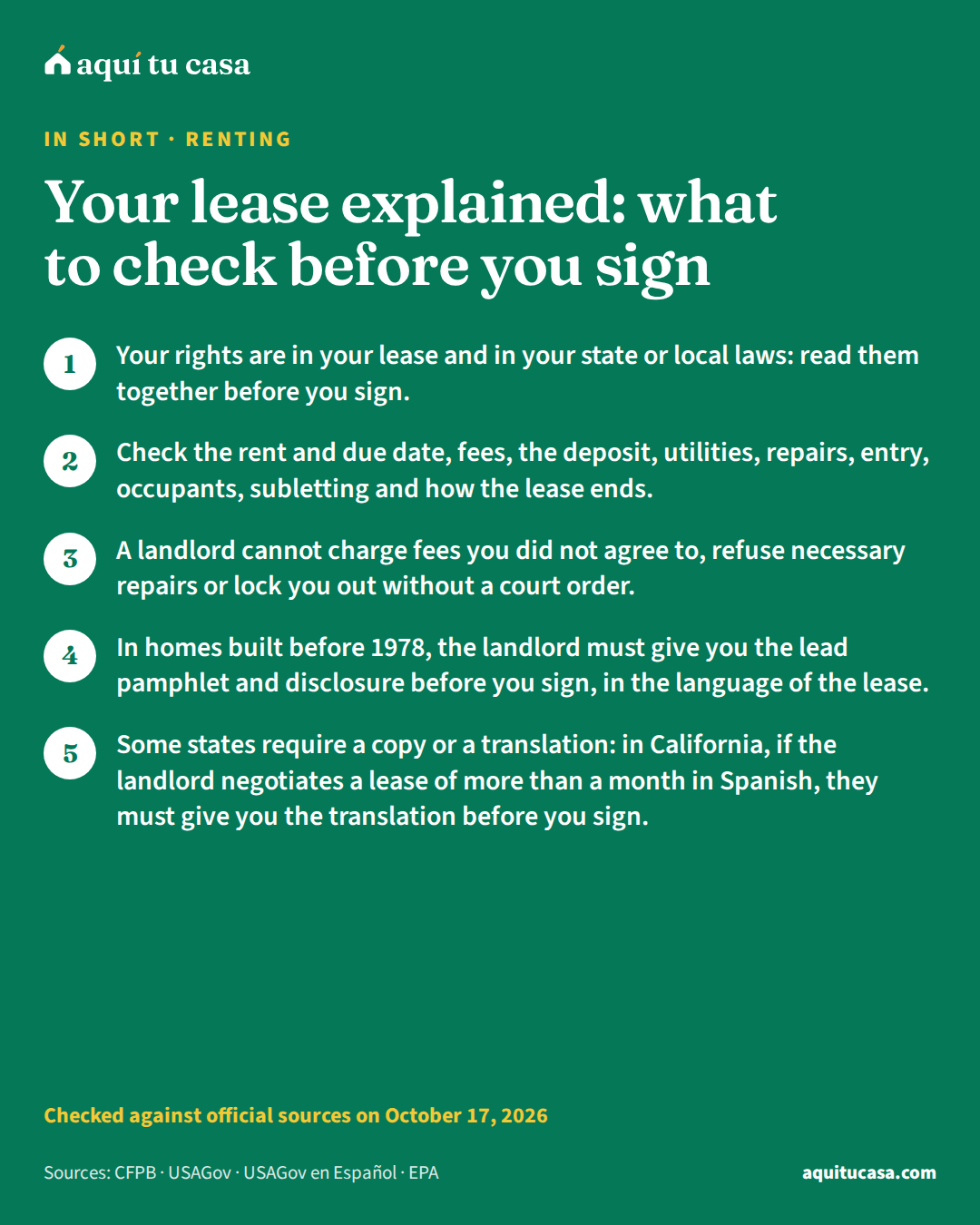
- Renting Your lease explained: what to check before you sign What a lease is, which clauses to read before you sign, the lead paint disclosure, your fair housing rights and where to get free help. 15 minute read
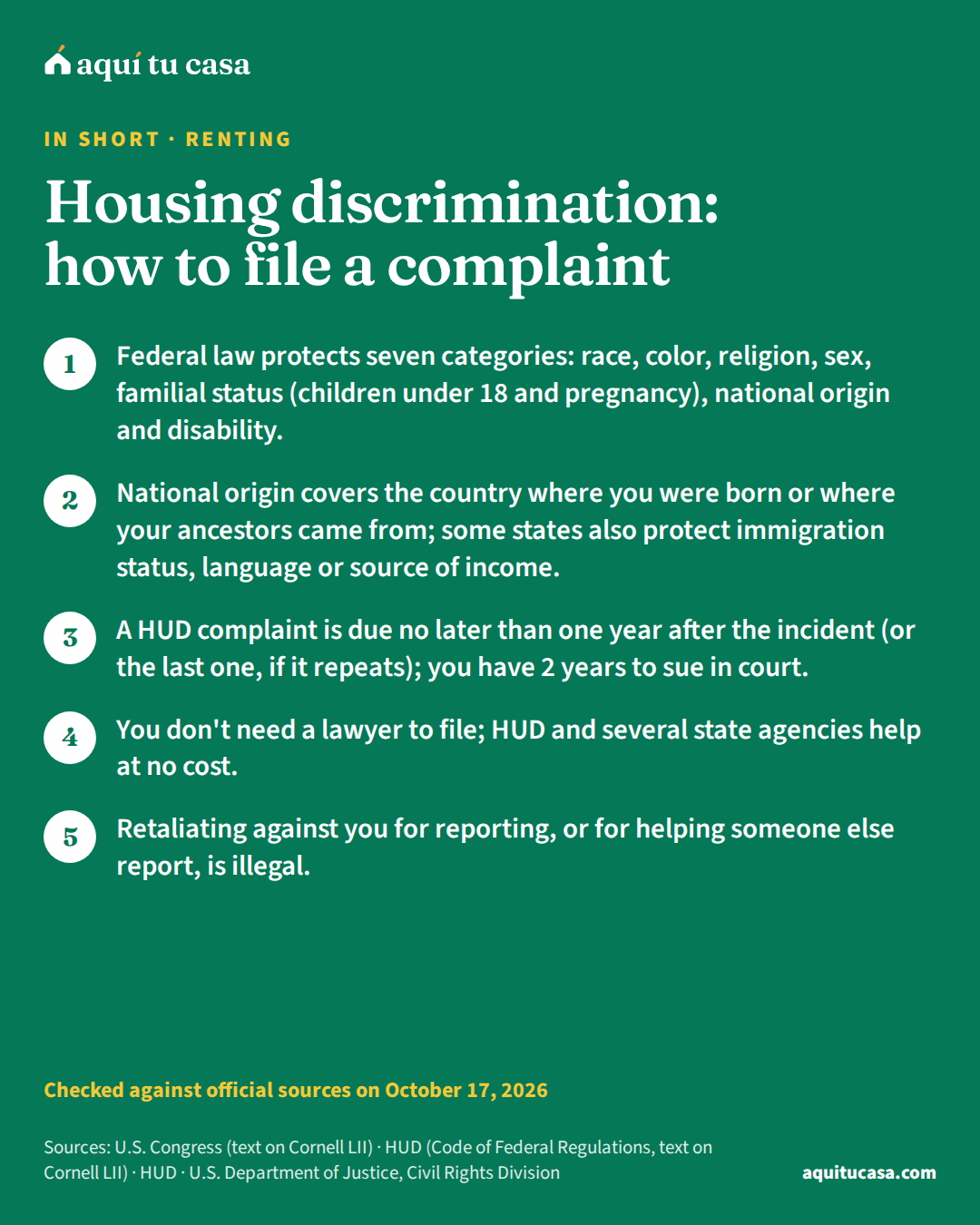
- Renting Housing discrimination: how to file a complaint What the Fair Housing Act prohibits when you rent, how national origin and children are covered, and how to file with HUD or your state on time. 11 minute read
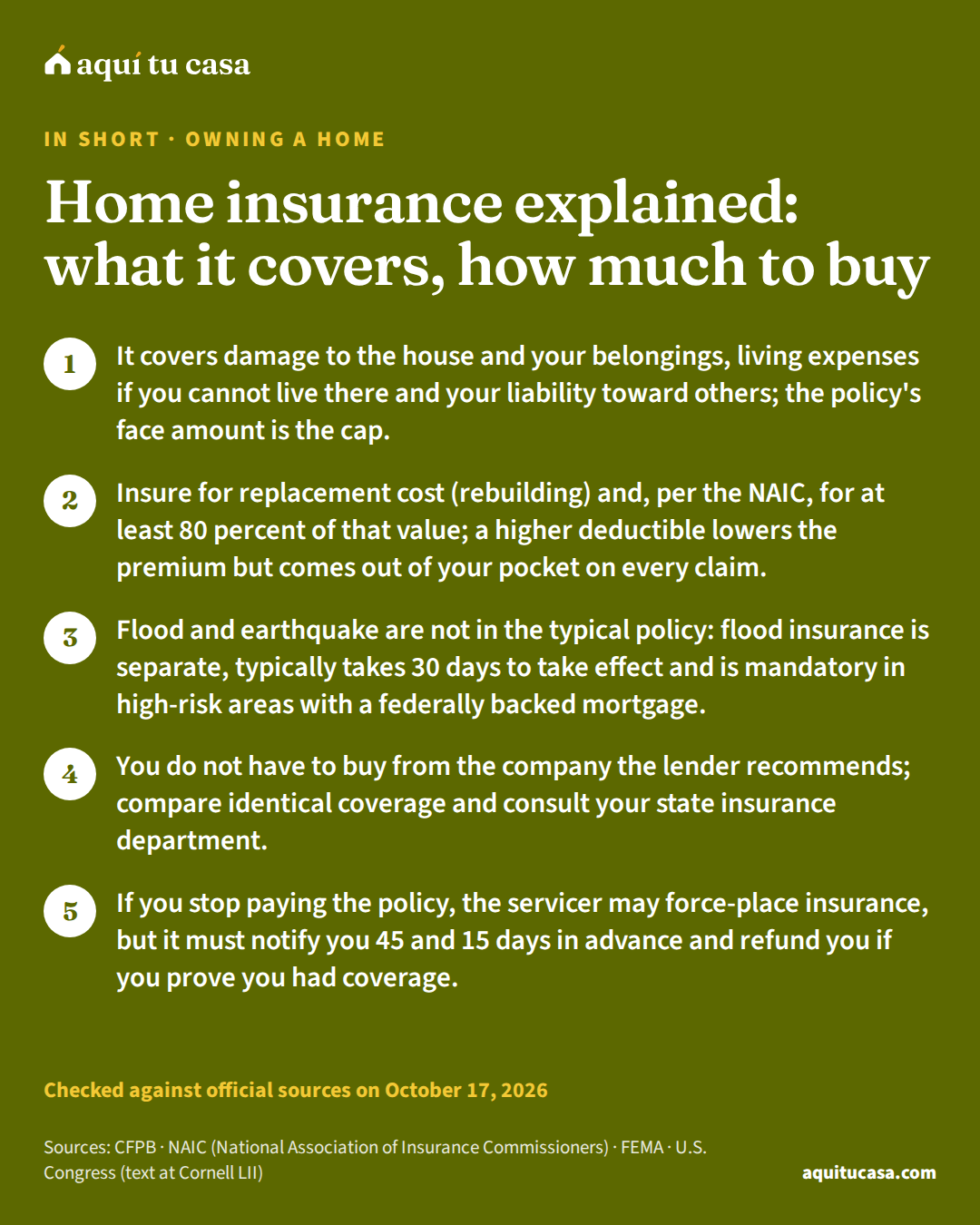
- Owning a home Home insurance explained: what it covers, how much to buy What home insurance covers, why the lender requires it, how to choose the amount and the deductible, why flood is separate and what happens if it lapses. 13 minute read
Tools for this topic
Was this guide useful?
Thank you. Your answer stays in your browser; nothing is sent.