Moving company scams and your rights in an interstate move
How to choose a registered mover, which estimate to ask for, how much you can be charged at delivery, how to protect your things and file a claim.
Verified against official sources on October 31, 2026 6 official sources

Show contents
In short
What you need to know
Quick answer
In an interstate move, the mover must be registered with the Department of Transportation, survey your goods in person (unless you waive it in writing) and give you a written estimate, binding or non-binding. At delivery, it cannot demand more than 100% of a binding estimate or 110% of a non-binding one, plus what you asked for later and up to 15% for difficult operations; if you pay that and it does not deliver, it is holding your goods in violation of federal law. Check the protection: the free option pays only 60 cents per pound. You have 9 months to file a claim.
What matters most
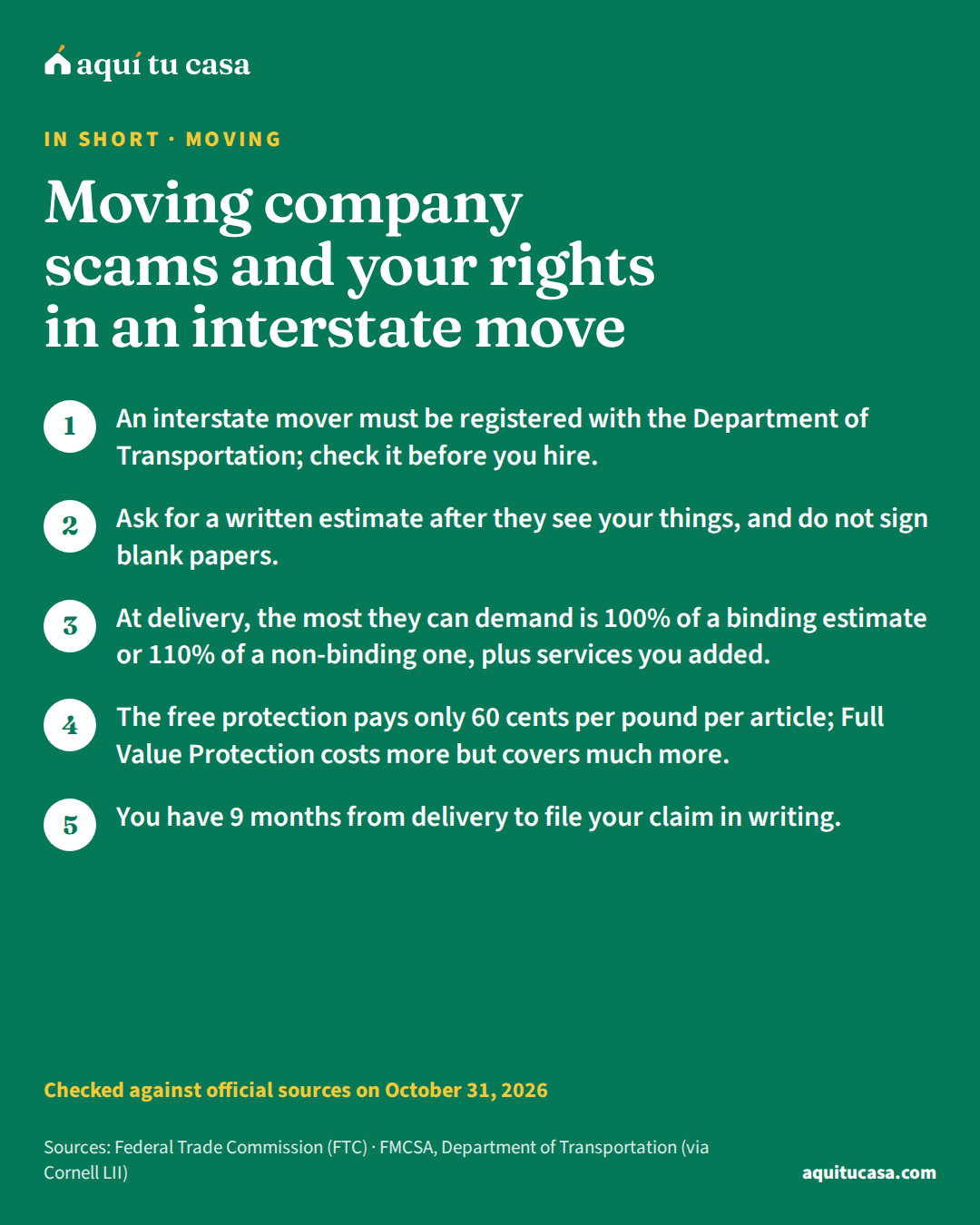
- An interstate mover must be registered with the Department of Transportation; check it before you hire.
- Ask for a written estimate after they see your things, and do not sign blank papers.
- At delivery, the most they can demand is 100% of a binding estimate or 110% of a non-binding one, plus services you added.
- The free protection pays only 60 cents per pound per article; Full Value Protection costs more but covers much more.
Is this for you?
This guide is for you if…
- You are moving to another state and will hire a moving company.
- The mover is demanding more than the estimate to unload your things from the truck.
- Your things arrived broken or missing, and you want to know how to file a claim.
Get direct help first if…
- Your move is within the same state: the federal rules in this guide are for interstate moves; ask your state consumer protection office.
- You are looking for the moving to-do list (license, mail, school): read «Moving to another state: checklist».
Moving to another state is stressful enough. The last thing you need is a mover charging you double on arrival or holding your things on a truck. Federal law gives you clear rights in an interstate move, and this guide explains them: how to choose a registered mover, which estimate to ask for, how much you can be charged at delivery, how to protect your things and how to file a claim if something goes wrong.
Choose a registered mover
The first step is the most important one. The FTC explains that movers that handle interstate moves must be registered with the Department of Transportation (DOT), and that you can check their registration and details on DOT’s website.1 The federal booklet adds that you should avoid movers and brokers that are not registered with FMCSA, the DOT agency that regulates moves, or that refuse to see your things in person.5
Be careful with brokers. A broker is a company that arranges your move with a registered mover, but does not move your things. It can give you an estimate on a mover’s behalf only if it has a written agreement with that mover and uses its tariff.5 Always ask: who will drive the truck and load my things? That name should appear on your papers.
Before you hire, the FTC recommends:1
- Looking on the mover’s website for a local address, contact details and proof of its registration, licenses and insurance.
- Reading reviews and searching the company’s name with the words “complaint” or “scam.”
- Getting written estimates from several movers.
The estimate: binding or non-binding
The mover must do a physical survey of your things and give you a written estimate based on it. You can waive the survey, but only in writing and by signing before loading.3 The FTC puts it this way: a serious company looks at your things in person or asks you to describe them fully before sending a price.1
Before you sign the transportation contract, the mover must tell you which type of estimate it is:3
Two types of estimate
Guaranteed price
Binding
- Guarantees the total cost for the items and services listed
- The mover may charge for it
- At delivery, the most is 100% of the estimate, plus what you added later
Estimated price
Non-binding
- What the mover believes it will cost; the final bill is based on actual weight
- You cannot be charged for it
- At delivery, the most is 110%; the rest is billed after 30 days
With either one, ask for the estimate in writing, signed and dated.
Other estimate rules that protect you:3
- The mover must tell you which forms of payment it accepts at delivery.
- You and the mover must sign the estimate, and you must get a dated copy.
- The estimate cannot be changed after your things are loaded.
With the estimate, the mover must also give you, on paper or by link, two DOT booklets: “Ready to Move?” and “Your Rights and Responsibilities When You Move.” And before you sign the transportation contract, it must give you notice that you can see its tariff, a summary of its arbitration program and of how it handles complaints, with its main phone number.2
Moving day: the inventory and the papers
At loading, the mover must make an inventory: a list of your things that notes any damage or wear they already had. You and the mover must sign every page, and you have the right to note anything you disagree with. Before you sign, check that all your things are listed and that each item’s condition is correct.5
You will also sign the bill of lading, which is the transportation contract. Check that it has the pickup and delivery dates you agreed on. And one key rule: do not sign blank documents.5
Practical tips for that day:
- Take photos of your most valuable things before packing, and of how they were loaded.
- Keep your important documents, medicine and money with you, not on the truck.
- Keep a copy of the inventory with the bill of lading: it is your receipt.

At delivery: how much you can be charged
This is when many scams show up: the truck arrives and you are asked for a lot more money to unload your things. Federal law sets a limit. The most a mover can demand at delivery is:4
- 100% of a binding estimate, or 110% of a non-binding one,
- plus additional services you requested after signing the contract,
- plus, if they apply, impracticable operations charges (for example, when the truck cannot reach your door), which cannot exceed 15% of all other charges.
If you pay that, the mover must give you your things. If it does not, it is holding your shipment hostage, in violation of federal law.5 Anything still owed on a non-binding estimate is billed after 30 days from delivery.5 On a non-binding estimate, the mover must also weigh your shipment and give you the weight tickets with the invoice.5
Careful: if you cannot pay 110% at delivery, the mover may put your things in storage at your expense.5 That is why it helps to have that money ready, in the form of payment the mover said it accepts. To figure out how much to set aside, put the moving payment in your family budget, and if you will also rent, the move-in cash calculator adds up the deposit and first month’s rent.
Example with real numbers
A family with a non-binding estimate
An example in words, not a real case, of how the 110% limit works.
- Their estimate
- Non-binding, in writing, after the mover saw their things
- On arrival, the shipment weighed more than estimated
- The mover can demand only 110% of the estimate at delivery
- They asked for an extra room to be packed after signing
- That service can be charged on top of the 110%
- The rest of the bill
- Is billed after 30 days from delivery
- If they pay 110% and the mover will not deliver
- The mover is holding their things in violation of federal law
The rules come from the federal moving regulations.45 Use the family budget to plan how much to have ready.
Run it with your numbersFamily budgetProtect your things: Full Value or Released Value
Every interstate mover is liable for the value of your things, but there are two levels, and the difference is huge:5
- Full Value Protection. It is included in the estimate and applies unless you waive it in writing. If something is lost or damaged, the mover repairs or replaces it. It raises the cost of the move; the minimum valuation used to price it is $6.00 per pound times your shipment’s weight.
- Released Value (waiving the protection). It costs nothing, but it pays only up to 60 cents per pound per article. A 10-pound item worth $1,000 would be paid no more than $6.00.
Think carefully before you waive Full Value Protection. The FTC also recommends asking each mover what it charges to insure your goods and what it pays for damage.1 If you have renters insurancerenters insuranceRenters insurance, also called tenants insurance, protects your belongings and protects you when you rent. The landlord's insurance covers the building, but not your furniture, clothes or electronics. It usually includes three coverages: your personal property, even if it is stolen away from home; additional living expenses if a covered loss forces you to move out for a while; and personal liability if someone is hurt in your home. A standard policy does not cover floods, which are insured separately. Some landlords require it.See the full definition or homeowners insurance, ask your insurer whether it covers your things during the move; our renters insurance guide explains what it covers.

If something arrives broken or missing: how to file a claim
At delivery, check your things against the inventory. If there is new damage, write it on the inventory and ask the mover to note it on its copy. Do not sign the final receipt until it is accurate, and do not sign anything that releases the mover from all liability: the rules do not allow it.5
Your claim, step by step
1. Note the damage at delivery
Delivery day
Write it on the inventory and ask the mover to note it on its copy.5
2. File the claim in writing
Within 9 months
Send it to the mover or its insurer, with photos, receipts and the inventory.5
4. Get the decision
120 days
It has 120 days to pay, decline or make an offer; if it needs more time, it tells you in writing.5
5. If you disagree, request arbitration
After the decision
The mover must have an arbitration program and cannot charge you more than half the cost of starting it.6
FMCSA cannot resolve your claim for you. If you cannot reach a settlement, you have the right to request arbitration from the mover; arbitration is required for the mover, but not for you.5 And if your whole shipment was lost, the mover cannot charge you for the transportation, unless the loss was your fault.5 For small disputes, your county’s small claims courtsmall claims courtSmall claims court is a state court for money cases that stay under a limit each state sets. The rules are simpler than in other courts, and many people represent themselves. In California, for example, you cannot bring a lawyer to the hearing, although you can ask one for advice beforehand. The judge's decision carries the same weight as a judgment from any other court. But if you win, it is usually up to you to collect the money: the court does not collect it for you.See the full definition may be another option; ask free legal aidlegal aidLegal aid is the free civil legal help that nonprofit organizations and their lawyers provide to low-income people in civil, not criminal, matters. In housing, that includes representing families facing eviction or foreclosure, alongside matters such as custody, child support, protection from domestic violence and access to benefits. In the United States, the Legal Services Corporation, created by Congress, funds a nationwide network of these organizations; its finder points you to the one in your area. Each sets its own income limits.See the full definition.
Report problems: if the move was interstate, to the Department of Transportation; if it was a scam, also to the FTC at ReportFraud.ftc.gov.1 If you already paid someone who disappeared, our guide I was scammed, what now? explains what to do first, and the complete guide to housing scams covers other scams that show up during a move.
If this is you
Your whole family is moving to another state
Get three written estimates after they see your things, and check each mover's registration.1
You have little money for the move
With a non-binding estimate, have up to 110% ready; if you cannot pay it, your things may go to storage at your cost.5
The truck arrived and they want more money
The most is 100% of a binding or 110% of a non-binding estimate, plus what you added.4
You are leaving a rental apartment
Take photos of your things and the inventory; they will help with your claim and your deposit.5
You are offered a very low price by phone, without seeing your things
Be wary: the mover must do a physical survey, unless you waive it in writing.3
They demand full payment in cash up front
The FTC says not to hire anyone who demands cash or a big deposit.1
Mistakes that cost you
Mistake: Hiring based on a phone price without the mover seeing your things.
Instead: Ask for a written estimate based on a physical survey.3
Mistake: Signing the bill of lading with blank spaces.
Instead: Do not sign blank documents; check dates and amounts first.5
Mistake: Choosing the free protection without thinking it through.
Instead: It pays only 60 cents per pound per article; compare it with Full Value Protection.5
Mistake: Paying whatever they ask so they will unload.
Instead: The most is 100% or 110% of the estimate, plus what you added.4
Mistake: Signing the final receipt without checking the inventory.
Instead: Note the damage on the inventory before you sign.5
Mistake: Waiting more than 9 months to file a claim.
Instead: File your claim in writing within 9 months of delivery.5
Mistake: Hiring a broker thinking it is the moving company.
Instead: Ask who will move your things and check that company's registration.5

What to do this week
- List three movers and check their registration on the Department of Transportation’s website.1
- Ask each one for a written estimate after they see your things.3
- Ask for the “Ready to Move?” and “Your Rights and Responsibilities When You Move” booklets.2
- Decide which protection you want and ask for it in writing.5
- Figure out how much to have ready on delivery day in your family budget.4
- Read Moving to another state: checklist for the rest of your moving tasks.
Your household this month
Let's do the math
Left each month
Enter what at least one person takes home to see the result.
What helps
- Pay savings first: set the goal aside the day the money arrives, before flexible spending.
- Add up the bills that come every few months (car insurance, school) and divide by twelve.
- If income changes, plan on a low month and save the extra from good months.
- A HUD-approved housing counselor can go over the budget with you, often for free.
This is a planning tool with your numbers, not a credit evaluation or an approval. The split reference is only a guide.
Ready to see the numbers? Find your county here
See how this applies in your county: its loan limits, prices and rents, from the official data.
Printable checklist
Frequently asked questions
How do I know whether a mover is registered?
The FTC says movers that cross state lines must be registered with the Department of Transportation and that you can check registrations on DOT's website. If the move is within your state, ask your state consumer protection office.
What is the difference between a binding and a non-binding estimate?
A binding estimate guarantees the total cost for the items and services listed, and the mover may charge for it. A non-binding estimate is what the mover believes it will cost; the final bill is based on the actual weight, and you cannot be charged for the estimate.
The mover wants more money to unload my things. What do I do?
At delivery, the mover cannot demand more than 100% of a binding estimate or 110% of a non-binding one, plus services you requested later and up to 15% for impracticable operations. If you pay that and it does not deliver, it is holding your goods in violation of federal law. Report it to the Department of Transportation.
What is a broker?
A company that arranges your move with a registered mover but does not move your things. It can give you an estimate on a mover's behalf only with a written agreement and using that mover's tariff. Ask who will actually carry your things.
Which protection should I choose for my things?
Full Value Protection is included in the estimate unless you waive it in writing; it costs more and the mover repairs or replaces damaged items. The free option pays only up to 60 cents per pound per article: a 10-pound item worth $1,000 would be paid no more than $6.00.
How long do I have to file a claim?
You have 9 months from delivery. The claim must be in writing. The mover has 30 days to acknowledge it and 120 days to give you an answer, with extensions if it notifies you in writing.
What if the mover will not pay my claim?
You can request arbitration: every interstate mover must have an arbitration program, and it cannot charge you more than half of the cost of starting it. You are not required to use arbitration; you can also look for legal aid.
Sources
Every figure in this guide comes from one of these official sources. The number next to a sentence leads to the source behind it.
Each source on one line: who publishes it, its title, its address and the date we read it.
- 1. Federal Trade Commission (FTC) · Avoid scams when you hire a moving company · consumer.ftc.gov · Accessed October 31, 2026
- 2. FMCSA, Department of Transportation (via Cornell LII) · 49 CFR §375.213, What information must I provide to a prospective individual shipper? · law.cornell.edu · Accessed October 31, 2026
- 3. FMCSA, Department of Transportation (via Cornell LII) · 49 CFR §375.401, Must I estimate charges? · law.cornell.edu · Accessed October 31, 2026
- 4. FMCSA, Department of Transportation (via Cornell LII) · 49 CFR §375.703, Maximum collect-on-delivery amount · law.cornell.edu · Accessed October 31, 2026
- 5. FMCSA, Department of Transportation (via Cornell LII) · Appendix A to Part 375, Your Rights and Responsibilities When You Move · law.cornell.edu · Accessed October 31, 2026
- 6. FMCSA, Department of Transportation (via Cornell LII) · 49 CFR §375.211, Must I have an arbitration program? · law.cornell.edu · Accessed October 31, 2026
Keep reading
Related guides
If this guide helped, these follow the same path.

Protect yourself from scams 17 minute read
Housing scams: the complete guide to spotting them
The rental, mortgage, title, contractor, credit and moving scams families run into most: how to spot them, what to do and where to report them.
- Three signs are enough to stop: they rush you, they ask you to pay before you get anything, and they want the money by wire, gift card, cryptocurrency or cash.
- Never follow payment instructions that arrive by email, and never pay rent without seeing the property and verifying the owner.
- A company selling mortgage help cannot charge you anything until you sign the agreement with your lender; the only exception is for attorneys licensed in your state who meet strict conditions. Help from HUD-approved counselors is free or close to it.
- Moving From Puerto Rico to Florida: what changes when you move What changes when you move from Puerto Rico to Florida: credit, birth certificate, license, homestead, home and hurricane insurance, flood and taxes. 15 minute read
- Money problems I was scammed: what to do in the first hours If you sent money or personal information to a scammer: who to call first, how to dispute a charge, where to report it and how to stop identity theft. 13 minute read
Tools for this topic
Was this guide useful?
Thank you. Your answer stays in your browser; nothing is sent.