I was scammed: what to do in the first hours
If you sent money or personal information to a scammer: who to call first, how to dispute a charge, where to report it and how to stop identity theft.
Verified against official sources on October 17, 2026 14 official sources

Show contents
In short
What you need to know
Quick answer
First, stop talking to the scammer and do not send any more money or information. Then call your bank, card company, payment app or remittance company right away: acting fast can limit what you lose, and an international remittance can be canceled at no cost if you paid less than 30 minutes ago and it has not been picked up. Report the scam at ic3.gov or reportfraud.ftc.gov, to your state attorney general and to local police. If you gave out your Social Security number or ITIN, report identity theft at IdentityTheft.gov, freeze your credit and be wary of anyone promising to recover your money.
What matters most
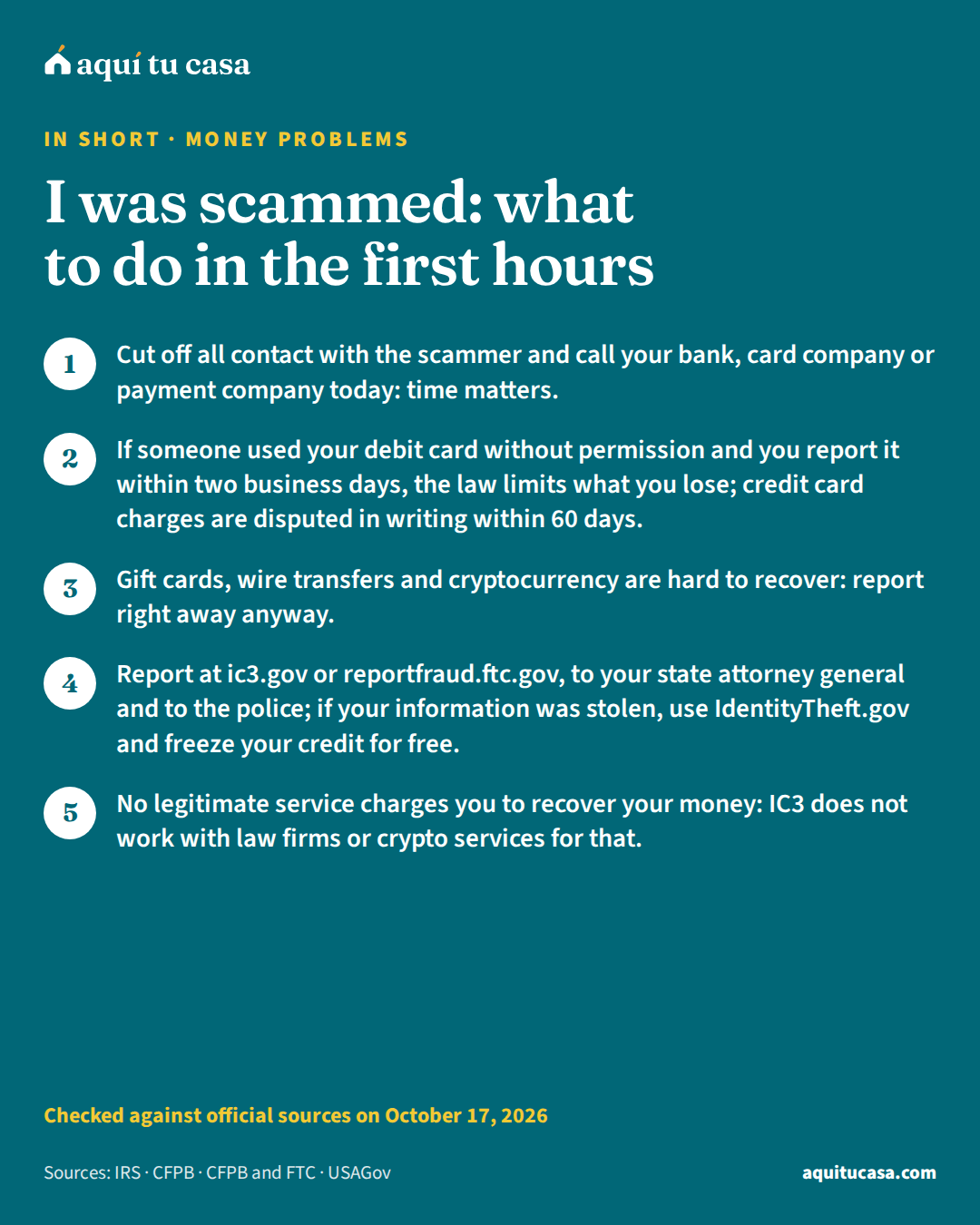
- Cut off all contact with the scammer and call your bank, card company or payment company today: time matters.
- If someone used your debit card without permission and you report it within two business days, the law limits what you lose; credit card charges are disputed in writing within 60 days.
- Gift cards, wire transfers and cryptocurrency are hard to recover: report right away anyway.
- Report at ic3.gov or reportfraud.ftc.gov, to your state attorney general and to the police; if your information was stolen, use IdentityTheft.gov and freeze your credit for free.
Is this for you?
This guide is for you if…
- You sent money to someone who turned out to be a scammer: by wire, app, remittance, card, gift card or cryptocurrency.
- You gave a scammer your Social Security number, ITIN, passwords or account details.
- You are helping a relative, such as a parent, who just fell for a scam.
Get direct help first if…
- You have not paid yet and only want to know whether a call or message is real: start with the guide on impostor calls.
- Someone is in immediate danger: call 911.
- A fake notario or consultant scammed you and you have questions about your immigration case: this guide tells you where to report it, but for your case talk with an accredited representative or a legal aid office.
If you just realized you were scammed, take a breath: you are not alone and it is not your fault. These scams are built to fool anyone. This guide is for anyone who already sent money or personal information to a scammer, or is helping a relative who did: it explains what to do in the first hours, how to ask for your money back depending on how you paid, where to report it and how to stop identity theft.
- To tell your bank your debit card was lost or stolen, and limit what you lose
- 2 business days3
- To cancel an international remittance at no cost, if it has not been picked up
- 30 minutes7
- To send a written dispute of a credit card charge
- 60 days4
- What your bank generally has to investigate an unauthorized charge
- 10 business days3
First: stop the damage
The most urgent thing is to keep the scammer from taking anything else. The IRS puts it simply: stop interacting with the scammer immediately, do not send more money or share more information, and contact your bank or credit union.1 Block their number, do not answer their messages and do not open their links.
If the scammer asks for “one last payment” to return your money, release a prize or “avoid” an arrest, that is part of the same scam. Real government agencies and banks do not ask you to send money to protect it.9
Then gather everything you have: receipts, screenshots, messages, emails, names, phone numbers and how you paid. You will need it for every call and report in this guide.
Call your bank or the payment company
The CFPB says that if you think you sent a money transfer or app payment to a scammer, you should contact your bank or the payment company right away and tell them there may have been an unauthorized transaction.2 Call the number on your card or the official website, not one the scammer gave you.
If someone used your debit card or account without your permission, federal law protects you, according to the CFPB. An unauthorized transaction is a charge or withdrawal you did not make or allow. Once you report it, the bank generally has ten business days to investigate (20 if the account is new), and if it cannot finish in time, it must generally give you a temporary credit while it keeps investigating.3
What you lose depends on how fast you report. If your card was lost or stolen and you report within two business days of discovering it, you cannot be held responsible for more than $50 or the amount taken, whichever is less. If you report later, you could be responsible for up to $500. And if a charge shows up on your statement, report it within 60 days; if you wait longer, you could have to pay for what happens after that period.3
The first hours and days
1. Cut off contact with the scammer
As soon as you realize
Do not send more money or information, even if they promise to return what you paid.1
2. Call your bank, card company or payment company
The first hour
Say there may have been an unauthorized transaction; if it was a wire, ask for it to be reversed.2
3. If it was a remittance, ask to cancel it
Within 30 minutes, if possible
If the money has not been picked up or deposited, you can cancel at no cost; check your receipt.7
4. Report the scam
The same day
At ic3.gov or reportfraud.ftc.gov, to your state attorney general and to local police.9
5. If you gave out your information, protect your identity
That same week
Report at IdentityTheft.gov and place a fraud alert or freeze your credit, for free.12
6. Send your credit card dispute in writing
Within 60 days of the statement
A phone call is not enough to protect your rights: keep a copy of your letter.4
7. Watch your accounts and statements
The following weeks
Report any new charge you do not recognize within 60 days.3
If you paid with a credit card
Credit cards have their own dispute process. The CFPB recommends calling the company right away and checking your card agreement for your rights on unauthorized charges. But to protect your rights you must also send a written billing error notice within 60 calendar days after the charge appeared on your statement. The company has 30 days to confirm it received it. Even if you already paid the charge, you can still dispute it. Keep copies of everything.4
Watch the address: the address for billing disputes may be different from where you send payments, and your statement says which one to use. While the company investigates, you do not have to pay the disputed charge or related finance charges, but you must keep paying the rest on time. The company gets another two billing cycles to finish its investigation.5

Wire transfers, remittances, gift cards and cryptocurrency
These are scammers’ favorite payment methods because they move money fast.2 Getting money back is harder, but not impossible, and time matters.
Wire transfer. The CFPB says to call your bank or wire-transfer company immediately and ask for a wire recall: reporting it as soon as possible can increase the likelihood of recovering your money.6 Even so, the CFPB and FTC warn that wiring money is like sending cash: once sent, you usually cannot get it back.8 There is more on this fraud in the glossary: wire transfer fraudwire fraud at closingThis is a scam aimed at people about to close on a home. Days before closing, the scammer sends an email that looks like it comes from your real estate agent or settlement agent with "new" instructions to wire or electronically transfer your down payment or closing costs to a different account. If it works, getting the money back can be very hard. The CFPB recommends writing down two trusted contacts ahead of time, confirming any instructions with them using only those numbers, and not using phone numbers or links in the email. If it happens to you, call your bank right away to stop or reverse the transfer.See the full definition.
Remittance abroad. If you sent a remittanceremittance transferA remittance transfer is an electronic money transfer you send from the United States to a person or company in another country through a remittance transfer provider, such as a bank or another financial services company. Federal law protects transfers above a minimum amount made by a provider in the normal course of its business. The provider must tell you, before and after you pay, the fees, taxes, exchange rate and how much the other person will receive, in your language if it advertises in it or served you in it. You have up to thirty minutes to cancel at no charge, if the money has not been picked up, and one hundred eighty days to report an error.See the full definition through a money transfer company, you can cancel at no cost if you paid less than 30 minutes ago and the money has not been picked up or deposited; for a scheduled transfer, up to three business days before. Your state’s law or the company’s rules may give you more time, and your receipt should generally state your cancellation period.7
Gift card. As soon as you tell someone the numbers on the back, they control the card. No legitimate business or government agency will insist that you pay with gift cards.8 Report it anyway.
Cryptocurrency. Cryptocurrency payments do not come with legal protections, and you usually cannot get the money back unless the person you paid sends it back.8
What you can do depending on how you paid
More protection
Debit or credit card
Act within minutes
Wire, app or remittance
Whatever you paid with, call today: reporting quickly can increase the chance of getting your money back.6

Report the scam
What you report can help protect your community from fraud.8 The CFPB says to contact the FBI, the FTC, your state attorney general or your local police. You can report to the FTC at reportfraud.ftc.gov or to the FBI at ic3.gov, find your attorney general through the National Association of Attorneys General, and call the police or sheriff on their non-emergency number.9
| Where | For what |
|---|---|
| ic3.gov (FBI) | Scams online, through apps or by wire |
| reportfraud.ftc.gov (FTC) | Any consumer scam or fraud |
| Your state attorney general | Scams in your state; many have a consumer protection office |
| Local police or sheriff | An official report, through the non-emergency number |
IC3, the FBI’s hub for reporting internet crime, asks you to file a report even if you are not sure your case qualifies.11 If you do not know which agency applies, USAGov’s where-to-report-a-scam tool guides you with a few questions.10
If the victim is an older adult or a person with a disability, the CFPB says to also contact your local adult protective services, which you can find through the Eldercare Locator or at (800) 677-1116.13 And if a bank, card company or money transfer company is not responding, you can submit a complaint to the CFPB; the company generally responds within 15 days. Keep in mind that the CFPB keeps complaint information, including your personal information, for 25 years and shares it with certain agencies as the law allows.13
If your information was stolen: stop identity theft
If you gave the scammer your Social Security number, ITIN, passwords or account details, the risk continues after the scam: someone can open accounts in your name. That is identity theftidentity theftIdentity theft happens when someone uses your personal information without your permission to commit fraud: for example, your name, your Social Security or Medicare number, or your credit card or bank account number. With that information, a thief can rent a home, get credit cards, receive government benefits or tax refunds, or open other accounts in your name. You often find out when your credit report or a statement shows accounts or charges you do not recognize, or when a debt collector calls. The federal site IdentityTheft.gov takes reports and gives you a recovery plan.See the full definition. The CFPB lists these steps:12
- Close affected accounts and call the fraud departments of your banks and card companies.
- Report the theft to the FTC at IdentityTheft.gov. You get an Identity Theft Report and a recovery plan.
- Place a fraud alertfraud alertA fraud alert is a note in your credit file that requires creditors who check your report to verify your identity before opening a new account, issuing an additional card or raising your credit limit. You only need to ask one of the nationwide credit reporting companies, which must notify the others. An initial alert is for anyone who suspects they are, or are about to become, a victim of fraud or identity theft, and it lasts one year unless you ask to remove it sooner. An extended alert requires an identity theft report and lasts seven years. When you place one, you are entitled to free copies of your report.See the full definition. You only need to contact one of the three nationwide credit reporting companies (Equifax, Experian or TransUnion), which must notify the others. An initial alert lasts one year; an extended alert lasts seven years if you filed a report at IdentityTheft.gov.
- Consider a credit freezesecurity freezeA security freeze, also called a credit freeze, keeps new creditors from seeing your credit file, which helps stop an identity thief from opening new accounts in your name. By law it is free to place and to lift, and you must ask each of the three nationwide credit reporting companies separately. While it is on, only a few can see your file, such as creditors on accounts you already have, and you can still review your reports. It does not affect your score. Because creditors rarely lend without checking your file, it stops you too; you can lift it for free for a period of time when you need to.See the full definition. Under federal law, freezing and unfreezing is free, but you must request it at each of the three companies.
- Ask them to block what is fake. With your identity theft report, the companies must block fraudulent information from your report within four business days.
If your Social Security number or ITIN was stolen, the IRS says to also report it to the IRS and get an IP PINIRS Identity Protection PIN (IP PIN)The IP PIN (Identity Protection PIN) is a six-digit number from the IRS that keeps anyone else from filing a tax return with your Social Security number or ITIN. Only you and the IRS know it. Anyone with an SSN or ITIN who can verify their identity can get one: online, by application or in person at an IRS office. It changes every year, and you must use it on every federal return you file that year. The IRS will never ask for your IP PIN by phone, email or text message: that is a scam.See the full definition, a PIN that keeps anyone else from filing a tax return in your name.1 The guide to reading your credit report helps you spot accounts that are not yours, and the guide to disputing errors helps you correct them.
Watch out for the second scam: people who “recover” your money
After a scam, calls often come from someone promising to recover your money for a fee: a supposed lawyer, a supposed agency or a “crypto expert.” The IRS warns that some victims get scammed again this way.1 The FBI’s IC3 says it does not work with non-law enforcement entities, such as law firms or crypto services, to recover lost funds, and that it never contacts you directly for information or money.11
If the scammer pretended to be from an agency, the guide to impostor calls explains how to check who is calling. If it was a fake notario or immigration consultant, EOIR takes complaints at EOIR.Fraud.Program@usdoj.gov, and its employees never call to ask for information or money.14 The guide a notario is not a lawyer explains where to turn instead.
If this is you
If this is you
The victim is an older adult
Besides reporting, contact adult protective services through the Eldercare Locator, (800) 677-1116.13
You gave out your ITIN or Social Security number
Report it at IdentityTheft.gov and to the IRS, and get an IP PIN.1
You paid for a home that did not exist
Call your bank or payment company and report the scam at ic3.gov.2 The housing scams guide has more warning signs.
A fake notario or “consultant” scammed you
Report it to EOIR at EOIR.Fraud.Program@usdoj.gov and keep all papers and messages.14
Example with real numbers
An example: you paid a scammer through an app
One possible order of steps, with what official sources say at each one.
- You realize it was a scam
- You call your bank and report a possible unauthorized transaction.2
- The same day
- You report at ic3.gov and to the police on the non-emergency number.9
- You had given out your Social Security number
- You report at IdentityTheft.gov and freeze your credit at all three companies.12
- Someone calls to “recover” your money for a fee
- You do not pay: IC3 does not work with law firms or crypto services for that.11
- What you keep
- Receipts, messages and the number of each report.
This is an example; your case may differ. If the scam left you short on money this month, the family budget tool helps you rework your spending.
Run it with your numbersFamily budget
Mistakes that make a scam worse
Mistake: Waiting until you are “sure” before calling the bank.
Instead: Call right away: time matters to limit what you lose.3
Mistake: Sending “one last payment” to get back what you paid.
Instead: Stop interacting with the scammer and do not send more money.1
Mistake: Disputing a credit card charge only by phone.
Instead: Also send the notice in writing within 60 days and keep a copy.4
Mistake: Paying someone who promises to recover your money.
Instead: IC3 does not work with law firms or crypto services to recover funds.11
Mistake: Not reporting out of embarrassment or because you think it is useless.
Instead: IC3 asks you to report even if you are not sure your case qualifies.11
Mistake: Freezing your credit at only one company.
Instead: A freeze is requested at each of the three companies, and it is free.12
What to do this week
- If you have not yet, call your bank, card company or payment company, and write down the case number.2
- If you paid by credit card, send your written dispute to the billing disputes address.5
- Report the scam at ic3.gov or reportfraud.ftc.gov, to your state attorney general and to local police.9
- If you gave out your information, report at IdentityTheft.gov and freeze your credit at all three companies.12
- If you have a Social Security number or ITIN, consider getting an IP PIN from the IRS.1
- Check your statements every week and report any new charge you do not recognize.3
- If you are short on money, the emergency fund guide and the family budget tool help you regroup. If reporting worries you because of your situation, a free legal aid office can guide you.
Your household this month
Let's do the math
Left each month
Enter what at least one person takes home to see the result.
What helps
- Pay savings first: set the goal aside the day the money arrives, before flexible spending.
- Add up the bills that come every few months (car insurance, school) and divide by twelve.
- If income changes, plan on a low month and save the extra from good months.
- A HUD-approved housing counselor can go over the budget with you, often for free.
This is a planning tool with your numbers, not a credit evaluation or an approval. The split reference is only a guide.
Ready to see the numbers? Find your county here
See how this applies in your county: its loan limits, prices and rents, from the official data.
Printable checklist
Frequently asked questions
Can I get back money I sent to a scammer?
It depends on how you paid and how fast you act. Debit and credit cards come with protections if you report in time; wire transfers, gift cards and cryptocurrency are much harder, because the CFPB and FTC explain that you usually cannot get that money back. Call your bank or the company you used right away and ask them to reverse the payment.
I sent a remittance home and it was a scam. Can I cancel it?
According to the CFPB, if you used a remittance transfer provider, you can cancel at no cost if you paid less than 30 minutes ago and the money has not been picked up or deposited; for a scheduled transfer, up to three business days before it is made. Check your receipt, which should generally state your cancellation period, and call the company immediately.
How much can I lose if someone used my debit card without permission?
According to the CFPB, if you tell your bank within two business days of discovering your card was lost or stolen, you cannot be held responsible for more than $50 or the amount taken, whichever is less; if you report later, you could be responsible for up to $500. Check your statements and report within 60 days.
Where do I report a scam?
The CFPB points to the FTC at reportfraud.ftc.gov, the FBI at ic3.gov, your state attorney general and your local police through their non-emergency number. If you are not sure which applies, USAGov's where-to-report-a-scam tool guides you with a few questions.
I gave my Social Security number or ITIN to a scammer. What do I do?
The CFPB says to report identity theft at IdentityTheft.gov, close affected accounts and place a fraud alert or freeze your credit, which is free. The IRS adds that you should report the stolen number and get an IP PIN so no one can file a tax return in your name.
Someone called offering to recover my money for a fee. Is it real?
Be wary. The IRS warns that some victims get scammed again by people offering to recover their money, and the FBI's IC3 says it does not work with law firms or crypto services to recover funds and never contacts you for information or money.
Will they ask for my personal information if I report the scam?
For a complaint, the CFPB asks for the key facts in your own words and supporting documents. The CFPB keeps complaint information, including your personal information, for 25 years and shares it with certain agencies as the law allows. If that worries you because of your situation, a legal aid office can guide you before you report.
Sources
Every figure in this guide comes from one of these official sources. The number next to a sentence leads to the source behind it.
Each source on one line: who publishes it, its title, its address and the date we read it.
- 1. IRS · If you were scammed · irs.gov · Accessed October 17, 2026
- 2. CFPB · What are some common types of fraud and scams? · consumerfinance.gov · Accessed October 17, 2026
- 3. CFPB · How do I get my money back after I discover an unauthorized transaction or money missing from my bank account? · consumerfinance.gov · Accessed October 17, 2026
- 4. CFPB · How do I dispute a charge on my credit card bill? · consumerfinance.gov · Accessed October 17, 2026
- 5. CFPB · How to fix mistakes in your credit card bill · consumerfinance.gov · Accessed October 17, 2026
- 6. CFPB · Mortgage closing scams: How to protect yourself and your closing funds · consumerfinance.gov · Accessed October 17, 2026
- 7. CFPB · Money transfer frequently asked questions · consumerfinance.gov · Accessed October 17, 2026
- 8. CFPB and FTC · How to prevent and report scams targeting older adults · consumerfinance.gov · Accessed October 17, 2026
See the other 6 sources
- 9. CFPB · Who do I contact for help with a scam or fraud? · consumerfinance.gov · Accessed October 17, 2026
- 10. USAGov · Learn where to report a scam · usa.gov · Accessed October 17, 2026
- 11. FBI · Internet Crime Complaint Center (IC3) · ic3.gov · Accessed October 17, 2026
- 12. CFPB · What do I do if I am a victim of identity theft? · consumerfinance.gov · Accessed October 17, 2026
- 13. CFPB · Submit a complaint · consumerfinance.gov · Accessed October 17, 2026
- 14. U.S. Department of Justice, EOIR · Fraud and Abuse Prevention Program · justice.gov · Accessed October 17, 2026
Keep reading
Related guides
If this guide helped, these follow the same path.

Protect yourself from scams 14 minute read
Impostor calls: how to spot them and report them
How to tell whether a call or message from the IRS, immigration court, the power company or your bank is real, and where to report impostors.
- Government agencies normally contact you first by letter; an unexpected call that rushes or threatens you is a warning sign.
- The IRS never calls to demand payment now or threaten arrest, and it never accepts gift cards as payment.
- Immigration court (EOIR) employees never call to ask for personal information or money, and the forms are free.
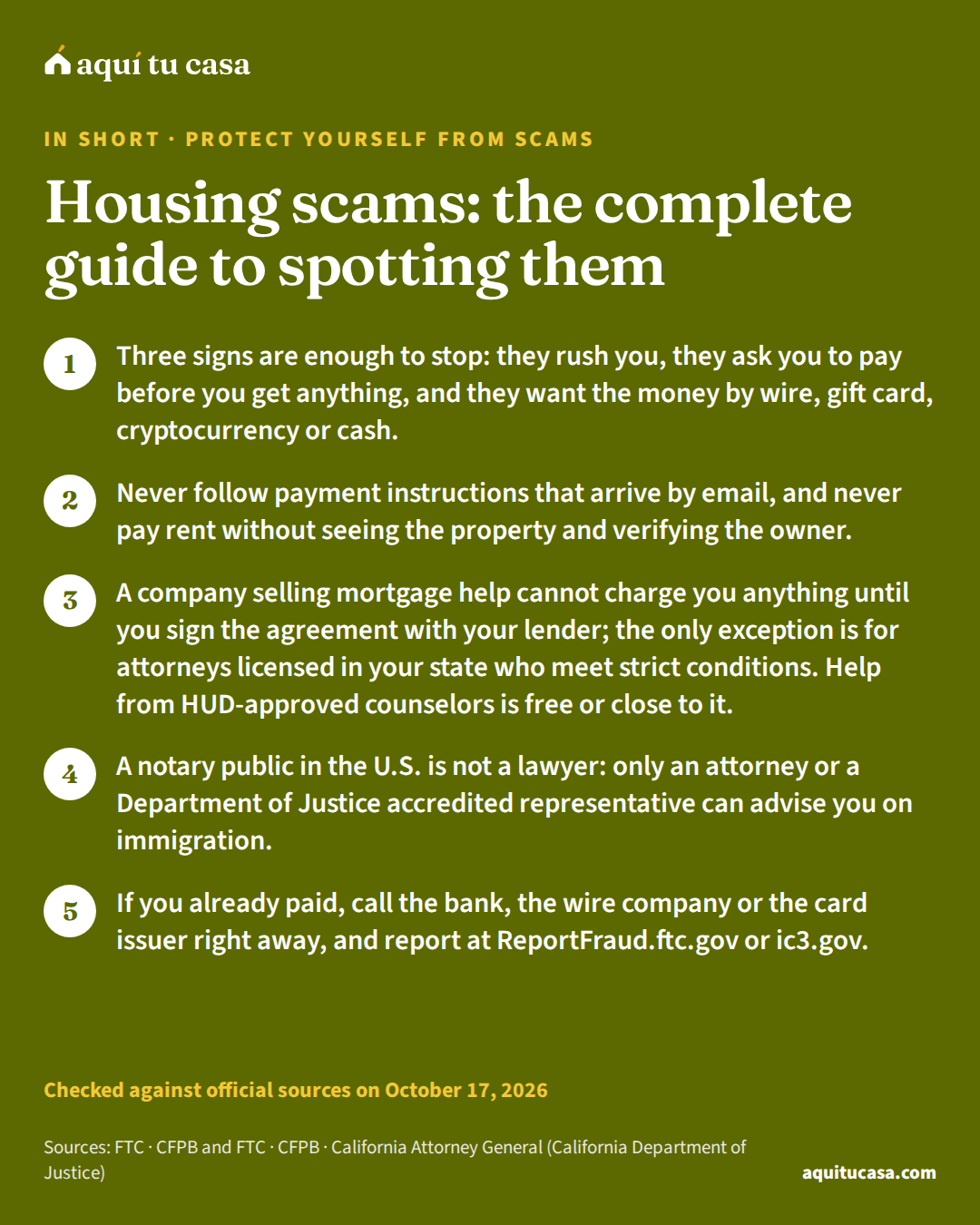
- Protect yourself from scams Housing scams: the complete guide to spotting them The rental, mortgage, title, contractor, credit and moving scams families run into most: how to spot them, what to do and where to report them. 17 minute read
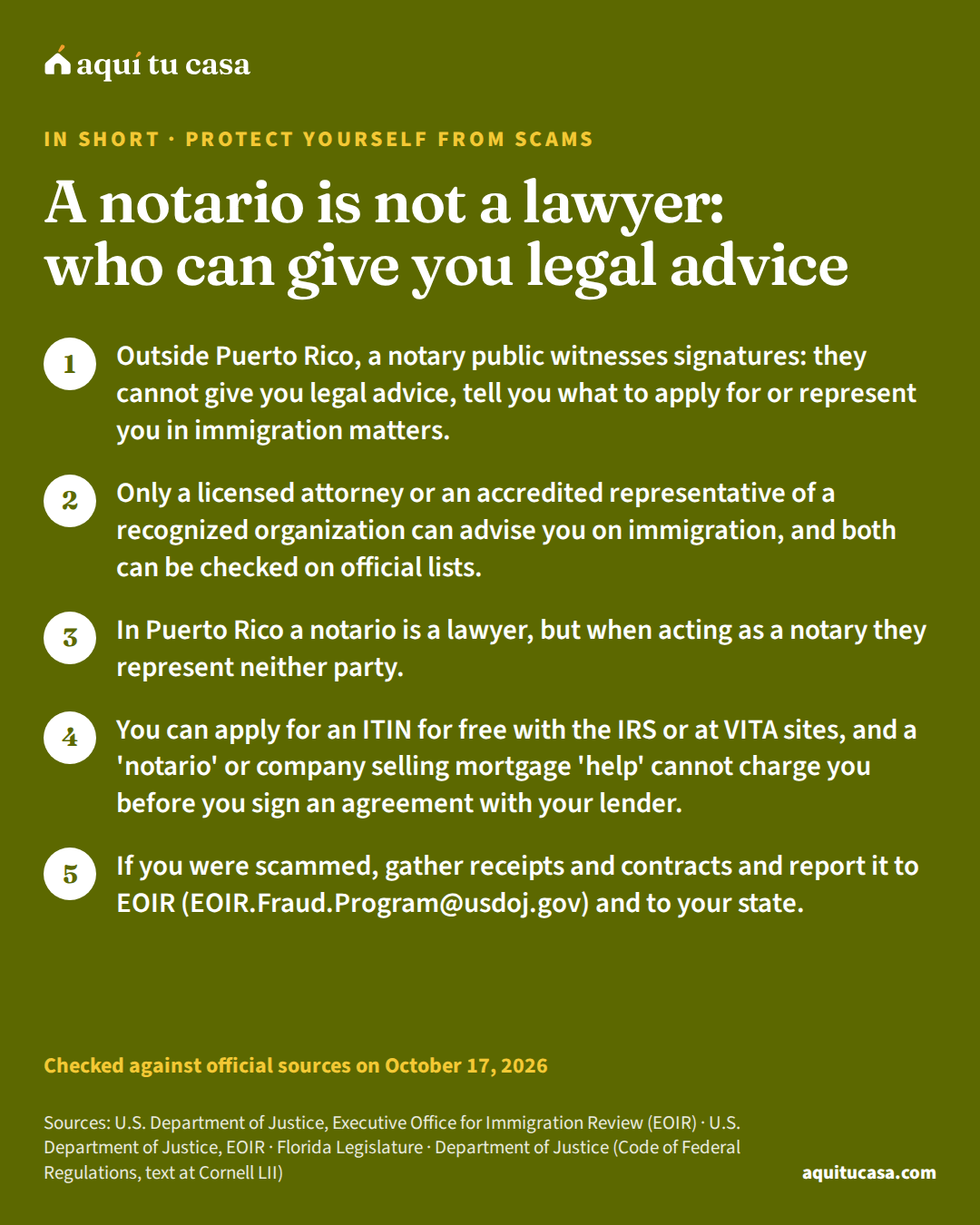
- Protect yourself from scams A notario is not a lawyer: who can give you legal advice Outside Puerto Rico, a notary public is not a lawyer. What a notary can do, who can advise you for free or at low cost, warning signs and how to report it. 12 minute read
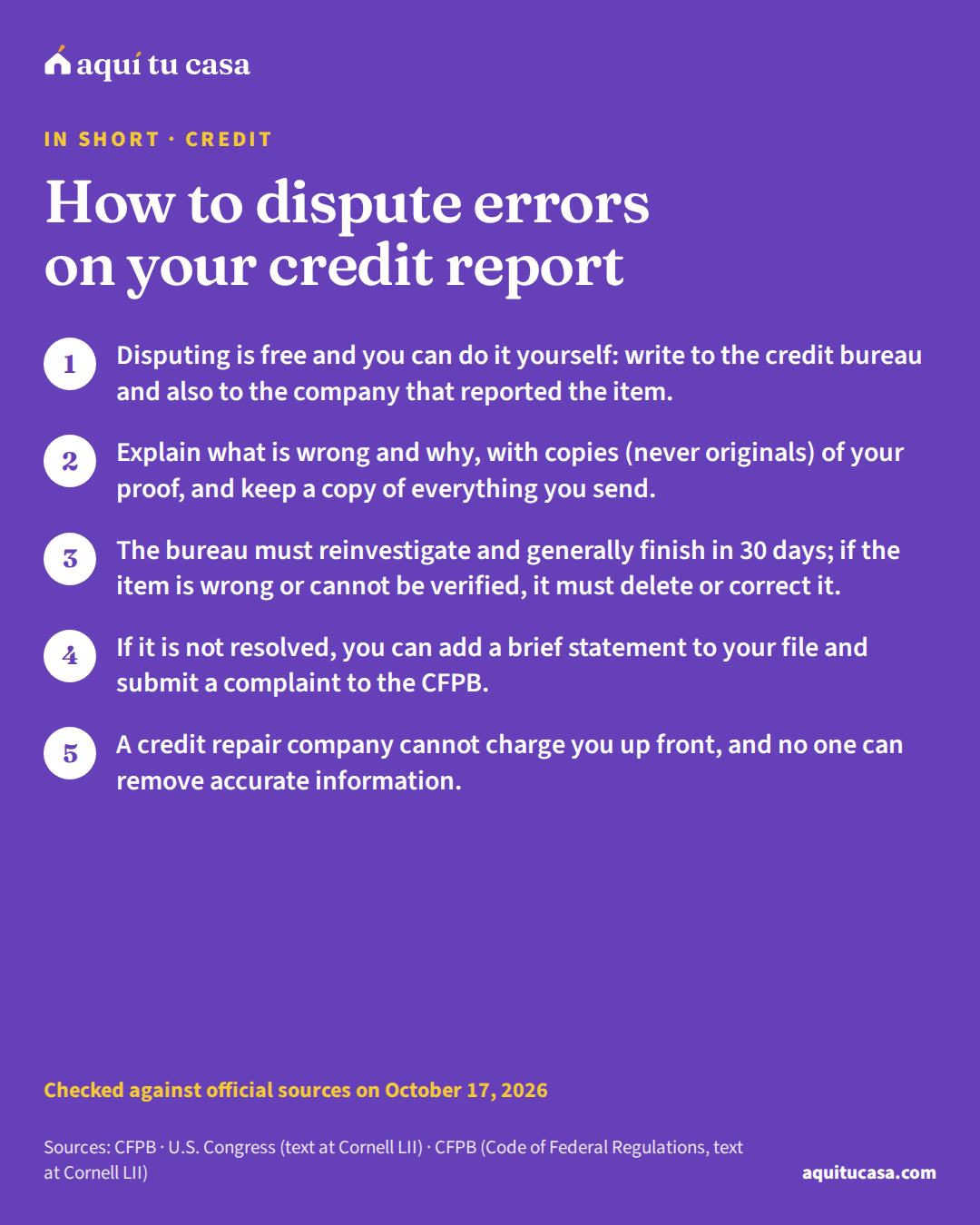
- Credit How to dispute errors on your credit report How to fix credit report errors for free: what to send each bureau and the company that reported it, legal deadlines, and credit repair scams. 14 minute read
Tools for this topic
Was this guide useful?
Thank you. Your answer stays in your browser; nothing is sent.