Buying or inheriting a home in Mexico from the United States
Buying or inheriting a home in Mexico from the U.S.: the restricted zone, the bank trust, the SRE filing, Mexican notaries, inheritance and scams.
Verified against official sources on October 31, 2026 9 official sources

Show contents
In short
What you need to know
Quick answer
In Mexico, foreigners cannot directly own land in the restricted zone: one hundred kilometers along the borders and fifty along the beaches. There they buy through a fideicomiso (bank trust): a bank holds the property rights and you hold the right to use and enjoy it, with a permit from the Ministry of Foreign Affairs, for up to fifty years that can be extended. Outside that zone, a foreigner files a written agreement with that Ministry. If you were born in Mexico or to a Mexican father or mother, the law treats you as Mexican for real estate in Mexico. A Mexican notario is different from a U.S. notary public.
What matters most
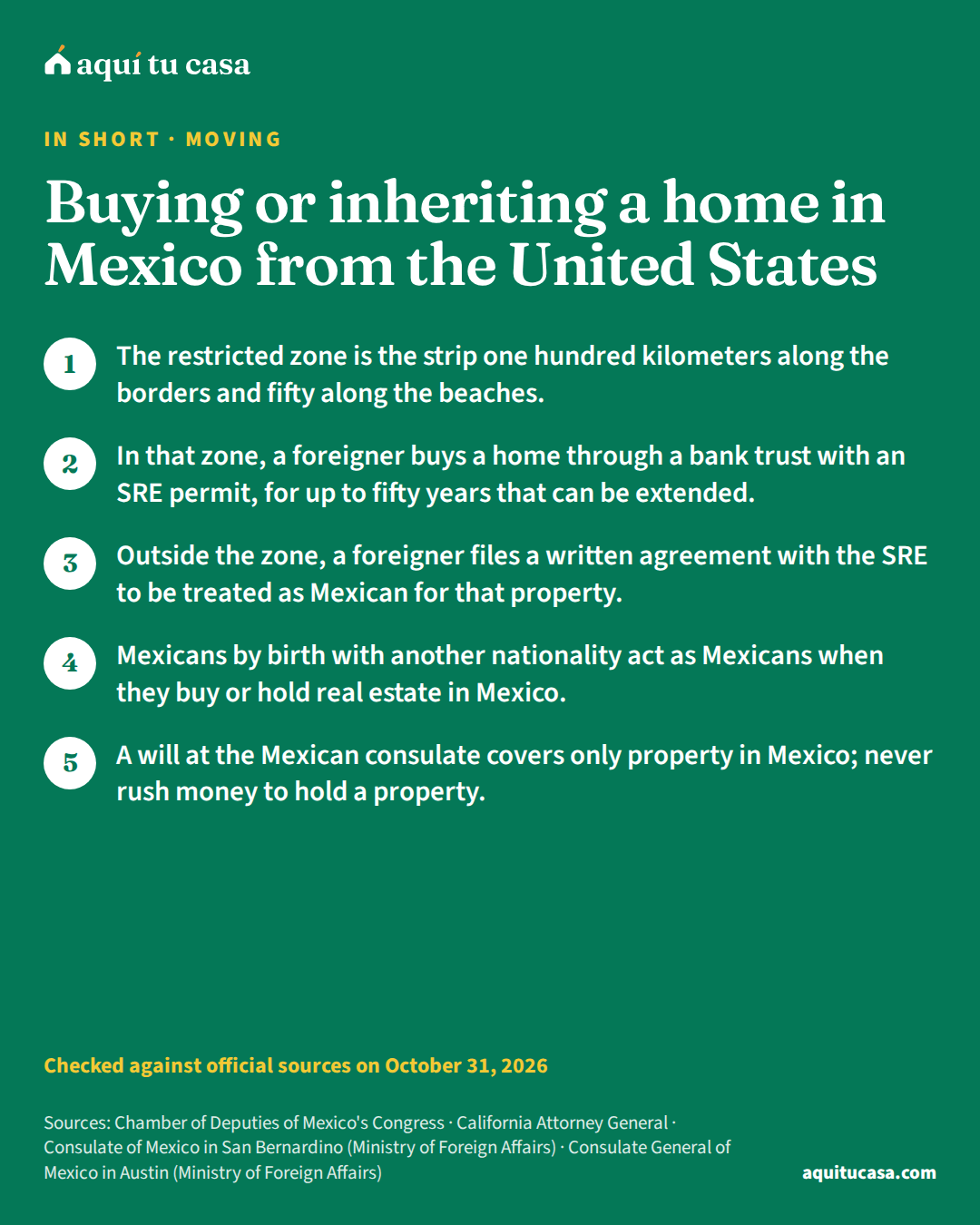
- The restricted zone is the strip one hundred kilometers along the borders and fifty along the beaches.
- In that zone, a foreigner buys a home through a bank trust with an SRE permit, for up to fifty years that can be extended.
- Outside the zone, a foreigner files a written agreement with the SRE to be treated as Mexican for that property.
- Mexicans by birth with another nationality act as Mexicans when they buy or hold real estate in Mexico.
Is this for you?
This guide is for you if…
- You live in the United States and want to buy a house or land in Mexico.
- You are going to inherit, or already inherited, your family's house in Mexico.
- You want to understand what a fideicomiso (bank trust) is and whether it applies to you.
Get direct help first if…
- You want to sell your U.S. home to move back: our Moving back to your home country guide explains what happens to your home and your lease.
- You need advice on your specific case: this guide sums up what the laws say; for your purchase or inheritance, talk to a notary or a lawyer in Mexico.
Many families who live in the United States dream of a house in Mexico, or already have one their parents left them. This guide explains what Mexico’s laws say about who can own property and how, what the fideicomiso (bank trust) is, why a Mexican notario is not a U.S. notary public, how an inheritance is handled and how to protect yourself from scams. It does not give advice on your case: for your purchase or inheritance, talk to a notary or a lawyer in Mexico.
The restricted zone: borders and beaches
Mexico’s Constitution (Article 27) says only Mexicans and Mexican companies have the right to acquire ownership of land. The State can give foreigners the same right if they agree before the Ministry of Foreign Affairs (Secretaría de Relaciones Exteriores, SRE) to consider themselves Mexican with respect to that property and not to seek their government’s protection; if they break the agreement, they lose the property. And in a strip of one hundred kilometers along the borders and fifty along the beaches, foreigners may not “under any circumstances” acquire direct ownership.1
The Foreign Investment Law calls that strip the restricted zone (zona restringida).2 Many places families look at, such as border cities and the coasts, are inside it. Before thinking about a purchase, ask which municipality the house is in and whether that municipality is inside, outside or partly inside the zone.
If you are Mexican by birth
Many people who read this guide were born in Mexico or are children of a Mexican father or mother. The Constitution says Mexicans by birth include those born in Mexico, whatever their parents’ nationality, and those born abroad to a Mexican father or mother. It also says no Mexican by birth may be deprived of their nationality.1
The Nationality Law adds something important: Mexicans by birth who have or acquire another nationality, such as U.S. citizenship, act as Mexicans in the legal acts they carry out in Mexico and when holding real estate in Mexico. In those acts they may not seek the protection of a foreign government; anyone who does loses the property.3 In practice, the question for the notary is which documents you need to prove you are Mexican by birth.
The bank trust: how a foreigner buys inside the zone
If you are not Mexican and want a home in the restricted zone, the law does not let you be the direct owner. What it allows is a fideicomiso, a bank trust. A bank, as trustee, acquires the rights over the property with an SRE permit, and you, as beneficiary (fideicomisario), have the right to use and enjoy it. That includes living in it and getting its fruits and returns, for example from renting it, through third parties or through the bank.2
The law sets time limits. A trust in the restricted zone lasts at most fifty years, and can be extended if you ask. The SRE may check at any time that the permit conditions are met. And it must decide a permit request within five business days if filed at its central office, or thirty business days if filed at a state office; if it does not decide in that time, the request is deemed approved.2
Inside or outside the restricted zone
Borders and beaches
Inside the zone
- A foreigner cannot hold direct ownership
- A bank holds the rights in a trust with an SRE permit
- You have the use and enjoyment, up to fifty years, extendable
The rest of the country
Outside the zone
- A foreigner can acquire the property
- First they file a written agreement with the SRE to be treated as Mexican for that property
- In a municipality fully outside the zone, the permit is deemed granted if there is no denial in five business days
Even with another nationality
Mexican by birth
- You act as Mexican when holding real estate in Mexico
- You cannot seek another government's protection over that property
- The notary will tell you how to prove your nationality
Always ask which municipality the property is in before you sign or pay.

Outside the zone: the written agreement with the SRE
If the property is outside the restricted zone, a foreigner can acquire it. The Foreign Investment Law says they must first file with the SRE a written agreement accepting what Article 27 says: to be treated as Mexican for that property and not seek their government’s protection. They must also obtain the permit. If the property is in a municipality fully outside the zone, the permit is deemed granted unless the SRE publishes a denial in the Official Gazette within five business days. If the municipality is partly inside the zone, the SRE decides within thirty business days. The SRE may also set cases in which the written agreement is enough, without a permit.2
These steps are not a detail. The law says acts declared void for going against it have no legal effect between the parties or toward others. And public officers who certify documents, such as notaries, must attach to their deeds the documents with the authorizations the law requires; if they do not, they face sanctions.2 That is why the notary should ask you for the SRE permit before you sign.
A Mexican notario is not a U.S. notary public
The word is the same, but the job is not. The California Attorney General explains that in many Spanish-speaking nations, notarios are attorneys with special legal credentials. In the United States, a notary public is a person authorized by the state to witness the signing of documents, and is not necessarily authorized to provide legal services.5 Our guide Notario is not a lawyer explains this difference in more detail.
What if you need to sign something here that has to work in Mexico? The Mexican consulate can help. According to the Consulate of Mexico in San Bernardino, consuls certify some acts carried out abroad, acting as notaries public, so those documents are valid in Mexico. A general power of attorneypower of attorney (POA)A power of attorney (POA) is a legal document that lets someone else act on your behalf. That person is called your agent. A financial power of attorney can help you plan ahead: it is generally "durable," meaning it stays in effect even if you can no longer make decisions. It can also be for something short-term, such as paying bills while you are away. If you show it to your bank, the bank should let your agent handle transactions for you. The CFPB warns that it gives a lot of authority over your money without regular oversight, so choose someone you trust deeply.See the full definition can be for lawsuits and collections, for managing property or for acts of ownership, which include buying, mortgaging, donating or selling the grantor’s property. A special power of attorney is for one matter only. Documents are subject to review and acceptance.6
A power of attorney for acts of ownership gives a lot of authority: it lets someone else sell your house. Give it only to someone you trust deeply, and choose a special power of attorney for a single matter when you can.
Buying in Mexico from the United States, step by step
1. Find the property's municipality
First of all
Ask whether the municipality is inside, outside or partly inside the restricted zone.2
2. Decide how you will buy
Before negotiating
As a Mexican by birth, through a bank trust inside the zone or with the SRE filing outside it.2
3. Choose a notary in Mexico
Before paying
They must attach to the deed the authorizations the law requires.2
4. The SRE permit
Before signing
Inside the zone, the bank requests the trust permit; the SRE decides in five or thirty business days.2
5. If you cannot travel, a power of attorney at the consulate
If needed
The consul acts as a notary so the power of attorney is valid in Mexico.6
6. Send the money carefully
When you pay
Check the cost and the exchange rate before sending; you can generally cancel within 30 minutes.9
Inheriting a house in Mexico
Mexico’s Constitution says real estate is governed by the law of the place where it is1, and the Federal Civil Code says rights over real estate are governed by the law of the place where it is, even if the owners are foreigners.4 So even if the heirs live in Texas or California, the family house in Mexico is handled under Mexican rules. Talk to a notary or a lawyer in the state where the house is; if you cannot travel, a power of attorney done at the consulate can let someone represent you there.6
If you are the one who owns a house in Mexico and want to leave it in order, the consulate can also help. According to the Consulate General of Mexico in Austin, you can make an open public will before the consul, who acts as a notary. It can only cover property located in Mexico. People who are not Mexican can also do it if the property is in Mexico. Witnesses must not be close relatives or heirs.7
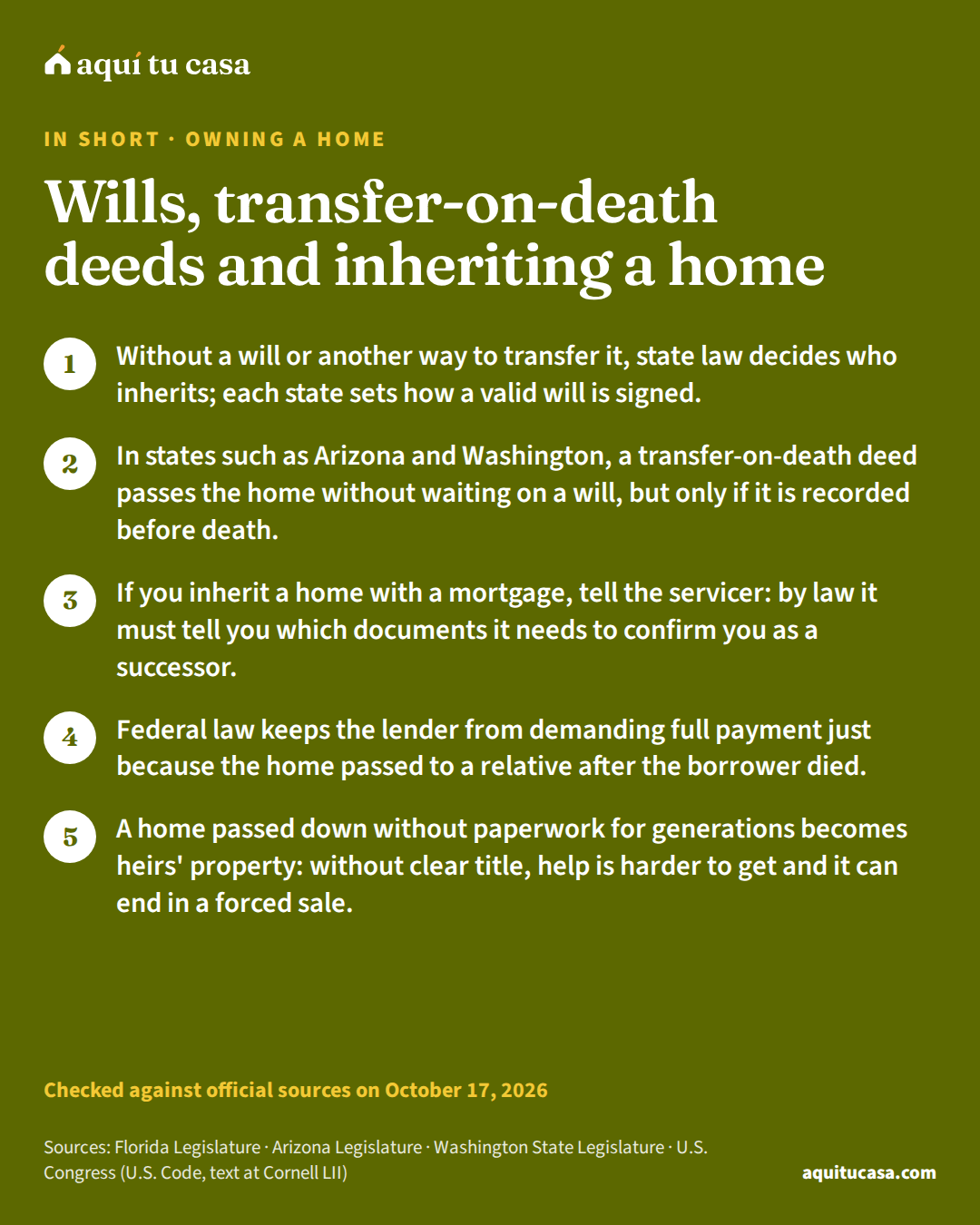
If you also own a house in the United States, remember that one is governed by your state’s law. Our guide Wills, transfer-on-death deeds and inheriting a home explains the options here, and the one on how to hold title with family explains the ways to hold title in the U.S.
Example with real numbers
Two siblings who inherit their mother's house in Michoacán
An example in words, not a real case, of how they can organize it.
- Where the house is
- In Michoacán, outside the restricted zone
- Where the siblings live
- One in Chicago and one in Houston
- Which law applies to the house
- The law of the place where it is, in Mexico
- How they are represented if they cannot travel
- With a power of attorney done at the Mexican consulate, valid in Mexico
- What they watch before signing
- A special power of attorney for one matter, given to someone they trust deeply
- Who handles the process
- A notary or a lawyer in the state where the house is
The rules in the example come from Mexico's Constitution and the consulate.1 If they plan to sell and split the money, the savings plan helps you decide what to do with your share.
Run it with your numbersDown payment savings plan
Scams that target people buying from far away
Buying from a distance makes you an easy target. Someone offers you “dirt cheap” land, sends photos and asks for an urgent deposit to hold it. According to the FTC, scammers pretend to be someone you know, say there is a problem or a prize, pressure you to act immediately and tell you to pay in a specific way. The FTC advises stopping and talking to someone you trust, and reporting the scam at ReportFraud.ftc.gov.8
If you are going to send money to Mexico, know your rights. According to the CFPB, before you pay you generally see the total cost with taxes and fees and the exchange rate, and you get a receipt saying when the money will be available. You can generally cancel within 30 minutes after sending, unless it was already picked up or deposited, and you can report an error up to 180 days later.9 Our guide Sending money abroad explains the tax on remittancesremittance transferA remittance transfer is an electronic money transfer you send from the United States to a person or company in another country through a remittance transfer provider, such as a bank or another financial services company. Federal law protects transfers above a minimum amount made by a provider in the normal course of its business. The provider must tell you, before and after you pay, the fees, taxes, exchange rate and how much the other person will receive, in your language if it advertises in it or served you in it. You have up to thirty minutes to cancel at no charge, if the money has not been picked up, and one hundred eighty days to report an error.See the full definition.
If you were already scammed, our guide I was scammed: what to do now tells you what to do in the first hours.
If this is you
You were born in Mexico and are now a U.S. citizen
The law treats you as Mexican when holding real estate in Mexico; ask the notary how to prove it.3
Your children were born in the U.S. to a Mexican father or mother
The Constitution says children born abroad to a Mexican father or mother are Mexican by birth.1
You want a house at the beach
If you are not Mexican, in the restricted zone you buy through a bank trust with an SRE permit.2
You want to leave your house in Mexico in order
The consulate can do a will before the consul for property in Mexico.7
You are asked for an urgent deposit for land
Pressure and the payment method are scam signs; stop and talk to someone you trust.8

Mistakes that cost you
Mistake: Buying at the beach or the border in your own name when you are not Mexican.
Instead: In the restricted zone foreigners cannot hold direct ownership; a bank trust with an SRE permit is used.1
Mistake: Signing before a U.S. notary public thinking it works like a Mexican notario.
Instead: For a power of attorney to be valid in Mexico, do it at the Mexican consulate.6
Mistake: Giving anyone a general power of attorney for acts of ownership.
Instead: That power lets someone sell your property; choose a special power of attorney for one matter.6
Mistake: Paying without the SRE permit in the deed.
Instead: The notary must attach the authorizations; a void act has no legal effect.2
Mistake: Thinking your U.S. will settles the house in Mexico.
Instead: Real estate is governed by the law of the place where it is; the consulate can do a will for property in Mexico.1
Mistake: Rushing a deposit for a property no one has checked.
Instead: Stop, talk to someone you trust and remember you can generally cancel a transfer within 30 minutes.9
What to do this week
- Find out which municipality the house or land is in and whether it is in the restricted zone.2
- If you were born in Mexico or your parents are Mexican, gather your Mexican birth certificate or theirs.1
- Find a notary in the Mexican state where the property is and ask which SRE authorizations you need.2
- If you cannot travel, book an appointment at the consulate for a special power of attorney.6
- If you want to leave your house in Mexico in order, ask the consulate about a will before the consul.7
- Before sending money, check the total cost and the exchange rate, and keep the receipt.9
Your numbers
We start with the typical home value in the United States ($332,700). Enter the price you are looking at.
Adjust advanced details
The minimum for this loan is 3.5%. A larger down payment lowers the monthly payment but takes longer to save.
As a share of the price. It is an example; your lender's Loan Estimate has the real figure.
Annual interest of the account where you keep the money. Leave it at zero if you do not know.
Let's do the math
Time to reach your goal
Enter how much you can save each month.
Your goal
- Down payment (3.5% of the price)
- $11,645
- Closing costs (3% of the price)
- $9,981
- Savings target
- $21,626
- You already have
- $0
- Still missing
- $21,626
What helps
- Set up an automatic transfer on payday into a separate account you do not use for spending.
- Ask about your state's and city's assistance programs before setting the goal: many cover part of the down payment or closing costs.
- If family gives you part of it, the lender usually asks for a gift letter and the transfer record; ask beforehand how they want it.
- Revisit the goal whenever the price you are looking at, the loan type or what you can save changes.
An educational estimate, not a loan offer. Closing costs are an example (3% of the price); the real figure comes in the Loan Estimate. We do not count the reserves some lenders require after closing.
Ready to see the numbers? Find your county here
See how this applies in your county: its loan limits, prices and rents, from the official data.
Printable checklist
Frequently asked questions
Can a U.S. citizen buy a house in Mexico?
Yes, with rules. The Constitution says that in the restricted zone (one hundred kilometers from the borders and fifty from the beaches) foreigners cannot hold direct ownership. There a bank trust is used, with an SRE permit. Outside that zone, the foreigner files a written agreement with the SRE accepting to be treated as Mexican for that property.
I was born in Mexico but I am now a U.S. citizen. Do I need a bank trust?
The Constitution says no Mexican by birth may be deprived of their nationality, and the Nationality Law says Mexicans by birth with another nationality act as Mexicans when holding real estate in Mexico. Ask the notary in Mexico which documents you need to prove your Mexican nationality.
What is a bank trust in the restricted zone?
It is a contract in which a bank, as trustee, holds the rights over the property with an SRE permit, and you, as beneficiary, have the right to use it, enjoy it and get its returns. By law it lasts up to fifty years and can be extended if you ask.
Can a U.S. notary public prepare the deed for my house in Mexico?
In the U.S., a notary public is a person authorized by the state to witness signatures and is not necessarily authorized to provide legal services. For a power of attorney or a will to be valid in Mexico, the Mexican consulate can do it: consuls act as notaries for acts that take effect in Mexico.
Can I make a will in the U.S. for my house in Mexico?
The Mexican consulate can do an open public will before the consul, who acts as a notary, only for property located in Mexico. People who are not Mexican can also do it if the property is in Mexico. Witnesses cannot be close relatives or heirs.
I inherited my parents' house in Mexico. Which law applies?
Mexico's Constitution says real estate is governed by the law of the place where it is, and the Federal Civil Code says rights over real estate are governed by the law of the place where it is, even if the holders are foreigners. Talk to a notary or a lawyer in the Mexican state where the house is; if you cannot travel, the consulate can do a power of attorney so someone can represent you there.
I am offered cheap land in Mexico and asked for an urgent deposit. What should I do?
Stop. The FTC says scammers pressure you to act immediately and tell you to pay in a specific way. Talk to someone you trust and have a notary in Mexico review the property before paying. If you send money, the CFPB explains that you can generally cancel within 30 minutes.
Sources
Every figure in this guide comes from one of these official sources. The number next to a sentence leads to the source behind it.
Each source on one line: who publishes it, its title, its address and the date we read it.
- 1. Chamber of Deputies of Mexico's Congress · Constitución Política de los Estados Unidos Mexicanos (current text) · diputados.gob.mx · Accessed October 31, 2026
- 2. Chamber of Deputies of Mexico's Congress · Ley de Inversión Extranjera (current text) · diputados.gob.mx · Accessed October 31, 2026
- 3. Chamber of Deputies of Mexico's Congress · Ley de Nacionalidad (current text) · diputados.gob.mx · Accessed October 31, 2026
- 4. Chamber of Deputies of Mexico's Congress · Código Civil Federal (current text) · diputados.gob.mx · Accessed October 31, 2026
- 5. California Attorney General · Attorney General Bonta Issues Consumer Alert on Notario Fraud · oag.ca.gov · Accessed October 31, 2026
- 6. Consulate of Mexico in San Bernardino (Ministry of Foreign Affairs) · Poderes · consulmex.sre.gob.mx · Accessed October 31, 2026
- 7. Consulate General of Mexico in Austin (Ministry of Foreign Affairs) · Testamento · consulmex.sre.gob.mx · Accessed October 31, 2026
- 8. Federal Trade Commission (FTC) · How To Avoid a Scam · consumer.ftc.gov · Accessed October 31, 2026
See the other 1 sources
- 9. Consumer Financial Protection Bureau (CFPB) · Sending money · consumerfinance.gov · Accessed October 31, 2026
Keep reading
Related guides
If this guide helped, these follow the same path.
Moving 21 minute read
Moving back to your home country: your home and your lease
How to end your lease in Texas or Florida, get your deposit back from abroad, and what the IRS says if you sell or rent out your home as a nonresident.
- Read your lease before you buy the ticket: move-out notice is counted by rent periods, and in Florida an early termination fee cannot exceed 2 months' rent and applies only if you signed the addendum.
- Leave your new address in writing and an email: in Texas the deposit waits until the landlord receives it; in Florida the claim notice goes to your last known address.
- Renting out your home from abroad without the 871(d) election means 30% withholding on gross rent; with the election and Form W-8ECI you pay on net income and file every year.
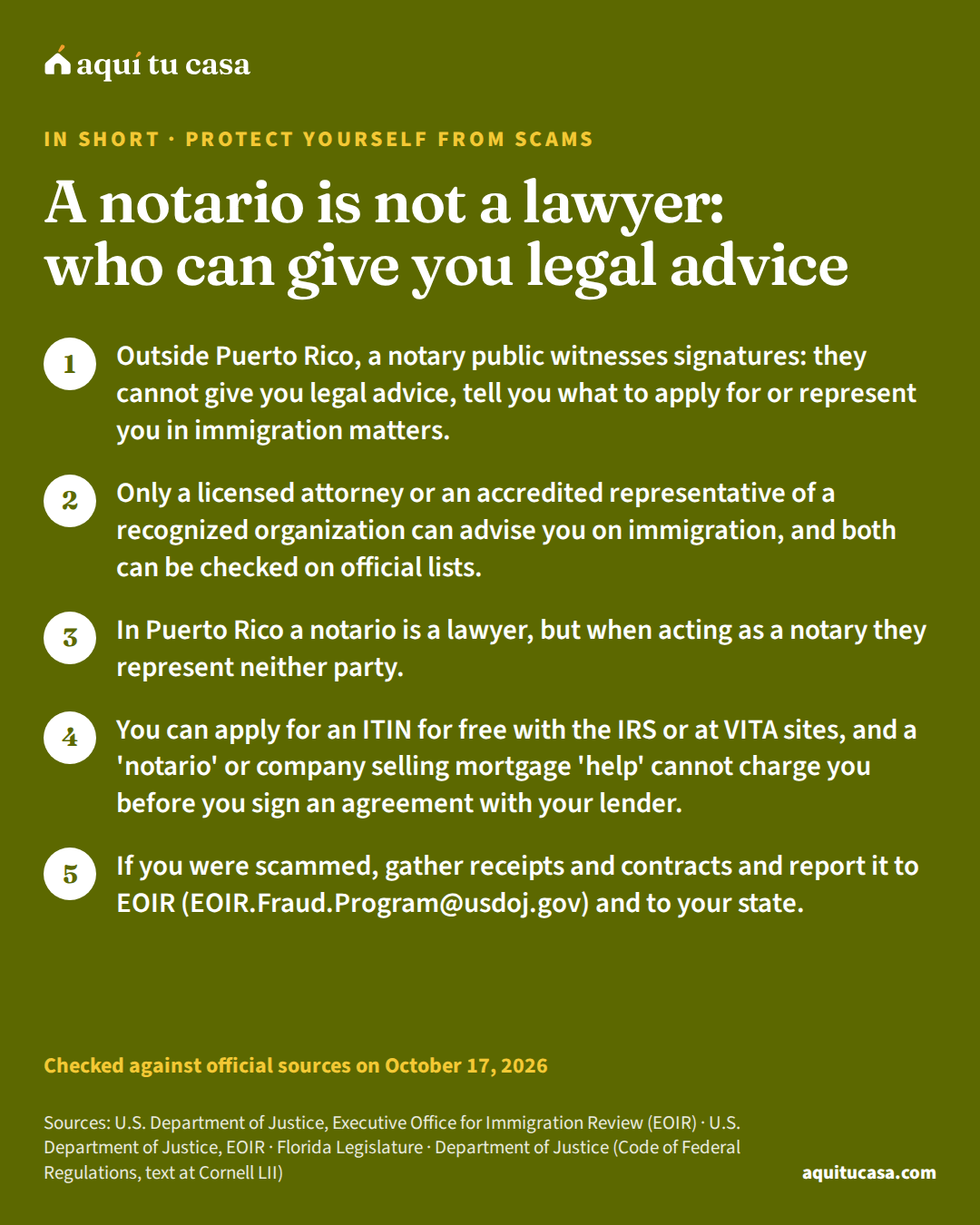
- Protect yourself from scams A notario is not a lawyer: who can give you legal advice Outside Puerto Rico, a notary public is not a lawyer. What a notary can do, who can advise you for free or at low cost, warning signs and how to report it. 12 minute read
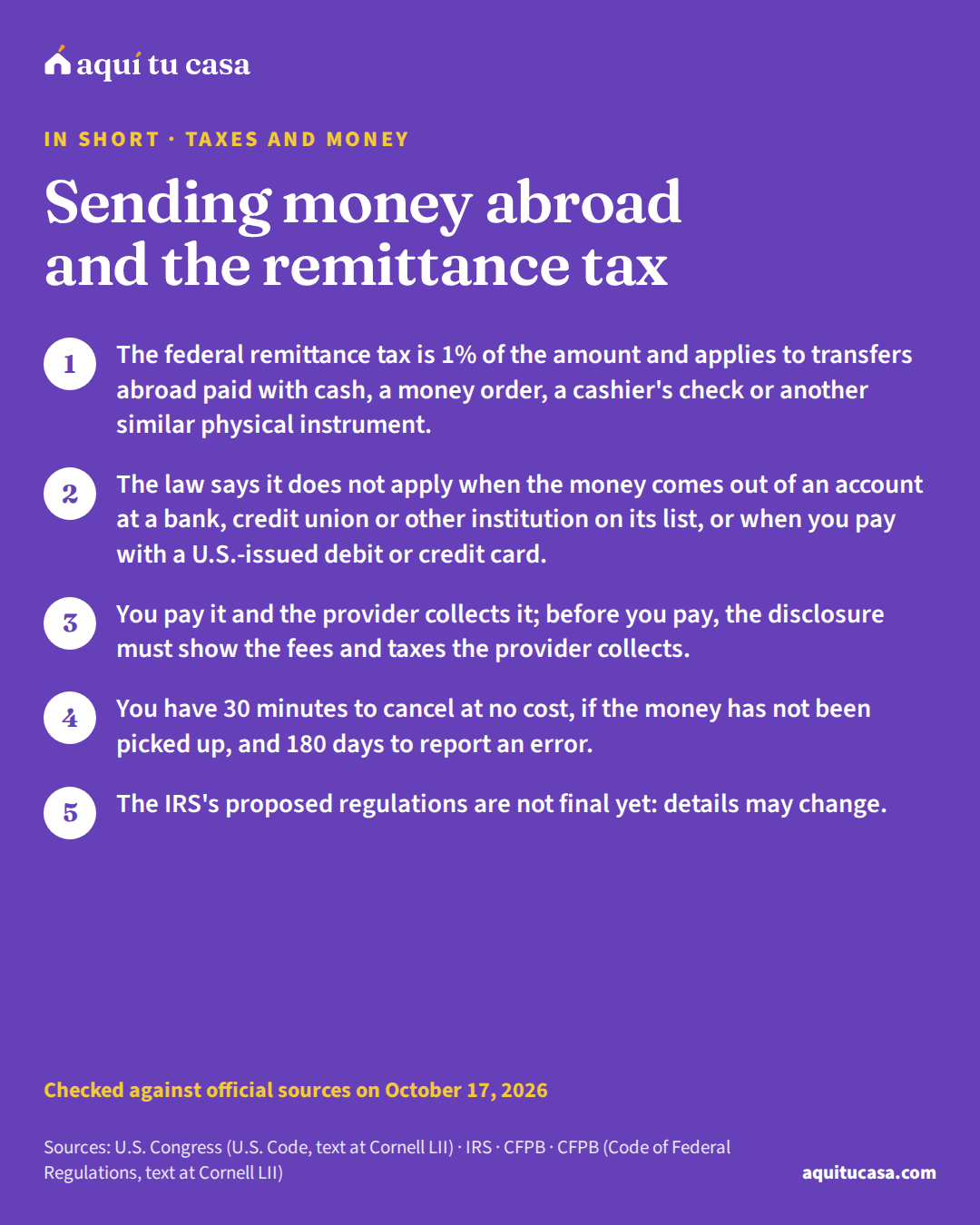
- Taxes and money Sending money abroad and the remittance tax The federal tax on cash-funded remittances: which transfers it applies to, which it does not, who collects it and your rights when you send money abroad. 10 minute read
- Owning a home Wills, transfer-on-death deeds and inheriting a home What a will requires, how a transfer-on-death deed works, what happens to the mortgage when you inherit a home and what heirs' property is. 14 minute read
Tools for this topic
Was this guide useful?
Thank you. Your answer stays in your browser; nothing is sent.