Sending money abroad and the remittance tax
The federal tax on cash-funded remittances: which transfers it applies to, which it does not, who collects it and your rights when you send money abroad.
Verified against official sources on October 17, 2026 12 official sources

Show contents
In short
What you need to know
Quick answer
For remittances made after December 31, 2025, federal law imposes a tax of 1% of the amount when you pay the provider with cash, a money order, a cashier's check or another similar physical instrument. The same law says it does not apply when the money comes out of an account at a bank, credit union or other financial institution on its list, or when you pay with a debit or credit card issued in the United States. The sender pays it and the provider collects it. Whatever way you pay, Regulation E gives you the right to see costs and the exchange rate before you pay, to cancel within 30 minutes and to report errors within 180 days.
What matters most
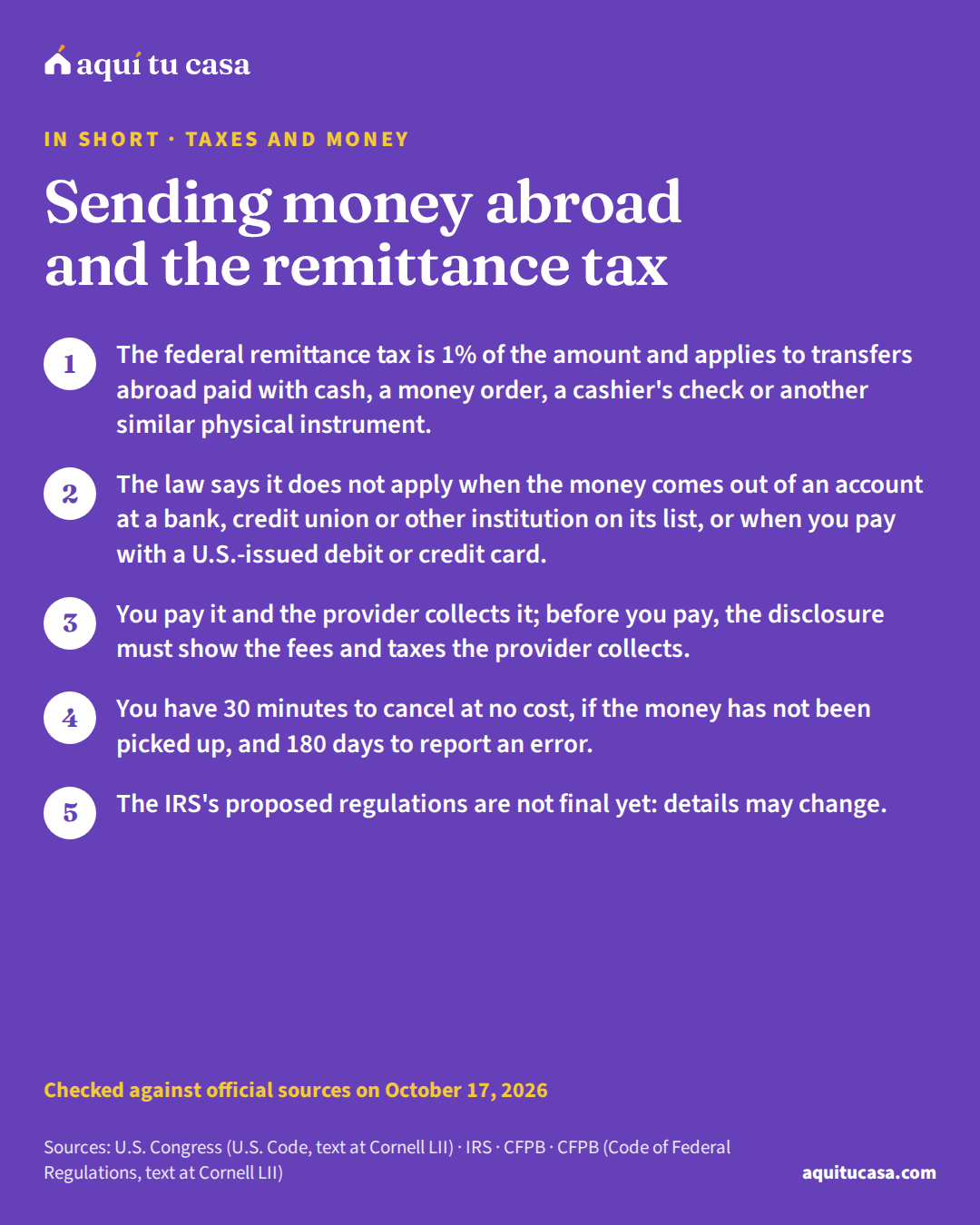
- The federal remittance tax is 1% of the amount and applies to transfers abroad paid with cash, a money order, a cashier's check or another similar physical instrument.
- The law says it does not apply when the money comes out of an account at a bank, credit union or other institution on its list, or when you pay with a U.S.-issued debit or credit card.
- You pay it and the provider collects it; before you pay, the disclosure must show the fees and taxes the provider collects.
- You have 30 minutes to cancel at no cost, if the money has not been picked up, and 180 days to report an error.
Is this for you?
This guide is for you if…
- You send money to family in another country and want to know when the federal remittance tax applies.
- You pay for your transfers with cash, a money order or a cashier's check.
- You had a problem with a transfer and do not know what rights you have.
Get direct help first if…
- You run a business that sends remittances for others: this guide is for senders, not providers.
- You have a question about your own tax return: an IRS VITA site helps qualifying people for free.
- You send money within the United States: these rules are for transfers to other countries.
This guide is for you if you send money to family in another country. A federal law now taxes certain remittances. You will see which transfers it applies to according to the law, which it does not, who pays it and who collects it, and the rights federal rules give you every time you send money: seeing the costs before you pay, canceling and reporting errors.
- Federal tax on the amount of a remittance paid with cash, a money order or a cashier's check
- 1%1
- To cancel at no cost after paying, if the money has not been picked up
- 30 minutes7
- For your refund if you canceled in time
- 3 business days7
- To report an error, from the date the money was supposed to be available
- 180 days9
What the remittance tax is
A remittanceremittance transferA remittance transfer is an electronic money transfer you send from the United States to a person or company in another country through a remittance transfer provider, such as a bank or another financial services company. Federal law protects transfers above a minimum amount made by a provider in the normal course of its business. The provider must tell you, before and after you pay, the fees, taxes, exchange rate and how much the other person will receive, in your language if it advertises in it or served you in it. You have up to thirty minutes to cancel at no charge, if the money has not been picked up, and one hundred eighty days to report an error.See the full definition is money you send from the United States to someone in another country through a provider, such as a money transfer company or a bank.5 Federal law (26 U.S.C. §4475) imposes a tax equal to 1% of the amount of the remittance, and it applies to transfers made after December 31, 2025.1
According to the IRS, the tax applies to remittances from the United States to recipients in foreign countries when the sender gives the provider cash, a money order, a cashier’s check or another similar physical instrument.3 The law uses the definitions of “remittance transfer,” “provider” and “sender” from the Electronic Fund Transfer Act.1
Which transfers it applies to and which it does not
The law is specific about how you pay. The tax applies only when you give the provider cash, a money order, a cashier’s check or another similar physical instrument, as the Treasury determines.1 And the same law says it does not apply in two cases:1
- When the money is withdrawn from an account at a financial institution named in the law. That list includes insured banks, commercial banks, U.S. branches of foreign banks, any credit unioncredit unionA credit union is a not-for-profit financial institution that, like a bank, accepts deposits, makes loans and offers other services, but is owned by its members. Members elect a volunteer board of directors, and profits go back to them as lower fees, higher savings rates and lower loan rates. To join you need a common bond, such as your employer, your family, where you live or a group you belong to. It is chartered by the NCUA, a federal agency, or by a state. If the credit union is federally insured, your deposits are protected by the NCUA's insurance fund.See the full definition and thrift institutions.2
- When you pay with a debit or credit card issued in the United States.1
How you pay and what the law says
The tax applies
Cash, money order or cashier's check
Does not apply
From a bank or credit union account
Does not apply
With a U.S.-issued debit or credit card
- The law excludes remittances funded with a card issued in the United States.1
Whatever way you pay, you have the right to see the fees, taxes and exchange rate before you pay.6
The law also has a special rule for multiple-party arrangements involving the sender: in those cases, the remittance is treated as a financing transaction under the tax code’s “anti-conduit” rule.1 If you have questions about how it applies to your situation, ask the IRS directly.

Who pays it and who collects it
The sender pays the tax. The provider collects it from you at the time of the transfer and sends it to the Treasury every quarter. If the provider does not collect it at the time of the transfer, the law says the provider must pay it.1 The IRS puts it the same way: the sender is liable for the tax, and if the provider does not collect it, it becomes the provider’s liability.3
The provider reports the tax to the IRS on Form 720, the Quarterly Federal Excise Tax Return.4 And when you send money, Regulation E requires the pre-payment disclosure to show the fees the provider charges and the taxes it collects, labeled “Transfer Fees” and “Transfer Taxes” or something similar.6
Your rights every time you send money
Beyond the tax, federal law protects you. According to the CFPB, a remittance is an electronic transfer of more than $15 that you send from the United States to a person or company in another country through a provider. A bank or other financial company can be a provider. But if a company made 500 or fewer transfers last year and makes 500 or fewer this year, it does not count as a provider, and federal law does not require it to give you these protections.5
Before you pay, the provider must give you a disclosure with the amount transferred, the fees, the taxes it collects, the total, the exchange rate and the amount the person will receive. When you pay, it must give you a receipt with that information, the date the money will be available and your rights to report errors and cancel.6 Where it applies, the disclosure also tells you that foreign taxes and fees may be deducted in the other country.5
In your language. The law generally requires the provider to use your language on receipts and disclosures if it uses that language in its advertising where you send money, or if you made the transfer in that language.5
Example with real numbers
What to check on the disclosure before you pay
An example of the lines Regulation E requires; the labels may be similar rather than identical.
- Transfer Amount
- The amount transferred to the recipient
- Transfer Fees
- The fees the provider charges you
- Transfer Taxes
- The taxes the provider collects on the transfer
- Exchange Rate
- The exchange rate the provider uses
- Total
- The amount transferred plus the fees and taxes
That is what Regulation E requires.6 If your transfer is paid with cash, a money order or a cashier's check, the 1% tax is one of the taxes the provider collects.1 Track your monthly transfers in the budget tool.
Run it with your numbersFamily budget
Canceling a transfer or reporting an error
Under Regulation E, you can cancel if you ask no later than 30 minutes after paying, with enough information to identify you and the transfer, and if the money has not been picked up or deposited. The provider must refund everything you paid, including fees and, to the extent the law does not prohibit it, taxes, within three business days.7 If you scheduled the transfer in advance, you can cancel up to three business days before it is made; sometimes state law or the provider’s own rules give you more time.8
If something went wrong, the provider must handle your notice of error if it receives it no later than 180 days after the availability date it gave you. It must investigate within 90 days and give you the results within three business days after that.9
One transfer, start to finish
1. Ask for and review the disclosure
Before you pay
Amount, fees, taxes, total and exchange rate, in your language if the provider advertises in it.6
2. Pay and keep the receipt
When you pay
The receipt shows the date the money will be available and your rights.6
Try it with your numbersFamily budget3. Changed your mind? Cancel
Within 30 minutes
If the money has not been picked up, you get everything you paid back within three business days.7
4. If there is an error, report it
Within 180 days
Counted from the availability date on the receipt; report it right away and then in writing.10
5. The provider investigates
Up to 90 days
It gives you the results within three business days after it finishes.9
6. If it is not resolved, complain
After its answer
You can file a complaint with the CFPB; its phone number and website are on your receipt.10
How to report an error. According to the CFPB, contact the provider right away; it may help to follow up in writing with your name and phone number or address, the recipient’s, the amount and what happened. Errors the provider must correct include delivering the wrong amount, not delivering the money on time or at all, and delivering it to the wrong person.10 If the money never arrived, you may get a refund or have it resent.5
Watch out for one case: if the mistake happened because you gave a wrong account or routing number and the provider took certain steps, it does not have to refund or resend the money. And some banks and credit unions are exempt from the federal error protections.10 If the problem is not solved, you can file a complaint with the CFPB, and for your state’s laws you can contact your state attorney general or financial regulator.10
If this is you
You are paid in cash and send in cash
The law imposes the 1% tax when you pay for the remittance with cash, a money order or a cashier's check.11
You do not have a Social Security number
Many banks open accounts with a passport, consular ID or ITIN;12 the law does not impose the tax when the money comes out of a bank or credit union account.1
You send money every month
Keep every receipt: you have 180 days from the availability date to report an error.9
You prefer to do it in Spanish
If the provider advertises in Spanish where you send money, it generally must give you the disclosure and receipt in Spanish.5
Mistakes that cost you money
Mistake: Paying without reviewing the disclosure.
Instead: Before you pay, check the fees, taxes, total and exchange rate.6
Mistake: Throwing away the receipt.
Instead: Keep it: it has the availability date and the phone numbers for complaints.10
Mistake: Waiting months to report that the money did not arrive.
Instead: Report it as soon as you can; the deadline is 180 days from the availability date.9
Mistake: Giving the recipient's account number in a hurry.
Instead: Check it twice: if the mistake was yours, the provider may not have to refund you.10
Mistake: Assuming a transfer can never be canceled.
Instead: You have 30 minutes after paying, if the money has not been picked up.7

What to do this week
- Look at how you pay for your transfers: the law imposes the tax only when you pay with cash, a money order, a cashier’s check or another similar physical instrument.1
- On your next transfer, ask for the disclosure before you pay and check the fee and tax lines.6
- Keep your transfer receipts in one place.10
- If a transfer did not arrive, tell the provider today and then in writing.10
- If you have questions about your own tax return, look for an IRS VITAVITA (free tax preparation)VITA (Volunteer Income Tax Assistance) and TCE (Tax Counseling for the Elderly) are IRS programs that offer free basic tax return preparation by IRS-certified volunteers. They are meant for people with moderate income, people with disabilities and limited-English speakers; TCE focuses on people sixty and older. The IRS sets no program-wide income limit, but individual sites may set their own. Many sites serve in Spanish and help with ITIN applications and renewals. Filing taxes every year builds the record lenders ask for.See the full definition site, which prepares basic returns for free for people who qualify.11
- Add your transfers to your family budget to see how much you send each month.
Your household this month
Let's do the math
Left each month
Enter what at least one person takes home to see the result.
What helps
- Pay savings first: set the goal aside the day the money arrives, before flexible spending.
- Add up the bills that come every few months (car insurance, school) and divide by twelve.
- If income changes, plan on a low month and save the extra from good months.
- A HUD-approved housing counselor can go over the budget with you, often for free.
This is a planning tool with your numbers, not a credit evaluation or an approval. The split reference is only a guide.
Ready to see the numbers? Find your county here
See how this applies in your county: its loan limits, prices and rents, from the official data.
Printable checklist
Frequently asked questions
How much is the remittance tax?
Federal law imposes 1% of the remittance amount, but only when you give the provider cash, a money order, a cashier's check or another similar physical instrument. It applies to transfers made after December 31, 2025.
Is it charged if I send money from my bank account?
The law says it does not apply when the money is withdrawn from an account at a financial institution on its list, such as an insured bank, a credit union or a thrift institution, or when you pay with a debit or credit card issued in the United States.
Who pays the tax, me or the money transfer company?
The sender pays it, and the provider collects it from you and sends it to the government every quarter. If the provider does not collect it at the time of the transfer, the law says the provider must pay it.
How do I know how much I am being charged?
Under Regulation E, before you pay the provider must give you a disclosure with the amount, the fees, the taxes it collects, the total and the exchange rate. When you pay, you get a receipt with that information and the date the money will be available.
Can I cancel a remittance?
Yes, if you ask no later than 30 minutes after paying and the money has not been picked up or deposited. The provider must refund everything you paid, including fees, within three business days. If you scheduled the transfer in advance, you can cancel up to three business days before.
What do I do if the money did not arrive?
Tell the provider as soon as you can; you have up to 180 days from the date the money was supposed to be available. The provider has 90 days to investigate and must give you the results. If the money never arrived, you may get a refund or have it resent. If the problem is not solved, you can complain to the CFPB.
Who sends the tax to the IRS?
The provider. The law says the provider collects the tax from the sender and sends it to the Treasury every quarter, and it reports it on Form 720. If you have questions about your own tax return, an IRS VITA site prepares basic returns for free for people who qualify.
Sources
Every figure in this guide comes from one of these official sources. The number next to a sentence leads to the source behind it.
Each source on one line: who publishes it, its title, its address and the date we read it.
- 1. U.S. Congress (U.S. Code, text at Cornell LII) · 26 U.S.C. §4475, Imposition of tax (remittance transfers) · law.cornell.edu · Accessed October 17, 2026
- 2. U.S. Congress (U.S. Code, text at Cornell LII) · 31 U.S.C. §5312, Definitions and application · law.cornell.edu · Accessed October 17, 2026
- 3. IRS · Treasury, IRS issue proposed regulations on the new remittance transfer tax (IR-2026-48) · irs.gov · Accessed October 17, 2026
- 4. IRS · Notice 2025-55, Relief from Penalty for Failure to Deposit Remittance Excise Tax · irs.gov · Accessed October 17, 2026
- 5. CFPB · What is a remittance transfer and what are my rights? · consumerfinance.gov · Accessed October 17, 2026
- 6. CFPB (Code of Federal Regulations, text at Cornell LII) · Regulation E, 12 CFR §1005.31, Disclosures (remittance transfers) · law.cornell.edu · Accessed October 17, 2026
- 7. CFPB (Code of Federal Regulations, text at Cornell LII) · Regulation E, 12 CFR §1005.34, Procedures for cancellation and refund of remittance transfers · law.cornell.edu · Accessed October 17, 2026
- 8. CFPB · Can I cancel an international money transfer? · consumerfinance.gov · Accessed October 17, 2026
See the other 4 sources
- 9. CFPB (Code of Federal Regulations, text at Cornell LII) · Regulation E, 12 CFR §1005.33, Procedures for resolving errors (remittance transfers) · law.cornell.edu · Accessed October 17, 2026
- 10. CFPB · How do I notify the remittance transfer provider about a mistake with my money transfer? · consumerfinance.gov · Accessed October 17, 2026
- 11. IRS · Free tax return preparation for qualifying taxpayers · irs.gov · Accessed October 17, 2026
- 12. FDIC · GetBanked · fdic.gov · Accessed October 17, 2026
Keep reading
Related guides
If this guide helped, these follow the same path.

ITIN 11 minute read
How to open a bank account without a Social Security number
What banks and credit unions ask for to open an account without a Social Security number (ITIN, passport or consular ID) and which account to pick.
- Federal law allows opening an account with an ITIN, a passport, an alien identification card or another government document; the bank chooses which it accepts.
- Bring a photo ID, a second proof (a bill or birth certificate), your ITIN if you have one and the opening deposit, usually between $25 and $100.
- Without a Social Security number or an ITIN you may only be able to open a no-interest account; with an ITIN, you sign the W-9 with that number.
- Taxes and money No-overdraft-fee bank accounts: what Bank On means What a Bank On certified account is, why an account helps you save and buy a home, credit unions, FDIC/NCUA insurance, check cashing and remittances. 13 minute read
- Taxes and money Credit unions vs. banks: how they differ Credit unions and banks: who can join, NCUA and FDIC insurance, fees and overdrafts, accounts with an ITIN, small-dollar loans and CDFIs. 11 minute read
- Taxes and money A family budget with several incomes: how to build it How to budget when several incomes, cash and remittances come into the home: tracking, weekly cash flow, rent and the emergency fund. 11 minute read
Tools for this topic
Was this guide useful?
Thank you. Your answer stays in your browser; nothing is sent.