Family budget
How much is left for housing each month.
What you get → what is left
Someone shared this page with you.
Questions and answers
Every question our 11 guides about Puerto Rico answer, grouped by guide. Each answer is the guide's own and leads to it, with its sources.
Open a question to read its answer. Each group ends with the full guide, its sources and, when it has one, its calculator.
We found no questions with those words. Try another word or open a topic.
From the guide
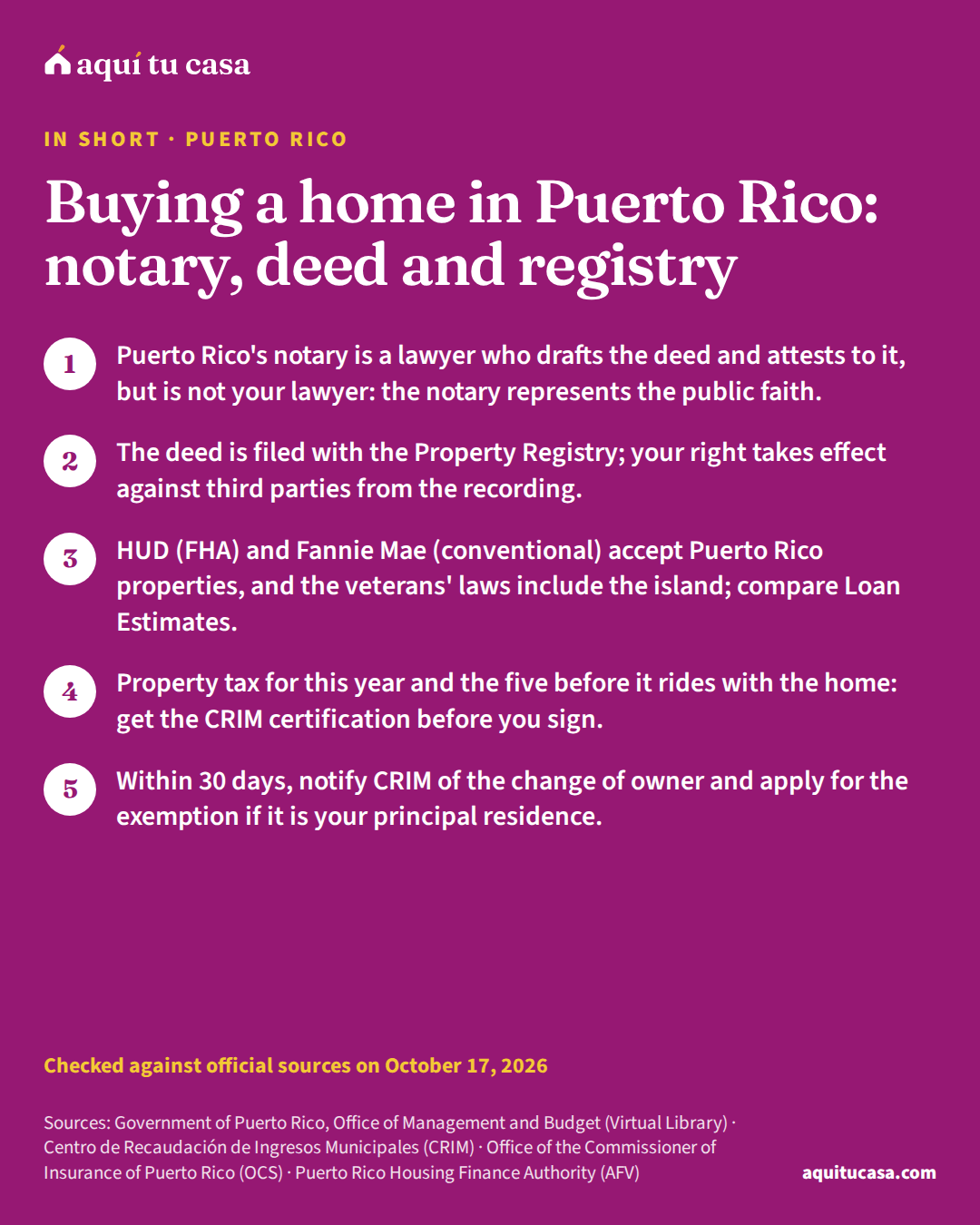
How buying a home works in Puerto Rico: the notary who is a lawyer, the public deed, the Property Registry, FHA, VA and conventional loans, AFV and CRIM.
Verified on October 17, 2026 17 official sources
Read the full guide Do the math: How much house can I afford?
Yes. Under the Notarial Act, only attorneys authorized by the Supreme Court of Puerto Rico can be notaries. But in the sale the notary is not the lawyer of either party: the notary represents the public faith and acts impartially.
Read the full guideThe Notarial Act sets a fee schedule: for a deed worth more than $10,000 and up to $5,000,000, the fee is agreed but cannot be more than 1% or less than 0.50% of the value, and never less than $250. The title study and consultations can be charged separately.
Read the full guideHUD's handbook accepts Puerto Rico properties for FHA loans, and for the veterans' laws «State» includes Puerto Rico. Fannie Mae also accepts properties on the island for conventional loans. Compare Loan Estimates from several lenders.
Read the full guideIt is the record of what is owed in property tax. It matters because the tax for this year and the five before it is the first lien on the home, even if it is not recorded. That is why the Notarial Act requires the notary to warn you that you should get it.
Read the full guideYes. The Municipal Code gives you 30 days from the purchase to report the change of owner, even if you already filed the deed with the Registry. If you do not, you are liable for bills issued in the previous owner's name.
Read the full guideThe Notarial Act lets one party make an offer in a deed and the other accept it in a separate document, on another date and place. But a notarial document executed outside Puerto Rico must be protocolized on the island to have effect as a public instrument. Ask the notary how they will handle it.
Read the full guideThe AFV publishes Pronto pa' tu casa, with CDBG-MIT funds for the down payment and closing costs of eligible buyers; Vivienda Joven, a loan for recent graduates aged 21 to 35; and the HOME Program. Each has its own requirements; the AFV gives guidance at 939-333-5417.
Read the full guideThe data behind these guides
The guides on Puerto Rico cite these figures. They update when their sources publish new ones; what you see here is current.
See all the dataSources: U.S. Census Bureau (Average 2020–2024) · HUD (2026 data)
From the guide
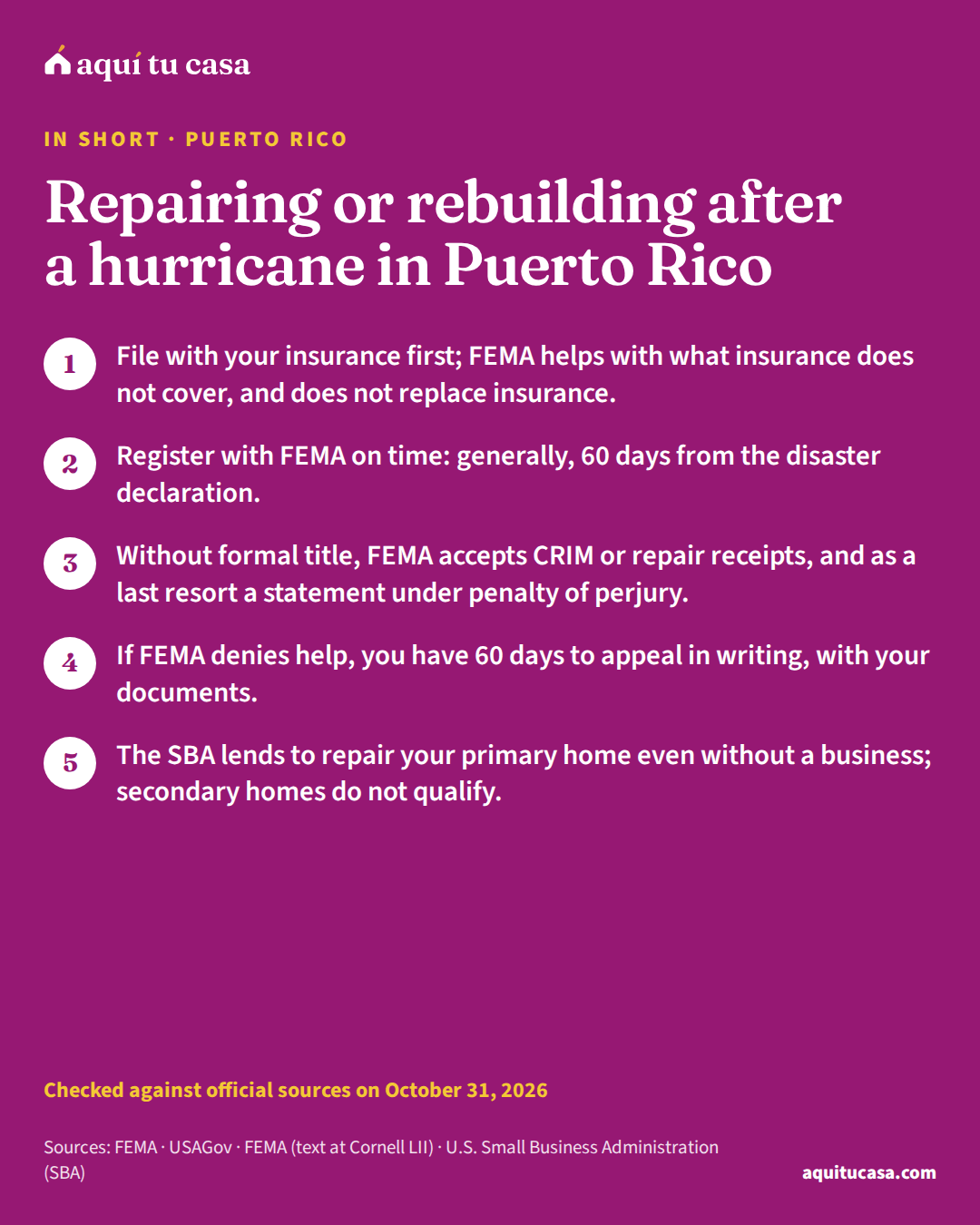
FEMA help to repair your home in Puerto Rico, how to prove it is yours, SBA disaster loans and the Department of Housing programs still open.
Verified on October 31, 2026 15 official sources
If there is a presidential disaster declaration, at DisasterAssistance.gov, with the FEMA app, at 1-800-621-3362 or at a Disaster Recovery Center. Have your Social Security number, insurance information, a description of the damage, your income and a bank account ready.
Read the full guideYes, but file with your insurer first. Under FEMA's rules, it helps if your claim was denied, if payment was significantly delayed through no fault of yours, or if insurance is not enough. And you must agree to refund anything you receive from another source for the same thing.
Read the full guideIt may. FEMA's rules treat as an owner-occupant someone without formal title who proves responsibility for the home with tax receipts, repair receipts or court documents. As a last resort, in insular areas, FEMA accepts a written statement under penalty of perjury.
Read the full guideAs a last resort, FEMA accepts a statement saying you are the nearest relative of the deceased in the line of succession, with a copy of the death certificate. To fix the title for the long term, see the guide to titles and inheritance in Puerto Rico.
Read the full guideYes. You have 60 days from the notice to appeal in writing, with an explanation or documents that support it. FEMA must answer in writing, with its reasons, within 90 days.
Read the full guideNo. According to the Department of Housing's portal, R3 is closed to new applications. If you have a case, call 1-833-234-2324. The Title Authorization Program does take applications, and says you may be eligible even if FEMA turned you down.
Read the full guideNo. The SBA lends homeowners up to $500,000 to repair or replace their primary residence, and owners and renters up to $100,000 to replace their belongings. The first payment is deferred 12 months.
Read the full guide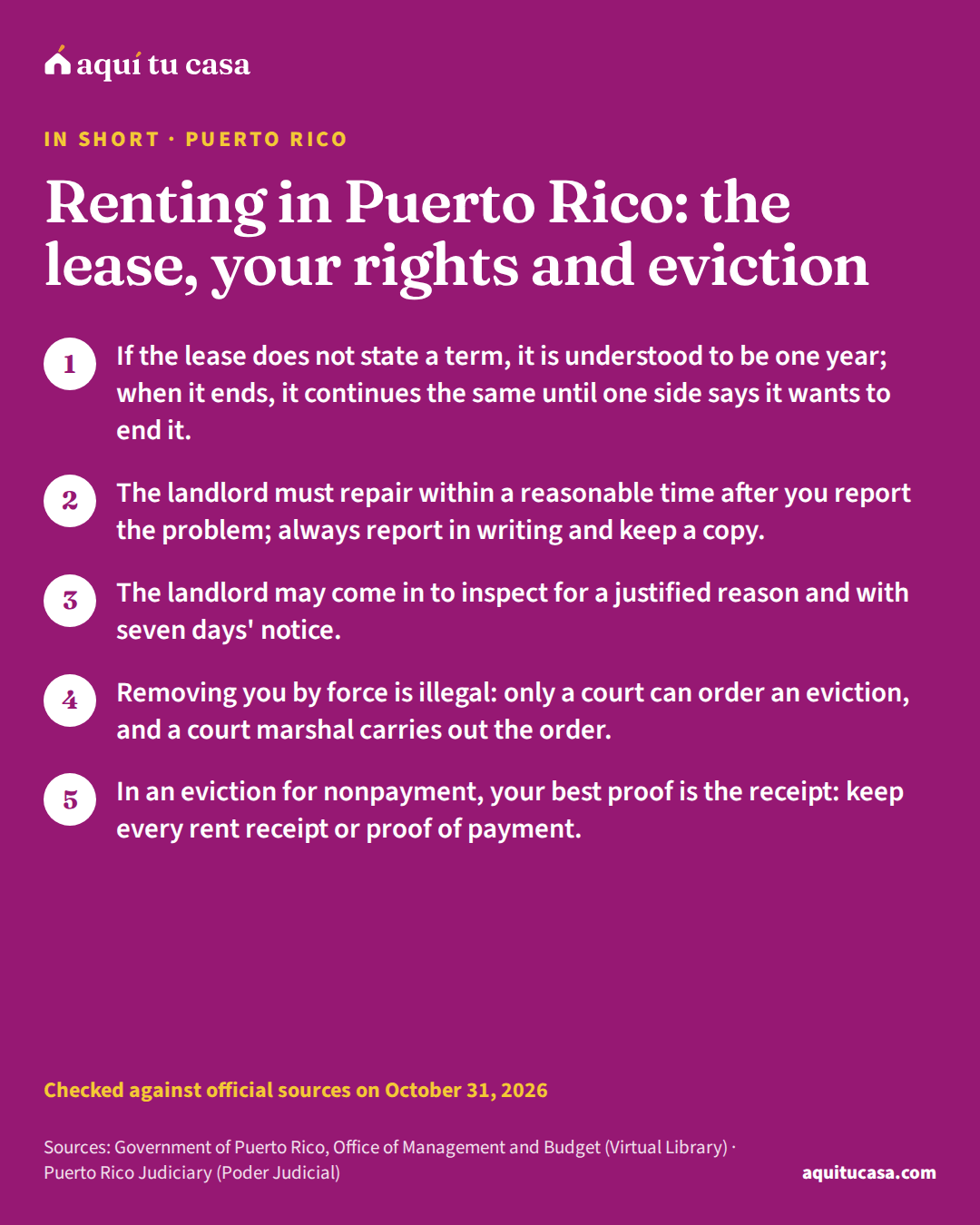
From the guide
What Puerto Rico's Civil Code says about leases, what each side must do, and how eviction (desahucio) works in court, step by step.
Verified on October 31, 2026 5 official sources
Read the full guide Do the math: How much rent can I afford?
Not to be valid. The Civil Code says a lease needs no special formality, except to record it in the Registry, and that it must be in writing if it is for more than six years. Still, a written lease helps you prove what you agreed.
Read the full guideUnder the Civil Code, the lease continues on the same terms until you or the landlord say you want to end it. This is called tacit renewal (tácita reconducción).
Read the full guideThe Civil Code says the tenant must allow inspection for justified reasons and with seven days' prior notice. If your lease says something different, read it carefully and ask for guidance if you are unsure.
Read the full guideThe landlord must make necessary repairs within a reasonable time after you report them. If the repair is urgent and you already told the landlord, the Civil Code says the tenant makes it at the landlord's cost. Report in writing and keep photos and receipts.
Read the full guideNo. The Judiciary explains that it is illegal for the owner to remove the tenant by force. The owner has to sue, win a judgment and request an order that a court marshal carries out.
Read the full guideAccording to the Judiciary, the hearing is set within the 10 business days after the lawsuit, and you must be served at least 5 days before. You can answer beforehand with form OAT 1801 or at the hearing. If you do not go, the case goes on without you.
Read the full guideNot necessarily. Under the Civil Code, if it is a home, the relatives who lived with the tenant for the six months before the death, or the person who lived with the tenant for that time, can take the tenant's place in the lease.
Read the full guide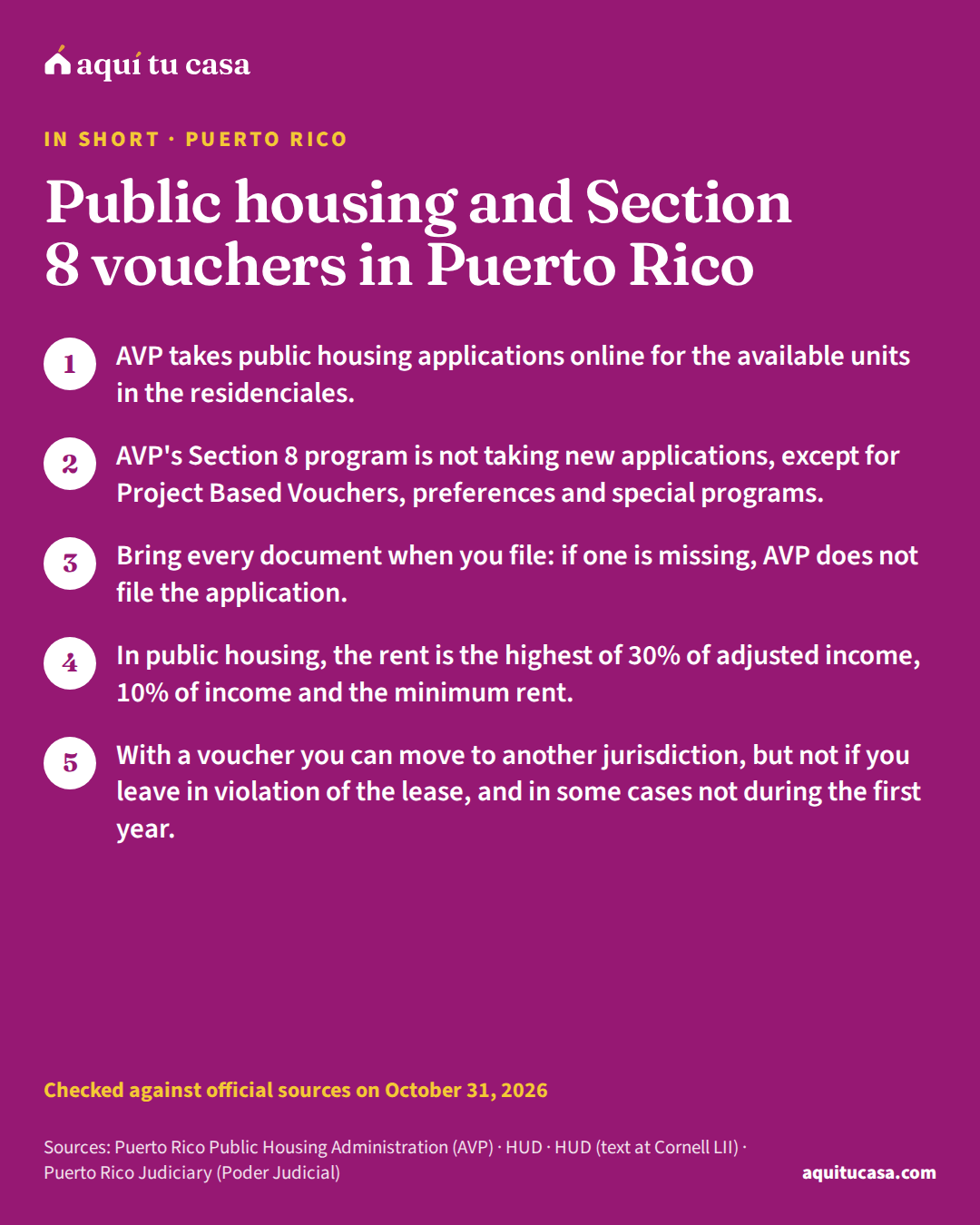
From the guide
How public housing (residenciales) and Section 8 vouchers work in Puerto Rico: AVP, who qualifies, the documents, the rent and moving with a voucher.
Verified on October 31, 2026 11 official sources
AVP has the public housing application for the available units in the residenciales online, at prphaenlinea.avp.pr.gov. It also posts the form in Spanish and English, the document list and the Personal Statement every applicant must complete.
Read the full guideAccording to AVP, its Section 8 Program is not accepting new applications at this time. It only accepts applications for Project Based Vouchers, preferences and special programs. Also ask at your municipality's housing office and check the housing authorities HUD lists for Puerto Rico.
Read the full guideThey are groups that go first. AVP gives preference to families displaced by a disaster or government action, including those whose FEMA housing assistance is ending; witnesses referred by law enforcement; certain families with a member with a disability; and victims of domestic violence, dating violence, sexual assault or stalking.
Read the full guideHUD explains that the rent is the highest of 30% of your monthly adjusted income, 10% of your monthly income, welfare rent if applicable, or a $25 minimum rent or the amount the authority sets, up to $50.
Read the full guideYes, if you do not meet the requirements. HUD says the authority must notify you in writing and tell you why, and that you can request an informal hearing.
Read the full guideHUD's rules give the family the right to use its voucher outside its authority's jurisdiction, in the jurisdiction of another authority with a voucher program, unless it moved out in violation of the lease. If you did not live in that jurisdiction when you applied, you do not have that right during the first 12 months, although the authority may allow it. Ask before you move.
Read the full guideAVP handles reasonable accommodation requests and rights complaints at 787-759-9407, extension 3007, and posts its reasonable accommodation forms on its Section 504 and Fair Housing page.
Read the full guide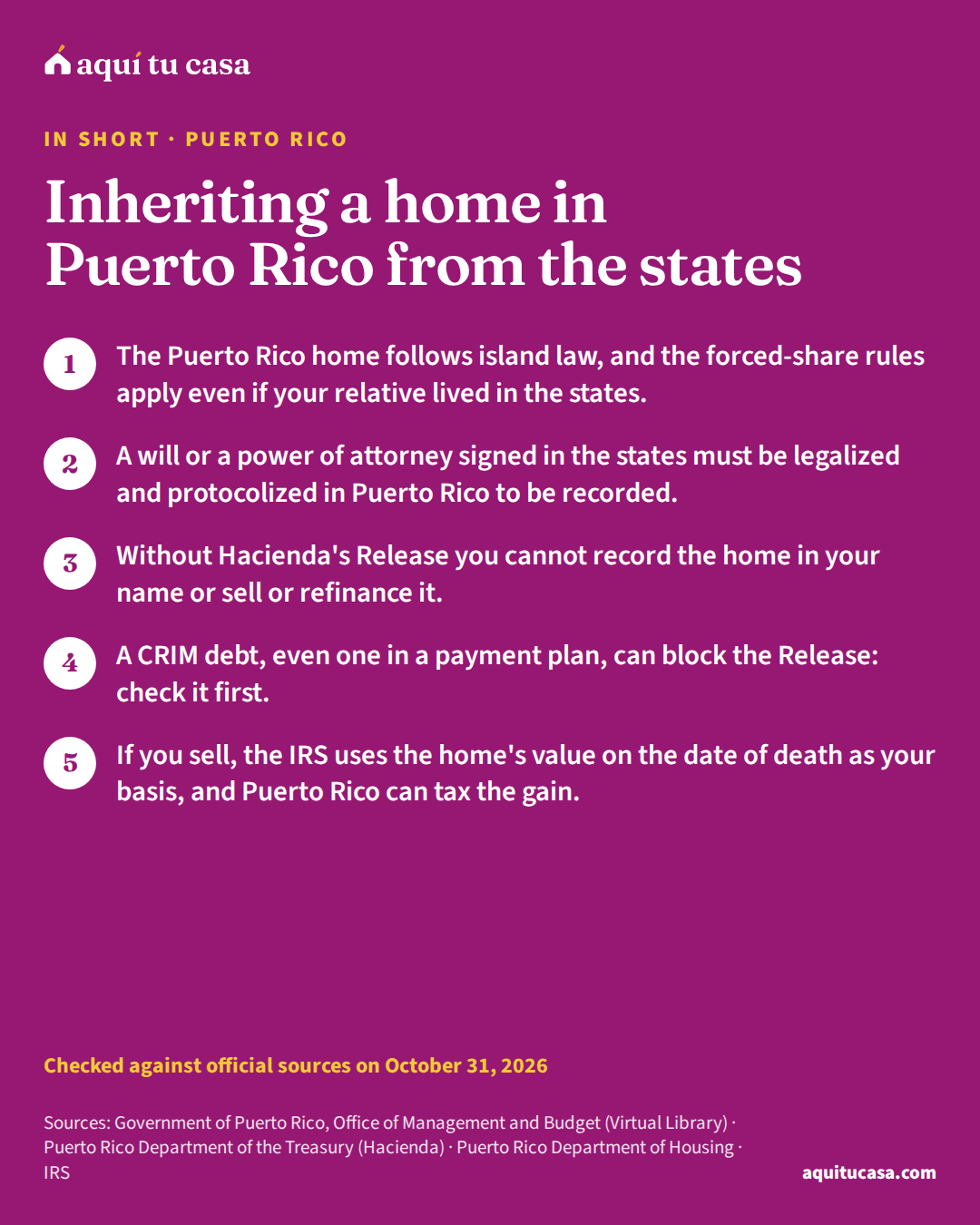
From the guide
If you live in the states and inherit a Puerto Rico home: which law applies, papers signed elsewhere, Hacienda's release, CRIM and taxes if you sell.
Verified on October 31, 2026 12 official sources
Read the full guide Do the math: How much will I keep when I sell?
The Civil Code says succession is governed by the law of the decedent's domicile at death, but the forced-share rules apply to every property in Puerto Rico, and ownership is governed by the law of the place where the property is. That is why the island home is recorded and divided under Puerto Rico's rules. In a situation like this, get legal guidance.
Read the full guideIts form is valid if it meets the law of Puerto Rico, of the place where it was made or of the domicile of the person who made it. To record the home, the Registry Act requires that an outside document be legalized and protocolized by a notary in Puerto Rico.
Read the full guideNot always. You can give a power of attorney, but to sell or mortgage the Civil Code requires a power that expressly authorizes it, and for acts done by public deed the power must be in a public instrument. If you sign it in the states, it must be protocolized in Puerto Rico.
Read the full guideAccording to Hacienda, the assets of people who died after the law eliminated that tax no longer pay it, whether or not they lived in Puerto Rico. But an informational return is due within 12 months of the death to get the Release. If the death was before that change, other forms apply: check which one is yours.
Read the full guideIt is the Lien Cancellation Certificate Hacienda issues. According to Hacienda, it is needed to record the home in the heirs' names, to sell or refinance it and to receive the decedent's bank accounts.
Read the full guideProperty taxes on a decedent's assets are paid before other debts, and the Registry does not record the partition if current taxes are unpaid. Also, Hacienda issues the regular Release only if there are no tax debts, including ones in a CRIM payment plan.
Read the full guideAccording to the IRS, the sale of inherited property is reported on your federal return, and the basis is generally the fair market value on the date of death; if you sell for more, there is a gain. Publication 570 explains that gain from real property generally comes from where the property is, and that you can claim a credit for tax you pay to Puerto Rico. A VITA site can help you for free if you qualify.
Read the full guide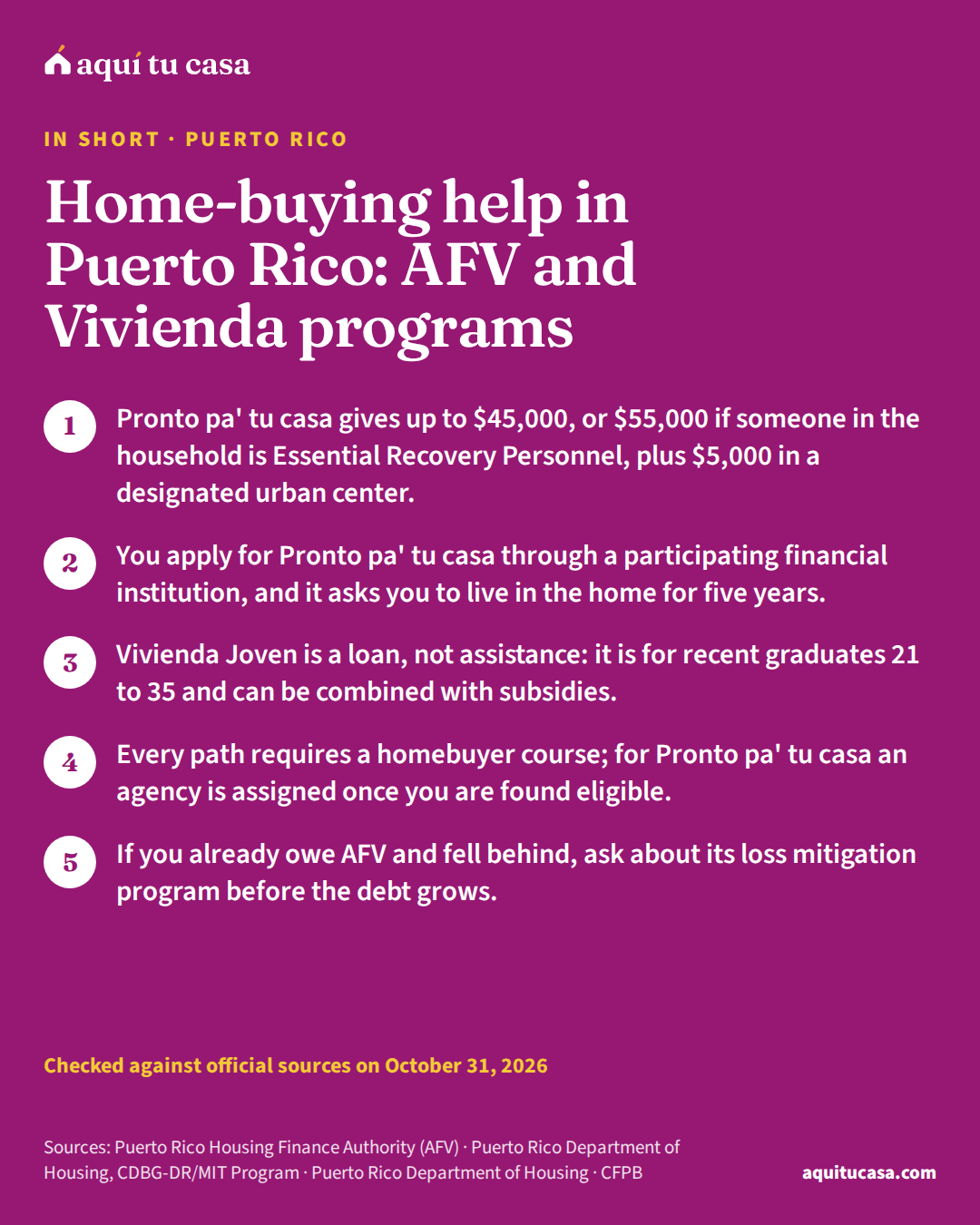
From the guide
The home-buying help Puerto Rico's AFV and Department of Housing publish: Pronto pa' tu casa, Vivienda Joven, HOME and more, and how to apply.
Verified on October 31, 2026 10 official sources
Read the full guide Do the math: How much house can I afford?
It is Puerto Rico's Housing Finance Authority (Autoridad para el Financiamiento de la Vivienda), a public corporation of the government. It offers mortgage loans such as Vivienda Joven and runs Pronto pa' tu casa with CDBG-MIT funds and the HOME Program. It gives guidance at 939-333-5417 and info@afv.pr.gov.
Read the full guideAccording to AFV, up to $45,000 per eligible household, up to $55,000 if at least one member is Essential Recovery Personnel, and $5,000 more if you buy in an urban center designated and certified by the Department of Housing. It can pay up to 100% of the down payment and reasonable closing costs.
Read the full guideThrough a participating financial institution, which submits the application to the program. First you prequalify there, find the home, and then AFV reviews your case. The list of institutions is on the program's page.
Read the full guideNo. AFV explains that Vivienda Joven is a loan guaranteed by AFV and offers no financial assistance. It can finance up to 98% of the lower of the price and the appraisal, and it can be combined with state or federal subsidies for the down payment or closing costs, if funds are available.
Read the full guideVivienda Joven accepts self-employed workers with at least one year of verifiable history. For any loan, AFV asks people with their own business for 2 years of tax returns with their 480 forms and financial statements notarized by a lawyer or certified by a CPA.
Read the full guideCall AFV at 939-333-5417, option 6, or write to lossmitigation@afv.pr.gov. Its loss mitigation program evaluates a forbearance, a payment plan, a modification or a deed in lieu, depending on your case.
Read the full guideIf it has restrictive conditions from the former CRUV, the Department of Housing requires an authorization to sell, refinance or mortgage it, or to remove those conditions. It asks for the deed, a recent title study and the mortgage balance, among other papers.
Read the full guideTools
The calculators these guides use. Each one leaves you with a result you can use today.
How much is left for housing each month.
What you get → what is left
The documents you'll be asked for.
What you get → your document list
Your monthly payment with taxes and insurance.
What you get → monthly payment
The cash you need on closing day.
What you get → cash to close
From the guide
Puerto Rico's principal-residence exoneration and CRIM exemptions for owners: veterans, homes under construction, displaced families, historic zones.
Verified on October 31, 2026 4 official sources
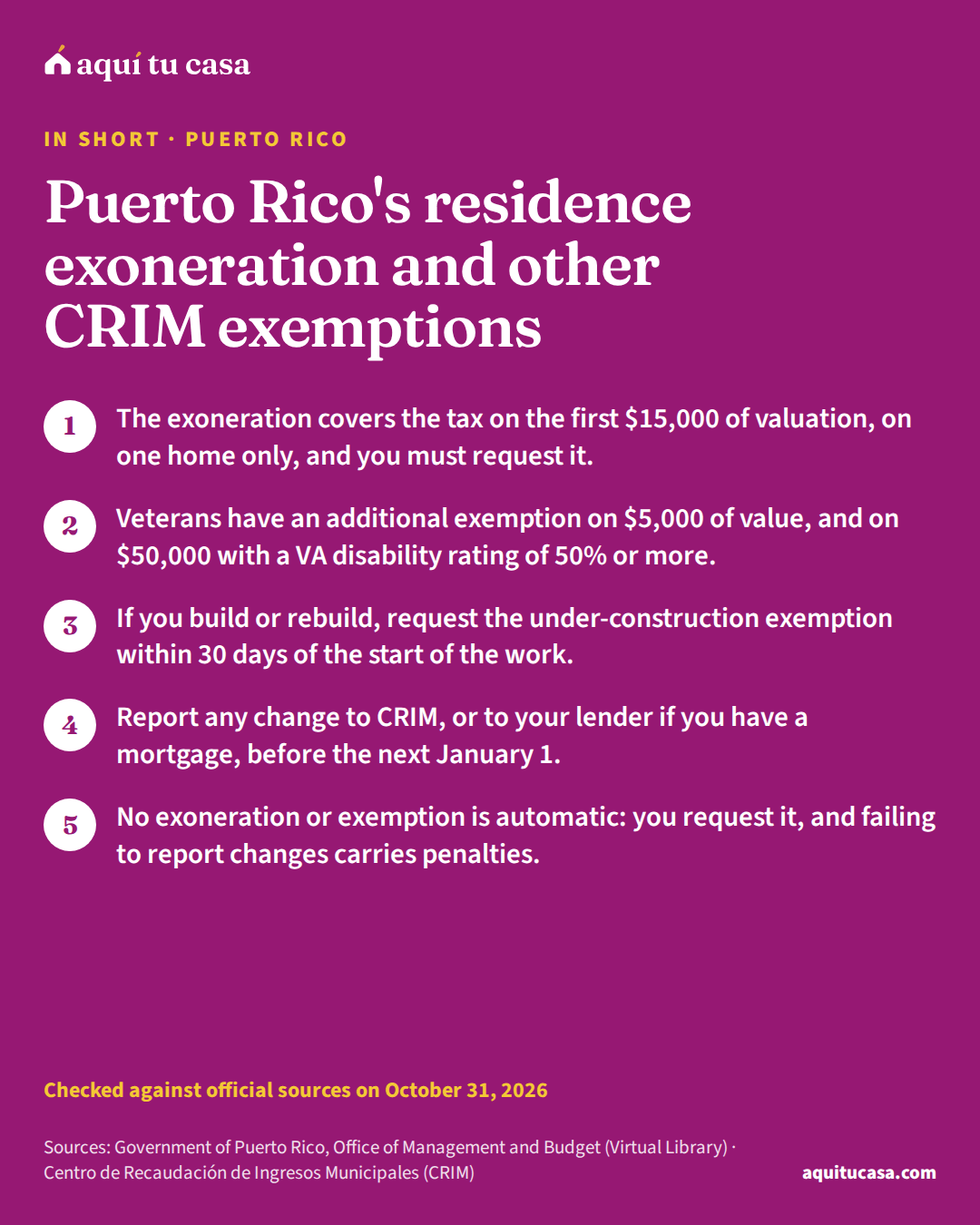
In practice, both reduce or eliminate the tax. The principal-residence exoneration is in the Municipal Code. According to CRIM, an exemption is granted by a law or a municipal ordinance, such as the veterans' one, and must be requested: it is not automatic.
Read the full guideThe Veteran's Bill of Rights exempts from property tax up to $5,000 of the assessed value of the principal residence of a veteran or surviving spouse. If the VA pays you compensation for a disability of 50% or more, the exemption reaches the first $50,000, on top of the $5,000. You request it from CRIM.
Read the full guideYes. The Municipal Code says a veteran's exoneration is figured after subtracting the veteran's exemption from the value, and the Veteran's Bill of Rights says the veteran's exemption is in addition to any other.
Read the full guideNot necessarily. Under the Veteran's Bill of Rights, the veteran's exemptions continue for the surviving spouse until remarriage, and for minor children until adulthood. And under the Municipal Code, a surviving spouse who is the original titleholder keeps the residence exoneration without reapplying.
Read the full guideThe Municipal Code exempts a building under construction until it is finished or starts to be occupied, for up to three years. You must request the exemption from CRIM within 30 days of the start of the work, and be current on your taxes.
Read the full guideThe Municipal Code forbids denying or revoking the exoneration for an owner with a critical illness or a disability who must move to a relative's home or a care center, as long as the owner receives no rent for the home.
Read the full guideThe Municipal Code lets you ask CRIM in writing for a credit or refund if you overpaid or were charged improperly, within four years of the payment. CRIM's portal also lists the retroactive exoneration (Article 8C) among its online services.
Read the full guide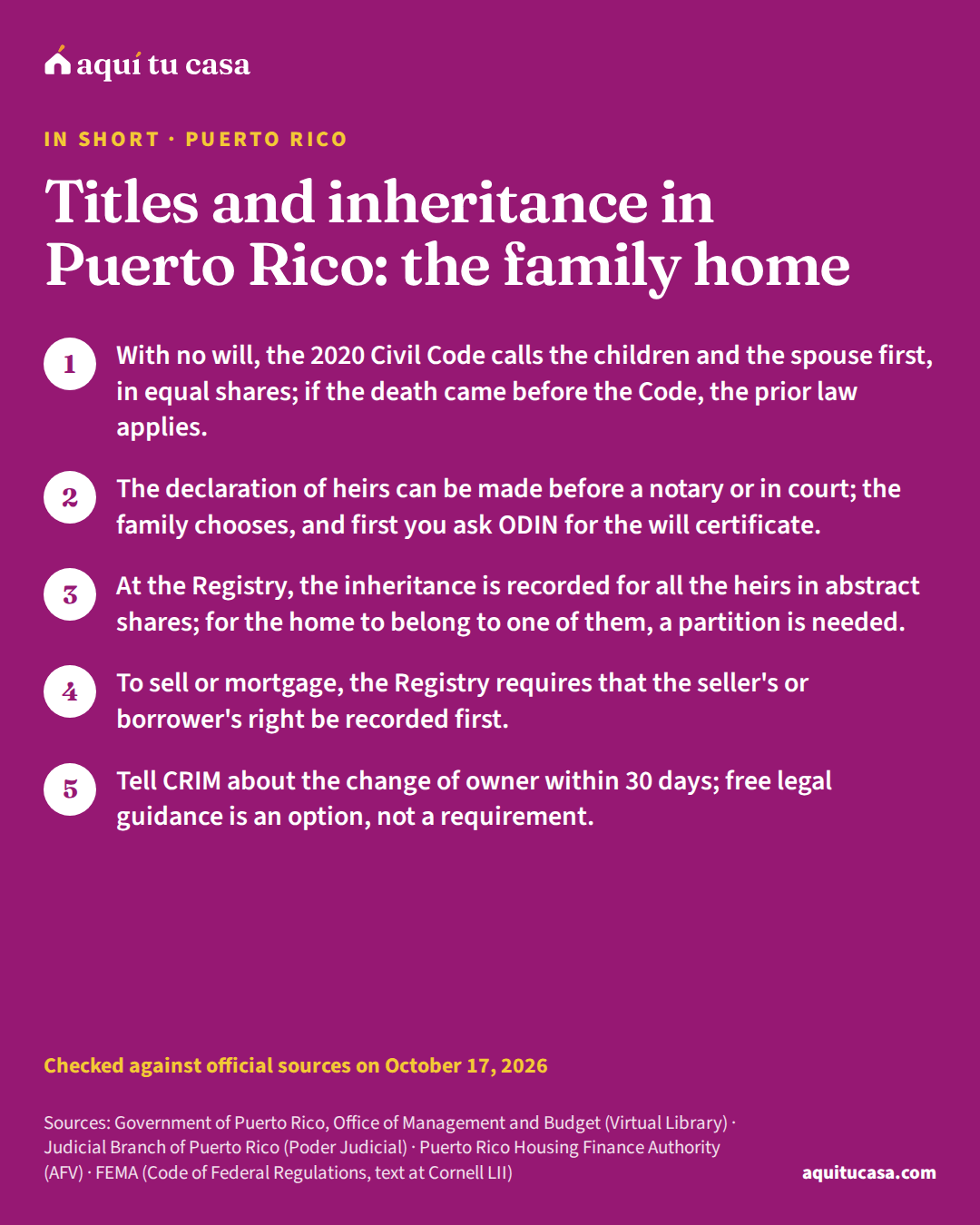
From the guide
What happens to a home in Puerto Rico when its owner dies: who inherits, the declaration of heirs, the Property Registry and why a clear title matters.
Verified on October 17, 2026 11 official sources
Under the 2020 Civil Code, the descendants and the surviving spouse inherit first: the children and the spouse in equal shares, and grandchildren in place of a child who died earlier. If there are none, the parents; after them, siblings and other relatives up to the sixth degree. If the person died before the Code took effect, the prior law applies.
Read the full guideIt is the document that says who the heirs are of a person who died without a will, with the date of death and the deceased's marital status. It can be done before a notary or in court; you choose. With it, the inheritance is recorded at the Property Registry.
Read the full guideThe Will Registry of the Office of Notary Inspection (ODIN) issues a confirming certification, if a will was reported, or a negative one, if none appears. It costs $5.00 in fees and, if the person died, you include a copy of the death certificate. The court does not accept a petition for a declaration of heirs without the negative certification.
Read the full guideTo sell or mortgage, the Registry requires that the seller's or borrower's right be recorded first. A policy issued in your name only applies up to your own interest. And some programs, like the AFV's HOME rehabilitation help, require you to hold title. For FEMA, the regulation also accepts other proof, such as tax or repair receipts.
Read the full guideAn inheritance includes rights and obligations. Under the Civil Code, after the partition creditors can collect from any heir, but only up to the value of what that heir received. Each person called can accept or reject the inheritance, and that decision cannot be undone.
Read the full guideThe declaration and the deeds are done by a notary, who in Puerto Rico is a lawyer, or handled in court. If there is a disagreement or you cannot afford it, free legal aid is an option: LSC funds organizations in Puerto Rico. No free help is mandatory.
Read the full guide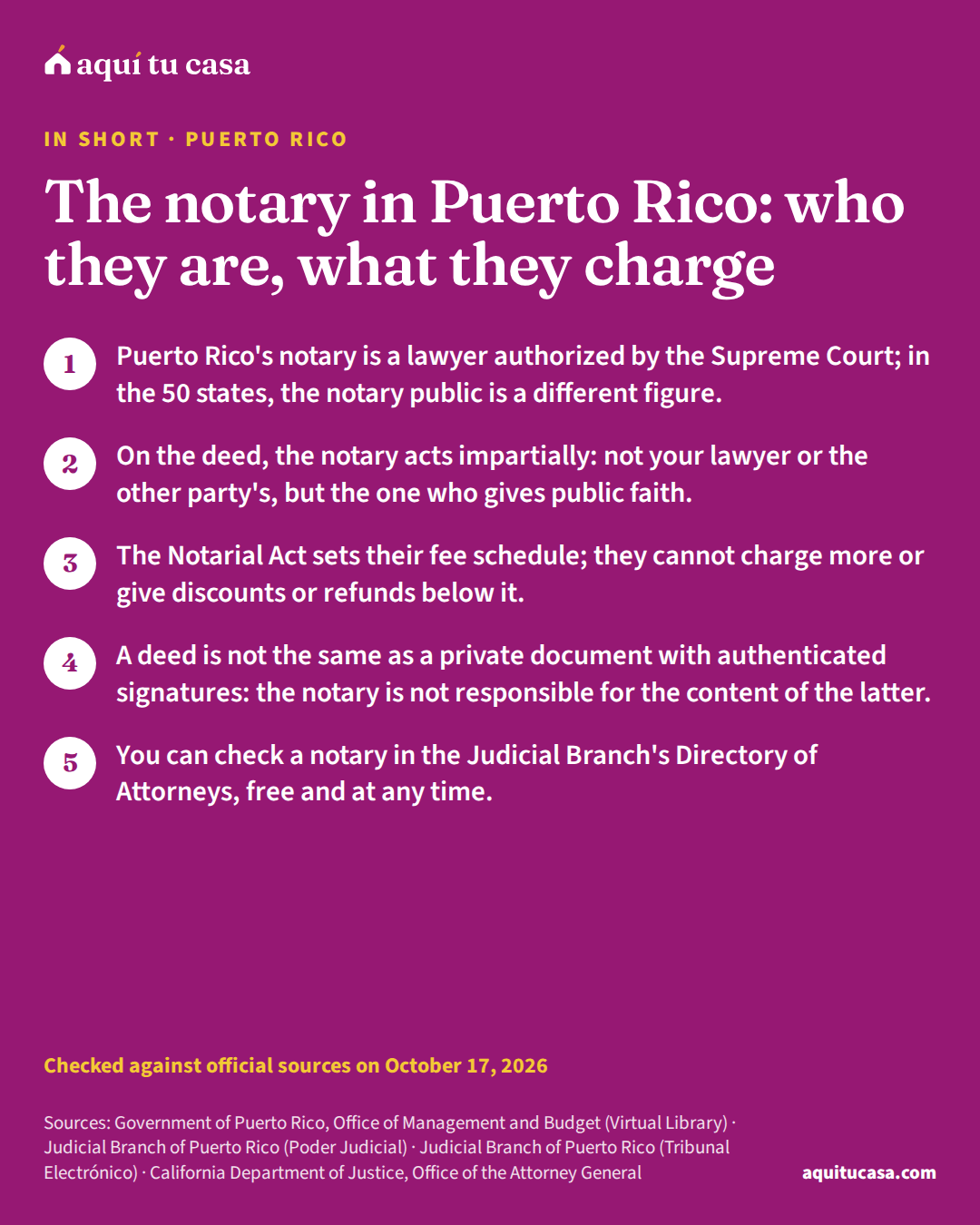
From the guide
In Puerto Rico the notary is a lawyer. Who can be one, what they do in a home sale, what the law lets them charge and how to check they are authorized.
Verified on October 17, 2026 8 official sources
Yes. The Notarial Act says only attorneys authorized by the Supreme Court of Puerto Rico can practice as notaries. Before practicing, they take an oath, post a bond of no less than $15,000 and register their signature and seal.
Read the full guideNo. The law explains that, in their role, the notary is not the lawyer of any of the parties: they represent the public faith and act impartially. If you want guidance just for you, you can seek it separately; free legal aid exists for those who qualify.
Read the full guideFor a deed worth more than $10,000 and up to $5,000,000, the Notarial Act says the fee is agreed but cannot be more than 1% or less than 0.50% of the value, and never less than $250. The title study and consultations can be charged separately.
Read the full guideThe law forbids charging any compensation other than the fee schedule, including refunds or discounts to lower it. It does allow the notary to provide the service for free when they consider it deserving, as long as it is not a habitual business practice.
Read the full guideYes. The Non-Contentious Matters before a Notary Act lets a notary handle it, just like a court; you choose where to bring it. If a dispute or opposition arises among those involved, the notary must stop.
Read the full guideThe parties, their representatives and successors have the right to copies. If the notary refuses, the law lets you go to the Director of the Office of Notarial Inspection.
Read the full guide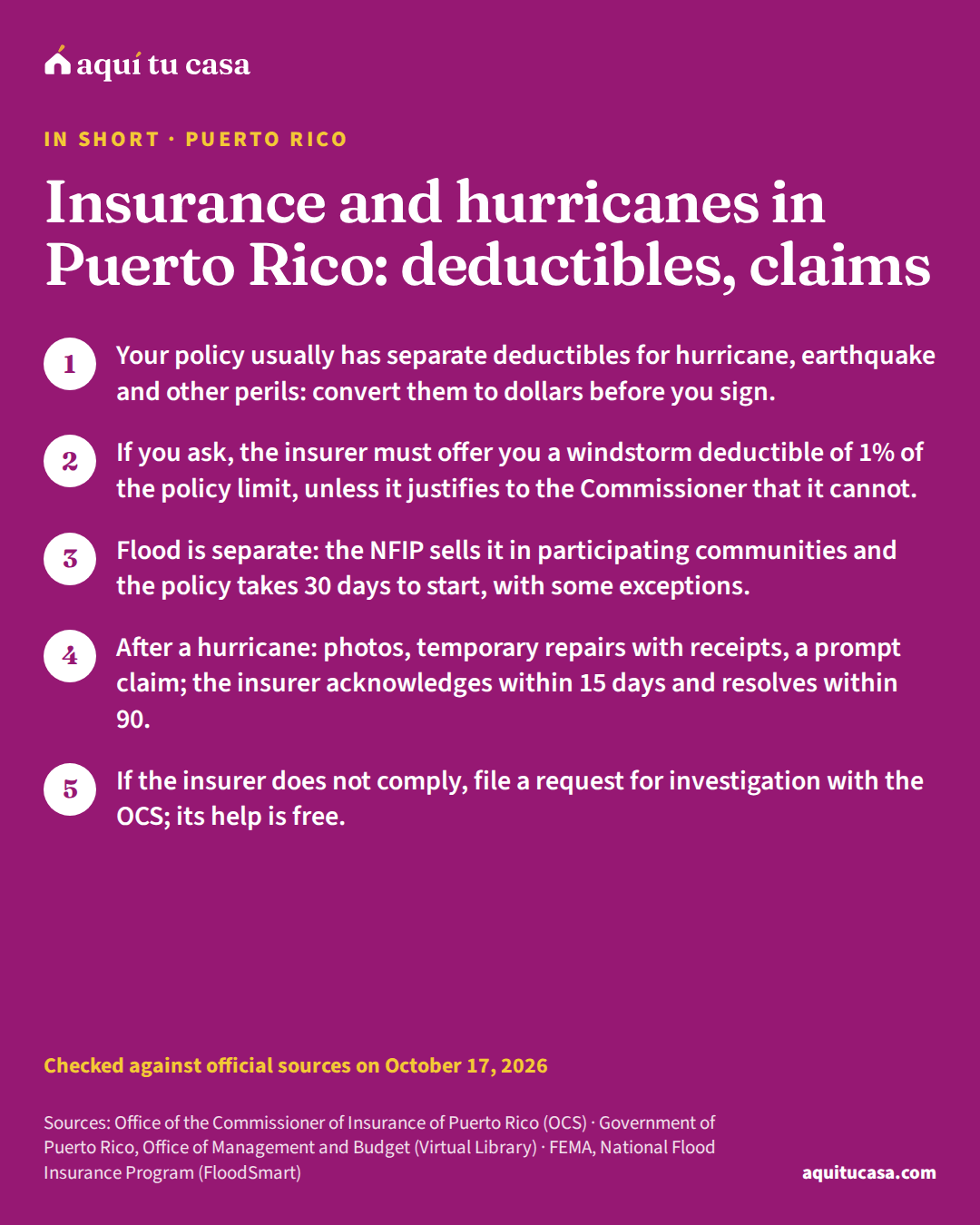
From the guide
Home insurance in Puerto Rico: what it covers, the windstorm deductible, separate flood coverage, your rights and how to file a claim after a hurricane.
Verified on October 17, 2026 12 official sources
The OCS explains that residential policies normally have a separate hurricane deductible, and it reminds people that floods are generally excluded from property policies: floodwater needs a separate policy. Read your policy and ask your producer what it covers.
Read the full guideIt depends on your policy. The Insurance Code requires the insurer to offer you, if you ask, a windstorm deductible of 1% of the policy limit, unless it justifies to the Commissioner that it cannot. If the deductible is a percentage of the limit, the policy must state the dollar amount.
Read the full guideThe Insurance Code gives it 15 days to acknowledge the claim and asks it to resolve the claim in the shortest reasonable time within 90 days. If you ask for reconsideration, you have the right to have it resolved within 30 days.
Read the full guideIf your home is in a special flood hazard area and you have a government-backed mortgage, it is required. Outside that zone it is not, but most home policies do not cover flood. The NFIP sells it in participating communities, at the same rate from any provider.
Read the full guideMake temporary repairs to prevent more damage and keep the receipts. The OCS advises against permanent repairs before you talk to your insurer, because it might not pay for repairs it did not authorize.
Read the full guideThe Insurance Consumer Bill of Rights gives you the right to have your individual policy written in English or Spanish, as you choose, and to get a copy of it.
Read the full guideYou can file a request for investigation with the OCS, for example by email to investigaciones@ocs.pr.gov. The Insurance Code treats as an unfair practice, among others, refusing to pay without a reasonable investigation.
Read the full guide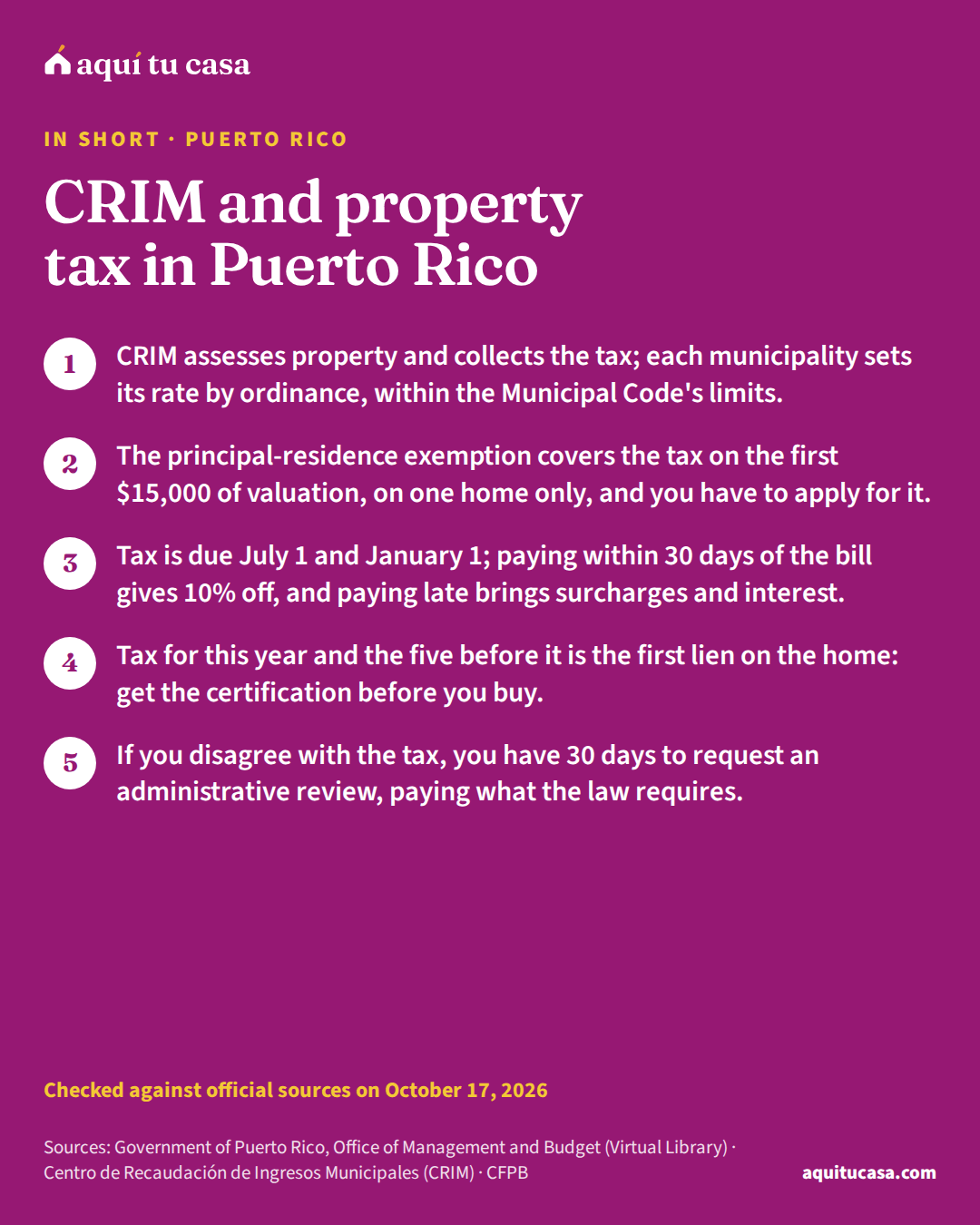
From the guide
What CRIM is, how property tax is figured and paid in Puerto Rico, the exemption for your residence, certifications and how to ask for a review.
Verified on October 17, 2026 7 official sources
It is the Centro de Recaudación de Ingresos Municipales, the entity that provides fiscal services to Puerto Rico's municipalities. It builds the cadastre, assesses property and collects and distributes property tax.
Read the full guideThe Municipal Code exempts you from the tax that would apply to the first $15,000 of your residence's valuation. What that means in dollars depends on the assessment and your municipality's rate; check your bill or ask CRIM for the certification of values.
Read the full guideBy semester and in advance: July 1 and January 1. If you pay within 30 days from when the bill was issued, you get 10% off the semester; between 30 and 60 days, 5%.
Read the full guidePaying 30 to 60 days after the due date adds a 5% surcharge; after 60 days, 10%; and interest of 10% a year runs. At 90 days the debt is delinquent, and CRIM can collect it by seizure.
Read the full guideOn CRIM's portal, with a MI CRIM account, you can see the debt on your properties and request the Account Statement, the Certification of Values or the Certification for All Items. If you own no property, you can request a negative certification.
Read the full guideTax from up to five years back plus the current year is a lien on the home. CRIM explains that if you bought without checking, you can ask that debts from years before the purchase be moved to the previous owner's name, with exceptions such as having taken on the debt yourself. Free legal help can look at your case.
Read the full guideYes. You have 30 calendar days from the notice to request an administrative review in writing, paying 100% of what you accept and 40% of what you dispute, or the full amount. CRIM decides within 60 days, which it can extend, and then you can go to court within 30 days.
Read the full guideChange topic without leaving the questions.

These answers explain the rules but do not know your situation. These organizations go over it with you, free.