CRIM and property tax in Puerto Rico
What CRIM is, how property tax is figured and paid in Puerto Rico, the exemption for your residence, certifications and how to ask for a review.
Verified against official sources on October 17, 2026 7 official sources

Show contents
In short
What you need to know
Quick answer
CRIM (the Municipal Revenue Collection Center) assesses properties and collects property tax for Puerto Rico's municipalities. It is paid by semester, in advance, on July 1 and January 1; if you pay within 30 days from the bill you get 10% off, and paying late brings surcharges and interest. If the home is your principal residence, you can apply for the exemption (exoneración) from the tax on the first $15,000 of valuation. If you buy or inherit, notify CRIM of the change of owner within 30 days.
What matters most
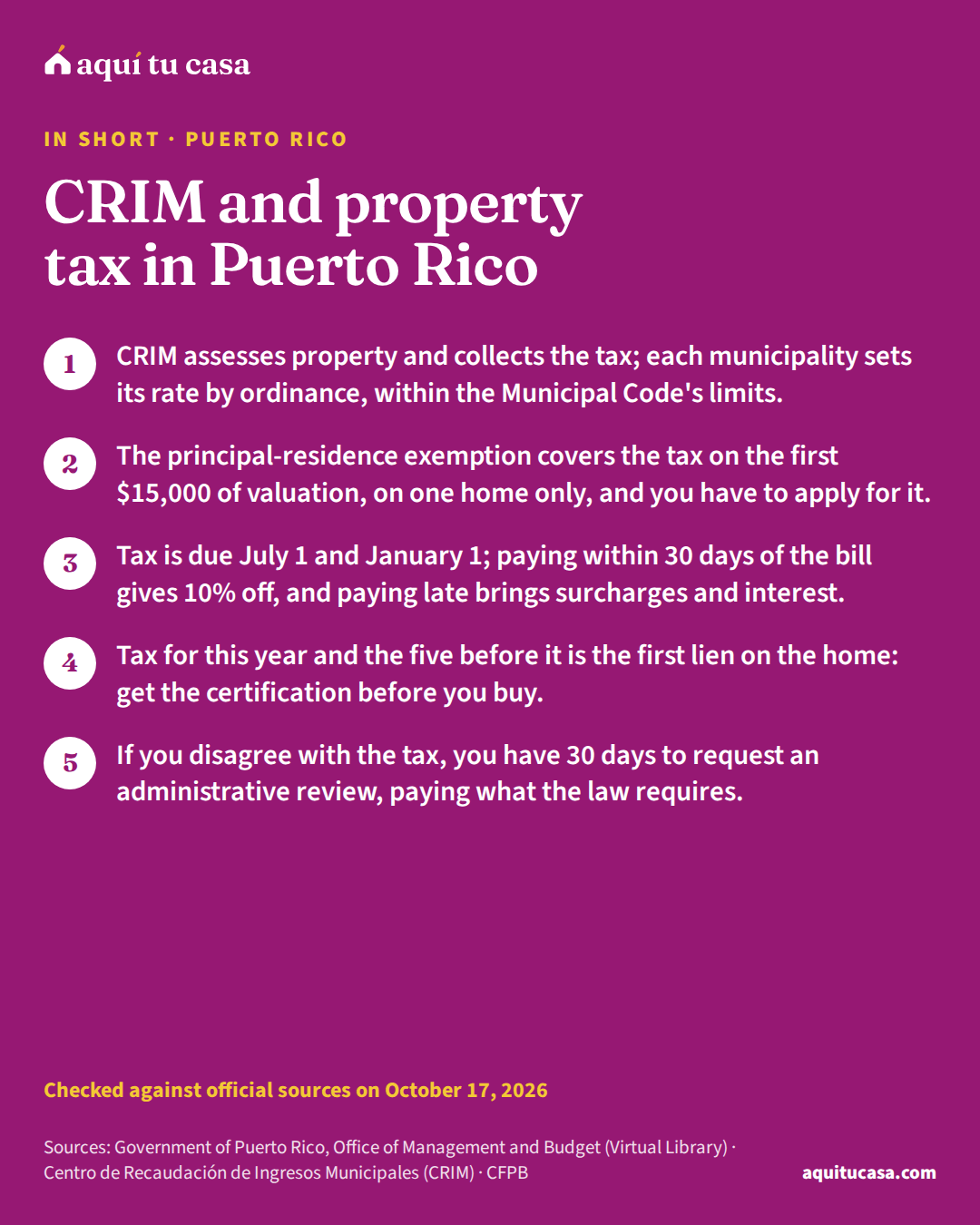
- CRIM assesses property and collects the tax; each municipality sets its rate by ordinance, within the Municipal Code's limits.
- The principal-residence exemption covers the tax on the first $15,000 of valuation, on one home only, and you have to apply for it.
- Tax is due July 1 and January 1; paying within 30 days of the bill gives 10% off, and paying late brings surcharges and interest.
- Tax for this year and the five before it is the first lien on the home: get the certification before you buy.
Is this for you?
This guide is for you if…
- You own a home in Puerto Rico, or are about to buy one, and want to understand the property tax CRIM collects.
- You want to apply for the exemption on your principal residence or check that you have it.
- You got a notice or a bill you do not understand, or you owe back taxes to CRIM.
Get direct help first if…
- Your home is in one of the 50 states: there property tax is collected by the county or city under other rules; start with the property tax guide.
- Your property is a business or equipment (personal property): it has its own return and rules that this guide does not cover.
- You already face a seizure (embargo) or an auction: look for free legal help as soon as you can; this guide only explains the general rules.
Puerto Rico’s contribución sobre la propiedad is the island’s version of the property taxproperty taxProperty tax is the tax the county, city, school district and other local bodies charge real property owners every year to pay for schools, police, fire and other public services. It is computed on the value the assessor's office assigns to your home, at each body's rate, minus the exemptions you qualify for, such as the primary-residence exemption in many states. If you have a mortgage you normally pay it month by month inside your payment, through the escrow account. It is generally deductible on your federal return if you itemize.See the full definition in the states. The municipality does not collect it directly: CRIM, the Municipal Revenue Collection Center (Centro de Recaudación de Ingresos Municipales), assesses and collects it and then distributes the money.1 This guide is for anyone who owns or will own a home on the island. It explains how the tax is figured, how to apply for the principal-residence exemption, when it is due, what happens if you fall behind and what to do if you disagree.
What CRIM is and what the cadastre is
CRIM is a municipal entity that provides fiscal services to the municipalities. Its main job is to collect, receive and distribute the funds that belong to them, and the Municipal Code puts it in charge of building the cadastre (catastro) of all real property in Puerto Rico and of classifying and assessing it.1 On its portal it sums it up: it notifies, assesses, collects, receives and distributes property tax.4
Your home has a cadastral number (número de catastro): the number that identifies it for CRIM. In the Digital Cadastre (Catastro Digital) you can look a property up by that number, by owner or by address. One thing confuses many families: the Digital Cadastre is part of CRIM and is not connected to the Property Registry. Recording a deed at the Registry does not, by itself, change anything at CRIM.3
How the tax is figured
The tax comes from two things: the assessed value CRIM sets (assessed valueassessed valueAssessed value, or assessment, is the value the local government's assessor gives your property to calculate property tax. It is only for taxes: it is not the appraisal a lender orders for your mortgage. The assessor first estimates market value, usually by comparing your home with similar homes that sold recently. In some places the assessment equals full market value, and in others it is a fraction of it. The assessor does not decide how much you pay: that depends on the rates set by the county, the city and the school district.See the full definition) and the rates applied to that value. The Municipal Code lets each municipality impose, by ordinance, a basic tax of up to 6% a year on the assessed value of real property. On top of that there is a special tax of 1.03% a year for the Commonwealth’s general obligations, and municipalities can impose an additional special tax.1 That is why two similar homes in different municipalities can pay different amounts.
Example with real numbers
How the tax on a residence is put together
An example in words; your figures are on your notice and on CRIM's certification of values.
- The home's assessed value
- The one CRIM set on your notice
- Minus the principal-residence exemption
- The tax on the first $15,000 of valuation1
- Times the rates that apply
- The municipality's basic tax (up to 6%), the 1.03% special tax and any additional special tax1
- What you pay
- In two semesters: July 1 and January 1, with a discount if you pay early1
If you have a mortgage, your lender usually pays it from your escrow account.1
Run it with your numbersProperty taxIf you have never seen your assessment, CRIM must give you a copy of the assessment card or sheet if you ask and pay the fee.1 The family budget tool shows how much this cost weighs in your monthly budget.

The exemption for your principal residence
The exemption (exoneración) is the most important benefit for people who live in their home. By law, the owner of a residential property is exempt from the tax that would apply to the first $15,000 of valuation. The law measures that valuation «a términos de costos de reemplazo para el año 1957, última tasación científica realizada» (in 1957 replacement-cost terms, the last scientific assessment).1 CRIM puts it this way: up to $15 thousand of assessed value, on one home per taxpayer, up to one cuerda, and the home has to be your principal residence.3
The rules families ask about most:
- One home only. If you own two homes, you choose which one gets the exemption.3
- Use on January 1. A home counts as residential if on January 1 of that year the owner or the owner’s family lives in it, with the owner collecting no rent. Family includes spouses and their relatives up to the fourth degree of blood or second degree of marriage.1
- Several owners. A home owned in common by several people, such as an estate (sucesión), counts as one home, and the exemption goes to any owner who lives there and has no exemption elsewhere.1
- If your spouse dies. The survivor keeps the exemption without applying again, if they are the original titleholder and keep meeting the requirements.1
- If you leave to care for a relative. The law forbids denying or revoking the exemption just because you move out for a while to care for a relative aged 60 or older with a critical illness.1
The exemption is not automatic: you prove the requirements with a certification filed with CRIM or with your mortgage lender. If your circumstances change, report it before the following January 1. And it is a condition that you owe no tax on that home as of the previous January 1, or that you set up a payment plan within 30 days after applying.1 When you buy, the notary must warn you to apply for it.6
When it is due and what happens if you fall behind
The tax is paid by semester and in advance. Discounts are counted from when the bill is issued; surcharges, from the date you should have paid.11
One semester of tax, step by step
1. The bill is issued
The discount days start counting from that date.1
2. You pay within 30 days
From the bill's issue date
You get 10% off the semester; between 30 and 60 days, 5%.1
4. You pay 30 to 60 days late
From the due date
A 5% surcharge is added, plus interest of 10% a year from the due date.1
5. You pay more than 60 days late
The surcharge goes up to 10%, and interest keeps running.1

If you have a mortgage: your lender pays from your escrow
If the home secures a loan, by law you deposit the tax with your mortgage lender, usually in your escrow accountescrow accountAn escrow account is an account set up by your mortgage lender to pay certain property-related expenses on your behalf, mainly property taxes and homeowners insurance. The money comes from a portion of your monthly mortgage payment: each month you contribute a share and the loan servicer pays the bills when they come due. That is why your payment is higher than principal and interest alone, and why it can change when taxes or the insurance premium go up. In some states the word also names the period between the offer and the closing.See the full definition. The Municipal Code sets rules for the lender: it must pay the tax as soon as the accumulated amount allows, to get the largest discount, or it owes you three times the lost discount. If you paid too much, the lender must refund the excess.1
You can also prove your right to the exemption with the mortgage lender, and changes in your qualifications are reported to the lender before the following January 1.1 Review your annual escrow statement: the guide Why did my escrow payment go up? explains how to read it.
If you buy or inherit: change of owner and old debts
The tax follows the home. This year’s tax and the five years before it are the first lienlienA lien is a legal right a creditor holds in your property to make sure you repay a debt. It usually prevents the property from being sold until the debt is paid, and if you do not pay, the creditor may be able to take the property. Your mortgage is a lien on your home: when you pay it off, the lien is released and that shows up in your county's property records. There are other kinds, such as a federal tax lien, which is the government's legal claim against all your property when you do not pay a tax debt.See the full definition on the property, even if nobody recorded it.1 That is why you get the debt certification before buying, and why it is worth getting when you inherit too.
Anyone who acquires a home, by purchase, gift, inheritance or another method, has 30 days to report the change of owner to CRIM, even if they already filed the deed at the Registry. If not, they are liable for bills issued in the previous owner’s name, with interest and surcharges.1

What if you bought and old debts showed up later? CRIM explains that you can ask that debts from years before your purchase be moved to the previous owner’s name. You cannot if the home has a recorded seizure, if you received it by inheritance, exchange or gift, or if you took on those debts in the purchase. You will be asked, among other papers, for the deed, the Registry certification or the title study, and payment of the preferred debt.3 For certifications, CRIM’s portal lets you see the debt and request the Account Statement, the Certification of Values or the Certification for All Items.2 The guide to titles and inheritance in Puerto Rico covers the rest of an inheritance.
If you disagree: the administrative review
Every time CRIM imposes or changes a tax, it must notify you and tell you of your right to request a review in writing.1 The process has strict deadlines:
Two ways to request a review within 30 days
Partial payment
You pay part of it
Either way, CRIM has 60 days to decide (it can extend them by 60 more), and then you have 30 days to go to the Court of First Instance.1
The request is filed within 30 calendar days from when the notice was sent, and it states your reasons, the amount you think is correct and any evidence you have.1 It is Puerto Rico’s version of the states’ assessment appealproperty tax appealA property tax appeal is the formal process to ask that the value the local government gave your property be changed, if you think it is too high or has errors. Each state calls it something different: in Texas it is a protest to the appraisal review board, and in New York it is a grievance with the municipality. Often you can first talk informally with the assessor's office. There are strict deadlines and it is up to you to bring evidence, such as sales of similar homes. The appeal reviews the value, not the tax rate.See the full definition, with its own deadlines.
If you cannot pay: payment plans and other options
There are paths before a seizure. If your financial circumstances are seriously adverse and you ask before the debt becomes delinquent, the law allows a payment plan without surcharges for up to 18 months, with interest of 10% a year.1 For debts already overdue, CRIM explains that you can request an installment plan: the down payment is at least 10% of the debt, you pay on the 1st of each month and you keep the following years current; keeping it avoids a seizure.3 A Final Agreement (Acuerdo Final) can wipe out interest and surcharges if you pay the principal, but it is a discretionary remedy.3
Among its online services, CRIM also lists the retroactive exemption (Article 8C) and benefits for people over 65, such as forgiveness of interest, surcharges and penalties according to the requirements.2 For guidance, CRIM lists the email crimcallcenter@crimpr.net and the phone number 787-625-CRIM.5
If this is you
What matters most for your situation
You live in your home
Check your certification to confirm you have the exemption; if not, apply with proof that it is your principal residence.1
You are over 65
CRIM lists benefits for people over 65, such as forgiveness of interest and surcharges according to the requirements.2
You inherited the home with your siblings
A home owned by an estate counts as one home, and the exemption goes to the owner who lives there.1 Report the change of owner within 30 days.1
You live in the states and own a home on the island
The exemption requires that on January 1 the owner or the owner's family lives there, with no rent collected.1

Costly mistakes
The mistake and what to do instead
Mistake: Thinking the exemption applies on its own.
Instead: You prove the requirements with a certification at CRIM or with your lender.1
Mistake: Assuming that recording the deed at the Registry notifies CRIM.
Instead: They are separate systems: report the change of owner to CRIM within 30 days.13
Mistake: Waiting until the due date to pay.
Instead: Paying within 30 days from the bill gives 10% off.1
Mistake: Letting a notice go by without checking it.
Instead: If you disagree, you have 30 days to request a review, with the payment the law requires.1
Mistake: Ignoring an old debt.
Instead: Ask for a payment plan before a seizure comes.3
What to do this week
- Find your cadastral number and create your MI CRIM account to see the debt on your property.2
- Request your certification and check whether you have the principal-residence exemption.1
- Mark July 1 and January 1, and pay within 30 days from the bill for the discount.1
- If you bought or inherited, report the change of owner within 30 days.1
- If you owe back taxes, ask about a payment plan before they become delinquent.1
- If you want help organizing your budget, a HUD-approved housing counselorHUD-approved housing counselorA HUD-approved housing counselor works at an agency HUD has approved to provide housing counseling: independent, expert advice customized to your situation about buying a home, renting, a missed mortgage payment, a foreclosure or credit problems. The agencies usually charge little or nothing; many serve in Spanish and offer the homebuyer education course several assistance programs require. They are not lenders or real estate agents and sell you nothing. Your county page lists the official agencies with phone numbers.See the full definition gives independent advice, often at little or no cost.7 For the whole buying process, see buying a home in Puerto Rico and the other Puerto Rico topics.
Your home and your county
We use the typical rate and value of the place you pick.
Typical home value in the United States (Census, ACS 2024). Enter your assessed value.
Let's do the math
Estimated tax per year
$3,127
About $261 a month, at a rate of 0.94% on $332,700.
Per month
$261
If you pay through escrow, your lender adds about this much to your payment.
The math
- Your home's value
- $332,700
- Taxable value
- $332,700
- Rate
- × 0.94%
- Tax per year
- $3,127
The rate changes within the county
Each home pays the districts it sits in (city, schools, services), and each sets its own rate. This rate is a county average, not your home's.
Your county's tax or assessor's office publishes your assessment, each district's rate and how to apply for an exemption or appeal.
This is an educational estimate from county averages, not your tax bill. Your bill depends on your home's districts, your assessment and your exemptions.
Ready to see the numbers? Find your county here
See how this applies in your county: its loan limits, prices and rents, from the official data.
Printable checklist
Frequently asked questions
What is CRIM?
It is the Centro de Recaudación de Ingresos Municipales, the entity that provides fiscal services to Puerto Rico's municipalities. It builds the cadastre, assesses property and collects and distributes property tax.
How much does the principal-residence exemption save me?
The Municipal Code exempts you from the tax that would apply to the first $15,000 of your residence's valuation. What that means in dollars depends on the assessment and your municipality's rate; check your bill or ask CRIM for the certification of values.
When is property tax due?
By semester and in advance: July 1 and January 1. If you pay within 30 days from when the bill was issued, you get 10% off the semester; between 30 and 60 days, 5%.
What happens if I pay late?
Paying 30 to 60 days after the due date adds a 5% surcharge; after 60 days, 10%; and interest of 10% a year runs. At 90 days the debt is delinquent, and CRIM can collect it by seizure.
How do I get a debt or values certification?
On CRIM's portal, with a MI CRIM account, you can see the debt on your properties and request the Account Statement, the Certification of Values or the Certification for All Items. If you own no property, you can request a negative certification.
I bought a home with old CRIM debts. Who pays them?
Tax from up to five years back plus the current year is a lien on the home. CRIM explains that if you bought without checking, you can ask that debts from years before the purchase be moved to the previous owner's name, with exceptions such as having taken on the debt yourself. Free legal help can look at your case.
Can I ask for my tax to be reviewed?
Yes. You have 30 calendar days from the notice to request an administrative review in writing, paying 100% of what you accept and 40% of what you dispute, or the full amount. CRIM decides within 60 days, which it can extend, and then you can go to court within 30 days.
Sources
Every figure in this guide comes from one of these official sources. The number next to a sentence leads to the source behind it.
Each source on one line: who publishes it, its title, its address and the date we read it.
- 1. Government of Puerto Rico, Office of Management and Budget (Virtual Library) · Código Municipal de Puerto Rico (Act 107-2020, as amended) · bvirtualogp.pr.gov · Accessed October 17, 2026
- 2. Centro de Recaudación de Ingresos Municipales (CRIM) · Bienvenidos a CRIM (official portal, crimpr.net) · crimpr.net · Accessed October 17, 2026
- 3. Centro de Recaudación de Ingresos Municipales (CRIM) · Preguntas Frecuentes (CRIM official portal) · portal.crim360.com · Accessed October 17, 2026
- 4. Centro de Recaudación de Ingresos Municipales (CRIM) · Sobre Nosotros (CRIM official portal) · portal.crim360.com · Accessed October 17, 2026
- 5. Centro de Recaudación de Ingresos Municipales (CRIM) · Contáctenos (CRIM official portal) · portal.crim360.com · Accessed October 17, 2026
- 6. Government of Puerto Rico, Office of Management and Budget (Virtual Library) · Ley Notarial de Puerto Rico (Ley Núm. 75 de 2 de julio de 1987, según enmendada) · bvirtualogp.pr.gov · Accessed October 17, 2026
- 7. CFPB · Find a Housing Counselor · consumerfinance.gov · Accessed October 17, 2026
Keep reading
Related guides
If this guide helped, these follow the same path.

Puerto Rico 13 minute read
Buying a home in Puerto Rico: notary, deed and registry
How buying a home works in Puerto Rico: the notary who is a lawyer, the public deed, the Property Registry, FHA, VA and conventional loans, AFV and CRIM.
- Puerto Rico's notary is a lawyer who drafts the deed and attests to it, but is not your lawyer: the notary represents the public faith.
- The deed is filed with the Property Registry; your right takes effect against third parties from the recording.
- HUD (FHA) and Fannie Mae (conventional) accept Puerto Rico properties, and the veterans' laws include the island; compare Loan Estimates.
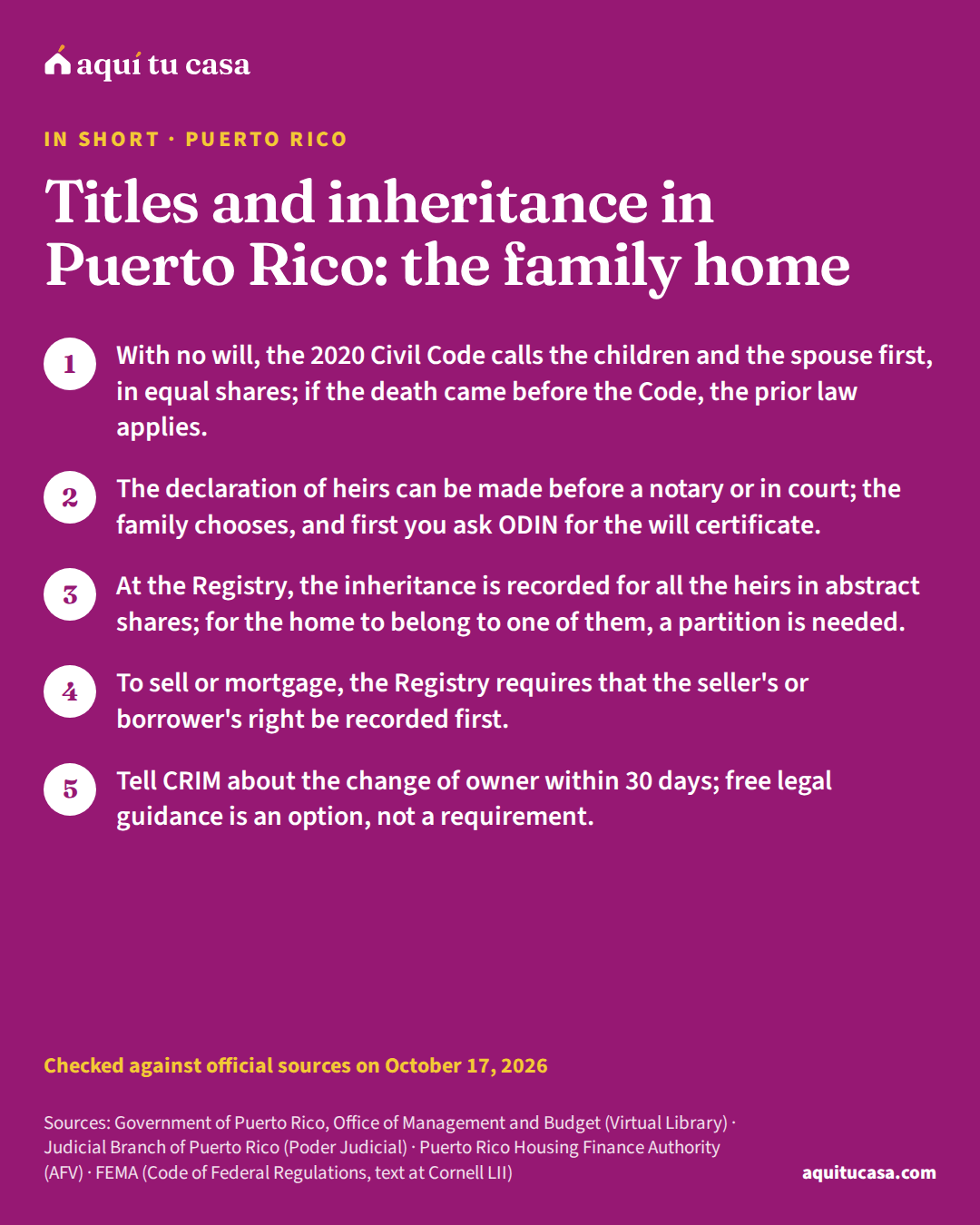
- Puerto Rico Titles and inheritance in Puerto Rico: the family home What happens to a home in Puerto Rico when its owner dies: who inherits, the declaration of heirs, the Property Registry and why a clear title matters. 11 minute read
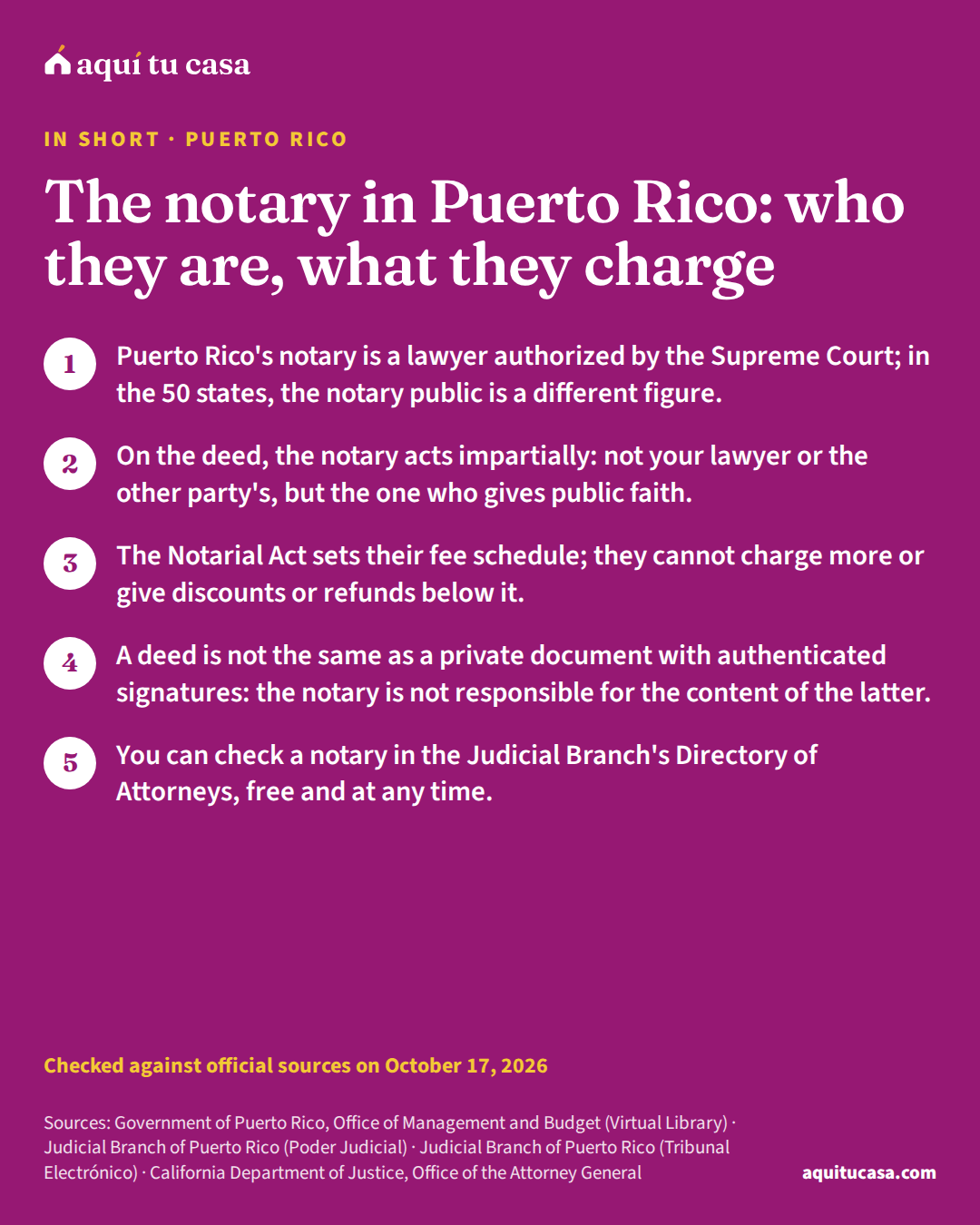
- Puerto Rico The notary in Puerto Rico: who they are, what they charge In Puerto Rico the notary is a lawyer. Who can be one, what they do in a home sale, what the law lets them charge and how to check they are authorized. 10 minute read
Tools for this topic
Was this guide useful?
Thank you. Your answer stays in your browser; nothing is sent.