Titles and inheritance in Puerto Rico: the family home
What happens to a home in Puerto Rico when its owner dies: who inherits, the declaration of heirs, the Property Registry and why a clear title matters.
Verified against official sources on October 17, 2026 11 official sources
Show contents
In short
What you need to know
Quick answer
When the owner of a home in Puerto Rico dies, the home passes to their heirs, but the Property Registry keeps showing it in the owner's name until the family does the paperwork. If there is no will, the 2020 Civil Code calls the children and the spouse first, in equal shares. With the will or a declaration of heirs (made before a notary or in court), the inheritance is recorded in favor of all the heirs; for the home to belong to just one of them, a partition is needed. A clear title matters to sell, mortgage, insure and apply for help after a disaster.
What matters most
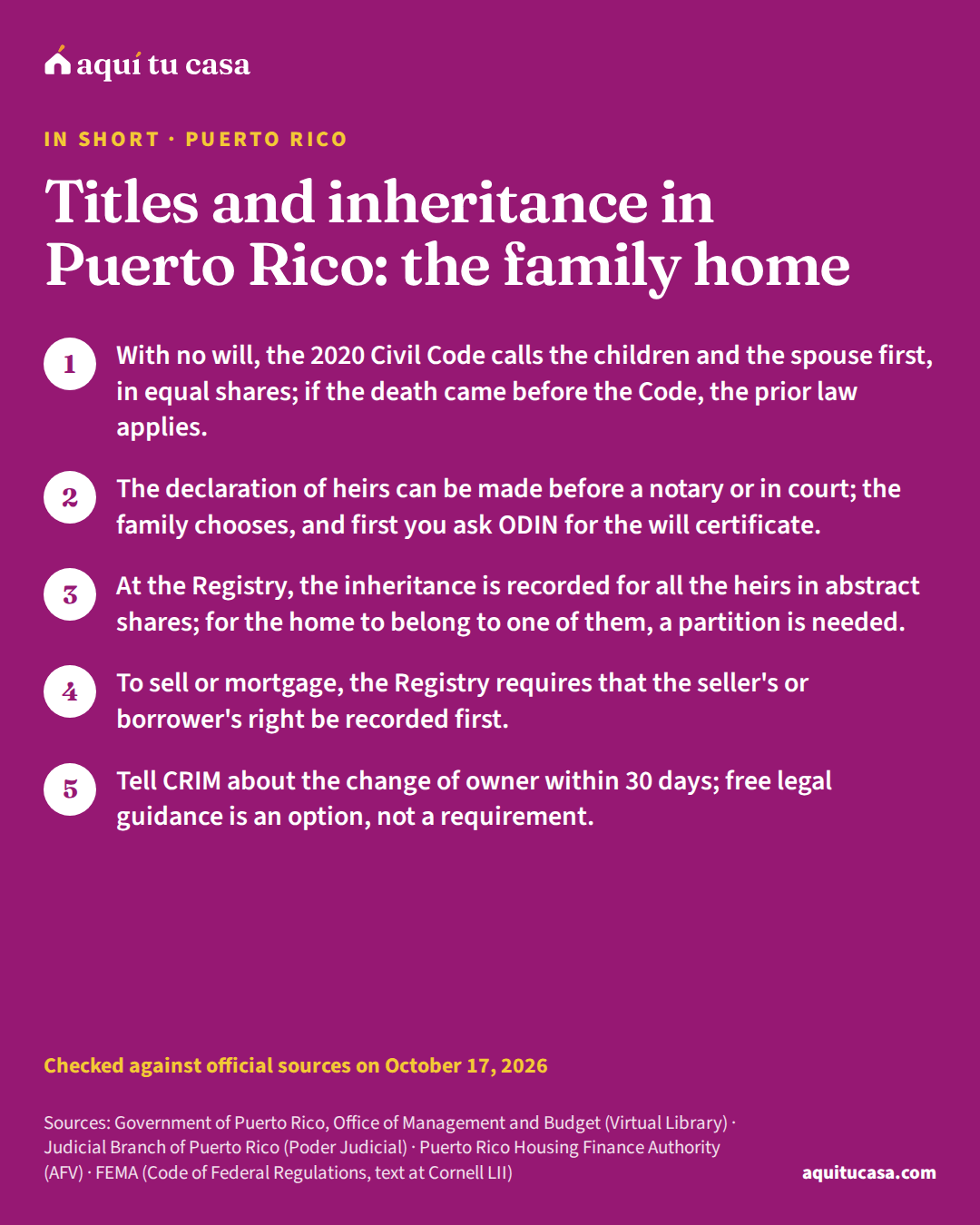
- With no will, the 2020 Civil Code calls the children and the spouse first, in equal shares; if the death came before the Code, the prior law applies.
- The declaration of heirs can be made before a notary or in court; the family chooses, and first you ask ODIN for the will certificate.
- At the Registry, the inheritance is recorded for all the heirs in abstract shares; for the home to belong to one of them, a partition is needed.
- To sell or mortgage, the Registry requires that the seller's or borrower's right be recorded first.
Is this for you?
This guide is for you if…
- A relative who owned a home in Puerto Rico died and the family does not know where to start.
- You live in a home you inherited, but the Property Registry still shows it in your parents' or grandparents' name.
- You want to sell, mortgage, insure or get repair help for an inherited home, and you are being asked for the title.
Get direct help first if…
- The heirs are in a lawsuit or someone objects: look for free legal guidance as soon as you can; this guide only explains the general rules.
- You want to know what to put in your will: that is individual legal advice, and we do not give it here.
- The home is in one of the 50 states: there, inheritance follows each state's law; start with the guide on wills, TOD deeds and inheritance.
In Puerto Rico it is common to live in a parent’s or grandparent’s home that is still in their name at the Property Registry (Registro de la Propiedad). The home belongs to the heirs from the moment of death, but the papers do not change by themselves.12 This guide is for families in that situation. It explains who inherits under the Civil Code, how the declaration of heirs works, how the inheritance is recorded and why a clear title matters to sell, mortgage, insure and apply for help. It is not legal advice: for your own case, we show you where to find free help.
What happens to the home when the owner dies
Under the 2020 Civil Code, an inheritance includes the rights and the obligations passed on by a person’s death, and the succession (sucesión) opens at the moment of death. It can be testate (with a will), intestate (without a will, or with one that does not work) or mixed.1 Each person called to inherit can accept or reject the inheritance, independently of the others, and that decision cannot be undone. Acceptance can be express, in a document, or implied, through acts that presume it.1
One date matters a lot: if your relative died before the 2020 Code took effect, their heirs are governed by the prior law. The Code took effect 180 days after it was approved.1 If you do not know which law applies to your case, ask during legal guidance before you sign anything.
Who inherits if there is no will
The Civil Code sets an order. Each group inherits only if there is no one in the group before it:1
- The descendants and the surviving spouse. The children and the spouse inherit in equal shares. If a child died earlier, that child’s children (the grandchildren) inherit in their place.
- The ascendants. If there are no descendants and no spouse, the parents inherit; if not, the grandparents or other closest ascendants.
- The collateral relatives. Next come siblings and nephews and nieces, first, and then other relatives up to the sixth degree.
- The people of Puerto Rico, if there is no one else.
With a will, the person decides more, but not everything. The legítima (forced share) is the part the law reserves for the forced heirs, and a person who has them can only freely dispose of half of their property. The surviving spouse can ask to be allotted the family home with preference and, if their share is not enough, a right to live there for life, free of charge, in proportion to the difference. The Code gives the spouse a forced share in ownership, not in usufruct (a right only to use).1
With a will and without one
Testate succession
There is a will
Either way, the home stays in the name of all the heirs until the partition is made.2
The declaration of heirs, step by step
From the death to the title in your name
1. Ask for the will certification
First
ODIN issues it with a written request, a copy of the death certificate and $5.00 in fees.7
3. Record the inheritance at the Registry
With the will or the declaration, in favor of all the heirs, in abstract shares.2
4. Make the partition
By agreement of all, if they are legally capable, or in court if there is no agreement.1
5. Record the allotment
With a deed signed by all the heirs or a final court ruling, the home is put in the name of the right person.2
The declaration of heirs (declaratoria de herederos) is the document that identifies the heirs. By law it must state the date of death, the deceased’s marital status, the heirs and the surviving spouse’s right to the widow’s usufruct share (cuota viudal usufructuaria), if there is one.2 A notary can handle it just as a court can, and the family chooses. If a dispute or objection arises among the people involved, the notary has to stop, and fees are agreed in writing.4 The guide on the notary in Puerto Rico explains how to check a notary.
What the Property Registry says
With the will or the declaration, the inheritance is recorded in favor of all the heirs.2 Until there is a partition, the Registry does not say “the home belongs to María”: it says each heir has an abstract, undivided share in everything the person left. If there is only one heir, the inheritance document already counts as the allotment.2
Example with real numbers
An example: grandmother's home, with no will
An example in words of what the Civil Code and the Registry Act say; every family has its own case.
- Grandmother dies without a will; she leaves three children and had no spouse
- The three children inherit in equal shares1
- One of the children had died earlier
- That child's children (the grandchildren) inherit in their place1
- After the declaration of heirs
- The home is recorded in favor of all of them, in abstract shares2
- One of the children wants to keep the home
- Partition: an agreement of all in a deed, or the court if there is no agreement1
- Meanwhile, one of the heirs lives there
- They can ask CRIM for the exemption; the home counts as a single home5
If grandmother died before the 2020 Code took effect, the prior law applies.1 A lawyer-notary or a legal aid organization can review your case.
Run it with your numbersDocument checklistIf grandmother left the home to someone in her will as a bequest (legado), that person records it with a deed of payment of the bequest signed by all the forced heirs, and the documents include a certification from the Treasury Department (Hacienda) on the release of the inheritance tax lien.2
Several heirs: the hereditary community
When several people inherit, the Civil Code says there is a hereditary community (comunidad hereditaria). Each heir can sell their share (their abstract part) without asking permission, but selling the home itself takes everyone’s consent. If one heir sells their share to an outsider, the others have 30 days to buy it first. The heirs can agree not to divide the estate for up to four years, and renew that agreement.1
Any heir can ask for the partition at any time. It can be testamentary, by agreement (if everyone is legally capable and agrees) or judicial (if there is no agreement). The partition includes the inventory, the appraisal, paying the debts and the allotment. And after the partition, creditors can collect from any heir, but only up to the value of what that heir received.1 At the Registry, sales or mortgages are only recorded on specific shares already allotted, although all the heirs together can sell their whole hereditary right to a third party.2
Why a clear title matters
A home still in the name of someone who died is what the glossary calls heirs’ propertyheirs' propertyHeirs' property is, according to the Department of Agriculture (USDA), family land owned jointly by the descendants of someone who died without the estate going through probate. The heirs have the right to use it but do not have clear title to sell it, and each generation usually adds more owners. Without proof of ownership it can be hard to get federal benefits, and a third party could force a partition sale. In Florida, a special law protects heirs in partition lawsuits: the value is set by an appraisal and the other owners can buy out whoever asked for the sale.See the full definition. You can live in it, but any paperwork becomes harder:
- Selling or mortgaging. The Registry requires that the seller’s or borrower’s right be recorded first; if not, it denies the recording.2 The heirs cannot record property in their favor without first, or at the same time, recording their relative’s title.2
- Insuring. Property insurance can only be enforced by someone with an insurable interest, and if the policy names a person, it only applies up to that person’s interest.6 The guide on insurance and hurricanes in Puerto Rico explains policies.
- Applying for help. The AFV’s HOME Program rehabilitation help requires you to hold title to the property, that it be your main residence and that it have no mortgages or liens.8 For FEMA’s individual assistance, the regulation accepts as an owner-occupant the legal owner and also a person living there with no formal title and no rent, if they show with documents their legal responsibility for the home, such as tax receipts, repair or improvement receipts, court documents or a letter from a public official.9 The guide on how to prove you own your home without a formal title explains that proof.
- CRIM. Inheriting is a change of owner that you report to CRIM within 30 days. An estate’s home counts as a single home for the exemption, which goes to the heir who lives there; and if one spouse dies, the other keeps it without applying again.5 The guide on CRIM explains it.
Free legal help, if you need it
None of this requires you to hire anyone in particular, but inheritances have details that change from family to family. If you cannot afford it, LSC funds legal aid organizations in the territories11 and lists Community Law Office, Inc. and Puerto Rico Legal Services, Inc. in Puerto Rico.10 The Notarial Act exempts notaries of Servicios Legales de Puerto Rico and of law school legal aid clinics from certain stamps when they make deeds for people who are indigent.3 The guide on free legal aid explains how to ask for it.
If this is your situation
What matters most for your situation
You inherited with your siblings
Selling the home takes everyone's consent; each of you can sell your share, with 30 days of first refusal for the others.1
Your husband or wife died
You can ask to be allotted the family home with preference.1 The CRIM exemption continues without a new application if you are the original owner.5
A hurricane damaged the inherited home
For FEMA, tax receipts, repair receipts or court documents can serve as proof.9
Mistakes that cost you
The mistake and what to do instead
Mistake: Leaving the home in the deceased's name for years.
Instead: Make the declaration and record the inheritance: without it you cannot sell or mortgage.2
Mistake: Signing a «sale» of the home without all the heirs.
Instead: The home itself can only be sold with everyone's consent.1
Mistake: Going to court without the will certification.
Instead: First ask ODIN for the negative certification; the court will not process the petition without it.3
Mistake: Forgetting CRIM.
Instead: Report the change of owner within 30 days.5
Mistake: Throwing away tax and repair receipts.
Instead: Keep them: they can serve as proof of your responsibility for the home with FEMA.9
What to do this week
- Get the death certificate and ask ODIN for the will certification.7
- List all the heirs following the Civil Code’s order, and confirm the date of death.11
- Ask for a title study or a Registry certification to see whose name the home is in.2
- Ask CRIM for the debt certification and report the change of owner.5
- Put the tax, repair and improvement receipts in one folder, kept outside the home.9
- If there is a disagreement or you cannot afford it, look for an LSC-funded legal aid organization: it is a free option, not a requirement.11 More topics are under Puerto Rico.
Your household this month
Let's do the math
Left each month
Enter what at least one person takes home to see the result.
What helps
- Pay savings first: set the goal aside the day the money arrives, before flexible spending.
- Add up the bills that come every few months (car insurance, school) and divide by twelve.
- If income changes, plan on a low month and save the extra from good months.
- A HUD-approved housing counselor can go over the budget with you, often for free.
This is a planning tool with your numbers, not a credit evaluation or an approval. The split reference is only a guide.
Ready to see the numbers? Find your county here
See how this applies in your county: its loan limits, prices and rents, from the official data.
Printable checklist
Frequently asked questions
Who inherits the home if there is no will in Puerto Rico?
Under the 2020 Civil Code, the descendants and the surviving spouse inherit first: the children and the spouse in equal shares, and grandchildren in place of a child who died earlier. If there are none, the parents; after them, siblings and other relatives up to the sixth degree. If the person died before the Code took effect, the prior law applies.
What is a declaration of heirs (declaratoria de herederos)?
It is the document that says who the heirs are of a person who died without a will, with the date of death and the deceased's marital status. It can be done before a notary or in court; you choose. With it, the inheritance is recorded at the Property Registry.
How do I know whether my relative left a will?
The Will Registry of the Office of Notary Inspection (ODIN) issues a confirming certification, if a will was reported, or a negative one, if none appears. It costs $5.00 in fees and, if the person died, you include a copy of the death certificate. The court does not accept a petition for a declaration of heirs without the negative certification.
Why do I need the title in my name if I already live in the home?
To sell or mortgage, the Registry requires that the seller's or borrower's right be recorded first. A policy issued in your name only applies up to your own interest. And some programs, like the AFV's HOME rehabilitation help, require you to hold title. For FEMA, the regulation also accepts other proof, such as tax or repair receipts.
Do I have to pay my relative's debts?
An inheritance includes rights and obligations. Under the Civil Code, after the partition creditors can collect from any heir, but only up to the value of what that heir received. Each person called can accept or reject the inheritance, and that decision cannot be undone.
Do I need a lawyer for all of this?
The declaration and the deeds are done by a notary, who in Puerto Rico is a lawyer, or handled in court. If there is a disagreement or you cannot afford it, free legal aid is an option: LSC funds organizations in Puerto Rico. No free help is mandatory.
Sources
Every figure in this guide comes from one of these official sources. The number next to a sentence leads to the source behind it.
Each source on one line: who publishes it, its title, its address and the date we read it.
- 1. Government of Puerto Rico, Office of Management and Budget (Virtual Library) · Código Civil de Puerto Rico de 2020 (Act 55 of June 1, 2020, as amended) · bvirtualogp.pr.gov · Accessed October 17, 2026
- 2. Government of Puerto Rico, Office of Management and Budget (Virtual Library) · Ley del Registro de la Propiedad Inmobiliaria del Estado Libre Asociado de Puerto Rico (Act 210-2015, as amended) · bvirtualogp.pr.gov · Accessed October 17, 2026
- 3. Government of Puerto Rico, Office of Management and Budget (Virtual Library) · Ley Notarial de Puerto Rico (Act 75 of July 2, 1987, as amended) · bvirtualogp.pr.gov · Accessed October 17, 2026
- 4. Government of Puerto Rico, Office of Management and Budget (Virtual Library) · Ley de Asuntos No Contenciosos Ante Notario (Act 282 of August 21, 1999, as amended) · bvirtualogp.pr.gov · Accessed October 17, 2026
- 5. Government of Puerto Rico, Office of Management and Budget (Virtual Library) · Código Municipal de Puerto Rico (Act 107-2020, as amended) · bvirtualogp.pr.gov · Accessed October 17, 2026
- 6. Government of Puerto Rico, Office of Management and Budget (Virtual Library) · Código de Seguros de Puerto Rico (Act 77 of June 19, 1957, as amended) · bvirtualogp.pr.gov · Accessed October 17, 2026
- 7. Judicial Branch of Puerto Rico (Poder Judicial) · Oficina de Inspección de Notarías · poderjudicial.pr · Accessed October 17, 2026
- 8. Puerto Rico Housing Finance Authority (AFV) · Autoridad para el Financiamiento de la Vivienda de Puerto Rico (home page) · afv.pr.gov · Accessed October 17, 2026
See the other 3 sources
- 9. FEMA (Code of Federal Regulations, text at Cornell LII) · 44 CFR §206.111, Definitions (Individuals and Households Program) · law.cornell.edu · Accessed October 17, 2026
- 10. Legal Services Corporation (LSC) · Our Grantees · lsc.gov · Accessed October 17, 2026
- 11. Legal Services Corporation (LSC) · I Need Legal Help · lsc.gov · Accessed October 17, 2026
Keep reading
Related guides
If this guide helped, these follow the same path.
Puerto Rico 12 minute read
Inheriting a home in Puerto Rico from the states
If you live in the states and inherit a Puerto Rico home: which law applies, papers signed elsewhere, Hacienda's release, CRIM and taxes if you sell.
- The Puerto Rico home follows island law, and the forced-share rules apply even if your relative lived in the states.
- A will or a power of attorney signed in the states must be legalized and protocolized in Puerto Rico to be recorded.
- Without Hacienda's Release you cannot record the home in your name or sell or refinance it.
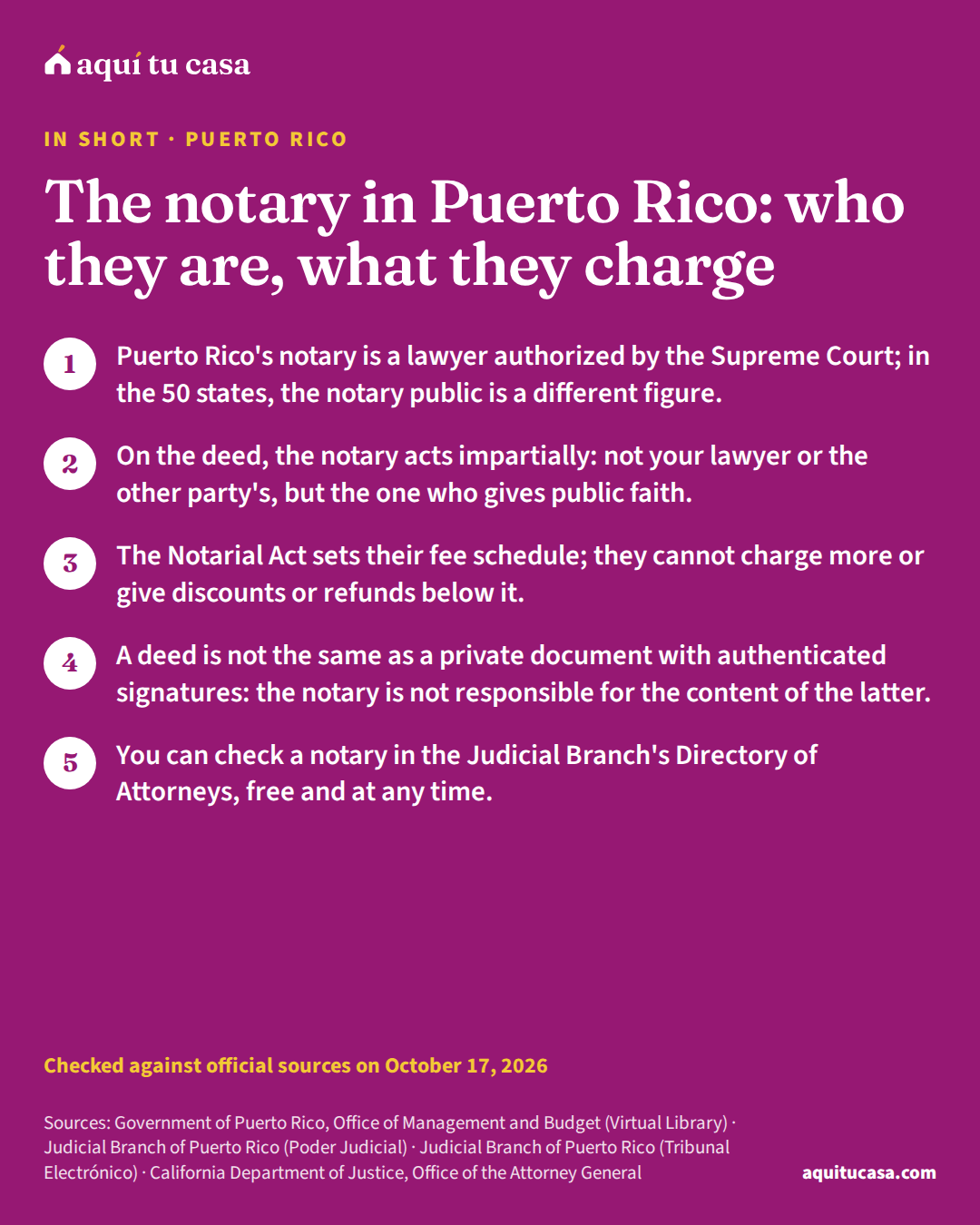
- Puerto Rico The notary in Puerto Rico: who they are, what they charge In Puerto Rico the notary is a lawyer. Who can be one, what they do in a home sale, what the law lets them charge and how to check they are authorized. 10 minute read
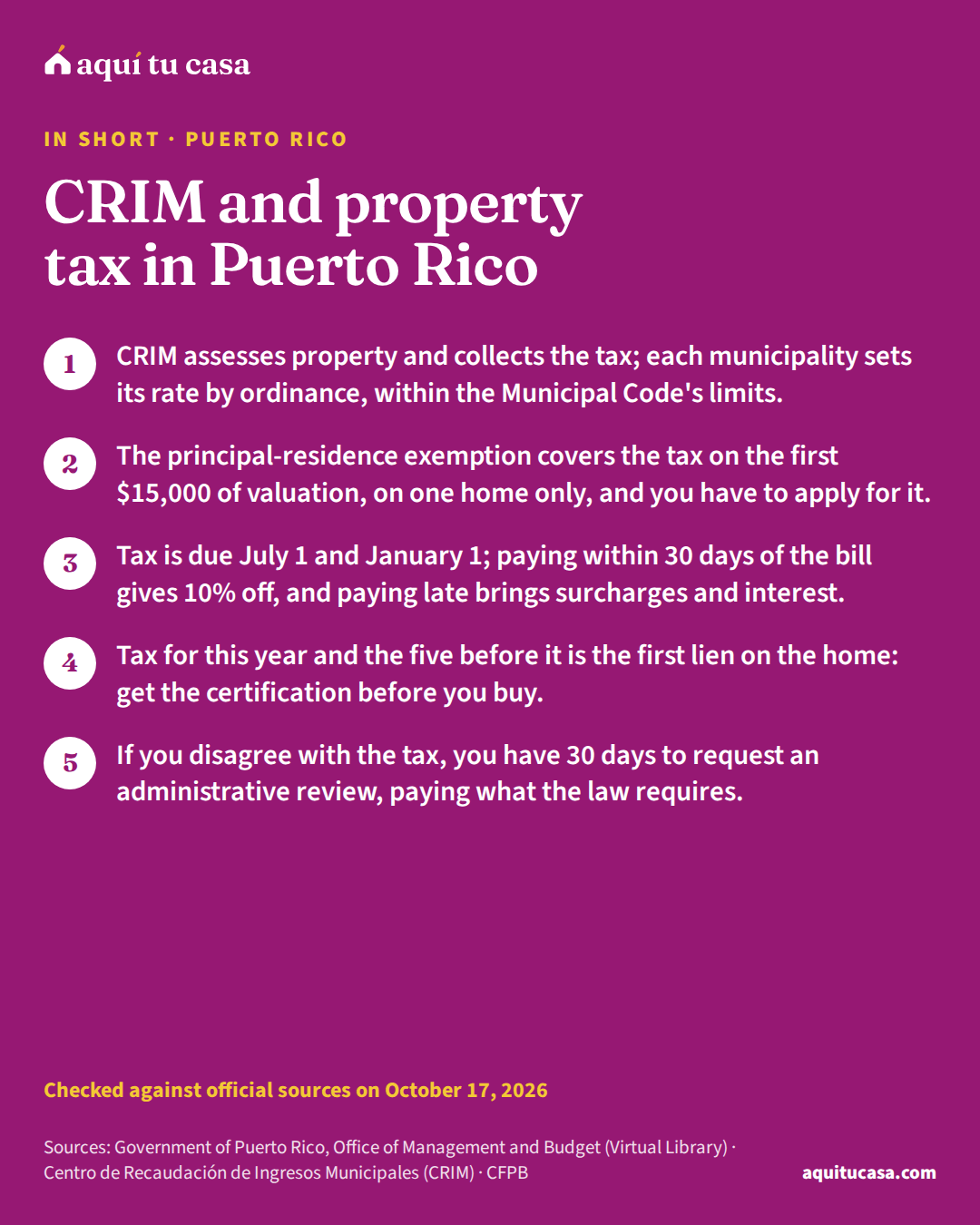
- Puerto Rico CRIM and property tax in Puerto Rico What CRIM is, how property tax is figured and paid in Puerto Rico, the exemption for your residence, certifications and how to ask for a review. 12 minute read
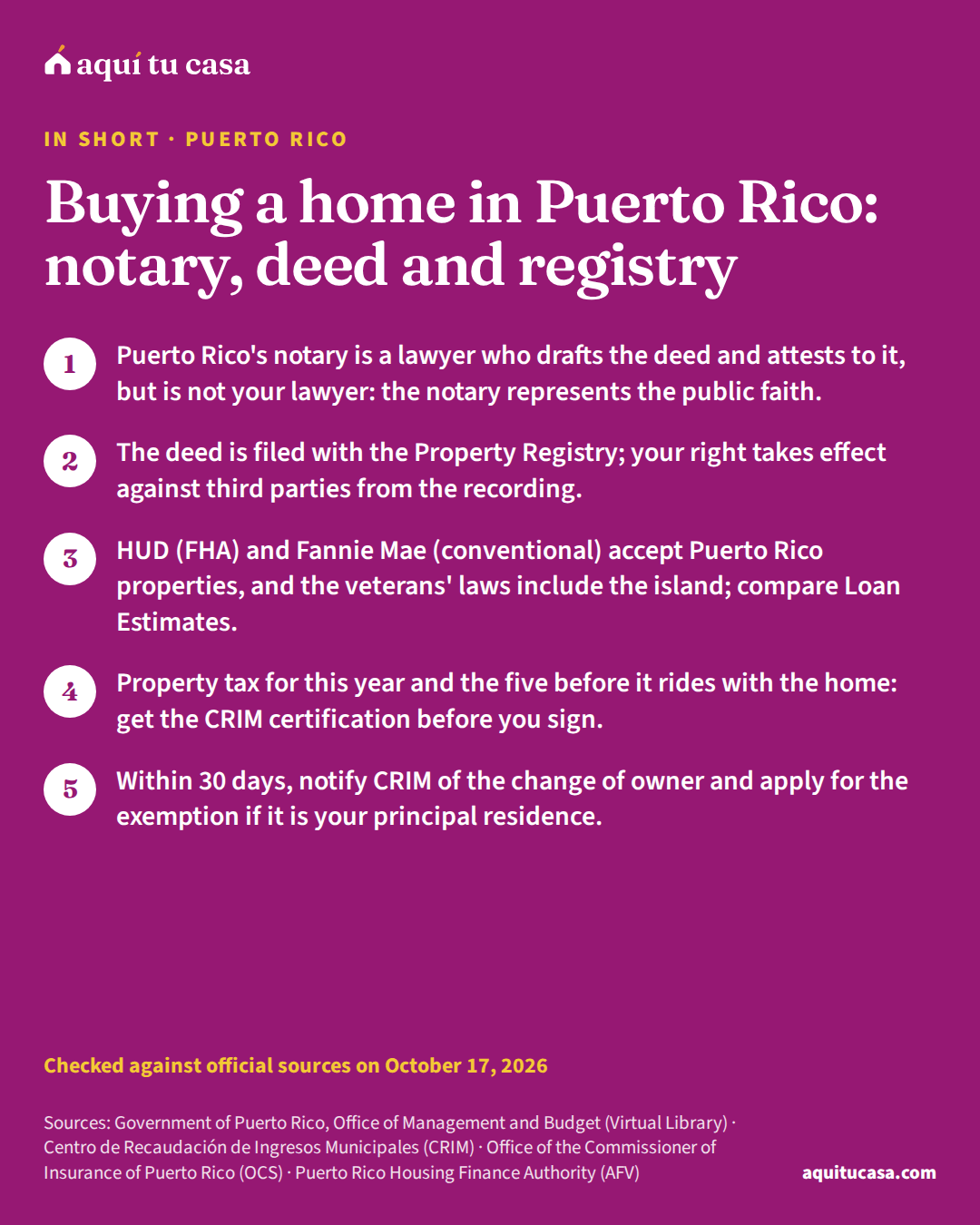
- Puerto Rico Buying a home in Puerto Rico: notary, deed and registry How buying a home works in Puerto Rico: the notary who is a lawyer, the public deed, the Property Registry, FHA, VA and conventional loans, AFV and CRIM. 13 minute read
Tools for this topic
Was this guide useful?
Thank you. Your answer stays in your browser; nothing is sent.