The notary in Puerto Rico: who they are, what they charge
In Puerto Rico the notary is a lawyer. Who can be one, what they do in a home sale, what the law lets them charge and how to check they are authorized.
Verified against official sources on October 17, 2026 8 official sources
Show contents
In short
What you need to know
Quick answer
In Puerto Rico, the notary is a lawyer whom the Supreme Court authorizes to give public faith: they draft the deeds, identify the parties, read the deed to them and give them the legal warnings, and they act impartially, representing neither side. Their fees are set by the Notarial Act: on a sale worth more than $10,000, between 0.50% and 1% of the value, never less than $250. You can check that they are authorized in the Judicial Branch's Directory of Attorneys, and the Office of Notarial Inspection oversees them.
What matters most
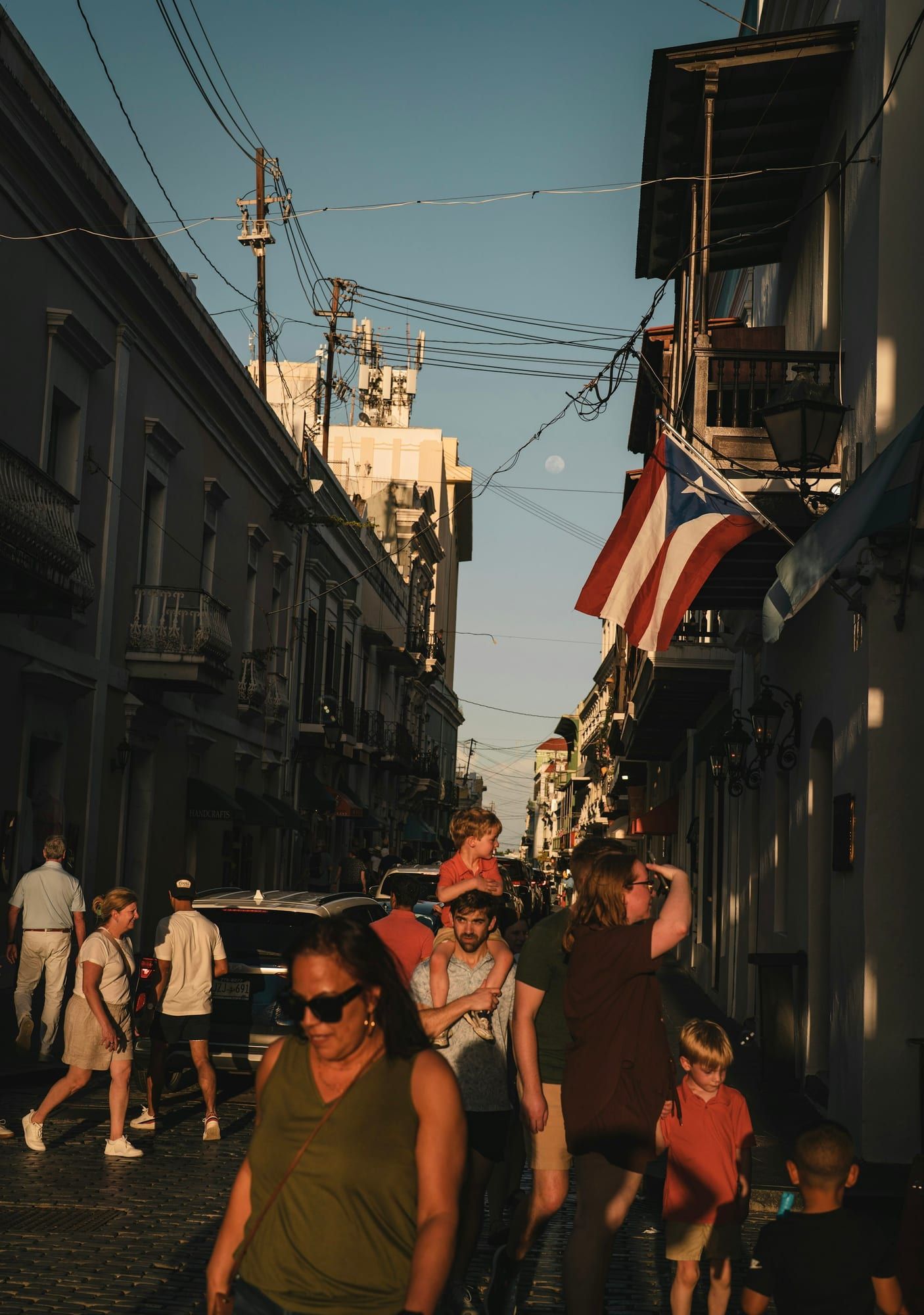
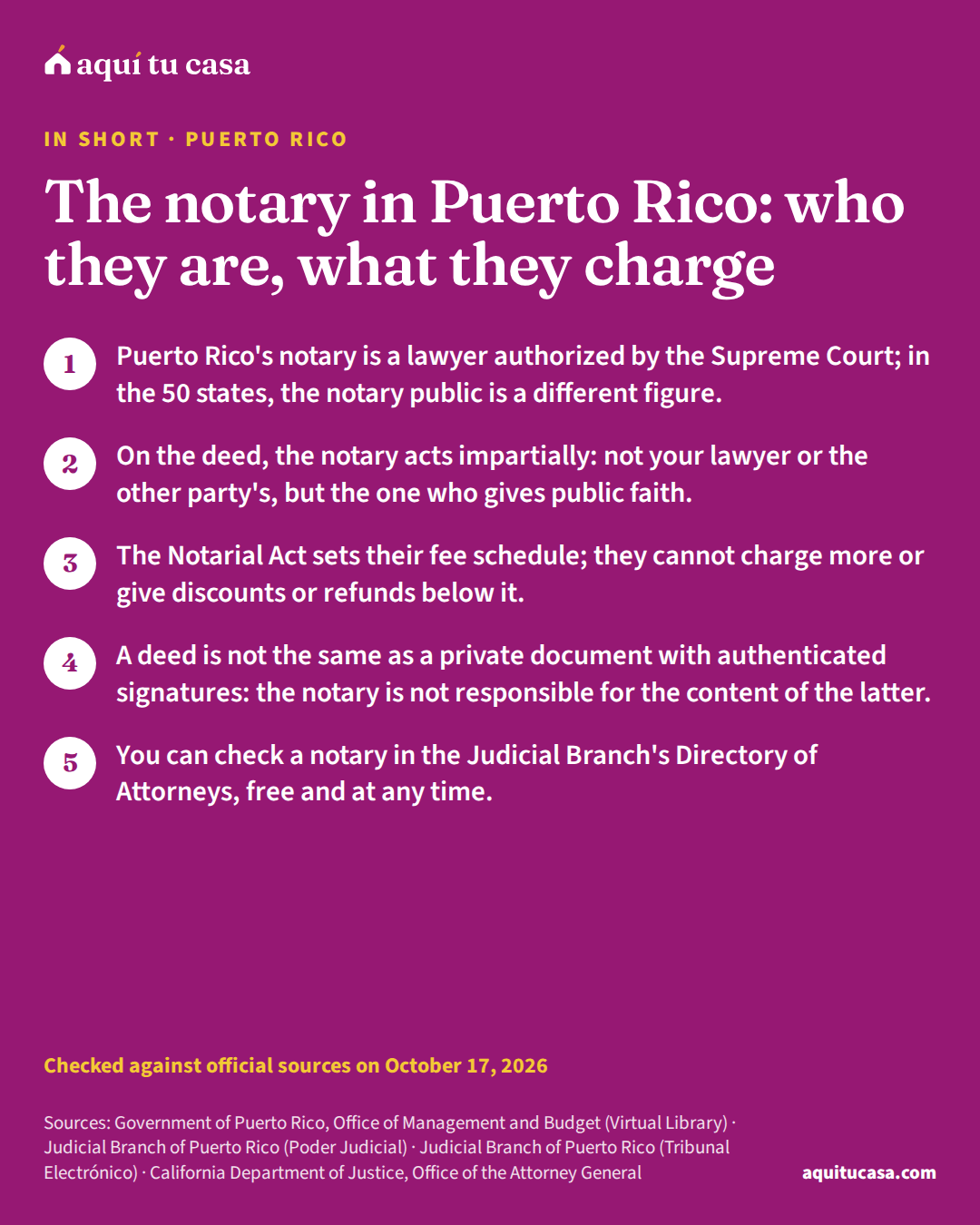
- Puerto Rico's notary is a lawyer authorized by the Supreme Court; in the 50 states, the notary public is a different figure.
- On the deed, the notary acts impartially: not your lawyer or the other party's, but the one who gives public faith.
- The Notarial Act sets their fee schedule; they cannot charge more or give discounts or refunds below it.
- A deed is not the same as a private document with authenticated signatures: the notary is not responsible for the content of the latter.
Is this for you?
This guide is for you if…
- You are buying, selling, mortgaging or inheriting property in Puerto Rico and need to go to the notary.
- You come from the states (or are moving there) and do not understand why the island's notary is a lawyer and the one there is not.
- You want to know how much a notary can charge and how to check that they are authorized.
Get direct help first if…
- You need someone who represents only you in a lawsuit or a negotiation: in their role, the notary represents neither party; look for legal guidance, which can be free.
- Your matter is in one of the 50 states: there the notary public is a different figure; start with the guide A notario is not a lawyer.
- You need help with an immigration case: that notario guide and the free legal aid guide explain who can help.
In many Spanish-speaking countries, and in Puerto Rico, the notary (notario) is a lawyer with a public function. Not in the 50 states: there the notary public witnesses signatures. This guide is for anyone who has to go to a notary on the island to buy, sell, mortgage or inherit. It explains who can be a notary, what they do on your deed, what the law lets them charge, how to check on them and how they differ from the notary in the states.15
- Minimum bond every notary must keep in force, renewed every year
- $15,0001
- Minimum fee for a deed with no stated value, under the Notarial Act
- $1501
- What each certification from the Office of Notarial Inspection's registry costs
- $53
- Fine the Supreme Court can impose on a notary, besides a reprimand or suspension
- Up to $5001
Who the notary is in Puerto Rico
The Notarial Act defines the notary as «el profesional del Derecho que ejerce una función pública» (the legal professional who exercises a public function). The notary attests to the transactions carried out before them, receives the parties’ wishes and drafts the deedsdeedA deed is the legal document the seller uses to transfer ownership of the home to you. The seller signs it at closing, it lists the names of all the buyers and you receive a copy. Afterward, the settlement agent records it with the county records office; that recording puts the public on notice that you are now the owner. There are several types: a warranty deed gives the most promises about the title, and a quitclaim deed promises nothing. Do not confuse it with a deed of trust, which is the mortgage document.See the full definition. The same law makes clear something that surprises many buyers: in that role, the notary is not the lawyer of either party. The notary represents the public faith.1
The law requires impartiality and places the notary under the administrative direction of the Supreme Court, through the Office of Notarial Inspection (ODIN). Its statement of motives describes a double role: legal professional, adviser and legal counselor, and at the same time the person who prepares the documents that make transactions secure.1 In practice, that means the notary can explain the deed and the laws that apply, but does so for both parties equally.
Who can be a notary
Only attorneys whom the Supreme Court of Puerto Rico authorizes for that purpose can practice as notaries.1 Before starting, the notary swears allegiance to the Constitutions of the United States and of Puerto Rico and posts a bond of no less than $15,000 that answers for their work; the bond is renewed every year and approved by the Supreme Court. The notary also registers their signature, sign, seal and flourish with the Clerk of the Court.1
The Clerk of the Supreme Court issues the notary a certification with their name, number and the date they were authorized, and the notary must display it on a wall of their office.1 There are cases where a notary cannot act: they cannot authorize a deed in which they are a party or that benefits them, nor one in which a party is their relative up to the fourth degree of blood or second degree of marriage, unless that relative appears on behalf of someone else.1
What the notary does on your deed
Signing day, step by step
1. The notary identifies you
If they do not know you, they accept photo ID with a signature or a passport.1
3. The notary reads it to you or lets you read it
They attest to your legal capacity and give you the legal warnings out loud, including the CRIM one.1
4. Witnesses, if needed
Only if someone asks for them or a party cannot read or sign.1
5. The notary affixes the stamps
Without the stamps the law requires, the deed or copy is voidable or ineffective.1
6. The notary keeps the original and gives you a copy
The original deed stays in the notary's Protocol; you get a certified copy.1
In every deed that transfers real property, the notary must warn that it is advisable to get the CRIM tax debt certification and must include the cadastral number.1 If the home will be your principal residence, the notary must also warn you to apply for the property tax exemption (exoneración).1 If you cannot read, the deed is read aloud twice; if you cannot sign, the notary takes the prints of both your thumbs.1
The original, called the escritura matriz, stays in the notary’s Protocol, which is secret and belongs to the State. You get a certified copy. The parties, their representatives and their successors (such as heirs) have the right to copies; if the notary refuses a copy, you can go to the ODIN Director.1

Deed, testimonio and sworn statement: not the same thing
The notary also issues testimonios, also called declarations of authenticity. With a testimonio the notary attests, for example, that the signatures on a private document belong to the people who signed, or that someone took an oath. But the notary is not responsible for what that private document says.1 A public deed is something else: the notary drafts it and attests to its entire content.1
What the notary can charge
The Notarial Act sets the fee schedule. For a sale or mortgage worth more than $10,000 and up to $5,000,000, the fee is agreed but cannot be more than 1% or less than 0.50% of the value, nor less than $250.1 For other matters:
Example with real numbers
The notarial fee schedule for other matters
What the Notarial Act says; you agree on the exact fee with the notary within those limits.
- Deed with no stated value
- Agreed, never less than $1501
- Testimonio, sworn statement or acknowledgment of signature
- Agreed between the parties and the notary1
- Mortgage cancellation
- No less than 0.50% of the note's principal, nor less than $2501
- Social-interest housing with AFV or another agency
- No less than 0.25% or $250, whichever is greater (not for FHA or veterans loans)1
On top of that, the notary can charge reasonable fees for title studies and consultations.1 Ask for the total in writing before you sign.
Run it with your numbersClosing costsThe law forbids the notary from charging any compensation other than the schedule, including refunds or discounts to lower it. The notary may provide the service for free if they consider it deserving, as long as it is not a habitual business practice. And a person who is not a notary and bills or shares notarial fees commits a felony.1 The other closing costsclosing costsClosing costs are all of the costs you pay on closing day on top of the down payment: lender fees, the appraisal, the credit report, title insurance, the closing agent's fees, any transfer taxes your state or county charges and the first deposits into the escrow account. The lender must itemize them on the Loan Estimate within days of your application and confirm them on the Closing Disclosure before you sign. Some can be paid by the seller, and several state programs help cover them.See the full definition of your purchase appear on your Loan Estimate.
Inheritances and other matters before a notary
Some matters that used to be handled only in court can now also be handled before a notary. The Non-Contentious Matters before a Notary Act lets a notary handle, among other things, the declaration of heirs (declaratoria de herederos) and the authentication of a handwritten will. You choose whether to bring it before the notary or the court. If a dispute or opposition arises among those involved, the notary must stop. Fees are agreed in writing.2

To request the declaration of heirs, you need to know whether the person left a will. ODIN issues certifications from the Registry of Wills, such as the negative certification when no will has been reported; each certification costs $5.00 in fees.3 The guide to titles and inheritance in Puerto Rico explains the whole process.
How to check on a notary
Before you hand over papers or money, confirm who you are dealing with:
- Look them up in the Directory. The Judicial Branch’s Directory of Attorneys (Directorio de Abogados y Abogadas) shows, free and at any time, information on people admitted to practice law and notarial practice in Puerto Rico. It draws on the Single Registry of Attorneys (RUA); if a detail is missing, the attorney did not authorize publishing it.4
- Look at the wall. The law requires the notary to display in their office the Supreme Court certification with the date they were authorized.1
- If there is a problem, ODIN. The Office of Notarial Inspection oversees and guides notaries and serves the public; its San Juan office lists the phone number (787) 763-8816.3 The Supreme Court can give a notary a reprimand, a fine of up to $500 or a suspension.1
Puerto Rico and the states: two different notaries
The island's notario and the states' notary public
A lawyer
Notary in Puerto Rico
If you move to the states, the «notario» there is not the lawyer you knew on the island.5
The guide A notario is not a lawyer explains who can give you legal advice in the states, and From Puerto Rico to Florida covers the move. If a notary publicnotary publicIn the United States, a notary public is a person authorized by law to administer oaths and witness signatures on legal documents; the notary verifies who is signing and certifies the signature. The rules for becoming a notary vary by state. It is not the same as a "notario público" in many Latin American countries, where the title means someone with the equivalent of a law license. Here, a notary who is not a lawyer cannot give you legal advice or help you with immigration paperwork. Some states, such as Oregon, forbid them from advertising as a "notario" or "notario público".See the full definition in the states offers to «fix» papers from the island, be wary.
If this is you
What matters most for your situation
You are buying your first home
Ask the notary for the fee in writing and ask about anything you do not understand before signing.1
A relative who owned a home died
The declaration of heirs can be handled before a notary or in court; you choose.2
You cannot afford it
The law exempts notaries of Servicios Legales de Puerto Rico and of law school legal clinics from certain stamps on deeds for indigent people.1
You live in the states
Your state's notary public is not a lawyer.5 For a deed on the island, talk to a Puerto Rico notary.
If you need free legal help, the LSC funds legal aid organizations in the territories8 and lists Community Law Office, Inc. and Puerto Rico Legal Services, Inc. in Puerto Rico.7 The free legal aid guide explains how to ask for it.
Costly mistakes
The mistake and what to do instead
Mistake: Thinking the notary negotiates for you.
Instead: The notary acts impartially and represents the public faith; ask your questions before you sign.1
Mistake: Accepting a «discount» below the fee schedule.
Instead: The law forbids it; be wary of offers that do not match the schedule.1
Mistake: Buying a piece of land with a private «notarized» paper.
Instead: Ask whether the subdivision is approved; the notary is not responsible for the content of a private document.1
Mistake: Paying someone who is not a notary for «the deed».
Instead: Check the Directory of Attorneys before you pay.4
Mistake: Leaving without a copy of your deed.
Instead: You have a right to a copy; if it is refused, go to ODIN.1
What to do this week
- Look the notary up in the Judicial Branch’s Directory of Attorneys.4
- Ask them in writing for their fee and what they will charge separately for the title study.1
- Bring your photo ID with signature, or your passport, on signing day.1
- Ask about the CRIM debt certification and the exemption before you sign.1
- Keep the certified copy of your deed in a safe place.1
- If you want legal guidance just for you and cannot afford it, look for an LSC-funded organization: it is a free option, not a requirement.8 More topics are under Puerto Rico.
Ready to see the numbers? Find your county here
See how this applies in your county: its loan limits, prices and rents, from the official data.
Printable checklist
Frequently asked questions
Is every notary in Puerto Rico a lawyer?
Yes. The Notarial Act says only attorneys authorized by the Supreme Court of Puerto Rico can practice as notaries. Before practicing, they take an oath, post a bond of no less than $15,000 and register their signature and seal.
Is the notary on my home sale my lawyer?
No. The law explains that, in their role, the notary is not the lawyer of any of the parties: they represent the public faith and act impartially. If you want guidance just for you, you can seek it separately; free legal aid exists for those who qualify.
How much does a notary charge for a deed of sale?
For a deed worth more than $10,000 and up to $5,000,000, the Notarial Act says the fee is agreed but cannot be more than 1% or less than 0.50% of the value, and never less than $250. The title study and consultations can be charged separately.
Can a notary give me a discount?
The law forbids charging any compensation other than the fee schedule, including refunds or discounts to lower it. It does allow the notary to provide the service for free when they consider it deserving, as long as it is not a habitual business practice.
How do I know whether a notary is authorized?
The Judicial Branch's Directory of Attorneys lets you see, free and at any time, information on people admitted to practice law and notarial practice. In addition, the law requires the notary to display in their office the Supreme Court certification with the date they were authorized.
Can the notary handle the declaration of heirs?
Yes. The Non-Contentious Matters before a Notary Act lets a notary handle it, just like a court; you choose where to bring it. If a dispute or opposition arises among those involved, the notary must stop.
What do I do if the notary will not give me a copy of my deed?
The parties, their representatives and successors have the right to copies. If the notary refuses, the law lets you go to the Director of the Office of Notarial Inspection.
Sources
Every figure in this guide comes from one of these official sources. The number next to a sentence leads to the source behind it.
Each source on one line: who publishes it, its title, its address and the date we read it.
- 1. Government of Puerto Rico, Office of Management and Budget (Virtual Library) · Ley Notarial de Puerto Rico (Ley Núm. 75 de 2 de julio de 1987, según enmendada) · bvirtualogp.pr.gov · Accessed October 17, 2026
- 2. Government of Puerto Rico, Office of Management and Budget (Virtual Library) · Ley de Asuntos No Contenciosos Ante Notario (Act 282 of August 21, 1999, as amended) · bvirtualogp.pr.gov · Accessed October 17, 2026
- 3. Judicial Branch of Puerto Rico (Poder Judicial) · Oficina de Inspección de Notarías · poderjudicial.pr · Accessed October 17, 2026
- 4. Judicial Branch of Puerto Rico (Tribunal Electrónico) · Directorio de Abogados y Abogadas · tribunalelectronico.poderjudicial.pr · Accessed October 17, 2026
- 5. California Department of Justice, Office of the Attorney General · Attorney General Bonta Issues Consumer Alert on Notario Fraud, Obtaining Immigration Legal Help, Locating Detained People · oag.ca.gov · Accessed October 17, 2026
- 6. Florida Legislature · Florida Statutes §117.05, Use of notary commission; unlawful use; notary fee; seal; duties; advertising · leg.state.fl.us · Accessed October 17, 2026
- 7. Legal Services Corporation (LSC) · Our Grantees · lsc.gov · Accessed October 17, 2026
- 8. Legal Services Corporation (LSC) · I Need Legal Help · lsc.gov · Accessed October 17, 2026
Keep reading
Related guides
If this guide helped, these follow the same path.

Puerto Rico 13 minute read
Buying a home in Puerto Rico: notary, deed and registry
How buying a home works in Puerto Rico: the notary who is a lawyer, the public deed, the Property Registry, FHA, VA and conventional loans, AFV and CRIM.
- Puerto Rico's notary is a lawyer who drafts the deed and attests to it, but is not your lawyer: the notary represents the public faith.
- The deed is filed with the Property Registry; your right takes effect against third parties from the recording.
- HUD (FHA) and Fannie Mae (conventional) accept Puerto Rico properties, and the veterans' laws include the island; compare Loan Estimates.
- Puerto Rico Titles and inheritance in Puerto Rico: the family home What happens to a home in Puerto Rico when its owner dies: who inherits, the declaration of heirs, the Property Registry and why a clear title matters. 11 minute read
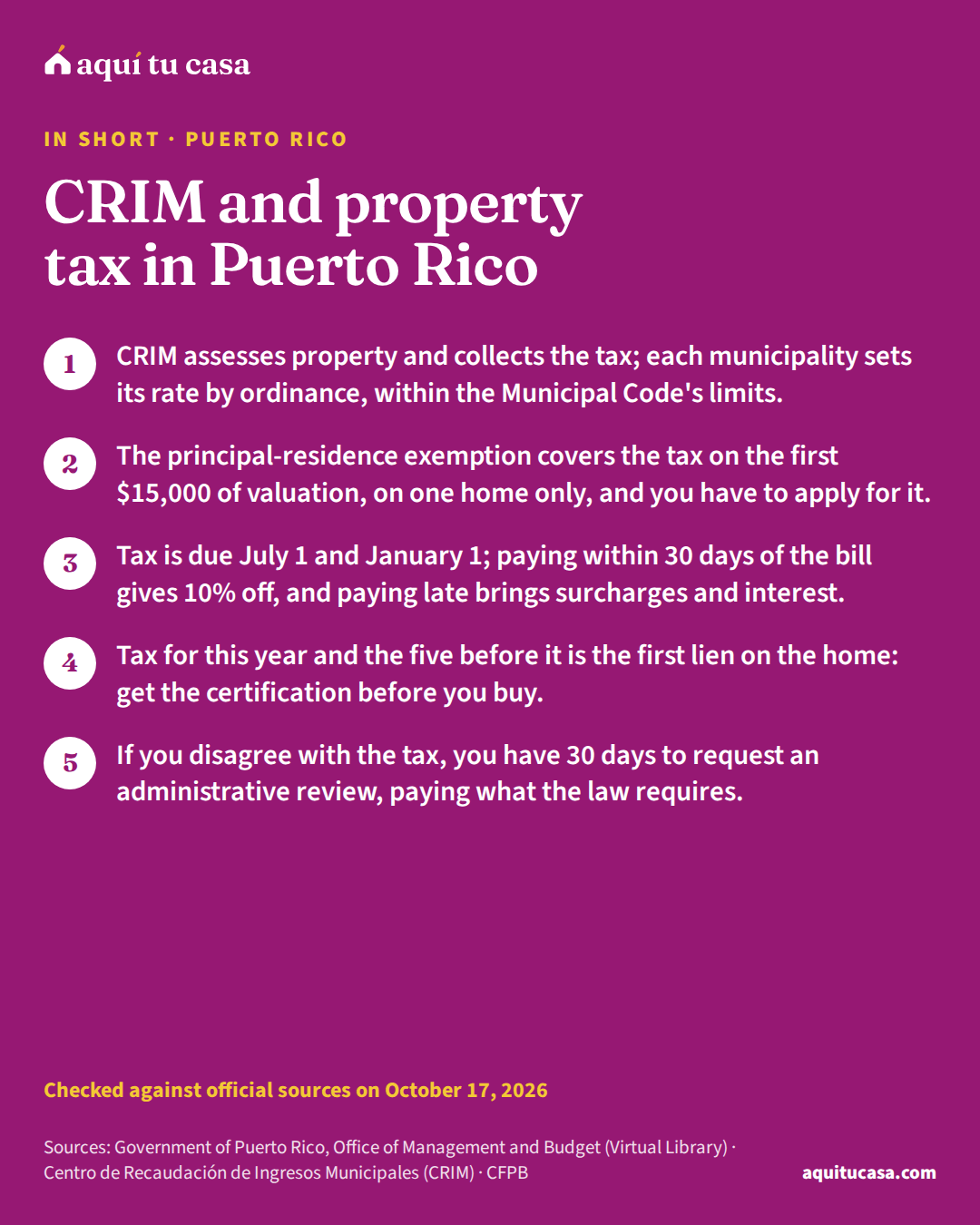
- Puerto Rico CRIM and property tax in Puerto Rico What CRIM is, how property tax is figured and paid in Puerto Rico, the exemption for your residence, certifications and how to ask for a review. 12 minute read
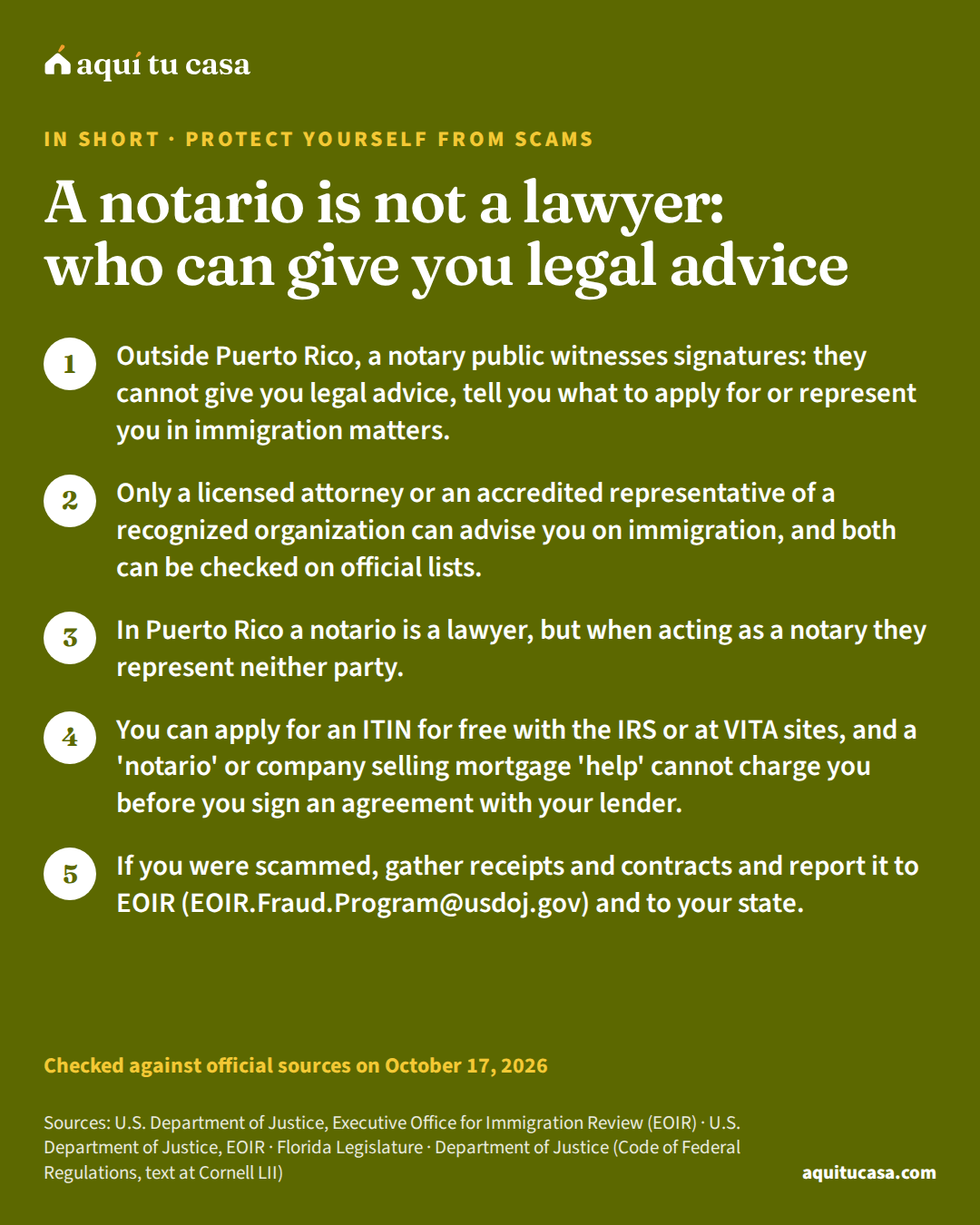
- Protect yourself from scams A notario is not a lawyer: who can give you legal advice Outside Puerto Rico, a notary public is not a lawyer. What a notary can do, who can advise you for free or at low cost, warning signs and how to report it. 12 minute read
Tools for this topic
Was this guide useful?
Thank you. Your answer stays in your browser; nothing is sent.