Puerto Rico Essential guide
Buying a home in Puerto Rico: notary, deed and registry
How buying a home works in Puerto Rico: the notary who is a lawyer, the public deed, the Property Registry, FHA, VA and conventional loans, AFV and CRIM.
Verified against official sources on October 17, 2026 17 official sources
Show contents
In short
What you need to know
Quick answer
In Puerto Rico the sale closes with a public deed signed before a notary, who there is a lawyer authorized by the Supreme Court and represents neither party but the public faith. The deed is then filed with the Property Registry, and your right holds against third parties from the recording. HUD accepts Puerto Rico properties for FHA loans and Fannie Mae for conventional loans, and the AFV publishes assistance such as Pronto pa' tu casa. Before signing, get the CRIM tax debt certification; afterward, notify CRIM of the change of owner within 30 days.
What matters most
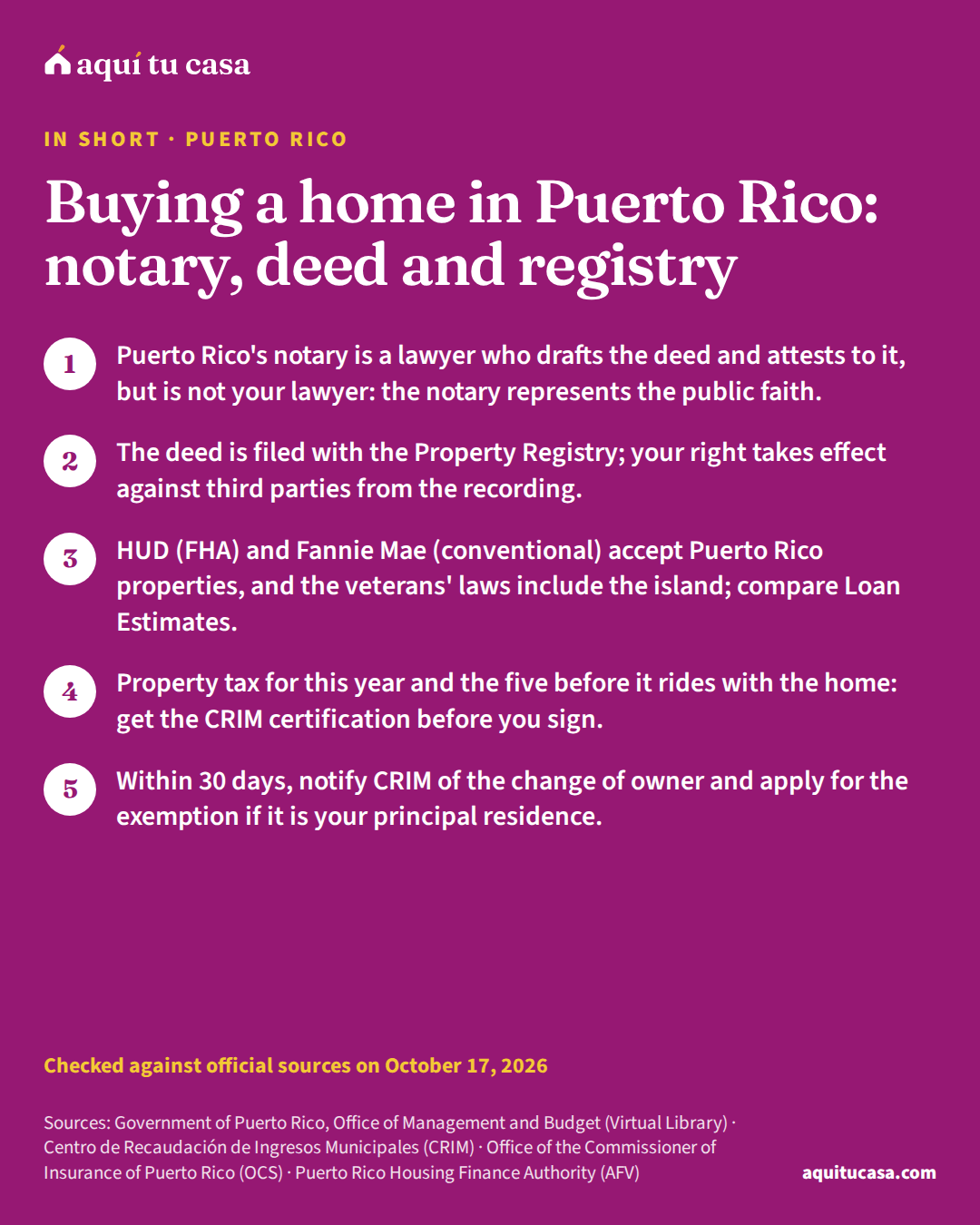
- Puerto Rico's notary is a lawyer who drafts the deed and attests to it, but is not your lawyer: the notary represents the public faith.
- The deed is filed with the Property Registry; your right takes effect against third parties from the recording.
- HUD (FHA) and Fannie Mae (conventional) accept Puerto Rico properties, and the veterans' laws include the island; compare Loan Estimates.
- Property tax for this year and the five before it rides with the home: get the CRIM certification before you sign.
Is this for you?
This guide is for you if…
- You are buying a home in Puerto Rico, whether you live on the island or in the states, and want to understand each step before you sign.
- You were told that in Puerto Rico the sale closes «before a notary» and you do not know what the notary does or what the Property Registry is.
- You want to know whether you can use an FHA, VA or conventional loan on the island and what assistance the AFV publishes.
Get direct help first if…
- You are buying in one of the 50 states: there the notary is not a lawyer and closing works differently; start with the step-by-step home buying guide.
- You inherited a home or the home is in the name of a relative who died: the guide on titles and inheritance in Puerto Rico covers that path.
- There is already a lawsuit over the property or a foreclosure under way: look for free legal help as soon as you can; this guide only explains the general rules.
Buying a home in Puerto Rico looks like buying in any state when it comes to the loan, but the legal side is different: the sale is signed in a public deed (escritura pública) before a notary who is a lawyer, and ownership is protected in the Property Registry (Registro de la Propiedad).12 This guide is for anyone buying on the island, whether they live there or in the states. It explains each step, what the notary does, which loans and assistance exist, and what happens with property tax and insurance.
Buying in Puerto Rico, step by step
The order looks like the one in the states, with three stops of its own: the title study at the Registry, the debt certification from CRIM (the Municipal Revenue Collection Center, which collects property tax) and the deed before a notary.1
From preapproval to the home in your name
1. Get preapproved for your loan
Before you house-hunt
HUD (FHA) and Fannie Mae (conventional) accept Puerto Rico properties,12 and the veterans' laws include the island.1410
Try it with your numbersHow much house can I afford?2. Ask about AFV assistance
Before you sign a contract
Pronto pa' tu casa requires a homebuyer course and is applied for through a participating financial institution.7
3. Order the title study
Before the deed
To record your purchase, the seller's right has to be recorded in the Registry first.2
4. Get the CRIM debt certification
Before the deed
Tax for this year and the five before it rides with the home even if it is not recorded.3
6. Sign the deed before the notary
Closing day
The notary identifies you, reads you the deed or lets you read it and gives you the legal warnings.1
7. The deed is filed with the Registry
After closing
Your right takes effect against third parties from the recording, in the order of filing.2
At every step the question is the same: what does the official document say? The Registry, CRIM and your lender have the answer in writing, and it is worth asking for it before you pay.
The notary: a lawyer, but not yours
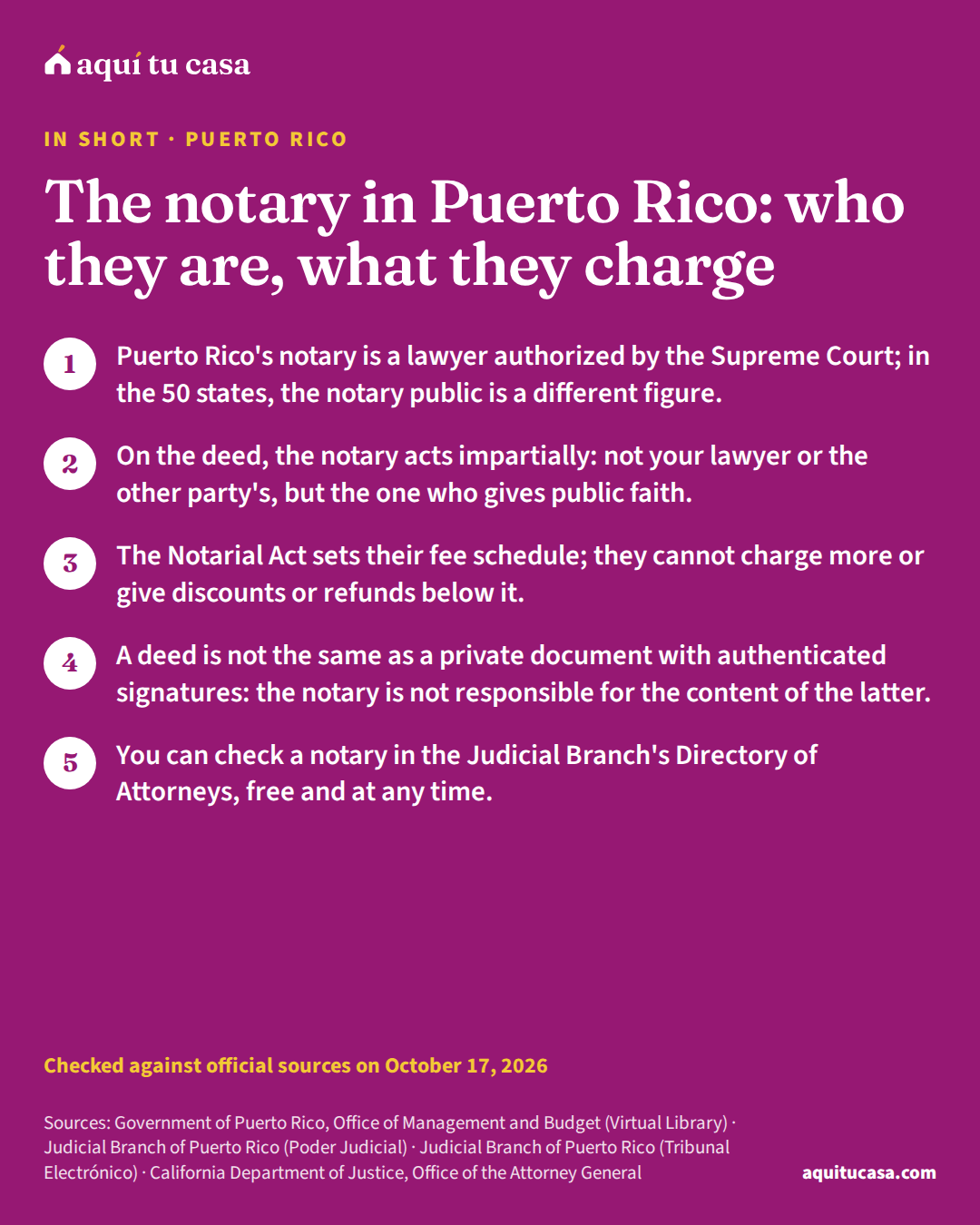
In the 50 states, a notary public witnesses signatures. In Puerto Rico the notario is a different figure. The Notarial Act defines the notary as «el profesional del Derecho que ejerce una función pública» (the legal professional who exercises a public function): the notary receives the parties’ wishes and drafts the deeds. Only attorneys authorized by the Supreme Court of Puerto Rico can be notaries. The same law makes clear that, in that role, the notary is not the lawyer of either party: the notary represents the public faith.1
That means the notary on your purchase works to make the transaction legal and clear for everyone, not to bargain for you. In the deed, the notary attests that they know the parties or verified their identity, that the parties have legal capacity, and that they read them the deed or let them read it. The notary also gives them the legal warnings out loud.1 If the notary does not know you, the law accepts photo ID with a signature issued in Puerto Rico, the United States or a state, or a passport issued by another country.1
Two warnings concern you directly. In every deed that transfers real property, the notary must warn that it is advisable to get the CRIM debt certification and must include the property’s cadastral number (número de catastro).1 And if the home will be your principal residence, the notary must warn you to apply for the property tax exemption (exoneración) and record that in the deed.1
The guide The notary in Puerto Rico explains the notary’s duties and how to check that they are authorized. If you move to the states, remember that a notary publicnotary publicIn the United States, a notary public is a person authorized by law to administer oaths and witness signatures on legal documents; the notary verifies who is signing and certifies the signature. The rules for becoming a notary vary by state. It is not the same as a "notario público" in many Latin American countries, where the title means someone with the equivalent of a law license. Here, a notary who is not a lawyer cannot give you legal advice or help you with immigration paperwork. Some states, such as Oregon, forbid them from advertising as a "notario" or "notario público".See the full definition there is not a lawyer: the guide A notario is not a lawyer explains it.
What the notary charges
The Notarial Act sets a fee schedule (arancel). It works by tiers based on the value of each deed, with rules for new homes, refinancing and social-interest housing.1
Example with real numbers
The notarial fee schedule on a purchase
What the Notarial Act says; the value of your deed comes from the contract.
- Deed worth up to $10,000
- $150
- Deed worth more than $10,000 and up to $5,000,000
- Between 0.50% and 1% of the value, never less than $250
- New home or refinancing with several deeds before the same notary
- The highest-value deed on the scale; the rest at half; in total, no more than 1% of the highest-value deed
- Social-interest housing with AFV or another agency (not FHA or veterans loans)
- Agreed, never less than 0.25% or $250, whichever is greater
These are the fees for authorizing the deed.1 The title study and consultations can be charged separately. Your Loan Estimate shows the other closing costs.
Run it with your numbersClosing costsThe same law lets the notary charge separately, with reasonable fees, for prior work such as the title study and consultations.1 Ask in writing, before the deed, what each item will cost. The other closing costs appear on your Loan Estimate.
The deed and the Property Registry
The public deeddeedA deed is the legal document the seller uses to transfer ownership of the home to you. The seller signs it at closing, it lists the names of all the buyers and you receive a copy. Afterward, the settlement agent records it with the county records office; that recording puts the public on notice that you are now the owner. There are several types: a warranty deed gives the most promises about the title, and a quitclaim deed promises nothing. Do not confuse it with a deed of trust, which is the mortgage document.See the full definition is the document that transfers the home to you. The Property Registry is where that right becomes public. By law, the Registry is public for anyone with an interest in knowing the legal status of a property, and online queries are available 24 hours a day. The public deed is one of the documents that get recorded.2
Three Registry rules explain why it matters to check the titletitleTitle is your legal right to own and possess a property. The deed is the document showing that the seller transferred that right to you, and legal title is the title that can be documented in public records. As part of the purchase, a title search is done to see whether anyone else has a claim against the home; common claims come from a previous owner's unpaid taxes or from contractors who say they were not paid for work on the home. Title insurance protects you if such a claim shows up later.See the full definition before you pay:
- Chain of title (tracto). To record a sale or a mortgage, the seller’s right has to be recorded first. If not, the Registry denies the recording.2 If the seller inherited the home and never recorded the inheritance, that has to be fixed first.
- Priority. Recorded titles hold against third parties from the recording, and the order depends on the date and time of filing.2
- Registry’s public faith (fe pública registral). Someone who buys in good faith, paying, from a person who appears in the Registry with the power to sell, and records it, is protected.2
That is why the lender and the notary order a title searchtitle searchA title search is a review of public records to find defects or encumbrances in a property's chain of title, such as someone else's claim or a lien. It keeps the buyer and the lender from being surprised later by an ownership problem that could have been foreseen. According to the CFPB, the title search fee is part of the title service fees, along with the premium for the lender's title insurance, and it appears on page 2 of your Loan Estimate and your Closing Disclosure. You can often shop for who provides these services.See the full definition (the estudio de título). If several people buy together, the recording states each one’s share as a percentage.2 The title insurance guide explains how title is protected, and the deed theft guide covers the warning signs.
Loans: FHA, VA and conventional on the island too
For financing, federal rules include Puerto Rico. HUD’s handbook accepts Puerto Rico properties for an FHA loanFHA loanAn FHA loan is a mortgage made by a private lender and insured by the Federal Housing Administration (FHA), an agency of the U.S. government. That insurance protects the lender if you stop paying, which is why the lender can accept a lower down payment and a less-than-perfect credit history than on a conventional loan. Federal law sets the minimum cash investment at 3.5% of the property's value and caps the loan amount at the FHA limit, which changes by county. In exchange for the insurance you pay a mortgage insurance premium.See the full definition, and if you do not file a federal return because you file on the island, the lender uses your Puerto Rico tax return.10 Fannie Mae accepts Puerto Rico properties for a conventional loanconventional loanA conventional loan is any mortgage that is not insured or guaranteed by the federal government: it is not FHA, VA or USDA. The lender, or the companies that buy the loans (Fannie Mae and Freddie Mac), carry the risk. When the amount is within the conforming loan limit the loan is called "conforming"; above it, it is a "jumbo" loan. It usually asks for a higher credit score than an FHA loan and, if your down payment is less than 20% of the price, you are normally required to buy private mortgage insurance (PMI) until you build enough equity in the home.See the full definition.12 And for the veterans’ benefits laws, «State» includes Puerto Rico.14
Three ways to finance in Puerto Rico
Low down payment
FHA
No government program
Conventional
Get Loan Estimates from several lenders and compare them before you decide.15
The CFPB notes that an FHA loan has a maximum amount that varies by location and always carries mortgage insurance.11 A VA loan has no monthly mortgage insurance but usually has an upfront fee at closing.15 The FHA loan, VA loan and conventional loan guides explain each one’s requirements, and the mortgage calculator lets you try your own numbers.

AFV assistance for buyers
The Puerto Rico Housing Finance Authority (AFV, Autoridad para el Financiamiento de la Vivienda) is Puerto Rico’s housing finance agencystate housing finance agency (HFA)A state housing finance agency (HFA) is a public body created by an act of a state legislature, or by a local government, with the power to finance housing. In that federal definition, "state" includes Puerto Rico and the District of Columbia. Its mission is to increase affordable housing for renters and homebuyers with low to moderate incomes, especially first-time homebuyers. HFAs usually do not lend directly: they work with participating lenders that offer their loans and down payment assistance. Programs vary by state.See the full definition. On its site it publishes these programs for buyers:
- Pronto pa’ tu casa. Helps with the down payment (pronto) and closing costs.8 It uses federal CDBG-MIT funds to buy an existing property whose price does not exceed the FHA limits or the appraisal. It gives up to $45,000 per eligible low- and moderate-income household, up to $55,000 if someone in the household is Essential Recovery Personnel, and $5,000 more if you buy in a designated urban center. It requires a homebuyer course, meeting the income limits, mortgage approval at a participating institution, not owning a home when you apply and being a U.S. citizen, U.S. national or qualified alien.7
- Vivienda Joven. It is not cash assistance: it is a loan guaranteed by the AFV for people aged 21 to 35 who graduated from an accredited institution in the last five years, for their principal residence.8
- HOME Program. Includes buyer assistance for low-income families who own no property, meet the income limits, can pay a mortgage and take a course. The AFV gives guidance at 939-333-5417.9
In Pronto pa’ tu casa, you apply through the participating financial institution, the home must have valid title free of liens, and if it is in a special flood hazard area you need a flood policy at closing.7 The down payment assistance guide explains how this kind of help works in general.
Property tax and insurance: before you sign
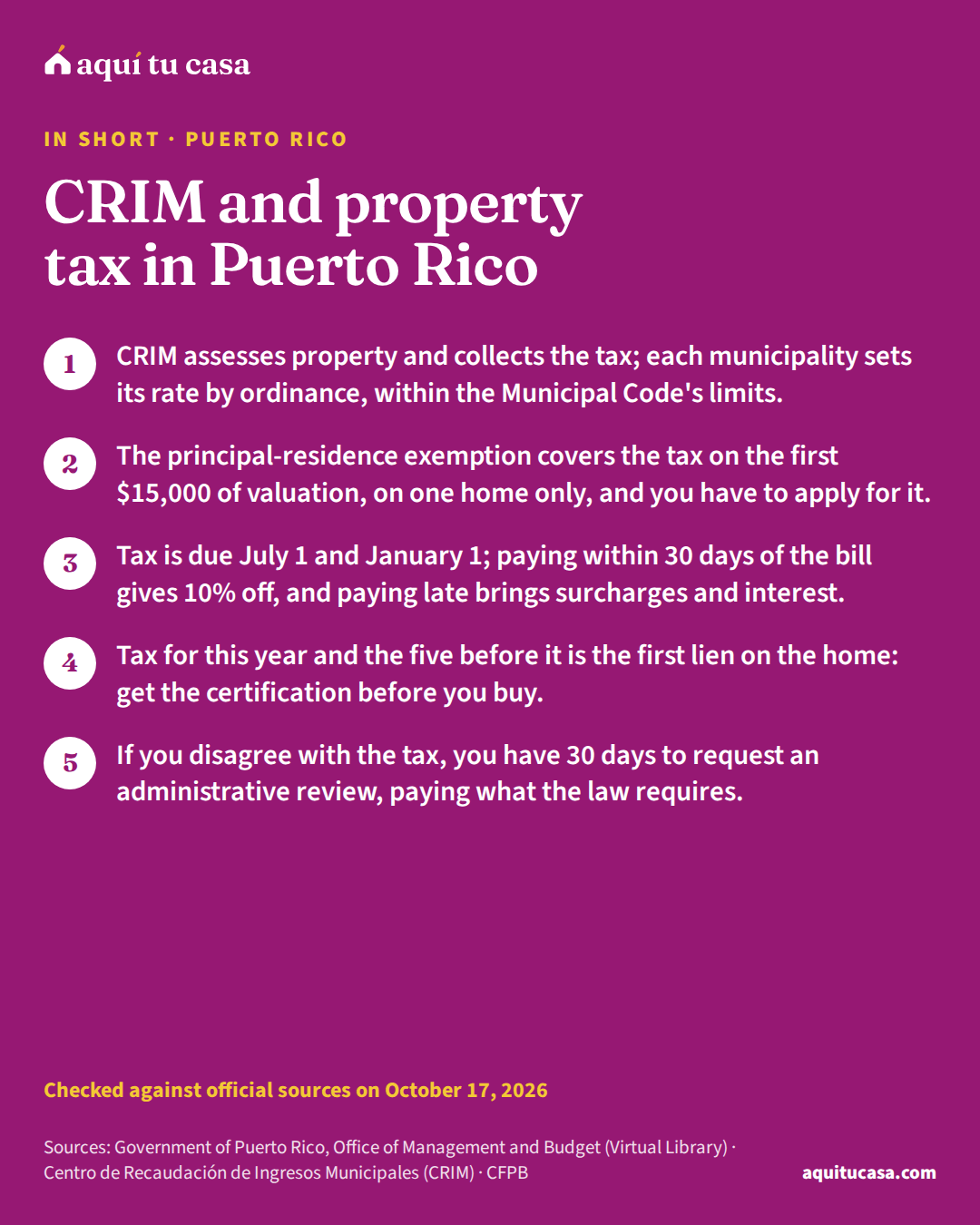
Two bills follow the home, not the person. The first is property tax, which CRIM collects. Under the Municipal Code, the tax for this year and the five before it is the first lienlienA lien is a legal right a creditor holds in your property to make sure you repay a debt. It usually prevents the property from being sold until the debt is paid, and if you do not pay, the creditor may be able to take the property. Your mortgage is a lien on your home: when you pay it off, the lien is released and that shows up in your county's property records. There are other kinds, such as a federal tax lien, which is the government's legal claim against all your property when you do not pay a tax debt.See the full definition on the home, even if it is not recorded.3 That is why the debt certification comes before the deed. Afterward, you have 30 days to report the change of owner, even if you already filed the deed with the Registry; if you do not, you are liable for bills issued in the previous owner’s name.3 CRIM’s portal lets you look up the debt and request certifications.5 The guide to CRIM and property tax explains the exemption and payments.
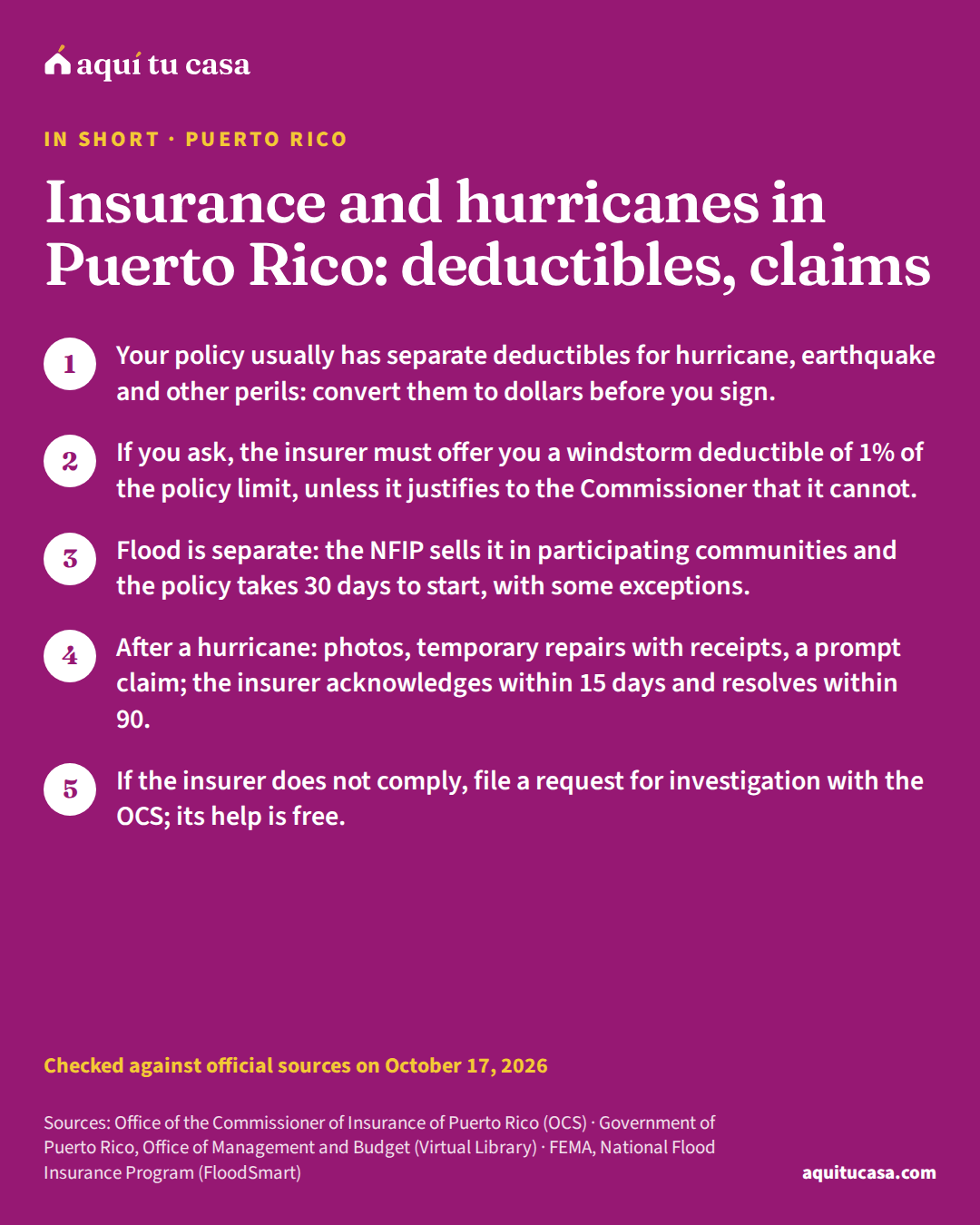
The second is insurance. You have the right to choose your insurer, and the bank must tell you the loan does not depend on buying insurance from it or its affiliates.4 A property policy almost never covers flood.6 If the home is in a special flood hazard area and the loan comes from a regulated institution, federal law requires flood insuranceflood insuranceFlood insurance is a separate policy that can cover a building, its contents, or both, when flood water causes damage. Most homeowners insurance policies do not cover that damage. Most of these policies are backed by FEMA's National Flood Insurance Program (NFIP) and bought through insurers and agents. If your home is in a high-risk flood area and your mortgage is backed by the federal government, the lender is required to demand it; outside those areas it is optional, but floods happen there too.See the full definition.16 The guide to insurance and hurricanes in Puerto Rico covers deductibles and claims.
If this is you
What matters most for your situation
You are buying from the states
A notarial document signed outside Puerto Rico has to be protocolized on the island.1 Talk to the notary before you sign anything.
You are a first-time buyer
Pronto pa' tu casa and HOME require that you not own a home and that you take a homebuyer course.79
You are a veteran or servicemember
The veterans' laws count Puerto Rico as a «State».14 A VA loan is requested from a private lender.15
You are buying with relatives
The recording states each person's share as a percentage.2 The guide on how to hold title with family explains the options.

Costly mistakes
The mistake and what to do instead
Mistake: Paying without seeing what the Registry says.
Instead: Order the title study: if the seller's right is not recorded, your purchase cannot be recorded.2
Mistake: Signing without the CRIM debt certification.
Instead: Get it first: up to five past years plus the current one follow the home.3
Mistake: Thinking the notary negotiates for you.
Instead: The notary represents the public faith, not one of the parties.1 Ask your questions before you sign.
Mistake: Forgetting the change of owner at CRIM.
Instead: Report it within 30 days, even if the deed is already at the Registry.3
Mistake: Paying an intermediary for an AFV repossessed property.
Instead: Do not pay or sign without the AFV's official participation.9
What to do this week
- Get preapproved and, if you file taxes in Puerto Rico, have your island returns at hand.10
- Call the AFV if you think you qualify for Pronto pa’ tu casa, Vivienda Joven or HOME.9
- Before you sign a contract, order the title study and the CRIM debt certification.3
- Get property insurance quotes from the insurer you choose, and price flood separately.4
- Ask the notary in writing for their fee and what they will charge for the title study.1
- If you want to review your numbers with someone, a HUD-approved housing counselorHUD-approved housing counselorA HUD-approved housing counselor works at an agency HUD has approved to provide housing counseling: independent, expert advice customized to your situation about buying a home, renting, a missed mortgage payment, a foreclosure or credit problems. The agencies usually charge little or nothing; many serve in Spanish and offer the homebuyer education course several assistance programs require. They are not lenders or real estate agents and sell you nothing. Your county page lists the official agencies with phone numbers.See the full definition gives independent advice, often at little or no cost.17 More island topics are under Puerto Rico.
Your numbers
The minimum for this loan is 3.5%. More down lowers the monthly payment.
Adjust advanced details
First number: share of income for housing. Second: housing plus debts. Lender references, not fixed rules.
Let's do the math
Estimated top price
National figure$227,000
Limited by the housing payment: at that price it would be about $1,883 a month, 28% of your income.
- By the housing payment (28% of income)Limits you$227,000
- By your total debts (36% of income)$292,000
- By your cash (down payment + closing)$330,500
- Typical home in the United States
- $332,700
- Your cap is 68% of the typical home.
What changes if…?
- …you save $10,000 more$227,000
- …you cut $200 a month in debts$227,000
Your maximum price with four loans
Same income, debts and savings; only the down payment and the loan type change. ITIN uses an example down payment and rate.
| FHA 3.5% | Conventional 5% | Conventional 20% | ITIN 15% (example) | |
|---|---|---|---|---|
| Maximum price | $227,000 | $232,000 | $93,000 | $119,000 |
| Payment per month | $1,883 | $1,882 | $616 | $898 |
Educational estimate, not a pre-approval. Uses example insurance (0.5% of value per year) and example closing costs (3% of price); the tax is the place’s typical rate.
Ready to see the numbers? Find your county here
See how this applies in your county: its loan limits, prices and rents, from the official data.
Printable checklist
Frequently asked questions
Is the notary in Puerto Rico a lawyer?
Yes. Under the Notarial Act, only attorneys authorized by the Supreme Court of Puerto Rico can be notaries. But in the sale the notary is not the lawyer of either party: the notary represents the public faith and acts impartially.
How much does the notary charge for the deed of sale?
The Notarial Act sets a fee schedule: for a deed worth more than $10,000 and up to $5,000,000, the fee is agreed but cannot be more than 1% or less than 0.50% of the value, and never less than $250. The title study and consultations can be charged separately.
Can I buy in Puerto Rico with an FHA or VA loan?
HUD's handbook accepts Puerto Rico properties for FHA loans, and for the veterans' laws «State» includes Puerto Rico. Fannie Mae also accepts properties on the island for conventional loans. Compare Loan Estimates from several lenders.
What is the CRIM debt certification and why does it matter?
It is the record of what is owed in property tax. It matters because the tax for this year and the five before it is the first lien on the home, even if it is not recorded. That is why the Notarial Act requires the notary to warn you that you should get it.
Do I have to tell CRIM that I bought the home?
Yes. The Municipal Code gives you 30 days from the purchase to report the change of owner, even if you already filed the deed with the Registry. If you do not, you are liable for bills issued in the previous owner's name.
Can I buy from the states without traveling to Puerto Rico?
The Notarial Act lets one party make an offer in a deed and the other accept it in a separate document, on another date and place. But a notarial document executed outside Puerto Rico must be protocolized on the island to have effect as a public instrument. Ask the notary how they will handle it.
What homebuying assistance does the AFV publish?
The AFV publishes Pronto pa' tu casa, with CDBG-MIT funds for the down payment and closing costs of eligible buyers; Vivienda Joven, a loan for recent graduates aged 21 to 35; and the HOME Program. Each has its own requirements; the AFV gives guidance at 939-333-5417.
Sources
Every figure in this guide comes from one of these official sources. The number next to a sentence leads to the source behind it.
Each source on one line: who publishes it, its title, its address and the date we read it.
- 1. Government of Puerto Rico, Office of Management and Budget (Virtual Library) · Ley Notarial de Puerto Rico (Ley Núm. 75 de 2 de julio de 1987, según enmendada) · bvirtualogp.pr.gov · Accessed October 17, 2026
- 2. Government of Puerto Rico, Office of Management and Budget (Virtual Library) · Ley del Registro de la Propiedad Inmobiliaria del Estado Libre Asociado de Puerto Rico (Act 210-2015, as amended) · bvirtualogp.pr.gov · Accessed October 17, 2026
- 3. Government of Puerto Rico, Office of Management and Budget (Virtual Library) · Código Municipal de Puerto Rico (Act 107-2020, as amended) · bvirtualogp.pr.gov · Accessed October 17, 2026
- 4. Government of Puerto Rico, Office of Management and Budget (Virtual Library) · Código de Seguros de Puerto Rico (Act 77 of June 19, 1957, as amended) · bvirtualogp.pr.gov · Accessed October 17, 2026
- 5. Centro de Recaudación de Ingresos Municipales (CRIM) · Bienvenidos a CRIM (official portal, crimpr.net) · crimpr.net · Accessed October 17, 2026
- 6. Office of the Commissioner of Insurance of Puerto Rico (OCS) · En temporada de huracanes: asegúrese de estar protegido · ocs.pr.gov · Accessed October 17, 2026
- 7. Puerto Rico Housing Finance Authority (AFV) · Pronto pa’ tu casa · afv.pr.gov · Accessed October 17, 2026
- 8. Puerto Rico Housing Finance Authority (AFV) · Programa de Préstamos AFV · afv.pr.gov · Accessed October 17, 2026
See the other 9 sources
- 9. Puerto Rico Housing Finance Authority (AFV) · Autoridad para el Financiamiento de la Vivienda de Puerto Rico (home page) · afv.pr.gov · Accessed October 17, 2026
- 10. HUD · Single Family Housing Policy Handbook 4000.1 · hud.gov · Accessed October 17, 2026
- 11. CFPB · FHA loans · consumerfinance.gov · Accessed October 17, 2026
- 12. Fannie Mae · B2-3-01, General Property Eligibility (Selling Guide) · selling-guide.fanniemae.com · Accessed October 17, 2026
- 13. CFPB · Conventional loans · consumerfinance.gov · Accessed October 17, 2026
- 14. U.S. Congress (text at Cornell LII) · 38 U.S.C. §101, Definitions · law.cornell.edu · Accessed October 17, 2026
- 15. CFPB · Special loan programs · consumerfinance.gov · Accessed October 17, 2026
- 16. U.S. Congress (text at Cornell LII) · Flood Disaster Protection Act, 42 U.S.C. §4012a, Flood insurance purchase and compliance requirements · law.cornell.edu · Accessed October 17, 2026
- 17. CFPB · Find a Housing Counselor · consumerfinance.gov · Accessed October 17, 2026
Keep reading
Related guides
If this guide helped, these follow the same path.

Puerto Rico 12 minute read
Home-buying help in Puerto Rico: AFV and Vivienda programs
The home-buying help Puerto Rico's AFV and Department of Housing publish: Pronto pa' tu casa, Vivienda Joven, HOME and more, and how to apply.
- Pronto pa' tu casa gives up to $45,000, or $55,000 if someone in the household is Essential Recovery Personnel, plus $5,000 in a designated urban center.
- You apply for Pronto pa' tu casa through a participating financial institution, and it asks you to live in the home for five years.
- Vivienda Joven is a loan, not assistance: it is for recent graduates 21 to 35 and can be combined with subsidies.
- Puerto Rico CRIM and property tax in Puerto Rico What CRIM is, how property tax is figured and paid in Puerto Rico, the exemption for your residence, certifications and how to ask for a review. 12 minute read
- Puerto Rico The notary in Puerto Rico: who they are, what they charge In Puerto Rico the notary is a lawyer. Who can be one, what they do in a home sale, what the law lets them charge and how to check they are authorized. 10 minute read
- Puerto Rico Insurance and hurricanes in Puerto Rico: deductibles, claims Home insurance in Puerto Rico: what it covers, the windstorm deductible, separate flood coverage, your rights and how to file a claim after a hurricane. 10 minute read
Tools for this topic
Was this guide useful?
Thank you. Your answer stays in your browser; nothing is sent.