Home-buying help in Puerto Rico: AFV and Vivienda programs
The home-buying help Puerto Rico's AFV and Department of Housing publish: Pronto pa' tu casa, Vivienda Joven, HOME and more, and how to apply.
Verified against official sources on October 31, 2026 10 official sources
Show contents
In short
What you need to know
Quick answer
In Puerto Rico, the Housing Finance Authority (AFV, Autoridad para el Financiamiento de la Vivienda) publishes three paths to buy: Pronto pa' tu casa, a grant from federal CDBG-MIT funds for the down payment (pronto) and closing costs, which you request through a participating bank or credit union (cooperativa); Vivienda Joven, an AFV-guaranteed loan for recent graduates 21 to 35, which gives no assistance money; and the HOME Program, for low-income families. Each one requires a homebuyer course and has its own income limits. AFV gives guidance at 939-333-5417.
What matters most
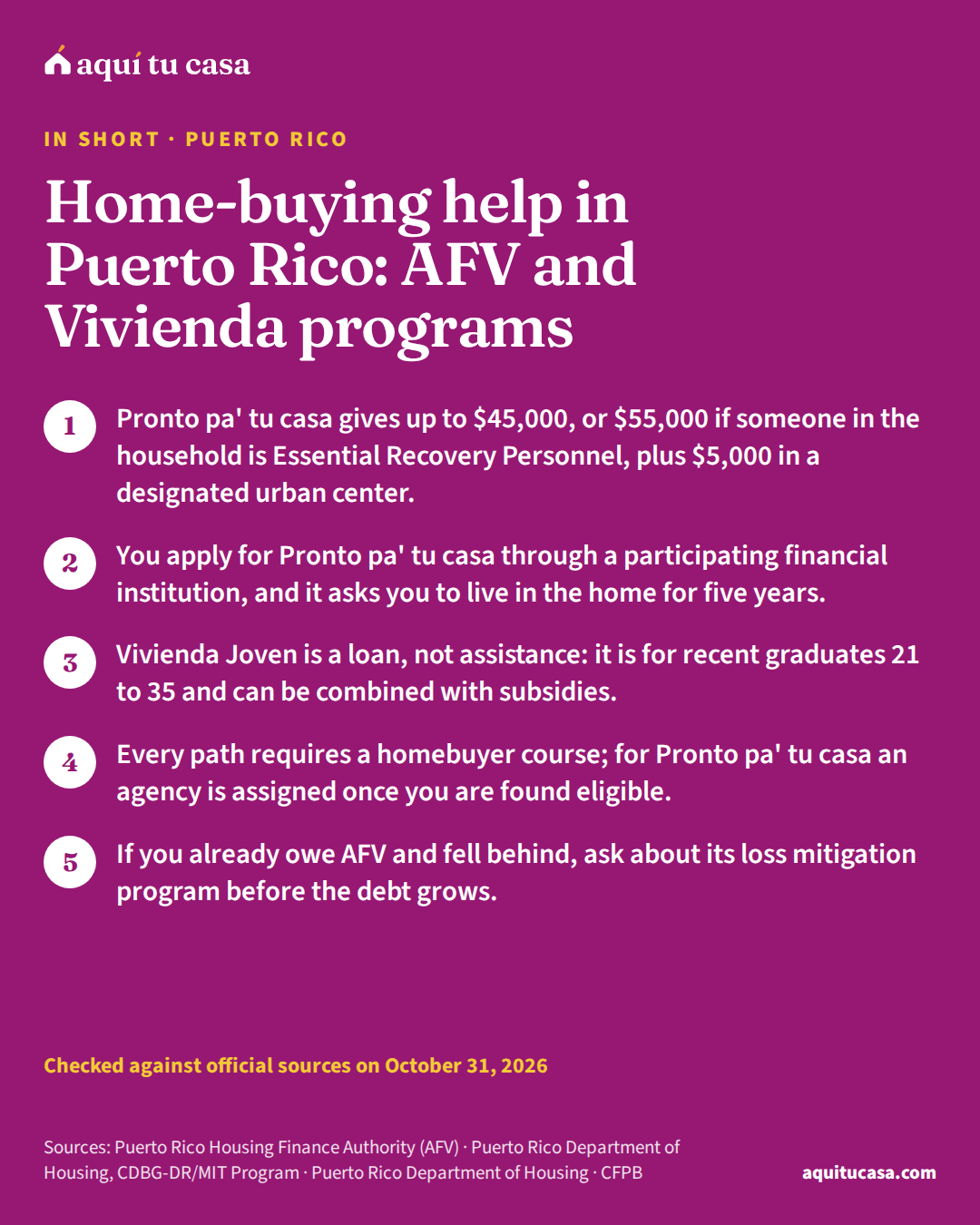
- Pronto pa' tu casa gives up to $45,000, or $55,000 if someone in the household is Essential Recovery Personnel, plus $5,000 in a designated urban center.
- You apply for Pronto pa' tu casa through a participating financial institution, and it asks you to live in the home for five years.
- Vivienda Joven is a loan, not assistance: it is for recent graduates 21 to 35 and can be combined with subsidies.
- Every path requires a homebuyer course; for Pronto pa' tu casa an agency is assigned once you are found eligible.
Is this for you?
This guide is for you if…
- You want to buy your first home in Puerto Rico and are looking for help with the down payment (pronto) or closing costs.
- You are 21 to 35, graduated recently and heard about Vivienda Joven.
- You already have an AFV loan and fell behind, or your home comes from the former CRUV and you want to sell or refinance.
Get direct help first if…
- You are buying in one of the 50 states: there, help comes from your state's housing agency, your city or your county; start with the down payment assistance guide.
- You are looking for a home to rent with government help: the public housing and vouchers in Puerto Rico guide explains AVP and Section 8.
Buying a home in Puerto Rico has its own steps: the notary, the deed, the Property Registry and CRIM. The guide to buying a home in Puerto Rico explains them. This guide is the missing piece: the help that the Housing Finance Authority (AFV) and the Department of Housing publish, what each program asks for and how to apply. It only includes programs whose official pages are current.
AFV is the island’s housing finance agencystate housing finance agency (HFA)A state housing finance agency (HFA) is a public body created by an act of a state legislature, or by a local government, with the power to finance housing. In that federal definition, "state" includes Puerto Rico and the District of Columbia. Its mission is to increase affordable housing for renters and homebuyers with low to moderate incomes, especially first-time homebuyers. HFAs usually do not lend directly: they work with participating lenders that offer their loans and down payment assistance. Programs vary by state.See the full definition. Its paths to buy are Pronto pa’ tu casa, Vivienda Joven and other loans, and the HOME Program. For guidance, AFV answers at 939-333-5417 and info@afv.pr.gov.1
- The most Pronto pa' tu casa gives an eligible household, or $55,000 with Essential Recovery Personnel
- $45,0002
- How long you commit to live in the home if you accept Pronto pa' tu casa
- 5 years6
- The age range for Vivienda Joven, if you graduated in the last five years
- 21 to 354
- How long AFV reserves Pronto pa' tu casa funds with its Commitment Letter
- 60 days6
AFV’s three paths, side by side
They are not the same thing. Pronto pa’ tu casa is assistance money: a grant from federal funds. Vivienda Joven is a loan. HOME is a program for low-income families that includes help for buyers.
What each program is
Down payment help
Pronto pa' tu casa
Loan
Vivienda Joven
All three require a homebuyer course. Ask AFV which one fits you before you start house hunting.
Pronto pa’ tu casa: help with the down payment and closing
Pronto pa’ tu casa uses federal CDBG-MIT funds that AFV administers. According to AFV, it gives up to $45,000 per eligible low- and moderate-income or urgent-need household, and up to $55,000 if at least one household member is Essential Recovery Personnel. If you buy in an urban center designated and certified by the Department of Housing, there is a $5,000 incentive on top. The home’s price cannot exceed the FHA mortgage limits or the appraised value.2
The Department of Housing’s recovery portal adds important details. The help is for buying a new or existing home outside high-risk zones. It can pay up to 100% of the down paymentdown paymentThe down payment is the part of the home's price you pay out of your own pocket when you buy; the loan covers the rest. In U.S. Spanish it is also called enganche, cuota inicial or entrada. Each loan type has its own minimum: FHA requires at least 3.5% of the value, VA and USDA loans may require none, and conventional loans ask for more if you want to avoid private mortgage insurance. A larger down payment lowers the loan, the monthly payment and the total interest; many state programs help families put it together.See the full definition your mortgage requires and reasonable closing costsclosing costsClosing costs are all of the costs you pay on closing day on top of the down payment: lender fees, the appraisal, the credit report, title insurance, the closing agent's fees, any transfer taxes your state or county charges and the first deposits into the escrow account. The lender must itemize them on the Loan Estimate within days of your application and confirm them on the Closing Disclosure before you sign. Some can be paid by the seller, and several state programs help cover them.See the full definition. And whoever accepts it commits to live in the home as a principal residence for five years.6
Who can apply. You must take a homebuyer course, be within the program’s and HUD’s income limits, get a mortgage approved at a participating financial institution, not own a home when you apply, and be a U.S. citizen, non-citizen national or qualified alien.2 The program publishes its income limits adjusted to 120% by family size.6 The do I qualify by income? tool compares your income with HUD’s limits for your municipality.
Which homes qualify. The home must be purchasable with valid title free of liens, be vacant when you sign the contract and have no tenants at closing, and meet what your bank or credit union requires. If it is newly built, it needs a Use Permit (Permiso de Uso).2 The Department of Housing’s portal also asks that it be built of concrete.6
If the home is in a special flood hazard areaspecial flood hazard area (SFHA)A special flood hazard area (SFHA) is an area FEMA identifies on its maps as being at high risk of flooding. On the maps it shows up as zones that start with A, or with V on the coast, where there is also a hazard from storm waves. If your home is in one of these zones, in a community that takes part in the National Flood Insurance Program (NFIP), and you have a government-backed mortgage or one from a regulated lender, the law requires you to carry flood insurance. The lender must tell you in writing if the home is in one of these zones.See the full definition, it qualifies only if you buy flood insurance and show proof at closing.2 The guide to insurance and hurricanes in Puerto Rico explains how that insurance works.
Pronto pa' tu casa, step by step
1. Prequalify at a participating institution
Before house hunting
The prequalification letter estimates how much you could borrow.6
2. Find a home that qualifies
Free of liens, built of concrete and vacant at closing.6
3. Start the mortgage application with the help
Your bank or credit union submits the application to the program, and AFV sends you an eligibility letter.2
4. Take the homebuyer course
After the eligibility letter
A counseling agency is assigned to you and sets the date and format with you.2
5. Get the Commitment Letter
AFV sets the final amount and reserves the funds for 60 calendar days.6
6. Close with the program
Your financial institution sets the closing date with AFV.6
For guidance about the program, AFV gives 1-833-234-2324; to prequalify, 939-333-5417.2
The homebuyer course
Every AFV path goes through a homebuyer coursehomebuyer education courseA homebuyer education course is a class with a set curriculum that covers the homebuying process, how to maintain a home, budgeting and why good credit matters. It can be in a group, in person, online or by phone. It is not the same as housing counseling, which is one-on-one help with an action plan for your situation. Some loans and some down payment assistance programs require you to finish a course before closing, especially first-time homebuyers. When you finish, you get a certificate.See the full definition. In Pronto pa’ tu casa you do not look for it yourself: once you are found eligible, your case goes to a counseling agency, which calls you to set up the course. If you already took one with a HUD-certified counseling program or the CDBG-DR one, tell the agency. You must hand in the certificate before the award decision.2
For Act 87 loans (Ley 87), such as Vivienda Joven, AFV’s sheet says you need the certificate of the Pre-Purchase Homebuyer Education Workshop, which costs $125 and is valid for 24 months.4 A HUD-approved housing counselorHUD-approved housing counselorA HUD-approved housing counselor works at an agency HUD has approved to provide housing counseling: independent, expert advice customized to your situation about buying a home, renting, a missed mortgage payment, a foreclosure or credit problems. The agencies usually charge little or nothing; many serve in Spanish and offer the homebuyer education course several assistance programs require. They are not lenders or real estate agents and sell you nothing. Your county page lists the official agencies with phone numbers.See the full definition can also help with your budget and credit, often at little or no cost.10 The guide to homebuyer education courses explains what to expect.
Vivienda Joven: the loan for recent graduates
Vivienda Joven is a mortgage loan guaranteed by AFV. AFV says it plainly: the program offers no financial assistance; it makes a loan available to people 21 to 35 who graduated in the last five years from an accredited university, technical or vocational institution, to buy their principal residence in Puerto Rico.3
According to the program’s sheet, the loan can finance up to 98% of the lower of the sale price and the appraised value. If it includes mortgage insurancemortgage insuranceMortgage insurance protects the lender, not you, if you fall behind on your loan payments. You pay for it, as part of the monthly payment and sometimes also as an upfront charge. It exists because it lets the lender accept a lower down payment. On an FHA loan it is called the mortgage insurance premium (MIP) and is charged by the FHA; on a conventional loan with a small down payment it is called private mortgage insurance (PMI) and comes from a private insurer. The rules for when you can stop paying it differ in each case.See the full definition, it can finance up to 7% more for closing costs, with a maximum of 105%. The home must be your principal residence, house or condo apartment. And the loan can be combined with state or federal subsidies for the down payment or closing, if funds are available.4
What it asks of the applicant:4
- Age and schooling: between 21 and 35 when you apply, and a diploma or official certification showing you graduated in the last five years.
- Income: annual income of no more than $200,000.
- Work: full time or a current formal contract, with six months on the job or a job offer letter. If you are self-employedself-employedFor the IRS, you are self-employed if you run a business as a sole proprietor or work as an independent contractor, if you are a member of a partnership that runs a business, or if you are otherwise in business for yourself, including part-time or as a gig worker. Because no employer withholds taxes for you, you generally pay estimated taxes every quarter and file a yearly return. Besides income tax, you pay self-employment tax, which covers Social Security and Medicare. Your profit or loss is figured by subtracting your business expenses from your business income, usually on Schedule C.See the full definition, at least one year of verifiable history.
- Credit: a positive history of 600. If your history is short or you have no score, alternative creditnontraditional creditNontraditional credit, sometimes called alternative credit, is a way to show you pay on time when you have no credit score or a very short traditional credit history. Under Fannie Mae's rules, the lender first checks all three credit bureaus; if there is no score, it documents your regular payments over the most recent twelve months, such as rent, utilities (electricity, gas, water, phone, internet), insurance, child care, school tuition or steady money transfers. How many references are needed depends on the loan product and how it is underwritten. In general it cannot replace a score you already have, even a low one.See the full definition is accepted: on-time payments of utilities, rent and other bills.
The sheet lists the institutions where you apply, among them AFV itself, at 939-333-5417 or hipotecas@afv.pr.gov.4
What they will ask you for a loan
When you call to prequalify, have the income of everyone in your household and your monthly debts at hand: credit cards, personal or student loans.1 To evaluate the application, AFV asks for:3
- If you earn a salary: your last 2 years of tax returns with schedules and W-2s, your last 2 pay stubs and an employment certification.
- If you have your own business: 2 years of returns with your 480 forms and schedules, and financial statements for 2 years plus year to date, notarized by a lawyer or certified by a CPA.
- If you are retired: a current Social Security, retirement or veteran certification.
Example with real numbers
A young couple combining two paths
An example in words, not a real case. Your numbers depend on the program, the home and your bank.
- He is 29 and finished a technical program three years ago
- They can apply for Vivienda Joven, if they meet the other requirements
- Their household income is within the Pronto pa' tu casa limits
- Their bank submits the down payment help application
- The home they choose is free of liens and vacant
- It meets what both programs ask
- They take the homebuyer course
- The assigned agency gives them the certificate
- What they achieve
- An AFV loan with help covering the down payment and part of closing, if funds are available
Vivienda Joven can be combined with state or federal subsidies, subject to availability. Ask AFV before you sign a purchase contract.
Run it with your numbersHow much house can I afford?AFV’s HOME Program
The HOME Program helps low-income families in three ways: buyer assistance, temporary rent help and home rehabilitation. To buy with HOME you must not own property, not exceed the income limits, be able to pay a mortgage and take the homebuyer course. The home must meet quality and construction standards.1
If you already own a home, HOME’s rehabilitation help requires that you hold the title and live there, that the land be its own segregated parcel, that there be no mortgages or liens and that it be a single unit: properties with two or more units and condominiums are not eligible.1 For any of the three, you ask for guidance by writing to HOME@afv.pr.gov.1
If you already have a loan or a home with conditions
You fell behind on your AFV mortgage. Its loss mitigation program evaluates a forbearance, which reduces or suspends the payment for a short time; a payment plan to catch up; a loan modificationloan modificationA loan modification is a change in the terms of your mortgage that you agree on with your loan servicer when you have trouble paying. It is a type of loss mitigation, meaning one of the options to avoid foreclosure. It can extend the time you have to repay, lower the interest rate, or defer or reduce part of the principal balance, which can lower your monthly payment. Often you start with a trial modification for a few months; if you make those payments on time, the change becomes permanent.See the full definition; or a deed in lieu (dación en pago), in which you hand over the home and the loan is canceled, if you qualify and the title is free of liens. Call 939-333-5417, option 6, or write to lossmitigation@afv.pr.gov.5 The guide if you can’t pay your mortgage explains these options.
You received a subsidy with restrictive conditions. If you need a certification that you met those conditions, AFV processes it with a title study and certifications from AAA (water) and AEE (power).1
Your home comes from the former CRUV. To sell, refinance or mortgage a home with restrictive conditions from the former CRUV, or to remove them, the Department of Housing requires an authorization. Bring the CRUV deed, a title study no more than six months old, the mortgage balance and a letter explaining the loan or the sale. If there was a divorce or a death, add the judgment or the death certificate and the declaration of heirs. Housing does not process incomplete requests.8 The guide to titles and inheritance in Puerto Rico explains the declaration of heirs.
You are looking for a government lot or home. Housing gives its inventory of properties for sale at 787-759-1950.9
A program that already closed
The Homebuyer Direct Assistance program (HBA), funded by CDBG-DR, closed its application period. If you have an open case, check its status at miestatushba.pr.gov or 1-833-234-2324.7
If this is your situation
What matters most in your situation
It is your first home
Prequalify at a participating institution and ask about Pronto pa' tu casa.2
You have little credit history
Vivienda Joven accepts alternative credit with on-time utility and rent payments.4
You are self-employed
AFV asks for your returns with your 480 forms and certified financial statements.3
Your income is low
Write to HOME@afv.pr.gov for guidance on buyer assistance.1
You live in the states and want to buy back home
Pronto pa' tu casa asks you to live in the home as a principal residence for five years.6
You already owe AFV and fell behind
Ask for a loss mitigation review at 939-333-5417, option 6.5

Costly mistakes
The mistake and what to do instead
Mistake: Signing a purchase contract before knowing whether the home qualifies.
Instead: Check that it is free of liens, vacant and, if new, has a Use Permit.2
Mistake: Thinking Vivienda Joven gives you the down payment.
Instead: It is a loan; ask whether you can combine it with a subsidy.4
Mistake: Leaving the course for the last minute.
Instead: Hand in the certificate before the award decision; the Act 87 one is valid for 24 months.24
Mistake: Buying in a flood zone without budgeting for the insurance.
Instead: Pronto pa' tu casa requires flood insurance at closing.2
Mistake: Paying someone who offers you an AFV repossessed home.
Instead: Do not hand over money without AFV's official participation.1
What to do this week
- Call AFV at 939-333-5417 with your household’s income and debts, and ask which path fits you.1
- Find the list of participating institutions for Pronto pa’ tu casa and prequalify.2
- If you are 21 to 35 and graduated recently, find your diploma and review the Vivienda Joven requirements.4
- Gather your tax returns, pay stubs and employment certification.3
- Figure out how much home you can afford with the affordability calculator and read the guide to down payment assistance. For the rest of the process, see CRIM property tax, the notary and the other Puerto Rico topics.
Your numbers
The minimum for this loan is 3.5%. More down lowers the monthly payment.
Adjust advanced details
First number: share of income for housing. Second: housing plus debts. Lender references, not fixed rules.
Let's do the math
Estimated top price
National figure$227,000
Limited by the housing payment: at that price it would be about $1,883 a month, 28% of your income.
- By the housing payment (28% of income)Limits you$227,000
- By your total debts (36% of income)$292,000
- By your cash (down payment + closing)$330,500
- Typical home in the United States
- $332,700
- Your cap is 68% of the typical home.
What changes if…?
- …you save $10,000 more$227,000
- …you cut $200 a month in debts$227,000
Your maximum price with four loans
Same income, debts and savings; only the down payment and the loan type change. ITIN uses an example down payment and rate.
| FHA 3.5% | Conventional 5% | Conventional 20% | ITIN 15% (example) | |
|---|---|---|---|---|
| Maximum price | $227,000 | $232,000 | $93,000 | $119,000 |
| Payment per month | $1,883 | $1,882 | $616 | $898 |
Educational estimate, not a pre-approval. Uses example insurance (0.5% of value per year) and example closing costs (3% of price); the tax is the place’s typical rate.
Ready to see the numbers? Find your county here
See how this applies in your county: its loan limits, prices and rents, from the official data.
Printable checklist
Frequently asked questions
What is AFV?
It is Puerto Rico's Housing Finance Authority (Autoridad para el Financiamiento de la Vivienda), a public corporation of the government. It offers mortgage loans such as Vivienda Joven and runs Pronto pa' tu casa with CDBG-MIT funds and the HOME Program. It gives guidance at 939-333-5417 and info@afv.pr.gov.
How much does Pronto pa' tu casa give?
According to AFV, up to $45,000 per eligible household, up to $55,000 if at least one member is Essential Recovery Personnel, and $5,000 more if you buy in an urban center designated and certified by the Department of Housing. It can pay up to 100% of the down payment and reasonable closing costs.
Where do I apply for Pronto pa' tu casa?
Through a participating financial institution, which submits the application to the program. First you prequalify there, find the home, and then AFV reviews your case. The list of institutions is on the program's page.
Does Vivienda Joven give me the down payment?
No. AFV explains that Vivienda Joven is a loan guaranteed by AFV and offers no financial assistance. It can finance up to 98% of the lower of the price and the appraisal, and it can be combined with state or federal subsidies for the down payment or closing costs, if funds are available.
Can I use these programs if I am self-employed?
Vivienda Joven accepts self-employed workers with at least one year of verifiable history. For any loan, AFV asks people with their own business for 2 years of tax returns with their 480 forms and financial statements notarized by a lawyer or certified by a CPA.
I fell behind on my AFV mortgage. What do I do?
Call AFV at 939-333-5417, option 6, or write to lossmitigation@afv.pr.gov. Its loss mitigation program evaluates a forbearance, a payment plan, a modification or a deed in lieu, depending on your case.
My home comes from the CRUV. Can I sell it?
If it has restrictive conditions from the former CRUV, the Department of Housing requires an authorization to sell, refinance or mortgage it, or to remove those conditions. It asks for the deed, a recent title study and the mortgage balance, among other papers.
Sources
Every figure in this guide comes from one of these official sources. The number next to a sentence leads to the source behind it.
Each source on one line: who publishes it, its title, its address and the date we read it.
- 1. Puerto Rico Housing Finance Authority (AFV) · Autoridad para el Financiamiento de la Vivienda de Puerto Rico (home page) · afv.pr.gov · Accessed October 31, 2026
- 2. Puerto Rico Housing Finance Authority (AFV) · Pronto pa' tu casa · afv.pr.gov · Accessed October 31, 2026
- 3. Puerto Rico Housing Finance Authority (AFV) · Programa de Préstamos AFV · afv.pr.gov · Accessed October 31, 2026
- 4. Puerto Rico Housing Finance Authority (AFV) · Financiamiento hipotecario Vivienda Joven (description, parameters and institutions sheet) · afv.pr.gov · Accessed October 31, 2026
- 5. Puerto Rico Housing Finance Authority (AFV) · Programa de mitigación de pérdida hipotecaria (loss mitigation) · afv.pr.gov · Accessed October 31, 2026
- 6. Puerto Rico Department of Housing, CDBG-DR/MIT Program · Pronto Pa' Tu Casa (Homebuyer Assistance Mitigation Program) · recuperacion.pr.gov · Accessed October 31, 2026
- 7. Puerto Rico Department of Housing, CDBG-DR/MIT Program · Ayuda al Ciudadano · recuperacion.pr.gov · Accessed October 31, 2026
- 8. Puerto Rico Department of Housing · Adquisición y venta de propiedades · vivienda.pr.gov · Accessed October 31, 2026
See the other 2 sources
- 9. Puerto Rico Department of Housing · Solares Disponibles · vivienda.pr.gov · Accessed October 31, 2026
- 10. CFPB · Find a Housing Counselor · consumerfinance.gov · Accessed October 31, 2026
Keep reading
Related guides
If this guide helped, these follow the same path.
Puerto Rico 13 minute read
Buying a home in Puerto Rico: notary, deed and registry
How buying a home works in Puerto Rico: the notary who is a lawyer, the public deed, the Property Registry, FHA, VA and conventional loans, AFV and CRIM.
- Puerto Rico's notary is a lawyer who drafts the deed and attests to it, but is not your lawyer: the notary represents the public faith.
- The deed is filed with the Property Registry; your right takes effect against third parties from the recording.
- HUD (FHA) and Fannie Mae (conventional) accept Puerto Rico properties, and the veterans' laws include the island; compare Loan Estimates.
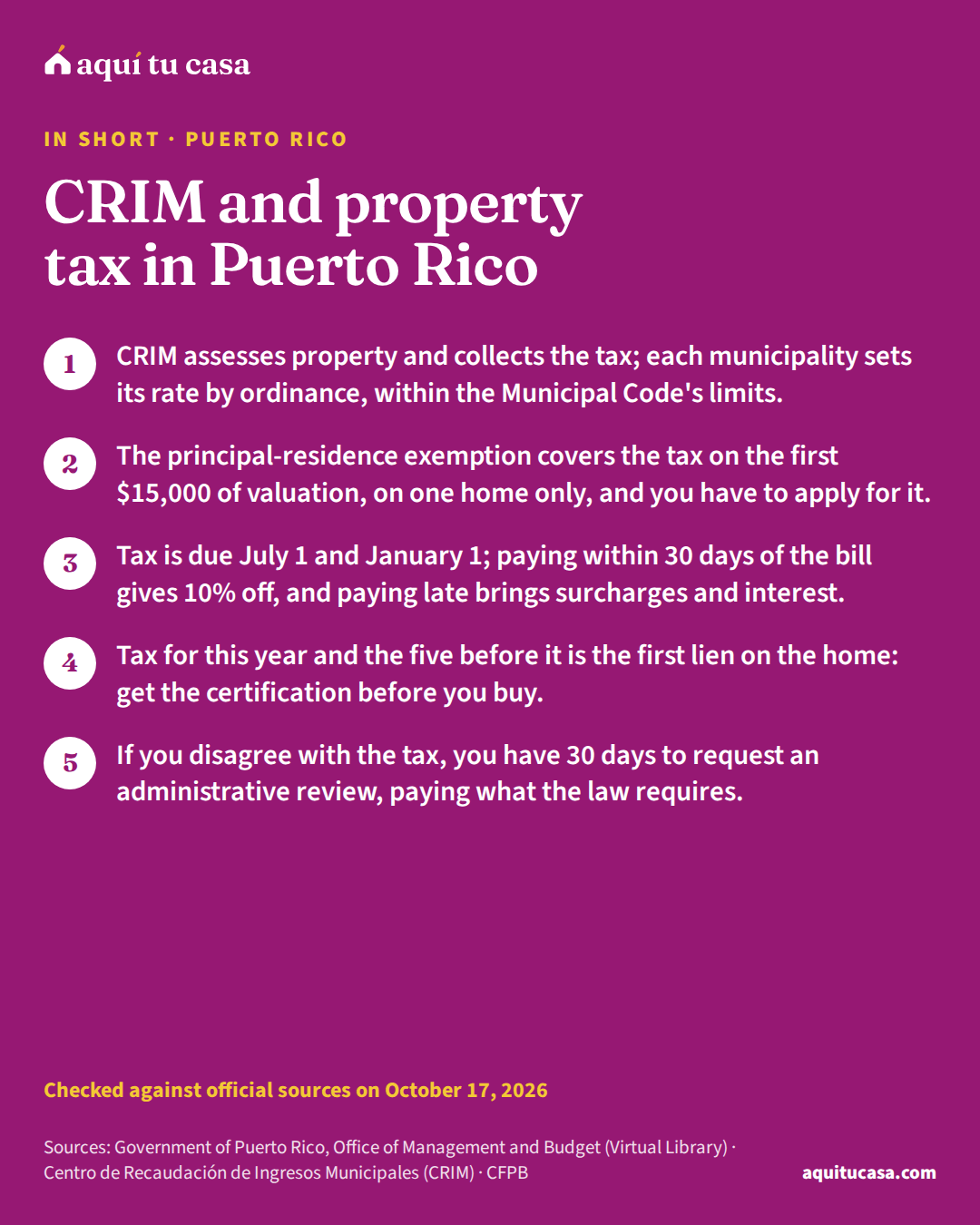
- Puerto Rico CRIM and property tax in Puerto Rico What CRIM is, how property tax is figured and paid in Puerto Rico, the exemption for your residence, certifications and how to ask for a review. 12 minute read
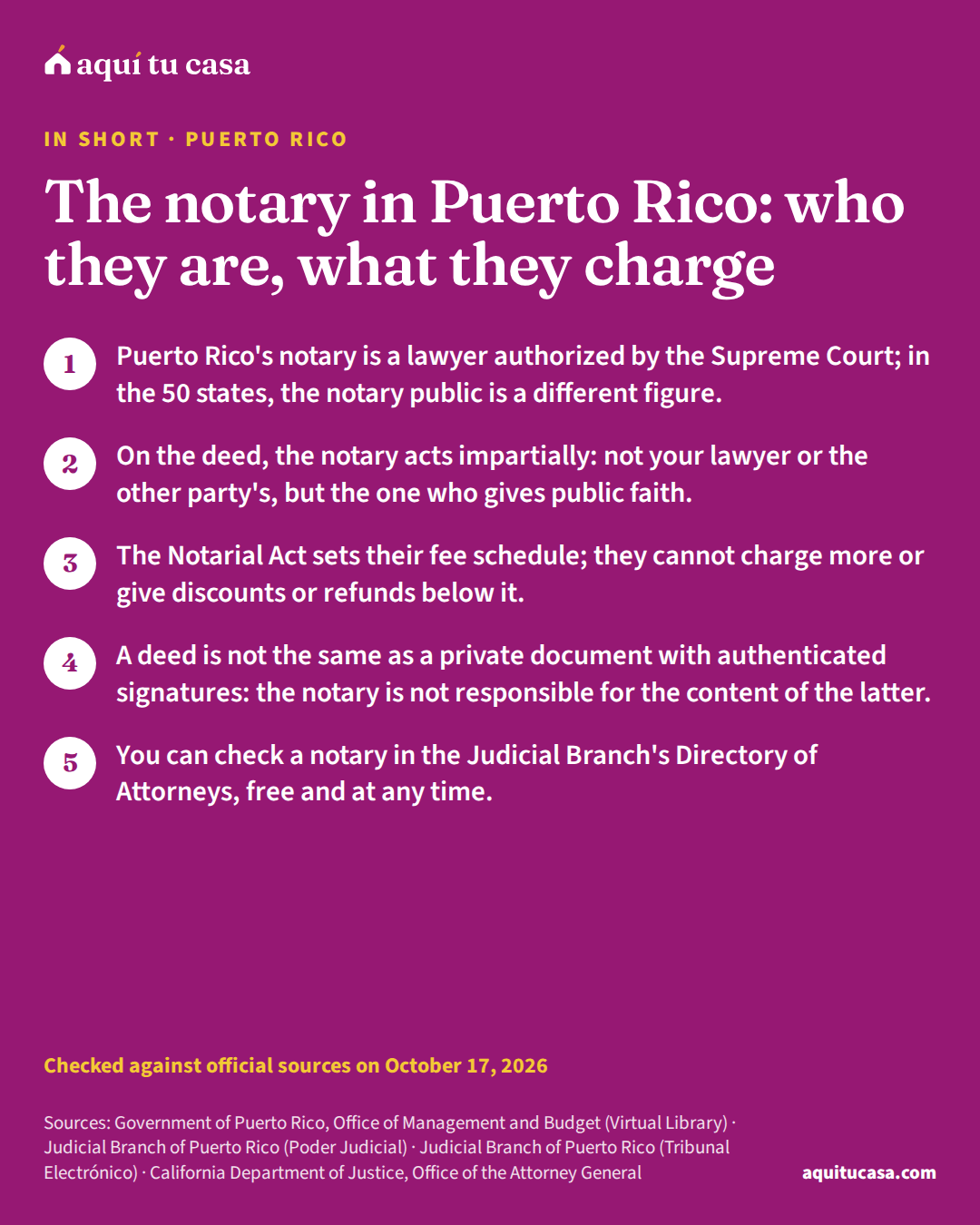
- Puerto Rico The notary in Puerto Rico: who they are, what they charge In Puerto Rico the notary is a lawyer. Who can be one, what they do in a home sale, what the law lets them charge and how to check they are authorized. 10 minute read
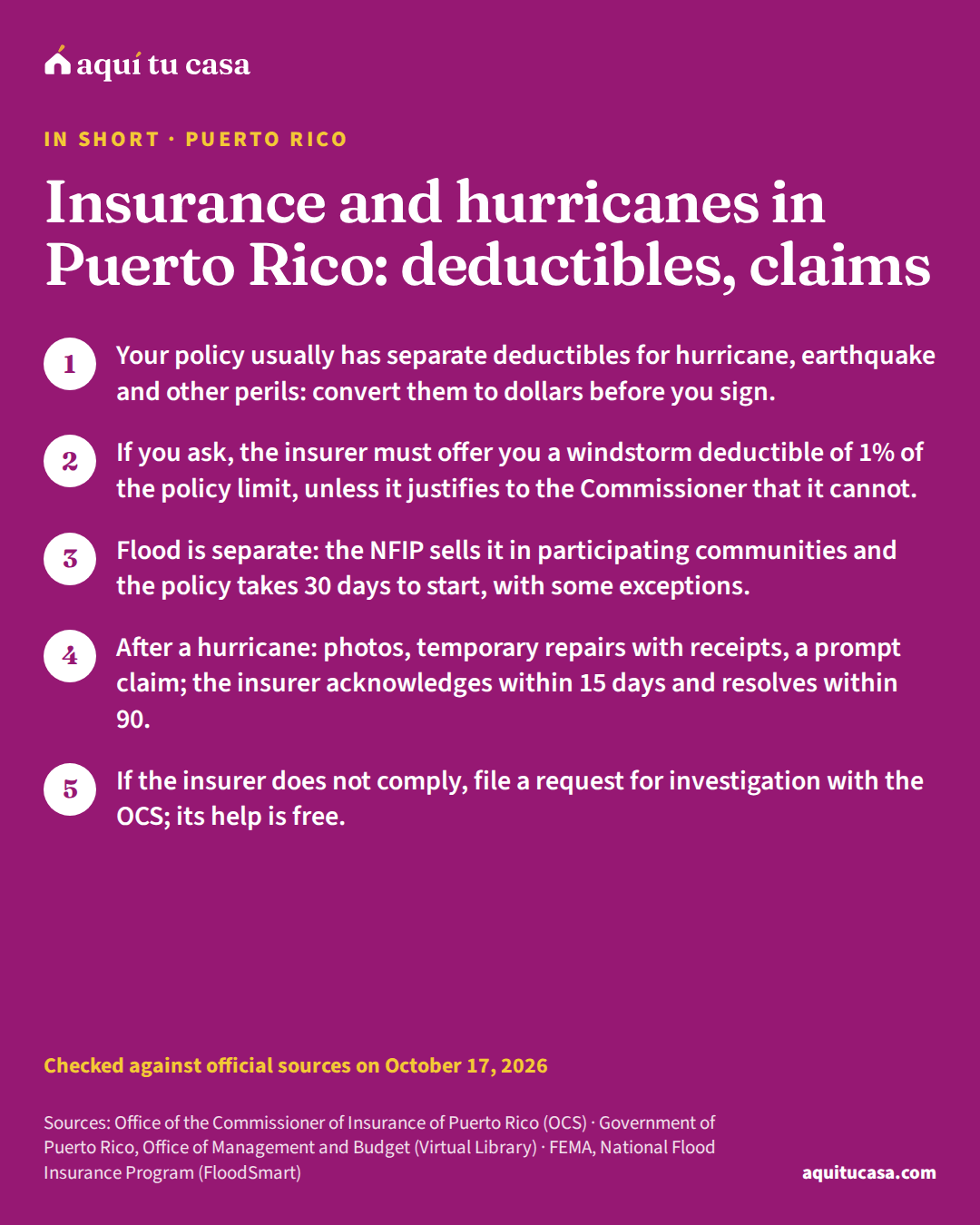
- Puerto Rico Insurance and hurricanes in Puerto Rico: deductibles, claims Home insurance in Puerto Rico: what it covers, the windstorm deductible, separate flood coverage, your rights and how to file a claim after a hurricane. 10 minute read
Tools for this topic
Was this guide useful?
Thank you. Your answer stays in your browser; nothing is sent.