Insurance and hurricanes in Puerto Rico: deductibles, claims
Home insurance in Puerto Rico: what it covers, the windstorm deductible, separate flood coverage, your rights and how to file a claim after a hurricane.
Verified against official sources on October 17, 2026 12 official sources

Show contents
In short
What you need to know
Quick answer
In Puerto Rico a home policy usually has three deductibles: one for hurricane, one for earthquake and one for everything else. By law, the insurer must offer you, if you ask, a windstorm deductible of 1% of the policy limit, and if your deductible is a percentage, the policy must state what it is in dollars. Flood is almost never included: it is bought separately through the NFIP and takes 30 days to start. After a hurricane, the insurer must acknowledge your claim within 15 days and resolve it within 90; if it does not, the OCS takes your request for investigation.
What matters most
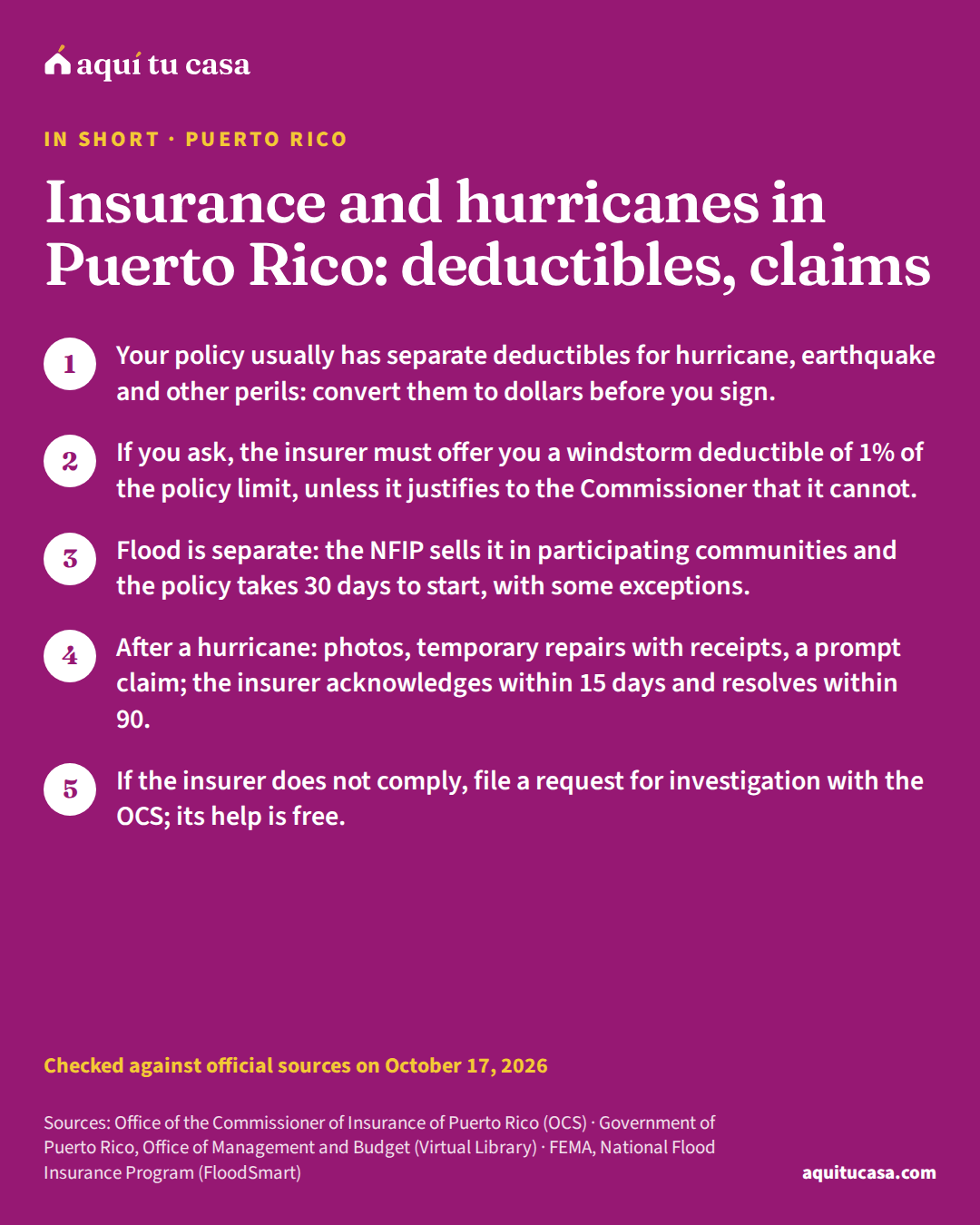
- Your policy usually has separate deductibles for hurricane, earthquake and other perils: convert them to dollars before you sign.
- If you ask, the insurer must offer you a windstorm deductible of 1% of the policy limit, unless it justifies to the Commissioner that it cannot.
- Flood is separate: the NFIP sells it in participating communities and the policy takes 30 days to start, with some exceptions.
- After a hurricane: photos, temporary repairs with receipts, a prompt claim; the insurer acknowledges within 15 days and resolves within 90.
Is this for you?
This guide is for you if…
- You own a home in Puerto Rico, or are about to buy one, and want to understand your policy before hurricane season.
- A hurricane or storm damaged your home and you want to know how to file a claim and what deadlines the insurer has.
- You do not know whether you need flood insurance or how to buy it on the island.
Get direct help first if…
- Your home is in one of the 50 states: insurance rules there belong to each state; start with the home insurance guide.
- Your claim is already in a lawsuit: look for free legal help; this guide only explains the general rules.
- You want FEMA assistance step by step: the guide on what to do after a hurricane, flood or fire explains it.
In Puerto Rico, hurricanes are not a distant possibility: they are part of the calendar. This guide is for anyone who owns or will own a home on the island. It explains what a property policy covers, how the windstorm deductible works, why flood is separate, what rights the Insurance Code gives you and how to file a claim after a hurricane, using what the Office of the Commissioner of Insurance (OCS) and FEMA publish.1
What your property policy covers
The OCS explains that a residential policy covers damage to the house up to the policy amount, other structures (such as a detached garage or a fence), your personal property and additional living costs if you cannot live in the home because of a covered loss.2 The key question is how you are paid: at actual cash valueactual cash value (ACV)Actual cash value (ACV) is a way a homeowners or renters insurance policy pays for damage: it gives you what it costs to repair or replace what was damaged minus depreciation, meaning the value it lost from age, use or wear. That is why it usually pays less than replacement cost, and you cover the difference. Many policies pay for your personal belongings this way unless you buy replacement cost coverage. And if you have that coverage, the first check on your claim is often for the actual cash value.See the full definition, which subtracts depreciation, or at replacement costreplacement costReplacement cost is a way a home insurance policy pays for damage: it gives you the money to repair or rebuild your home, or replace your belongings, with materials of similar quality at today's prices, without subtracting what they lost in value from age or use (depreciation). It is different from actual cash value, which does subtract depreciation. Many insurers pay these claims in two checks: the first one minus depreciation, and the second, for the amount held back, when you finish the repair. Your policy says which of the two methods it uses.See the full definition, which does not.2
The OCS stresses one point: the cost to rebuild is not the same as market value or the assessment. If you insure the home for less than it costs to rebuild, the payout may fall short and coinsurance penalties may apply.1 That is why it advises reviewing your limits, especially if you added structures such as terraces, carports, solar panels or cisterns.1
If you rent, remember that the owner’s insurance protects the structure, not your belongings: that is what renters insurancerenters insuranceRenters insurance, also called tenants insurance, protects your belongings and protects you when you rent. The landlord's insurance covers the building, but not your furniture, clothes or electronics. It usually includes three coverages: your personal property, even if it is stolen away from home; additional living expenses if a covered loss forces you to move out for a while; and personal liability if someone is hurt in your home. A standard policy does not cover floods, which are insured separately. Some landlords require it.See the full definition is for.2 The home insurance guide explains the rest of a policy’s terms.
The windstorm and hurricane deductible
The deductibledeductibleA deductible is the part of an insurance claim you pay yourself. When you have a covered loss, the insurance company subtracts the deductible from the claim amount and pays you the rest. You may have a different deductible for each type of coverage. You will find it on the first page of your policy, called the declarations page, along with your coverages and limits. In taxes, the word "deductible" means something else: an expense that can lower the taxes you owe.See the full definition is what you pay before insurance pays. The OCS explains that residential policies normally have three different deductibles: one for earthquake, one for hurricane and one for other perils.2 The Insurance Code sets rules for the windstorm one:
Example with real numbers
How to read your policy's windstorm deductible
What the Insurance Code says; your exact deductible is in your policy.
- Deductible the insurer must offer you if you ask
- 1% of the policy limit for windstorm, with a minimum of no more than $5008
- If the deductible is a percentage of the limit
- The policy must clearly state the dollar amount8
- If it is a percentage of the property's value
- Only allowed if that value was agreed in advance in the policy (agreed value)8
- If you live in a condominium
- The insurer offers the option of a deductible prorated by the area affected8
If the insurer cannot offer the minimum deductible, for example because of the reinsurance market, it must justify that to the Commissioner.8 Always ask for the deductible in dollars to compare it with your savings.
Run it with your numbersFamily budgetThe OCS explains that the premiuminsurance premiumAn insurance premium is what you pay the insurance company in exchange for your policy's protection. It can be paid in one lump sum or, more often, in periodic installments for the life of the contract. Each company decides whether to sell you a policy and how much to charge. For home insurance it usually looks at the cost to rebuild the home, building materials, location, nearness to a fire station, your past claims and, at some companies, your credit score. Discounts can lower it. If you stop paying the premium, the company can cancel your policy.See the full definition depends, among other things, on the coverages, limits and deductibles you choose.2 What matters is knowing how much you would have to pay yourself after a hurricane, and having it in your emergency fund.
Flood: almost never in your policy
Water from a flood is another story. The OCS reminds people that floods are generally excluded from property policies,1 and that flood insurance is bought separately through the federal government’s National Flood Insurance Program (NFIP).2 You can buy it whether you are inside or outside a high-risk area, from a property insurance agent or from your insurer.4
According to FloodSmart, the NFIP’s site, any owner in a participating community can buy it; a building policy covers up to $250,000 and a contents policy up to $100,000, with separate deductibles; and the rate does not change by provider.9 Coverage starts 30 days after purchase, unless you buy it when getting or renewing a mortgage, and the policy lasts a year. It does not cover temporary housing while you repair.10
Is it required? If your home is in a special flood hazard areaspecial flood hazard area (SFHA)A special flood hazard area (SFHA) is an area FEMA identifies on its maps as being at high risk of flooding. On the maps it shows up as zones that start with A, or with V on the coast, where there is also a hazard from storm waves. If your home is in one of these zones, in a community that takes part in the National Flood Insurance Program (NFIP), and you have a government-backed mortgage or one from a regulated lender, the law requires you to carry flood insurance. The lender must tell you in writing if the home is in one of these zones.See the full definition and your mortgage is government-backed, yes. And if the property received federal disaster aid before, you need the insurance to get aid in the future: the requirement goes with the home, not the owner.11 The flood insurance and NFIP guide explains how to buy it.
Before hurricane season
The OCS publishes a list to get ready before there is any threat:1
- Check that your policy is active and current.
- Confirm that the limits reflect the current cost to rebuild or replace, not the sale price.
- Know your hurricane, wind and other-risk deductibles, and go over limitations, coinsurance penalties and exclusions with your producer.
- Take an inventory of your belongings with photos and video, and keep digital copies of the policy and receipts in a safe place.
- Do not wait until the last minute: once a storm watch or warning is issued, insurers can temporarily restrict new policies or changes.

You have the right to a copy of your policy, written in English or Spanish, as you choose.8 And if you paid off the home, the OCS reminds you that the need to protect it does not end when the mortgage is paid.1
After the hurricane: how to file a claim
Your claim, step by step
2. Keep every receipt
Do not make permanent repairs before talking to your insurer: it might not pay for repairs it did not authorize.6
3. File the claim
As soon as possible
Have your policy number; if you do not know who insures you, ask whoever financed your home.5
4. The insurer acknowledges it
Within 15 days
It must do so within that time from when you notify it.8
6. The offer, with a breakdown
It must explain the adjustment and why items were declined; receiving the check does not waive your claim.8
If the Governor declares a state of emergency, the OCS can order insurers to make partial or advance payments for the items that are not in dispute. They must pay you no later than 10 days after you accept the offer in writing, and accepting it does not waive what remains in dispute.8 If the home became unlivable, most policies cover additional living expenses, such as a hotel, but not mortgage payments.6
Adjusters: who is who
The three kinds of adjuster
Paid by the insurer
Company or independent adjuster
Hiring a public adjuster is an option, not a requirement: the OCS helps with your questions at no cost.6
On an NFIP flood claim, ask the adjuster for their Flood Control Number card. Payment can take four to eight weeks, and if you have a mortgage, the check is made out to you and your mortgage company. The NFIP does not cover mold, so clean and dry as soon as possible. If your claim is denied, you can appeal to FEMA.12
Your rights and what to do if the insurer does not comply
The Insurance Consumer Bill of Rights gives you, among others, the right to choose your insurer and producer, to have them show you their license, to a copy of your policy and to file a request for investigation with the Commissioner.8 Your lender cannot require you to buy insurance from a particular producer or insurer; and if it places insurance that protects only its own interest, it must first give you a list of at least five insurers to choose from.8
The Insurance Code also treats as unfair practices, among others, refusing to pay without a reasonable investigation, requiring you to sign a release that frees the insurer from obligations that were not negotiated and denying a valid claim on mere suspicion of fraud.8 If you think your insurer is not complying, you can file a request for investigation with the OCS, for example by email to investigaciones@ocs.pr.gov.7 The OCS answers at (787) 304-8686.1
If the damage is large, you may also be entitled to federal disaster aid.3 The guide on what to do after a hurricane, flood or fire explains that path. Note: FloodSmart explains that disaster aid is usually a loan repaid with interest, while a flood claim payment does not have to be paid back.11
If this is you
What matters most for your situation
You have a mortgage
You choose your insurer; the lender cannot impose one.8 An NFIP flood check is also made out to your mortgage company.12
You rent your home
The owner's insurance protects the structure; for your belongings you need your own policy.2
The hurricane already hit
Photos, temporary repairs with receipts and a claim as soon as possible.5

Costly mistakes
The mistake and what to do instead
Mistake: Insuring the home for its sale price.
Instead: Insure it for what it costs to rebuild; otherwise coinsurance penalties may apply.1
Mistake: Seeing the deductible only as a percentage.
Instead: The policy must state it in dollars; find it and compare it with your savings.8
Mistake: Buying flood insurance when the storm is already coming.
Instead: An NFIP policy takes 30 days to start, with some exceptions.10
Mistake: Making permanent repairs before filing the claim.
Instead: Make only temporary ones and keep the receipts.6
Mistake: Signing a blanket release to get paid faster.
Instead: Requiring a release from obligations that were not negotiated is an unfair practice; ask before you sign.8
What to do this week
- Ask for a copy of your policy, in the language you prefer, and find your deductibles in dollars.8
- Compare your coverage limit with the current cost to rebuild your home.1
- Ask whether the 1%-of-limit windstorm deductible the law requires insurers to offer makes sense for you.8
- Get an NFIP flood quote before the season, because of the 30-day wait.10
- Take an inventory of your belongings with photos and keep copies outside the home.1
- If you have questions about your policy or your claim, the OCS gives guidance at (787) 304-8686.1 More island topics are under Puerto Rico.
Your numbers
Starts at the typical home value in the United States. Change it to the price you have in mind.
That is $11,645 (3.5% of the price). The usual minimum for this loan is 3.5%.
This week's average ± a quarter or half point.
National average as of November 5, 2026 (Freddie Mac); your rate may be different.
Adjust advanced details
Let's do the math
Estimated monthly payment
National figure$2,759
at 7.18% · 30 years
- Loan amount
- $326,673
- Total interest
- $470,006
- Paid off in
- November 2056
Includes $5,618 FHA upfront mortgage insurance premium.
Does it fit the income?
Comfortable
up to $1,884 a month
Tight
$1,884 to $2,422 a month
Hard
more than $2,422 a month
Your payment · 41%
Compared with the typical household income in the United States ($80,734 a year). Reference: HUD calls paying more than 30% of income for housing a cost burden.
| Principal & interest | $2,213 |
|---|---|
| Property tax | $261 |
| Home insurance | $139 |
| FHA mortgage insurance (MIP) | $147 |
How does it compare with incomes?
For this payment to be 28% of your income, you'd need to earn about $118,260 a year. With your other debts, to stay under 36%: about $91,980 a year.
You need at least $11,645 for the down payment, plus closing costs.
This is an estimate to give you an idea, not a loan offer. Your real payment depends on your rate, your credit, and the insurance and taxes on the home you buy.
Total monthly payment $2,759; principal and interest $2,213.
Ready to see the numbers? Find your county here
See how this applies in your county: its loan limits, prices and rents, from the official data.
Printable checklist
Frequently asked questions
Does my home insurance cover hurricane damage?
The OCS explains that residential policies normally have a separate hurricane deductible, and it reminds people that floods are generally excluded from property policies: floodwater needs a separate policy. Read your policy and ask your producer what it covers.
How much is the hurricane deductible in Puerto Rico?
It depends on your policy. The Insurance Code requires the insurer to offer you, if you ask, a windstorm deductible of 1% of the policy limit, unless it justifies to the Commissioner that it cannot. If the deductible is a percentage of the limit, the policy must state the dollar amount.
How long does the insurer have to pay my claim?
The Insurance Code gives it 15 days to acknowledge the claim and asks it to resolve the claim in the shortest reasonable time within 90 days. If you ask for reconsideration, you have the right to have it resolved within 30 days.
Do I need flood insurance in Puerto Rico?
If your home is in a special flood hazard area and you have a government-backed mortgage, it is required. Outside that zone it is not, but most home policies do not cover flood. The NFIP sells it in participating communities, at the same rate from any provider.
Can I make repairs before the adjuster comes?
Make temporary repairs to prevent more damage and keep the receipts. The OCS advises against permanent repairs before you talk to your insurer, because it might not pay for repairs it did not authorize.
Do they have to give me my policy in Spanish?
The Insurance Consumer Bill of Rights gives you the right to have your individual policy written in English or Spanish, as you choose, and to get a copy of it.
What do I do if the insurer does not answer me?
You can file a request for investigation with the OCS, for example by email to investigaciones@ocs.pr.gov. The Insurance Code treats as an unfair practice, among others, refusing to pay without a reasonable investigation.
Sources
Every figure in this guide comes from one of these official sources. The number next to a sentence leads to the source behind it.
Each source on one line: who publishes it, its title, its address and the date we read it.
- 1. Office of the Commissioner of Insurance of Puerto Rico (OCS) · En temporada de huracanes: asegúrese de estar protegido · ocs.pr.gov · Accessed October 17, 2026
- 2. Office of the Commissioner of Insurance of Puerto Rico (OCS) · Introducción a los Seguros para Residencias (Universidad del Seguro, Vol. 4) · docs.pr.gov · Accessed October 17, 2026
- 3. Office of the Commissioner of Insurance of Puerto Rico (OCS) · Temporada de huracanes: ¿estás preparado para un huracán? · docs.pr.gov · Accessed October 17, 2026
- 4. Office of the Commissioner of Insurance of Puerto Rico (OCS) · Seguro de Inundaciones (Universidad del Seguro, Vol. 7) · docs.pr.gov · Accessed October 17, 2026
- 5. Office of the Commissioner of Insurance of Puerto Rico (OCS) · Consejos útiles a los asegurados para la presentación de reclamaciones · docs.pr.gov · Accessed October 17, 2026
- 6. Office of the Commissioner of Insurance of Puerto Rico (OCS) · Guía de siniestros después de una catástrofe · docs.pr.gov · Accessed October 17, 2026
- 7. Office of the Commissioner of Insurance of Puerto Rico (OCS) · Conozca paso a paso cómo reclamar sus derechos como asegurado o reclamante · docs.pr.gov · Accessed October 17, 2026
- 8. Government of Puerto Rico, Office of Management and Budget (Virtual Library) · Código de Seguros de Puerto Rico (Act 77 of June 19, 1957, as amended) · bvirtualogp.pr.gov · Accessed October 17, 2026
See the other 4 sources
- 9. FEMA, National Flood Insurance Program (FloodSmart) · Lo que debe saber sobre la adquisición de un seguro de inundación · floodsmart.gov · Accessed October 17, 2026
- 10. FEMA, National Flood Insurance Program (FloodSmart) · Buy a policy (FAQs) · floodsmart.gov · Accessed October 17, 2026
- 11. FEMA, National Flood Insurance Program (FloodSmart) · Who's eligible for NFIP flood insurance? · floodsmart.gov · Accessed October 17, 2026
- 12. FEMA, National Flood Insurance Program (FloodSmart) · How to start a flood insurance claim · floodsmart.gov · Accessed October 17, 2026
Keep reading
Related guides
If this guide helped, these follow the same path.

Puerto Rico 12 minute read
Repairing or rebuilding after a hurricane in Puerto Rico
FEMA help to repair your home in Puerto Rico, how to prove it is yours, SBA disaster loans and the Department of Housing programs still open.
- File with your insurance first; FEMA helps with what insurance does not cover, and does not replace insurance.
- Register with FEMA on time: generally, 60 days from the disaster declaration.
- Without formal title, FEMA accepts CRIM or repair receipts, and as a last resort a statement under penalty of perjury.
- Money problems After a hurricane, flood or fire: what to do What to do after a disaster: your home, flood or renters insurance claim, federal disaster aid, your mortgage and how to avoid scams. 16 minute read
- Owning a home Flood insurance (NFIP): who needs it and what it covers Why home insurance does not cover floods, when you must buy NFIP coverage, what it covers, the 30-day wait, flood zones and how to file a claim. 13 minute read
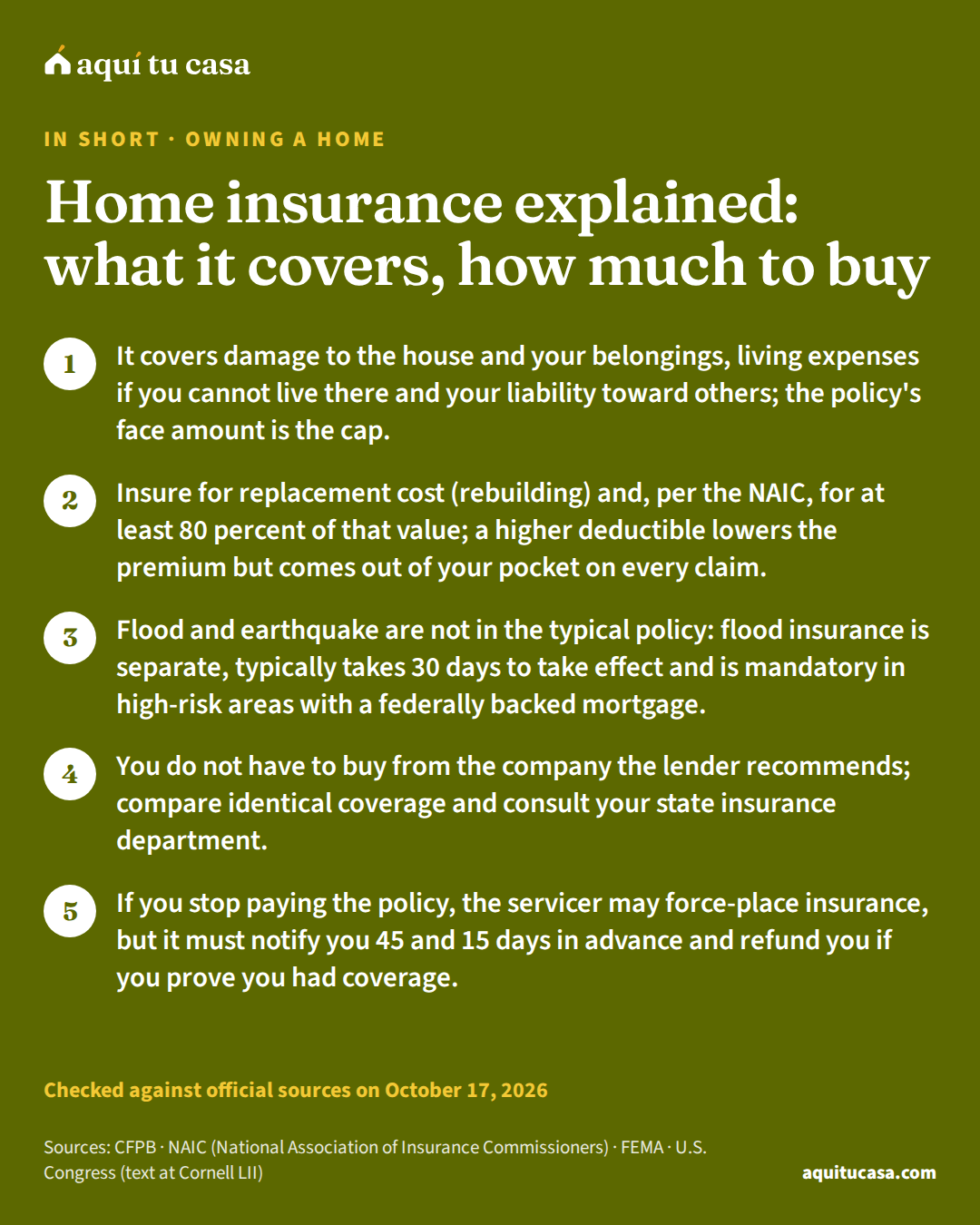
- Owning a home Home insurance explained: what it covers, how much to buy What home insurance covers, why the lender requires it, how to choose the amount and the deductible, why flood is separate and what happens if it lapses. 13 minute read
Tools for this topic
Was this guide useful?
Thank you. Your answer stays in your browser; nothing is sent.