Repairing or rebuilding after a hurricane in Puerto Rico
FEMA help to repair your home in Puerto Rico, how to prove it is yours, SBA disaster loans and the Department of Housing programs still open.
Verified against official sources on October 31, 2026 15 official sources
Show contents
In short
What you need to know
Quick answer
After a hurricane in Puerto Rico, federal help to repair your home starts with FEMA, if there is a presidential disaster declaration: you register at DisasterAssistance.gov or 1-800-621-3362, generally within 60 days. FEMA pays for repairs to make the home safe and livable, but it does not replace your insurance: you file with your insurer first. If your home has no formal title, FEMA accepts other papers, such as CRIM receipts, and as a last resort a sworn statement. The SBA lends up to $500,000 to repair your primary residence. The Department of Housing's R3 Program no longer takes applications, but the Title Authorization Program does.
What matters most
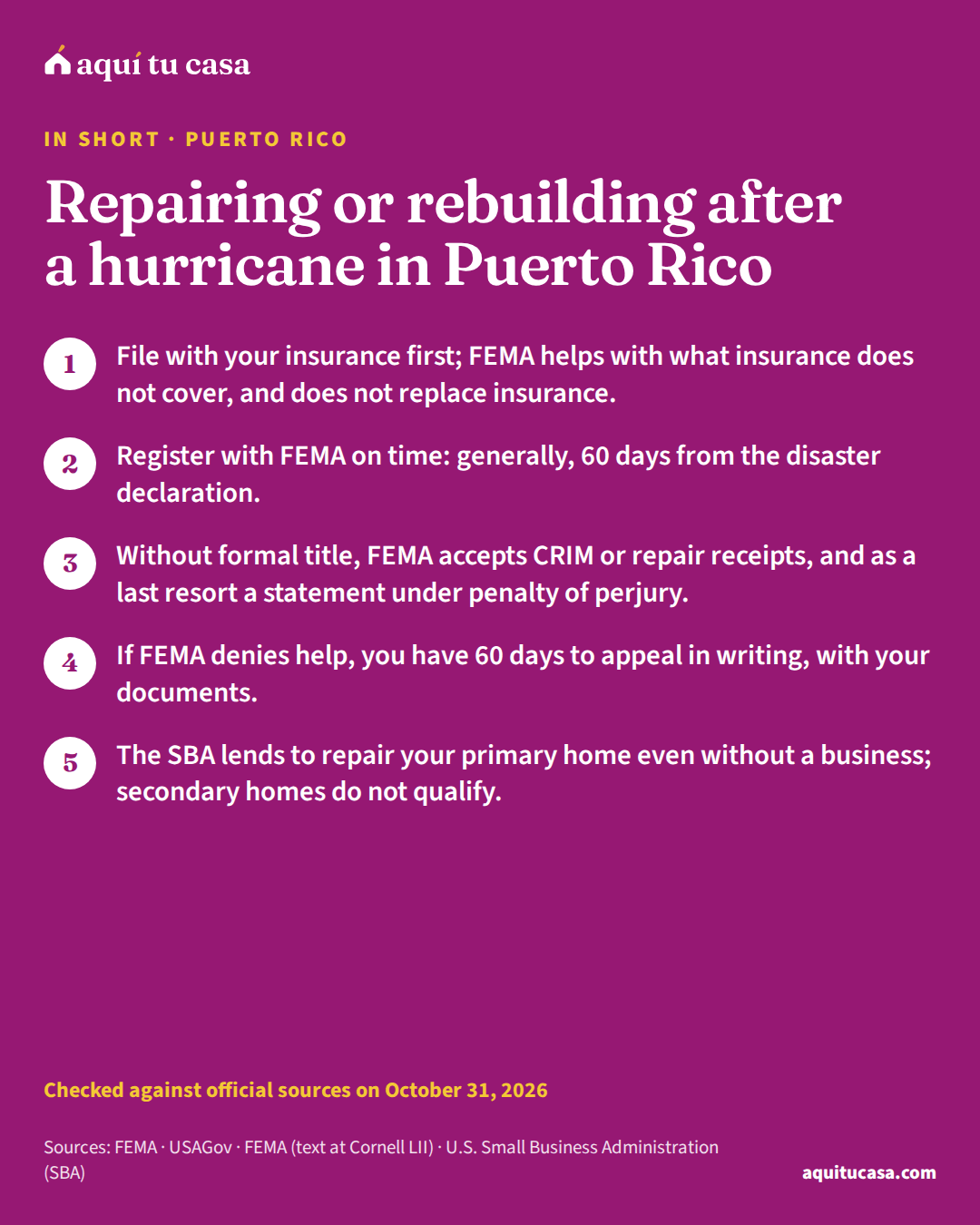
- File with your insurance first; FEMA helps with what insurance does not cover, and does not replace insurance.
- Register with FEMA on time: generally, 60 days from the disaster declaration.
- Without formal title, FEMA accepts CRIM or repair receipts, and as a last resort a statement under penalty of perjury.
- If FEMA denies help, you have 60 days to appeal in writing, with your documents.
Is this for you?
This guide is for you if…
- A hurricane or storm damaged your home in Puerto Rico and you want to know what help exists to repair or rebuild it.
- Your home has no formal title or is an undivided inheritance and you fear FEMA will deny help.
- You applied to FEMA or a Department of Housing program and want to know how to appeal or where your case stands.
Get direct help first if…
- You are still in danger: call 911 and follow the authorities' instructions; this guide is for afterward.
- Your home is in one of the 50 states: FEMA's steps are similar, but the local programs are different; start with the guide to after a hurricane, flood or fire.
- What you need is to file a claim with your insurer: the insurance and hurricanes in Puerto Rico guide explains the claim step by step.
After a hurricane, repairing the home is a race with a lot of paperwork. And if your home has no recorded deed or is an inheritance that was never divided, asking for help gets harder. This guide explains, with what FEMA, the SBA and the Department of Housing say, what help exists to repair or rebuild, how to prove the home is yours, how to appeal and which local programs are still open.
If you have not filed with your insurer yet, start with the guide to insurance and hurricanes in Puerto Rico. The one on after a hurricane, flood or fire covers the first days.
Insurance first, then FEMA
FEMA warns that its help is not a substitute for insurance and cannot compensate for all losses from a disaster.1 Under its regulation, if you have insurance, FEMA helps only when you filed and your claim was denied, when payment was significantly delayed through no fault of yours, or when insurance and other help are not enough. You must also agree to refund any help you receive from another source for the same thing. FEMA does not help people with adequate insurance that pays on time.5
That is why you should file with your insurer even if you think they will not pay. Check your policy for the hurricane deductiblehurricane deductibleA hurricane deductible is a special deductible some home insurance policies apply when the damage is caused by wind, hurricanes or other storms; other damage uses the regular deductible. It can be a fixed amount or a percentage of the amount of insurance, so it can mean high out-of-pocket costs. In Puerto Rico, if the windstorm deductible is a percentage of the policy limit, the policy must clearly state how many dollars it represents. In Florida, the insurer must show that dollar amount on the declarations page, and the deductible applies per calendar year to all covered hurricane losses.See the full definition and whether you have flood insuranceflood insuranceFlood insurance is a separate policy that can cover a building, its contents, or both, when flood water causes damage. Most homeowners insurance policies do not cover that damage. Most of these policies are backed by FEMA's National Flood Insurance Program (NFIP) and bought through insurers and agents. If your home is in a high-risk flood area and your mortgage is backed by the federal government, the lender is required to demand it; outside those areas it is optional, but floods happen there too.See the full definition; the insurance and hurricanes in Puerto Rico guide explains both.
FEMA help to repair your home
FEMA’s Individuals and Households Program helps people and families with necessary expenses insurance does not cover. For housing, it includes temporary rent and funds to repair or replace the primary residenceprincipal residenceYour principal residence is the home where you live permanently and spend most of the year. According to FHA, a person can have only one principal residence at a time. Lenders tell it apart from a second home, which you occupy in addition to your principal residence but for less than most of the year, and from an investment property, which you own but do not live in. Fannie Mae buys loans on all three, but it applies a loan-level price adjustment (LLPA) to loans on investment properties.See the full definition of an owner who lives there.1
How to apply. You must live in a presidentially declared disaster area. You apply at DisasterAssistance.gov, with the FEMA app, at 1-800-621-3362 or in person at a Disaster Recovery Center. Have your Social Security number, your insurance information, a description of the damage, your household income, your contact information and a bank account ready.2
The deadline. The standard registration period is 60 days from the declaration. FEMA can extend it, and afterward it accepts late registrations for 60 more days if you explain why you were late.4
What FEMA repairs. FEMA can help repair the primary residence if the disaster damaged it and insurance does not cover the damage. The repair is to make it safe and sanitary: the structure, such as the foundation, walls and roof; windows and doors; air conditioning; power, water and sewage; floors, walls, ceilings and cabinets; and private access.7 It does not pay for improvements beyond the home’s pre-disaster condition, except what the building code requires, eligible hazard mitigation or accessibility.5
FEMA help and an SBA loan
Help you do not repay
FEMA
Ask about both: FEMA for what insurance does not cover and the SBA for what is still missing.
Proving the home is yours, even without a deed
If your home has no deed, this is the first thing to know. FEMA’s regulation considers a home owner-occupied in three cases: if the legal owner lives there with verifiable documentation; if someone without formal title who pays no rent lives there and proves responsibility for the home with tax receipts, receipts for major repairs or improvements, court documents or a letter from a public official; or if someone with a lifetime occupancy right lives there while title is in another’s name.3
The ownership documents FEMA accepts include the deed or an official record, mortgage papers, a CRIM receipt or bill and court documents. Most can be dated up to one year before the disaster or within the assistance period, and repair receipts up to five years before.8
The last resort: a statement. If you live in an insular area and have no acceptable document, FEMA may accept a written statement, under penalty of perjury, that you meet the owner-occupant definition. It includes the home’s address, how long you have lived there as your primary residence and your signature.8
If the home is an undivided inheritance. The statement says you are the nearest relative of the deceased in the line of succession, and comes with a copy of the death certificate.8 This works for the help, but does not fix the title. The guide to titles and inheritance in Puerto Rico explains the declaration of heirsdeclaration of heirs (Puerto Rico)In Puerto Rico, a declaration of heirs (declaratoria de herederos) is the document that states who the heirs are of a person who died without a will. A court or a notary issues it, as the person asking chooses; the notary stops if a dispute arises among the interested parties. It must state the date of death, the person's marital status, the heirs and the surviving spouse's share, if any. The court will not accept the petition without a certificate from the Office of Notarial Inspection (ODIN) showing that no will is on record. With the declaration, the inheritance is recorded in the Property Registry in favor of all the heirs.See the full definition, and the one on proving you own your home without a formal title gives more detail.
The fastest way to send your documents to FEMA is to upload them to DisasterAssistance.gov.8

If FEMA denies help: the appeal
You can appeal any FEMA decision within 60 days from when you are notified. The appeal is in writing, with an explanation or documents that support it. If someone else files it for you, you need a signed statement authorizing them. FEMA must give you a written answer, with its reasons, within 90 days of receiving it.6
From the storm to the repair, step by step
1. Document the damage
Before you clean up
Photos and video of every room, the roof and your belongings.
2. File with your insurance
FEMA helps with what insurance does not cover; you need your insurer's answer.5
4. Prove the home is yours
Deed, CRIM receipts or, as a last resort, a statement under penalty of perjury.8
5. Apply for an SBA loan if money is short
Up to $500,000 for the primary home, with the first payment at 12 months.9
6. Appeal if you are denied
Within 60 days
In writing, with your documents; FEMA answers within 90 days.6
SBA loans for your home
The Small Business Administration (SBA) does not only lend to businesses. If your home or belongings were damaged in a declared disaster area, you can apply for a low-interest loan:9
- Up to $500,000 to repair or replace your primary residence.
- Up to $100,000, for owners and renters, to replace belongings such as clothing, furniture, cars and appliances.
- It covers what insurance does not fully cover, and insurance proceeds may be deducted.
- The first payment is deferred 12 months, with no interest in that time. If you cannot get credit elsewhere, the fixed rate will not exceed 4%, and the term is up to 30 years, with no prepayment penalty.
- It is not for upgrades, except what the building code requires. In some cases, the SBA can refinance all or part of a previous mortgage.
- Collateral. The SBA asks for collateral to the extent possible for loans over $50,000 in presidential declarations, but will not decline a loan for lack of collateral.
- Secondary or vacation homes do not qualify.
Example with real numbers
A family combining insurance, FEMA and the SBA
An example in words, not a real case. What you receive depends on your policy, your case and the programs.
- The hurricane tears off part of the roof
- They take photos and file with their insurer
- Insurance pays part, after the deductible
- They keep the insurer's letter
- They register with FEMA on time
- FEMA can help with what insurance does not cover
- Money is still short to finish
- They apply for an SBA loan, with the first payment at 12 months
- What they achieve
- They repair the home from several sources, without being paid twice for the same thing
If they receive money from another source for the same damage, they must refund that part to FEMA.
Run it with your numbersFamily budget
Department of Housing programs: what is still open
With federal recovery funds (CDBG-DR and CDBG-MIT), the Department of Housing ran several programs for damaged homes. Not all are still open:
The R3 Program is closed. R3 helped repair or rebuild single-family homes damaged by Hurricanes Irma and María, and offered voluntary relocation to families with substantial damage in risk zones. It is closed to new applications.10 If you have a case, the program answers at 1-833-234-2324, TTY 787-522-5950, or infoCDBG@vivienda.pr.gov.10
The Title Authorization Program does take applications. It helps legitimize the title of homes that lack one, in all 78 municipalities. Owners, or people who believe they have an ownership right, on private land or Department of Housing land, who lived in the home as a primary residence when Irma or María struck and have low or moderate income under HUD’s levels, can apply. It asks for ID, proof of residence and income, and a sworn statement of ownership with documents such as a declaration of heirs, a court judgment, a private purchase contract, a usufruct, FEMA letters or CRIM receipts. The program says you may be eligible even if FEMA or another source turned you down. You apply at 1-833-234-2324 or a Department of Housing regional office.11 R3 also referred people with nontraditional ownership documents to this program.10
The Nueva Energía Program is closed. It covered renewable energy equipment for low-income owners; it no longer takes applications, and people who applied can check their status.12
Other repair help. The Department of Housing has a building materials assistance program. It asks, among other things, for the deed or proof you own the home, proof of income for everyone over 18 in the home, a materials estimate for the damaged area, the written agreement with the contractor who will do the work and three quotes from hardware stores on the General Services Administration list.13 AFV has HOME Program rehabilitation help for owners who live in their home, with no mortgages or liens, and temporary rent help that asks for your FEMA certification with your case number.14 The guide to home-buying help in Puerto Rico explains AFV.
If you lost your home and need a place to live. AVP’s first preference for its Section 8 program goes to families displaced by a declared disaster that left their home uninhabitable, including those whose FEMA housing assistance is ending.15 The guide to public housing and vouchers in Puerto Rico explains how to apply.
If this is your situation
What matters most in your situation
You have a deed and insurance
File with your insurer first and register with FEMA on time for what it does not cover.54
The home is an undivided inheritance
FEMA accepts a statement that you are the nearest relative, with the death certificate.8
You have no formal title
The Title Authorization Program takes applications, even if FEMA turned you down.11
You rent the damaged home
The SBA lends renters up to $100,000 to replace their belongings.9
You lost your home
AVP gives the first Section 8 preference to families displaced by a disaster.15
Costly mistakes
The mistake and what to do instead
Mistake: Not filing with your insurer because you think they will not pay.
Instead: FEMA needs to know what your insurance covers; file and keep the answer.5
Mistake: Waiting to have a deed before registering with FEMA.
Instead: Register on time and prove ownership with CRIM receipts or a statement.48
Mistake: Throwing away the FEMA letter that denies help.
Instead: You have 60 days to appeal in writing, with your documents.6
Mistake: Using the help to enlarge the home.
Instead: FEMA and the SBA do not pay for upgrades, except what code requires.59
Mistake: Letting the flood insurance you were required to keep lapse.
Instead: Without it, FEMA can deny help in the next disaster.5
What to do this week
- Photograph the damage and file with your insurer.5
- If there is a disaster declaration, register with FEMA at DisasterAssistance.gov or 1-800-621-3362.2
- Gather your proof of ownership: deed, CRIM receipts, repair receipts or court documents.8
- If you have no title, call 1-833-234-2324 and ask about the Title Authorization Program.11
- Check your budget with the family budget tool, and if you owe CRIM property tax, ask about a payment plan. The other Puerto Rico topics explain insurance, title and inheritance.
Your household this month
Let's do the math
Left each month
Enter what at least one person takes home to see the result.
What helps
- Pay savings first: set the goal aside the day the money arrives, before flexible spending.
- Add up the bills that come every few months (car insurance, school) and divide by twelve.
- If income changes, plan on a low month and save the extra from good months.
- A HUD-approved housing counselor can go over the budget with you, often for free.
This is a planning tool with your numbers, not a credit evaluation or an approval. The split reference is only a guide.
Ready to see the numbers? Find your county here
See how this applies in your county: its loan limits, prices and rents, from the official data.
Printable checklist
Frequently asked questions
How do I apply for FEMA help in Puerto Rico?
If there is a presidential disaster declaration, at DisasterAssistance.gov, with the FEMA app, at 1-800-621-3362 or at a Disaster Recovery Center. Have your Social Security number, insurance information, a description of the damage, your income and a bank account ready.
I have insurance. Can I still ask FEMA for help?
Yes, but file with your insurer first. Under FEMA's rules, it helps if your claim was denied, if payment was significantly delayed through no fault of yours, or if insurance is not enough. And you must agree to refund anything you receive from another source for the same thing.
My home has no deed. Will FEMA help me?
It may. FEMA's rules treat as an owner-occupant someone without formal title who proves responsibility for the home with tax receipts, repair receipts or court documents. As a last resort, in insular areas, FEMA accepts a written statement under penalty of perjury.
I inherited the home with my siblings and we never did the declaration of heirs. What do I do?
As a last resort, FEMA accepts a statement saying you are the nearest relative of the deceased in the line of succession, with a copy of the death certificate. To fix the title for the long term, see the guide to titles and inheritance in Puerto Rico.
FEMA denied my help. Can I appeal?
Yes. You have 60 days from the notice to appeal in writing, with an explanation or documents that support it. FEMA must answer in writing, with its reasons, within 90 days.
Is the R3 program still open?
No. According to the Department of Housing's portal, R3 is closed to new applications. If you have a case, call 1-833-234-2324. The Title Authorization Program does take applications, and says you may be eligible even if FEMA turned you down.
Does the SBA only lend to businesses?
No. The SBA lends homeowners up to $500,000 to repair or replace their primary residence, and owners and renters up to $100,000 to replace their belongings. The first payment is deferred 12 months.
Sources
Every figure in this guide comes from one of these official sources. The number next to a sentence leads to the source behind it.
Each source on one line: who publishes it, its title, its address and the date we read it.
- 1. FEMA · Individuals and Households Program · fema.gov · Accessed October 31, 2026
- 2. USAGov · How to apply for disaster assistance · usa.gov · Accessed October 31, 2026
- 3. FEMA (text at Cornell LII) · 44 CFR 206.111, Definitions (Individuals and Households Program) · law.cornell.edu · Accessed October 31, 2026
- 4. FEMA (text at Cornell LII) · 44 CFR 206.112, Registration period · law.cornell.edu · Accessed October 31, 2026
- 5. FEMA (text at Cornell LII) · 44 CFR 206.113, Eligibility factors · law.cornell.edu · Accessed October 31, 2026
- 6. FEMA (text at Cornell LII) · 44 CFR 206.115, Appeals · law.cornell.edu · Accessed October 31, 2026
- 7. FEMA (text at Cornell LII) · 44 CFR 206.117, Housing assistance · law.cornell.edu · Accessed October 31, 2026
- 8. FEMA · Verifying Home Ownership or Occupancy · fema.gov · Accessed October 31, 2026
See the other 7 sources
- 9. U.S. Small Business Administration (SBA) · Physical damage loans · sba.gov · Accessed October 31, 2026
- 10. Puerto Rico Department of Housing, CDBG-DR/MIT Program · Programa R3 (Repair, Reconstruction or Relocation) · recuperacion.pr.gov · Accessed October 31, 2026
- 11. Puerto Rico Department of Housing, CDBG-DR/MIT Program · Programa de Autorización de Títulos (Title Authorization Program) · recuperacion.pr.gov · Accessed October 31, 2026
- 12. Puerto Rico Department of Housing, CDBG-MIT Program · Programa Nueva Energía · nuevaenergia.pr.gov · Accessed October 31, 2026
- 13. Puerto Rico Department of Housing · Ayuda de materiales · vivienda.pr.gov · Accessed October 31, 2026
- 14. Puerto Rico Housing Finance Authority (AFV) · Autoridad para el Financiamiento de la Vivienda de Puerto Rico (home page) · afv.pr.gov · Accessed October 31, 2026
- 15. Puerto Rico Public Housing Administration (AVP) · Criterios de Admisión por Preferencias (Housing Choice Voucher Program, Section 8) · docs.pr.gov · Accessed October 31, 2026
Keep reading
Related guides
If this guide helped, these follow the same path.
Puerto Rico 10 minute read
Insurance and hurricanes in Puerto Rico: deductibles, claims
Home insurance in Puerto Rico: what it covers, the windstorm deductible, separate flood coverage, your rights and how to file a claim after a hurricane.
- Your policy usually has separate deductibles for hurricane, earthquake and other perils: convert them to dollars before you sign.
- If you ask, the insurer must offer you a windstorm deductible of 1% of the policy limit, unless it justifies to the Commissioner that it cannot.
- Flood is separate: the NFIP sells it in participating communities and the policy takes 30 days to start, with some exceptions.
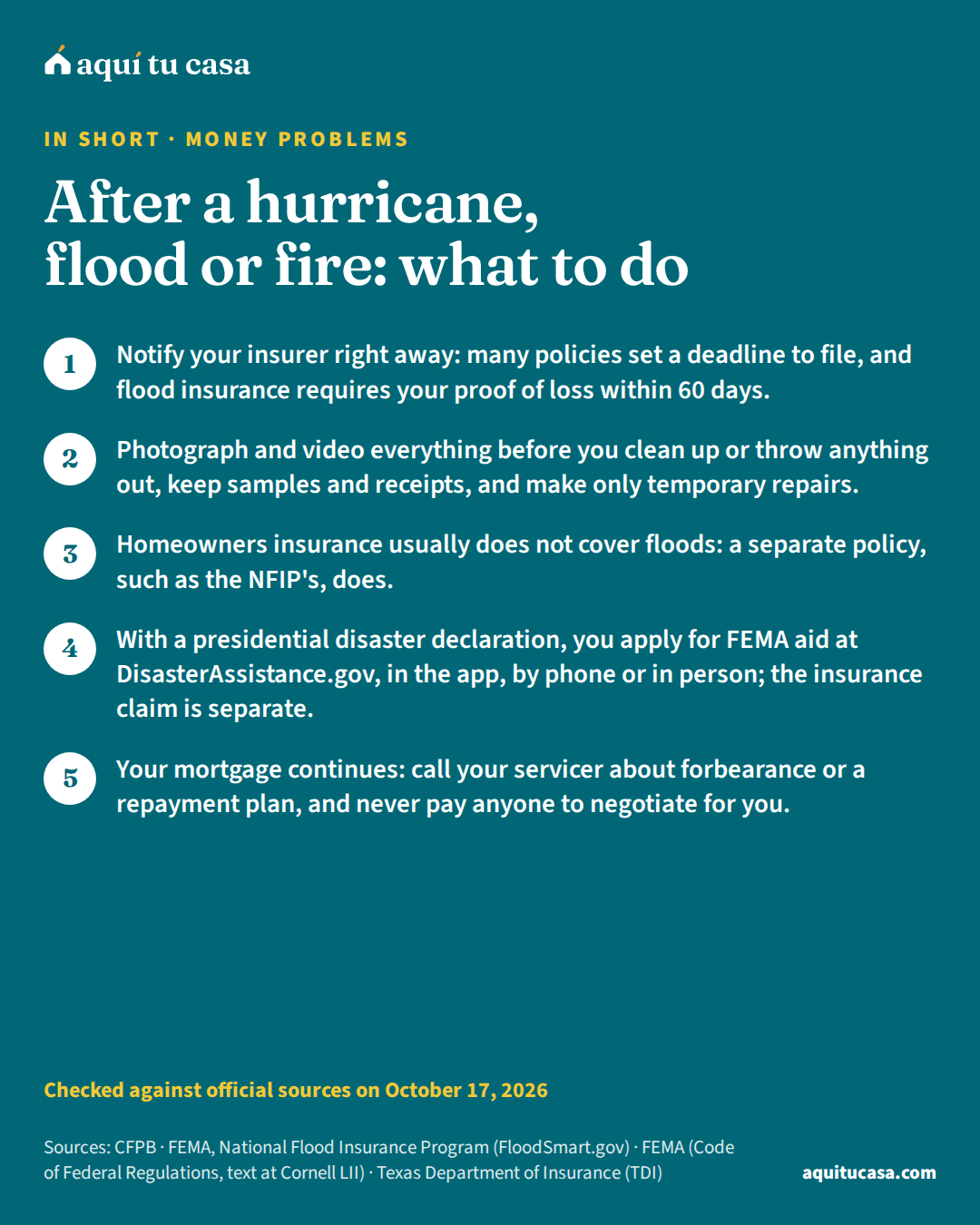
- Money problems After a hurricane, flood or fire: what to do What to do after a disaster: your home, flood or renters insurance claim, federal disaster aid, your mortgage and how to avoid scams. 16 minute read
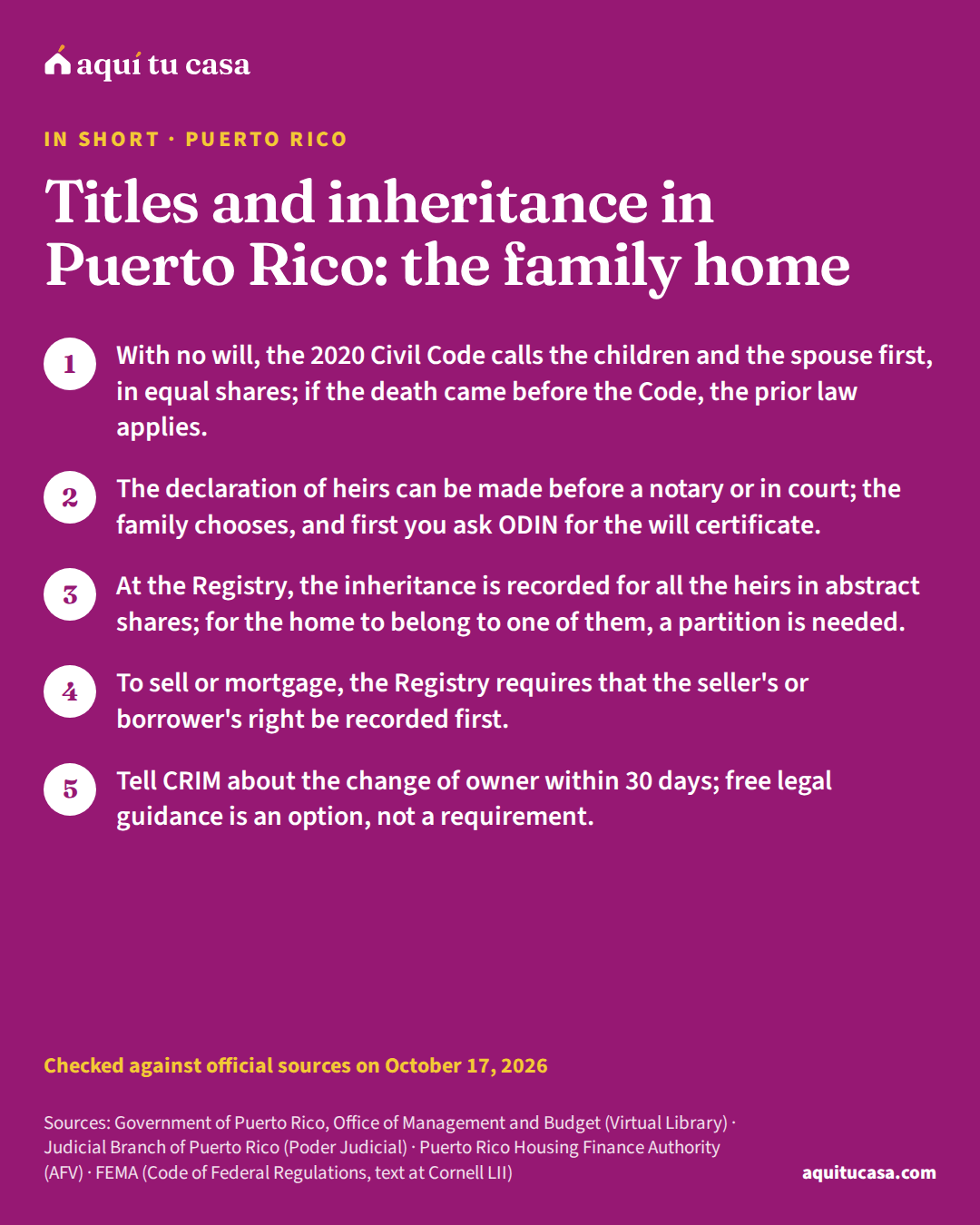
- Puerto Rico Titles and inheritance in Puerto Rico: the family home What happens to a home in Puerto Rico when its owner dies: who inherits, the declaration of heirs, the Property Registry and why a clear title matters. 11 minute read
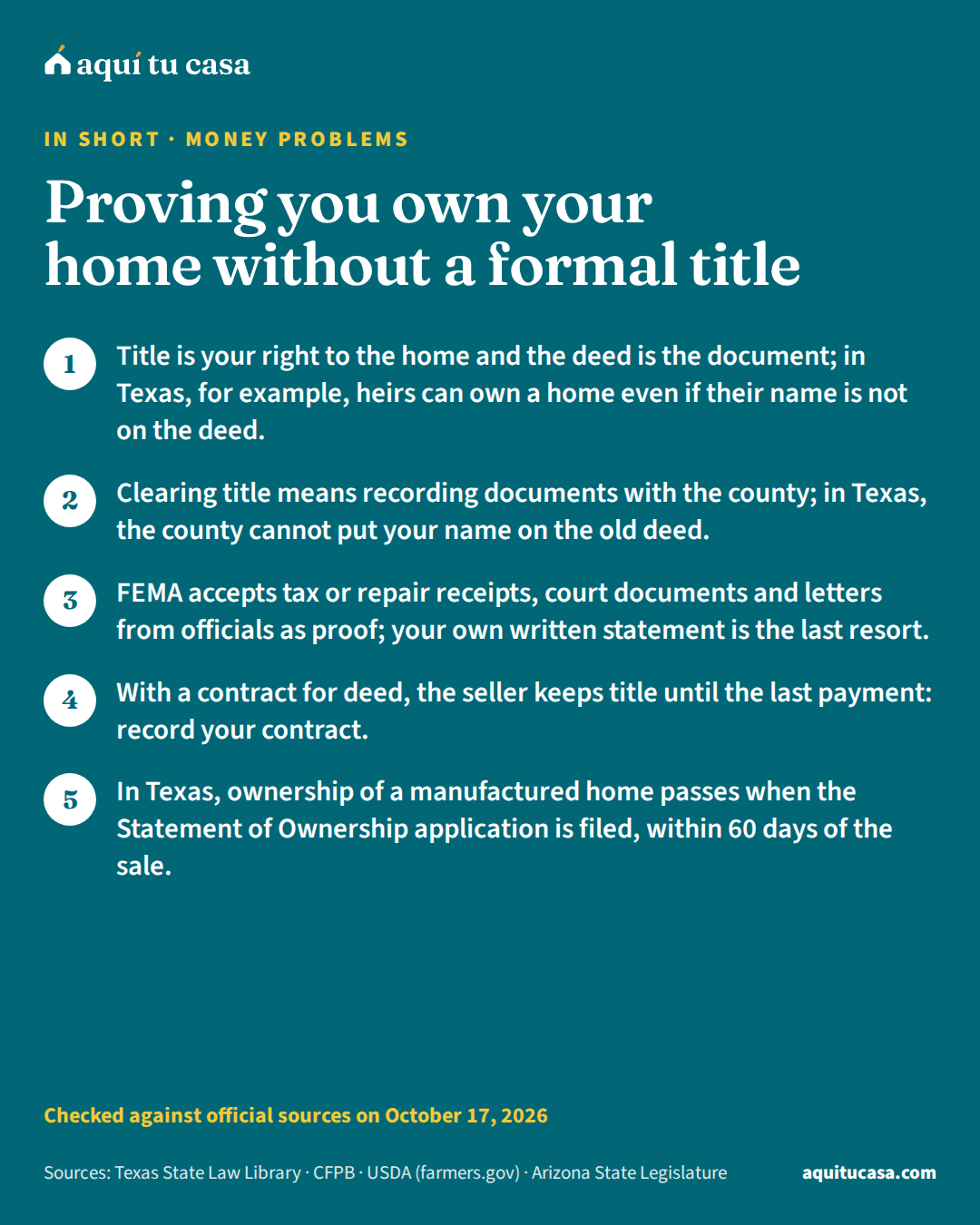
- Money problems Proving you own your home without a formal title Inherited home never transferred, contract for deed or mobile home: which papers prove it is yours and why they matter to FEMA, insurers and lenders. 13 minute read
Tools for this topic
Was this guide useful?
Thank you. Your answer stays in your browser; nothing is sent.