Proving you own your home without a formal title
Inherited home never transferred, contract for deed or mobile home: which papers prove it is yours and why they matter to FEMA, insurers and lenders.
Verified against official sources on October 17, 2026 16 official sources

Show contents
In short
What you need to know
Quick answer
Gather everything that shows the home is yours or that you are responsible for it: property tax receipts, repair receipts, court documents, letters from officials and, if you inherited it, the death certificate and the will. To clear the title, documents are usually recorded with the county, and each state has its own path: in Texas, for example, an affidavit of heirship or a court order; in Arizona, an affidavit of succession. After a disaster, FEMA accepts several of those papers and, as a last resort, a written statement from you if the home was passed down through heirship. A free legal aid office can review your case.
What matters most
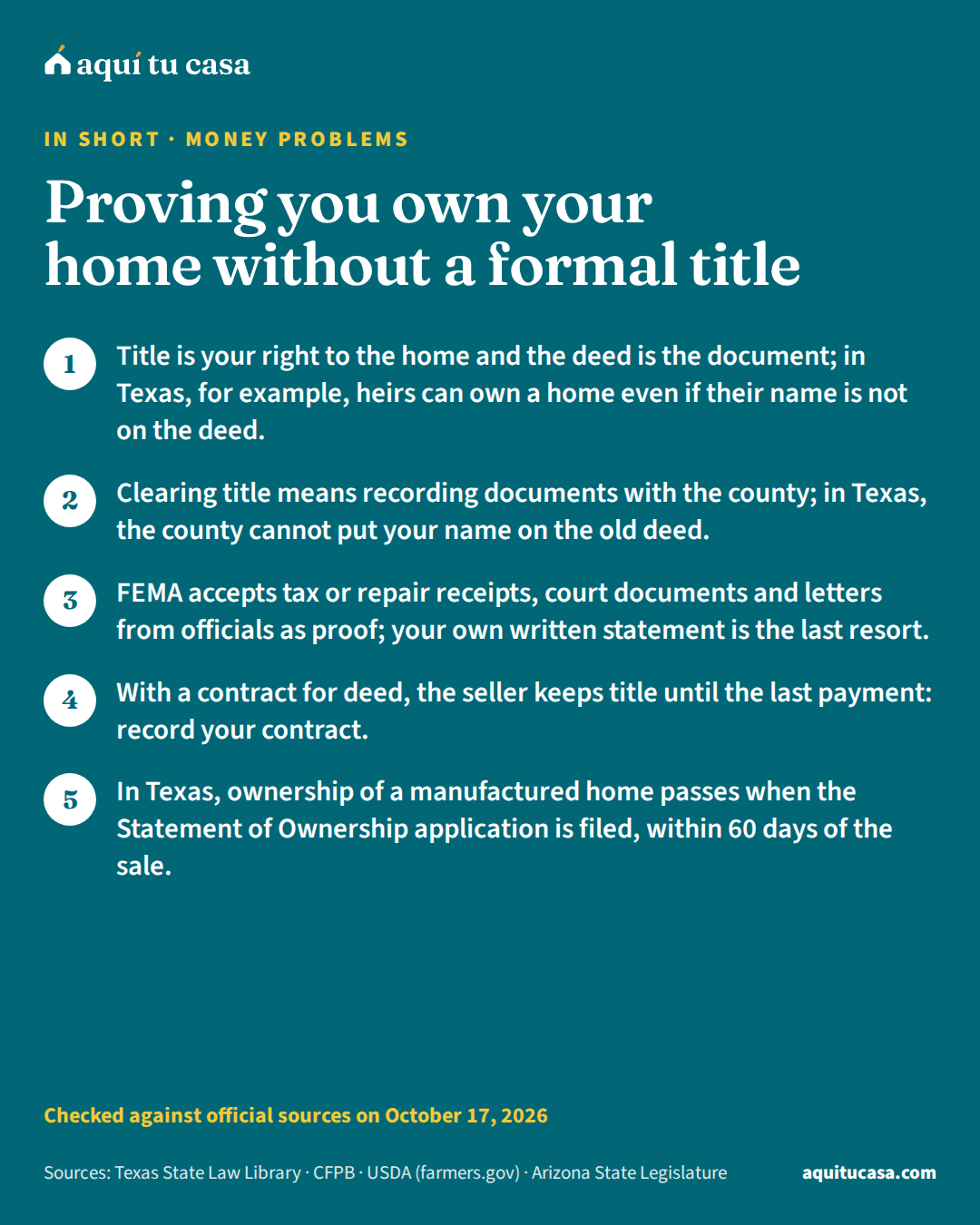
- Title is your right to the home and the deed is the document; in Texas, for example, heirs can own a home even if their name is not on the deed.
- Clearing title means recording documents with the county; in Texas, the county cannot put your name on the old deed.
- FEMA accepts tax or repair receipts, court documents and letters from officials as proof; your own written statement is the last resort.
- With a contract for deed, the seller keeps title until the last payment: record your contract.
Is this for you?
This guide is for you if…
- You live in your late parents' or grandparents' home and the deed is still in their name.
- You bought with a contract for deed and the seller still holds the title.
- You have a mobile or manufactured home and cannot find the title, or never got one.
- After a disaster, you are asked to prove ownership for FEMA aid or for insurance.
Get direct help first if…
- There is already a lawsuit over the home or you were served court papers: contact a free legal aid office today.
- You want to plan what happens to your home after you are gone: start with the guide on wills, transfer-on-death deeds and inheriting a home.
- Someone recorded a fake deed in their name: the deed theft guide explains what to do.
This guide is for you if you live in a home that belongs to your family but the papers are not in your name: you inherited it and no one did the paperwork, you bought it with a contract for deed, or it is a mobile home with no title. You will see what official sources say about the documents that help prove it is yours and why they matter for disaster aid, insurance and loans. Rules change from state to state; here you will find examples from Texas and Arizona, and free legal help is always an option.
- Situations in which FEMA's regulation treats a home as owner-occupied
- 313
- Your written statement to FEMA, if the home was inherited and you have no other papers
- Last resort14
- In Arizona, the minimum time after the owner's death to use the affidavit of succession
- 6 months6
- In Texas, to apply for a manufactured home's Statement of Ownership after a sale
- 60 days12
Title and deed: not the same thing
Two words get mixed up a lot. TitletitleTitle is your legal right to own and possess a property. The deed is the document showing that the seller transferred that right to you, and legal title is the title that can be documented in public records. As part of the purchase, a title search is done to see whether anyone else has a claim against the home; common claims come from a previous owner's unpaid taxes or from contractors who say they were not paid for work on the home. Title insurance protects you if such a claim shows up later.See the full definition is your right to use, rent or sell the home; it is not a piece of paper. A deeddeedA deed is the legal document the seller uses to transfer ownership of the home to you. The seller signs it at closing, it lists the names of all the buyers and you receive a copy. Afterward, the settlement agent records it with the county records office; that recording puts the public on notice that you are now the owner. There are several types: a warranty deed gives the most promises about the title, and a quitclaim deed promises nothing. Do not confuse it with a deed of trust, which is the mortgage document.See the full definition is a document: the one that transfers ownership from one person to another.1 When you buy a home, you receive a deed showing the seller transferred their legal ownership to you.4
What happens when the owner dies and nobody does the paperwork? The Texas State Law Library explains that if the estate did not go through probate or was settled informally, the heirs may not be listed on the deed but still own all the rights to the property.1
In Texas, to prove it, certain documents are filed with the county clerk’s office. The county cannot add your name to the old deed or issue you a new one: ownership is shown by the existing deed plus the documents you record. That creates a clear “chain of title,” which makes it easier to sell and avoids problems later. Each county may ask for different things, so ask the clerk’s office.1
Possible documents include an affidavit of death with a copy of the death certificate, a deed signed by the estate’s executor or administrator, or a court order establishing you as the rightful owner.1 The title insurance and home title guide explains how title is checked when you buy.
Why having your papers in order matters
Without clear papers, the home is still your family’s, but many steps get harder:
Where you may be asked to prove the home is yours
After a disaster
FEMA aid
When you file a claim
Insurance
Getting your papers in order before you need them saves time when it matters most.1
The USDA describes it this way for inherited land: without proof of ownership, it can be hard to obtain federal benefits, and third parties could force a partition sale.5
Papers also matter for taxes. In Texas, for example, an heir who lives in the home can claim the homestead exemptionhomestead exemptionA homestead exemption is a legal protection for the home where you and your family live. It can keep certain creditors from collecting your debts out of your main home, and it can also lower the property tax on that home. In Texas, for example, the residence homestead exemption removes part of your home's value from the tax calculation; to get it you must own the home, live there as your principal residence and apply. State laws vary widely: some cap the amount protected and others depend on the size of the property or the owner's age.See the full definition even if not named on the deed, by giving the appraisal district an affidavit of their ownership interest, a copy of the prior owner’s death certificate, the most recent utility bill and, if available, a citation of any court record. Each other heir who lives there must sign an affidavit authorizing the application.7 The homestead exemption guide explains how it works in each state.
If you inherited the home and nobody transferred it
According to the USDA, heirs’ propertyheirs' propertyHeirs' property is, according to the Department of Agriculture (USDA), family land owned jointly by the descendants of someone who died without the estate going through probate. The heirs have the right to use it but do not have clear title to sell it, and each generation usually adds more owners. Without proof of ownership it can be hard to get federal benefits, and a third party could force a partition sale. In Florida, a special law protects heirs in partition lawsuits: the value is set by an appraisal and the other owners can buy out whoever asked for the sale.See the full definition is family land owned jointly by descendants of a person who died, whose estate did not clear probate. The heirs can use it, but they do not have a clear or marketable title. It often passes without a will or deed, and each generation adds more heirs.5
Probate is the legal process for distributing a person’s property after they die; even without a will, the estate may have to go through it.2 Each state has its own paths. Two examples:
In Texas, the state’s law library describes several options:3
- Determination of heirship: a court proceeding that says who the heirs are and their shares. To transfer the home, a copy of the court orders is recorded in the property records.
- Small estate affidavit: if there is a homestead, the heirs record a copy of the court-approved affidavit.
- Affidavit of heirship: a sworn statement listing the heirs, signed by someone who knows the family history. The court does not verify it and it lacks the legal weight of the other methods. It is filed with the county clerk’s office. Buyers and title companies commonly accept it, but no law requires anyone to, and banks usually do not.
In Arizona, the law allows an affidavit of succession to real property. It is filed with the county court no sooner than six months after the death, with a certified copy of the death certificate, and signed by the people entitled to the home, for example as the sole heirs without a will or under a valid will. Among other conditions, no personal representative may have been appointed, and the value of the estate’s Arizona real property, less liens, may not exceed $300,000 as of the date of death. A false statement can bring perjury penalties. The certified copy is recorded with the county recorder.6
Example with real numbers
One case: grandma's house in Texas
An example in words; your case may need other steps.
- The situation
- Grandma died without a will and the deed is still in her name; you live in the home
- For the homestead exemption
- An affidavit of your interest, the death certificate and the latest utility bill
- To clear the title
- A court order or an affidavit of heirship, recorded with the county
- If a hurricane hits
- For FEMA, tax or repair receipts, or court documents
- Where to ask
- At the county clerk's office and at a free legal aid office
The exemption documents come from the Texas Comptroller7 and the title options from the state's law library.3 The papers FEMA accepts are in its regulation.13
If the home has a mortgage, tell the loan servicerloan servicerThe loan servicer is the company that sends you your mortgage statements and handles the day-to-day tasks of the loan: it processes your payments, answers your questions, keeps track of principal and interest paid and manages your escrow account, if you have one. It can also offer options if you fall behind and, in certain cases, start a foreclosure. It may be the same company that lent you the money or a different one, and it is common for another company to take over the loan after closing.See the full definition. To give you account information, it may ask for proof of your right to the home, such as a copy of the will and the death certificate or a letter from the executor. The servicer should tell you what proof it needs, and what you can get varies by state.8 The guide on wills, transfer-on-death deeds and inheriting a home explains your rights as an heir with the servicer.

If you bought with a contract for deed
According to the CFPB, in a contract for deed the seller keeps legal title to the home until you make all the payments, even though you act as the owner: you pay taxes, insurance and repairs. The deed is what represents legal ownership. The seller might not tell you they lack clear title, or might refuse to hand over the deed at the end.9
That is why recording the contract matters. Protections vary by state: in some the contract must be registered, and even where it is not required you can file it with the land records office. That entitles you to receive notices about the home.10 The CFPB’s report explains that enforcing your rights is harder when the contract is not recorded, and that title defects can keep you from getting legal title or selling later.11
The CFPB recommends talking to an expert before signing, such as a HUD-approved housing counselingHUD-approved housing counselorA HUD-approved housing counselor works at an agency HUD has approved to provide housing counseling: independent, expert advice customized to your situation about buying a home, renting, a missed mortgage payment, a foreclosure or credit problems. The agencies usually charge little or nothing; many serve in Spanish and offer the homebuyer education course several assistance programs require. They are not lenders or real estate agents and sell you nothing. Your county page lists the official agencies with phone numbers.See the full definition agency.9 The contract for deed guide explains the risks and what some states protect.

If your home is a mobile or manufactured home
A mobile home is sometimes considered real property and sometimes personal property, like a car.1 That changes which paper proves it is yours.
In Texas, the document that confirms ownership and lienslienA lien is a legal right a creditor holds in your property to make sure you repay a debt. It usually prevents the property from being sold until the debt is paid, and if you do not pay, the creditor may be able to take the property. Your mortgage is a lien on your home: when you pay it off, the lien is released and that shows up in your county's property records. There are other kinds, such as a federal tax lien, which is the government's legal claim against all your property when you do not pay a tax debt.See the full definition on a manufactured home is the Statement of Ownership from the Department of Housing and Community Affairs (TDHCA). Ownership does not pass to the buyer until the completed application is filed, which must happen within 60 days of any sale or move. By default the home is personal property, unless the application elects real property status and it is recorded with the county clerk; that election is only possible if the home is attached to land you own or lease under a qualifying long-term lease.12
Never received a title and the seller is gone? The TDHCA asks for evidence of ownership, such as the bill of sale, purchase agreement, contract, receipts or deed records.12 Other states work differently: the guide to buying land or a manufactured home explains how these homes are titled.
After a disaster: how FEMA asks you to prove ownership
FEMA’s regulation says a home is owner-occupied in three cases:13
- The legal owner lives there, with verifiable documents.
- Someone without formal title lives there and pays no rent, but shows verifiable documents of responsibility for the home: tax payment receipts, receipts for major repairs, maintenance or improvements, court documents, a letter from a public official or, for a mobile home or travel trailer in a commercial park, a letter from the park owner or manager.
- Someone with documents of lifetime occupancy rights lives there, with title in another person’s name.
In a rule published in the Federal Register in January 2024, FEMA acknowledged that proving ownership is a burden, especially for homes passed down through heirship. It explained that it accepts those documents and that, as a last resort, it may accept your written statement if the home was a mobile home or travel trailer, if you live in insular areas, islands or Tribal lands, or if the home was passed down through heirship. Its inspectors do not accept it: you mail it, upload it to your online account or hand it in at a Disaster Recovery Center. And FEMA follows up through casework with people who still cannot prove it.14 Policies can change, so ask what is required when you apply.
Insurance asks too. The standard flood policy requires, in your proof of loss, your interest in the property and anyone else’s, and any changes in title; the insurer may ask to see the deed showing you own it.15 The guide After a hurricane, flood or fire walks through the claim and federal aid step by step.
How to put your home's papers in order
1. Gather what you already have
Today
Tax receipts, repair or improvement receipts, court documents and letters from officials.13
2. Ask what is recorded with the county
This week
The county clerk's office can tell you what is on record and what your county requires.1
3. Find out whether the estate needs probate
Before you sign anything
Even without a will, the estate may have to go through the court.2
4. Ask what proof each party accepts
With each process
Your loan servicer should tell you what proof it needs; it varies by state.8
5. Record your documents
Once you have them
In Texas, an heir can record their interest with the county clerk.7
If this is you
The home belonged to your parents or grandparents
Ask the county which documents get recorded; in Texas, heirs can own a home even if they are not on the deed.1
Several siblings are heirs
Each generation adds heirs; clearing title in time avoids problems when you want to sell.51
You bought with a contract for deed
File the contract with the land records office to receive notices about the home.10
Costly mistakes
Mistake: Signing an affidavit with facts you are not sure about.
Instead: Check every fact: in Arizona, a false statement can bring perjury penalties.6
Mistake: Handing your written statement to the FEMA inspector.
Instead: Mail it, upload it to your account or take it to a Disaster Recovery Center.14
Mistake: Throwing away property tax or repair receipts.
Instead: Keep them: they are among the documents FEMA accepts.13
Mistake: Leaving your contract for deed unrecorded.
Instead: File it with the land records office.10
Mistake: Buying a manufactured home in Texas without applying for the Statement of Ownership.
Instead: Apply within 60 days of the sale: until then, ownership does not pass.12
Mistake: Asking the county to put your name on the old deed.
Instead: In Texas it cannot: what gets recorded are the documents that prove your right.1

Where to get free help
Proving ownership of an inherited home can involve court proceedings. The Legal Services Corporation (LSC) funds civil legal aid for low-income people: on its site you find an office near you by address or city, and LawHelp.org has free information and forms.16 In Texas, the Comptroller notes that the State Bar lists people and organizations offering free or reduced-fee legal help.7 The free legal aid guide explains how it works and what to ask.
If someone recorded a fake deed on your home, the deed theft and title fraud guide explains what to do.
What to do this week
- Put tax receipts, repair receipts and any court documents about the home in one folder.13
- Find the prior owner’s death certificate and will, if there is one.8
- Call the county clerk’s office and ask what is on record and which documents your county requires.1
- If you bought with a contract for deed, ask how to record it.10
- If you have a manufactured home in Texas, check that a Statement of Ownership exists in your name.12
- Look for a free legal aid office to review which path fits your state.16
Ready to see the numbers? Find your county here
See how this applies in your county: its loan limits, prices and rents, from the official data.
Printable checklist
Frequently asked questions
Is the home mine if the deed is still in my late father's name?
It may be. The Texas State Law Library explains that if the estate did not go through probate, the heirs may not be listed on the deed but still own all the rights to the property. To prove it, certain documents are recorded with the county. Rules vary by state; a legal aid office can review your case.
What papers does FEMA accept to prove I am the owner?
FEMA's regulation lists verifiable documents such as tax payment receipts, receipts for major repairs or improvements, court documents and letters from public officials, and for mobile homes in a park, a letter from the park manager. As a last resort, FEMA explained it may accept a written statement if the home was passed down through heirship.
Can the FEMA inspector take my written statement?
No. FEMA explained that its inspectors do not accept those statements, because they are a last resort. You mail them, upload them to your online account or hand them in at a Disaster Recovery Center.
What is an affidavit of heirship?
In Texas, it is a sworn statement listing the heirs, signed by someone who knows the family history. It is filed with the county clerk's office. Buyers and title companies commonly accept it, but no law requires anyone to accept it and banks usually do not.
I bought with a contract for deed. Am I the owner?
According to the CFPB, in a contract for deed the seller keeps legal title until you make all the payments. You can file the contract with the land records office, which entitles you to receive notices about the home, and some states require it.
My mobile home in Texas has no title. What do I do?
In Texas, the document that confirms ownership is the TDHCA's Statement of Ownership. If you never received a title and the seller is gone, the TDHCA asks for evidence such as the bill of sale, purchase agreement, contract, receipts or deed records.
Why won't the bank lend if the home belongs to my family?
Most lenders require a lender's title insurance policy, and the Texas State Law Library says banks usually do not accept an affidavit of heirship. Without clear title it can also be hard to sell. Clearing the title with the county helps.
Sources
Every figure in this guide comes from one of these official sources. The number next to a sentence leads to the source behind it.
Each source on one line: who publishes it, its title, its address and the date we read it.
- 1. Texas State Law Library · Real Property Deeds, Probate Law Guide · guides.sll.texas.gov · Accessed October 17, 2026
- 2. Texas State Law Library · General Information, Probate Law Guide · guides.sll.texas.gov · Accessed October 17, 2026
- 3. Texas State Law Library · Informal Methods, Probate Law Guide · guides.sll.texas.gov · Accessed October 17, 2026
- 4. CFPB · What is owner's title insurance? · consumerfinance.gov · Accessed October 17, 2026
- 5. USDA (farmers.gov) · Heirs' Property Landowners · farmers.gov · Accessed October 17, 2026
- 6. Arizona State Legislature · Arizona Revised Statutes §14-3971, Collection of personal property by affidavit; affidavit of succession to real property · azleg.gov · Accessed October 17, 2026
- 7. Texas Comptroller of Public Accounts · Property Tax Exemptions · comptroller.texas.gov · Accessed October 17, 2026
- 8. CFPB · How do I get mortgage information about a home I inherited? · consumerfinance.gov · Accessed October 17, 2026
See the other 8 sources
- 9. CFPB · What is a contract for deed? · consumerfinance.gov · Accessed October 17, 2026
- 10. CFPB · Consumer advisory: Help is available for people facing housing problems because of a contract for deed · consumerfinance.gov · Accessed October 17, 2026
- 11. CFPB · Contract for Deed: Consumer Risks (report) · files.consumerfinance.gov · Accessed October 17, 2026
- 12. Texas Department of Housing and Community Affairs (TDHCA) · Frequently Asked Questions: Statement of Ownership · tdhca.texas.gov · Accessed October 17, 2026
- 13. FEMA (Code of Federal Regulations, text at Cornell LII) · 44 CFR §206.111, Definitions (Federal Assistance to Individuals and Households) · law.cornell.edu · Accessed October 17, 2026
- 14. FEMA (Federal Register, text at govinfo.gov) · Individual Assistance Program Equity (Federal Register, January 22, 2024) · govinfo.gov · Accessed October 17, 2026
- 15. FEMA (Code of Federal Regulations, text at Cornell LII) · 44 CFR Part 61, Appendix A(1): Standard Flood Insurance Policy, Dwelling Form · law.cornell.edu · Accessed October 17, 2026
- 16. Legal Services Corporation (LSC) · I Need Legal Help · lsc.gov · Accessed October 17, 2026
Keep reading
Related guides
If this guide helped, these follow the same path.
Owning a home 14 minute read
Wills, transfer-on-death deeds and inheriting a home
What a will requires, how a transfer-on-death deed works, what happens to the mortgage when you inherit a home and what heirs' property is.
- Without a will or another way to transfer it, state law decides who inherits; each state sets how a valid will is signed.
- In states such as Arizona and Washington, a transfer-on-death deed passes the home without waiting on a will, but only if it is recorded before death.
- If you inherit a home with a mortgage, tell the servicer: by law it must tell you which documents it needs to confirm you as a successor.
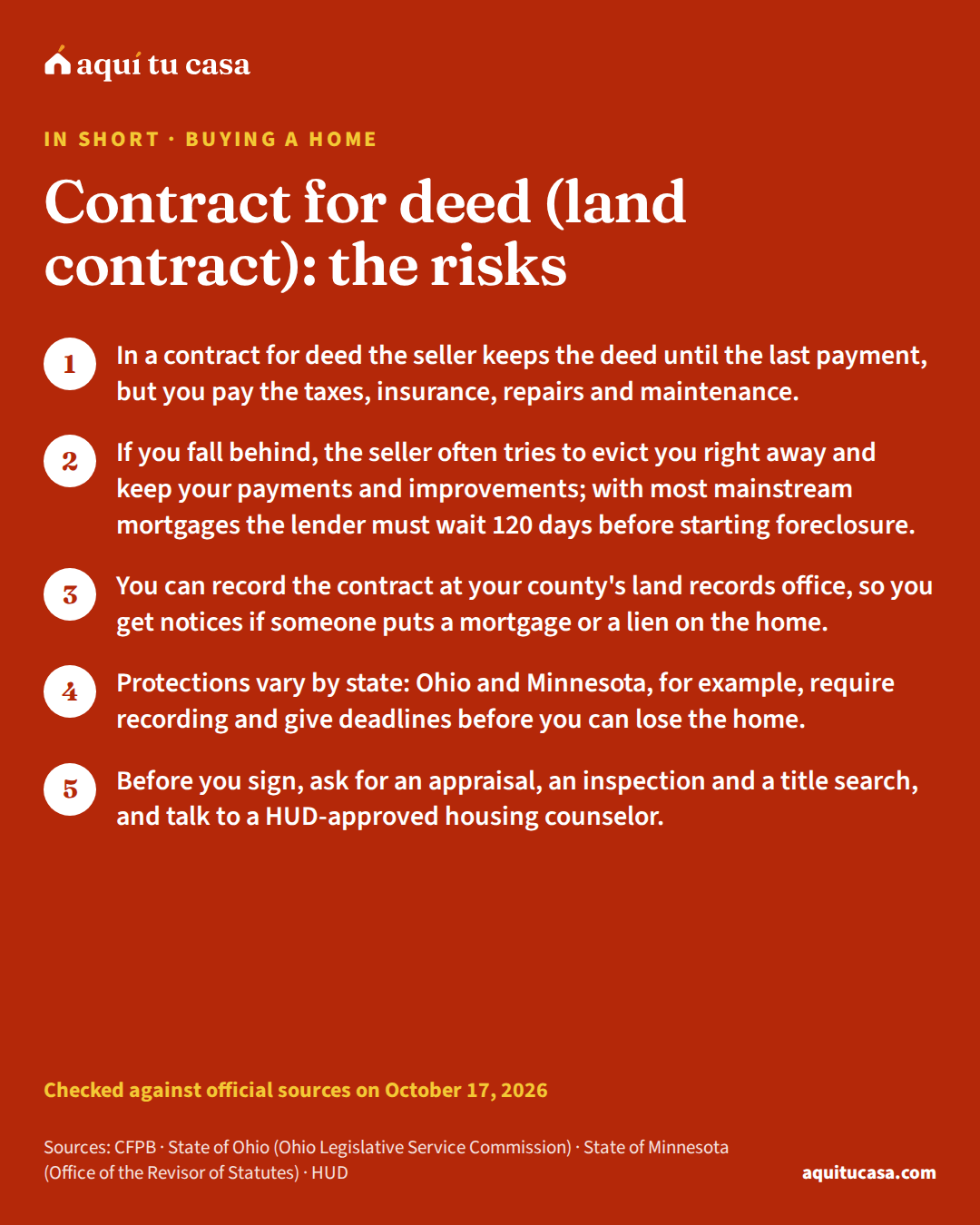
- Buying a home Contract for deed (land contract): the risks What a contract for deed is, why you can lose the home and what you paid, how to record it and what some states require before a seller can take it back. 12 minute read
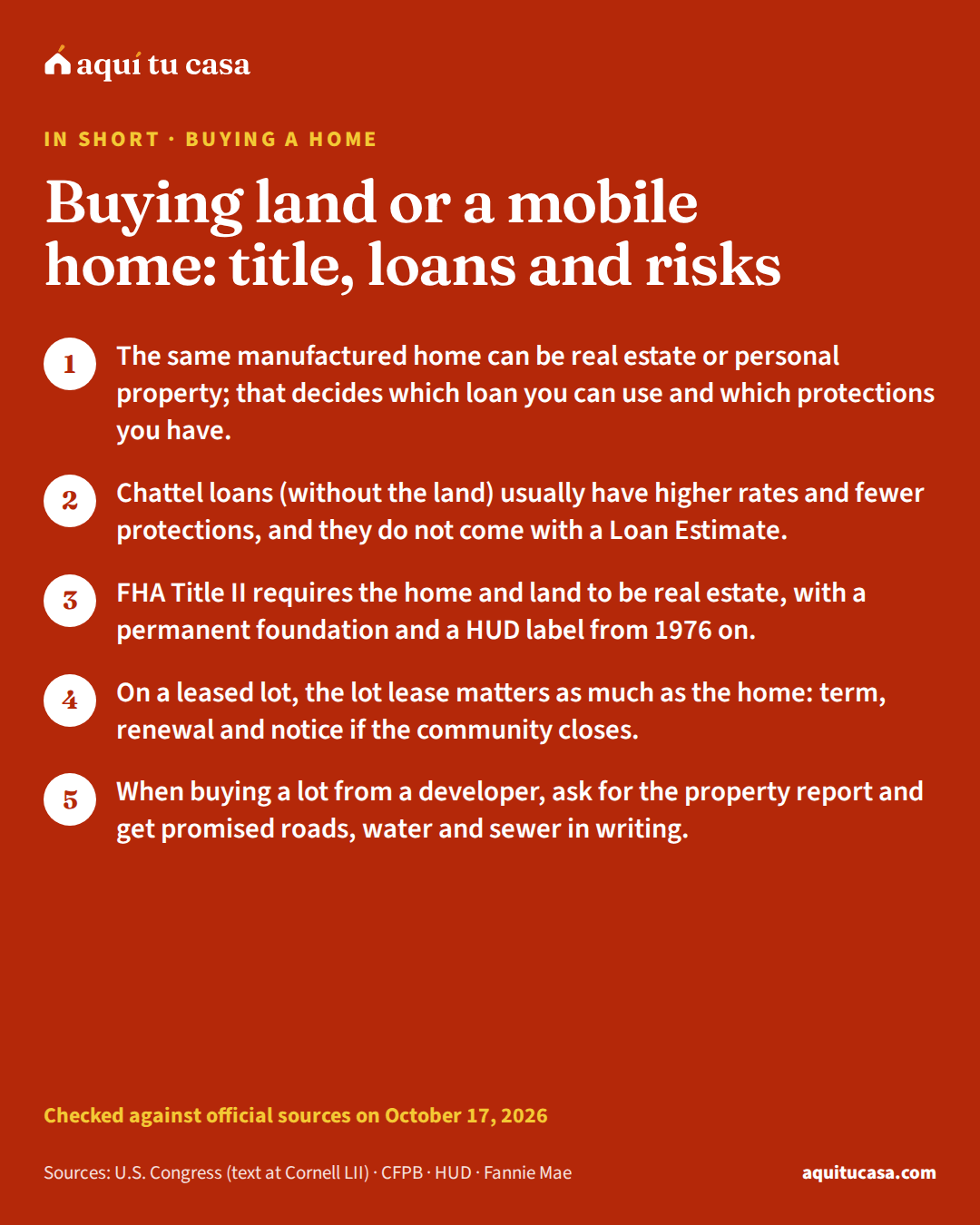
- Buying a home Buying land or a mobile home: title, loans and risks How to buy land or a manufactured (mobile) home: real or personal property, how it is titled, FHA and chattel loans, leased lots and colonias. 12 minute read
- Buying a home Title insurance and your home's title: what they protect What your home's title is, the difference between the lender's and the owner's title insurance, where they appear on the Loan Estimate and how to compare. 10 minute read

Was this guide useful?
Thank you. Your answer stays in your browser; nothing is sent.