Contract for deed (land contract): the risks
What a contract for deed is, why you can lose the home and what you paid, how to record it and what some states require before a seller can take it back.
Verified against official sources on October 17, 2026 10 official sources

Show contents
In short
What you need to know
Quick answer
A contract for deed (also called a land contract or bond for deed) is an installment purchase in which the seller keeps the deed until the last payment. According to the CFPB, meanwhile you pay the taxes, insurance and repairs, and if you fall behind the seller often tries to evict you right away and keep what you paid. Protections vary by state: some require the contract to be recorded and give you more time before the seller can take the home back. Before signing, talk to a HUD-approved housing counselor.
What matters most
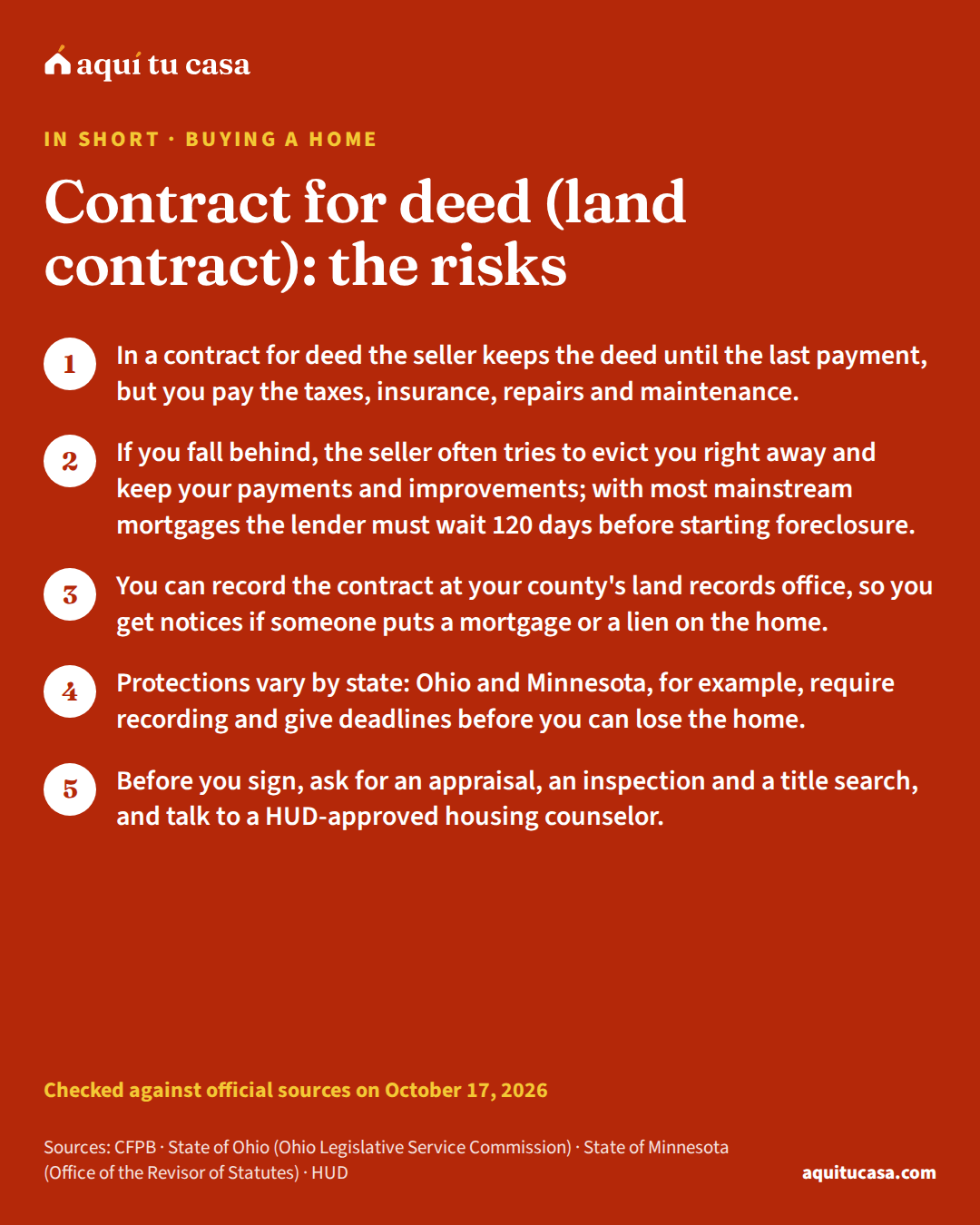
- In a contract for deed the seller keeps the deed until the last payment, but you pay the taxes, insurance, repairs and maintenance.
- If you fall behind, the seller often tries to evict you right away and keep your payments and improvements; with most mainstream mortgages the lender must wait 120 days before starting foreclosure.
- You can record the contract at your county's land records office, so you get notices if someone puts a mortgage or a lien on the home.
- Protections vary by state: Ohio and Minnesota, for example, require recording and give deadlines before you can lose the home.
Is this for you?
This guide is for you if…
- You are being offered a house or land paid for in monthly installments to the owner, who keeps the deed until the last payment.
- You already signed a contract for deed (also called a land contract or bond for deed) and want to know your rights.
- You are having trouble with one: missed payments, unpaid taxes or a seller who will not hand over the deed.
Get direct help first if…
- You are being offered a rent-to-own deal: that is a different arrangement, explained in the rent-to-own guide.
- You already got a notice to leave or a lawsuit: look for free legal aid today; this guide does not replace that help.
- You are buying with a mortgage from a bank or credit union: start with the step-by-step home buying guide.
Buying a home by paying the owner directly, in installments, with no bank involved, can sound like the way out when a loan seems out of reach. This guide is for anyone thinking about signing a contract for deed or who already has one: it explains how it works, why you can lose the home and what you paid, how recording protects you and what some state laws say.
What a contract for deed is
According to the CFPB, in a contract for deed the seller keeps legal titletitleTitle is your legal right to own and possess a property. The deed is the document showing that the seller transferred that right to you, and legal title is the title that can be documented in public records. As part of the purchase, a title search is done to see whether anyone else has a claim against the home; common claims come from a previous owner's unpaid taxes or from contractors who say they were not paid for work on the home. Title insurance protects you if such a claim shows up later.See the full definition to the home until you make every payment. Instead of borrowing from a bank to pay the seller in full, you pay the seller in monthly installments. The deeddeedA deed is the legal document the seller uses to transfer ownership of the home to you. The seller signs it at closing, it lists the names of all the buyers and you receive a copy. Afterward, the settlement agent records it with the county records office; that recording puts the public on notice that you are now the owner. There are several types: a warranty deed gives the most promises about the title, and a quitclaim deed promises nothing. Do not confuse it with a deed of trust, which is the mortgage document.See the full definition, the document that shows who legally owns the home, stays in the seller’s name until you finish.1
It goes by other names: “land contract,” “bond for deed,” “land installment contract” or “buying on contract.” The idea is the same: an installment purchase instead of a traditional mortgage.1
One key point: even though the deed is not yours yet, you have to act as the owner. In a typical contract you pay the property taxesproperty taxProperty tax is the tax the county, city, school district and other local bodies charge real property owners every year to pay for schools, police, fire and other public services. It is computed on the value the assessor's office assigns to your home, at each body's rate, minus the exemptions you qualify for, such as the primary-residence exemption in many states. If you have a mortgage you normally pay it month by month inside your payment, through the escrow account. It is generally deductible on your federal return if you itemize.See the full definition, insurance, repairs and maintenance.1 The CFPB report adds that the buyer typically takes on the responsibilities of an owner, including improvements.3
The CFPB acknowledges that some contracts for deed can be a path to homeownership, but says most carry risks.1
How it differs from a mortgage
Mainstream mortgage and contract for deed, side by side
Loan from a lender
Mainstream mortgage
The biggest difference is what happens if you fall behind: with a contract for deed you can lose everything you paid.3
With a mortgagemortgageA mortgage is an agreement between you and a lender (a bank, a credit union or a mortgage company) that gives the lender the right to take your property if you do not repay the money it lent you, plus interest. Mortgage loans are used to buy a home or to borrow money against the value of a home you already own. You repay it in monthly payments that cover the principal (the money borrowed) and the interest, and often the property taxes and insurance as well. In Spanish, "hipoteca" and "préstamo hipotecario" mean the same thing.See the full definition, if you fall behind, the lender generally has to wait before starting foreclosureforeclosureForeclosure is the process by which the lender or servicer takes back the property after the homeowner fails to make mortgage payments. The rules and timelines depend on each state; all of them include advance notices and, in general, time to catch up or ask for an alternative, such as a repayment plan or a loan modification. If you fall behind, call your servicer and a HUD-approved housing counseling agency early: foreclosure counseling is free and exists for exactly this.See the full definition. With a contract for deed, according to the CFPB, the seller often tries to start an evictionevictionEviction is the legal process a landlord uses to get back a rented home when the tenant does not want to leave. The most common reasons are unpaid rent, serious lease violations or a lease that has ended. First the landlord must give you written notice. If it is not resolved, the landlord needs a court order, and a law enforcement officer must carry out the removal. If you are sued, you have the right to file a written answer explaining to the court why you should not be evicted. The rules change by state and city.See the full definition right away.1 The CFPB report puts it this way: lenders of most mainstream mortgages must wait 120 days after the first missed payment, which gives time to catch up, refinance, sell or ask for a modification.3
Another difference matters more over the years. With a mortgage, title is yours from the start and you can sell or refinance. With a contract for deed, usually not.3
The most common risks

The CFPB and its research report describe the problems that come up most often:
- Losing the home over one late payment. The seller may try to evict you if you miss an installment, cannot make a large balloon paymentballoon paymentA balloon payment is a large, one-time payment at the end of the loan term, higher than the payments before it and sometimes much higher. On the Loan Estimate, "Balloon Payment" means any payment that is more than two times a regular payment. Loans with a balloon payment usually have shorter terms and lower monthly payments that do not pay off the whole debt. If you cannot make the final payment, you may have to refinance or sell the home, or face foreclosure. With limited exceptions, a Qualified Mortgage (QM) cannot have a balloon payment.See the full definition the contract requires, or do not pay taxes or maintenance.1
- Losing what you paid. Contracts usually allow the seller, on any default, to take the home back and keep all payments, the down payment and the improvements you made.3
- A seller without clear title. Even if you pay everything, the seller may owe a mortgage or a lienlienA lien is a legal right a creditor holds in your property to make sure you repay a debt. It usually prevents the property from being sold until the debt is paid, and if you do not pay, the creditor may be able to take the property. Your mortgage is a lien on your home: when you pay it off, the lien is released and that shows up in your county's property records. There are other kinds, such as a federal tax lien, which is the government's legal claim against all your property when you do not pay a tax debt.See the full definition on the home, or simply refuse to hand over the deed.1
- Unpaid taxes and insurance. Sometimes the seller collects the tax and insurance money but does not pay it, and when you finally own the home you face big bills and penalties.1
- Tough prices and terms. Many contracts carry inflated prices and higher interest rates than mainstream mortgages, some with large balloon payments at the end, and seller-financers often do not check whether you can repay.3
- A home that needs a lot of work. Substandard conditions can require expensive repairs that you pay for.3 And since no appraisal is required, you may agree to a price without knowing what the home is worth.3
The CFPB report notes that today these contracts are disproportionately concentrated in low-income, Hispanic and immigrant communities.3 In the colonias near the Texas-Mexico border, many landowners and developers have sold through contracts for deed, which do not require the seller to show clear title, provide basic infrastructure or make sure structures meet county codes.3
Recording the contract: your best protection
According to the CFPB, some states require a contract for deed to be registered. And even if your state does not, you can file it with the state or local office in charge of land records. That entitles you to notices about the home: for example, if the seller transfers the deed to someone else, takes out a mortgage on the property or someone files a lien.2
Recording matters because, according to the CFPB report, buyers often have a harder time exercising their rights when the contract showing their interest is not recorded.3
Two examples of what state laws require:
- Ohio. Within 20 days of signing, the seller must have a copy of the contract recorded and deliver another copy to the county auditor.4
- Minnesota. Contracts for deed must be recorded within four months. For a home, the seller must give you at signing a copy with original signatures ready to record, and within four months pay any delinquent taxes needed and record it. The contract cannot take those duties away.5
The title insurance and home title guide explains what a title searchtitle searchA title search is a review of public records to find defects or encumbrances in a property's chain of title, such as someone else's claim or a lien. It keeps the buyer and the lender from being surprised later by an ownership problem that could have been foreseen. According to the CFPB, the title search fee is part of the title service fees, along with the premium for the lender's title insurance, and it appears on page 2 of your Loan Estimate and your Closing Disclosure. You can often shop for who provides these services.See the full definition is, and the deed theft guide shows how to keep an eye on your home’s records.

What protections some states give
Protections vary a lot from state to state. The CFPB says some states require sellers to offer foreclosure-like protections before taking the home back, which can give you more time to catch up.2 Ohio and Minnesota are two examples with published laws you can read online.
Ohio (Revised Code chapter 5313). The contract is signed in duplicate and each party gets a copy. Among other things, it must state the price, the down payment, the balance, each installment, the interest rate and any liens on the home, and it must require the seller to deliver the deed at the end. If the seller stops paying a mortgage on the home, the contract must let you pay it and get credit, and the seller cannot mortgage the home for more than you owe without your consent.4 At least once a year, or when you ask, the seller must give you a statement of what went to principal and interest and the balance.4
If you fall behind in Ohio, the seller can enforce forfeiture only after 30 days, and you avoid it by paying everything due and the contract’s fees within that time. After that, the written notice gives you 10 days to comply. And if you have paid for five years or more, or 20% or more of the price, the seller can take the home back only through foreclosure and a judicial sale.4
Minnesota (Statutes section 559.21). For contracts signed on or after August 1, 1985, to end the contract over a default the seller must serve you a notice saying the contract will terminate 60 days later unless before then you cure the default, pay everything due and certain costs. The law sets different periods in some cases.6
If you live in another state, ask a housing counselor or your local legal aid what your law says. Do not assume you have the same protections as with a mortgage.2
Before you sign, step by step
What to check before you sign
1. Talk to a housing counselor
Before you hand over any money
The CFPB recommends asking an expert, such as a HUD-approved housing counseling agency, before you sign.1
2. Get a complete copy of the contract
Before you sign
Check the price, the interest rate, each installment and whether there is a balloon payment at the end.3
3. Find out whose name the home is in
Before you sign
The seller may owe a mortgage or a lien on the home; a title search shows it.1
4. Ask for an inspection and an appraisal
Before you sign
They are usually not done for contracts for deed, and without an appraisal you can pay more than the home is worth.3
5. Record the contract
Right after signing
That way you get notices if someone puts a mortgage or a lien on the home.2
6. Keep proof that taxes and insurance were paid
Every year
Sometimes the seller collects that money and does not pay it; check that the payments go through.1
A home inspectionhome inspectionA home inspection is a review of the property's physical condition by an inspector before you finish buying: roof, foundation, plumbing, electrical, heating and cooling, signs of moisture or pests. It is often part of the home buying process and you pay for it, not the lender; unlike the appraisal, it does not say what the home is worth but what problems it has. With the report you can ask for repairs, negotiate the price or walk away if your contract includes an inspection contingency. Some assistance programs require one.See the full definition and an appraisalhome appraisalAn appraisal is a written document that gives a professional appraiser's opinion of how much a property is worth. The lender orders it before approving the mortgage, because the home is the loan's collateral and the lender does not want to lend more than it is worth. If the appraisal comes in below the price you agreed, the bank bases the loan on the lower value and you will have to cover the difference, renegotiate the price or walk away if your contract allows it. An appraisal is not an inspection: it measures value, not the home's condition.See the full definition are part of what normally protects someone who buys with a mortgage.3 The home inspection guide explains what an inspector checks.
If you already signed and have problems
If you fell behind, the seller is not paying the taxes or will not hand over the deed, do not wait. The CFPB takes complaints about contracts for deed at consumerfinance.gov/complaint or (855) 411-2372: choose “Mortgage,” then “Other type of mortgage,” and type “contract for deed.”1 For complaints about local individuals or companies, the CFPB suggests contacting your state’s attorney general.2
A HUD-approved housing counselorHUD-approved housing counselorA HUD-approved housing counselor works at an agency HUD has approved to provide housing counseling: independent, expert advice customized to your situation about buying a home, renting, a missed mortgage payment, a foreclosure or credit problems. The agencies usually charge little or nothing; many serve in Spanish and offer the homebuyer education course several assistance programs require. They are not lenders or real estate agents and sell you nothing. Your county page lists the official agencies with phone numbers.See the full definition can help with your numbers and options, often for free or at low cost.9 If you got a notice to leave, free legal aidlegal aidLegal aid is the free civil legal help that nonprofit organizations and their lawyers provide to low-income people in civil, not criminal, matters. In housing, that includes representing families facing eviction or foreclosure, alongside matters such as custody, child support, protection from domestic violence and access to benefits. In the United States, the Legal Services Corporation, created by Congress, funds a nationwide network of these organizations; its finder points you to the one in your area. Each sets its own income limits.See the full definition is an option: LSC has a search tool for legal aid organizations by address or city.10 The free legal aid guide explains who qualifies and how to ask for it.
Another option: a mortgage loan
If you are considering a contract for deed because you think you would not get a loan, first check what you would need with a mainstream mortgage: on an FHA loan, your minimum contribution is at least 3.5% of the home’s value.7
Example with real numbers
Buying a typical home with an FHA loan
With the typical US home value, the FHA minimum down payment and Freddie Mac's closing cost range.
- Home price (typical US value)
- $332,700
- FHA minimum down payment (3.5%)
- $11,645
- Closing costs (2% to 5% of the price)
- $6,654 to $16,635
- Cash to close, before credits
- $18,299 to $28,280
This is an example with national numbers.78 With a mortgage, title is in your name at signing.3 Try your own numbers.
Run it with your numbersHow much house can I afford?
The mortgage loan types guide compares FHA, conventional, VA and USDA loans. If you do not have a Social Security number, the ITIN mortgage guide explains who lends and how. And the which programs do I qualify for tool looks for down payment assistance programs.
If this is you
You are offered the contract because you have no Social Security number
The ITIN mortgage guide explains which loans exist and who lends. Talk to a counselor before you sign.1
You have no credit history
Seller-financers often do not check whether you can repay, and that does not protect you.3 See how to build credit from zero.

Costly mistakes
Mistake: Signing without knowing whether the seller owes a mortgage or a lien on the home.
Instead: Get a title search: even if you pay everything, a seller without clear title cannot pass the home to you.1
Mistake: Not recording the contract.
Instead: Record it at the county land records office so you get notices about the home.2
Mistake: Paying the seller for taxes and insurance without checking that they were paid.
Instead: Ask for proof: sometimes the seller keeps that money.1
Mistake: Signing without understanding the balloon payment at the end.
Instead: Ask how much it is and when it is due: if you cannot pay it, you can lose the home.13
Mistake: Assuming a late payment gives you the same time as a mortgage.
Instead: Many contracts allow eviction over one missed payment; check what your state's law says.32
Mistake: Making big improvements before you have the deed.
Instead: If you lose the contract, the seller can keep your improvements.3
What to do this week
- If you are offered a contract for deed, do not sign yet: get a complete copy and take it to a HUD-approved housing counselor.19
- Check at the county land records office whose name the home is in and whether it has mortgages or liens.1
- If you already signed, check whether the contract is recorded; if not, record it.2
- Gather your installment receipts and proof that taxes and insurance were paid.1
- Compare with a mortgage: see what you would need with the mortgage calculator and read the housing scams guide to spot warning signs.7
- If you already have a notice to leave, look for free legal aid today.10
Your numbers
Starts at the typical home value in the United States. Change it to the price you have in mind.
That is $11,645 (3.5% of the price). The usual minimum for this loan is 3.5%.
This week's average ± a quarter or half point.
National average as of November 5, 2026 (Freddie Mac); your rate may be different.
Adjust advanced details
Let's do the math
Estimated monthly payment
National figure$2,759
at 7.18% · 30 years
- Loan amount
- $326,673
- Total interest
- $470,006
- Paid off in
- November 2056
Includes $5,618 FHA upfront mortgage insurance premium.
Does it fit the income?
Comfortable
up to $1,884 a month
Tight
$1,884 to $2,422 a month
Hard
more than $2,422 a month
Your payment · 41%
Compared with the typical household income in the United States ($80,734 a year). Reference: HUD calls paying more than 30% of income for housing a cost burden.
| Principal & interest | $2,213 |
|---|---|
| Property tax | $261 |
| Home insurance | $139 |
| FHA mortgage insurance (MIP) | $147 |
How does it compare with incomes?
For this payment to be 28% of your income, you'd need to earn about $118,260 a year. With your other debts, to stay under 36%: about $91,980 a year.
You need at least $11,645 for the down payment, plus closing costs.
This is an estimate to give you an idea, not a loan offer. Your real payment depends on your rate, your credit, and the insurance and taxes on the home you buy.
Total monthly payment $2,759; principal and interest $2,213.
Ready to see the numbers? Find your county here
See how this applies in your county: its loan limits, prices and rents, from the official data.
Printable checklist
Frequently asked questions
What is a contract for deed?
It is an installment purchase: you pay the seller instead of borrowing from a bank, and the seller keeps the deed until you finish paying. It is also called a land contract, bond for deed or land installment contract. According to the CFPB, in the meantime you act as the owner: you pay the taxes, insurance, repairs and maintenance.
Is it the same as rent-to-own?
No. With a contract for deed you are already buying and paying the price in installments. Minnesota law, for example, says a lease with an option to purchase is not a contract for deed. The rent-to-own guide explains that other arrangement.
What happens if I miss a payment?
According to the CFPB, the seller often tries to evict you right away and keep what you paid, though protections vary by state. In Ohio, for example, the seller must wait 30 days from the default, and if you have paid for five years or 20% of the price the seller has to go through foreclosure. If this happens to you, look for free legal aid as soon as you can.
Do I have to record the contract?
It depends on the state. In Ohio the seller must have it recorded within 20 days of signing, and in Minnesota it must be recorded within four months. Even if your state does not require it, the CFPB says you can file it with the land records office, which gets you notices if someone takes out a mortgage or files a lien on the home.
Who pays the property taxes and insurance?
In a typical contract, the buyer. The CFPB warns that sometimes the seller collects the tax and insurance money but does not pay it, and the buyer ends up facing large bills and penalties. Ask for proof of every payment.
What can I do if the seller will not give me the deed?
The CFPB says sellers sometimes refuse to hand over the deed even after you pay everything. You can file a complaint with the CFPB, contact your state's attorney general and ask for free legal aid. In Ohio, for example, the law lets the buyer enforce their rights in court.
Why does a contract for deed seem easier than a mortgage?
The CFPB report says seller-financers often do not check whether you can repay and do not do an appraisal, inspection or title search. That can make it feel fast, but many contracts have inflated prices, higher interest rates and large balloon payments at the end.
Where can I complain about a problem with my contract?
The CFPB takes complaints at consumerfinance.gov/complaint or (855) 411-2372: choose 'Mortgage', then 'Other type of mortgage', and type 'contract for deed'. You can also contact your state's attorney general.
Sources
Every figure in this guide comes from one of these official sources. The number next to a sentence leads to the source behind it.
Each source on one line: who publishes it, its title, its address and the date we read it.
- 1. CFPB · What is a contract for deed? · consumerfinance.gov · Accessed October 17, 2026
- 2. CFPB · Consumer advisory: Help is available for people facing housing problems because of a contract for deed · consumerfinance.gov · Accessed October 17, 2026
- 3. CFPB · Contract for Deed: Risks and Realities (research report, August 2024) · files.consumerfinance.gov · Accessed October 17, 2026
- 4. State of Ohio (Ohio Legislative Service Commission) · Ohio Revised Code, Chapter 5313, Land Installment Contracts · codes.ohio.gov · Accessed October 17, 2026
- 5. State of Minnesota (Office of the Revisor of Statutes) · Minnesota Statutes §507.235, Filing contracts for deed · revisor.mn.gov · Accessed October 17, 2026
- 6. State of Minnesota (Office of the Revisor of Statutes) · Minnesota Statutes §559.21, Contract termination; notice; service; costs; conditions · revisor.mn.gov · Accessed October 17, 2026
- 7. HUD · FHA Single Family Housing Policy Handbook 4000.1 · hud.gov · Accessed October 17, 2026
- 8. Freddie Mac · What Are Closing Costs and How Much Will I Pay? · myhome.freddiemac.com · Accessed October 17, 2026
See the other 2 sources
- 9. CFPB · Find a Housing Counselor · consumerfinance.gov · Accessed October 17, 2026
- 10. Legal Services Corporation (LSC) · I Need Legal Help · lsc.gov · Accessed October 17, 2026
Keep reading
Related guides
If this guide helped, these follow the same path.

Buying a home 10 minute read
Rent-to-own homes: the risks and what to get in writing
How rent-to-own (a lease with an option to buy) works, the risks regulators warn about, what to get in writing and how your rent counts toward a mortgage.
- With rent-to-own you are a tenant until you buy; what happens to your money depends on what the contract says.
- For the mortgage, FHA and Fannie Mae count as a credit only the part of your rent above the market rent the appraiser estimates.
- Get the price, the term, the rent, the monthly credit and who pays for repairs in writing.
- Buying a home Title insurance and your home's title: what they protect What your home's title is, the difference between the lender's and the owner's title insurance, where they appear on the Loan Estimate and how to compare. 10 minute read
- Protect yourself from scams Deed theft and title fraud: how to protect your home What deed theft is, who is most at risk, the warning signs, your county's property alerts and what to do if someone records a fake deed. 10 minute read
- Mortgage loans Mortgage loan types: FHA, conventional, VA and USDA What each mortgage type asks for, what its insurance costs, fixed or adjustable rate, points and APR. A neutral comparison with official sources. 14 minute read

Tools for this topic
Was this guide useful?
Thank you. Your answer stays in your browser; nothing is sent.