Rent-to-own homes: the risks and what to get in writing
How rent-to-own (a lease with an option to buy) works, the risks regulators warn about, what to get in writing and how your rent counts toward a mortgage.
Verified against official sources on October 17, 2026 9 official sources

Show contents
In short
What you need to know
Quick answer
Rent-to-own means renting a home with the right to buy it later, on the terms the contract sets. Until title is transferred, you are a tenant. The New York Department of Financial Services warns that these deals often do not lead to homeownership and can leave all the repairs to you. When you eventually apply for a mortgage, FHA and Fannie Mae count as a credit only the part of your rent above market rent, and they ask for the contract and proof of every payment.
What matters most
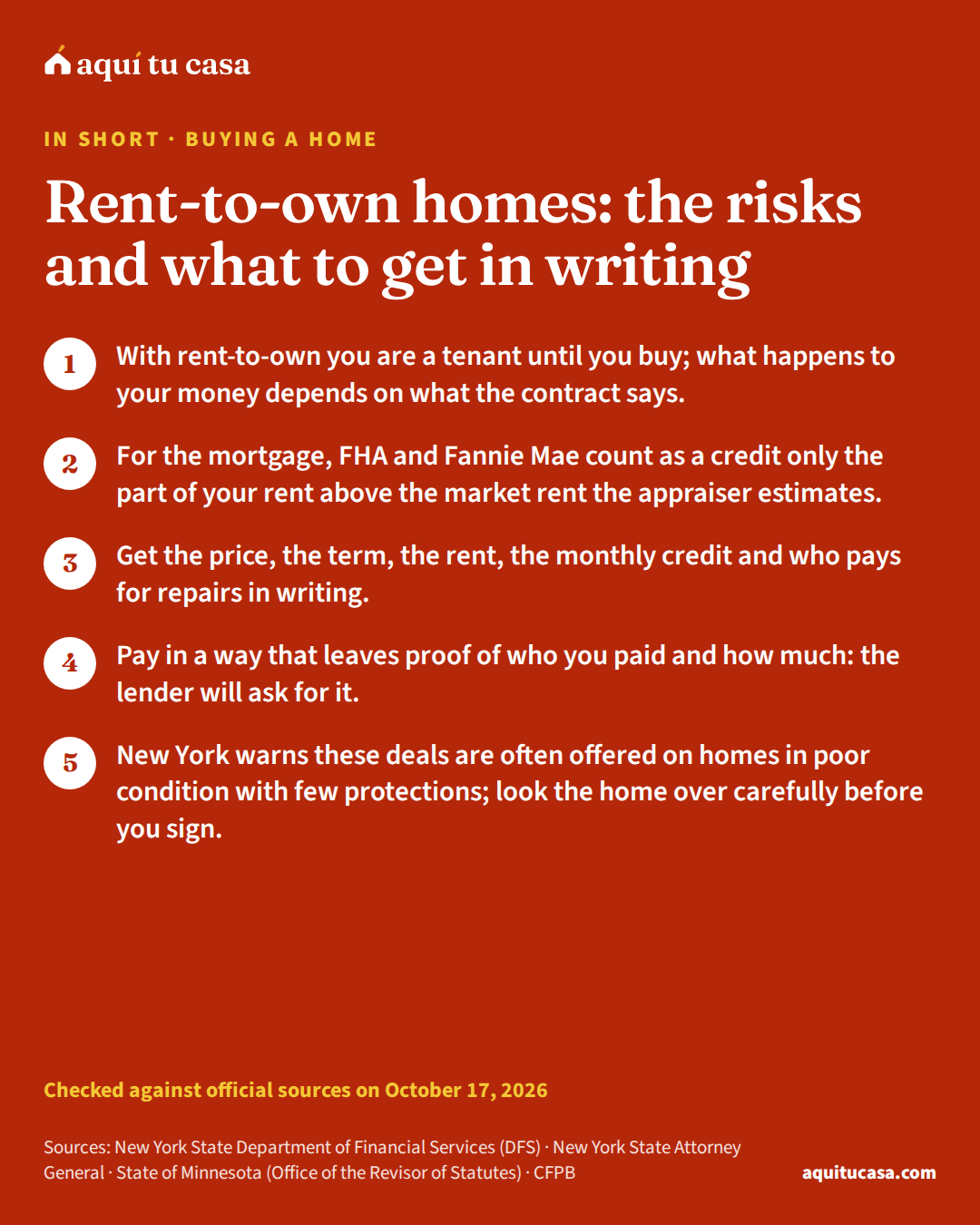
- With rent-to-own you are a tenant until you buy; what happens to your money depends on what the contract says.
- For the mortgage, FHA and Fannie Mae count as a credit only the part of your rent above the market rent the appraiser estimates.
- Get the price, the term, the rent, the monthly credit and who pays for repairs in writing.
- Pay in a way that leaves proof of who you paid and how much: the lender will ask for it.
Is this for you?
This guide is for you if…
- You are being offered a home to rent with the option to buy it later (rent-to-own, lease-to-own or a lease with an option to purchase).
- You already rent with an option to buy and want to know how your rent will count when you apply for a mortgage.
- You want to know what the contract should say before you sign or hand over money.
Get direct help first if…
- You are being offered a home paid in installments while the owner keeps the deed until the end: that is a contract for deed, which has its own guide.
- You rent with no option to buy and have questions about your lease: start with the guide to your lease explained.
- You already received an eviction notice: look for free legal aid today; this guide does not replace that help.
Renting a home now and buying it later sounds like a good plan if you do not qualify for a mortgage yet. This guide is for anyone thinking about signing a rent-to-own agreement or already living in a home under one: it explains how it works, the risks regulators warn about, what to get in writing and how your rent counts when you finally apply for the loan.
How rent-to-own works
Rent-to-own combines two things: a leaseleaseA lease, or rental agreement, is the contract in which the owner or landlord gives you the right to live in and use a property for a set period of time in exchange for payment, usually rent. While the lease lasts you have possession, but the landlord still owns the property. The lease says how much you pay and when, who handles maintenance and how the agreement can end. Your rights as a tenant are usually spelled out in the lease and in your state and local laws. Before complaining to the landlord, it helps to read the lease and make sure you are also following the rules you agreed to.See the full definition and an option, meaning the right to buy the home later on the terms the agreement sets. You will see it called “rent-to-own,” “lease-to-own” or a “lease with option to purchase.”
In principle, until you buy, you are a tenant. New York, for example, requires rent-to-own agreements for manufactured homes in parks to state that until title is transferred, the tenant is occupying a rented home.2 What happens to your money, to repairs and to the price depends on what the contract says and on your state’s laws. That is why it helps to compare the purchase price with the home’s fair market value, one of the items New York requires in those contracts.2
Many agreements promise that part of your rent is “credited” toward the purchase. For a lender, that credit has rules: Fannie Mae defines it as the portion of rent payments that can be credited toward the down payment under a documented agreement.6 Further down you will see how much actually counts.
How it differs from a contract for deed
They look alike, but they are not the same. With a contract for deed you are already buying: the seller keeps title until the last payment, and you act as the owner, typically paying taxes, insurance, repairs and maintenance.4 With rent-to-own, you rent and have the right to buy later. Minnesota law says it plainly: a lease, including one with an option to purchase, is not a contract for deed.3
Rent-to-own and contract for deed
You rent and can buy later
Rent-to-own
Read what your contract says, not what it is called: New York DFS warns that some companies offer hybrid deals, part lease and part mortgage, with few protections.1
The contract for deed guide explains that other arrangement and how to record it.
The risks regulators warn about
The New York State Department of Financial Services (DFS) urges caution before signing any rent-to-own agreement. It is investigating whether some of these deals are really unlicensed, predatory mortgage lending. It says they are often marketed to families in financial trouble, with the promise of homeownership, but that they often do not lead to owning a home.1
The risks DFS describes:
- Fewer protections. Leases and mortgages must provide basic protections, but some companies claim to offer a “hybrid” agreement that provides none, with harsh terms. DFS suggests considering whether a traditional lease is a better option.1
- Homes in poor shape, with repairs on you. These companies tend to deal in severely distressed homes that have sat empty a long time, and their agreements put the whole cost of repairs on you, even though New York law would put it on the landlord.1
- Tours that do not show everything. Tours are usually done with the utilities off, so you cannot test whether they work. Some companies already have inspections that found mold, termites or asbestos, but if you do not spot it, they will not tell you.1
- Possible violations of the law. In New York, these deals may violate laws on fair lending, mortgage protections, interest rates, habitabilitywarranty of habitabilityThe warranty of habitability is a tenant's right to a livable, safe and sanitary home. The rules depend on the state. In New York, according to the Attorney General's office, this right is implied in every written or oral residential lease, and a lease clause that waives it is void; it is breached, for example, when heat or hot water is not provided regularly. In California, the landlord must keep plumbing, heating, electrical equipment and locks in working order and keep the unit free of pests. In Arizona, the law requires keeping the home in a fit and habitable condition.See the full definition and property condition.1

What you should have in writing
New York offers a good model. For manufactured homes in parks, it requires the contract to clearly describe the terms, all fees and payments, the home’s fair market value and who pays for major repairs. It also gives a right to an itemized account of your payments once a year, and if the park owner ends the lease, the owner must pay back the payments made under the rent-to-own contract.2 Even if your situation is different, that list works as a checklist for any contract.
And think about what the lender will ask for on the day you apply. To count your rent credit, Fannie Mae requires an agreement showing an original term of at least 12 months, the total number of months, the monthly rent and the monthly credit.6 FHA requires the lease with option to purchase and evidence that the payments were received.5
Before you sign and while you rent
1. Get the full contract and take it to a counselor
Before you hand over any money
A HUD-approved housing counselor can go over it with you, often for free or at low cost.8
2. See the home with the utilities on
Before you sign
A tour with no power or water does not let you test them; ask for an inspection.1
3. Get the price, the term and the monthly credit in writing
Before you sign
Fannie Mae requires a term of at least 12 months, the monthly rent and the monthly credit.6
4. Get in writing who pays for repairs
Before you sign
New York requires contracts for homes in parks to say who covers major repairs.2
5. Pay in a way that leaves proof
Every month
Checks, transfers or money orders that show who you paid and how much.6
6. Get your loan application ready
Before the option runs out
Gather your bank statements and proof of where your down payment comes from.7
Try it with your numbersMortgage calculator
When it is time to buy: how much your rent counts
One key point: not all the rent you paid counts toward the mortgage.
On an FHA loanFHA loanAn FHA loan is a mortgage made by a private lender and insured by the Federal Housing Administration (FHA), an agency of the U.S. government. That insurance protects the lender if you stop paying, which is why the lender can accept a lower down payment and a less-than-perfect credit history than on a conventional loan. Federal law sets the minimum cash investment at 3.5% of the property's value and caps the loan amount at the FHA limit, which changes by county. In exchange for the insurance you pay a mortgage insurance premium.See the full definition, “rent credits” are only the part of each payment above the fair market rent the appraiser estimates. The lender may add those amounts up and use them toward your minimum contribution, the Minimum Required Investment.5 That contribution is at least 3.5% of the home’s value.5
For a conventional loanconventional loanA conventional loan is any mortgage that is not insured or guaranteed by the federal government: it is not FHA, VA or USDA. The lender, or the companies that buy the loans (Fannie Mae and Freddie Mac), carry the risk. When the amount is within the conforming loan limit the loan is called "conforming"; above it, it is a "jumbo" loan. It usually asks for a higher credit score than an FHA loan and, if your down payment is less than 20% of the price, you are normally required to buy private mortgage insurance (PMI) until you build enough equity in the home.See the full definition that follows Fannie Mae’s rules, the credit is the difference between the market rent, which the appraiser sets in the appraisalhome appraisalAn appraisal is a written document that gives a professional appraiser's opinion of how much a property is worth. The lender orders it before approving the mortgage, because the home is the loan's collateral and the lender does not want to lend more than it is worth. If the appraisal comes in below the price you agreed, the bank bases the loan on the lower value and you will have to cover the difference, renegotiate the price or walk away if your contract allows it. An appraisal is not an inspection: it measures value, not the home's condition.See the full definition, and the rent you actually paid, and it cannot be more than that.6 If your rent matched the market, there is no credit, whatever the contract says.
Notice who decides the market rent: the appraiser, in the appraisal of the home you are buying.6 In other words, the final credit is known only once you are applying for the loan. If the contract promises a very large monthly credit, ask how it was calculated and keep a copy. And remember that requirements vary from lender to lender, and that a lender may reject incomplete documents.7
Example with real numbers
Renting now and buying later, with typical numbers
With the typical US rent and home value, an FHA loan with the minimum down payment and the average rate of 7.18% as of November 5, 2026.
- Typical monthly rent in the US
- $1,413
- Price of a typical US home
- $332,700
- FHA minimum down payment (3.5%)
- $11,645
- Monthly FHA payment (with taxes and insurance)
- $2,759
This is an example with national numbers.5 Only the part of your rent above market rent counts as a credit toward the down payment.56 Try your own numbers.
Run it with your numbersRent or buy?
The rent vs. buy tool compares both options with your numbers, and the how much down payment you need guide explains the minimum for each loan.
If you have problems or face eviction
If you fall behind or the owner wants to end the deal, your rights depend on your state and your contract. In New York, DFS says that under the “equitable mortgage” doctrine, someone living in a single-family home who pays rent and improves it can build equity in it; so the company cannot just evict them for falling behind, and they should get the protections of a foreclosureforeclosureForeclosure is the process by which the lender or servicer takes back the property after the homeowner fails to make mortgage payments. The rules and timelines depend on each state; all of them include advance notices and, in general, time to catch up or ask for an alternative, such as a repayment plan or a loan modification. If you fall behind, call your servicer and a HUD-approved housing counseling agency early: foreclosure counseling is free and exists for exactly this.See the full definition proceeding. If you received an evictionevictionEviction is the legal process a landlord uses to get back a rented home when the tenant does not want to leave. The most common reasons are unpaid rent, serious lease violations or a lease that has ended. First the landlord must give you written notice. If it is not resolved, the landlord needs a court order, and a law enforcement officer must carry out the removal. If you are sued, you have the right to file a written answer explaining to the court why you should not be evicted. The rules change by state and city.See the full definition notice, DFS suggests talking to a lawyer about that defense.1
Free legal aidlegal aidLegal aid is the free civil legal help that nonprofit organizations and their lawyers provide to low-income people in civil, not criminal, matters. In housing, that includes representing families facing eviction or foreclosure, alongside matters such as custody, child support, protection from domestic violence and access to benefits. In the United States, the Legal Services Corporation, created by Congress, funds a nationwide network of these organizations; its finder points you to the one in your area. Each sets its own income limits.See the full definition is an option: LSC has a search tool for organizations by address or city.9 In New York, the HOPP program connects people with counselors and legal services at no cost at (855) 466-3456, and the HOPE NOW hotline answers 24 hours a day at 888-995-4673.1 The guide on what to do if you get an eviction notice explains the first steps.
If the problem is about money rather than the law, a HUD-approved housing counselor can go over your budget, your contract and your options with you, often for free or at low cost.8 Bring the contract, your payment receipts and any notice you received.

If this is you
You already rent-to-own
Keep proof of every payment, showing who you paid and how much: the lender will ask for it.6 Check your contract against the guide to your lease explained.
You need time to build credit
Use the rental months to get your application ready: bank statements and proof of your down payment.7 See how to report your rent to the credit bureaus.
Costly mistakes
Mistake: Believing all your rent counts toward the down payment.
Instead: For the mortgage, only the part above market rent counts, and only with paperwork.56
Mistake: Paying rent in cash without receipts.
Instead: Pay by check, transfer or money order: the proof must show who you paid and how much.6
Mistake: Touring the home with the utilities off and signing.
Instead: Ask for an inspection with power, water and gas on.1
Mistake: Accepting that every repair is yours without checking your state's law.
Instead: Get in writing who pays for what: in New York, the law would put repairs on the landlord.1
Mistake: Not asking what happens to your money if you do not buy.
Instead: Ask for the contract to say it clearly before you sign.2

What to do this week
- Ask for the full contract, including the option to purchase, and do not hand over money until you have read it carefully.1
- Take it to a HUD-approved housing counselorHUD-approved housing counselorA HUD-approved housing counselor works at an agency HUD has approved to provide housing counseling: independent, expert advice customized to your situation about buying a home, renting, a missed mortgage payment, a foreclosure or credit problems. The agencies usually charge little or nothing; many serve in Spanish and offer the homebuyer education course several assistance programs require. They are not lenders or real estate agents and sell you nothing. Your county page lists the official agencies with phone numbers.See the full definition to review it, often for free or at low cost.8
- Get in writing the price, the term, the rent, the monthly credit and who pays for repairs.62
- Ask for a home inspectionhome inspectionA home inspection is a review of the property's physical condition by an inspector before you finish buying: roof, foundation, plumbing, electrical, heating and cooling, signs of moisture or pests. It is often part of the home buying process and you pay for it, not the lender; unlike the appraisal, it does not say what the home is worth but what problems it has. With the report you can ask for repairs, negotiate the price or walk away if your contract includes an inspection contingency. Some assistance programs require one.See the full definition with the utilities on; the home inspection guide explains what it covers.1
- If you already rent this way, gather proof of all your payments and your bank statementsbank statementA bank statement is the summary your bank or credit union gives you of the activity in your account over a period: deposits, withdrawals, payments and the ending balance. Most send one every month, on paper or online; the law only requires a monthly statement when there was at least one electronic transfer that month, and otherwise it may come quarterly. When you apply for a mortgage, the lender can use your statements to verify you have money for the down payment, closing and reserves. Under Fannie Mae's rules, they must show the bank's name, your name, part of the account number, the period, all transactions and the ending balance.See the full definition.67
- If you get a notice to leave, look for free legal aid today.9
Your numbers
That is $11,645. The minimum for this loan is 3.5%.
It changes the result the most.
Adjust advanced details
These are example scenarios, not data: no one knows how much a home will rise.
Real data: in the United States, according to the FHFA House Price Index, prices changed by 6.3% a year on average in the 10 years through 2025. The past does not tell you how much they will rise.
Example assumption; change it.
Repairs and upkeep. Example assumption.
What the money you do not put into the home would earn. Example assumption.
Commissions and taxes when selling. Example assumption.
Let's do the math
If you stay 7 years
Renting comes out ahead by about $90,044
With these assumptions, buying does not come out ahead within 30 years.
- Cost of buying per month (first year)
- $3,037
- Rent per month (first year)
- $1,413
- Cash up front to buy
- $21,626
- What you keep when selling in year 7
- $86,049
Buying's advantage, year by year
Above the dashed line buying is better; below it, renting. The dot marks the years you stay.
Under other scenarios (7 years)
| Appreciation | Break-even | In 7 years |
|---|---|---|
| Low (1%) | Never | Rent +$135,484 |
| Medium (3%) | Never | Rent +$90,044 |
| High (5%) | Year 17 | Rent +$38,767 |
This rests on assumptions
We use the place's typical tax (0.94% of value), an example insurance (0.5% of value a year) and example closing costs (3% of price). Appreciation, rent increases and returns are examples: change them and watch how the result moves.
An educational estimate, not a recommendation. It does not include tax deductions or rate changes.
Ready to see the numbers? Find your county here
See how this applies in your county: its loan limits, prices and rents, from the official data.
Printable checklist
Frequently asked questions
What is rent-to-own?
It means renting a home with the right to buy it later, on the terms the contract sets. Until title is transferred, you are a tenant. It is also called lease-to-own or a lease with an option to purchase.
Does the rent I pay count toward the down payment?
Only what the contract says, and lenders set limits. FHA can count toward your minimum contribution the part of the rent above the fair market rent the appraiser estimates. Fannie Mae calculates the credit as the difference between market rent and what you paid, with an agreement of at least 12 months.
Is it the same as a contract for deed?
No. With a contract for deed you are already buying in installments and you act as the owner, even though the seller keeps the deed. Minnesota law, for example, says a lease with an option to purchase is not a contract for deed.
Who makes the repairs on the home?
It depends on the contract and your state. New York DFS warns that these agreements often put all repairs on the consumer, even though that state's law would put them on the landlord. Ask for the contract to say clearly who pays for what.
What happens to my money if I do not end up buying?
It depends on what the contract says, so get it in writing before you sign. New York DFS warns that these deals often do not lead to homeownership. In New York, for manufactured homes in a park, if the park owner ends the lease, the owner must pay back the payments made under the rent-to-own contract.
What papers will the lender ask for?
To count your rent credit: the lease with option to purchase, proof of every payment (canceled checks, bank statements or receipts showing who you paid and how much) and the appraisal showing market rent. Plus the papers for any application, such as your most recent bank statements.
Can I be evicted if I fall behind on rent?
It depends on your state and your contract. In New York, DFS says that under the equitable mortgage doctrine, someone who pays rent and improves a single-family home can build equity and be entitled to the protections of a foreclosure proceeding. If you get a notice, look for free legal aid as soon as you can.
Where can I get free help?
A HUD-approved housing counselor can go over the contract and your numbers with you, often for free or at low cost. For a legal problem, LSC has a legal aid search by address or city. In New York, the HOPP program connects people with counselors and legal services at no cost.
Sources
Every figure in this guide comes from one of these official sources. The number next to a sentence leads to the source behind it.
Each source on one line: who publishes it, its title, its address and the date we read it.
- 1. New York State Department of Financial Services (DFS) · Rent-To-Own and Land Installment Contracts · dfs.ny.gov · Accessed October 17, 2026
- 2. New York State Attorney General · Residential Tenants' Rights Guide · ag.ny.gov · Accessed October 17, 2026
- 3. State of Minnesota (Office of the Revisor of Statutes) · Minnesota Statutes §507.235, Filing contracts for deed · revisor.mn.gov · Accessed October 17, 2026
- 4. CFPB · What is a contract for deed? · consumerfinance.gov · Accessed October 17, 2026
- 5. HUD · FHA Single Family Housing Policy Handbook 4000.1 · hud.gov · Accessed October 17, 2026
- 6. Fannie Mae · Fannie Mae Selling Guide B3-4.3-12, Rent-Related Credits · selling-guide.fanniemae.com · Accessed October 17, 2026
- 7. CFPB · Create a loan application packet · consumerfinance.gov · Accessed October 17, 2026
- 8. CFPB · Find a Housing Counselor · consumerfinance.gov · Accessed October 17, 2026
See the other 1 sources
- 9. Legal Services Corporation (LSC) · I Need Legal Help · lsc.gov · Accessed October 17, 2026
Keep reading
Related guides
If this guide helped, these follow the same path.

Buying a home 12 minute read
Contract for deed (land contract): the risks
What a contract for deed is, why you can lose the home and what you paid, how to record it and what some states require before a seller can take it back.
- In a contract for deed the seller keeps the deed until the last payment, but you pay the taxes, insurance, repairs and maintenance.
- If you fall behind, the seller often tries to evict you right away and keep your payments and improvements; with most mainstream mortgages the lender must wait 120 days before starting foreclosure.
- You can record the contract at your county's land records office, so you get notices if someone puts a mortgage or a lien on the home.
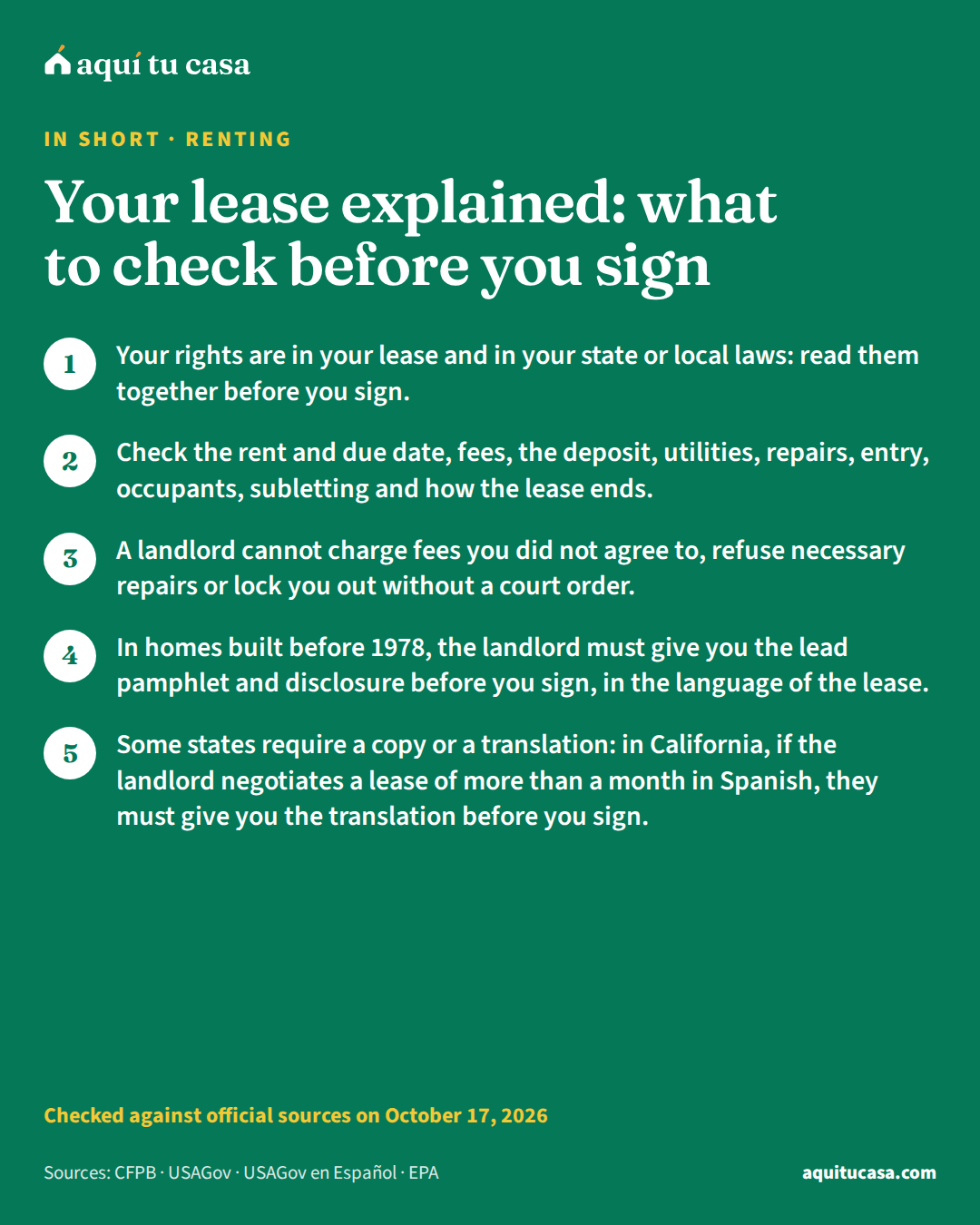
- Renting Your lease explained: what to check before you sign What a lease is, which clauses to read before you sign, the lead paint disclosure, your fair housing rights and where to get free help. 15 minute read
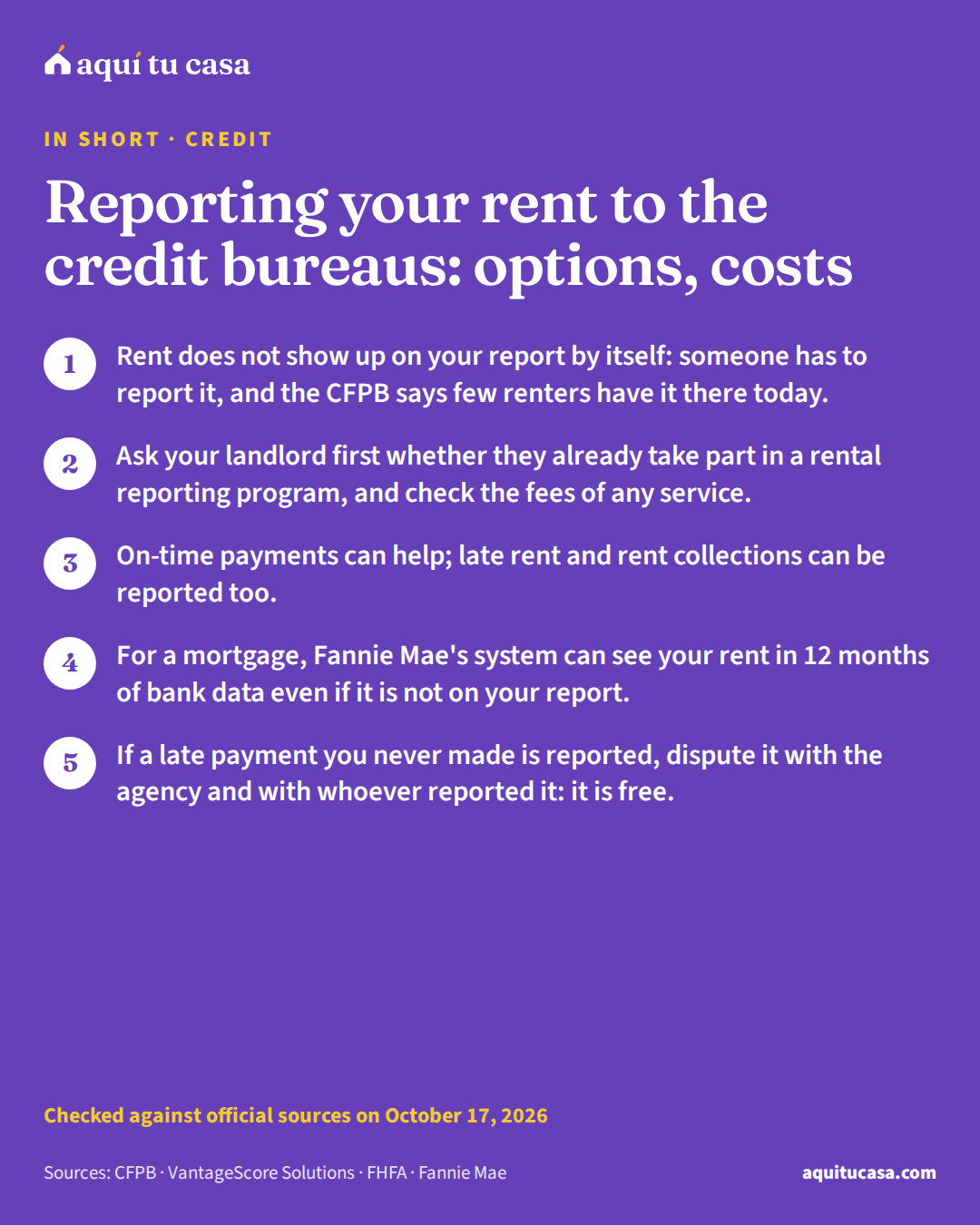
- Credit Reporting your rent to the credit bureaus: options, costs How to make your rent payments count on your credit: what your landlord does, what services exist, which fees to check and what happens if you pay late. 11 minute read
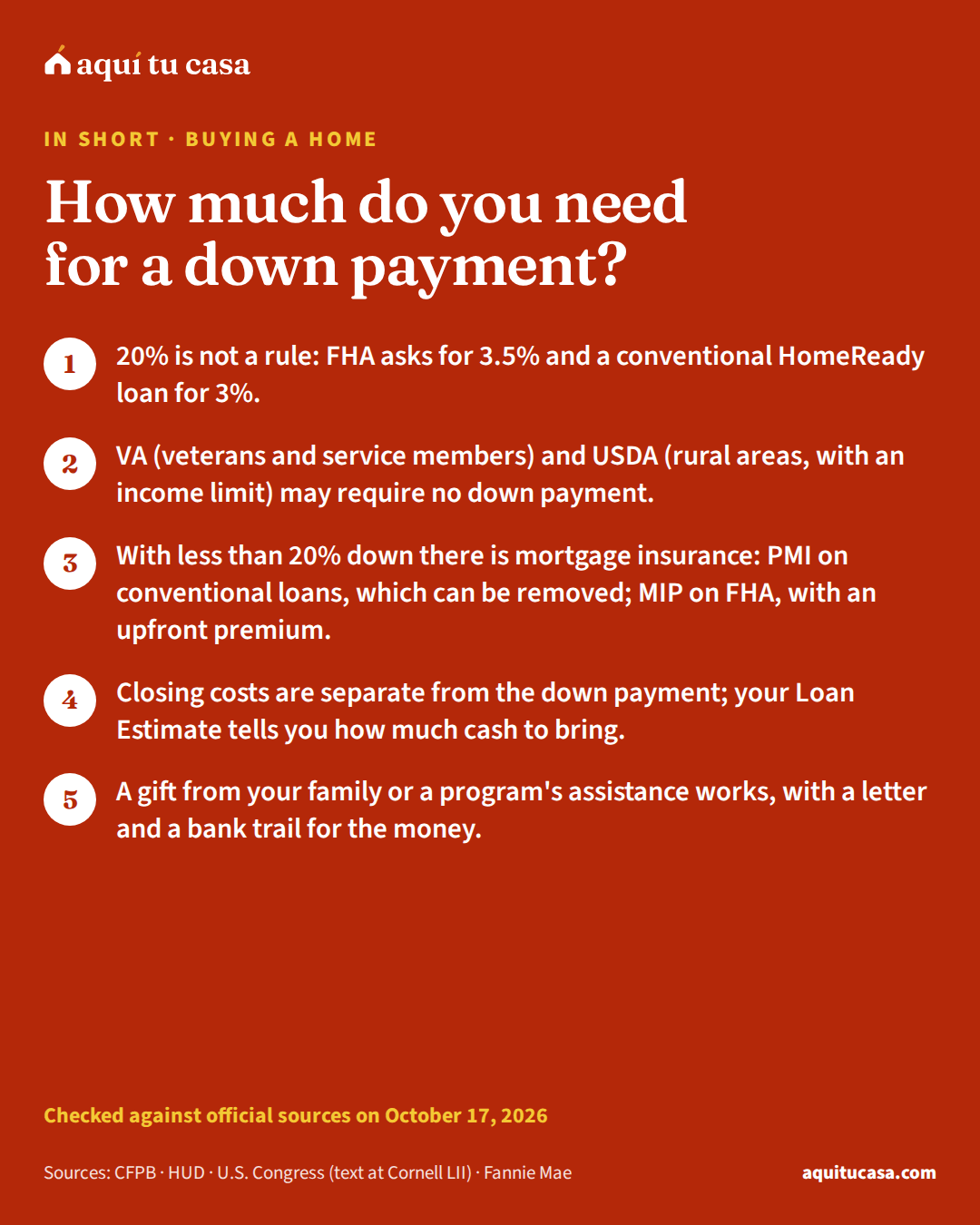
- Buying a home How much do you need for a down payment? 20% is not required: what each loan asks for (FHA, conventional, VA, USDA), what changes with less than 20% down, and where the money can come from. 11 minute read
Tools for this topic
Was this guide useful?
Thank you. Your answer stays in your browser; nothing is sent.