Buying land or a mobile home: title, loans and risks
How to buy land or a manufactured (mobile) home: real or personal property, how it is titled, FHA and chattel loans, leased lots and colonias.
Verified against official sources on October 17, 2026 15 official sources

Show contents
In short
What you need to know
Quick answer
A manufactured (mobile) home can be titled as real estate or as personal property, and that changes everything: with the land and a permanent foundation it can be financed with a mortgage, such as an FHA Title II or conventional loan; as personal property it is financed with a chattel loan, which according to the CFPB usually has higher rates and fewer protections. FHA also offers Title I loans for the home alone, the lot alone or both. If you buy a lot from a developer, federal law can give you a property report and seven days to cancel.
What matters most
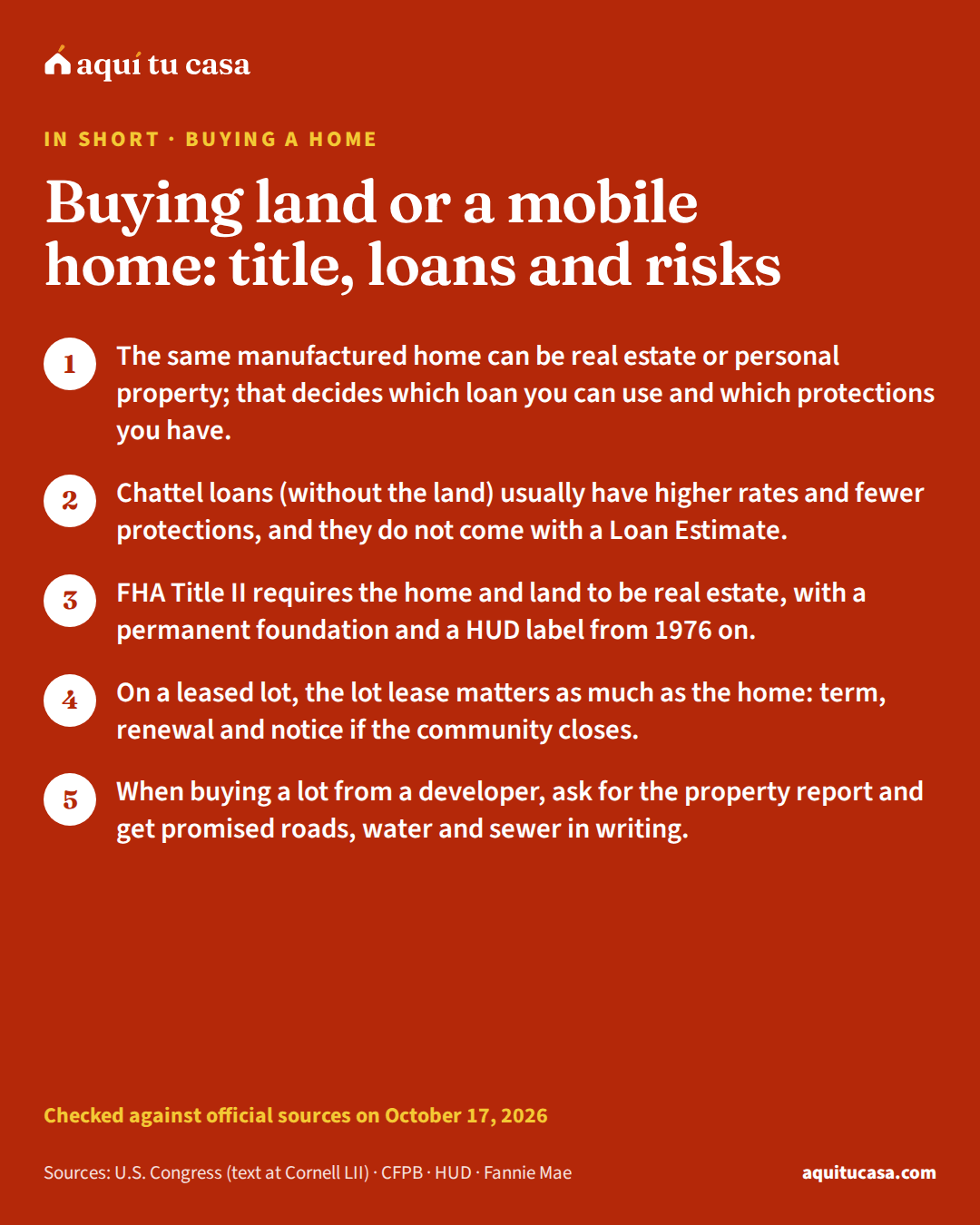
- The same manufactured home can be real estate or personal property; that decides which loan you can use and which protections you have.
- Chattel loans (without the land) usually have higher rates and fewer protections, and they do not come with a Loan Estimate.
- FHA Title II requires the home and land to be real estate, with a permanent foundation and a HUD label from 1976 on.
- On a leased lot, the lot lease matters as much as the home: term, renewal and notice if the community closes.
Is this for you?
This guide is for you if…
- You want to buy a manufactured home, also called a mobile home or trailer, new or used.
- You want to buy land to place a manufactured home on or to build.
- Your home will sit on a leased lot or in a manufactured home community and you want to know what changes.
Get direct help first if…
- You are buying a new site-built home from a builder: the new construction guide is for you.
- You already signed a contract for deed and are having problems with the seller: free legal aid can review your case; here we only explain what it is.
A manufactured home, which many people call a mobile home or trailer, can be the most affordable way to own a home, especially if you already have or can buy land. But the rules differ from those for a site-built house. This guide is for anyone thinking about buying land, a manufactured home or both: it explains when the home is real estate and when it is personal property, how it is titled, which loans exist and what to check before you sign.
Mobile home, manufactured home and land: what we mean
Federal law calls a manufactured home a structure transportable in one or more sections, of a certain minimum size, designed to be used as a dwelling with or without a permanent foundation when connected to utilities.1 The CFPB explains that these homes are commonly called mobile homes or trailers. They are built in a factory, carried to the site on their own framework and must be built and installed under HUD standards.2
The big difference from a site-built house is legal: a manufactured home can be titled as real estate or as personal property. To be real estate, it generally has to sit on a permanent foundation on land owned by the home’s owner. As personal property, it is generally financed with a personal property loan, called a chattel loan.2 That difference decides which loan you can use, what it costs and which protections you get.
Real estate or personal property, side by side
Home and land together
Real estate
If you own the land, ask whether the home can be titled as real estate before accepting a chattel loan.2
Why real estate versus personal property matters
According to the CFPB, chattel loans are secured by the home but not the land, and generally have higher interest rates and fewer consumer protections than mortgages. Some people choose them so they do not put their land at risk if they cannot pay. Manufactured homes often come with higher rates and few chances to refinance, and owners who do not own the land are more likely to see their homes lose value and have fewer protections if they fall behind.3
The paperwork changes too. The CFPB notes that only mortgage borrowers get certain RESPA disclosures when applying for and closing a loan.2 And for a manufactured home loan not secured by real estate, you do not get a Loan EstimateLoan EstimateThe Loan Estimate is a three-page form you receive from the lender within days of applying for a mortgage. In the same format at every bank, it sums up the terms of the loan being offered: amount, interest rate, whether the payment can change, the estimated monthly payment with taxes and insurance, the itemized closing costs and how much cash you need at closing. Because every lender uses the same form, it lets you compare offers side by side. It commits you to nothing: requesting one is not accepting the loan.See the full definition or Closing Disclosure, but “Truth-in-Lending” disclosures instead.4 Those disclosures still show the interest rateinterest rateThe interest rate on a mortgage is what you pay each year to borrow the money, expressed as a percentage of the loan balance. It does not include fees or other charges; that is what the annual percentage rate (APR) is for. On a fixed-rate loan the rate never changes over the life of the loan; on an adjustable-rate loan it can go up or down after an initial period. The rate you are offered depends on your credit score, your down payment, the loan type and the market, and you see it on the first page of the Loan Estimate.See the full definition and costs: compare several offers.

Lenders can also charge slightly more for a manufactured home loan than for a site-built home.5 The interest rates guide explains how to compare offers, and the mortgage loan types guide covers the differences between FHA and conventional loans.
How a manufactured home is titled
Each state has its own process for turning a manufactured home from personal property into real estate. As an example, in Florida the owner of a mobile home permanently affixed to land the same person owns, or leases under a recorded lease of 30 years or more, can permanently retire the mobile home title. They record the original title, the land’s legal description and a sworn statement that the home is affixed to the land with the county, then ask the state to retire the title. From then on, the home is conveyed by deed together with the land.9
This matters for the loan. For FHA Title II, at closing the titletitleTitle is your legal right to own and possess a property. The deed is the document showing that the seller transferred that right to you, and legal title is the title that can be documented in public records. As part of the purchase, a title search is done to see whether anyone else has a claim against the home; common claims come from a previous owner's unpaid taxes or from contractors who say they were not paid for work on the home. Title insurance protects you if such a claim shows up later.See the full definition must show the home and land classified as real estate, and if there were two titles, state or local requirements for canceling the personal property title must be met.6 Fannie Mae also requires the home and land to be legally classified as real property under state law.7 The title insurance guide explains how title is checked and what a deeddeedA deed is the legal document the seller uses to transfer ownership of the home to you. The seller signs it at closing, it lists the names of all the buyers and you receive a copy. Afterward, the settlement agent records it with the county records office; that recording puts the public on notice that you are now the owner. There are several types: a warranty deed gives the most promises about the title, and a quitclaim deed promises nothing. Do not confuse it with a deed of trust, which is the mortgage document.See the full definition is.
Loans: FHA Title II, FHA Title I, conventional and chattel
| Option | What it finances | Main requirements |
|---|---|---|
| FHA Title II | Home and land as real estate | Permanent foundation, at least 400 square feet, HUD label from 1976 on |
| FHA Title I | The home alone, the lot alone or both | Living in the home; the home can be personal property |
| Conventional (Fannie Mae) | Home and land as real estate | At least 12 feet wide and 400 square feet, no wheels or axles |
| Chattel | The home only, as personal property | Varies by lender |
For an FHA Title II loan, the home must be designed for one family, have at least 400 square feet and carry the HUD certification label showing it was built on or after June 15, 1976, under federal standards. It must also be classified as real estate, stay on its permanent chassis, have a permanent foundation under HUD’s guide and have come directly from the manufacturer or dealer to the site.6
FHA Title I works differently. It finances the purchase or refinance of the home alone, the lot alone where you will place it, or the home and lot together. The home can be treated as personal property when it keeps its vehicle title, or as real estate when that title is canceled. The lender may take the home as personal property collateral and, at the same time, a lienlienA lien is a legal right a creditor holds in your property to make sure you repay a debt. It usually prevents the property from being sold until the debt is paid, and if you do not pay, the creditor may be able to take the property. Your mortgage is a lien on your home: when you pay it off, the lien is released and that shows up in your county's property records. There are other kinds, such as a federal tax lien, which is the government's legal claim against all your property when you do not pay a tax debt.See the full definition on the land. You must own the home and live in it as your principal residence. The maximum term is 20 years and 32 days for the home and 15 years and 32 days for the lot.6
On a conventional loan Fannie Mae buys, the loan is secured by the home and your interest in the land, and both must be real estate.7 The home must sit on a permanent chassis attached to a permanent foundation, with the HUD data plate and label; with no hitch, wheels or axles; at least 12 feet wide and 400 square feet; and permanently connected to a septic tank or sewer.8

If the home goes on a leased lot or in a community
Many manufactured homes sit on leased lots. For a Title I loan in a community of three or more homes owned by the same entity, the lot lease must run three years or longer, be renewable for terms of one year or more and require the owner to give you written notice at least 180 days before the term ends if you must move because the community is closing. If notice is late, the lease renews for another year.6
Fannie Mae, by contrast, only accepts a home on leased land if you own the home and it is in a condo or planned development it has approved.7 And remember what the CFPB says: owners who do not own the land are more likely to see their homes lose value and have fewer protections if they fall behind.3
If this is you
Your home will go on a leased lot
With an FHA Title I loan, the lot lease must last at least three years and give you 180 days' notice if the community closes.6
You want to buy land to build
A construction loan is usually short-term with a higher rate; compare several.10 The new construction guide covers inspections and warranties.
You are looking for the most affordable option
A HUD-approved housing counselor can compare a chattel loan and a mortgage with you, often for free or at low cost.15

Buying land: what to check before you sign
If you buy a lot from a developer, the Interstate Land Sales Full Disclosure Act protects you when the sale is not exempt. The developer must give you a printed property report before you sign the contract, and it cannot say it will provide or finish roads, sewers, water, gas, electricity or recreational amenities without putting that in the contract.11 You can cancel the contract until midnight of the seventh day after signing, or longer if your state allows; and if you did not get the report before signing, you have up to two years.11
Buying land and a manufactured home, step by step
1. You check the lot and what the seller promises
Before signing
If you are promised roads, water or sewer, they must be in the contract.11
2. You ask for the property report
Before signing with a developer
If the sale is not exempt, you have 7 days to cancel; 2 years if you did not get it.11
3. You check the home and its label
Before making an offer
For FHA Title II, the HUD label must show June 15, 1976, or later.6
4. You decide how it will be titled
Before applying for the loan
Real estate with the land, or personal property: that sets the loan.2
5. You compare loans
With several offers
Chattel loans usually have higher rates and fewer protections.3
Try it with your numbersCompare loans
If you plan to build on your land, the CFPB explains that a construction loan is usually short-term, with higher rates than a mortgage, and the money is advanced in stages as work progresses. At the end you may pay the balance in a lump sum or perhaps convert it to a mortgage; if it does not convert on its own, you may have to apply for a new loan.10 If you only want the lot for a manufactured home, FHA Title I has loans to buy the lot.6
Colonias and contracts for deed
The word “colonia” has a meaning in federal law. A colonia is a community in Arizona, California, New Mexico or Texas, within 150 miles of the Mexican border, identified by criteria such as lack of potable water, adequate sewage or decent, safe and sanitary housing, that already existed before the law that defined it. Those four states must set aside part of their federal community development funds for water, sewage and housing for colonia residents.12
Contracts for deed also come up in land and home purchases. According to the CFPB, the seller keeps legal title until you finish all the payments, and in the meantime you usually carry the repairs, property taxes and improvements. The CFPB found these products often target Hispanic and immigrant communities, among others.13 Before signing one, or if you already signed and have doubts, free legal aid can review your case. LSC funds legal aidlegal aidLegal aid is the free civil legal help that nonprofit organizations and their lawyers provide to low-income people in civil, not criminal, matters. In housing, that includes representing families facing eviction or foreclosure, alongside matters such as custody, child support, protection from domestic violence and access to benefits. In the United States, the Legal Services Corporation, created by Congress, funds a nationwide network of these organizations; its finder points you to the one in your area. Each sets its own income limits.See the full definition organizations in every state, and on its site you find the nearest one by address or city.14 The free legal aid guide explains how to ask for it.

Costly mistakes
Mistake: Accepting a chattel loan without asking whether the home can be real estate.
Instead: If you own the land, ask: chattel loans usually have higher rates and fewer protections.3
Mistake: Placing the home on a leased lot without reading the lot lease.
Instead: Check the term, renewal and notice if the community closes.6
Mistake: Buying a lot from a developer without the property report.
Instead: Ask for it before signing; if you did not get it, you can cancel within two years.11
Mistake: Trusting promises of roads, water or sewer that are not in the contract.
Instead: Insist that they be written into the contract.11
Mistake: Buying an older home without checking the HUD label.
Instead: For FHA Title II, it must be from June 15, 1976, or later.6
Mistake: Signing a contract for deed without understanding who holds title.
Instead: The seller keeps title until the last payment; free legal aid can review it with you first.13
What to do this week
- Find out whether the home you are interested in is titled as real estate or personal property.2
- Check the year of manufacture and the HUD certification label.6
- If the home will go on a leased lot, ask for the lot lease and check the term, renewal and notice.6
- If you are buying a lot from a developer, ask for the property report before signing.11
- Get offers from several lenders, mortgage and chattel, and compare them in the compare loans tool.3
- If you want help, a HUD-approved housing counselorHUD-approved housing counselorA HUD-approved housing counselor works at an agency HUD has approved to provide housing counseling: independent, expert advice customized to your situation about buying a home, renting, a missed mortgage payment, a foreclosure or credit problems. The agencies usually charge little or nothing; many serve in Spanish and offer the homebuyer education course several assistance programs require. They are not lenders or real estate agents and sell you nothing. Your county page lists the official agencies with phone numbers.See the full definition gives independent advice, often free or at low cost.15
Your numbers
We start with the typical home value in the United States. Enter the price you are looking at.
Adjust advanced details
FHA
Estimated monthly payment
$2,759
Principal and interest, tax, homeowners insurance and mortgage insurance.
- Down payment
- $11,645 (3.5%)
- Mortgage insurance
- $147 a monthFHA annual premium · whole term
- Upfront premium or fee
- $5,618FHA upfront mortgage insurance · added to the loan
- Paid in 5 years
- $141,609
- Balance after 5 years
- $308,088
- County limit
- Find your county to see the limit
Rules and notes
- Minimum down payment of 3.5% with a score of 580 or more; between 500 and 580 at least 10% is required.In effect since September 14, 2016 · Source ↗
- Mortgage insurance: 1.75% upfront plus an annual premium; with less than 10% down it lasts the whole term.In effect since March 20, 2023 · Source ↗
- Only citizens, lawful permanent residents and citizens of the Freely Associated States; non-permanent residents are no longer eligible.In effect since May 25, 2025 · Source ↗
Conventional, 3% down
Estimated monthly payment
$2,747
Principal and interest, tax, homeowners insurance and mortgage insurance.
- Down payment
- $9,981 (3%)
- Mortgage insurance
- $161 a monthPMI (example) · ends around year 13
- Upfront premium or fee
- None
- Paid in 5 years
- $140,854
- Balance after 5 years
- $304,358
- County limit
- Find your county to see the limit
Rules and notes
- Fannie Mae requires a minimum score of 620 on manually underwritten fixed-rate loans; its automated system (DU) sets no fixed minimum.In effect since April 22, 2026 · Source ↗
- Private mortgage insurance (PMI) with less than 20% down; it cancels on its own at 78% of the original value.In effect since January 1, 2024 · Source ↗
- Fannie Mae buys loans to lawful permanent and non-permanent residents on the same terms as citizens; the lender verifies the status.In effect since July 28, 2015 · Source ↗
Conventional, 5% down
Estimated monthly payment
$2,698
Principal and interest, tax, homeowners insurance and mortgage insurance.
- Down payment
- $16,635 (5%)
- Mortgage insurance
- $158 a monthPMI (example) · ends around year 12
- Upfront premium or fee
- None
- Paid in 5 years
- $137,950
- Balance after 5 years
- $298,082
- County limit
- Find your county to see the limit
Rules and notes
- Fannie Mae requires a minimum score of 620 on manually underwritten fixed-rate loans; its automated system (DU) sets no fixed minimum.In effect since April 22, 2026 · Source ↗
- Private mortgage insurance (PMI) with less than 20% down; it cancels on its own at 78% of the original value.In effect since January 1, 2024 · Source ↗
- Fannie Mae buys loans to lawful permanent and non-permanent residents on the same terms as citizens; the lender verifies the status.In effect since July 28, 2015 · Source ↗
Conventional, 20% down
Lowest paymentEstimated monthly payment
$2,202
Principal and interest, tax, homeowners insurance and mortgage insurance.
- Down payment
- $66,540 (20%)
- Mortgage insurance
- None
- Upfront premium or fee
- None
- Paid in 5 years
- $108,184
- Balance after 5 years
- $251,017
- County limit
- Find your county to see the limit
Rules and notes
- Fannie Mae requires a minimum score of 620 on manually underwritten fixed-rate loans; its automated system (DU) sets no fixed minimum.In effect since April 22, 2026 · Source ↗
- Private mortgage insurance (PMI) with less than 20% down; it cancels on its own at 78% of the original value.In effect since January 1, 2024 · Source ↗
- Fannie Mae buys loans to lawful permanent and non-permanent residents on the same terms as citizens; the lender verifies the status.In effect since July 28, 2015 · Source ↗
VA
Estimated monthly payment
$2,702
Principal and interest, tax, homeowners insurance and mortgage insurance.
- Down payment
- $0 (0%)
- Mortgage insurance
- None
- Upfront premium or fee
- $7,153VA funding fee · added to the loan
- Paid in 5 years
- $138,137
- Balance after 5 years
- $320,517
- County limit
- Find your county to see the limit
Rules and notes
- Military service requirements by period of service; you must meet VA's and your lender's credit standards.In effect since September 22, 2026 · Source ↗
- No down payment as long as the price is not above the appraisal; funding fee of 2.15% on first use with no down payment (exempt: zero). No monthly mortgage insurance.In effect since April 7, 2023 · Source ↗
- Up to the conforming limit with no down payment in most areas; more with a down payment.In effect since January 7, 2026 · Source ↗
USDA
Estimated monthly payment
$2,773
Principal and interest, tax, homeowners insurance and mortgage insurance.
- Down payment
- $0 (0%)
- Mortgage insurance
- $97 a monthUSDA annual fee · whole term
- Upfront premium or fee
- $3,327USDA upfront fee · added to the loan
- Paid in 5 years
- $142,404
- Balance after 5 years
- $316,909
- County limit
- No county limit
Rules and notes
- Home in an eligible rural area and income within the area limit; finances the full price for those who qualify.In effect since December 9, 2013 · Source ↗
- Upfront fee of 1% and annual fee of 0.35% of the balance.In effect since October 1, 2026 · Source ↗
- Each lender sets the score.
- Applicants must show they are U.S. citizens, U.S. non-citizen nationals or qualified aliens, as the federal rule defines them.In effect since November 29, 2022 · Source ↗
ITIN loan (example)
ExampleEstimated monthly payment
$2,315
Principal and interest, tax, homeowners insurance and mortgage insurance.
- Down payment
- $49,905 (15%)
- Mortgage insurance
- None
- Upfront premium or fee
- None
- Paid in 5 years
- $114,945
- Balance after 5 years
- $266,705
- County limit
- No county limit
Rules and notes
- Not a federal program: each lender sets the down payment, rate and documents. The 15% is only an example; rates are usually higher.
- They usually ask for ITIN tax returns for the last two years and more reserves; compare several lenders.
An educational estimate, not a loan offer. The same rate for every program (the real one differs); homeowners insurance is an example (0.5% of the value a year) and so is PMI (0.6% a year). The rules quoted are dated; check with your lender.
Ready to see the numbers? Find your county here
See how this applies in your county: its loan limits, prices and rents, from the official data.
Printable checklist
Frequently asked questions
What is the difference between a mobile home and a manufactured home?
People say mobile home or trailer, but federal law uses manufactured home: a transportable structure designed as a dwelling with or without a permanent foundation. For FHA Title II, the home must carry the HUD label showing it was built on or after June 15, 1976, under federal standards.
What is a chattel loan?
It is a personal property loan: it is secured by the home but not the land. According to the CFPB, it generally has higher rates and fewer protections than a mortgage, although origination costs are lower and it closes quickly.
Can I buy a manufactured home with FHA?
Yes, in two ways. With Title II, the home and land must be real estate, with a permanent foundation, at least 400 square feet and the HUD label. With Title I, FHA insures loans for the home alone, the lot alone or both, and the home can be personal property; you must live in it.
Will I get a Loan Estimate for a mobile home?
Only if the loan is secured by real estate. According to the CFPB, for a manufactured or mobile home loan not secured by real estate you do not get a Loan Estimate or Closing Disclosure, but Truth-in-Lending disclosures instead.
How do I convert my mobile home to real estate?
It depends on your state. In Florida, for example, if the home is permanently affixed to land you own, you record certain documents with the county and ask the state to retire the mobile home title; afterwards it is conveyed by deed together with the land. Ask your state's title office and your county recorder.
Can I cancel a lot purchase from a developer?
If the sale is not exempt from the Interstate Land Sales Full Disclosure Act, you can cancel until midnight of the seventh day after signing, or longer if your state allows. If you did not get the property report before signing, you have up to two years.
What is a colonia?
Federal law defines a colonia as a community in Arizona, California, New Mexico or Texas, within 150 miles of the Mexican border, that existed before November 28, 1990 and is identified by lack of potable water, adequate sewage or decent housing. Those states set aside part of their federal community development funds for water, sewage and housing in colonias.
Can I finance land to build my home?
There are several ways. FHA Title I has loans to buy a lot for placing a manufactured home. For building, a construction loan is usually short-term, with higher rates than a mortgage, and you may need to apply for a new loan afterwards if it does not convert on its own.
Sources
Every figure in this guide comes from one of these official sources. The number next to a sentence leads to the source behind it.
Each source on one line: who publishes it, its title, its address and the date we read it.
- 1. U.S. Congress (text at Cornell LII) · 42 U.S.C. §5402, Definitions (National Manufactured Housing Construction and Safety Standards) · law.cornell.edu · Accessed October 17, 2026
- 2. CFPB · CFPB Finds Majority of Manufactured-Housing Borrowers Have Expensive Loans · consumerfinance.gov · Accessed October 17, 2026
- 3. CFPB · Manufactured Housing Loan Borrowers Face Higher Interest Rates, Risks, and Barriers to Credit · consumerfinance.gov · Accessed October 17, 2026
- 4. CFPB · What is a Loan Estimate? · consumerfinance.gov · Accessed October 17, 2026
- 5. CFPB · Request and review multiple Loan Estimates · consumerfinance.gov · Accessed October 17, 2026
- 6. HUD · Single Family Housing Policy Handbook 4000.1 · hud.gov · Accessed October 17, 2026
- 7. Fannie Mae · Selling Guide B5-2-02, Manufactured Housing Loan Eligibility · selling-guide.fanniemae.com · Accessed October 17, 2026
- 8. Fannie Mae · Selling Guide B2-3-02, Special Property Eligibility and Underwriting Considerations: Factory-Built Housing · selling-guide.fanniemae.com · Accessed October 17, 2026
See the other 7 sources
- 9. Florida Legislature · Florida Statutes §319.261, Real property transactions; retiring title to mobile home · leg.state.fl.us · Accessed October 17, 2026
- 10. CFPB · What is a construction loan? · consumerfinance.gov · Accessed October 17, 2026
- 11. U.S. Congress (text at Cornell LII) · 15 U.S.C. §1703, Requirements respecting sale or lease of lots (Interstate Land Sales Full Disclosure Act) · law.cornell.edu · Accessed October 17, 2026
- 12. U.S. Congress (text at Cornell LII) · 42 U.S.C. §5306 and note (Cranston-Gonzalez National Affordable Housing Act §916, colonias) · law.cornell.edu · Accessed October 17, 2026
- 13. CFPB · CFPB takes action to stop contract-for-deed investors from setting borrowers up to fail · consumerfinance.gov · Accessed October 17, 2026
- 14. Legal Services Corporation (LSC) · I Need Legal Help · lsc.gov · Accessed October 17, 2026
- 15. CFPB · Find a Housing Counselor · consumerfinance.gov · Accessed October 17, 2026
Keep reading
Related guides
If this guide helped, these follow the same path.

Mortgage loans 14 minute read
Mortgage loan types: FHA, conventional, VA and USDA
What each mortgage type asks for, what its insurance costs, fixed or adjustable rate, points and APR. A neutral comparison with official sources.
- No loan type is best for everyone: according to the CFPB, each is designed for different situations; if several fit, get several quotes.
- FHA insurance lasts the life of the loan if you put down less than 10%; a conventional loan's PMI ends by law at 78% of the original value, if you are current.
- VA and USDA require no down payment if you qualify; VA charges no monthly insurance and USDA charges guarantee fees.
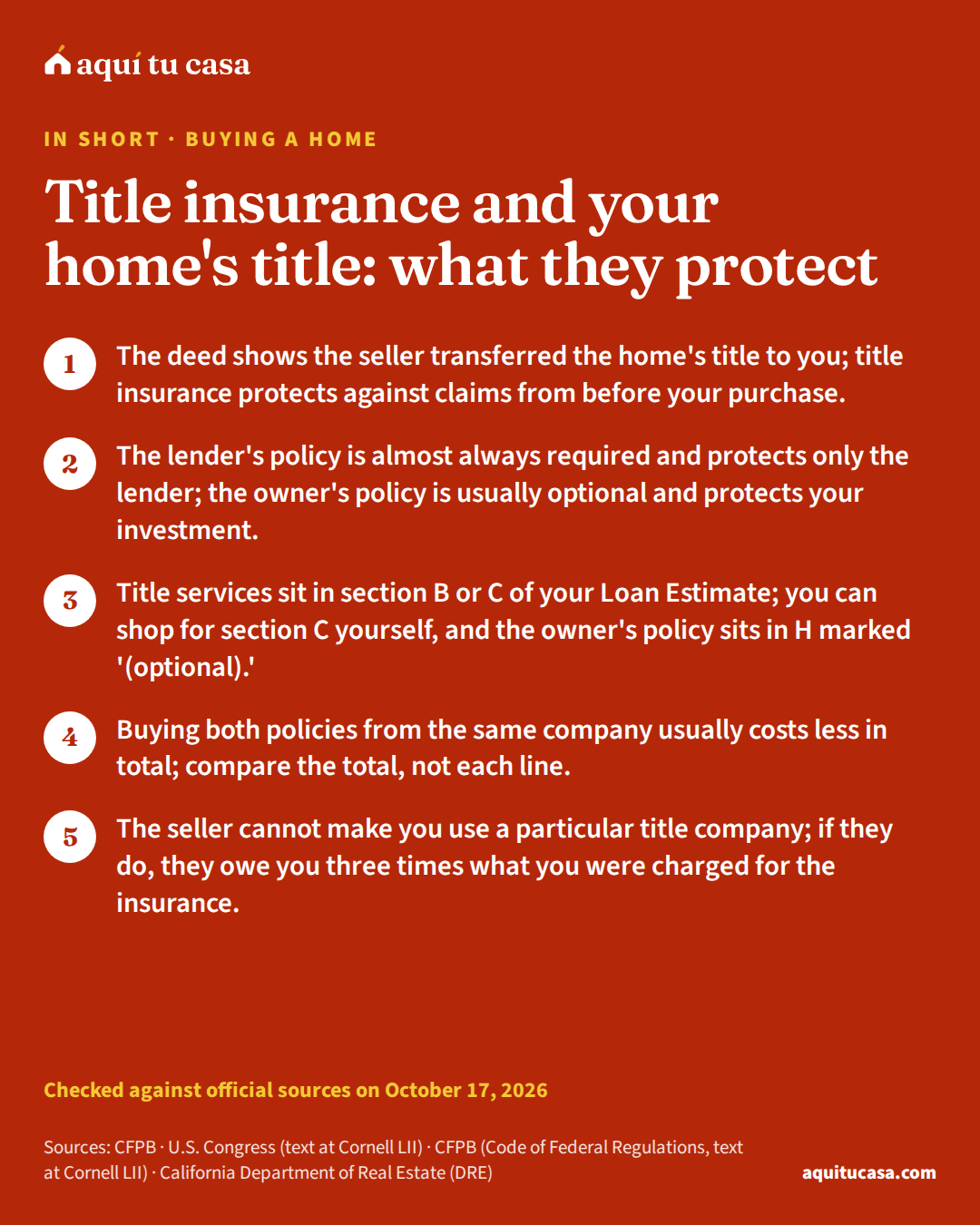
- Buying a home Title insurance and your home's title: what they protect What your home's title is, the difference between the lender's and the owner's title insurance, where they appear on the Loan Estimate and how to compare. 10 minute read
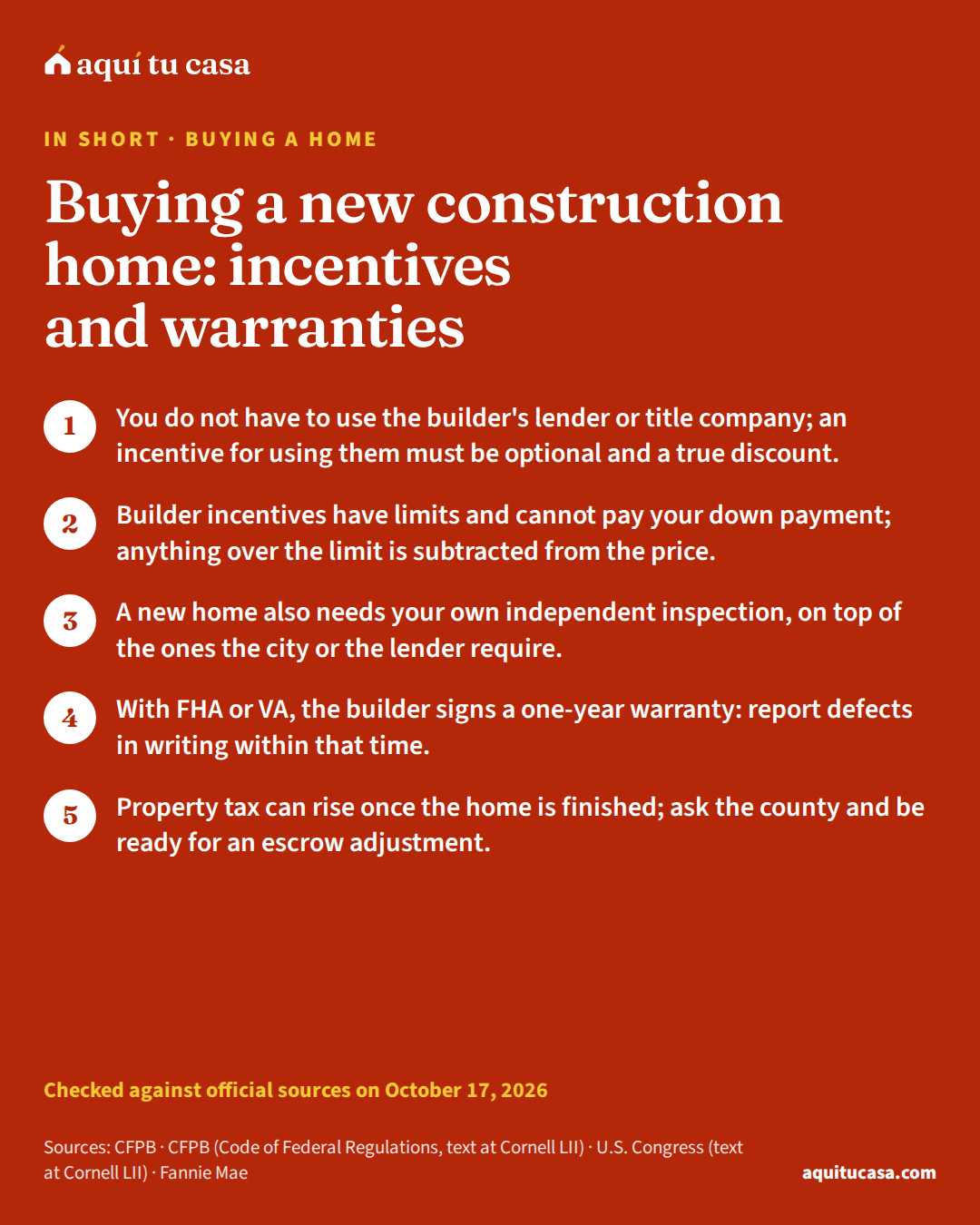
- Buying a home Buying a new construction home: incentives and warranties How to buy a new home from a builder: incentives and rate buydowns, its affiliated lender, inspections, the warranty and the tax once it is built. 13 minute read
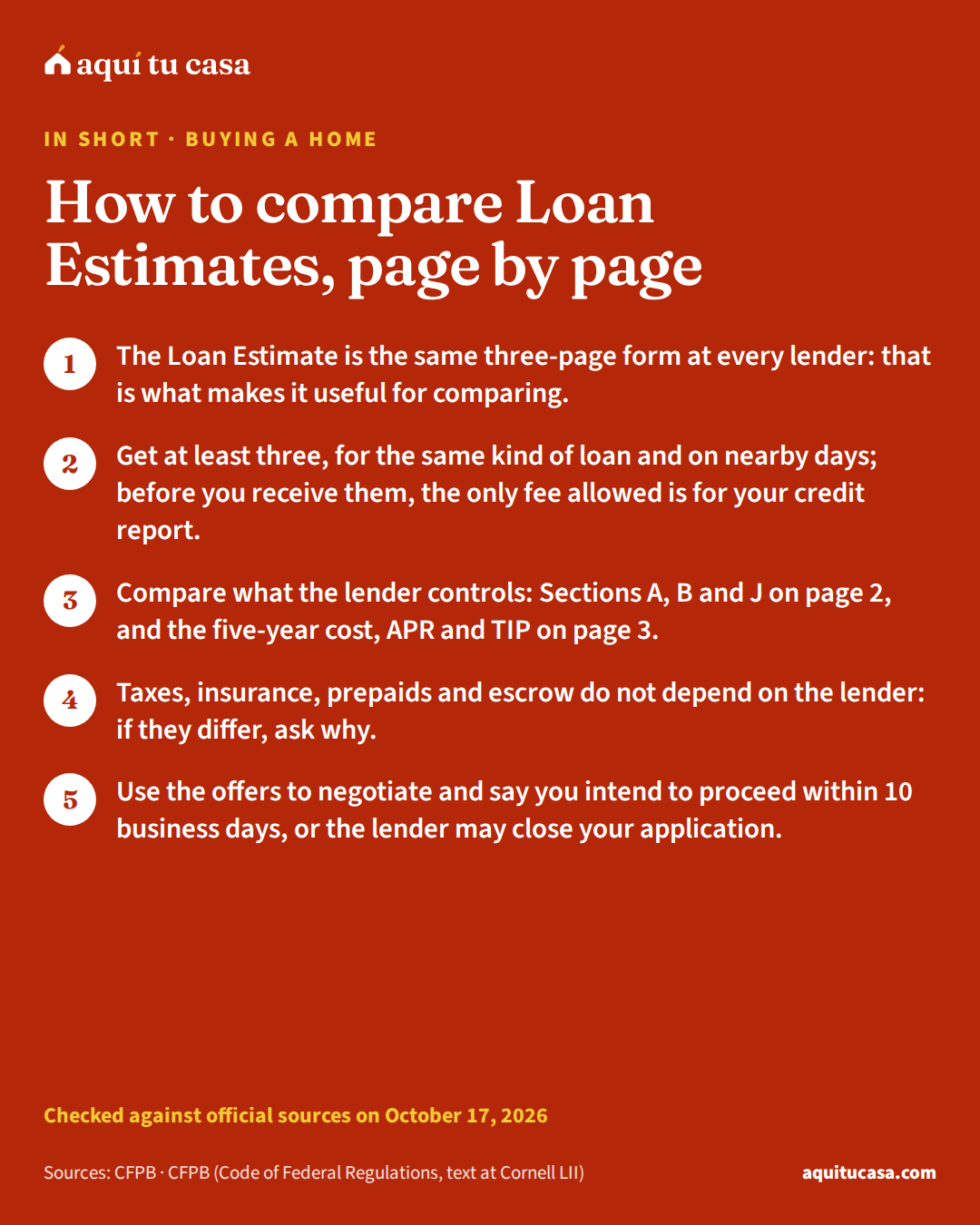
- Buying a home How to compare Loan Estimates, page by page How to read and compare two or three Loan Estimates side by side: what to check on each page, what can change and how to negotiate with lenders. 16 minute read
Tools for this topic
Was this guide useful?
Thank you. Your answer stays in your browser; nothing is sent.