Mortgage interest rates: fixed, adjustable, points and APR
What your mortgage rate is and what moves it, how fixed and adjustable rates differ, and how points, the APR and rate locks work.
Verified against official sources on October 17, 2026 20 official sources

Show contents
In short
What you need to know
Quick answer
The interest rate is what you pay each year to borrow the money, as a percentage of the loan. Yours depends mostly on your credit score, down payment, loan term and loan type, plus the market, which changes daily. With a fixed rate, the rate and your principal and interest payment do not change; with an adjustable rate, the rate can go up or down after an initial period, within caps. Points lower the rate in exchange for paying more at closing, and the APR adds the rate and those charges so you can compare total cost.
What matters most
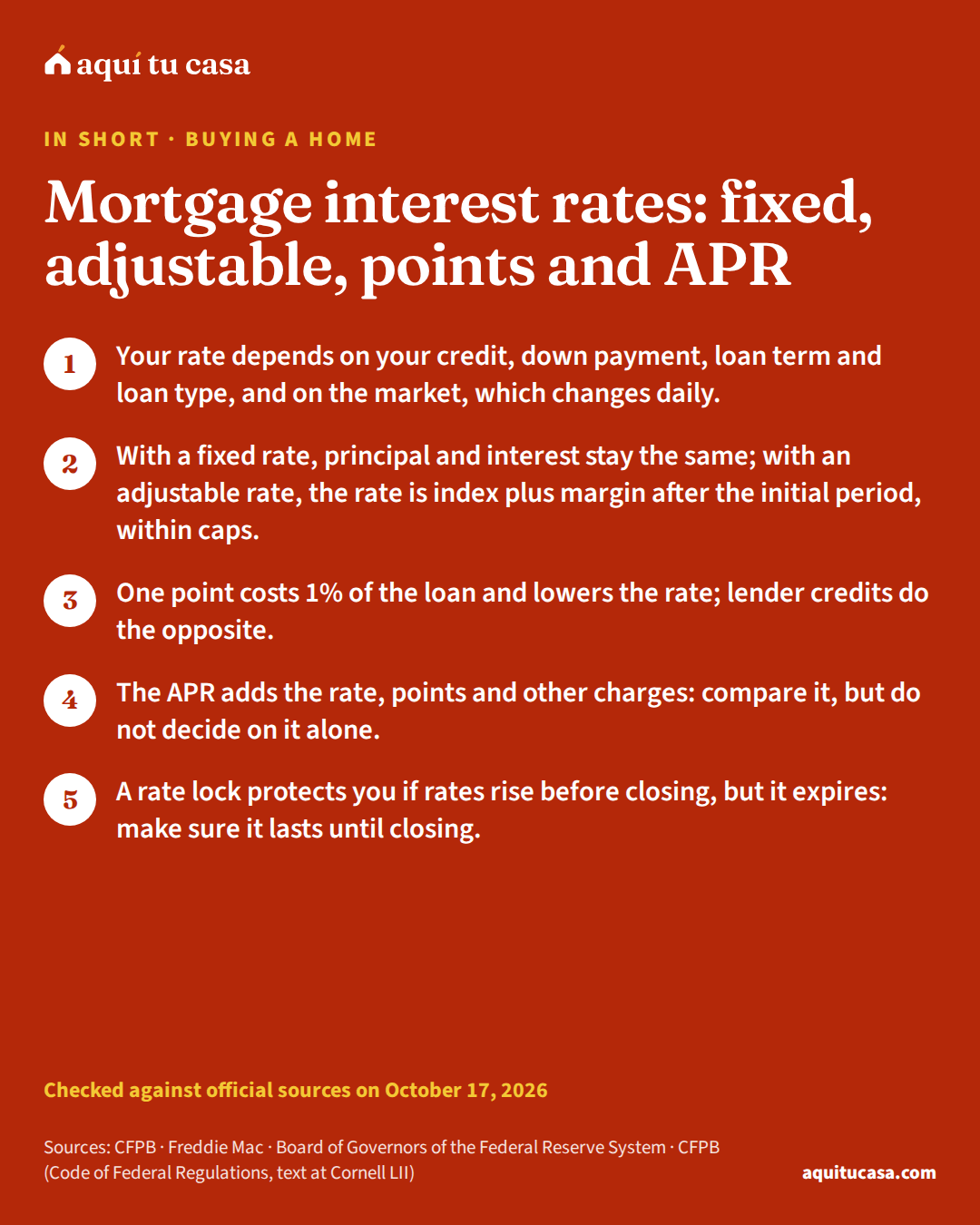
- Your rate depends on your credit, down payment, loan term and loan type, and on the market, which changes daily.
- With a fixed rate, principal and interest stay the same; with an adjustable rate, the rate is index plus margin after the initial period, within caps.
- One point costs 1% of the loan and lowers the rate; lender credits do the opposite.
- The APR adds the rate, points and other charges: compare it, but do not decide on it alone.
Is this for you?
This guide is for you if…
- You are about to apply for a mortgage and want to understand interest rates before comparing offers.
- You are being offered an adjustable rate, discount points or a temporary buydown and do not know how they work.
- You want to know whether to lock your rate and what happens if rates go up or down.
Get direct help first if…
- You already have two or three Loan Estimates and want to compare them page by page: the guide on comparing Loan Estimates is for you.
- You already own a home and want a lower rate: start with the refinancing guide.
Your interest rate drives much of what you pay for your home for years. This guide is for anyone about to apply for a mortgage who wants to understand rates before comparing offers: what moves them, how fixed and adjustable rates differ, how points and temporary buydowns work, what the APR measures and when to lock your rate.
What the interest rate is and what moves yours
According to the CFPB, the interest rateinterest rateThe interest rate on a mortgage is what you pay each year to borrow the money, expressed as a percentage of the loan balance. It does not include fees or other charges; that is what the annual percentage rate (APR) is for. On a fixed-rate loan the rate never changes over the life of the loan; on an adjustable-rate loan it can go up or down after an initial period. The rate you are offered depends on your credit score, your down payment, the loan type and the market, and you see it on the first page of the Loan Estimate.See the full definition is what you pay each year to borrow the money, expressed as a percentage. It does not include the loan’s fees.1 Each monthly payment is split in two: one part pays down your debt, the principalprincipalThe principal is the amount of money you borrowed and have to pay back, not counting the interest. In Spanish it is also called "capital". When you start, the principal is the loan amount; with every payment a part goes toward reducing it, and what remains is called the balance. Interest is computed on that balance, so the less principal you owe, the less interest you pay. On your monthly payment you will see P&I: principal and interest, the part of the payment that goes to the loan, separate from taxes and insurance.See the full definition, and the other pays interest. Early in the term you owe more interest because the balance is high, so most of the payment goes to interest. Over the years, more of the payment goes to principal. This is called amortizationamortizationAmortization means paying off a loan with regular payments over time, so that the amount you owe decreases with each payment. On a fixed-rate mortgage the principal-and-interest payment is always the same, but its split changes: at first most of each payment is interest and only a small part reduces the debt; over the years it is the other way around. The amortization schedule shows, month by month, how much goes to interest, how much to principal and how much is left to pay. Paying a little extra toward principal brings the end of the loan forward.See the full definition.2
Why does one person get one rate and someone else another? The CFPB names four factors that are yours: your credit scorecredit scoreA credit score is a number that predicts how likely you are to pay back a loan on time. It is computed from the information in your credit report: whether you pay on time, how much you owe relative to your limits, how long you have used credit and how many new accounts you opened. FICO is one brand of score; VantageScore is another, and each lender decides which one it uses. A higher score usually brings a lower interest rate and more loan options; each program publishes the minimum it accepts. You can check your report for free and dispute errors.See the full definition, your down payment, the loan term and the loan type. A higher score generally gets you lower rates. A bigger down payment typically lowers the rate. A shorter term usually brings a lower rate, because there is less risk to the lender. And if you qualify, VA, USDA or FHA loans can have lower rates.3
Your credit carries a lot of weight. Most mortgage lenders use FICO scores, look at all three credit reporting companies and use the middle score to set your rate. An error on your report can lower your score and raise your rate: check and correct it well before you apply, and avoid applying for a lot of new credit in a short time.4 The guide on what moves your credit score explains how it works.

The averages in the chart come from Freddie Mac’s weekly survey (PMMS), published every Thursday from the rates on thousands of applications from lenders across the country. It is an average for conventional loans to borrowers with good or excellent credit, 20% down and a one-unit home the owner will live in.5 It gives you an idea of what you might be offered, but the rate is not the only cost of a mortgage.3
What about the market? According to the Federal Reserve, when it changes the federal funds rate, the change shows up quickly on floating-rate loans. Rates on long-term loans, like a 30-year fixed mortgage, depend more on what is expected of the economy over the life of the loan than on today’s Fed rate.6 On top of that, mortgage rates can change daily, sometimes hourly.18
Fixed rate or adjustable rate
With a fixed ratefixed-rate mortgageA fixed-rate mortgage is a home loan whose interest rate is set when you take out the loan and does not change over its whole life. The part of your payment that covers principal and interest is therefore the same every month, from the first payment to the last; what can change is what you pay for taxes and insurance if they ride in the same payment. It is the most common choice in the United States and the one almost every state assistance program uses. The most common terms are thirty and fifteen years.See the full definition, the rate is set when you take out the loan and does not change.8 Your principal and interest payment is the same for the whole term, although the total payment can change if taxes, homeowners insurance or mortgage insurance go up or down. Most borrowers choose a fixed rate.7
With an adjustable rateadjustable-rate mortgage (ARM)An adjustable-rate mortgage (ARM) is a loan whose interest rate can change, usually in step with a market index. It often starts with a fixed rate for an initial period (for example, the first few years) and then adjusts at set intervals, so your payment can go up or down. The contract sets caps on how much the rate can rise at each adjustment and in total. Before accepting one, check on the Loan Estimate how high your payment could reach and whether you could afford it.See the full definition (an ARM), the rate can go up or down. Many start lower than a fixed rate, and that initial rate can last months, one year or a few years.8 Most have two periods: an initial one with a fixed rate and another in which the rate rises and falls with the market. In the second, your principal and interest payment could go up a lot, even double.7
Fixed and adjustable rates, side by side
Stable
Fixed rate
The CFPB warns not to assume you will be able to sell or refinance before the rate changes: your home's value or your finances can change.8
How is the new rate calculated? When the initial period ends, the rate is an index plus a margin. The index is a rate that moves with the market. The margin is set by the lender, written into your loan agreement and does not change after closing. So the changes depend on the market, not on your personal finances. The margin can vary a lot between lenders, and you can negotiate it.9
ARM names tell you how they work. On a 5/1 or a 5/6m, the first number is how long the initial rate lasts and the second is how often it changes after that: on a 5/6m, the rate stays the same for the first five years and may then adjust every six months.12 The CFPB says most have a fixed rate for an initial period, for example 3 or 5 years, and are typically recalculated once a year after that, though not all work that way.11
Caps limit the changes. There are three: the first-adjustment cap, commonly 2 or 5 percentage points; the cap on later adjustments, most commonly 1 or 2; and the lifetime cap, most commonly 5, though some loans have a higher one. Two lenders can offer the same initial rate with different caps. The CFPB recommends asking the lender to calculate the highest payment you could ever have.10
How an adjustable rate changes over time
1. You close at the initial rate
Initial period, for example 3 or 5 years
The rate does not change during the initial fixed period.11
2. You get notice of the first adjustment
210 to 240 days before the first new payment
The notice comes separately, before the first payment at the adjusted rate is due.15
3. First adjustment
When the initial period ends
New rate = index + margin, within the first-adjustment cap.9
4. You get notice of each payment change
60 to 120 days before the first payment at the new amount
So you know what you will pay before it is due.15
6. The life of the loan
Until the last payment
The lifetime cap limits how much the rate can rise in total.10
Before you pay a non-refundable fee, the lender must give you the CFPB’s handbook on adjustable-rate mortgages (CHARM) and a disclosure for the program you are interested in.14 On the Loan Estimate, an adjustable rate comes with the “Adjustable Interest Rate (AIR) Table,” showing the index and margin, the initial rate, the minimum and maximum, and when and by how much it can change.13
Loan term: 15 or 30 years
The loan termloan termThe loan term is how long you have to repay the whole loan. According to the CFPB, for most homes the usual terms are 15, 20 or 30 years. On the Loan Estimate it appears as "Loan Term," in years or months. The term changes your monthly payment: if you refinance and your payment goes down, part of that drop may come from a longer term rather than a lower rate. A Qualified Mortgage (QM) cannot have a term longer than 30 years.See the full definition also moves the rate. According to the CFPB, a shorter term, like 15 years, brings higher monthly payments but usually a lower rate and a lower total cost: you borrow for less time, and the rate is usually lower, by as much as a full percentage point. Rates vary among lenders, especially for shorter terms.7
Example with real numbers
Rate, term and interest on a typical home
With the typical US home value, an FHA loan with the minimum down payment (3.5%) and average rates as of November 5, 2026.
- Home price (typical US value)
- $332,700
- FHA loan, with the upfront premium financed
- $326,674
- Average 30-year rate
- 7.18%
- Average 15-year rate, for comparison
- 6.57%
- Principal and interest per month, 30 years
- $2,213
- Interest over 30 years, if you pay the full term
- $470,007
This is an example with national numbers: the averages are for conventional loans and your rate may differ.5 Try your own price, rate and term in the calculator.
Run it with your numbersMortgage calculatorThe mortgage calculator lets you change the rate and term to see your payment, and the how much house can I afford tool shows how the price you can pay changes.

Points, credits and temporary buydowns
Discount pointsdiscount pointsDiscount points are a payment you make to the lender at closing in exchange for a lower interest rate over the life of the loan. Each point costs a percentage of the loan amount. The opposite is lender credits: the bank lowers your closing costs today in exchange for a higher rate. Buying points only pays off if you keep the loan long enough for the monthly savings to exceed what you paid. Points appear on the Loan Estimate, in section A of the closing costs.See the full definition let you pay more at closing in exchange for a lower rate. One point costs 1% of the loan amount. The CFPB says they can make sense if you plan to keep the loan a long time. By law, the points on your Loan Estimate must be connected to a discounted rate, and how much the rate drops per point depends on the lender, the kind of loan and the market.16
Lender credits work in reverse: you accept a higher rate and the lender gives you money toward closing costs. On a worksheet they may appear as “negative points.” If you do not know how long you will stay, the CFPB suggests asking for two options, with and without points or credits, and the total cost over several timeframes.16 The CHARM booklet adds that you never have to pay points: compare what they cost with what you save with the lower rate.12

A temporary rate buydowntemporary buydownA temporary buydown makes your monthly payment lower for a limited time at the start of the loan, in exchange for an upfront fee or a higher interest rate later. According to the CFPB, it usually lasts one to three years, and the payment goes up each year until the buydown ends. On loans Fannie Mae buys, there must be a written agreement with whoever provides the money, and the lender qualifies you at the full note rate, not the reduced rate. If that money were not available, you would still owe the payments set by the note.See the full definition is something else. Someone, such as the seller, the builder or the lender, puts up money so you pay a lower rate at the start. On loans Fannie Mae buys, the reduction cannot exceed 3%, the rate cannot rise more than 1% per year and the buydown period cannot exceed 3 years. There must be a written agreement, and if the buydown money is not available, you are still obligated to pay what the promissory notepromissory noteThe promissory note (or simply the note) is the document you sign at closing to promise you will repay the loan to the lender. It describes what you are agreeing to: how much you owe, the interest rate, the payment dates, the total you will pay, the length of the loan, whether the payments can change and where to send them. It is separate from the mortgage or deed of trust, the document that gives the lender the right to take the home if you do not pay. Some terms, such as a prepayment penalty, may be in an addendum to the note. You can ask for copies of the documents before closing to review them.See the full definition says. The lender qualifies you at the full note rate, not the reduced one.17 The guide on buying a new construction home explains these offers.
If this is you
You have little credit history
Higher scores open the door to lower rates; check your report and fix errors well before you apply.4 The credit plan tool helps you get started.
You are buying for the first time
A HUD-approved housing counselor can review the options with and without points with you.16 It is often free or low cost.20
You are buying with an ITIN
The CFPB says nonqualified (non-QM) loans can be riskier or more expensive, and are sometimes marketed to borrowers without Social Security numbers.7 The ITIN mortgage guide explains how they work.
You already have an adjustable rate
You must get notice of the first adjustment 210 to 240 days before the first payment at the new rate.15 The refinancing guide explains your options.
The APR: the loan’s cost as a rate
The APRannual percentage rate (APR)The annual percentage rate (APR) is a broader measure of the cost of borrowing money than the interest rate. Besides the interest, it includes certain loan charges, such as discount points and some lender fees, spread over the life of the loan and expressed as a yearly percentage. That is why the APR is almost always a little higher than the interest rate. It is useful for comparing offers: if two loans have the same interest rate but a different APR, the one with the higher APR charges more in fees.See the full definition (annual percentage rate) measures more than the rate: it includes the interest rate, points, mortgage broker fees and other charges you pay to get the loan. That is why it is usually higher than your rate. On the Loan Estimate, the rate is on page 1 and the APR on page 3.1
The APR is useful for comparing similar offers, but it has limits. On an adjustable rate it does not reflect the maximum rate, and you need to be careful comparing the APR of a fixed loan with that of an adjustable one. The CFPB advises against deciding on the APR alone.1 The guide on how to compare Loan Estimates explains how to use it alongside the five-year cost and the TIP.
Locking your rate: when and for how long
A rate lockrate lockA rate lock (or lock-in) means your interest rate will not change between the offer and closing, as long as you close within the agreed time frame and your application does not change. Rates can change daily; if yours is not locked, it can change at any time. Even when locked, it can change if your loan amount, credit score, verified income or appraisal changes. Extending a lock can cost money, and if rates fall you may be stuck with the higher rate. The first page of the Loan Estimate says whether your rate is locked and until when.See the full definition holds your rate between the offer and closing, as long as you close within the time frame and nothing changes in your application. Locks typically last 30, 45 or 60 days, sometimes longer. There are two risks: extending one can be expensive, and it can keep you from a lower rate if rates fall.18 Locking protects you if rates rise before closing.19
Some lenders lock the rate when they give you the Loan Estimate and some do not.18 The top of page 1 says whether your rate is locked and the date and time the lock ends. If it is not locked, the rate, points and credits can change.13 If you lock it later, the lender must give you a revised Loan Estimate no later than three business days after.14
A locked rate can still change if your application changes: the loan amount, your credit score or your verified income. For example, if you change the kind of loan or your down payment.18 And if you do not close before the lock expires, even because of the lender’s processing time, you might have to pay to extend it. Ask whether you can switch to a longer lock and at what cost.19 Policies vary, and the Loan Estimate does not say what an extension would cost.18

Costly mistakes
Mistake: Comparing offers on the rate alone.
Instead: Also look at the APR, points and fees; and do not decide on the APR alone.1
Mistake: Choosing an adjustable rate assuming you will sell or refinance before it changes.
Instead: Your home's value or your finances can change; look at the highest possible payment.8
Mistake: Not asking about the margin and caps on an adjustable rate.
Instead: Compare them across lenders: the margin can be negotiated and caps vary.9
Mistake: Paying points without knowing how much they lower the rate.
Instead: Ask for the offer with and without points and the total cost over several timeframes.16
Mistake: Thinking a buydown's reduced rate is your rate for good.
Instead: It is temporary: it lasts at most 3 years and you are qualified at the note rate.17
Mistake: Locking the rate for less time than closing will take.
Instead: Ask what happens if closing is delayed and what a longer lock costs.19
What to do this week
- Check your credit report and dispute errors before you apply for the loan.4
- Look at this week’s average rate in the chart and request Loan Estimates from several lenders on nearby days.18
- If you are offered an adjustable rate, ask in writing for the index, margin, all three caps and the highest possible payment.10
- If you are offered points or a buydown, ask for the offer with and without them and compare the total cost.16
- Before you lock, ask how long the lock lasts, what a longer one costs and what happens if closing is delayed.19
- If you want help, a HUD-approved housing counselorHUD-approved housing counselorA HUD-approved housing counselor works at an agency HUD has approved to provide housing counseling: independent, expert advice customized to your situation about buying a home, renting, a missed mortgage payment, a foreclosure or credit problems. The agencies usually charge little or nothing; many serve in Spanish and offer the homebuyer education course several assistance programs require. They are not lenders or real estate agents and sell you nothing. Your county page lists the official agencies with phone numbers.See the full definition gives independent advice, often free or at low cost.20
Your numbers
Starts at the typical home value in the United States. Change it to the price you have in mind.
That is $11,645 (3.5% of the price). The usual minimum for this loan is 3.5%.
This week's average ± a quarter or half point.
National average as of November 5, 2026 (Freddie Mac); your rate may be different.
Adjust advanced details
Let's do the math
Estimated monthly payment
National figure$2,759
at 7.18% · 30 years
- Loan amount
- $326,673
- Total interest
- $470,006
- Paid off in
- November 2056
Includes $5,618 FHA upfront mortgage insurance premium.
Does it fit the income?
Comfortable
up to $1,884 a month
Tight
$1,884 to $2,422 a month
Hard
more than $2,422 a month
Your payment · 41%
Compared with the typical household income in the United States ($80,734 a year). Reference: HUD calls paying more than 30% of income for housing a cost burden.
| Principal & interest | $2,213 |
|---|---|
| Property tax | $261 |
| Home insurance | $139 |
| FHA mortgage insurance (MIP) | $147 |
How does it compare with incomes?
For this payment to be 28% of your income, you'd need to earn about $118,260 a year. With your other debts, to stay under 36%: about $91,980 a year.
You need at least $11,645 for the down payment, plus closing costs.
This is an estimate to give you an idea, not a loan offer. Your real payment depends on your rate, your credit, and the insurance and taxes on the home you buy.
Total monthly payment $2,759; principal and interest $2,213.
Ready to see the numbers? Find your county here
See how this applies in your county: its loan limits, prices and rents, from the official data.
Printable checklist
Frequently asked questions
What is the mortgage interest rate today?
In Freddie Mac's weekly survey, the average 30-year fixed rate was 7.18% as of November 5, 2026, and the 15-year rate was 6.57%. It is an average for conventional loans to borrowers with good or excellent credit and 20% down: your rate may differ. Your real rate is on your Loan Estimate.
Which is better, a fixed or an adjustable rate?
It depends on your situation; no one can decide it for you. The CFPB explains that a fixed rate gives stable principal and interest payments, while an adjustable rate is less predictable but could be cheaper in the short term, for example if you move during the initial fixed period. It also warns not to assume you will be able to sell or refinance before the rate changes.
What is a discount point and is it worth paying?
One point costs 1% of the loan amount and lowers your rate. The CFPB says points can make sense if you plan to keep the loan a long time, and the CHARM booklet suggests comparing the cost of the points with what you save with the lower rate. You never have to pay points.
Why is the APR higher than my rate?
Because the APR adds points, broker fees and other charges for getting the loan to the rate. It helps compare the cost of similar offers, but on an adjustable rate it does not reflect the maximum rate, and the CFPB advises against deciding on the APR alone.
When should I lock my rate?
The CFPB explains that a lock protects you if rates rise before closing, but it can also keep you from a lower rate if they fall, and extending it can be expensive. What matters is that the lock lasts until closing. Ask the lender how long it lasts, what a longer one costs and what happens if closing is delayed.
How high can the rate on an adjustable-rate loan go?
Caps limit it: one for the first adjustment, one for later adjustments and one for the life of the loan. The CFPB says the most common lifetime cap is five percent, though some loans have a higher one. Your Loan Estimate shows the maximum rate in the Adjustable Interest Rate (AIR) table.
Does the Federal Reserve set my mortgage rate?
Not directly. According to the Federal Reserve, its changes show up quickly on floating-rate loans, but rates on long-term loans depend on expectations for the economy over the life of the loan, not just today's federal funds rate.
What is a temporary rate buydown?
It is a written agreement in which someone, such as the seller or the lender, puts up money so you pay a lower rate at the start. On loans Fannie Mae buys, the buydown lasts at most 3 years, the rate rises by no more than 1% per year, and the lender qualifies you at the full note rate.
Sources
Every figure in this guide comes from one of these official sources. The number next to a sentence leads to the source behind it.
Each source on one line: who publishes it, its title, its address and the date we read it.
- 1. CFPB · What is the difference between a mortgage interest rate and an APR? · consumerfinance.gov · Accessed October 17, 2026
- 2. CFPB · How does paying down a mortgage work? · consumerfinance.gov · Accessed October 17, 2026
- 3. CFPB · Explore interest rates · consumerfinance.gov · Accessed October 17, 2026
- 4. CFPB · Does my credit score affect my ability to get a mortgage loan or the mortgage rate I pay? · consumerfinance.gov · Accessed October 17, 2026
- 5. Freddie Mac · Primary Mortgage Market Survey (PMMS) · freddiemac.com · Accessed October 17, 2026
- 6. Board of Governors of the Federal Reserve System · Monetary Policy: What Are Its Goals? How Does It Work? · federalreserve.gov · Accessed October 17, 2026
- 7. CFPB · Understand the different kinds of loans available · consumerfinance.gov · Accessed October 17, 2026
- 8. CFPB · What is the difference between a fixed-rate and adjustable-rate mortgage (ARM) loan? · consumerfinance.gov · Accessed October 17, 2026
See the other 12 sources
- 9. CFPB · For an adjustable-rate mortgage (ARM), what are the index and margin, and how do they work? · consumerfinance.gov · Accessed October 17, 2026
- 10. CFPB · What are rate caps with an adjustable-rate mortgage (ARM), and how do they work? · consumerfinance.gov · Accessed October 17, 2026
- 11. CFPB · If I am considering an adjustable-rate mortgage (ARM), what should I look out for in the fine print? · consumerfinance.gov · Accessed October 17, 2026
- 12. CFPB · Consumer Handbook on Adjustable-Rate Mortgages (CHARM) · files.consumerfinance.gov · Accessed October 17, 2026
- 13. CFPB (Code of Federal Regulations, text at Cornell LII) · Regulation Z, 12 CFR §1026.37, Content of disclosures for certain mortgage transactions (Loan Estimate) · law.cornell.edu · Accessed October 17, 2026
- 14. CFPB (Code of Federal Regulations, text at Cornell LII) · Regulation Z, 12 CFR §1026.19, Certain mortgage and variable-rate transactions · law.cornell.edu · Accessed October 17, 2026
- 15. CFPB (Code of Federal Regulations, text at Cornell LII) · Regulation Z, 12 CFR §1026.20, Disclosure requirements regarding post-consummation events · law.cornell.edu · Accessed October 17, 2026
- 16. CFPB · How should I use lender credits and points (also called discount points)? · consumerfinance.gov · Accessed October 17, 2026
- 17. Fannie Mae · Selling Guide B2-1.4-04, Temporary Interest Rate Buydowns · selling-guide.fanniemae.com · Accessed October 17, 2026
- 18. CFPB · What's a lock-in or a rate lock on a mortgage? · consumerfinance.gov · Accessed October 17, 2026
- 19. CFPB · Choose a loan offer · consumerfinance.gov · Accessed October 17, 2026
- 20. CFPB · Find a Housing Counselor · consumerfinance.gov · Accessed October 17, 2026
Keep reading
Related guides
If this guide helped, these follow the same path.

Mortgage loans 14 minute read
Mortgage loan types: FHA, conventional, VA and USDA
What each mortgage type asks for, what its insurance costs, fixed or adjustable rate, points and APR. A neutral comparison with official sources.
- No loan type is best for everyone: according to the CFPB, each is designed for different situations; if several fit, get several quotes.
- FHA insurance lasts the life of the loan if you put down less than 10%; a conventional loan's PMI ends by law at 78% of the original value, if you are current.
- VA and USDA require no down payment if you qualify; VA charges no monthly insurance and USDA charges guarantee fees.
- Buying a home Closing costs explained: what you pay and what can change What closing costs are, how to read them on your Loan Estimate, which charges cannot go up before closing and how to compare offers to pay less. 14 minute read
- Mortgage loans Refinancing your mortgage: types, costs and break-even Refinancing explained: rate-and-term vs cash-out, closing costs, the break-even point and FHA and VA streamline refinances. 12 minute read
Tools for this topic
Was this guide useful?
Thank you. Your answer stays in your browser; nothing is sent.