Buying a new construction home: incentives and warranties
How to buy a new home from a builder: incentives and rate buydowns, its affiliated lender, inspections, the warranty and the tax once it is built.
Verified against official sources on October 17, 2026 21 official sources

Show contents
In short
What you need to know
Quick answer
When you buy a new home from a builder, you do not have to use its lender or title company: you can compare, and if you are referred to an affiliated company you must get a written disclosure of that relationship. Builder incentives have limits (on FHA loans, 6% of the price, including rate buydowns) and cannot cover your down payment. Get an independent inspection, keep the warranty in writing and ask the county what the tax will be on the finished home, because it can go up after the first year.
What matters most
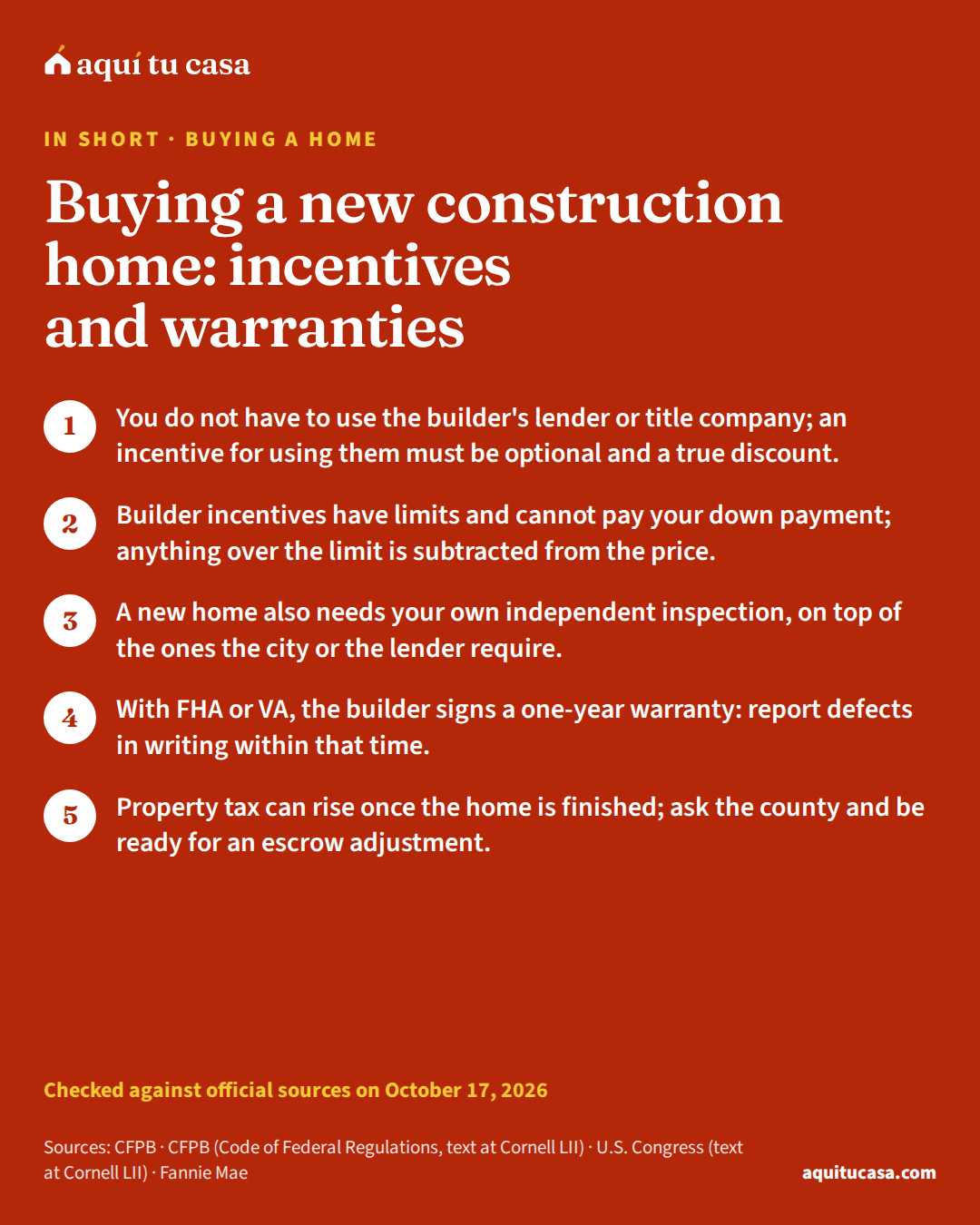
- You do not have to use the builder's lender or title company; an incentive for using them must be optional and a true discount.
- Builder incentives have limits and cannot pay your down payment; anything over the limit is subtracted from the price.
- A new home also needs your own independent inspection, on top of the ones the city or the lender require.
- With FHA or VA, the builder signs a one-year warranty: report defects in writing within that time.
Is this for you?
This guide is for you if…
- You want to buy a new or yet-to-be-built home directly from a builder.
- The builder offers incentives if you use its lender or title company and you do not know whether that is a good deal.
- You already bought a new home and want to understand the warranty or why your property tax may go up.
Get direct help first if…
- You are building on your own land with a construction loan: this guide is about buying a home from a builder.
- You are buying a manufactured or mobile home: the land and mobile home guide explains its rules.
- You have a serious construction problem and are thinking of suing: free legal aid can guide you; this guide does not replace that advice.
Buying a new home from a builder has its own rules: deposits before the house exists, incentives tied to the builder’s lender, inspections during construction, a warranty and a property tax that can change once the home is finished. This guide is for anyone about to sign with a builder, or who already has, and wants to know what the law and loan programs say about each step.
- Of the price, the most the builder and other interested parties can contribute on an FHA loan
- 6%9
- The longest a temporary rate buydown can last on loans Fannie Mae buys
- 3 years10
- Before closing, the latest your Loan Estimate can be revised if construction runs long
- 60 days11
- Of builder warranty on FHA and VA loans, from conveyance of title
- 1 year16
Before you sign: the contract and the deposit
If the home is not built yet, the builder may ask for an upfront deposit, also called earnest moneyearnest moneyEarnest money is a deposit the buyer pays when signing the purchase contract to show good faith that the offer is serious. The seller does not keep it: a neutral third party (the title company or a closing agent) normally holds it, and at closing it is applied to your down payment or closing costs. If you back out for a reason the contract allows, such as an inspection or financing contingency, you get it back; if you back out without a valid reason, you can lose it.See the full definition. The CFPB recommends asking, before you commit, under what conditions you get it back.1 It also suggests making your contract depend on two things: getting the loan and a satisfactory inspection. Those contingenciescontingencyA contingency is a condition you add to your offer or purchase contract to protect yourself: if it is not met, you can change or end the contract and, in general, get your earnest money back. The most common are the inspection contingency, if the inspection finds problems; the appraisal contingency, if the appraisal comes in below the price; the financing or mortgage contingency, if you cannot get the loan within the agreed time; and the home sale contingency, tied to selling your current home. Contingencies are a normal part of buying, but too many can make your offer less attractive to the seller.See the full definition let you walk away if you cannot get the loan or the inspection finds serious flaws.1
Before signing, get an informal homeowners insurance estimate: in some areas insurance can cost more than you expect.1 And check who will handle the closing. If you buy with a federally related mortgage loan, the seller cannot require you, as a condition of selling, to buy title insurancetitle insuranceTitle is the legal right of ownership of the home, and title insurance protects you if, after closing, someone claims a right to it: an old debt, an heir, an error in the records. There are two policies. Most lenders require a lender's policy, which protects the amount they lent. The owner's policy is optional, paid once at closing, and protects you for as long as you own the home, including the legal costs of defending your right. You can shop for a title company; the price varies by state.See the full definition from a particular title companytitle companyA title company is a company, or its authorized agent, that is qualified to issue title insurance. It searches public records for problems with the home's title (a title search), prepares the title commitment and issues the lender's and owner's policies. In most states, the fee for conducting your closing is also part of its charges. If title services are listed in section C of your Loan Estimate, you can shop for them yourself. Under the federal Real Estate Settlement Procedures Act (RESPA), a seller may not require you to buy title insurance from a particular company.See the full definition. A seller who does is liable to you for three times the charges for that insurance.7 The title insurance guide explains how to compare it.
Buying a new home, step by step
1. You choose the builder and the home
Before signing
Ask under what conditions the builder deposit is returned.1
2. You sign the contract
With contingencies
Make it depend on getting the loan and on a satisfactory inspection.1
3. You compare lenders
Before choosing
You do not have to use the builder's lender; get Loan Estimates from others.1
Try it with your numbersCompare loans4. You receive the Loan Estimate
If closing is more than 60 days away
It can be revised up to 60 days before closing, only if the Loan Estimate says so.11
5. Construction moves forward and gets inspected
During construction
On top of the city's inspections, hire your own independent inspector.15
6. You lock your rate
When you know the closing date
Locks are typically 30, 45 or 60 days; extending one can be expensive.13
7. You close and receive the warranty
Closing day
With FHA or VA, you must get a copy of the builder's warranty.16
8. Your first year in the home
Up to one year after
Report defects in writing within the year and check the new tax bill.16
The builder’s lender: you can choose another
The CFPB explains that builders often work with an associated lender. You do not have to use it, and you have the right to shop for a better deal.1 Even if the builder has a preferred lender, it pays to compare.2 The guide on how to choose a mortgage lender explains how.
When the builder owns, in whole or in part, the lender, the title company or another closing service, the law calls it an affiliated business arrangementaffiliated business arrangementAn affiliated business arrangement is when someone who can refer you to a closing service, such as your real estate agent or your lender, is affiliated with or owns part of the company it refers you to, and sends you there. Federal law (RESPA) allows it if you get a written notice on a separate page explaining the relationship and estimating what the company charges; if you are not required to use it, with some exceptions; and if the only thing they earn is a return on ownership, not a payment per referral. According to the CFPB, it pays to shop around.See the full definition. RESPA prohibits giving or receiving payments for referring closing business. These arrangements are allowed only if they are disclosed to you with an estimate of the charge, if you are not required to use that provider and if the only thing received is a return on ownership.6
Regulation X adds what the disclosure must look like: in writing, on a separate piece of paper and no later than the referral. It must explain the ownership relationship and financial interest, and the provider’s estimated charge.3
What about incentives for using the builder’s lender? Under Regulation X, offering a package or a discount for using several services does not count as requiring you to use them, as long as it is optional, a true discount below generally available prices and not made up by higher costs elsewhere in the closing.4 In practice, that means comparing the whole offer. Get the Loan Estimate from the builder’s lender, with the incentive, and from other lenders for the same kind of loan. The guide on comparing Loan Estimates explains how to read them side by side.
Incentives and rate buydowns: what counts and what does not
Loan programs cap what a builder can pay on your behalf. On an FHA loan, the builder, the seller and other interested parties can contribute up to 6% of the sales price toward your closing costs, prepaids and discount points. That limit includes what they pay for rate buydowns. Anything above the limit, and perks like a decorating or moving allowance, is subtracted dollar for dollar from the price when your loan is sized. And those contributions cannot cover the minimum investment you have to make.9
On loans Fannie Mae buys, the builder is also an interested party. Its contributions cannot be used for your down payment, and what it can put toward your closing costs depends on how much you borrow against the home’s value: 3% above 90%, 6% from 75.01% to 90%, and 9% at 75% or less. Furniture, giveaways and decorator allowances are subtracted from the sales price.8
Three kinds of incentive, side by side
At closing
Closing cost credit
First years
Temporary rate buydown
Get each incentive in writing and compare it with an offer without it: if it is made up with a higher rate or price, it is not a true discount.4
A temporary rate buydowntemporary buydownA temporary buydown makes your monthly payment lower for a limited time at the start of the loan, in exchange for an upfront fee or a higher interest rate later. According to the CFPB, it usually lasts one to three years, and the payment goes up each year until the buydown ends. On loans Fannie Mae buys, there must be a written agreement with whoever provides the money, and the lender qualifies you at the full note rate, not the reduced rate. If that money were not available, you would still owe the payments set by the note.See the full definition is one of the most common incentives. On loans Fannie Mae buys, the reduction cannot exceed 3%, the rate cannot rise more than 1% per year and the period cannot exceed 3 years. There must be a written agreement, and if the buydown money is not available, you still owe the full payments. The lender qualifies you at the note rate, not the reduced one.10 The interest rates guide explains how it compares with discount points.
Example with real numbers
What an incentive can and cannot cover on a typical home
With the typical US home value and an FHA loan with the minimum down payment.
- Home price (typical US value)
- $332,700
- FHA minimum down payment (3.5%): yours to pay
- $11,645
- Closing costs an incentive could cover (2% to 5% of the price)
- $6,654 to $16,635
- One discount point (1% of the loan)
- $3,211
This is an example with national numbers. On FHA, builder contributions cannot cover your minimum investment and are capped at 6% of the price, including rate buydowns.9 Work out your cash to close with your own numbers.
Run it with your numbersClosing costsIf this is you
You are buying for the first time
A HUD-approved housing counselor can review the builder's contract and incentives with you, often for free or at low cost.21
You are buying with a VA loan
The builder's warranty is the same form for FHA and VA (HUD-92544 and VA 26-1859), with one year to report defects.16 The VA home loan guide covers the rest.
You want room for your family
If you are looking at a 2- to 4-unit home or one with an accessory dwelling unit (ADU), read the duplex and ADU guide. Incentives have the same limits.9

The Loan Estimate and your rate lock when construction runs long
A home under construction can take months to finish, and that changes two things. First, the Loan EstimateLoan EstimateThe Loan Estimate is a three-page form you receive from the lender within days of applying for a mortgage. In the same format at every bank, it sums up the terms of the loan being offered: amount, interest rate, whether the payment can change, the estimated monthly payment with taxes and insurance, the itemized closing costs and how much cash you need at closing. Because every lender uses the same form, it lets you compare offers side by side. It commits you to nothing: requesting one is not accepting the loan.See the full definition. If the lender expects to close more than 60 days after giving it to you, it can give you a revised one at any time up to 60 days before closing, but only if the original Loan Estimate clearly says so. If it does not, it cannot revise it for that reason.11 That notice appears on page 3, under “Other Considerations.”12
Second, the rate lock. With a lock, your rate does not change until closing as long as you close within the time frame and your application does not change. Locks are typically 30, 45 or 60 days, sometimes longer, and extending one can be expensive if the purchase takes longer.13 If you do not close before it expires, even if the delay is the lender’s, you might have to pay for an extension. Ask whether you can choose a longer lock, at what cost and what the extension policy is.14

Inspections: the city’s and yours
A new home is not necessarily a flawless one. For an FHA loan, new construction includes proposed homes, homes under construction and homes finished less than a year ago that have never been occupied. The loan file includes the builder’s certification of plans and site (HUD-92541), its warranty (HUD-92544), the certificate of occupancy and building permit or the required inspections, and a termite guarantee.9 The lender gathers those papers for the loan.
The CFPB also recommends an independent home inspectionhome inspectionA home inspection is a review of the property's physical condition by an inspector before you finish buying: roof, foundation, plumbing, electrical, heating and cooling, signs of moisture or pests. It is often part of the home buying process and you pay for it, not the lender; unlike the appraisal, it does not say what the home is worth but what problems it has. With the report you can ask for repairs, negotiate the price or walk away if your contract includes an inspection contingency. Some assistance programs require one.See the full definition by an inspector accountable to you. It warns that if the inspector is paid by someone else, or not paid until closing, they might underemphasize problems. If your contract depends on a satisfactory inspection, you can cancel without penalty if you are not satisfied. Attend if you can, and since inspectors may not need a license in some areas, ask for references and look them up with your state or county licensing authority.15 The home inspection guide explains what they check.

The builder’s warranty
What a new home warranty covers depends on your contract and your state’s laws, so get it in writing. If you buy with FHA or VA, there is a warranty the builder signs on form HUD-92544, which is also VA form 26-1859.16
On that form, the builder warrants that the home is built in substantial conformity with the plans and specifications. It also warrants it against defects in equipment, material or workmanship for one year from conveyance of title, and must fix them at its own expense. To use it, you must notify the builder in writing within one year. This warranty is in addition to your other rights under other laws or documents, and you must get a copy at closing.16
Property tax goes up once the home is finished
Property taxproperty taxProperty tax is the tax the county, city, school district and other local bodies charge real property owners every year to pay for schools, police, fire and other public services. It is computed on the value the assessor's office assigns to your home, at each body's rate, minus the exemptions you qualify for, such as the primary-residence exemption in many states. If you have a mortgage you normally pay it month by month inside your payment, through the escrow account. It is generally deductible on your federal return if you itemize.See the full definition is set by your local or state government, not by the lender. To avoid surprises, the CFPB recommends checking whether the lender estimated it correctly and contacting your local tax authority.17 On a new home this matters more, because the tax assessmentassessed valueAssessed value, or assessment, is the value the local government's assessor gives your property to calculate property tax. It is only for taxes: it is not the appraisal a lender orders for your mortgage. The assessor first estimates market value, usually by comparing your home with similar homes that sold recently. In some places the assessment equals full market value, and in others it is a fraction of it. The assessor does not decide how much you pay: that depends on the rates set by the county, the city and the school district.See the full definition can change once the house is finished.
Two examples of how state laws put it. In Florida, real property is assessed on January 1 each year, and improvements not substantially completed that day receive no value. So the bill for a year when the home was not ready may mostly reflect the land.18 In California, completed new construction is assessed at its market value as of the date it was finished, on a supplemental roll that does not wait for the next January 1. If the assessment goes up, you get a supplemental tax bill.19
Effective property tax rate and typical home value
| State | Property tax (effective rate) | Typical home value |
|---|---|---|
| Alabama | 0.38% | $209,900 |
| Alaska | 1.11% | $352,900 |
| Arizona | 0.48% | $394,500 |
| Arkansas | 0.55% | $188,000 |
| California | 0.7% | $734,700 |
| Colorado | 0.48% | $539,400 |
| Connecticut | 1.81% | $366,900 |
| Delaware | 0.5% | $352,000 |
| District of Columbia | 0.58% | $737,100 |
| Florida | 0.76% | $359,000 |
| Georgia | 0.77% | $303,300 |
| Hawaii | 0.27% | $839,100 |
| Idaho | 0.49% | $418,600 |
| Illinois | 2.01% | $263,300 |
| Indiana | 0.74% | $218,200 |
| Iowa | 1.39% | $208,000 |
| Kansas | 1.29% | $217,200 |
| Kentucky | 0.75% | $205,600 |
| Louisiana | 0.55% | $216,500 |
| Maine | 1.02% | $296,600 |
| Maryland | 0.97% | $419,900 |
| Massachusetts | 1.07% | $562,100 |
| Michigan | 1.25% | $231,600 |
| Minnesota | 1.02% | $329,300 |
| Mississippi | 0.72% | $169,800 |
| Missouri | 0.85% | $230,300 |
| Montana | 0.72% | $375,800 |
| Nebraska | 1.49% | $238,600 |
| Nevada | 0.47% | $435,400 |
| New Hampshire | 1.66% | $402,500 |
| New Jersey | 2.11% | $454,400 |
| New Mexico | 0.7% | $248,100 |
| New York | 1.55% | $423,800 |
| North Carolina | 0.66% | $288,900 |
| North Dakota | 0.99% | $249,900 |
| Ohio | 1.31% | $214,800 |
| Oklahoma | 0.8% | $199,800 |
| Oregon | 0.81% | $477,600 |
| Pennsylvania | 1.3% | $254,500 |
| Puerto Rico | 0.49% | $131,500 |
| Rhode Island | 1.21% | $404,200 |
| South Carolina | 0.48% | $259,000 |
| South Dakota | 1.06% | $257,400 |
| Tennessee | 0.5% | $286,700 |
| Texas | 1.49% | $283,800 |
| Utah | 0.52% | $489,400 |
| Vermont | 1.59% | $316,600 |
| Virginia | 0.73% | $383,700 |
| Washington | 0.81% | $564,600 |
| West Virginia | 0.53% | $162,600 |
| Wisconsin | 1.42% | $266,500 |
| Wyoming | 0.57% | $309,700 |
These are statewide averages; for a newly finished home, ask the county for its estimate. Source: Census Bureau (ACS)
If your loan has an escrowescrow accountAn escrow account is an account set up by your mortgage lender to pay certain property-related expenses on your behalf, mainly property taxes and homeowners insurance. The money comes from a portion of your monthly mortgage payment: each month you contribute a share and the loan servicer pays the bills when they come due. That is why your payment is higher than principal and interest alone, and why it can change when taxes or the insurance premium go up. In some states the word also names the period between the offer and the closing.See the full definition account and the tax goes up, the account can come up short. If the escrow shortageescrow shortageAn escrow shortage is, under Regulation X, the amount by which your escrow account falls short of the balance it should have when your loan servicer analyzes the account. The servicer reviews the account every year, and it can come up short if, for example, your property taxes or insurance went up. If the shortage is less than one month's escrow payment, the servicer can leave it, ask you to pay it within a short time or spread it over monthly payments; if it is larger, the servicer can leave it or spread it over equal monthly payments for at least twelve months.See the full definition is one month’s escrow payment or more, the servicer can only leave it or spread it over equal monthly payments for at least 12 months.20 The guide on why your escrow payment went up explains the annual analysis, and the property tax guide covers exemptions that could lower it.

Costly mistakes
Mistake: Using the builder's lender without getting other offers.
Instead: You do not have to use it: get Loan Estimates from other lenders and compare.1
Mistake: Signing without knowing when your deposit is returned.
Instead: Ask about the conditions first and get financing and inspection contingencies.1
Mistake: Accepting the builder's title company as a condition of buying.
Instead: The seller cannot require you to use a particular title company.7
Mistake: Skipping the inspection because the home is new.
Instead: Hire an independent inspector who is accountable to you.15
Mistake: Letting the warranty year pass without reporting defects.
Instead: Notify the builder in writing within the year and keep a copy.16
Mistake: Budgeting with the tax bill from before the home was finished.
Instead: Ask the county for the tax on the finished home.17
What to do this week
- Ask the builder, in writing, under what conditions the deposit is returned, and ask for financing and inspection contingencies.1
- If you are referred to an affiliated lender or title company, ask for the affiliated business disclosure.3
- Get a Loan Estimate from the builder’s lender, with and without the incentive, and from two other lenders.4
- Hire an independent inspector and, if you can, go along.15
- Get the warranty in writing and note the deadline for reporting defects.16
- Call your county tax office to find out the tax on the finished home.17
- If you want help reviewing the contract and incentives, a HUD-approved housing counselorHUD-approved housing counselorA HUD-approved housing counselor works at an agency HUD has approved to provide housing counseling: independent, expert advice customized to your situation about buying a home, renting, a missed mortgage payment, a foreclosure or credit problems. The agencies usually charge little or nothing; many serve in Spanish and offer the homebuyer education course several assistance programs require. They are not lenders or real estate agents and sell you nothing. Your county page lists the official agencies with phone numbers.See the full definition gives independent advice, often free or at low cost.21
Your numbers
We start with the typical home value in the United States. Enter the price you are looking at.
Adjust advanced details
FHA
Estimated monthly payment
$2,759
Principal and interest, tax, homeowners insurance and mortgage insurance.
- Down payment
- $11,645 (3.5%)
- Mortgage insurance
- $147 a monthFHA annual premium · whole term
- Upfront premium or fee
- $5,618FHA upfront mortgage insurance · added to the loan
- Paid in 5 years
- $141,609
- Balance after 5 years
- $308,088
- County limit
- Find your county to see the limit
Rules and notes
- Minimum down payment of 3.5% with a score of 580 or more; between 500 and 580 at least 10% is required.In effect since September 14, 2016 · Source ↗
- Mortgage insurance: 1.75% upfront plus an annual premium; with less than 10% down it lasts the whole term.In effect since March 20, 2023 · Source ↗
- Only citizens, lawful permanent residents and citizens of the Freely Associated States; non-permanent residents are no longer eligible.In effect since May 25, 2025 · Source ↗
Conventional, 3% down
Estimated monthly payment
$2,747
Principal and interest, tax, homeowners insurance and mortgage insurance.
- Down payment
- $9,981 (3%)
- Mortgage insurance
- $161 a monthPMI (example) · ends around year 13
- Upfront premium or fee
- None
- Paid in 5 years
- $140,854
- Balance after 5 years
- $304,358
- County limit
- Find your county to see the limit
Rules and notes
- Fannie Mae requires a minimum score of 620 on manually underwritten fixed-rate loans; its automated system (DU) sets no fixed minimum.In effect since April 22, 2026 · Source ↗
- Private mortgage insurance (PMI) with less than 20% down; it cancels on its own at 78% of the original value.In effect since January 1, 2024 · Source ↗
- Fannie Mae buys loans to lawful permanent and non-permanent residents on the same terms as citizens; the lender verifies the status.In effect since July 28, 2015 · Source ↗
Conventional, 5% down
Estimated monthly payment
$2,698
Principal and interest, tax, homeowners insurance and mortgage insurance.
- Down payment
- $16,635 (5%)
- Mortgage insurance
- $158 a monthPMI (example) · ends around year 12
- Upfront premium or fee
- None
- Paid in 5 years
- $137,950
- Balance after 5 years
- $298,082
- County limit
- Find your county to see the limit
Rules and notes
- Fannie Mae requires a minimum score of 620 on manually underwritten fixed-rate loans; its automated system (DU) sets no fixed minimum.In effect since April 22, 2026 · Source ↗
- Private mortgage insurance (PMI) with less than 20% down; it cancels on its own at 78% of the original value.In effect since January 1, 2024 · Source ↗
- Fannie Mae buys loans to lawful permanent and non-permanent residents on the same terms as citizens; the lender verifies the status.In effect since July 28, 2015 · Source ↗
Conventional, 20% down
Lowest paymentEstimated monthly payment
$2,202
Principal and interest, tax, homeowners insurance and mortgage insurance.
- Down payment
- $66,540 (20%)
- Mortgage insurance
- None
- Upfront premium or fee
- None
- Paid in 5 years
- $108,184
- Balance after 5 years
- $251,017
- County limit
- Find your county to see the limit
Rules and notes
- Fannie Mae requires a minimum score of 620 on manually underwritten fixed-rate loans; its automated system (DU) sets no fixed minimum.In effect since April 22, 2026 · Source ↗
- Private mortgage insurance (PMI) with less than 20% down; it cancels on its own at 78% of the original value.In effect since January 1, 2024 · Source ↗
- Fannie Mae buys loans to lawful permanent and non-permanent residents on the same terms as citizens; the lender verifies the status.In effect since July 28, 2015 · Source ↗
VA
Estimated monthly payment
$2,702
Principal and interest, tax, homeowners insurance and mortgage insurance.
- Down payment
- $0 (0%)
- Mortgage insurance
- None
- Upfront premium or fee
- $7,153VA funding fee · added to the loan
- Paid in 5 years
- $138,137
- Balance after 5 years
- $320,517
- County limit
- Find your county to see the limit
Rules and notes
- Military service requirements by period of service; you must meet VA's and your lender's credit standards.In effect since September 22, 2026 · Source ↗
- No down payment as long as the price is not above the appraisal; funding fee of 2.15% on first use with no down payment (exempt: zero). No monthly mortgage insurance.In effect since April 7, 2023 · Source ↗
- Up to the conforming limit with no down payment in most areas; more with a down payment.In effect since January 7, 2026 · Source ↗
USDA
Estimated monthly payment
$2,773
Principal and interest, tax, homeowners insurance and mortgage insurance.
- Down payment
- $0 (0%)
- Mortgage insurance
- $97 a monthUSDA annual fee · whole term
- Upfront premium or fee
- $3,327USDA upfront fee · added to the loan
- Paid in 5 years
- $142,404
- Balance after 5 years
- $316,909
- County limit
- No county limit
Rules and notes
- Home in an eligible rural area and income within the area limit; finances the full price for those who qualify.In effect since December 9, 2013 · Source ↗
- Upfront fee of 1% and annual fee of 0.35% of the balance.In effect since October 1, 2026 · Source ↗
- Each lender sets the score.
- Applicants must show they are U.S. citizens, U.S. non-citizen nationals or qualified aliens, as the federal rule defines them.In effect since November 29, 2022 · Source ↗
ITIN loan (example)
ExampleEstimated monthly payment
$2,315
Principal and interest, tax, homeowners insurance and mortgage insurance.
- Down payment
- $49,905 (15%)
- Mortgage insurance
- None
- Upfront premium or fee
- None
- Paid in 5 years
- $114,945
- Balance after 5 years
- $266,705
- County limit
- No county limit
Rules and notes
- Not a federal program: each lender sets the down payment, rate and documents. The 15% is only an example; rates are usually higher.
- They usually ask for ITIN tax returns for the last two years and more reserves; compare several lenders.
An educational estimate, not a loan offer. The same rate for every program (the real one differs); homeowners insurance is an example (0.5% of the value a year) and so is PMI (0.6% a year). The rules quoted are dated; check with your lender.
Ready to see the numbers? Find your county here
See how this applies in your county: its loan limits, prices and rents, from the official data.
Printable checklist
Frequently asked questions
Do I have to use the builder's lender?
No. The CFPB says builders often work with an associated lender, but you do not have to use it and you have the right to shop for a better deal. Get a Loan Estimate from the builder's lender and from others, for the same kind of loan, and compare.
Is it legal for the builder to give me an incentive if I use its lender?
Regulation X says offering a package or discount for using several services does not count as requiring you to use them, as long as it is optional, a true discount below generally available prices and not made up by higher costs elsewhere in the closing. That is why it pays to compare the whole offer: rate, fees and price.
Can the builder make me use its title company?
RESPA says a seller cannot require, as a condition of selling, that you buy title insurance from a particular company when you buy with a federally related mortgage loan. A seller who does is liable for three times the charges for that insurance.
Do I need an inspection if the home is new?
The CFPB recommends an independent inspection by an inspector accountable to you, and warns that an inspector paid by someone else might underemphasize problems. The papers and inspections an FHA loan requires are gathered by the lender for the loan; the independent inspection is for you.
What warranty comes with a new home?
It depends on your contract and your state. If you buy with FHA or VA, the builder signs form HUD-92544: it warrants the home against defects in equipment, material or workmanship for one year from conveyance of title, and you must notify the builder in writing. You must get a copy at closing.
Why can my property tax go up after the first year?
Because the finished home is reassessed. In Florida, a home not substantially completed on January 1 receives no value that year. In California, completed new construction is assessed at market value and you may get a supplemental bill. If your escrow comes up short, a shortage of one month or more is spread over at least 12 months.
Can my Loan Estimate change if the home takes months to finish?
Yes, in one case. If the lender expects to close more than 60 days after giving you the Loan Estimate, it can revise it at any time up to 60 days before closing, but only if the original Loan Estimate clearly says so.
Do I get the builder deposit back if I cannot get the loan?
It depends on your contract. The CFPB recommends asking the builder, before you commit, under what conditions the deposit is returned, and making your contract contingent on getting the loan and on a satisfactory inspection.
Sources
Every figure in this guide comes from one of these official sources. The number next to a sentence leads to the source behind it.
Each source on one line: who publishes it, its title, its address and the date we read it.
- 1. CFPB · Find the right home · consumerfinance.gov · Accessed October 17, 2026
- 2. CFPB · Contact multiple lenders · consumerfinance.gov · Accessed October 17, 2026
- 3. CFPB (Code of Federal Regulations, text at Cornell LII) · Regulation X, 12 CFR §1024.15, Affiliated business arrangements · law.cornell.edu · Accessed October 17, 2026
- 4. CFPB (Code of Federal Regulations, text at Cornell LII) · Regulation X, 12 CFR §1024.2, Definitions · law.cornell.edu · Accessed October 17, 2026
- 5. CFPB (Code of Federal Regulations, text at Cornell LII) · Regulation X, Appendix D to Part 1024, Affiliated Business Arrangement Disclosure Statement Format Notice · law.cornell.edu · Accessed October 17, 2026
- 6. U.S. Congress (text at Cornell LII) · 12 U.S.C. §2607, Prohibition against kickbacks and unearned fees (RESPA §8) · law.cornell.edu · Accessed October 17, 2026
- 7. U.S. Congress (text at Cornell LII) · 12 U.S.C. §2608, Title companies; liability of seller (RESPA §9) · law.cornell.edu · Accessed October 17, 2026
- 8. Fannie Mae · Selling Guide B3-4.1-02, Interested Party Contributions (IPCs) · selling-guide.fanniemae.com · Accessed October 17, 2026
See the other 13 sources
- 9. HUD · Single Family Housing Policy Handbook 4000.1 · hud.gov · Accessed October 17, 2026
- 10. Fannie Mae · Selling Guide B2-1.4-04, Temporary Interest Rate Buydowns · selling-guide.fanniemae.com · Accessed October 17, 2026
- 11. CFPB (Code of Federal Regulations, text at Cornell LII) · Regulation Z, 12 CFR §1026.19, Certain mortgage and variable-rate transactions · law.cornell.edu · Accessed October 17, 2026
- 12. CFPB (Code of Federal Regulations, text at Cornell LII) · Regulation Z, 12 CFR §1026.37, Content of disclosures for certain mortgage transactions (Loan Estimate) · law.cornell.edu · Accessed October 17, 2026
- 13. CFPB · What's a lock-in or a rate lock on a mortgage? · consumerfinance.gov · Accessed October 17, 2026
- 14. CFPB · Choose a loan offer · consumerfinance.gov · Accessed October 17, 2026
- 15. CFPB · Schedule a home inspection · consumerfinance.gov · Accessed October 17, 2026
- 16. HUD · Form HUD-92544, Warranty of Completion of Construction · hud.gov · Accessed October 17, 2026
- 17. CFPB · Loan Estimate Explainer · consumerfinance.gov · Accessed October 17, 2026
- 18. Florida Legislature · Florida Statutes §192.042, Date of assessment · leg.state.fl.us · Accessed October 17, 2026
- 19. California State Board of Equalization (BOE) · California Property Tax: An Overview (Publication 29) · boe.ca.gov · Accessed October 17, 2026
- 20. CFPB (Code of Federal Regulations, text at Cornell LII) · Regulation X, 12 CFR §1024.17, Escrow accounts · law.cornell.edu · Accessed October 17, 2026
- 21. CFPB · Find a Housing Counselor · consumerfinance.gov · Accessed October 17, 2026
Keep reading
Related guides
If this guide helped, these follow the same path.

Buying a home 13 minute read
How to choose a mortgage lender: compare, verify, ask
How to find and compare mortgage lenders, check their license on NMLS, what to ask the loan officer and which warning signs to watch for.
- Contact at least three lenders, including some you find on your own, even if your agent or builder recommends one.
- Check on NMLS Consumer Access that the company and the loan officer are licensed in your state; their NMLS ID must appear on your documents.
- Compare Loan Estimates for the same kind of loan: fees in Sections A and B, credits in J, the APR and the five-year table.
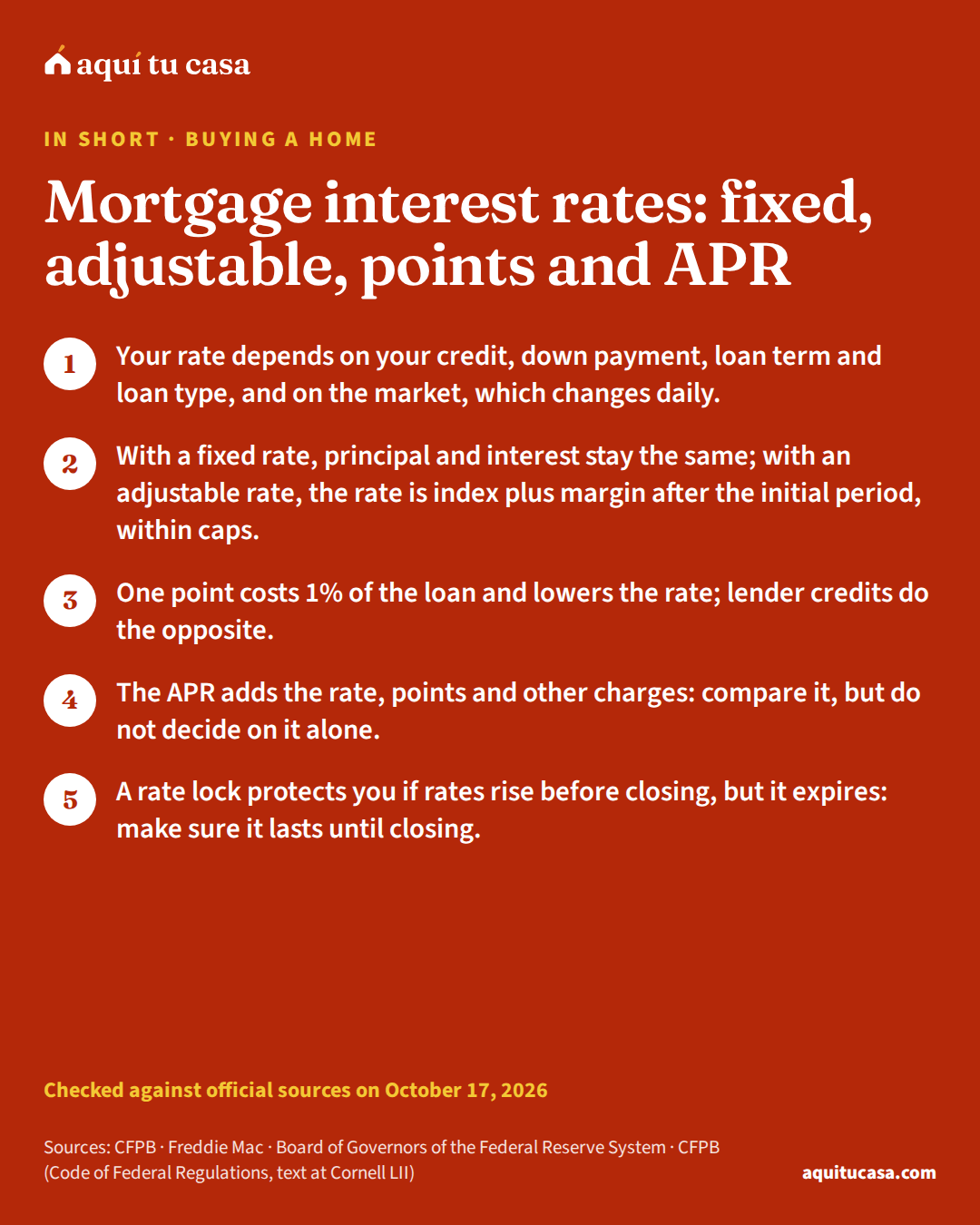
- Buying a home Mortgage interest rates: fixed, adjustable, points and APR What your mortgage rate is and what moves it, how fixed and adjustable rates differ, and how points, the APR and rate locks work. 13 minute read
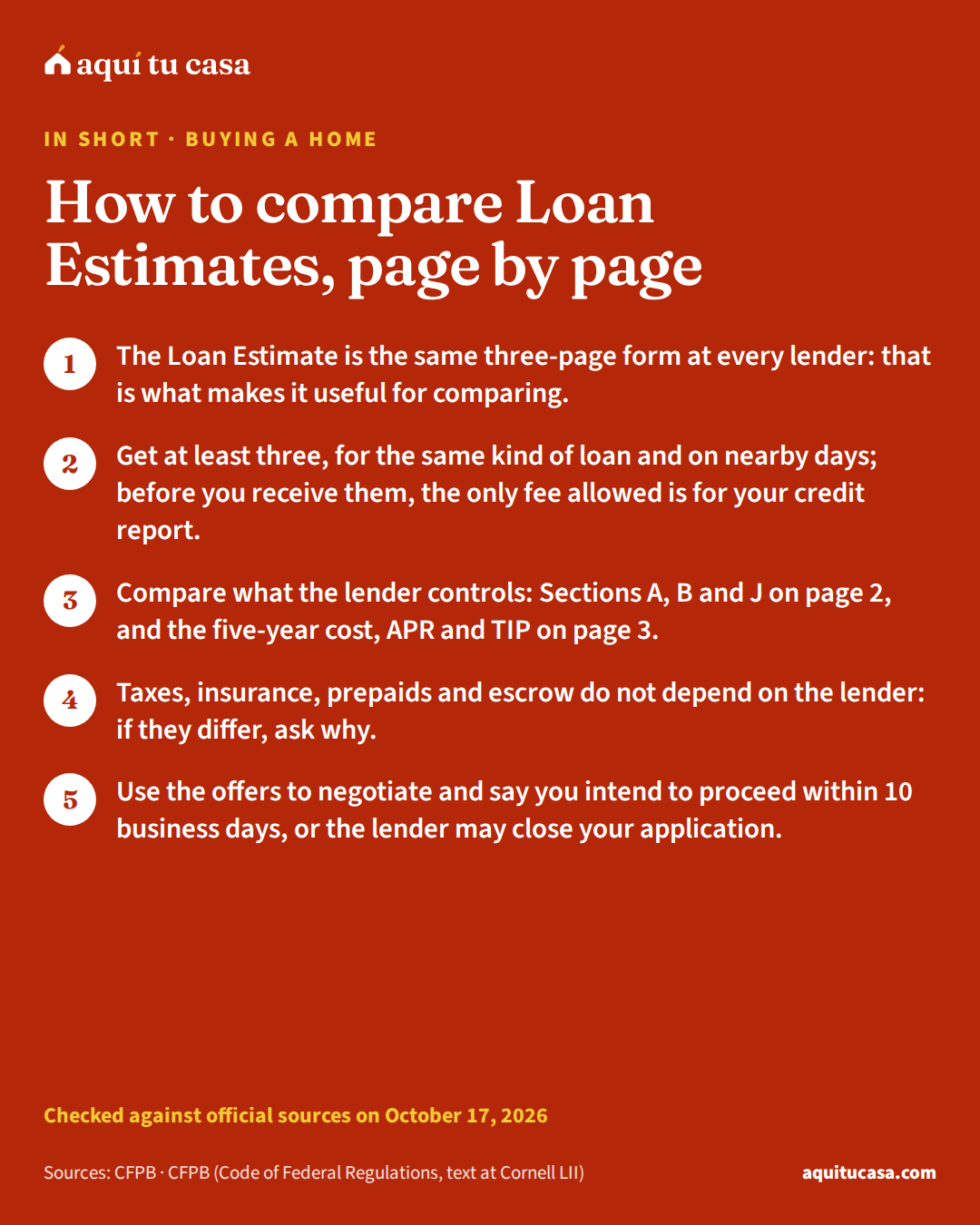
- Buying a home How to compare Loan Estimates, page by page How to read and compare two or three Loan Estimates side by side: what to check on each page, what can change and how to negotiate with lenders. 16 minute read
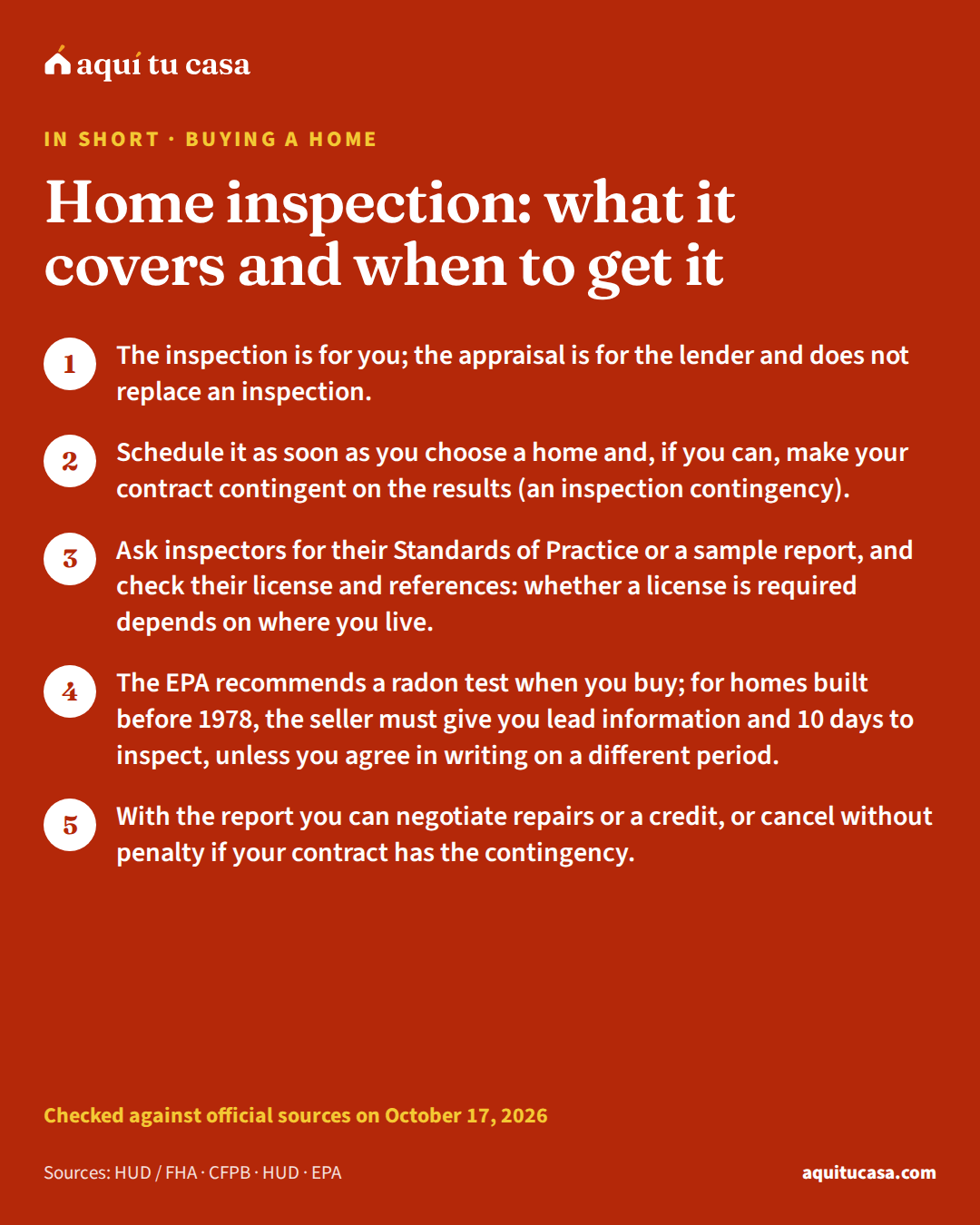
- Buying a home Home inspection: what it covers and when to get it What a home inspection is, how it differs from the appraisal, when to get it under a contingency, radon and lead tests, and what to do with the report. 12 minute read
Tools for this topic
Was this guide useful?
Thank you. Your answer stays in your browser; nothing is sent.