Buying a duplex or a home with an ADU to live with family
How to buy a 2- to 4-unit home or a home with an accessory dwelling unit (ADU) for family or to rent out part: who lives there, rent, limits and reserves.
Verified against official sources on October 17, 2026 15 official sources

Show contents
In short
What you need to know
Quick answer
Yes, you can buy a 2- to 4-unit home, or a home with an accessory dwelling unit (ADU), to live with family or rent out part of it, as long as you live there: with FHA, at least one borrower must move in within 60 days and plan to stay a year. Rent from the other units can help you qualify, but the lender counts only part of it (on FHA, 75% of the lesser of market rent or lease rent), and ADU rent is capped. Loan limits are higher for 2 to 4 units, and you may be asked for more reserves.
What matters most
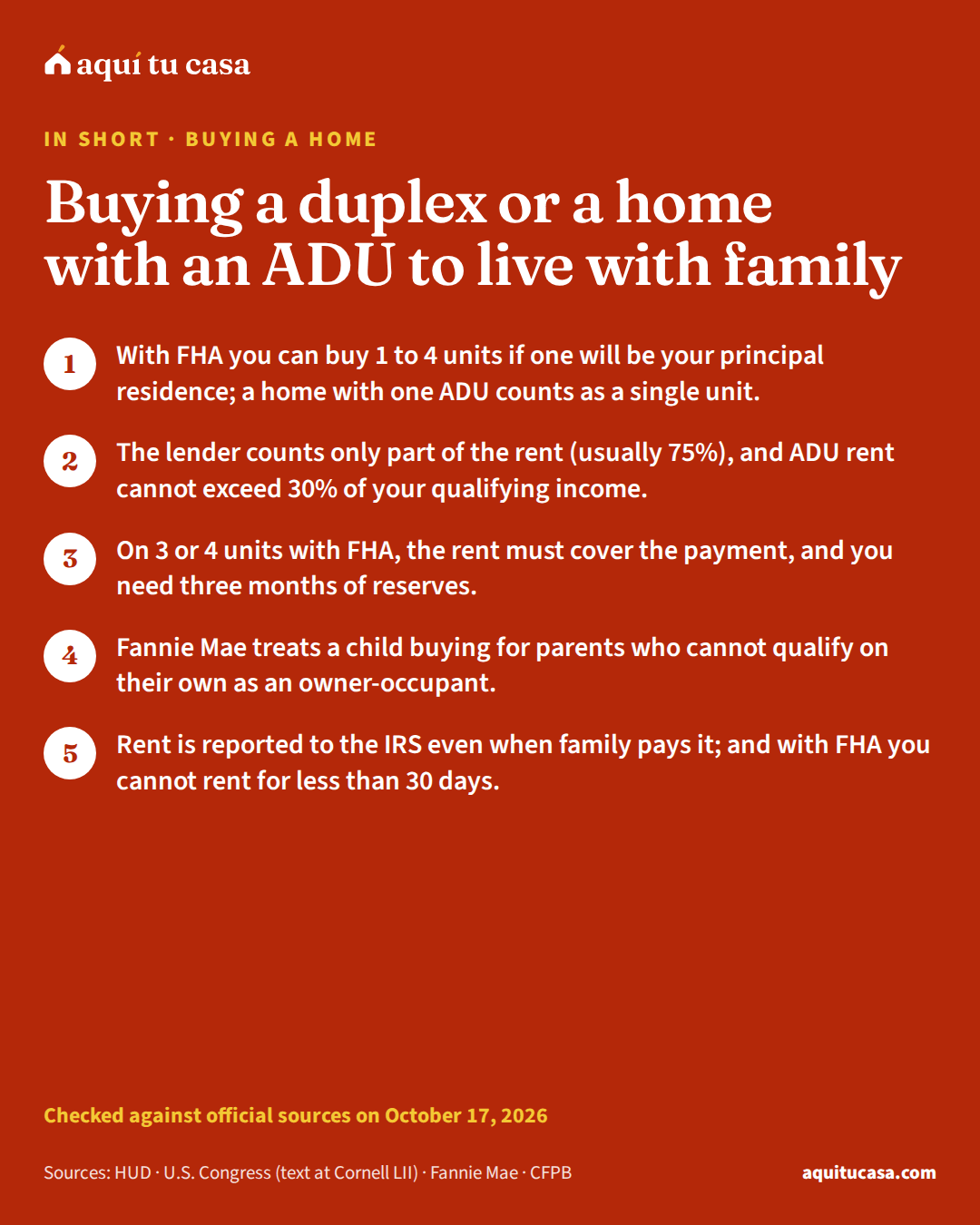
- With FHA you can buy 1 to 4 units if one will be your principal residence; a home with one ADU counts as a single unit.
- The lender counts only part of the rent (usually 75%), and ADU rent cannot exceed 30% of your qualifying income.
- On 3 or 4 units with FHA, the rent must cover the payment, and you need three months of reserves.
- Fannie Mae treats a child buying for parents who cannot qualify on their own as an owner-occupant.
Is this for you?
This guide is for you if…
- You want to buy a duplex, a 3- or 4-unit home or a home with an accessory dwelling unit (ADU) to live near your family.
- You plan to rent out part of the home and want to know whether that rent helps you qualify for the loan.
- You want to buy a home where your parents or an adult child with a disability will live.
Get direct help first if…
- You are looking for a property purely as an investment, without living in it: this guide is about buying where you or your family will live.
- You want to know who can sign the loan with you: the guide on buying with family as co-borrowers covers that.
- You already own a home and want to build an ADU: this guide is about buying.
Many families want to live together but with their own space: grandparents in one unit, the kids in another, or a rented part that helps pay the mortgage. This guide is for anyone thinking about buying a duplex, a 3- or 4-unit home or a home with an accessory dwelling unit (ADU): it explains what FHA and Fannie Mae say about who must live there, how they count rent, loan limits and what changes when you become a landlord.
Duplex, 3 or 4 units, or a home with an ADU: what each one is
For FHA, a one-unit home can have one accessory dwelling unit (ADU) and still count as one unit. A two-unit property has two dwellings, and a three- or four-unit property has three or four dwellings, or two or three plus an ADU.1 An ADU is a complete dwelling with its own way in and out, smaller than the main home, that can be attached to it, inside it or separate from it, and forms a single piece of real estate with the home.1
Fannie Mae defines it similarly: an ADU has space for living, sleeping, cooking and a bathroom, sits on the same parcel and is smaller than the main home. Only one is allowed per parcel, and none with a 2- to 4-unit property. Whether a property counts as one unit with an ADU or as two units depends on things like separate meters, its own address and whether the unit can be legally rented; the appraiser decides.6
Three ways to live close, side by side
Counts as 1 unit
Home with an ADU
2 units
Duplex
Loans on homes with more than one unit can cost slightly more: compare Loan Estimates from several lenders.10
Is the ADU legal? It depends on your city or county. Fannie Mae considers an ADU legal if current zoning allows it; if zoning does not allow it, the property may still be eligible under additional conditions.6 Before you make an offer, ask your city’s zoning or permits office.
Who has to live there
The basic rule is that the home must be your principal residence. With an FHA loanFHA loanAn FHA loan is a mortgage made by a private lender and insured by the Federal Housing Administration (FHA), an agency of the U.S. government. That insurance protects the lender if you stop paying, which is why the lender can accept a lower down payment and a less-than-perfect credit history than on a conventional loan. Federal law sets the minimum cash investment at 3.5% of the property's value and caps the loan amount at the FHA limit, which changes by county. In exchange for the insurance you pay a mortgage insurance premium.See the full definition, at least one borrower must move in within 60 days of signing and intend to live there for at least one year. You can have only one principal residence, and FHA will not insure a loan designed to obtain investment properties.1
If a family member signs with you but will not live there, FHA limits the loan. With a co-borrowerco-borrowerA co-borrower is a person who applies for the mortgage with you, signs the note and is responsible for the debt just as you are. On an FHA loan, all borrowers and co-borrowers, whether or not they will live in the home, must take title in their own name or a living trust, be obligated on the note and sign the security documents. It is not the same as a co-signer: according to Fannie Mae, a co-signer signs the note and is liable for the debt but has no ownership interest on the title. Co-borrowers who will not live in the home have their own rules.See the full definition who does not live in the home, the maximum is 75% of the value. It can reach 96.5% if you are family, but not on a 2- to 4-unit property.1 The guide on buying with family as co-borrowers explains who can sign.
Fannie Mae has two cases that matter to many families. With several borrowers, only one has to live in the home and be on the title. And it treats as an owner-occupant a child who buys a home for their parents if the parents cannot work or lack sufficient income to qualify on their own; the same goes for parents buying for an adult child with a disability.5

If this is you
You want to give your parents a home
Fannie Mae treats you as an owner-occupant if your parents cannot work or cannot qualify on their own.5
You are buying for an adult child with a disability
Fannie Mae treats the parent or guardian in that situation as an owner-occupant.5
Family signs with you but will not live there
With FHA, on 2 to 4 units the loan cannot exceed 75% of the value.1 The guide on how to hold title with family explains the ways to own together.
Rent from the other units: how much counts toward qualifying
Rent can help you qualify, but the lender does not count all of it. With FHA, rent from the property counts as income when it is a home with an ADU or a 2- to 4-unit property. For 2 to 4 units, the lender documents it with an appraisal showing fair market rentfair market rent (FMR)The fair market rent (FMR) is the rent HUD estimates every year for each area and each unit size, including the cost of utilities (except telephone). It is neither the lowest nor the highest rent: by rule it is set at the 40th percentile, the dollar amount below which 40% of the area's standard-quality rental units rent. HUD uses it to set the payment standards of the Housing Choice Voucher program (Section 8) and for other programs; on aquitucasa we use it as the benchmark for what renting costs in your county and for the wage needed to pay it.See the full definition and any leases. If you have no landlord history, it uses 75% of the lesser of market rent and lease rent. ADU rent cannot exceed 30% of your total qualifying income. And the lender may not subtract that rent from your mortgage payment: it adds it to your income.1
Fannie Mae calculates it differently. On a purchase, it multiplies monthly gross rent by 75% and subtracts the full property payment. If you have less than 12 months of rental management experience, a positive result can only offset that payment, not count as extra income. For an ADU, only rent from one existing ADU counts, up to 30% of your qualifying income.7 Rent from the unit you live in generally does not count.8
Example with real numbers
Market rent and a typical payment, for comparison
With national numbers: HUD's two-bedroom fair market rent and the payment on a typical home with FHA.
- Two-bedroom fair market rent (national average)
- $1,750
- Price of a typical US home
- $332,700
- Typical monthly payment with FHA (principal, interest, tax, insurance and mortgage insurance)
- $2,759
This is an example with national numbers, not of a duplex. If you have no landlord history, FHA counts only 75% of the lesser of market rent and lease rent.1 Try your own numbers in the calculator.
Run it with your numbersHow much house can I afford?On 3 or 4 units, FHA adds a test: the rent has to cover the payment. Principal, interest, taxes and insurance, divided by the net rent of all units, cannot exceed 100%. That net rent uses market rent for all units, including yours, minus the greater of the appraiser’s vacancy and maintenance estimate or 25%.1 The debt-to-income guide explains how your income and debts add up.

Loan limits and the savings you will need
The FHA limit is not the same for a house and a duplex. The law figures the maximum separately for 1-, 2-, 3- and 4-family homes.4 According to HUD, limits for multiple units are fixed multiples of the one-unit limit, and you can look up your county’s on its FHA limits page.3 The one-unit FHA limitFHA loan limitThe FHA loan limit is the maximum mortgage amount the Federal Housing Administration can insure in a county or metropolitan area. The law computes it from the area's median home price: in general it is 115% of that price, but never less than a national floor (65% of the conforming loan limit) nor more than a national ceiling (150% of that limit). That is why expensive counties have higher limits. There is a separate limit for one-, two-, three- and four-unit homes. HUD publishes the limits every year and we show them for every county.See the full definition ranges from $541,287 to $1,299,500 depending on the county.
FHA one-unit limits by state
| State | FHA limit (1 unit) | Typical home value |
|---|---|---|
| Alabama | $541,287 | $209,900 |
| Alaska | $541,287 – $596,850 | $352,900 |
| Arizona | $541,287 – $609,500 | $394,500 |
| Arkansas | $541,287 | $188,000 |
| California | $541,287 – $1,249,125 | $734,700 |
| Colorado | $541,287 – $1,249,125 | $539,400 |
| Connecticut | $541,287 – $977,500 | $366,900 |
| Delaware | $541,287 – $630,200 | $352,000 |
| District of Columbia | $1,249,125 | $737,100 |
| Florida | $541,287 – $990,150 | $359,000 |
| Georgia | $541,287 – $718,750 | $303,300 |
| Hawaii | $586,500 – $1,299,500 | $839,100 |
| Idaho | $541,287 – $1,249,125 | $418,600 |
| Illinois | $541,287 | $263,300 |
| Indiana | $541,287 | $218,200 |
| Iowa | $541,287 | $208,000 |
| Kansas | $541,287 | $217,200 |
| Kentucky | $541,287 | $205,600 |
| Louisiana | $541,287 | $216,500 |
| Maine | $541,287 – $615,250 | $296,600 |
| Maryland | $541,287 – $1,249,125 | $419,900 |
| Massachusetts | $541,287 – $1,249,125 | $562,100 |
| Michigan | $541,287 | $231,600 |
| Minnesota | $541,287 – $552,000 | $329,300 |
| Mississippi | $541,287 | $169,800 |
| Missouri | $541,287 | $230,300 |
| Montana | $541,287 – $754,400 | $375,800 |
| Nebraska | $541,287 – $603,750 | $238,600 |
| Nevada | $541,287 – $736,000 | $435,400 |
| New Hampshire | $541,287 – $962,550 | $402,500 |
| New Jersey | $541,287 – $1,249,125 | $454,400 |
| New Mexico | $541,287 – $692,300 | $248,100 |
| New York | $541,287 – $1,249,125 | $423,800 |
| North Carolina | $541,287 – $805,000 | $288,900 |
| North Dakota | $541,287 | $249,900 |
| Ohio | $541,287 – $591,100 | $214,800 |
| Oklahoma | $541,287 | $199,800 |
| Oregon | $541,287 – $762,450 | $477,600 |
| Pennsylvania | $541,287 – $630,200 | $254,500 |
| Puerto Rico | $541,287 – $690,000 | $131,500 |
| Rhode Island | $787,750 | $404,200 |
| South Carolina | $541,287 – $690,000 | $259,000 |
| South Dakota | $541,287 – $541,650 | $257,400 |
| Tennessee | $541,287 – $1,029,250 | $286,700 |
| Texas | $541,287 – $813,050 | $283,800 |
| Utah | $541,287 – $1,163,800 | $489,400 |
| Vermont | $541,287 – $575,000 | $316,600 |
| Virginia | $541,287 – $1,249,125 | $383,700 |
| Washington | $541,287 – $1,063,750 | $564,600 |
| West Virginia | $541,287 – $1,249,125 | $162,600 |
| Wisconsin | $541,287 – $552,000 | $266,500 |
| Wyoming | $541,287 – $1,249,125 | $309,700 |
These are one-unit limits; limits for 2 to 4 units are fixed multiples of these, according to HUD. Source: HUD · Census Bureau (ACS)
You will also be asked for more reservesreservesReserves are the cash and other easy-to-cash assets you still have available after the mortgage closes. They are measured in months: how many full monthly house payments (principal, interest, taxes, insurance and association dues) you could cover with them. Under Fannie Mae's rules, they include money in checking or savings accounts, investments, the vested part of a retirement account and the cash value of a life insurance policy; personal loans and the money you use to close do not count. An eligible gift can also be used. How many months are required depends on the loan and the property.See the full definition, meaning savings left after closing. With FHA, the lender must verify three months of payments on 3 or 4 units, and two months on a home with an ADU if rental income is used to qualify you.1 For Fannie Mae loans evaluated with its Desktop Underwriter system, six months are required for a 2- to 4-unit principal residence.9 And loans on homes with more than one unit can cost slightly more.10 The guide on how much down payment you need explains each loan’s minimums.

When you become a landlord: rent, taxes and fair housing
If you have an FHA loan on a 2- to 4-unit property, you sign form HUD-92561. In it you agree not to rent any part for transient or hotel use while the loan is insured: HUD defines that as any rental of less than 30 days, or one with hotel services like cleaning or linens.2 For a regular rental, a written leaseleaseA lease, or rental agreement, is the contract in which the owner or landlord gives you the right to live in and use a property for a set period of time in exchange for payment, usually rent. While the lease lasts you have possession, but the landlord still owns the property. The lease says how much you pay and when, who handles maintenance and how the agreement can end. Your rights as a tenant are usually spelled out in the lease and in your state and local laws. Before complaining to the landlord, it helps to read the lease and make sure you are also following the rules you agreed to.See the full definition helps; the guide to your lease explains what it covers.
Rent is reported to the IRS. According to Publication 527, in most cases you include all rent you receive in your income. If you rent part of your property, you split certain expenses between the rented part and yours, and expenses for the rented part are deducted on Schedule E. Watch out with family: if a relative lives in the unit without paying a fair rent as their main home, those days count as personal use. A fair rent is what someone unrelated to you would pay.11 A VITAVITA (free tax preparation)VITA (Volunteer Income Tax Assistance) and TCE (Tax Counseling for the Elderly) are IRS programs that offer free basic tax return preparation by IRS-certified volunteers. They are meant for people with moderate income, people with disabilities and limited-English speakers; TCE focuses on people sixty and older. The IRS sets no program-wide income limit, but individual sites may set their own. Many sites serve in Spanish and help with ITIN applications and renewals. Filing taxes every year builds the record lenders ask for.See the full definition site prepares basic returns for free if you qualify; services vary by site, so ask whether they handle rental income.14
From family plan to keys, step by step
1. You decide with your family who lives in each unit
Before you search
At least one FHA borrower moves in within 60 days and stays a year.1
2. You check whether the ADU or units are legal
Before you make an offer
Fannie Mae considers an ADU legal if current zoning allows it.6
3. You look up your county's limit
When you get preapproved
Limits for multiple units are multiples of the one-unit limit.3
4. The appraiser estimates the rent
During the loan process
With FHA, for 2 to 4 units the appraisal shows fair market rent.1
6. You sign and move in
Closing day
On 2 to 4 units with FHA, you agree not to rent for less than 30 days.2
7. You report the rent
On your tax return
Include the rent in your income and split the expenses of the rented part.11
Costly mistakes
Mistake: Budgeting with the full rent from the other units.
Instead: The lender usually counts 75%, and sometimes only to offset the payment.7
Mistake: Counting on a family member who signs but will not live in an FHA duplex.
Instead: On 2 to 4 units, that FHA loan cannot exceed 75% of the value.1
Mistake: Assuming the ADU is legal.
Instead: Ask your city; the appraiser checks zoning.6
Mistake: Renting a unit by the night with an FHA loan.
Instead: With FHA you cannot rent for less than 30 days while you have the loan.2
Mistake: Not reporting rent your family pays you.
Instead: Include it in your income; if it is not a fair rent, your deductions change.11
Mistake: Saying in the ad what kind of tenant you prefer.
Instead: Discriminatory ads are prohibited even if you live in the property.13

What to do this week
- Talk with your family about who will live in each unit and who will sign; with FHA, at least one borrower must move in within 60 days.1
- Look up your county’s FHA limit for 2, 3 or 4 units on HUD’s page.3
- Ask your city whether the ADU or units you are interested in are legal.6
- Ask several lenders how they would count the rent in your case and how much in reserves they would require.1
- Work out your savings for the down payment, closing and reserves with the how much house can I afford tool.1
- If you want help with your plan, a HUD-approved housing counselorHUD-approved housing counselorA HUD-approved housing counselor works at an agency HUD has approved to provide housing counseling: independent, expert advice customized to your situation about buying a home, renting, a missed mortgage payment, a foreclosure or credit problems. The agencies usually charge little or nothing; many serve in Spanish and offer the homebuyer education course several assistance programs require. They are not lenders or real estate agents and sell you nothing. Your county page lists the official agencies with phone numbers.See the full definition gives independent advice, often free or at low cost.15
Your numbers
The minimum for this loan is 3.5%. More down lowers the monthly payment.
Adjust advanced details
First number: share of income for housing. Second: housing plus debts. Lender references, not fixed rules.
Let's do the math
Estimated top price
National figure$227,000
Limited by the housing payment: at that price it would be about $1,883 a month, 28% of your income.
- By the housing payment (28% of income)Limits you$227,000
- By your total debts (36% of income)$292,000
- By your cash (down payment + closing)$330,500
- Typical home in the United States
- $332,700
- Your cap is 68% of the typical home.
What changes if…?
- …you save $10,000 more$227,000
- …you cut $200 a month in debts$227,000
Your maximum price with four loans
Same income, debts and savings; only the down payment and the loan type change. ITIN uses an example down payment and rate.
| FHA 3.5% | Conventional 5% | Conventional 20% | ITIN 15% (example) | |
|---|---|---|---|---|
| Maximum price | $227,000 | $232,000 | $93,000 | $119,000 |
| Payment per month | $1,883 | $1,882 | $616 | $898 |
Educational estimate, not a pre-approval. Uses example insurance (0.5% of value per year) and example closing costs (3% of price); the tax is the place’s typical rate.
Ready to see the numbers? Find your county here
See how this applies in your county: its loan limits, prices and rents, from the official data.
Printable checklist
Frequently asked questions
Can I buy a duplex with an FHA loan?
Yes. FHA's single family programs cover one- to four-unit properties that are the owner's principal residence. At least one borrower must move in within 60 days of signing and plan to live there for at least one year.
Does rent from the other unit help me qualify?
It can help, but not in full. On FHA, if you have no rental history, the lender uses 75% of the lesser of market rent or lease rent. Fannie Mae multiplies gross rent by 75% and subtracts the property payment; if you have less than 12 months of landlord experience, it can only offset that payment.
Does a home with an ADU count as two units?
For FHA, a one-unit home with a single ADU remains one unit. For Fannie Mae, it depends on the property's features, such as separate meters, its own address and whether the unit can be legally rented; the appraiser decides.
How much can I borrow for a duplex?
FHA limits for multiple units are fixed multiples of the one-unit limit, which ranges from $541,287 to $1,299,500 depending on the county. You can look up your county's 2-, 3- or 4-unit limit on HUD's FHA mortgage limits page.
Can I buy a home for my parents without living there?
Fannie Mae treats a child buying to house their parents as an owner-occupant if the parents cannot work or lack sufficient income to qualify on their own. Ask several lenders which programs they offer for your situation.
Do I have to report rent my family pays me?
According to the IRS, in most cases you must include all rent you receive in your income. If a family member lives there without paying a fair rent as their main home, those days count as personal use, which changes how you split expenses. A VITA site can help for free if you qualify.
Can I rent one of the units by the night with FHA?
Not while the loan is FHA-insured. On form HUD-92561 you agree not to rent any part for transient or hotel use, which HUD defines as rentals of less than 30 days or with hotel services.
Will I need more savings to buy several units?
With FHA, the lender must verify three months of payments in reserves on 3 or 4 units, and two months on a home with an ADU if rental income is used to qualify you. Fannie Mae loans evaluated with Desktop Underwriter require six months for a 2- to 4-unit principal residence.
Sources
Every figure in this guide comes from one of these official sources. The number next to a sentence leads to the source behind it.
Each source on one line: who publishes it, its title, its address and the date we read it.
- 1. HUD · Single Family Housing Policy Handbook 4000.1 · hud.gov · Accessed October 17, 2026
- 2. HUD · Form HUD-92561, Borrower's Contract with Respect to Hotel and Transient Use of Property · hud.gov · Accessed October 17, 2026
- 3. HUD · FHA Mortgage Limits · entp.hud.gov · Accessed October 17, 2026
- 4. U.S. Congress (text at Cornell LII) · 12 U.S.C. §1709, Insurance of mortgages (National Housing Act §203) · law.cornell.edu · Accessed October 17, 2026
- 5. Fannie Mae · Selling Guide B2-1.1-01, Occupancy Types · selling-guide.fanniemae.com · Accessed October 17, 2026
- 6. Fannie Mae · Selling Guide B2-3-04, Special Property Eligibility Considerations · selling-guide.fanniemae.com · Accessed October 17, 2026
- 7. Fannie Mae · Selling Guide B3-3.8-02, Rental Income from the Subject Property · selling-guide.fanniemae.com · Accessed October 17, 2026
- 8. Fannie Mae · Selling Guide B3-3.8-01, General Rental Income Information · selling-guide.fanniemae.com · Accessed October 17, 2026
See the other 7 sources
- 9. Fannie Mae · Selling Guide B3-4.1-01, Minimum Reserve Requirements · selling-guide.fanniemae.com · Accessed October 17, 2026
- 10. CFPB · Request and review multiple Loan Estimates · consumerfinance.gov · Accessed October 17, 2026
- 11. IRS · Publication 527, Residential Rental Property · irs.gov · Accessed October 17, 2026
- 12. U.S. Congress (text at Cornell LII) · 42 U.S.C. §3603, Effective dates of certain prohibitions (Fair Housing Act) · law.cornell.edu · Accessed October 17, 2026
- 13. U.S. Congress (text at Cornell LII) · 42 U.S.C. §3604, Discrimination in the sale or rental of housing (Fair Housing Act) · law.cornell.edu · Accessed October 17, 2026
- 14. IRS · Free tax return preparation for eligible taxpayers · irs.gov · Accessed October 17, 2026
- 15. CFPB · Find a Housing Counselor · consumerfinance.gov · Accessed October 17, 2026
Keep reading
Related guides
If this guide helped, these follow the same path.

Buying a home 11 minute read
Buying a home with family: co-borrowers and co-signers
Who in your family can sign the loan with you, how incomes and debts add up, and what changes if your relative will not live in the home or has an ITIN.
- A co-borrower signs the note and usually goes on the title; a co-signer signs the note and is liable for the debt but does not own the home.
- The lender adds the income of everyone who signs, but also their debts; if a relative does not live in the home, their own housing payment counts too.
- On FHA, with a borrower who will not live in the home, the most you can finance is 75% unless you are family; with Fannie Mae, the maximum is 95% through its automated system.
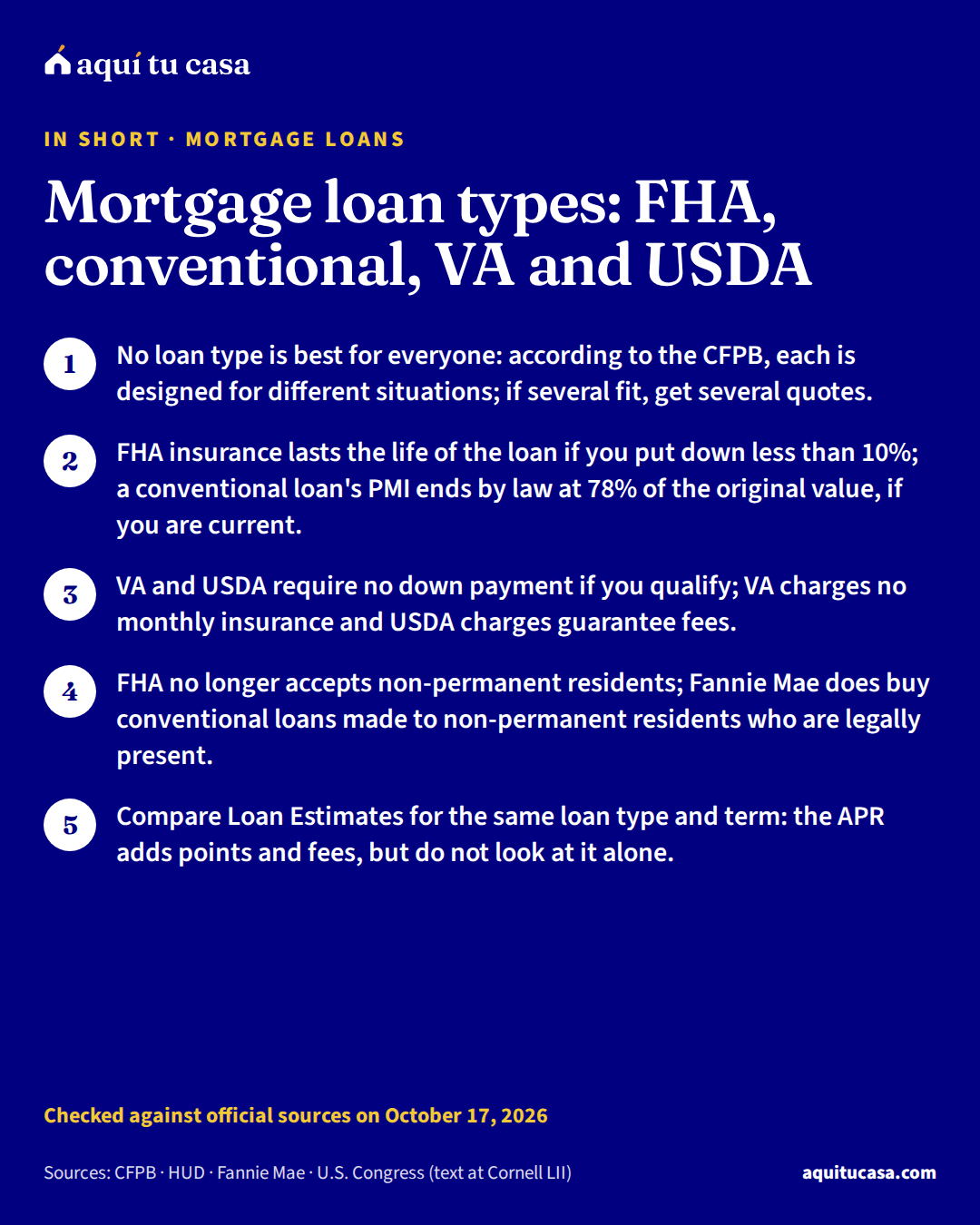
- Mortgage loans Mortgage loan types: FHA, conventional, VA and USDA What each mortgage type asks for, what its insurance costs, fixed or adjustable rate, points and APR. A neutral comparison with official sources. 14 minute read
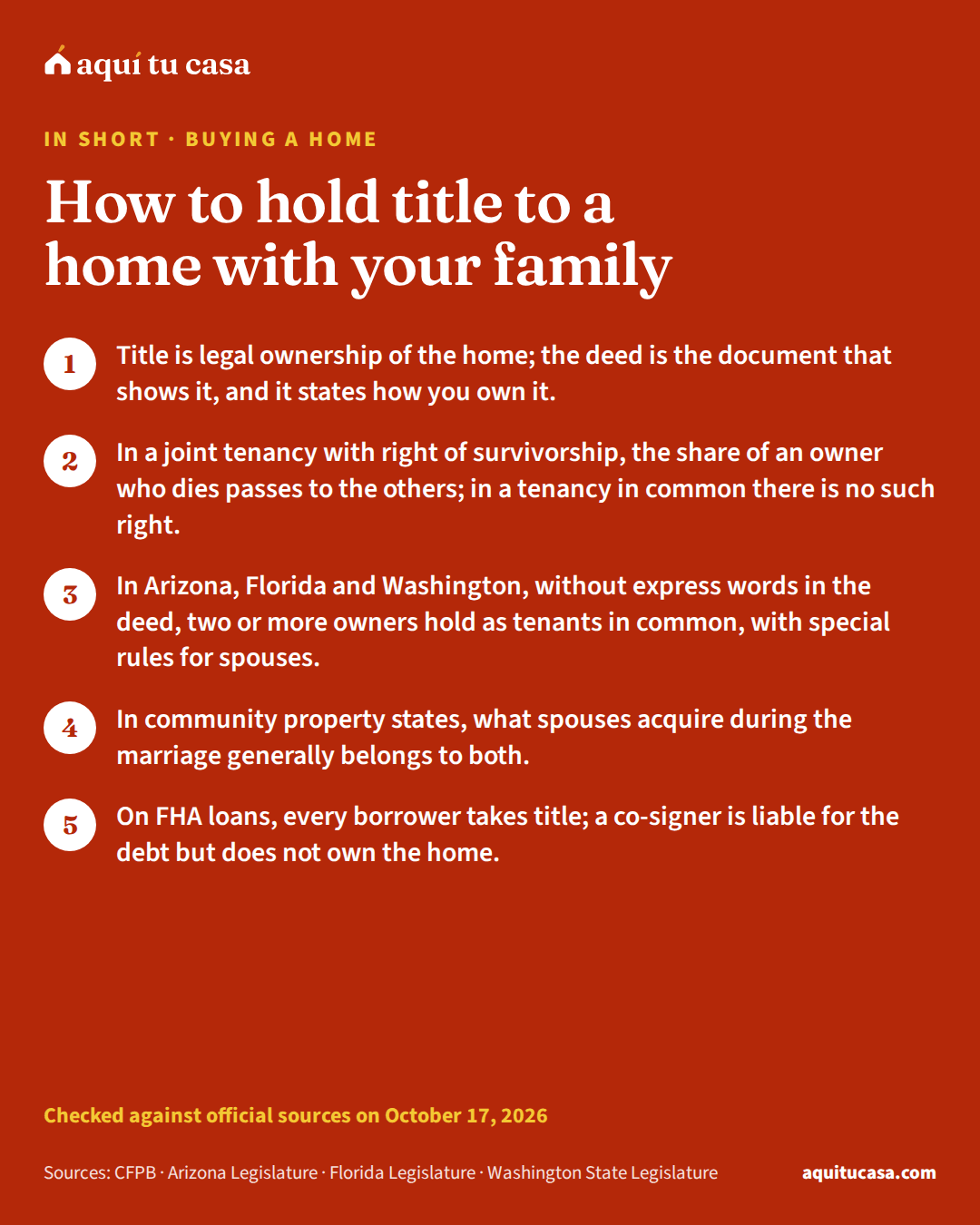
- Buying a home How to hold title to a home with your family Joint tenancy, tenancy in common and community property: what some state laws say, what loans require and where to find free legal help. 10 minute read
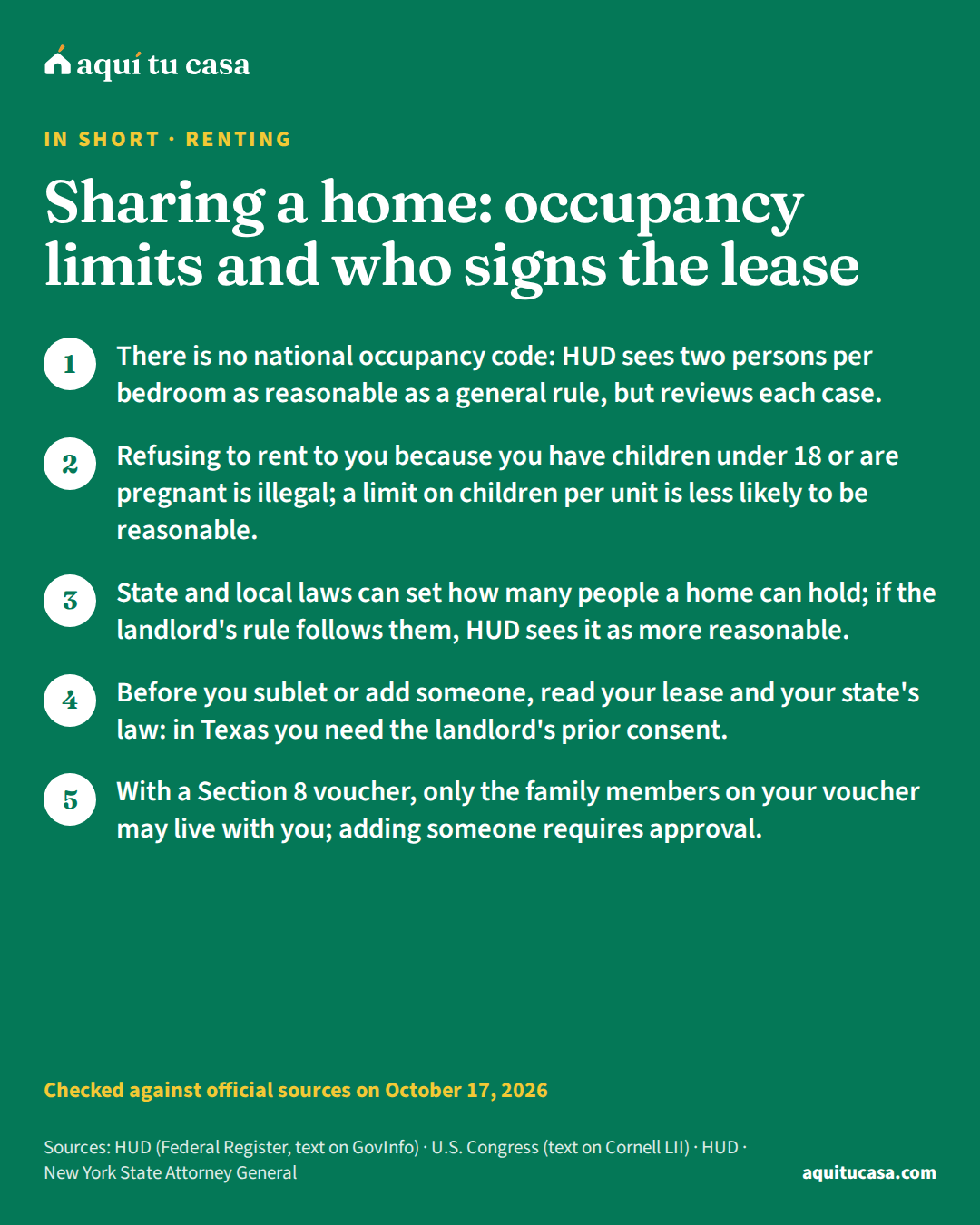
- Renting Sharing a home: occupancy limits and who signs the lease How many people can live in a home, when an occupancy limit discriminates against families with children, and what to know before subletting. 11 minute read
Tools for this topic
Was this guide useful?
Thank you. Your answer stays in your browser; nothing is sent.