Inheriting a home in Puerto Rico from the states
If you live in the states and inherit a Puerto Rico home: which law applies, papers signed elsewhere, Hacienda's release, CRIM and taxes if you sell.
Verified against official sources on October 31, 2026 12 official sources

Show contents
In short
What you need to know
Quick answer
If you inherit a home in Puerto Rico while living in the states, the home follows the island's rules: ownership and its recording are governed by Puerto Rico law, and the forced-share rules apply to every property there, even if your relative lived in the states. Papers signed elsewhere, such as a will or a power of attorney to sell, must be legalized and protocolized before a notary in Puerto Rico. Hacienda asks for an inheritance return and issues the Release (Relevo), without which the home cannot be recorded or sold; for recent deaths there is no tax, but the informational return is due within 12 months. And CRIM must be told about the change of owner within 30 days.
What matters most
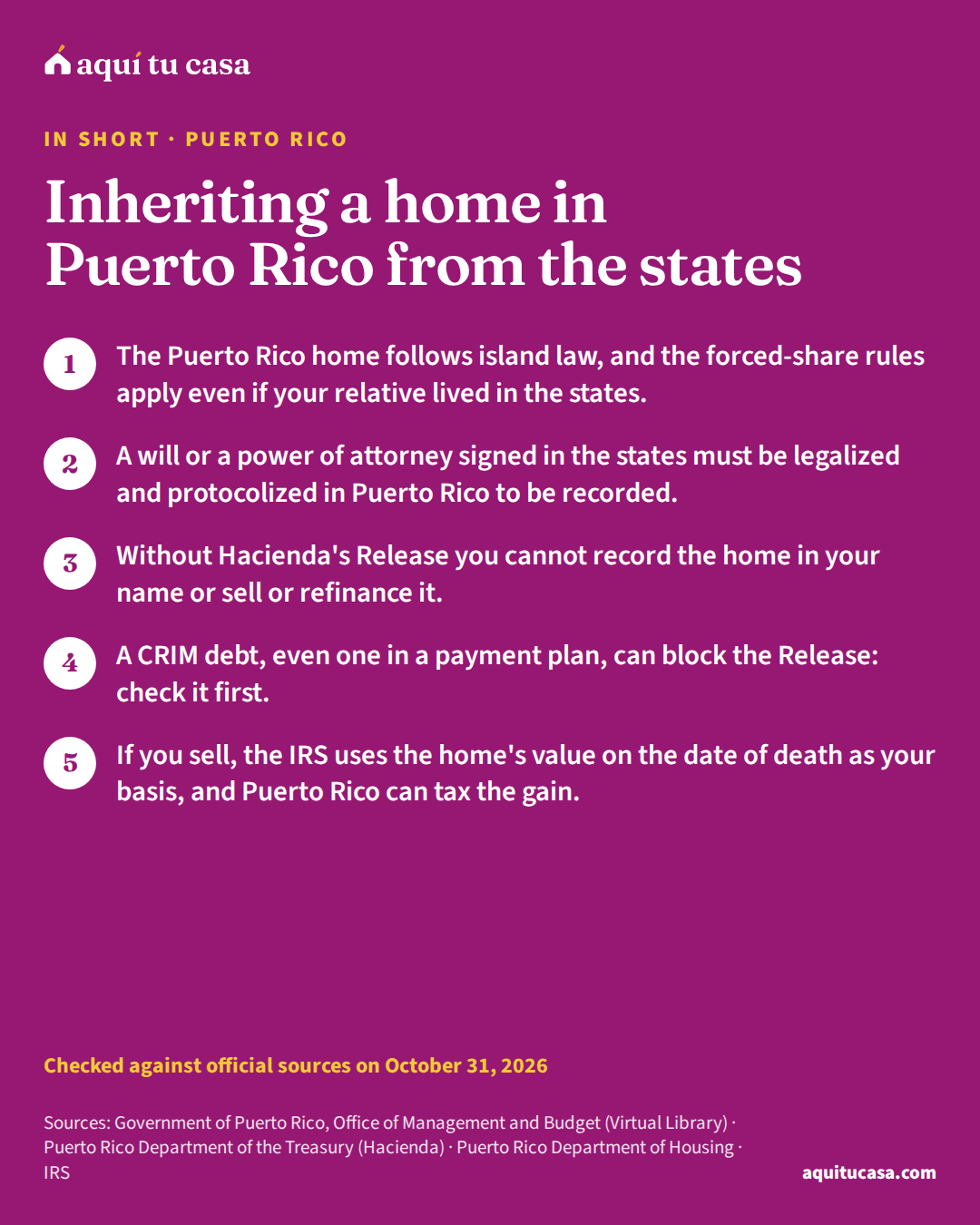
- The Puerto Rico home follows island law, and the forced-share rules apply even if your relative lived in the states.
- A will or a power of attorney signed in the states must be legalized and protocolized in Puerto Rico to be recorded.
- Without Hacienda's Release you cannot record the home in your name or sell or refinance it.
- A CRIM debt, even one in a payment plan, can block the Release: check it first.
Is this for you?
This guide is for you if…
- You live in one of the states and a relative who owned a home in Puerto Rico died.
- Your mother or father lived in the states but left a house on the island, with or without a will.
- You and your siblings live in different places and want to fix up, rent out or sell the family home.
Get direct help first if…
- You want to understand who inherits, the declaration of heirs and the Property Registry: start with the guide to titles and inheritance in Puerto Rico, which this guide complements.
- The home you inherit is in one of the 50 states: there, inheritance follows that state's rules; see the guide to wills, TOD deeds and inheriting a home.
- There is a dispute among heirs or with a third party: get legal guidance; this guide only explains the general rules.
If your relative died and left a home in Puerto Rico, and you live in Florida, New York, Texas or another state, the process can seem impossible from far away: papers in a different system, offices you do not know and siblings in different cities. This guide explains what changes when you inherit from the states: which law applies, how papers signed elsewhere work on the island, what Hacienda asks for, what CRIM asks for and what taxes there may be if you sell.
For the basics, such as who inherits without a will, the declaration of heirs and recording in the Registry, first read the guide to titles and inheritance in Puerto Rico. This guide complements it.
Which law applies if your relative lived in the states
Under Puerto Rico’s Civil Code, succession is governed by the law of the place where the decedent lived (their domicile). But two rules protect the island home: the forced-share rules apply to every property in Puerto Rico, and ownership and its recording are governed by the law of the place where the property is.1 The forced share (legítima) is the part of the estate the law reserves for certain heirs.
If there is a will made in the states. Its form is valid if it meets the law of Puerto Rico, of the place where it was made or of the domicile of the person who made it.1 That does not mean it records on its own: see the next section.
The rules on which law applies can get complicated, especially with property in two places or heirs who disagree. If that is your case, get legal guidance: the free legal aid guide explains where.
Papers signed outside Puerto Rico
This is the step that most surprises people in the states. A document signed there does not go into the island’s Property Registry by itself. To record a document executed outside Puerto Rico, the Registry Act requires, among other things, that it be legalized by the competent authority of the place where it was signed and that a notary in Puerto Rico protocolize it, if no court process is needed for it to take effect.2 The Notarial Act says the same for any notarial document made elsewhere: it must first be protocolized to work as a public instrument, and the notary charges the same fees as if it had been made in Puerto Rico.3
If you want to sign from the states. You can give a power of attorneypower of attorney (POA)A power of attorney (POA) is a legal document that lets someone else act on your behalf. That person is called your agent. A financial power of attorney can help you plan ahead: it is generally "durable," meaning it stays in effect even if you can no longer make decisions. It can also be for something short-term, such as paying bills while you are away. If you show it to your bank, the bank should let your agent handle transactions for you. The CFPB warns that it gives a lot of authority over your money without regular oversight, so choose someone you trust deeply.See the full definition to someone on the island. But watch the wording: under the Civil Code, a power in general terms covers only administration; to sell, mortgage or encumber the home you need a power that expressly authorizes it, and if the act is done by public deed, the power must be in a public instrument.1 Signed in the states, that power must also be protocolized in Puerto Rico.3
Three offices, three separate processes
The Release
Hacienda
The property tax
CRIM
All three are separate: recording with the Registry does not notify CRIM, and CRIM does not process the Release.
Hacienda: the inheritance return and the Release
Who files it. According to Hacienda, the estate tax return (planilla de caudal relicto), the inheritance return, is filed for people who lived in Puerto Rico at death and also for nonresidents who owned property in Puerto Rico. It reports all the decedent’s assets, wherever they are. It is filed by the administrator or anyone holding estate assets, such as the widow or widower or the heirs.5
What it is for. With the return, Hacienda issues the Lien Certificate, known as the Release (Relevo). Without the Release, the heirs cannot record the home in their names, sell or refinance it, or receive the decedent’s bank accounts.5
Is there a tax? According to Hacienda, the law eliminated the inheritance tax for deaths after a date set by the Internal Revenue Code, whether or not the person lived in Puerto Rico. In those cases, the administrator files under oath an informational return, Form SC 2800 C, within the 12 months after the death, complete in every part, with each asset, its adjusted basis and how the decedent acquired it. Issuing the Release can cost up to $25.7 If the death was many years ago, before that change, the form is different: Hacienda warns that the form depends on the date of death and that the return does not count if you use the wrong one.6
How to file. According to Hacienda, inheritance transactions, including the Release request, are done only online, in the Unified Internal Revenue System (SURI). The administrator files them; that can be a forced heir, the surviving spouse, the executor or a court-appointed administrator, who must register in SURI even without income.8 Among the documents, Hacienda names the death certificate, bank statements, a CRIM certification that the home owes no taxes and a Hacienda certification that the decedent owed none.6
If there were debts. The Internal Revenue Code gives the Government a preferred lien on the estate’s assets for the decedent’s taxes, including property taxes. Hacienda issues the regular Release only if the decedent had no tax debts, and that includes debts in a payment plan with Hacienda or CRIM. If the debts are under review, it can issue a Conditional Release with a bond. And if they are not under review, it can authorize a sale or financing to pay them, if what remains under the lien is worth at least twice what is owed.7

CRIM: the change of owner and the home’s debts
Report the change of owner. Anyone who acquires a property by inheritance must notify CRIM of the change of owner, on its form, within the 30 days after, even if the inheritance was already filed with the Registry. If not, they are liable for bills issued in the previous owner’s name, with interest, surcharges and penalties, and for the lien on the home.4
Taxes are paid first. When settling a decedent’s assets, the property taxes those assets owe come before any other debt. No executor or administrator may divide the assets until overdue taxes are paid, and the Registry will not record the partition if current taxes are unpaid.4 Ask for CRIM’s debt certification before any other step: the guide to CRIM and property tax explains how.
The exoneration, if someone lives in the home. A home in an estate counts as one home, and the principal-residence exoneration goes to the heir who lives there and has none elsewhere. If no one in the family lives there on January 1, or if it is rented out, it no longer counts as residential.4 The guide to the residence exoneration and other CRIM exemptions explains more.
If the home comes from the CRUV. To sell, refinance or mortgage it, the Department of Housing requires an authorization, and in case of death it asks for the death certificate and the declaration of heirs.9
Inheriting the home from the states, in order
1. Ask CRIM for the debt certification
As soon as possible
To learn what the home owes; taxes are paid first.4
2. Do the declaration of heirs or prove the will
If the will or the power of attorney was signed elsewhere, it must be legalized and protocolized in Puerto Rico.2
3. Name the administrator and register them in SURI
It can be an heir, the surviving spouse or the executor.8
4. File the inheritance return with Hacienda
Within 12 months, in recent cases
With all the documents, to get the Release.7
5. Tell CRIM about the change of owner
Within 30 days
Even if the inheritance was already filed with the Registry.4
6. Record the home in the Registry
With the Release and the protocolized documents.5
If you decide to sell: taxes on both sides
In the states. According to the IRS, the sale of inherited property counts in your gross income and is reported on your federal return, on Schedule D or Form 8949. To know whether there is a gain, the basis of an inherited home is generally its fair market value on the date of death. If you sell for more, the difference is taxable gain.10 That is why it helps to have an appraisal or proof of the home’s value on that date.
In Puerto Rico. IRS Publication 570 explains that a citizen who is not a bona fide resident of Puerto Rico generally files a Puerto Rico return with their island-source income, plus their federal return with all their income, and can claim a credit for tax paid to Puerto Rico. The gain from selling real property generally comes from where the property is.11 To learn how much Puerto Rico charges and whether there is withholding at the sale, ask Hacienda before you sign.
The federal estate tax. It is a tax on the right to transfer property at death, and the gross estate includes everything the person owned, including real estate. A federal return (Form 706) is required only if the estate exceeds the threshold for the year of death, and most simple estates do not file one.12
A VITAVITA (free tax preparation)VITA (Volunteer Income Tax Assistance) and TCE (Tax Counseling for the Elderly) are IRS programs that offer free basic tax return preparation by IRS-certified volunteers. They are meant for people with moderate income, people with disabilities and limited-English speakers; TCE focuses on people sixty and older. The IRS sets no program-wide income limit, but individual sites may set their own. Many sites serve in Spanish and help with ITIN applications and renewals. Filing taxes every year builds the record lenders ask for.See the full definition site can prepare your return for free if you qualify; the guide to filing taxes for free explains how, and the one on taxes when you sell your home covers the rest.
Example with real numbers
Three siblings who inherit their mother's home in Caguas
An example in words, not a real case, of how the paperwork gets split up.
- One lives in Orlando, one in New York and one in Caguas
- They agree the one in Caguas will be the administrator in SURI
- They ask CRIM for the debt certification
- The home owed one semester; they pay it before requesting the Release
- The ones in the states sign a power of attorney with express authority to sell
- They have it legalized and a notary in Puerto Rico protocolizes it
- They file the inheritance return and get the Release
- They tell CRIM about the change of owner within 30 days
- What they achieve
- The home recorded in all three names, ready to sell or rent with its papers in order
If they sell, each one checks how to report the sale on their federal return, with the basis of the value on the date of death.
Run it with your numbersHow much will I keep when I sell?
If this is your situation
What matters most in your situation
You live in the states and inherited the home
Papers you sign there must be legalized and protocolized in Puerto Rico.23
You are several siblings in different states
Choose one administrator for SURI and give powers of attorney with express authority if you will sell.81
A sibling lives in the home
They can have the residence exoneration, if they have none on another home.4
You are the surviving spouse
You can be the estate's administrator in SURI.8
You cannot pay the home's debts
Hacienda can authorize a sale to pay the taxes, if the value is enough.7
Costly mistakes
The mistake and what to do instead
Mistake: Sending the island a general power of attorney signed in the states to sell the home.
Instead: Selling requires a power with express authority, protocolized in Puerto Rico.13
Mistake: Thinking that since there is no tax, there is no need to go to Hacienda.
Instead: Without the informational return and the Release, the home cannot be recorded or sold.57
Mistake: Leaving CRIM debts in a payment plan and requesting the Release.
Instead: A debt in a payment plan counts as a tax debt for the Release; ask first.7
Mistake: Recording with the Registry and forgetting CRIM.
Instead: Report the change of owner to CRIM within 30 days, separately from the Registry.4
Mistake: Selling without knowing what the home was worth on the date of death.
Instead: That is your basis for the IRS; keep an appraisal or proof of value.10
What to do this week
- Find the death certificate and ask whether there is a will.6
- Ask CRIM for the debt certification with the home’s cadastral number.4
- Talk among the heirs and choose who will be the administrator in SURI.8
- If you will sign from the states, ask a notary in Puerto Rico what your power of attorney must say and how to legalize it.12
- Read the guide to titles and inheritance in Puerto Rico for the declaration of heirs and recording, and the other Puerto Rico topics.
Your household this month
Let's do the math
Left each month
Enter what at least one person takes home to see the result.
What helps
- Pay savings first: set the goal aside the day the money arrives, before flexible spending.
- Add up the bills that come every few months (car insurance, school) and divide by twelve.
- If income changes, plan on a low month and save the extra from good months.
- A HUD-approved housing counselor can go over the budget with you, often for free.
This is a planning tool with your numbers, not a credit evaluation or an approval. The split reference is only a guide.
Ready to see the numbers? Find your county here
See how this applies in your county: its loan limits, prices and rents, from the official data.
Printable checklist
Frequently asked questions
My mother lived in Florida and owned a house in Puerto Rico. Which law applies?
The Civil Code says succession is governed by the law of the decedent's domicile at death, but the forced-share rules apply to every property in Puerto Rico, and ownership is governed by the law of the place where the property is. That is why the island home is recorded and divided under Puerto Rico's rules. In a situation like this, get legal guidance.
Is a will made in the states valid in Puerto Rico?
Its form is valid if it meets the law of Puerto Rico, of the place where it was made or of the domicile of the person who made it. To record the home, the Registry Act requires that an outside document be legalized and protocolized by a notary in Puerto Rico.
Do I have to travel to Puerto Rico to sign?
Not always. You can give a power of attorney, but to sell or mortgage the Civil Code requires a power that expressly authorizes it, and for acts done by public deed the power must be in a public instrument. If you sign it in the states, it must be protocolized in Puerto Rico.
Is there an inheritance tax in Puerto Rico?
According to Hacienda, the assets of people who died after the law eliminated that tax no longer pay it, whether or not they lived in Puerto Rico. But an informational return is due within 12 months of the death to get the Release. If the death was before that change, other forms apply: check which one is yours.
What is the Release and what is it for?
It is the Lien Cancellation Certificate Hacienda issues. According to Hacienda, it is needed to record the home in the heirs' names, to sell or refinance it and to receive the decedent's bank accounts.
The house owes CRIM property taxes. What happens?
Property taxes on a decedent's assets are paid before other debts, and the Registry does not record the partition if current taxes are unpaid. Also, Hacienda issues the regular Release only if there are no tax debts, including ones in a CRIM payment plan.
If we sell the house, do we pay taxes in the states?
According to the IRS, the sale of inherited property is reported on your federal return, and the basis is generally the fair market value on the date of death; if you sell for more, there is a gain. Publication 570 explains that gain from real property generally comes from where the property is, and that you can claim a credit for tax you pay to Puerto Rico. A VITA site can help you for free if you qualify.
Sources
Every figure in this guide comes from one of these official sources. The number next to a sentence leads to the source behind it.
Each source on one line: who publishes it, its title, its address and the date we read it.
- 1. Government of Puerto Rico, Office of Management and Budget (Virtual Library) · Código Civil de Puerto Rico de 2020 (Act 55 of June 1, 2020, as amended) · bvirtualogp.pr.gov · Accessed October 31, 2026
- 2. Government of Puerto Rico, Office of Management and Budget (Virtual Library) · Ley del Registro de la Propiedad Inmobiliaria del Estado Libre Asociado de Puerto Rico (Act 210-2015, as amended) · bvirtualogp.pr.gov · Accessed October 31, 2026
- 3. Government of Puerto Rico, Office of Management and Budget (Virtual Library) · Ley Notarial de Puerto Rico (Act 75 of July 2, 1987, as amended) · bvirtualogp.pr.gov · Accessed October 31, 2026
- 4. Government of Puerto Rico, Office of Management and Budget (Virtual Library) · Código Municipal de Puerto Rico (Act 107-2020, as amended) · bvirtualogp.pr.gov · Accessed October 31, 2026
- 5. Puerto Rico Department of the Treasury (Hacienda) · Planillas de Contribución sobre Caudal Relicto · hacienda.pr.gov · Accessed October 31, 2026
- 6. Puerto Rico Department of the Treasury (Hacienda) · Pasos a seguir para solicitar una Certificación de Gravamen (Relevo) · hacienda.pr.gov · Accessed October 31, 2026
- 7. Puerto Rico Department of the Treasury (Hacienda) · Determinación Administrativa Núm. 18-09: estates of decedents who died after December 31, 2017 · hacienda.pr.gov · Accessed October 31, 2026
- 8. Puerto Rico Department of the Treasury (Hacienda) · Carta Circular de Rentas Internas Núm. 18-19: moving estate transactions to SURI · hacienda.pr.gov · Accessed October 31, 2026
See the other 4 sources
- 9. Puerto Rico Department of Housing · Adquisición y venta de propiedades · vivienda.pr.gov · Accessed October 31, 2026
- 10. IRS · Gifts & inheritances (frequently asked questions) · irs.gov · Accessed October 31, 2026
- 11. IRS · Publication 570, Tax Guide for Individuals With Income From U.S. Territories · irs.gov · Accessed October 31, 2026
- 12. IRS · Estate tax · irs.gov · Accessed October 31, 2026
Keep reading
Related guides
If this guide helped, these follow the same path.
Puerto Rico 11 minute read
Titles and inheritance in Puerto Rico: the family home
What happens to a home in Puerto Rico when its owner dies: who inherits, the declaration of heirs, the Property Registry and why a clear title matters.
- With no will, the 2020 Civil Code calls the children and the spouse first, in equal shares; if the death came before the Code, the prior law applies.
- The declaration of heirs can be made before a notary or in court; the family chooses, and first you ask ODIN for the will certificate.
- At the Registry, the inheritance is recorded for all the heirs in abstract shares; for the home to belong to one of them, a partition is needed.
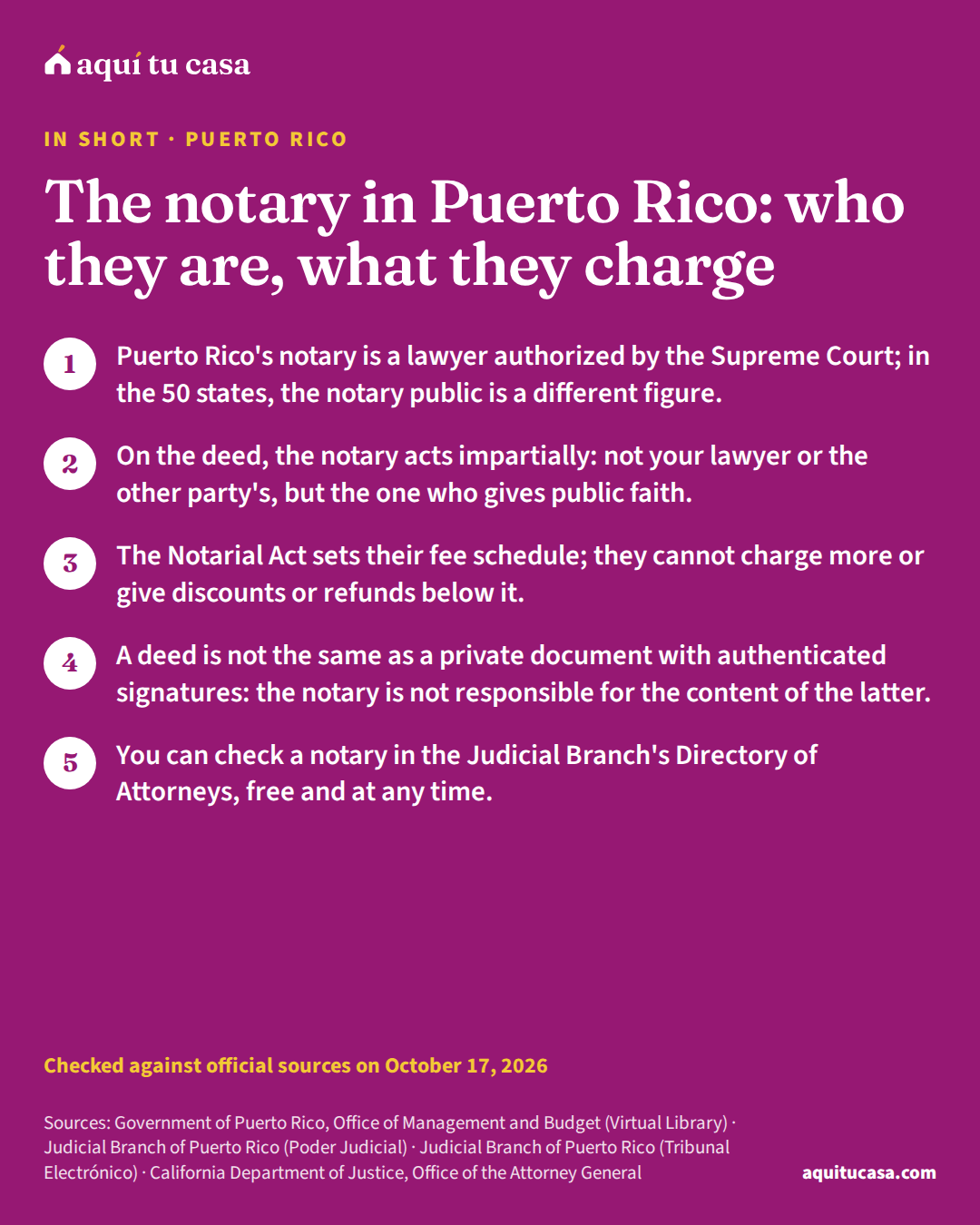
- Puerto Rico The notary in Puerto Rico: who they are, what they charge In Puerto Rico the notary is a lawyer. Who can be one, what they do in a home sale, what the law lets them charge and how to check they are authorized. 10 minute read
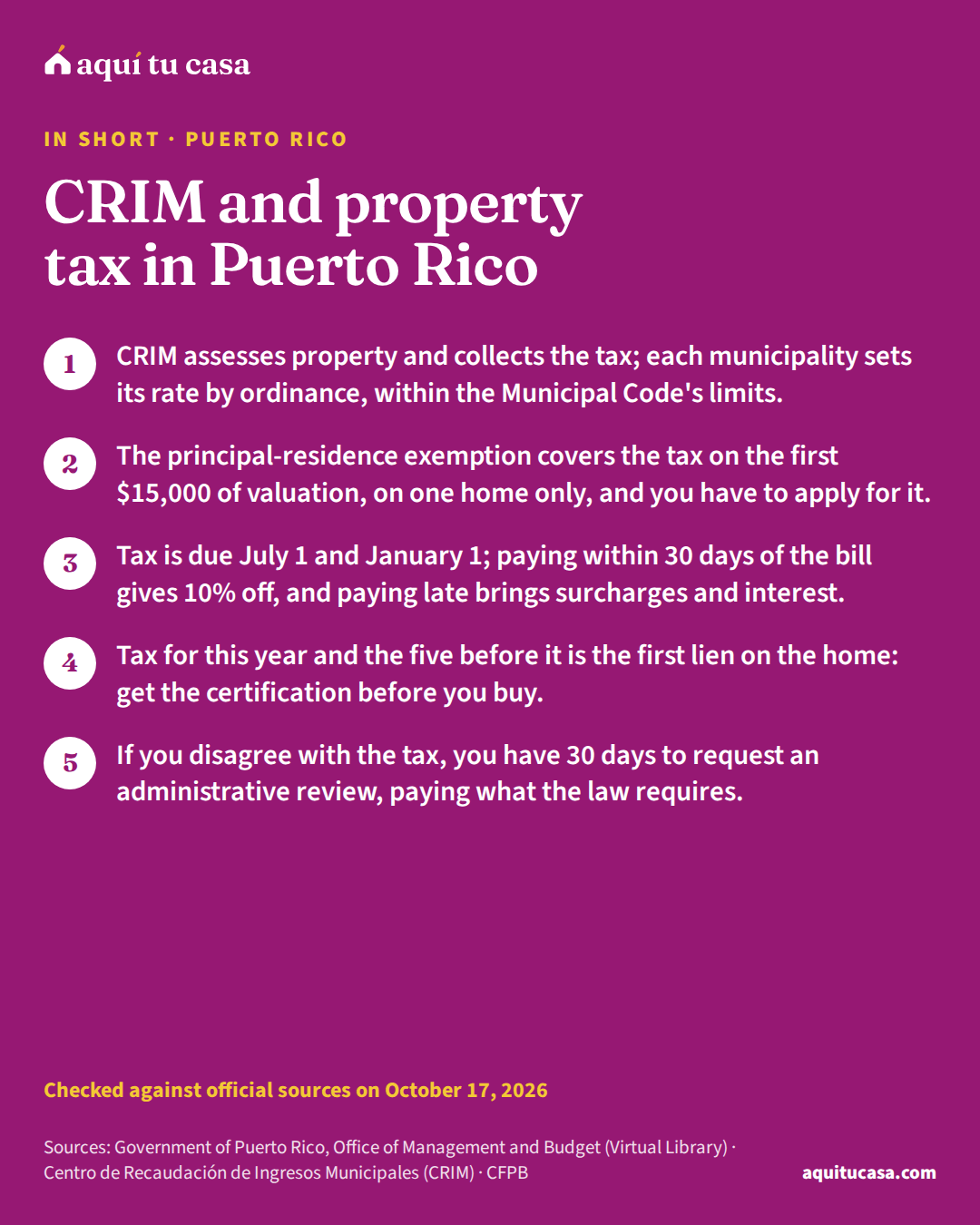
- Puerto Rico CRIM and property tax in Puerto Rico What CRIM is, how property tax is figured and paid in Puerto Rico, the exemption for your residence, certifications and how to ask for a review. 12 minute read
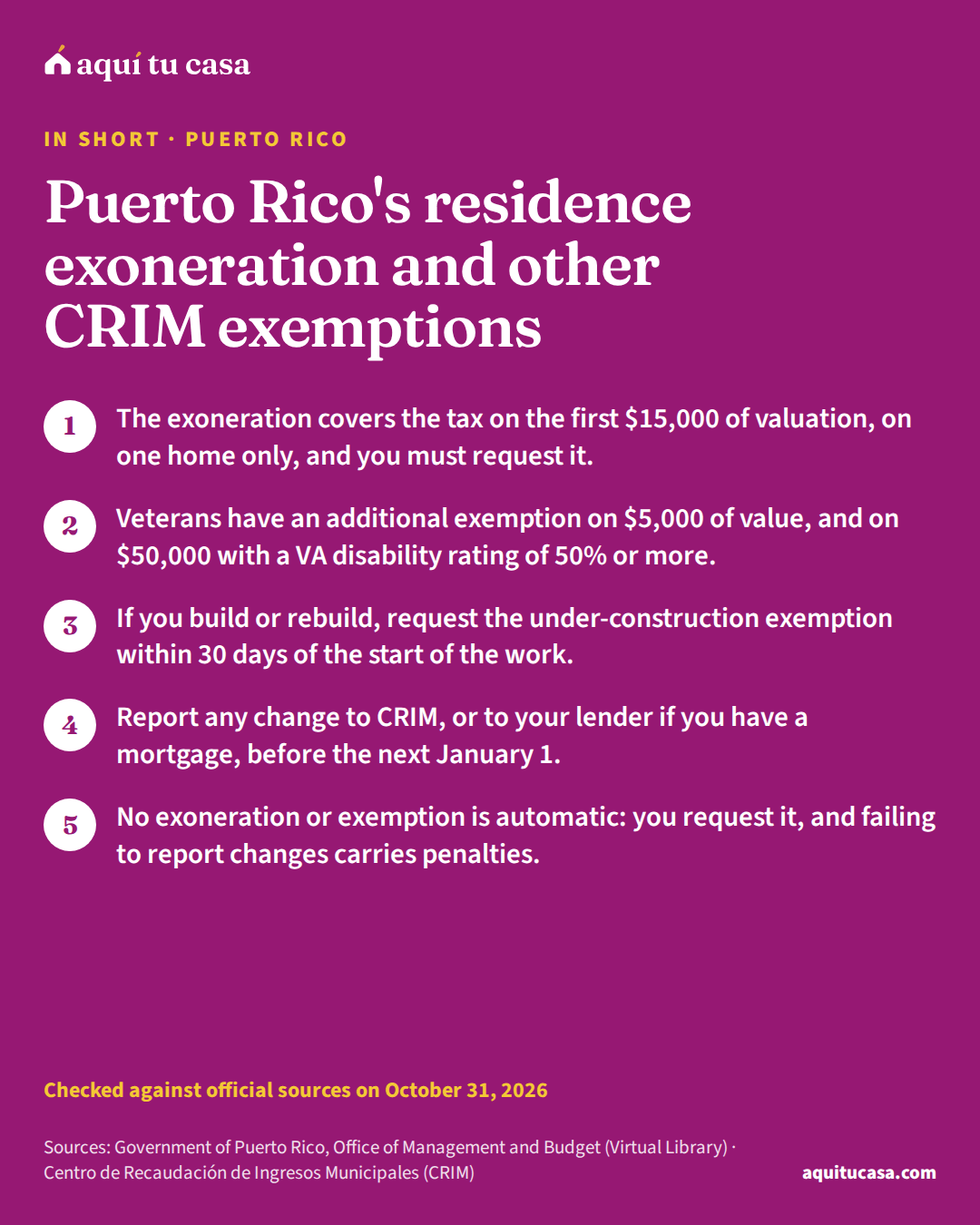
- Puerto Rico Puerto Rico's residence exoneration and other CRIM exemptions Puerto Rico's principal-residence exoneration and CRIM exemptions for owners: veterans, homes under construction, displaced families, historic zones. 12 minute read
Tools for this topic
Was this guide useful?
Thank you. Your answer stays in your browser; nothing is sent.