Puerto Rico's residence exoneration and other CRIM exemptions
Puerto Rico's principal-residence exoneration and CRIM exemptions for owners: veterans, homes under construction, displaced families, historic zones.
Verified against official sources on October 31, 2026 4 official sources

Show contents
In short
What you need to know
Quick answer
In Puerto Rico, the principal-residence exoneration frees you from the property tax on the first $15,000 of valuation of the home where you live, on one home only; you request it from CRIM or your mortgage lender, and report any change before January 1. There are also separate exemptions: veterans get an exemption on $5,000 of value, which rises to the first $50,000 if the VA rates them 50% disabled or more; homes under construction are exempt for up to three years if you request it within 30 days; and there are reductions for people displaced by government projects and exemptions in historic zones. None of them is automatic.
What matters most
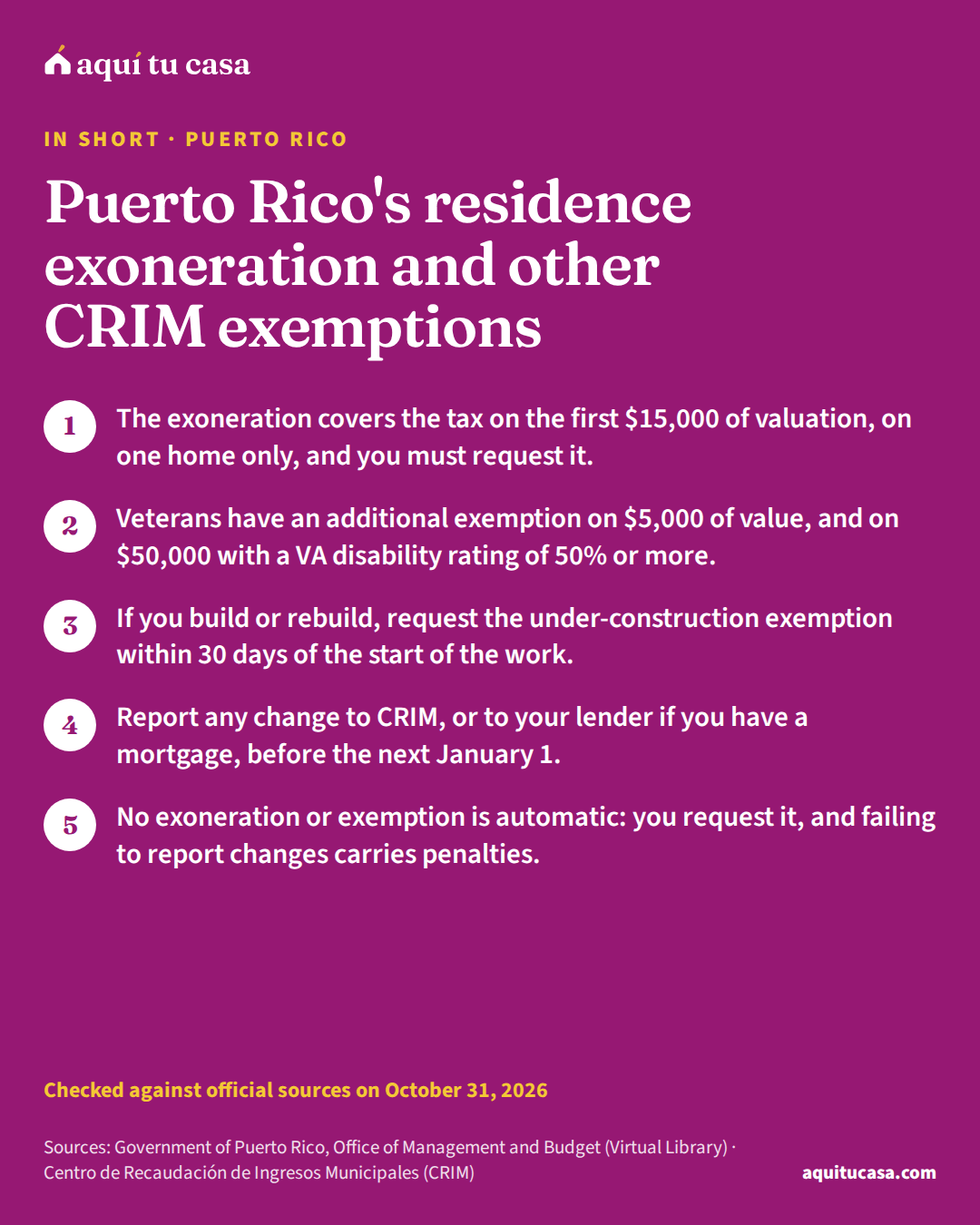
- The exoneration covers the tax on the first $15,000 of valuation, on one home only, and you must request it.
- Veterans have an additional exemption on $5,000 of value, and on $50,000 with a VA disability rating of 50% or more.
- If you build or rebuild, request the under-construction exemption within 30 days of the start of the work.
- Report any change to CRIM, or to your lender if you have a mortgage, before the next January 1.
Is this for you?
This guide is for you if…
- You own a home in Puerto Rico and want to know which CRIM exonerations or exemptions you can request.
- You are a veteran, the spouse of a veteran who died, or have a disability rating from the VA.
- You are building or rebuilding your home, live in a historic zone or were displaced by a government project.
Get direct help first if…
- What you want is to understand how the tax is figured, paid or reviewed: the guide to CRIM and property tax explains it.
- Your home is in one of the 50 states: there the exemption is called homestead and your county grants it; see the homestead exemption guide.
- Your property is a business or equipment: personal property exemptions have rules this guide does not cover.
The property tax CRIM collects can be reduced or eliminated in several ways, but none arrives on its own: you have to ask. This guide explains the principal-residence exoneration in more detail than the guide to CRIM and property tax, plus the other exemptions the law gives homeowners: for veterans, homes under construction, people displaced by government projects and historic zones.
According to CRIM, an exemption is granted by a law or a municipal ordinance, and must be requested: it is not automatic.3 The same goes for the exoneration.1
The principal-residence exoneration, in depth
Under the Municipal Code, the owner of a home they live in is exonerated from the basic, special and municipal taxes in an amount equal to the tax on the first $15,000 of valuation. The law measures that valuation at the replacement costs of the last scientific assessment, which the Code sets. If the property is only partly residential, for example with a store downstairs, the exoneration counts only for the part where you live.1 This is the residential exonerationresidential property tax exoneration (Puerto Rico)In Puerto Rico, the residential exoneration (exoneración residencial) is the Municipal Code benefit that exempts you from paying the property tax (CRIM) on part of the value of the home you live in. It applies to only one home per owner, used as a home by the owner or the owner's family without charging rent. To get it, you file a certification with CRIM, or with your mortgage lender if you have a mortgage. A home owned in common by several people, such as heirs, counts as one home, and the exoneration goes to an owner who lives there and has no other exoneration. If your eligibility changes or you transfer the home, you must report it.See the full definition, Puerto Rico’s version of the states’ homestead exemptionhomestead exemptionA homestead exemption is a legal protection for the home where you and your family live. It can keep certain creditors from collecting your debts out of your main home, and it can also lower the property tax on that home. In Texas, for example, the residence homestead exemption removes part of your home's value from the tax calculation; to get it you must own the home, live there as your principal residence and apply. State laws vary widely: some cap the amount protected and others depend on the size of the property or the owner's age.See the full definition.
Who gets it.
- One home per owner. If you have two properties, you choose which one gets it.13
- Both spouses. Both are owners and beneficiaries. If one dies, the survivor keeps it without reapplying, if the survivor is the original titleholder and still lives there.1
- An inherited home. A property owned in common by several people, such as an estate (sucesión), counts as one home. The right is not divided: it goes to any owner who lives there and has no exoneration elsewhere.1 The guide to titles and inheritance explains the estate.
- A housing cooperative. It is figured on the share of value that belongs to each unit.1
What counts as a residence. The home that on January 1 of that year the owner or the owner’s family uses as a home, without the owner charging rent. It includes the lot in an urban zone, or up to one cuerda in a rural zone. Family includes spouses and their relatives up to the fourth degree of blood or the second degree of marriage.1 So a house where your mother or brother lives rent-free can have the exoneration, even if you live elsewhere, as long as you have no exoneration on another home.1
If you move to give or receive care. The law forbids denying or revoking the exoneration just because the owner or family moves or sleeps away for a time to care for a relative 60 or older with a critical illness or a disability. It also protects an owner with a critical illness or a disability who must move to a relative’s home or a care center, as long as no rent is charged for the home.1
How to request it and what to report
The exoneration, step by step
1. File the certification
With CRIM, or with your mortgage lender if you have a mortgage, in the form CRIM sets.1
2. Get current or request a payment plan
Within 30 days
If you owe tax, propose a payment plan within 30 days of the certification.1
3. If you bought a new home
Within 30 days of the purchase
File the request within the 30 days after you acquire it.3
4. Report changes
Before the next January 1
If you stop living there, rent it out or sell it, tell CRIM or your lender.1
If you owe tax. It is a condition that on the January 1 before the fiscal year you owe no tax on that home, or that you propose and get approved a payment plan within 30 days of filing the certification. If you do not make the plan, the exoneration is not recognized for those years. If you stop paying the plan, the whole debt comes due and CRIM can collect it by enforcement and record a seizure.1
If you have a mortgage. You report changes to your lender, who in turn reports them to CRIM. If you buy a new home built after January 1, your lender withholds the tax on the value above $15,000 and notifies CRIM within 30 days of the purchase.1 The guide to why your escrow payment went up explains how to read your escrowescrow accountAn escrow account is an account set up by your mortgage lender to pay certain property-related expenses on your behalf, mainly property taxes and homeowners insurance. The money comes from a portion of your monthly mortgage payment: each month you contribute a share and the loan servicer pays the bills when they come due. That is why your payment is higher than principal and interest alone, and why it can change when taxes or the insurance premium go up. In some states the word also names the period between the offer and the closing.See the full definition account.
Where to request it. CRIM’s portal lets you request the tax exoneration or the veteran’s exemption online. Its call center handles prospective exoneration only.3 For guidance, CRIM lists the email crimcallcenter@crimpr.net and the phone 787-625-CRIM.4
The veterans’ exemption
The Puerto Rican Veteran’s Bill of Rights gives three property tax exemptions on the principal residence:
The veterans' exemptions, under the Veteran's Bill of Rights
Up to $5,000
Every veteran
For an incapacitated or impaired veteran, the law fully exempts the house and its lot while it is the residence.2
Every veteran. Up to $5,000 of the assessed value of the home a veteran or surviving spouse builds or buys as a principal residence, with its lot, is permanently exempt. If the building has several homes, the share the veteran occupies counts. It is requested as CRIM determines and, once approved, applies up to three years back.2
Disability of 50% or more. A veteran who receives VA compensation for a disability of 50% or more has an exemption on the first $50,000 of the assessed value of the residence, if they lived there on January 1. It is claimed at the CRIM regional office when paying the tax, with the Armed Forces discharge, the VA certification of the disability rating and a sworn statement that the house was the residence. If the disability is permanent, requesting it the first time is enough.2
Incapacitated or impaired veteran. The law fully exempts the house the veteran builds, buys or remodels, with its lot of up to 1,000 square meters in an urban zone or one cuerda in a rural zone, while it is the residence of the veteran or the veteran’s immediate family.2
If the veteran dies. The exemptions continue for the surviving spouse until remarriage, and for minor children until they reach adulthood.2
Together with the exoneration. A veteran’s residence exoneration is figured after subtracting the veteran’s exemption from the value,1 and the veteran’s exemption is in addition to any other.2 The guide to the VA home loan explains the federal benefit to buy a home.

Other exemptions for homeowners
If you build or rebuild. A building under construction is exempt from tax until it is finished, ready to use or starts to be occupied, but never for more than three years from the start of the work. You must request the exemption from CRIM within 30 days of the start of the work; CRIM rejects late requests unless there were extraordinary circumstances. If it asks for more information, you have 30 days to give it. And it does not recognize the exemption while you owe taxes, unless they are contested, deferred or pending collection.1 If you are rebuilding after a hurricane, the guide to repairing or rebuilding after a hurricane explains the help available.
If a government project displaced you. If you bought or built your home because you were displaced from a blighted area or slum by an urban renewal, housing or public improvement project or other government action, and the home is assessed at no more than $10,000 at the costs of the last scientific assessment, your tax is reduced by 75% for 10 years and by 50% for 5 more years. It is proven only with a certificate from the Department of Housing, and it ends if you sell or stop living there. This reduction and the relief for homes used as residences do not add up: you claim only one per year, although it does not affect the veteran’s exemption or the prompt-payment discount.1
If your home is in a housing or urban renewal project area. Properties in areas the Planning Board recommended for those projects are exempt. Request it from CRIM within 60 days of the Planning Board’s notice, or within 30 days of the tax notice, whichever comes first. If your home is affected and you live there, the lot and the house are exempt while building is legally impossible; if you rent it out, 50%.1
If your home is in a historic zone. Property in historic zones declared by the Planning Board or the Institute of Puerto Rican Culture is exempt, but only if you present the current Certification of Compliance from the corresponding agency.1
If you hold a government usufruct. Land the Government grants in usufruct pays tax. But if the usufruct is for more than five years or for life, the usufructuary is treated as the owner for the exemption laws.1
Example with real numbers
A veteran who rebuilds her home
An example in words, not a real case. The exact amounts come from your assessment and your municipality.
- She starts rebuilding her home after a storm
- She requests the under-construction exemption within 30 days
- She finishes the work and moves in
- She files the exoneration certification for her residence
- She is a veteran
- She also requests her veteran's exemption from CRIM
If she owes CRIM, she must get current or propose a payment plan so she does not lose the exoneration.
Run it with your numbersProperty taxIf you overpaid or fell behind
The refund. If you believe you overpaid or were charged improperly, you can ask CRIM in writing for a credit or refund, with your reasons. You have four years from the payment, and the refund cannot exceed what you paid in the four years before your request.1
The retroactive exoneration and people over 65. CRIM’s portal lists among its online services the retroactive exoneration (Article 8C) and benefits for people over 65, such as forgiveness of interest, surcharges and penalties under the requirements.3 The guide to property tax relief for older homeowners explains how it works in the states.

If this is your situation
What matters most in your situation
You live in your home
Check your certification to confirm you have the exoneration, and report any change before January 1.1
You are a veteran or a veteran's spouse
Request the $5,000 exemption, and the $50,000 one if the VA rates you 50% disabled or more.22
You inherited the home with your siblings
It counts as one home, and the exoneration goes to the owner who lives there.1
You moved so someone can care for you
They cannot take away the exoneration because you moved to a relative's home or a care center, if you charge no rent.1
You live in the states and your family lives in the home
It counts as a residence if your family uses it on January 1 without paying you rent.1
Costly mistakes
The mistake and what to do instead
Mistake: Thinking the veteran's exemption applies on its own.
Instead: Request it from CRIM; once approved, it applies up to three years back.2
Mistake: Starting to rebuild without telling CRIM.
Instead: Request the under-construction exemption within 30 days of the start of the work.1
Mistake: Renting out the exonerated home without reporting it.
Instead: If you charge rent, it is no longer residential; report it before January 1.11
Mistake: Requesting the exoneration with debts and not making the payment plan.
Instead: Propose the plan within 30 days, or it will not be recognized for those years.1
Mistake: Letting years pass after overpaying.
Instead: The refund is requested in writing within four years of the payment.1

What to do this week
- Log in to your MI CRIM account and check whether your home has the exoneration.3
- If you are a veteran, gather your discharge and, if it applies, the VA certification, and request your exemption.22
- If you are building, write down the date the work began and request the exemption before 30 days pass.1
- If you owe CRIM, ask about a payment plan at 787-625-CRIM.4
- Check how much the tax weighs in your family budget and read the other Puerto Rico topics, such as the guide to buying a home in Puerto Rico.
Your home and your county
We use the typical rate and value of the place you pick.
Typical home value in the United States (Census, ACS 2024). Enter your assessed value.
Let's do the math
Estimated tax per year
$3,127
About $261 a month, at a rate of 0.94% on $332,700.
Per month
$261
If you pay through escrow, your lender adds about this much to your payment.
The math
- Your home's value
- $332,700
- Taxable value
- $332,700
- Rate
- × 0.94%
- Tax per year
- $3,127
The rate changes within the county
Each home pays the districts it sits in (city, schools, services), and each sets its own rate. This rate is a county average, not your home's.
Your county's tax or assessor's office publishes your assessment, each district's rate and how to apply for an exemption or appeal.
This is an educational estimate from county averages, not your tax bill. Your bill depends on your home's districts, your assessment and your exemptions.
Ready to see the numbers? Find your county here
See how this applies in your county: its loan limits, prices and rents, from the official data.
Printable checklist
Frequently asked questions
What is the difference between exoneration and exemption?
In practice, both reduce or eliminate the tax. The principal-residence exoneration is in the Municipal Code. According to CRIM, an exemption is granted by a law or a municipal ordinance, such as the veterans' one, and must be requested: it is not automatic.
I am a veteran. What exemption do I have?
The Veteran's Bill of Rights exempts from property tax up to $5,000 of the assessed value of the principal residence of a veteran or surviving spouse. If the VA pays you compensation for a disability of 50% or more, the exemption reaches the first $50,000, on top of the $5,000. You request it from CRIM.
Can a veteran have both the exemption and the exoneration?
Yes. The Municipal Code says a veteran's exoneration is figured after subtracting the veteran's exemption from the value, and the Veteran's Bill of Rights says the veteran's exemption is in addition to any other.
My husband, a veteran, died. Do I lose the exemption?
Not necessarily. Under the Veteran's Bill of Rights, the veteran's exemptions continue for the surviving spouse until remarriage, and for minor children until adulthood. And under the Municipal Code, a surviving spouse who is the original titleholder keeps the residence exoneration without reapplying.
I am rebuilding my home. Do I pay tax in the meantime?
The Municipal Code exempts a building under construction until it is finished or starts to be occupied, for up to three years. You must request the exemption from CRIM within 30 days of the start of the work, and be current on your taxes.
I moved in with my daughter so she can care for me. Do I lose the exoneration?
The Municipal Code forbids denying or revoking the exoneration for an owner with a critical illness or a disability who must move to a relative's home or a care center, as long as the owner receives no rent for the home.
I overpaid because I did not have the exoneration. Can I get money back?
The Municipal Code lets you ask CRIM in writing for a credit or refund if you overpaid or were charged improperly, within four years of the payment. CRIM's portal also lists the retroactive exoneration (Article 8C) among its online services.
Sources
Every figure in this guide comes from one of these official sources. The number next to a sentence leads to the source behind it.
Each source on one line: who publishes it, its title, its address and the date we read it.
- 1. Government of Puerto Rico, Office of Management and Budget (Virtual Library) · Código Municipal de Puerto Rico (Act 107-2020, as amended) · bvirtualogp.pr.gov · Accessed October 31, 2026
- 2. Government of Puerto Rico, Office of Management and Budget (Virtual Library) · Carta de Derechos del Veterano Puertorriqueño del Siglo XXI (Act 203 of December 14, 2007, as amended) · bvirtualogp.pr.gov · Accessed October 31, 2026
- 3. Centro de Recaudación de Ingresos Municipales (CRIM) · Preguntas Frecuentes (CRIM official portal) · portal.crim360.com · Accessed October 31, 2026
- 4. Centro de Recaudación de Ingresos Municipales (CRIM) · Contáctenos (CRIM official portal) · portal.crim360.com · Accessed October 31, 2026
Keep reading
Related guides
If this guide helped, these follow the same path.

Puerto Rico 12 minute read
CRIM and property tax in Puerto Rico
What CRIM is, how property tax is figured and paid in Puerto Rico, the exemption for your residence, certifications and how to ask for a review.
- CRIM assesses property and collects the tax; each municipality sets its rate by ordinance, within the Municipal Code's limits.
- The principal-residence exemption covers the tax on the first $15,000 of valuation, on one home only, and you have to apply for it.
- Tax is due July 1 and January 1; paying within 30 days of the bill gives 10% off, and paying late brings surcharges and interest.
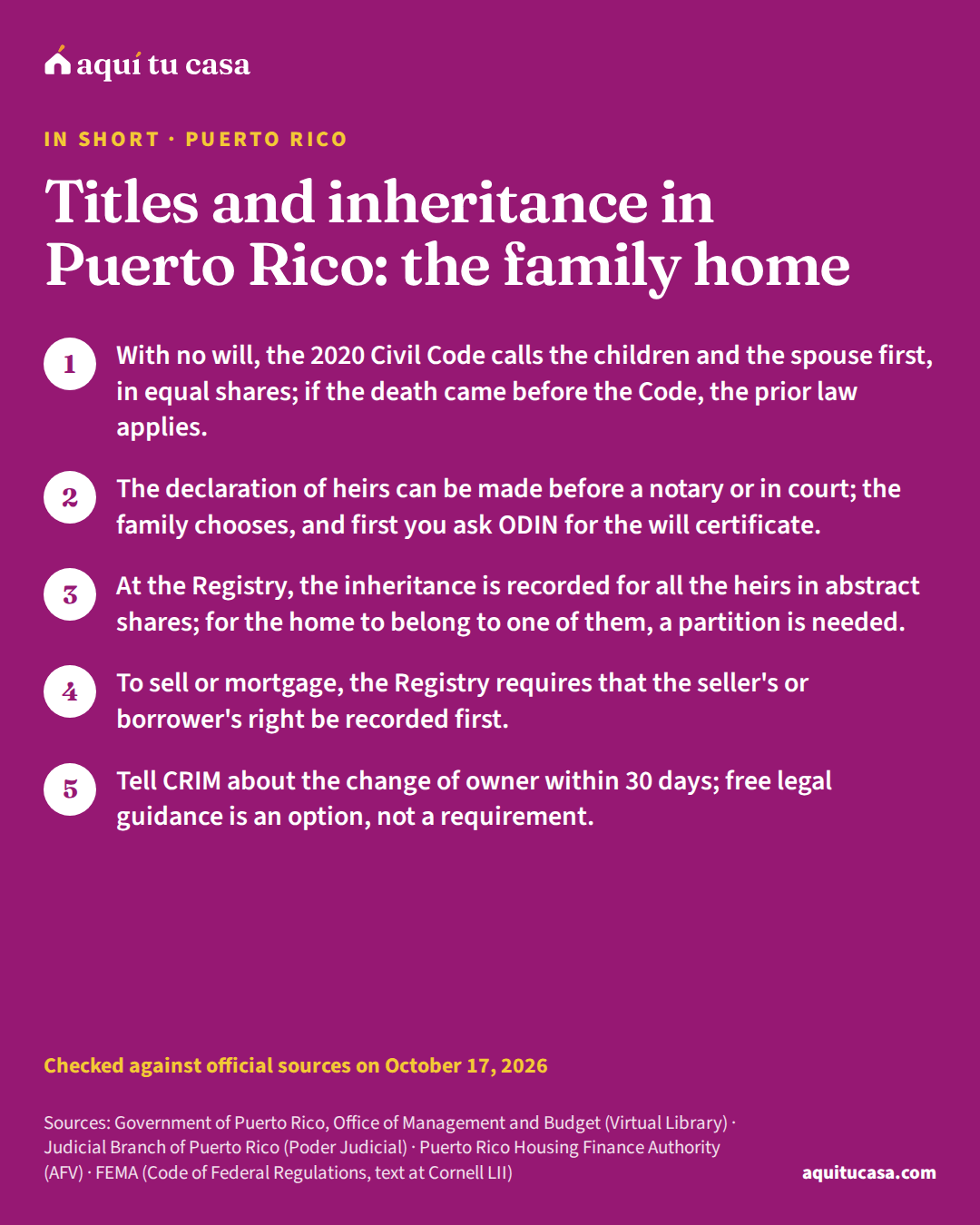
- Puerto Rico Titles and inheritance in Puerto Rico: the family home What happens to a home in Puerto Rico when its owner dies: who inherits, the declaration of heirs, the Property Registry and why a clear title matters. 11 minute read
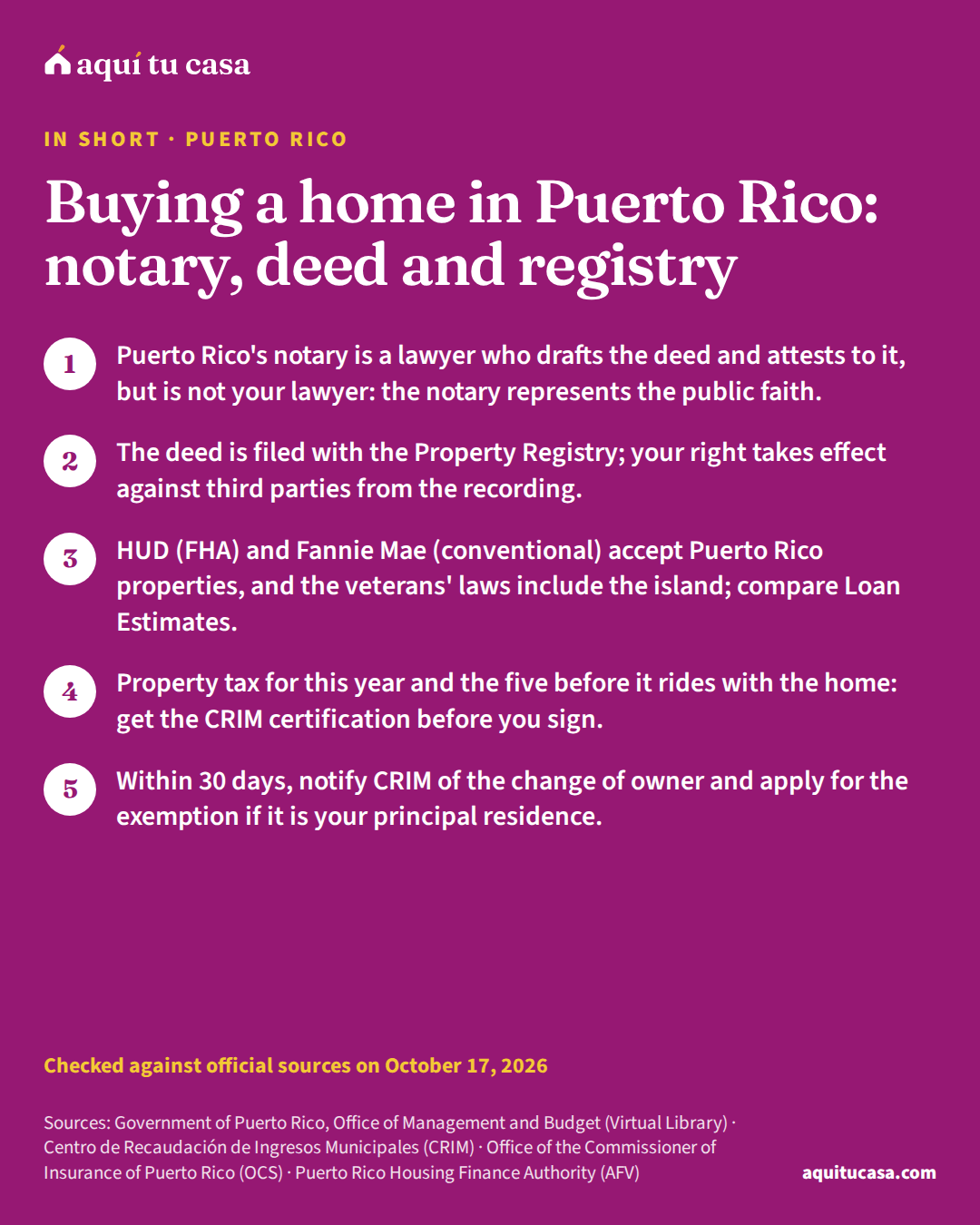
- Puerto Rico Buying a home in Puerto Rico: notary, deed and registry How buying a home works in Puerto Rico: the notary who is a lawyer, the public deed, the Property Registry, FHA, VA and conventional loans, AFV and CRIM. 13 minute read
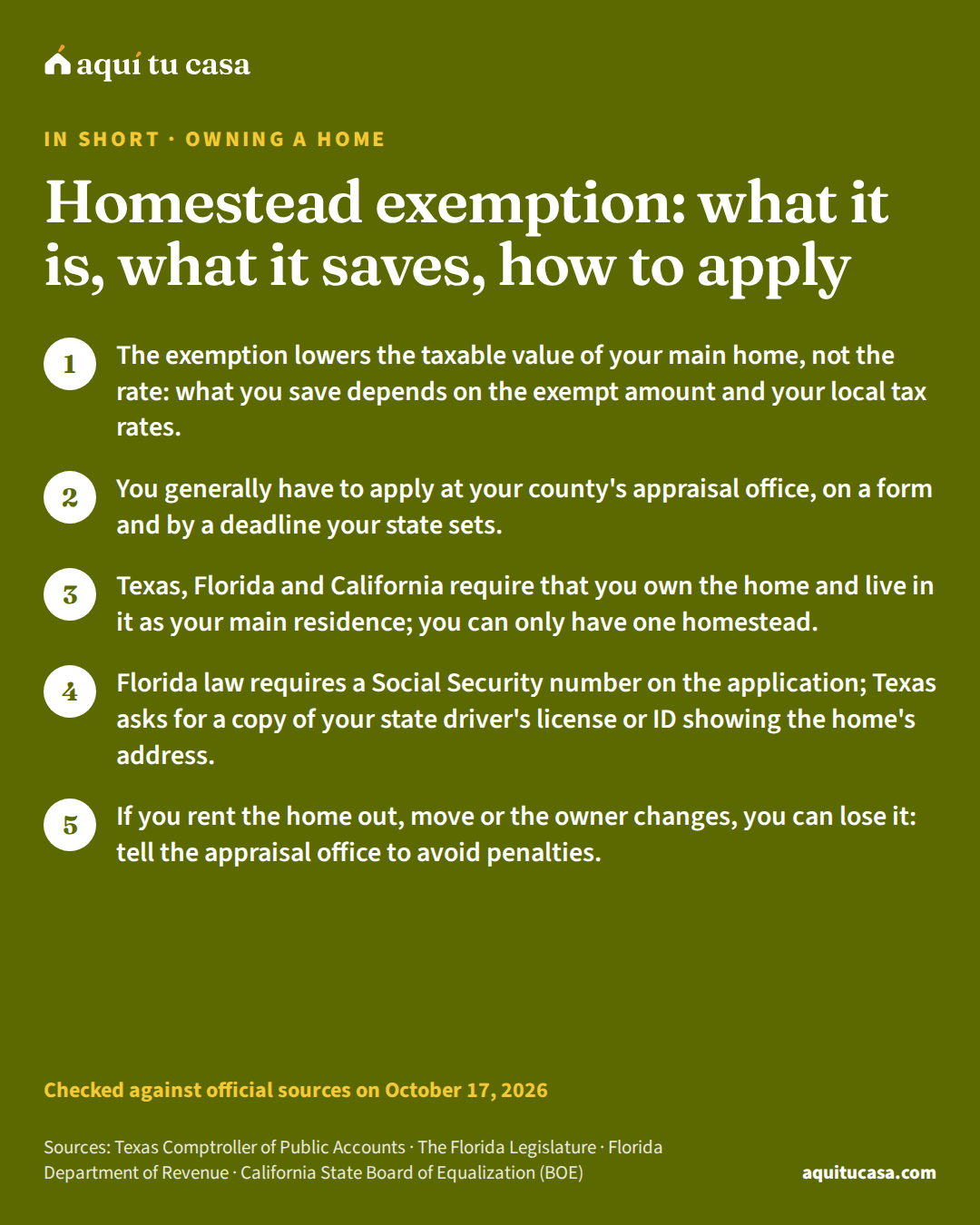
- Owning a home Homestead exemption: what it is, what it saves, how to apply What the homestead exemption is, who qualifies, how much it lowers your home's value in Texas, Florida and California, how to apply and which dates matter. 13 minute read
Tools for this topic
Was this guide useful?
Thank you. Your answer stays in your browser; nothing is sent.