Renting in Puerto Rico: the lease, your rights and eviction
What Puerto Rico's Civil Code says about leases, what each side must do, and how eviction (desahucio) works in court, step by step.
Verified against official sources on October 31, 2026 5 official sources

Show contents
In short
What you need to know
Quick answer
In Puerto Rico, the Civil Code governs leases. A lease for a home does not have to be in writing to be valid, though it helps, and if it does not state a term it is understood to be for one year; when it ends, it continues on the same terms until one side says it wants to end it. The landlord must hand over the home in good condition and make repairs within a reasonable time after you report them; you must pay on time, take care of the home and return it as you received it, except for normal use. No one can remove you by force: eviction (desahucio) is a court process, with a hearing within the 10 business days after the lawsuit is filed and 5 days to appeal the judgment.
What matters most
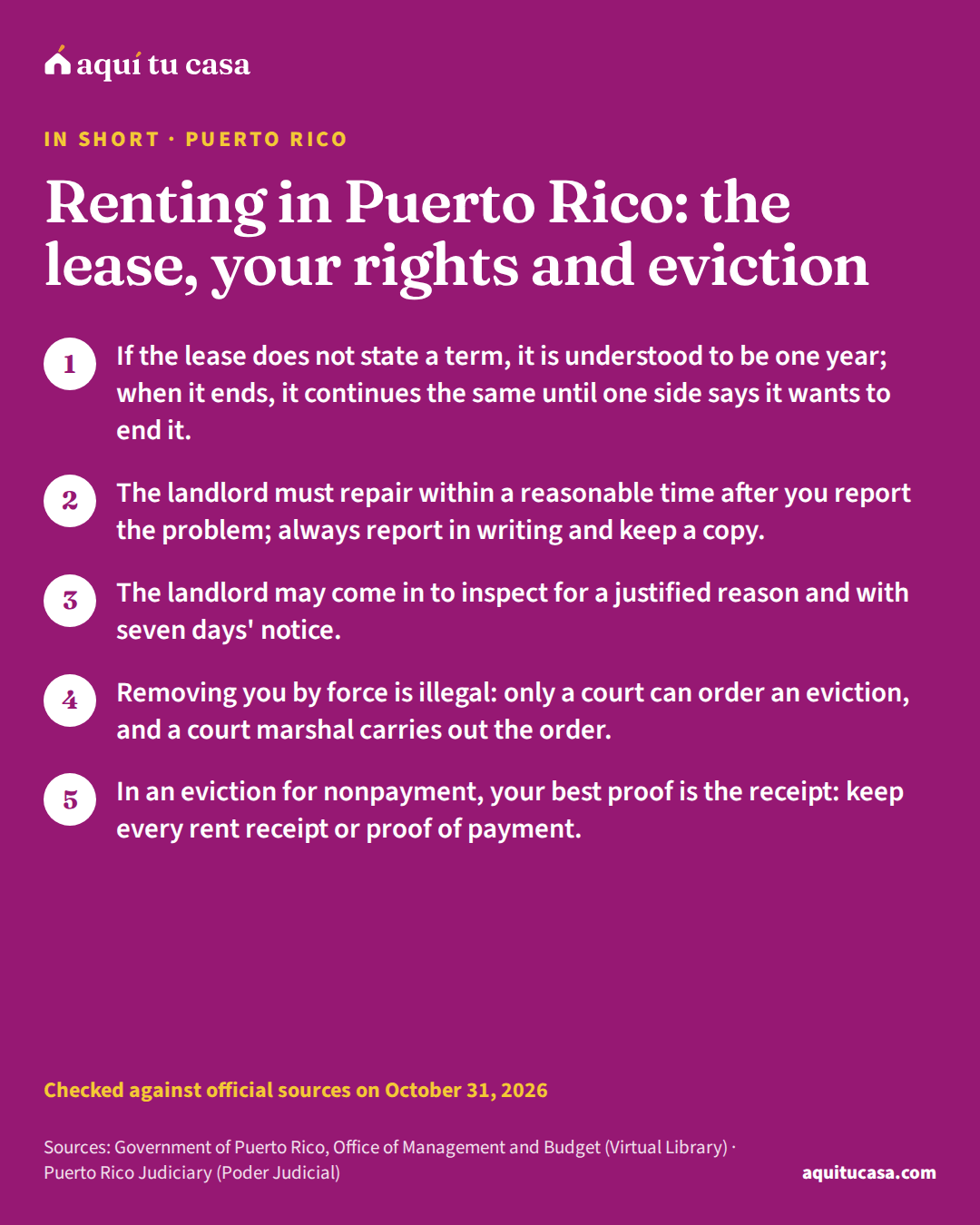
- If the lease does not state a term, it is understood to be one year; when it ends, it continues the same until one side says it wants to end it.
- The landlord must repair within a reasonable time after you report the problem; always report in writing and keep a copy.
- The landlord may come in to inspect for a justified reason and with seven days' notice.
- Removing you by force is illegal: only a court can order an eviction, and a court marshal carries out the order.
Is this for you?
This guide is for you if…
- You rent a house or an apartment in Puerto Rico and want to know what the law says about your lease.
- Your landlord wants you out, sued you for eviction (desahucio) or you received a summons.
- You rent out a property you own on the island and want to understand your duties as a landlord.
Get direct help first if…
- You rent in one of the 50 states: there, rent and eviction rules belong to each state; start with the guide on what to do if you get an eviction notice.
- You live in public housing (a residencial) or with a Section 8 voucher: those programs have their own rules; see also the public housing and vouchers in Puerto Rico guide.
- You already have an eviction judgment: look for free legal help today, because the deadline to appeal is a matter of days.
Renting in Puerto Rico is not governed by a state’s laws but by Puerto Rico’s Civil Code and by the eviction procedure (desahucio) the island’s courts handle. This guide explains, with what those sources say, what a lease is, what each side must do, when it can end and how an eviction works step by step. It does not replace guidance on your own case: at the end we tell you where to get it for free.
The lease
In a lease, the landlord agrees to give you the use of the home for a time in exchange for a set price, the rent.1 The leaseleaseA lease, or rental agreement, is the contract in which the owner or landlord gives you the right to live in and use a property for a set period of time in exchange for payment, usually rent. While the lease lasts you have possession, but the landlord still owns the property. The lease says how much you pay and when, who handles maintenance and how the agreement can end. Your rights as a tenant are usually spelled out in the lease and in your state and local laws. Before complaining to the landlord, it helps to read the lease and make sure you are also following the rules you agreed to.See the full definition does not have to be in writing to be valid. It must be in writing only if it is for more than six years, and it needs formalities if someone wants to record it in the Property Registry.1 Even so, a written lease is your best proof of what you agreed: the rent, the payment date, the security depositsecurity depositA security deposit is money you pay the landlord when you start renting as security that you will follow the lease: pay the rent and take care of the home. The money still belongs to you. The landlord holds it and, when you move out, must return it minus the charges the law allows, such as past-due rent or damage beyond normal wear and tear. You should not be charged for damage that was already there when you moved in. The maximum amount and the deadline to return it depend on your state's law and sometimes your city's.See the full definition, who pays power and water, and whether pets are allowed.
Three Civil Code rules many families do not know:
- The term. If the lease does not say how long it lasts, a home lease is understood to be for one year.1
- When rent is due. The parties agree on the rent. If the lease does not say whether it is paid in advance or at the end of the month, it is understood to be paid in arrears.1 Most written leases say rent is paid in advance; read yours.
- When the lease ends. On the end date, the lease continues on the same terms until you or the landlord say you want to end it. If someone signed as a guarantor, their guarantee ends at that point.1
The guide your lease explained reviews the usual clauses, and the security deposits guide explains how to document the home’s condition to get it back.
What the landlord must do and what you must do
Each side's duties, under the Civil Code
Who rents out the home
The landlord
Every notice is better in writing and dated: it is your proof if there is a disagreement later.
Repairs. The landlord must repair within a reasonable time after you report the problem.1 If the repair is urgent and you already told the landlord, the Civil Code says the tenant makes it at the landlord’s cost.1 Keep photos, the notice, the estimate and the receipts. The guide to repairs and housing conditions explains how to document a problem.
Owner visits. You must let the landlord inspect the home, but for justified reasons and with seven days’ prior notice.1
Improvements you make. If you paint, install a ceiling fan or put up window bars, you cannot demand repayment for useful or luxury improvements. You may take them with you when you leave if removing them does not damage the home.1 Before a big improvement, ask the landlord for permission in writing.
When you move out. You must return the home in the condition you received it, except for wear from time and ordinary use.1 A move-in inspectionmove-in inspectionA move-in inspection is the walk-through of the home done before you move in to record in writing the condition of the unit and the equipment that comes with it. In public housing, the federal rule requires the agency and the tenant to inspect it together and sign a statement of its condition. Another inspection is done when you move out. The difference between the condition at move-in and at move-out is the basis for any charge against your deposit, if the damage goes beyond normal wear and tear. That record helps keep you from being charged for damage that was already there.See the full definition with photos on day one protects you at the end.
Sharing, subletting and other changes
Subletting. If the lease does not expressly forbid it, you may subletsubletTo sublet, or sublease, is to rent all or part of the home you rent to another person, for a shorter time than your own lease. It is a new contract between you and that person: you become their landlord, but the owner has no contract with them. You remain responsible to the owner for meeting your lease. The owner can forbid subletting, although some places allow it in certain cases despite that ban. In public housing, the federal rule requires the lease to prohibit subletting.See the full definition all or part of the home, and you remain responsible to the landlord. The landlord can refuse only if the person moving in does not have the same financial qualifications as you, or if the use causes the landlord financial harm.1
A home with several owners. If the home belongs to several people in common, such as the heirs to a house, one of them alone cannot lease it without the others’ consent, although they can ratify the lease later.1 The guide to titles and inheritance in Puerto Rico explains the community of heirs.
If the house is sold or the owner dies. The landlord’s death or the sale of the home does not change the length of the lease, unless agreed otherwise.1
If the person who signed dies. In a home, the relatives who lived with the tenant for the six months before the death, or the person who lived with the tenant for that time, can take the tenant’s place in the lease.1

When the lease can end
The lease ends when its term ends, if one side says it does not want to continue.1 The parties can also agree to end it early.1 The Civil Code also lets one side terminate it if the other breaks it:1
- The landlord may terminate it if you abandon or stop using the home, change the agreed use, fail to keep it up, or fail to pay rent for two periods in a row.
- You may terminate it if the landlord does not keep the home fit to live in, breaches the warranties against eviction by a third party or hidden defects, or deprives you of part of the use through the landlord’s improvements. In that last case, you may instead ask for a proportional rent reduction.
Ending the lease does not give the landlord permission to remove you on their own. If you do not leave, the landlord has to go to court.

No one can remove you by force
The Judiciary says it plainly: it is illegal for the owner to remove the tenant by force. To remove you, the owner has to file an evictionevictionEviction is the legal process a landlord uses to get back a rented home when the tenant does not want to leave. The most common reasons are unpaid rent, serious lease violations or a lease that has ended. First the landlord must give you written notice. If it is not resolved, the landlord needs a court order, and a law enforcement officer must carry out the removal. If you are sued, you have the right to file a written answer explaining to the court why you should not be evicted. The rules change by state and city.See the full definition lawsuit, called desahucio in Puerto Rico, and win a judgment.3 Then the owner has to request a removal order (orden de lanzamiento), and a court marshal (alguacil) carries it out.3 Changing your lock or taking your things out without that order is an illegal lockoutillegal lockoutAn illegal lockout happens when the landlord shuts you out of your home by changing the locks without a court order. A landlord cannot force you out that way, or pressure you by cutting off utilities under the landlord's control. To evict you, the landlord must follow the legal process: written notice, a court case and a judge's order. Most states prohibit removing or shutting out a tenant without a court order. Depending on your state's law, you may be able to get back into the home, end the lease or recover damages.See the full definition; the guide on illegal lockouts and utility shutoffs explains what to do.
Eviction, step by step
Eviction can be sought for nonpayment, because the lease ended and the person will not leave, for breaking an essential clause of the lease, such as the number of occupants, animals, the use or noise, or for breaking a federal contract, such as HUD subsidy contracts.3
How an eviction moves through the court
1. The landlord files the lawsuit
With form OAT 931 and summons OAT 972, in the Municipal Court if the claim is up to $5,000, or the Superior Court if it is more.3
2. The court sets the hearing
Within 10 business days
You must be served the complaint and the summons at least 5 days before.3
3. You answer
Before the hearing or at it
You can use form OAT 1801 or answer on the day of the hearing.3
4. The hearing
You go on your own or with a lawyer and present your proof; if you do not go, the case continues without you.3
5. The judgment
5 days to appeal
Whoever appeals must pay a bond; if no one appeals, the judgment is final.3
6. The removal order
It is not automatic: the landlord requests it with form OAT 1742, and a court marshal carries it out.3
If you skip the hearing. The court enters your default and the case goes on without you: it can decide with only the landlord’s evidence.3 That is a default judgmentdefault judgmentA default judgment is a decision a court makes in favor of the person suing when the person being sued does not respond to the summons or does not appear. According to the CFPB, if you are sued over a debt and do not respond by the date in the court papers, the court will most likely order you to pay what the collector says you owe, plus the fees, interest and attorney fees it allows. With a judgment, depending on your state's law, the creditor may garnish your wages, place a lien on your home or freeze your bank account. A default judgment can sometimes be set aside if you have valid reasons for not appearing.See the full definition. Always go, even if you think you have no defense.
Your defenses. The Judiciary names some: a conflict over who owns the property, having paid and having proof, not having done anything against the lease, not having been served, or having a community of property because you contributed to the home.3
If it is for nonpayment. The law says that when the lawsuit is based on nonpayment, the defendant may offer no proof other than the receipt or a document showing payment.2 That is why every receipt counts. Pay in a way that leaves a record and keep the proof.
If you contributed to your partner’s home. A recent law changed the procedure: if you are sued for eviction and claim a community of property because you contributed to the home you share, you can present proof and require that the case go through the ordinary process, not the fast eviction track.2 If this is your case, get legal guidance before the hearing.
Example with real numbers
A tenant who receives a lawsuit for nonpayment
An example in words, not a real case, of how to use the deadlines in your favor.
- She receives the summons with the hearing date
- She writes down the date and looks for free guidance that same day
- She gathers her rent receipts and messages with the landlord
- In a nonpayment case, the receipt is the proof that counts
- She calls the Pro Se Center for her region
- They explain the forms, such as the OAT 1801 answer
- She goes to the hearing and presents her proof
- If she skipped it, the court would enter a default
- What she achieves
- She defends herself with her proof and knows she has 5 days to appeal if the judgment goes against her
If she cannot pay the fees, she can ask for a waiver with forms OAT 1480 and OAT 1481.
Run it with your numbersFamily budgetIf you cannot pay court fees. The landlord files the lawsuit with internal revenue stamps, and the court can waive fees for indigent people who ask, with forms OAT 1480 and OAT 1481.3
On the day of removal. The marshal goes to the home and removes the occupants, with the landlord present. If the court found the family insolvent, the marshal arranges for the Department of the Family and the Department of Housing to be there.3
Where to get free help
The court does not give legal advice.4 But help exists:
- The Judiciary’s Pro Se Centers give general information and forms to people representing themselves, including in evictions. You can visit, call or email the one for your judicial region, or call the Judiciary’s Information Line at (787) 641-6263.5
- Free legal aidlegal aidLegal aid is the free civil legal help that nonprofit organizations and their lawyers provide to low-income people in civil, not criminal, matters. In housing, that includes representing families facing eviction or foreclosure, alongside matters such as custody, child support, protection from domestic violence and access to benefits. In the United States, the Legal Services Corporation, created by Congress, funds a nationwide network of these organizations; its finder points you to the one in your area. Each sets its own income limits.See the full definition, if you qualify: the organizations the Judiciary lists include Servicios Legales de Puerto Rico, at (787) 728-5070 or 1-800-981-5342, Ayuda Legal Puerto Rico, the Bar Association’s Pro-Bono, Inc., the law school clinics, the Office of the Advocate for Persons with Disabilities and, for people over 60, the Office of the Advocate for the Elderly.4
The guide to free legal aid explains how to prepare for the call, and the one on what to do if you can’t pay your rent reviews options before a lawsuit arrives.
If this is your situation
What matters most in your situation
Your lease ended and you are still there
It continues on the same terms until one side says it wants to end it.1
The person who signed the lease died
If you lived with that person for the six months before, you can take their place in the lease.1
You were sued for eviction
The hearing is within 10 business days; go, bring your receipts and call the Pro Se Center.35
You are 60 or older
The Office of the Advocate for the Elderly gives legal advice to people over 60.4

Costly mistakes
The mistake and what to do instead
Mistake: Paying rent in cash without asking for a receipt.
Instead: Ask for a receipt or pay in a way that leaves a record: in a nonpayment eviction, it is your proof.2
Mistake: Reporting a repair only by word of mouth.
Instead: Report it in writing, with a date and photos; the landlord must repair within a reasonable time after notice.1
Mistake: Skipping the hearing because you have no lawyer.
Instead: You can appear on your own; if you do not go, the court enters a default.3
Mistake: Letting the judgment pass without acting.
Instead: You have 5 days to appeal from notice; look for legal help that same day.3
Mistake: Letting the owner take your things out without a court order.
Instead: Removing you by force is illegal; only a court marshal carries out a removal order.33
What to do this week
- Find your lease. If it was verbal, write down what you agreed: rent, payment date, deposit and utilities.1
- Keep all your rent receipts together in an envelope or folder.2
- If something is broken, tell the landlord in writing and keep a copy.1
- If you were sued, write down the hearing date and call the Pro Se Center or Servicios Legales de Puerto Rico.54
- Check your budget with the rent calculator and read the other Puerto Rico topics, such as insurance and hurricanes, which explains renters insurance.
Your income
Let's do the math
Rent that fits your budget (30% of income)
$2,018
With an income of $6,728 a month. Up to $3,364 would already be a severe burden (50% of income).
Compared with HUD’s Fair Market Rent in the United States
- 2 bedrooms$1,750Fits · 26%Needs $33.65 an hour
The wage needed pays that rent without going over 30% of income, working 40 hours a week all year.
The typical rent households actually pay in the United States is $1,413 a month (Census).
A reference to give you an idea. Each landlord and each program sets its own requirements.
Ready to see the numbers? Find your county here
See how this applies in your county: its loan limits, prices and rents, from the official data.
Printable checklist
Frequently asked questions
Does my lease have to be in writing?
Not to be valid. The Civil Code says a lease needs no special formality, except to record it in the Registry, and that it must be in writing if it is for more than six years. Still, a written lease helps you prove what you agreed.
My lease ended and I still live here. What happens?
Under the Civil Code, the lease continues on the same terms until you or the landlord say you want to end it. This is called tacit renewal (tácita reconducción).
Can the owner come into my apartment whenever they want?
The Civil Code says the tenant must allow inspection for justified reasons and with seven days' prior notice. If your lease says something different, read it carefully and ask for guidance if you are unsure.
The refrigerator broke or there is a leak. Who pays?
The landlord must make necessary repairs within a reasonable time after you report them. If the repair is urgent and you already told the landlord, the Civil Code says the tenant makes it at the landlord's cost. Report in writing and keep photos and receipts.
Can they change my lock or take my things out because I fell behind?
No. The Judiciary explains that it is illegal for the owner to remove the tenant by force. The owner has to sue, win a judgment and request an order that a court marshal carries out.
I got an eviction lawsuit. How much time do I have?
According to the Judiciary, the hearing is set within the 10 business days after the lawsuit, and you must be served at least 5 days before. You can answer beforehand with form OAT 1801 or at the hearing. If you do not go, the case goes on without you.
The person who signed the lease died. Do I have to leave?
Not necessarily. Under the Civil Code, if it is a home, the relatives who lived with the tenant for the six months before the death, or the person who lived with the tenant for that time, can take the tenant's place in the lease.
Sources
Every figure in this guide comes from one of these official sources. The number next to a sentence leads to the source behind it.
Each source on one line: who publishes it, its title, its address and the date we read it.
- 1. Government of Puerto Rico, Office of Management and Budget (Virtual Library) · Código Civil de Puerto Rico de 2020 (Act 55 of June 1, 2020, as amended) · bvirtualogp.pr.gov · Accessed October 31, 2026
- 2. Government of Puerto Rico, Office of Management and Budget (Virtual Library) · Act 95 of 2026 (amendments to Articles 621 and 627 of the Code of Civil Procedure, eviction) · bvirtualogp.pr.gov · Accessed October 31, 2026
- 3. Puerto Rico Judiciary (Poder Judicial) · Guía informativa comunitaria: proceso judicial de desahucio · poderjudicial.pr · Accessed October 31, 2026
- 4. Puerto Rico Judiciary (Poder Judicial) · Representación legal durante un proceso judicial de desahucio · poderjudicial.pr · Accessed October 31, 2026
- 5. Puerto Rico Judiciary (Poder Judicial) · Representación por derecho propio: información de contacto de los Centros Pro Se · poderjudicial.pr · Accessed October 31, 2026
Keep reading
Related guides
If this guide helped, these follow the same path.

Renting 15 minute read
Your lease explained: what to check before you sign
What a lease is, which clauses to read before you sign, the lead paint disclosure, your fair housing rights and where to get free help.
- Your rights are in your lease and in your state or local laws: read them together before you sign.
- Check the rent and due date, fees, the deposit, utilities, repairs, entry, occupants, subletting and how the lease ends.
- A landlord cannot charge fees you did not agree to, refuse necessary repairs or lock you out without a court order.
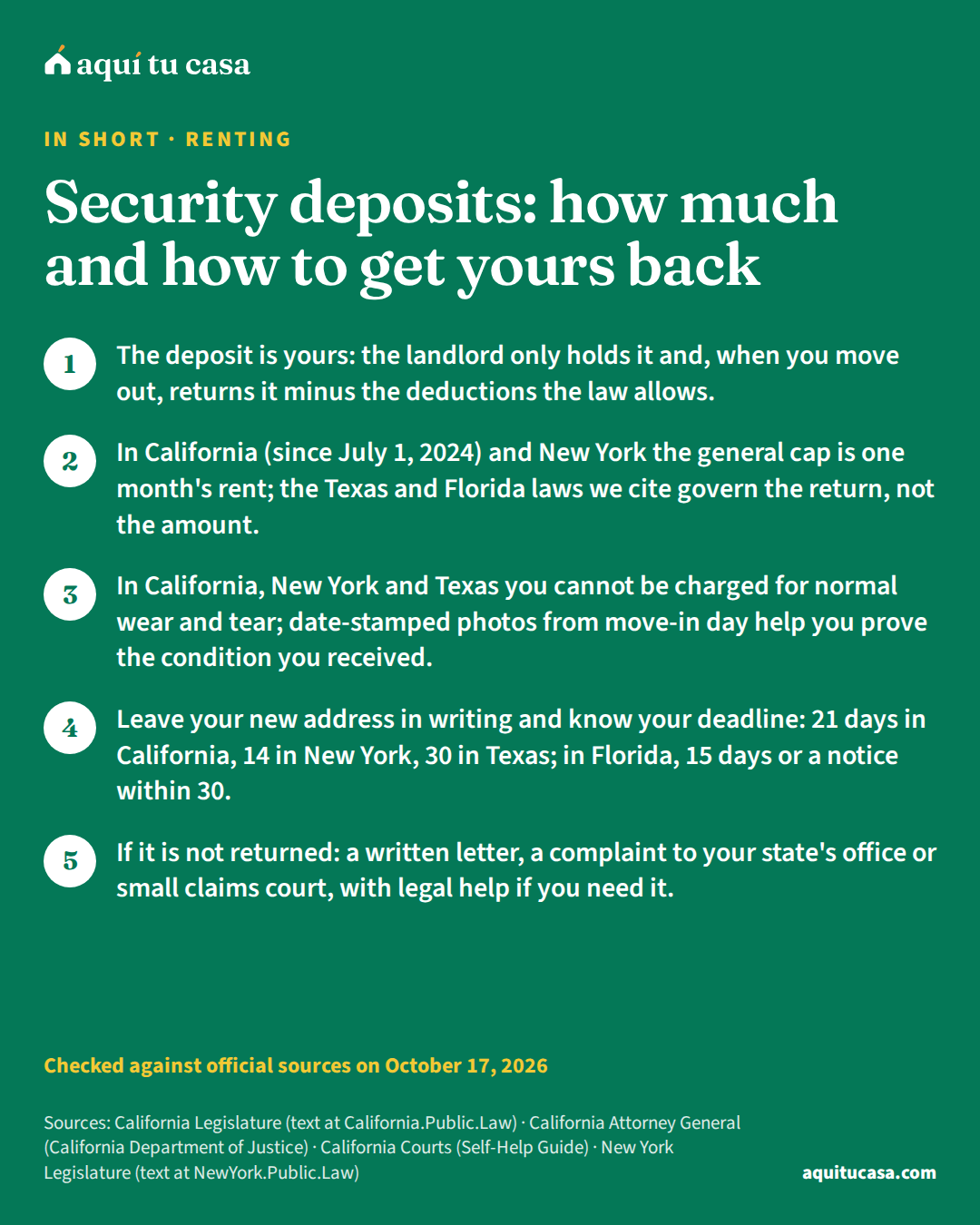
- Renting Security deposits: how much and how to get yours back What a security deposit is, how much a landlord may charge in your state, what can be deducted, when it must be returned and where to complain if it isn't. 14 minute read
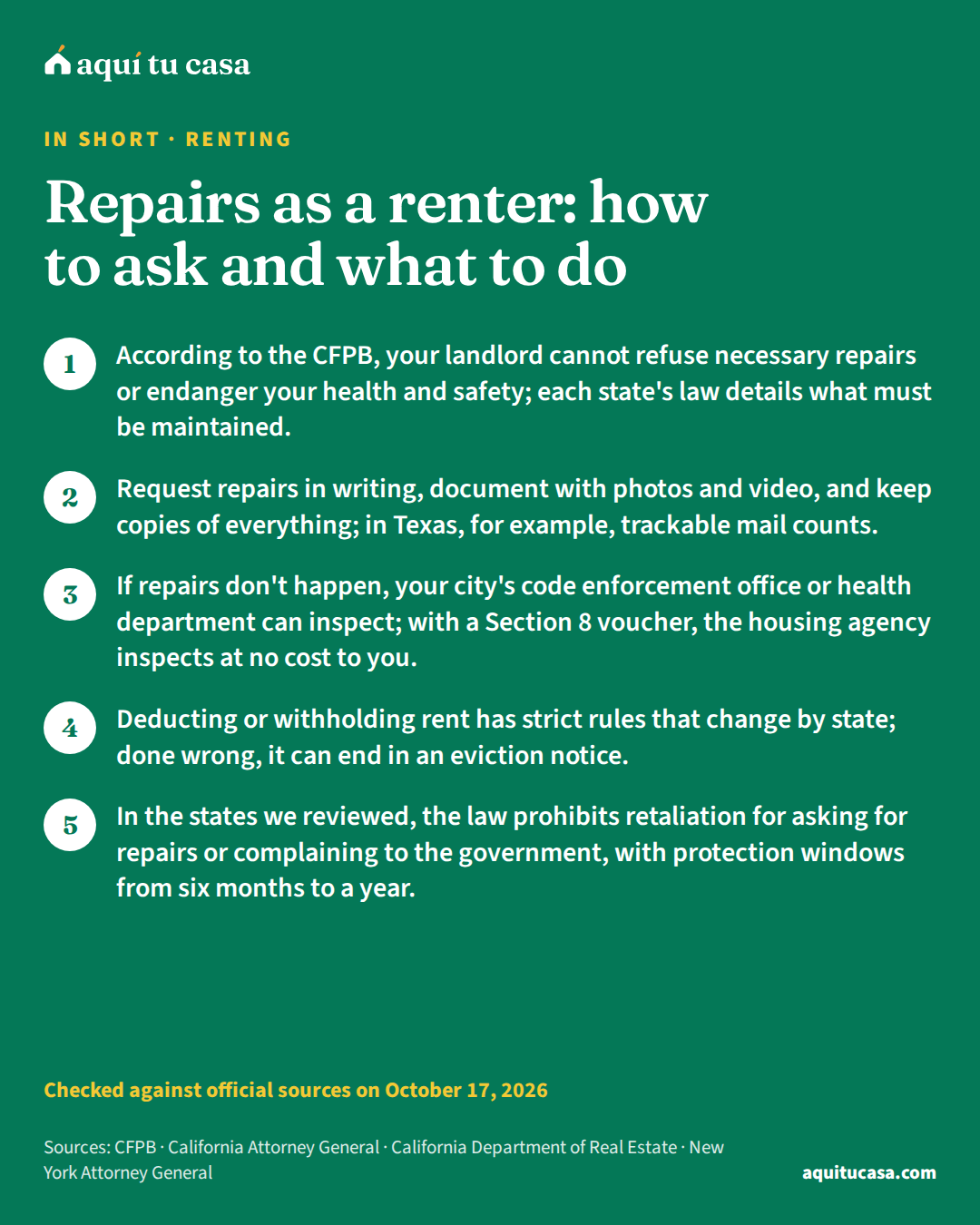
- Renting Repairs as a renter: how to ask and what to do Which repairs fall on the landlord, how to request them in writing, when to call your city's code inspectors and the risks of withholding rent. 13 minute read
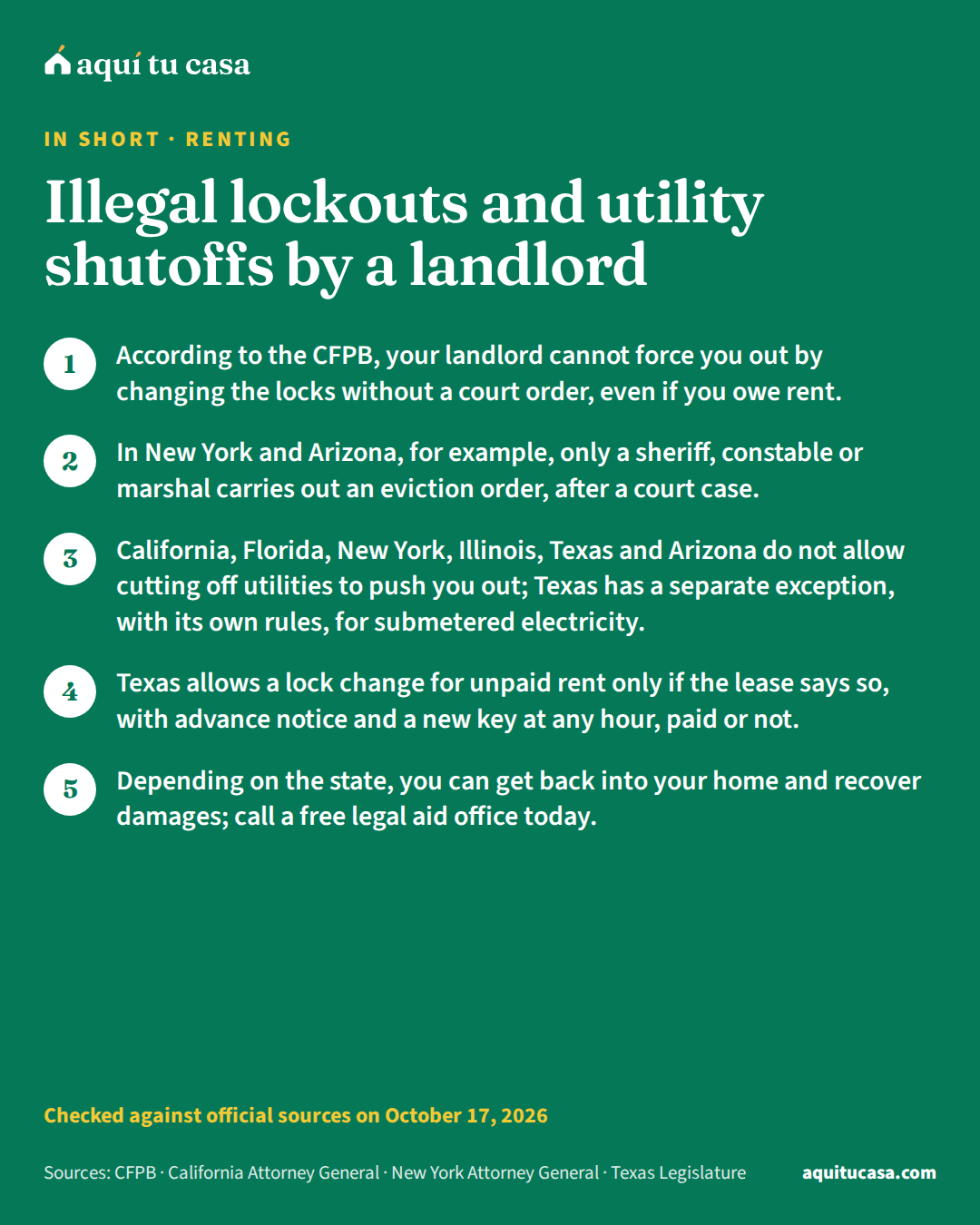
- Renting Illegal lockouts and utility shutoffs by a landlord If your landlord changed the locks, removed your things or cut off water or power to make you leave: what several states' laws say and what to do today. 12 minute read
Tools for this topic
Was this guide useful?
Thank you. Your answer stays in your browser; nothing is sent.