Building an ADU for your family: what to check first
Before you build an ADU for your parents or children: permits, your city's rules, how to pay for it, taxes and what FHA and Fannie Mae require.
Verified against official sources on October 31, 2026 6 official sources

Show contents
In short
What you need to know
Quick answer
An accessory dwelling unit (ADU) is a complete place to live, with its own entrance, kitchen and bathroom, on the same lot as your home. Before building one for your family, ask your city or county whether zoning allows it and which permits you need: in California, for example, state law requires a complete application to be approved or denied within 60 days. To pay for it you can use savings, a renovation loan such as Fannie Mae's HomeStyle or FHA's 203(k), or your home's equity. An unpermitted ADU can cause problems with your insurance and when you sell. If you charge a relative rent, the IRS has rules.
What matters most
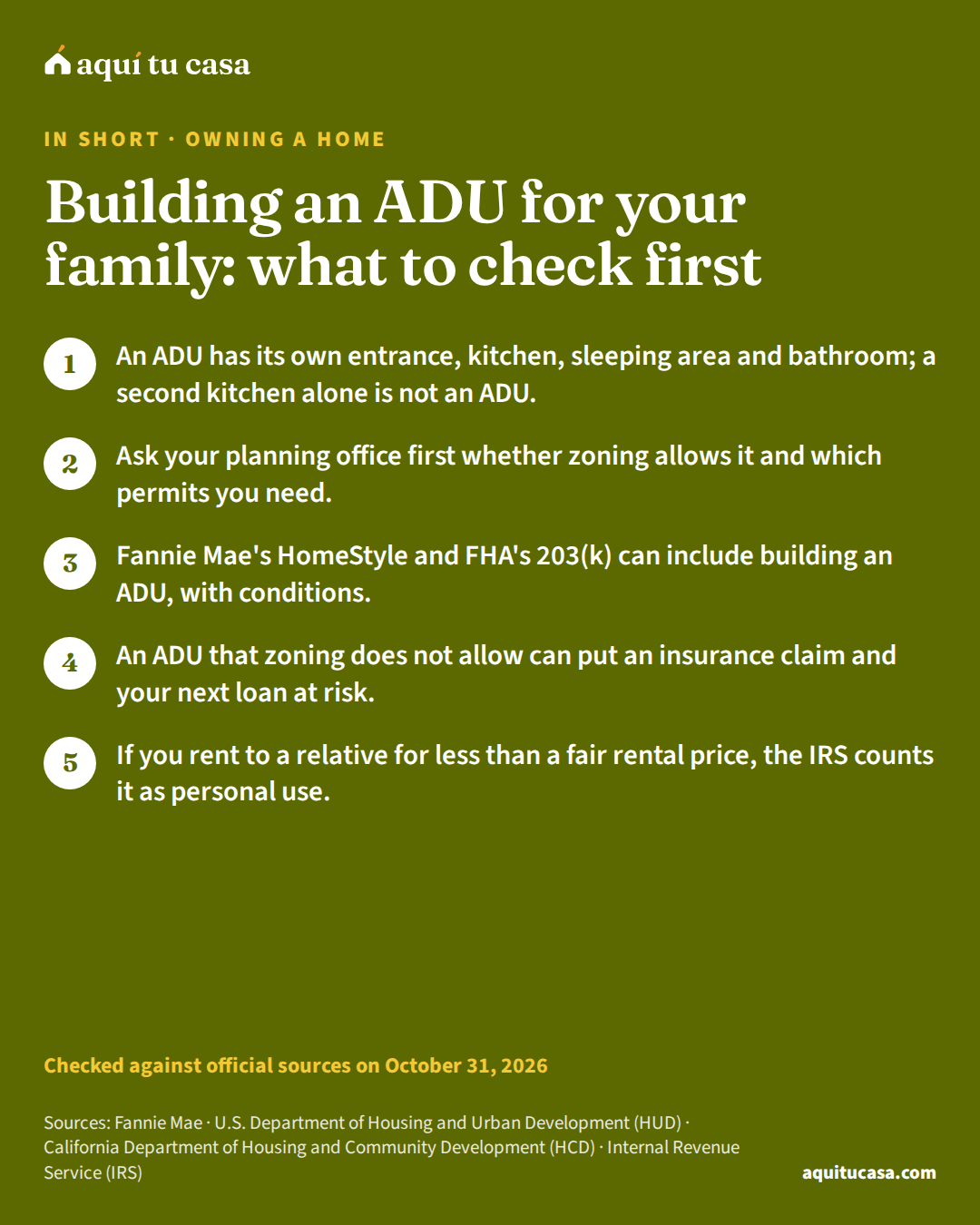
- An ADU has its own entrance, kitchen, sleeping area and bathroom; a second kitchen alone is not an ADU.
- Ask your planning office first whether zoning allows it and which permits you need.
- Fannie Mae's HomeStyle and FHA's 203(k) can include building an ADU, with conditions.
- An ADU that zoning does not allow can put an insurance claim and your next loan at risk.
Is this for you?
This guide is for you if…
- You own a home and want to build a separate unit for your parents, children or other relatives.
- You want to turn the garage or basement into a place to live.
- You already have a unit built without a permit and do not know what to do.
Get direct help first if…
- You do not own a home yet and want to buy one that already has an ADU: read «Buying a duplex or home with an ADU» first.
- You want to rent out a room inside your home: read «Renting out a room or unit».
Many families want to keep the grandparents close, give an adult child a place of their own or take in a relative who just arrived. An accessory dwelling unit, or ADU, can be the answer: a complete place to live on the same lot as your home. But building one is a big project, with permits, money and tax rules. This guide explains what to check before you start, with examples from official sources. If you do not own a home yet and want to buy one that already has an ADU, read Buying a duplex or home with an ADU.
What an ADU is (and is not)
An accessory dwelling unitaccessory dwelling unit (ADU)An accessory dwelling unit (ADU) is a living space, separate from the main house, on the same lot. It can be attached to the house, inside it or detached. According to Fannie Mae, it must have its own entrance, kitchen, sleeping area and bathroom, and be smaller than the main house. If it can only be reached through the main house, or it is open to it with no privacy, it does not count as an ADU. A second kitchen alone does not make one either. Fannie Mae allows only one per lot, and not with a two- to four-unit home.See the full definition is a place to live that is independent of the primary home. For Fannie Mae, it must provide for living, sleeping, cooking and bathing, and be on the same lot. It must be smaller than the primary home and have its own entrance, kitchen, sleeping area and bathroom. It is not an ADU if it can only be reached through the primary home, or is open to it with no privacy.1
The kitchen matters. It must have at least cabinets, a countertop, a sink with running water and a stove or stove hookup. A hotplate, microwave or toaster oven does not count as a stove. And a second kitchen by itself does not turn a room into an ADU.1 Fannie Mae allows only one ADU per lot, and not on a two- to four-unit property.1
It can be over the garage, in the basement or in a small addition, and it can be site-built or factory-built, including a HUD Code manufactured home that is real property.1 For FHA, a one-unit home with a single ADU remains a one-unit property.3
ADU, room with a bathroom or second kitchen
Fannie Mae and FHA
ADU
- Its own entrance, kitchen, sleeping area and bathroom
- Smaller than the primary home
- One per lot
Part of your home
Room with a bathroom
- Reached through the primary home
- No kitchen of its own
- Not an ADU
Part of your home
Second kitchen
- An extra kitchen inside the home
- By itself it is not an ADU
- A microwave or hotplate does not count as a stove
If you want the unit to count as an ADU for a loan, design it with its own entrance, full kitchen and bathroom.
First: zoning and permits
Before you spend on plans, ask your city’s or county’s planning or building office whether your lot’s zoningzoningZoning is the set of local rules about what each piece of land can be used for and what can be built on it. In Arizona, for example, state law lets each city or town regulate whether buildings and land are used for housing, business, industry or agriculture, along with their height, size and setback lines. In an appraisal, the appraiser reports the home's zoning class (such as R-1 or R-2) and whether its use is legal, legal because it predates the current rules (grandfathered), illegal, or in an area with no local zoning. Some construction projects need a zoning permit from the local government.See the full definition allows an ADU, how big it can be and which building permitsbuilding permitA building permit is the approval a local government gives to start a construction project. Not every area of the country requires one. If you renovate with an FHA 203(k) loan, the program requires all building permits to be obtained before work starts and posted on site. Freddie Mac also recommends working with your contractor to get any permits you need before a renovation begins.See the full definition you need. Get the rules in writing. If your home is in a homeowners association, check its rules too; the guide HOA and CDD explained explains how.
The rules vary a lot from place to place. California is an example of a state with its own ADU law. According to the California housing department’s ADU Handbook, ADUs there are approved without discretionary review or a hearing, under objective standards. The permitting agency must approve or deny your complete application within 60 days, if there is already a home on the lot. If it denies it, it must give you in writing the list of what is missing and how to fix it within those 60 days.4
In California, the local government also cannot require the owner to live on the property to have an ADU, except in one case of separate sale. There is also the JADU, a unit of no more than 500 square feet inside the home; if it shares a bathroom with the home, the owner must live there. And local governments may require ADUs to be rented for terms longer than 30 days.4
Why an unpermitted ADU is costly
Building without a permit may seem faster and cheaper, but it can cost you later. Fannie Mae considers an ADU legal if current zoning allows it. If zoning does not allow an ADU under any circumstance, the property is only eligible for one of its loans if the lender confirms the unit will not jeopardize a future property insurance claim.1 For FHA, the ADU must comply with zoning, which may include a legal nonconforming use.3
In plain terms: an unpermitted unit can complicate your next refinance, the sale of the home and an insurance claim. Tell your insurer before you build and ask whether it covers the new unit; the guide Home insurance explained helps you review your policy. Building can also change your property taxproperty taxProperty tax is the tax the county, city, school district and other local bodies charge real property owners every year to pay for schools, police, fire and other public services. It is computed on the value the assessor's office assigns to your home, at each body's rate, minus the exemptions you qualify for, such as the primary-residence exemption in many states. If you have a mortgage you normally pay it month by month inside your payment, through the escrow account. It is generally deductible on your federal return if you itemize.See the full definition: ask your county assessor’s office and read Property tax explained.
How to pay for the ADU
There are several ways to finance the work, each with different costs:
- A Fannie Mae renovation loan (HomeStyle). It can be used to build outdoor structures, for example accessory units, when local zoning allows and they meet building codes. It cannot be used to tear down and rebuild the whole home, and not every lender offers it: they need special approval.2
- An FHA 203(k) loan. Under the section of HUD’s Handbook that takes effect November 10, 2026, the Standard 203(k) requires at least $5,000 in improvements, and can include converting a home into a home with an ADU, adding an ADU attached to the home or renovating an existing ADU.3
- Your home’s equity. A home equity line of credit (HELOC) or a cash-out refinance. The guide HELOC vs. cash-out refinance compares the two, and the refinance tool helps you see the numbers.
A renovation loanrenovation mortgageA renovation mortgage is a home loan that combines, in one loan with one closing, the money to buy or refinance a home and the cost of renovating it. Freddie Mac, for example, buys conventional CHOICERenovation loans, which can pay for a new roof, a kitchen or bath remodel or an addition, and CHOICEReno eXPress loans for smaller projects. FHA has its own version, the 203(k) loan. According to HUD, this avoids typical construction lending with two loans; a construction loan is usually short-term.See the full definition uses your home as collateral. If you cannot pay it, you can lose your home. Before signing, compare offers and talk with a HUD-approved housing counselor, often for free.6
From the idea to the finished ADU
2. Design a complete ADU
With the plans
Its own entrance, kitchen with a stove, sleeping area and bathroom.1
3. Choose how to pay for it
Before hiring anyone
HomeStyle, 203(k), HELOC or savings; compare costs.2
Try it with your numbersShould I refinance?4. Apply for the permit
With a complete application
In California, the answer must come within 60 days.4
6. Hire with a written contract
When work starts
Licensed, with a written bid and payments as work progresses.
Choose the contractor carefully. Ask for a license, a written contract and payments as the work progresses, never everything up front. The guide Contractor and home repair scams explains the warning signs.
If your relative pays you rent: taxes
For the IRS, in most cases everything you receive as rent goes in your gross income.5 But when the person living in the unit is family, there is a special rule. A day counts as personal use if a member of your family uses it, unless it is their main home and they pay a fair rental price. It also counts as personal use if anyone pays less than a fair rental price. For this rule, family is your spouse, your siblings and half siblings, your parents and grandparents, and your children and grandchildren. A fair rental price is generally what someone not related to you would pay.5
Why does it matter? Because personal-use days change which expenses for the unit you can deduct. If your parents live in the ADU rent-free, there is no rent to report, but those days count as personal use. If you charge your son rent, report it. A VITA site can help you with your case, and the guide Renting out a room or unit explains the lease, insurance and fair housing if you ever rent to someone outside the family.
Example with real numbers
Two families, two ADUs
An example in words, not a real case, of how the rules change.
- Family 1, the grandparents live rent-free
- No rent; for the IRS, those days are personal use
- Family 2, the son pays a fair rent
- The rent goes in income; it is his main home
- Both built with a permit
- The ADU counts for the appraisal and insurance
- Both have their own entrance, kitchen and bathroom
- For Fannie Mae, it is an ADU
- What they have in common
- They asked about the rules, got a permit and told their insurer
The rules come from the IRS and Fannie Mae.511 Use the family budget to see how much you can pay each month for the work.
Run it with your numbersFamily budgetIf this is your situation
You will build for your parents
If they live rent-free, there is no rent to report, but the IRS counts it as personal use.5
You want to convert the garage
A space over or in the garage can be an ADU if it has its own entrance, kitchen and bathroom.11
You already have an unpermitted unit
It can affect your insurance and your next loan; ask whether you can legalize it.1
You have no savings for the work
HomeStyle and the 203(k) can include an ADU; compare and talk with a counselor.23
You live in California
State law sets 60 days to answer your complete application.4
Costly mistakes
Mistake: Building without asking about zoning.
Instead: Ask first; an ADU that zoning does not allow complicates loans and insurance.1
Mistake: Putting only a microwave in the kitchen.
Instead: To count as an ADU it needs a stove or stove hookup.1
Mistake: Making the only entrance through the primary home.
Instead: An ADU needs its own entrance.1
Mistake: Not telling your insurer.
Instead: Confirm before building that your policy covers the new unit.1
Mistake: Charging your relative rent without reporting it.
Instead: What you receive as rent goes in your gross income.5
What to do this week
- Call your city’s or county’s planning office and ask for the ADU rules in writing.4
- Check with a simple sketch whether your idea has its own entrance, kitchen, sleeping area and bathroom.1
- Ask your insurer how it would cover the new unit.1
- Ask two lenders about HomeStyle or the 203(k).23
- Decide whether your relative will pay rent and review the IRS rule.5
- Build your family budget with the work payment included and read Budgeting for home maintenance and repairs.
Your two loans
Today's loan
The new loan
Adjust advanced details
Your plans
Let's do the math
Your payment would drop by
Enter what you owe, your rate and the time left on today's loan to see the comparison.
This is an educational estimate, not a loan offer. Taxes, insurance and mortgage insurance are not included. Your Loan Estimate has the real figures.
Ready to see the numbers? Find your county here
See how this applies in your county: its loan limits, prices and rents, from the official data.
Printable checklist
Frequently asked questions
What counts as an ADU?
For Fannie Mae, a living space with its own entrance, kitchen, sleeping area and bathroom, smaller than the primary home and on the same lot. It can be over the garage, in the basement or in an addition. A second kitchen alone is not an ADU.
Do I need a permit to build an ADU?
Generally yes. Ask your city's or county's planning or building office. In California, the agency must approve or deny your complete application within 60 days if there is already a home on the lot.
Can I pay for the ADU with a mortgage loan?
There are options. Fannie Mae's HomeStyle Renovation loan can be used to build accessory units if zoning allows. FHA's Standard 203(k) includes adding or renovating an ADU, with at least $5,000 in improvements.
What if I already have an ADU built without a permit?
It can affect your next loan and your insurance. Fannie Mae only accepts an ADU that zoning does not allow if the lender confirms it does not jeopardize a future insurance claim. Ask your city whether you can legalize it.
In California, do I have to live in the home to build an ADU?
Not for an ADU: the local government cannot require it, except in one case of separate sale. For a JADU that shares a bathroom with the home, owner occupancy is required.
My parents will live in the ADU rent-free. Do I have to report anything?
If you receive no rent, there is no rent to report. But for the IRS, if a relative uses the unit and does not pay a fair rental price, those days are personal use, which changes what you can deduct. Ask at a VITA site.
If I charge my son rent, do I report it?
Yes. The IRS says that in most cases everything you receive as rent goes in your gross income. If the rent is below a fair rental price, the IRS treats it as personal use.
Sources
Every figure in this guide comes from one of these official sources. The number next to a sentence leads to the source behind it.
Each source on one line: who publishes it, its title, its address and the date we read it.
- 1. Fannie Mae · Selling Guide B2-3-04, Special Property Eligibility Considerations · selling-guide.fanniemae.com · Accessed October 31, 2026
- 2. Fannie Mae · Selling Guide B5-3.2-01, HomeStyle Renovation Mortgages · selling-guide.fanniemae.com · Accessed October 31, 2026
- 3. U.S. Department of Housing and Urban Development (HUD) · Handbook 4000.1, FHA Single Family Housing Policy Handbook · hud.gov · Accessed October 31, 2026
- 4. California Department of Housing and Community Development (HCD) · Accessory Dwelling Unit Handbook (March 2026) · hcd.ca.gov · Accessed October 31, 2026
- 5. Internal Revenue Service (IRS) · Publication 527, Residential Rental Property · irs.gov · Accessed October 31, 2026
- 6. Consumer Financial Protection Bureau (CFPB) · Find a housing counselor · consumerfinance.gov · Accessed October 31, 2026
Keep reading
Related guides
If this guide helped, these follow the same path.

Buying a home 11 minute read
Buying a duplex or a home with an ADU to live with family
How to buy a 2- to 4-unit home or a home with an accessory dwelling unit (ADU) for family or to rent out part: who lives there, rent, limits and reserves.
- With FHA you can buy 1 to 4 units if one will be your principal residence; a home with one ADU counts as a single unit.
- The lender counts only part of the rent (usually 75%), and ADU rent cannot exceed 30% of your qualifying income.
- On 3 or 4 units with FHA, the rent must cover the payment, and you need three months of reserves.
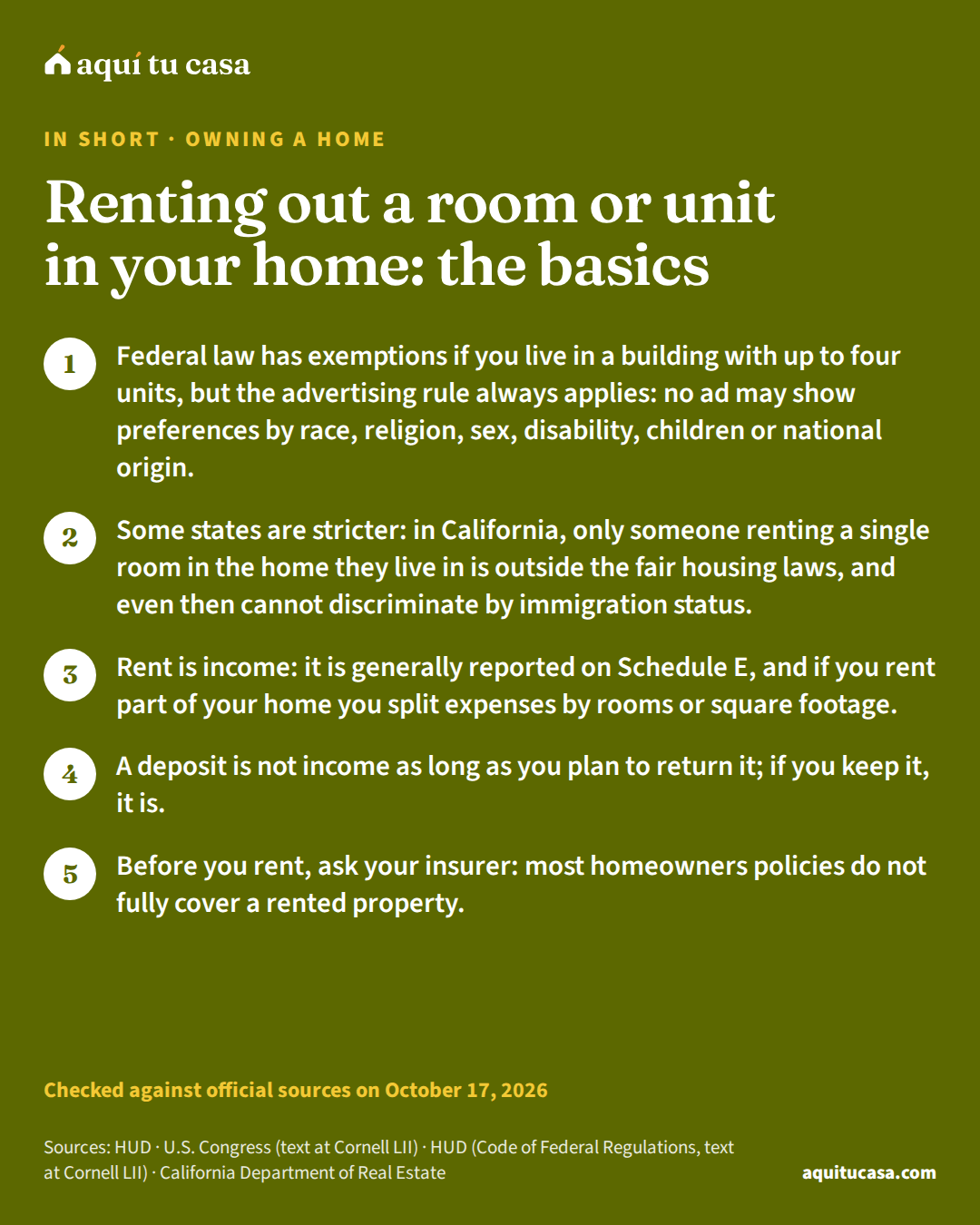
- Owning a home Renting out a room or unit in your home: the basics Before you rent out a room, half of a duplex or a separate unit: fair housing, your ad, the lease, the deposit, taxes and insurance. 12 minute read
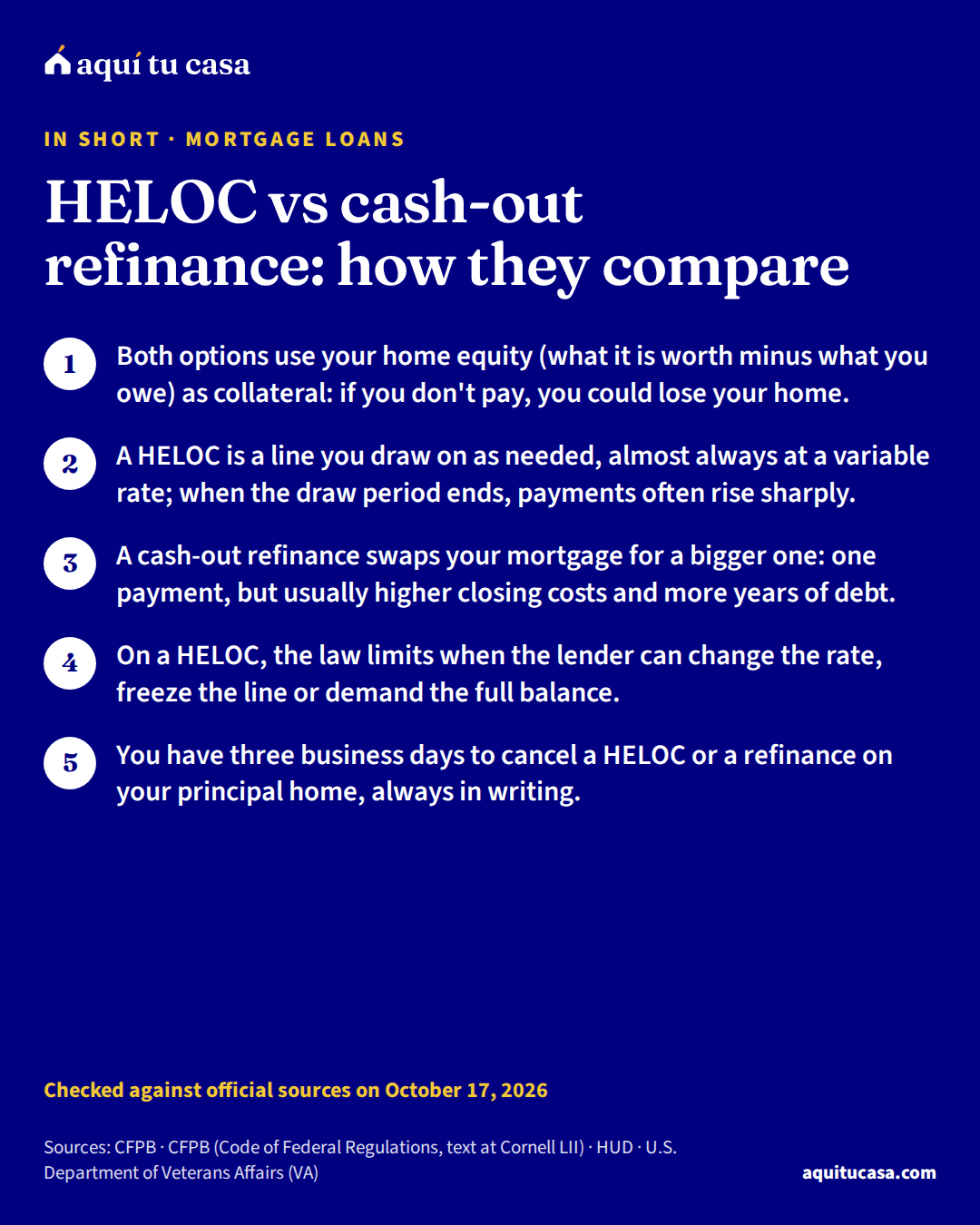
- Mortgage loans HELOC vs cash-out refinance: how they compare A home equity line of credit (HELOC) or a cash-out refinance: how each works, what it costs, your rights and the risks to your home. 11 minute read
- Protect yourself from scams Contractor and home repair scams: how to protect yourself How to spot a dishonest contractor, check a license, sign a solid contract, pay safely and cancel a sale made at your home. 11 minute read

Tools for this topic
Was this guide useful?
Thank you. Your answer stays in your browser; nothing is sent.