Home maintenance: how to budget for repairs
How to plan and save for home maintenance and repairs: what insurance does not cover, what the IRS says and what help exists to fix up your home.
Verified against official sources on October 17, 2026 12 official sources

Show contents
In short
What you need to know
Quick answer
Your home needs maintenance and repairs, and the CFPB says to budget and save for them on top of your mortgage payment. The official sources we checked do not set a percentage: the CFPB suggests basing your goal on the unexpected expenses you have already had. Homeowners insurance generally does not pay for wear and tear or slow leaks, so those repairs are on you. If your income is low, your state's Weatherization Assistance Program (WAP) may help with energy upgrades.
What matters most
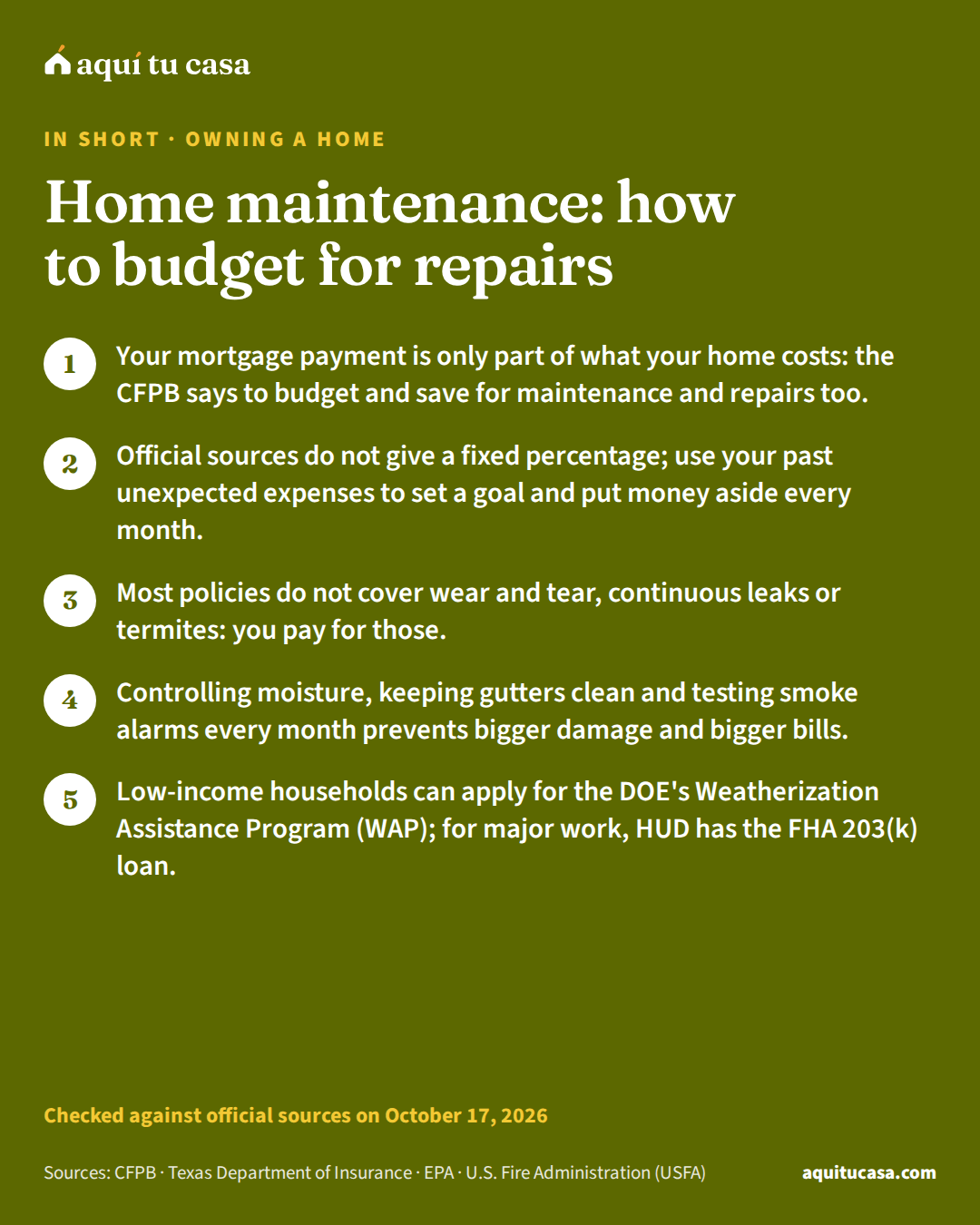
- Your mortgage payment is only part of what your home costs: the CFPB says to budget and save for maintenance and repairs too.
- Official sources do not give a fixed percentage; use your past unexpected expenses to set a goal and put money aside every month.
- Most policies do not cover wear and tear, continuous leaks or termites: you pay for those.
- Controlling moisture, keeping gutters clean and testing smoke alarms every month prevents bigger damage and bigger bills.
Is this for you?
This guide is for you if…
- You just bought a home, or are about to, and want to know how much to set aside for repairs and upkeep.
- You already own and a big repair caught you by surprise.
- You have a low income, or you are an older adult, and you are looking for help repairing or weatherizing your home.
Get direct help first if…
- Your home was damaged by a hurricane, flood or other disaster: start with your insurance policy and your state's disaster assistance.
- You rent: repairs are usually the landlord's job under your lease and your state's law; this guide is for owners.
- You want to compare loans for a major remodel: here we only explain the general options.
Buying the home is the beginning. Then come the water heater that quits, the roof that leaks or the smoke alarm that chirps for a battery. This guide is for owners and future owners who want to plan for those costs: what official sources say about budgeting for maintenance, what insurance does not pay, which upkeep prevents bigger damage, what the IRS says about repairs and what help exists when money is tight.
- Test your smoke alarms, according to the U.S. Fire Administration
- Every month6
- To dry out a leak or spill and, in most cases, prevent mold
- 24 to 48 hours5
- Average yearly energy savings for households that get weatherization (WAP)
- $372 or more8
- To repair or improve your home inside a Limited FHA 203(k) mortgage
- Up to $75,00010
Maintenance is part of what your home costs
The CFPB says it plainly in its homebuyer guide: in most cases, your lender only checks whether you are able to repay the mortgage, not whether you are comfortable repaying it. So it asks you to think about whether you want to take on the payment plus the other costs of homeownership, such as appliances, repairs and maintenance.1 In its section for owners, it adds that your mortgage payment is just one part of what it costs to live in your home, and that your home needs maintenance and repairs, so you should budget and save for those too.1
Those costs are not part of your mortgage payment: you cover them yourself, separately.1 The CFPB also warns that some home-related costs are likely to rise over time, and that building codes and energy efficiency can affect what you pay for utilities and insurance.2

How much to set aside? The official sources we checked do not set a percentage of the home’s value. What the CFPB does say is to think about the most common unexpected expenses you have had and what they cost, and to set your goal from there.3 If you just bought and had a home inspectionhome inspectionA home inspection is a review of the property's physical condition by an inspector before you finish buying: roof, foundation, plumbing, electrical, heating and cooling, signs of moisture or pests. It is often part of the home buying process and you pay for it, not the lender; unlike the appraisal, it does not say what the home is worth but what problems it has. With the report you can ask for repairs, negotiate the price or walk away if your contract includes an inspection contingency. Some assistance programs require one.See the full definition, its report is a good starting point for your list; our home inspection guide explains how to read it.
What insurance pays and what you pay
Homeowners insurancehomeowners insuranceHomeowners insurance pays for losses and damage to your property if something unexpected happens, like a fire or a burglary, and usually includes liability coverage if someone is hurt at your home. Lenders require it as long as you have a mortgage, because the home is their collateral, and almost always collect it inside your monthly payment through the escrow account. The price depends on the location, the rebuilding cost, the deductible and your history. A standard policy does not cover floods or, in many states, earthquakes: those risks are insured separately.See the full definition pays for damage from the risks your policy covers, not the normal wear on a house. The Texas Department of Insurance explains that most policies cover fire, lightning and the sudden and accidental release of water or smoke, but not flooding, a continuous water leak, termites, insects or rodents, or wear and tear. Coverage varies by company, so read your policy or ask your agent.4 Flooding takes a separate policy; our flood insurance (NFIP) guide explains it.
Example with real numbers
Does insurance pay, or do you?
An example using the list the Texas Department of Insurance publishes. Your policy may differ.
- A pipe bursts suddenly and soaks the floor
- Most policies cover it, minus your deductible
- A slow leak under the sink, for months
- Most policies do not cover it
- Termites in the wood
- Most policies do not cover them
- An old roof that has simply worn out
- Most policies do not cover wear and tear
- What insurance does not cover
- Comes out of your home fund
The list comes from the Texas Department of Insurance's home insurance guide; coverage varies by company.4 Use the family budget tool to see how much you can set aside each month.
Run it with your numbersFamily budgetThere is another reason not to put off repairs: even when insurance pays, the deductibledeductibleA deductible is the part of an insurance claim you pay yourself. When you have a covered loss, the insurance company subtracts the deductible from the claim amount and pays you the rest. You may have a different deductible for each type of coverage. You will find it on the first page of your policy, called the declarations page, along with your coverages and limits. In taxes, the word "deductible" means something else: an expense that can lower the taxes you owe.See the full definition is the part of the claim you pay yourself, and a continuous leak, like one left running for months, is generally not covered.4 Our home insurance guide explains what a typical policy covers and how to file a claim.
How to build your maintenance budget
A maintenance budget is a separate fund for your home. The CFPB says an emergency fundemergency fundAn emergency fund is cash you set aside only for unplanned expenses or emergencies, such as car or home repairs, medical bills or a loss of income. It is not for routine monthly spending. The CFPB explains that without savings, even a small financial shock can push you into debt that is hard to pay off. How much you need depends on your situation; the CFPB suggests thinking about the unexpected expenses you have had before. You can keep it in a bank or credit union account, on a prepaid card or in cash, and it grows more easily with automatic saving or part of a tax refund.See the full definition is a cash reserve set aside for unplanned expenses, and lists home repairs as one of the most common examples.3 It also suggests not sacrificing savings to buy a bigger house, and adding more to your emergency fund or household fund so you do not go into debt for sudden repairs or expensive replacements.2
Your maintenance plan, step by step
1. Add up the home costs that are not in your payment
Before you buy, or this month
Appliances, repairs and maintenance are part of what it costs to own.1
Try it with your numbersFamily budget2. Check what your policy covers and your deductible
When you renew your insurance
Most policies do not cover wear and tear or continuous leaks.4
3. Set a goal from your past expenses
Once a year
Think about the unexpected expenses you have had and what they cost.3
4. Put money into a home fund every month
Every month
That way you do not go into debt when something breaks suddenly.2
5. Do the upkeep that prevents bigger damage
Throughout the year
Control moisture, fix leaks and clean the gutters.5
6. Keep receipts for improvements
Always
The cost of an improvement is added to your home's basis; keep those records.7
If you have an escrow accountescrow accountAn escrow account is an account set up by your mortgage lender to pay certain property-related expenses on your behalf, mainly property taxes and homeowners insurance. The money comes from a portion of your monthly mortgage payment: each month you contribute a share and the loan servicer pays the bills when they come due. That is why your payment is higher than principal and interest alone, and why it can change when taxes or the insurance premium go up. In some states the word also names the period between the offer and the closing.See the full definition, taxes and insurance are paid from it, but maintenance is not: that money is yours to manage.1 If you live in a community with a homeowners association (HOA)homeowners association (HOA)A homeowners association (HOA) is the organization formed in many subdivisions and condominium buildings to manage shared expenses such as landscaping, a pool, maintenance of common areas and, in condos, the roof and exteriors. Each owner pays dues, normally monthly, and must follow its rules, which can cover anything from the color of your door to renting the home out. If you do not pay, the association can add charges and, in several states, place a lien on your home. The dues count toward your monthly payment when lenders judge whether you can afford the mortgage.See the full definition, plan for special assessments too; our HOA and CDD guide explains when they can come.
What is left after housing and debts has to cover utilities, groceries, childcare and health insurance, among other expenses.1 Our family budget tool helps you see how much you can set aside, and the emergency fund guide explains where to keep it.

The upkeep that prevents big bills
Many expensive repairs start with water. The EPA says the key to mold control is moisture control, and that if you dry wet materials within 24 to 48 hours after a leak or spill, in most cases mold will not grow.5
| Task | How often | Who recommends it |
|---|---|---|
| Test smoke alarms | Every month | USFA |
| Replace the 9-volt battery or the alarm’s backup battery | At least once a year | USFA |
| Replace the whole alarm (9-volt or hardwired) | Every 10 years | USFA |
| Clean and repair roof gutters | Regularly | EPA |
| Fix plumbing leaks and dry what got wet | As soon as possible, within 24 to 48 hours | EPA |
| Keep air conditioning drip pans clean and drain lines flowing | Always | EPA |
| Make sure the ground slopes away from the foundation | Always | EPA |
| Keep indoor humidity in check | Below 60%, ideally between 30% and 50% | EPA |
Smoke alarms deserve their own note. The U.S. Fire Administration (USFA) says an alarm with a dead or missing battery is the same as having no alarm at all, and that you should never take the battery out while cooking. Some fire departments offer reduced-price or free alarms, and some install them at no cost.6
If you already have mold, the EPA says to clean it up promptly and fix the water problem.5 Do not paint or caulk over mold: clean it and dry the surface first. If you hire someone, make sure they have experience with mold and check their references.5

Repair or improvement: what the IRS says
For your taxes, fixing is not the same as improving. IRS Publication 530 explains it this way:7
Repair and improvement, side by side
Maintains
Repair
Repairs done as part of a major remodel count as improvements. Keep receipts for improvements as long as they matter for figuring basis.7
Your home’s basis is generally what it cost, and improvements increase it. It is the starting point for figuring your gain or loss if you ever sell. The IRS also lists homeowners association fees and repairs to the home among the payments you cannot deduct.7
If the repair is big: how to pay for it
Ideally, you pay from your home fund. The CFPB warns that if you pay an unexpected expense with a credit card or a loan, it can grow significantly because of interest and fees.3 HUD’s 203(k) fact sheet adds that home improvement loans often have high interest rates, short repayment terms or balloon payments.11
For major work, HUD has the FHA 203(k) loan. It lets you buy or refinancerefinanceTo refinance is to take out a new mortgage loan to pay off and replace the one you have. According to the CFPB, common reasons are to lower the interest rate, lower the monthly payment or borrow additional money. When you refinance you usually pay closing costs again. If your payment goes down, the CFPB says to understand how much of the drop comes from a lower rate and how much from a longer loan term. In many refinances you have a right to cancel (right of rescission) until midnight of the third business day, but not if you refinance with the same lender without borrowing more.See the full definition and combine the cost of renovation or repairs into a single FHA loanFHA loanAn FHA loan is a mortgage made by a private lender and insured by the Federal Housing Administration (FHA), an agency of the U.S. government. That insurance protects the lender if you stop paying, which is why the lender can accept a lower down payment and a less-than-perfect credit history than on a conventional loan. Federal law sets the minimum cash investment at 3.5% of the property's value and caps the loan amount at the FHA limit, which changes by county. In exchange for the insurance you pay a mortgage insurance premium.See the full definition, through FHA-approved lenders. Eligible improvements include energy efficiency upgrades and accessibility for people with disabilities, and the program requires building permits before work starts.11 There are two types:10
| Limited 203(k) | Standard 203(k) | |
|---|---|---|
| For | Repairing, improving or upgrading the home | Major rehabilitation and repair of single-family homes |
| Cost of the work | Up to $75,000 | At least $5,000 |
| Condition | Financed into the mortgage | The home’s total value must stay within the area’s FHA limit |
Another option is to tap your home equityhome equityHome equity (or equity) is what your home is worth today minus what you still owe on the mortgages on it. You can borrow against that equity: with a home equity loan, which you receive as a lump sum and which usually has a fixed rate; with a HELOC; or with a cash-out refinance. In all of these the home is the collateral and, if you do not repay, the lender could take it. With a reverse mortgage, the balance grows each month and your equity goes down.See the full definition with a home equity line of credit (HELOC)home equity line of credit (HELOC)A home equity line of credit (HELOC) lets you borrow again and again against the equity in your home: what the home is worth minus what you owe on your mortgage. During the draw period you can take out money up to your credit limit, usually with special checks or a card. When that period ends you can no longer borrow and you enter the repayment period, when payments are often much higher; sometimes the whole balance is due at once. It usually has a variable interest rate. If you do not repay it, you could lose your home.See the full definition or a cash-out refinance. Our HELOC vs. cash-out refinance guide explains how they work and their risks. And before you hire anyone for a big job, read our contractor scams guide.
Help for low-income households: weatherization and more
The Department of Energy’s (DOE) Weatherization Assistance Program (WAP) lowers energy costs for low-income households by making their homes more energy efficient, while looking after their health and safety. According to a national evaluation, these households save on average $372 or more a year.8
Here is how it works, according to the DOE. States and local agencies run the program: you first find your state’s weatherization administrator and then the local provider. Under DOE guidelines, households at or below 200% of the poverty guidelines or receiving Supplemental Security Income (SSI) are eligible; your state may use LIHEAP’s criterion of 60% of state median income instead. Priority goes to older adults, families with a member with a disability, families with children and households that spend a lot on energy. The provider asks for proof of income for the prior year, such as pay stubs or Social Security payments, and eligible households go on a waitlist. Then an energy auditor visits your home, runs a test to measure where outside air gets in and recommends the most cost-effective savings measures; at the end, an inspector reviews the work.9
The same DOE page lists other programs. LIHEAP provides short-term help paying utility bills to eligible low-income families. The USDA offers loans for very low-income rural homeowners to repair, improve or modernize their homes, and grants for elderly very low-income homeowners to remove health or safety hazards. The DOE also recommends checking with your state and local government.9
If this is you
Your income is low
Apply for weatherization (WAP) through your state's administrator; you will be asked for proof of income for the prior year.9
You are an older adult
WAP gives priority to older adults, and the USDA has grants for very low-income older homeowners in rural areas.99
Someone in your family has a disability
WAP gives those families priority, and an FHA 203(k) can finance accessibility improvements.911
You just bought your first home
Start your home fund in the first month; the CFPB advises against spending all your savings on the purchase.2

Costly mistakes
Mistake: Spending all your savings on the purchase and having no cushion left.
Instead: Set money aside for sudden repairs and expensive replacements from the start.2
Mistake: Expecting insurance to pay for wear and tear or a slow leak.
Instead: Check your policy: most do not cover wear and tear or continuous leaks.4
Mistake: Putting off a leak.
Instead: Fix it and dry what got wet within 24 to 48 hours to prevent mold.5
Mistake: Painting over mold.
Instead: Clean the mold, fix the water problem and dry the surface before painting.5
Mistake: Putting a big repair on a credit card with no plan.
Instead: Interest and fees can make the cost grow a lot; compare options first.3
Mistake: Pulling the battery when the smoke alarm goes off while cooking.
Instead: Never remove it: test the alarm every month and replace the battery every year.6
What to do this week
- List the unexpected home expenses you had last year and what they cost; use that to set your goal.3
- Open or set aside an account for your home fund and give it a fixed amount each month in your family budget.1
- Read your insurance policy: which risks it covers, what it excludes and what your deductible is.4
- Test your smoke alarms and check your gutters and the pipes under your sinks.65
- Keep the receipts for any improvements in one folder.7
- If your income is low, find your state’s weatherization administrator. If you want help with your budget, a HUD-approved housing counselorHUD-approved housing counselorA HUD-approved housing counselor works at an agency HUD has approved to provide housing counseling: independent, expert advice customized to your situation about buying a home, renting, a missed mortgage payment, a foreclosure or credit problems. The agencies usually charge little or nothing; many serve in Spanish and offer the homebuyer education course several assistance programs require. They are not lenders or real estate agents and sell you nothing. Your county page lists the official agencies with phone numbers.See the full definition gives independent advice, often at little or no cost.912 Our first year as a homeowner guide covers the other bills.
Your household this month
Let's do the math
Left each month
Enter what at least one person takes home to see the result.
What helps
- Pay savings first: set the goal aside the day the money arrives, before flexible spending.
- Add up the bills that come every few months (car insurance, school) and divide by twelve.
- If income changes, plan on a low month and save the extra from good months.
- A HUD-approved housing counselor can go over the budget with you, often for free.
This is a planning tool with your numbers, not a credit evaluation or an approval. The split reference is only a guide.
Ready to see the numbers? Find your county here
See how this applies in your county: its loan limits, prices and rents, from the official data.
Printable checklist
Frequently asked questions
How much should I save for home maintenance?
The official sources we checked do not set a percentage. The CFPB says your home needs maintenance and repairs and that you should budget and save for them, and it suggests setting a goal based on the unexpected expenses you have had and what they cost. Our family budget tool helps you see how much you can set aside each month.
Does homeowners insurance pay for repairs?
It pays for damage from the risks your policy covers. The Texas Department of Insurance explains that most policies cover fire or a sudden and accidental release of water, but not a continuous leak, termites or rodents, or wear and tear. Coverage varies by company: read your policy or ask your agent.
Can I deduct home repairs on my taxes?
No. The IRS says you cannot deduct repair costs and generally cannot add them to your home's basis either. Improvements, such as a new roof, are not deductible, but their cost is added to your basis; keep those receipts as long as they matter for figuring it.
Is there help fixing my home if I earn little?
Yes, there are programs. The Department of Energy's Weatherization Assistance Program (WAP) makes low-income households' homes more energy efficient. According to the DOE, LIHEAP helps pay utility bills, and the USDA offers loans to very low-income rural homeowners to repair their homes and grants to elderly homeowners to remove health or safety hazards.
How do I apply for weatherization assistance (WAP)?
Find your state's weatherization administrator and then the local provider for your county. Under DOE guidelines, households at or below 200% of the poverty guidelines or receiving SSI are eligible, and your state may use another criterion. You will be asked for proof of income for the prior year and, if eligible, placed on a waitlist.
Can I roll repair costs into my mortgage?
With an FHA 203(k) loan you can, when buying or refinancing. According to HUD, the Limited 203(k) finances up to $75,000 to repair or improve, and the Standard 203(k) is for major work of at least $5,000. You apply through FHA-approved lenders.
Are there still federal tax credits for energy improvements?
According to the IRS, you cannot claim the residential clean energy credit for expenditures made after December 31, 2025, or the energy efficient home improvement credit for property placed in service after that date. If a seller promises you that credit for new work, check what the IRS says.
How often should I check my smoke alarms?
The U.S. Fire Administration says to test them every month, replace a 9-volt or backup battery at least once a year, and replace the whole alarm every 10 years. Some fire departments give out or install alarms at no cost.
Sources
Every figure in this guide comes from one of these official sources. The number next to a sentence leads to the source behind it.
Each source on one line: who publishes it, its title, its address and the date we read it.
- 1. CFPB · Your home loan toolkit: A step-by-step guide · files.consumerfinance.gov · Accessed October 17, 2026
- 2. CFPB · How can I figure out if I can afford to buy a home and take out a mortgage? · consumerfinance.gov · Accessed October 17, 2026
- 3. CFPB · An essential guide to building an emergency fund · consumerfinance.gov · Accessed October 17, 2026
- 4. Texas Department of Insurance · Home insurance guide · tdi.texas.gov · Accessed October 17, 2026
- 5. EPA · A Brief Guide to Mold, Moisture and Your Home · epa.gov · Accessed October 17, 2026
- 6. U.S. Fire Administration (USFA) · Smoke alarms · usfa.fema.gov · Accessed October 17, 2026
- 7. IRS · Publication 530, Tax Information for Homeowners · irs.gov · Accessed October 17, 2026
- 8. U.S. Department of Energy (DOE) · Weatherization Assistance Program · energy.gov · Accessed October 17, 2026
See the other 4 sources
- 9. U.S. Department of Energy (DOE) · How to Apply for Weatherization Assistance · energy.gov · Accessed October 17, 2026
- 10. HUD · 203(k) Rehabilitation Mortgage Insurance Program Types · hud.gov · Accessed October 17, 2026
- 11. HUD · Buying a House That Needs Rehabilitation or Renovating Your Home? (FHA 203(k) consumer fact sheet) · hud.gov · Accessed October 17, 2026
- 12. CFPB · Find a Housing Counselor · consumerfinance.gov · Accessed October 17, 2026
Keep reading
Related guides
If this guide helped, these follow the same path.

Buying a home 13 minute read
Your first year as a homeowner: escrow, taxes and insurance
Who collects your mortgage and what happens if that changes, the yearly escrow review, taxes, exemptions, insurance, records and scams aimed at new owners.
- Your servicer generally sends a statement every billing cycle; if servicing moves to another company, you get written notice and 60 days of protection from late fees.
- Escrow is reviewed once a year: a surplus of $50 or more is refunded if you are current, and a shortage of one month's escrow or more can be repaid over at least 12 months.
- Your tax can go up after the purchase, and homestead exemptions have deadlines: check your state's page.
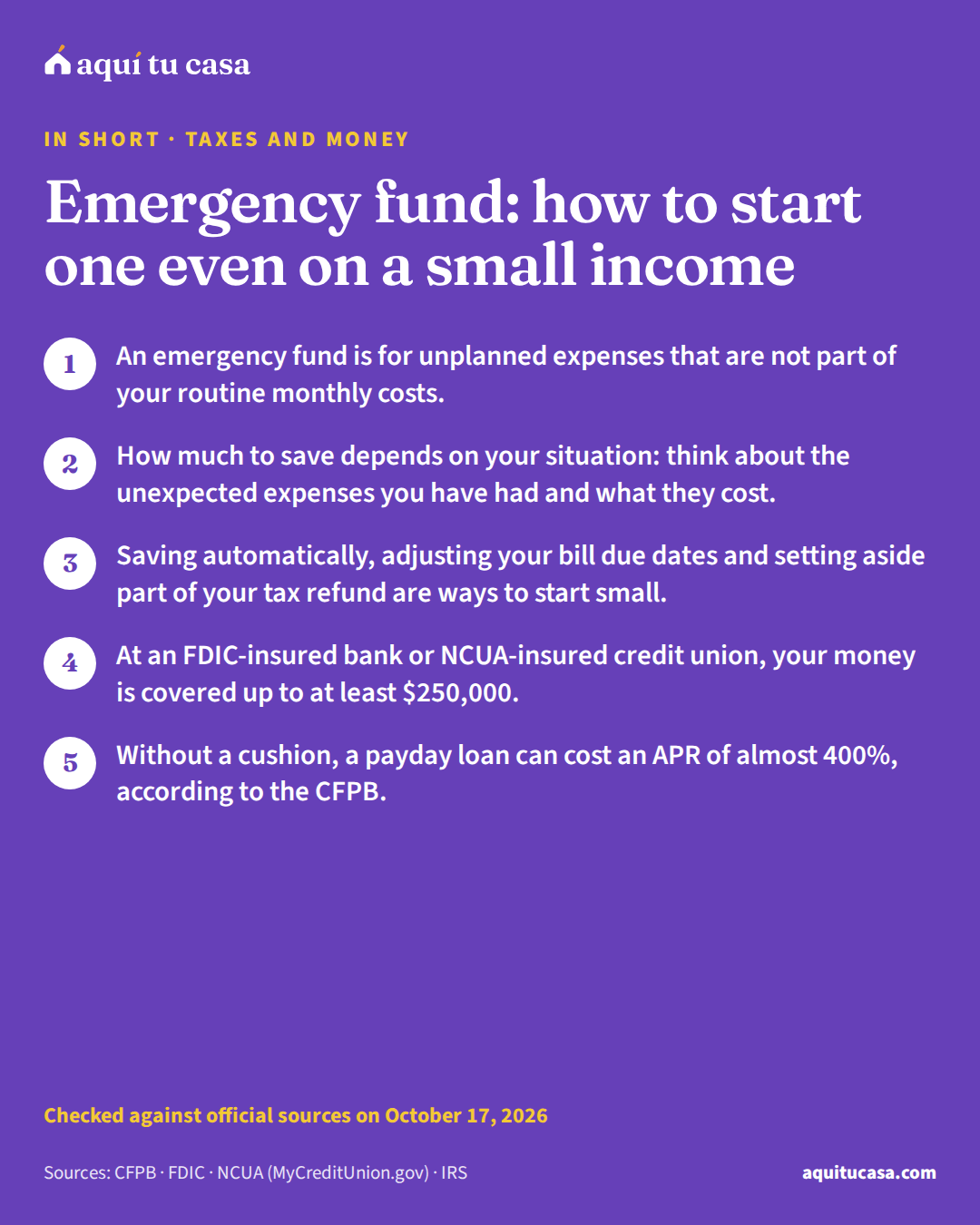
- Taxes and money Emergency fund: how to start one even on a small income What an emergency fund is, how much to save for your situation, how to start with little money, where to keep it safe and what it costs not to have one. 10 minute read
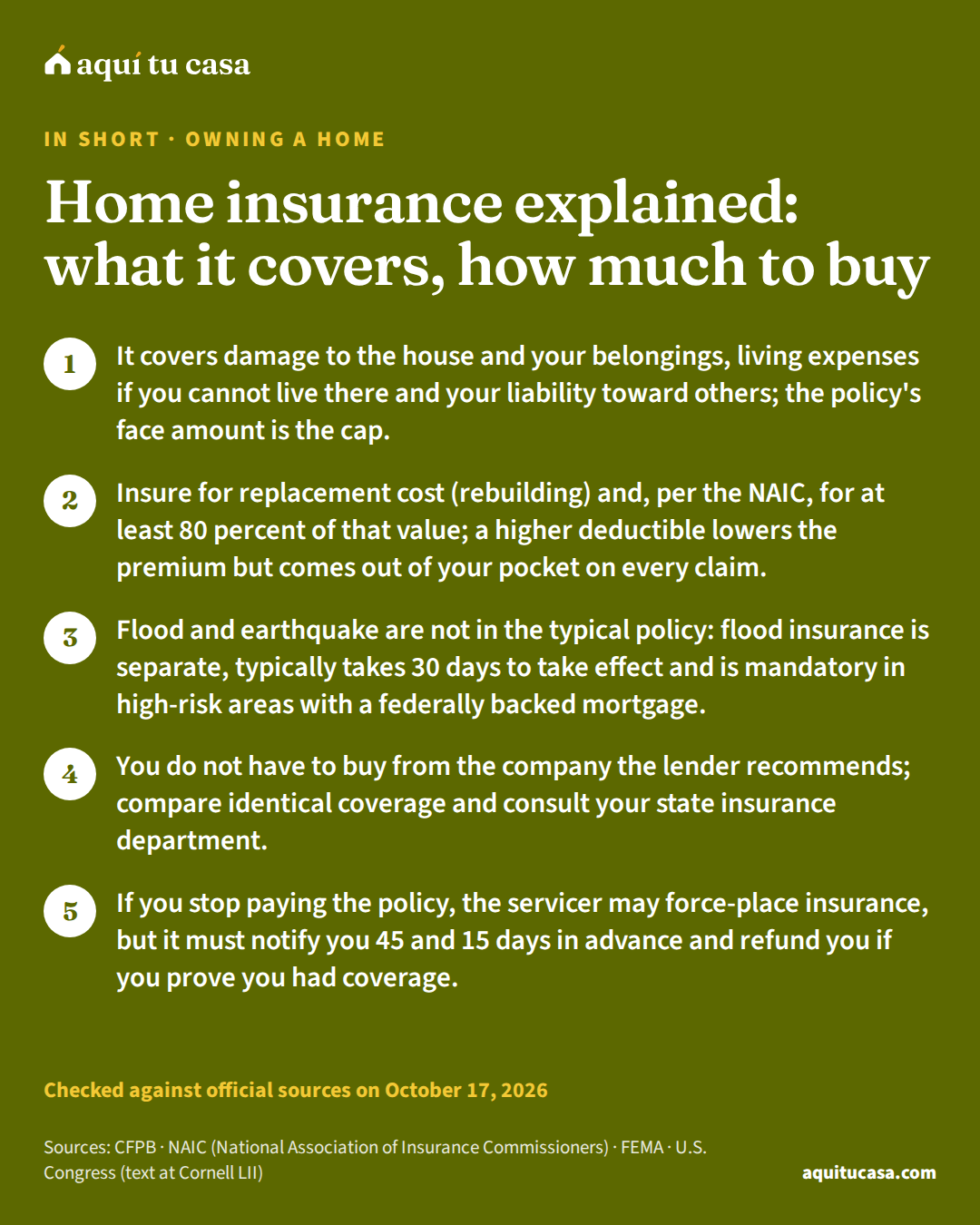
- Owning a home Home insurance explained: what it covers, how much to buy What home insurance covers, why the lender requires it, how to choose the amount and the deductible, why flood is separate and what happens if it lapses. 13 minute read
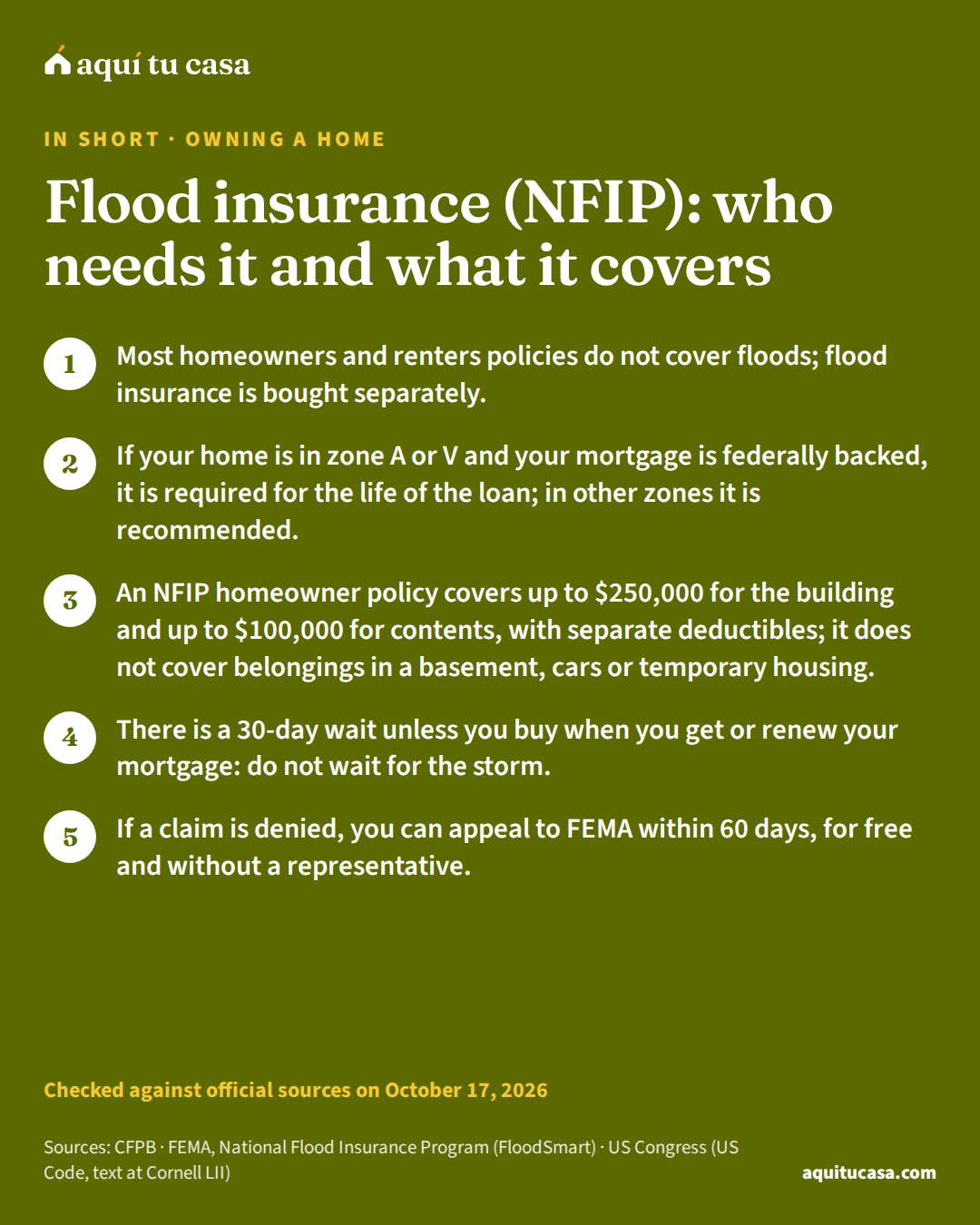
- Owning a home Flood insurance (NFIP): who needs it and what it covers Why home insurance does not cover floods, when you must buy NFIP coverage, what it covers, the 30-day wait, flood zones and how to file a claim. 13 minute read
Tools for this topic
Was this guide useful?
Thank you. Your answer stays in your browser; nothing is sent.