Earthquake and wildfire insurance
What your homeowners policy leaves out, how earthquake policies work, what the FAIR Plan is and what to do if your insurer drops you over wildfire risk.
Verified against official sources on October 17, 2026 11 official sources

Show contents
In short
What you need to know
Quick answer
In most cases, homeowners insurance covers fire, including wildfire, but not earthquakes: for that you need a separate policy, which in California you buy from your insurer or from the California Earthquake Authority (CEA) through it. With fire, the most common risk is being insured for less than it costs to rebuild, so make sure your limit is the rebuilding cost, not the market value. If no one will insure you, the California or Texas FAIR Plan is the last resort, with a basic fire policy.
What matters most
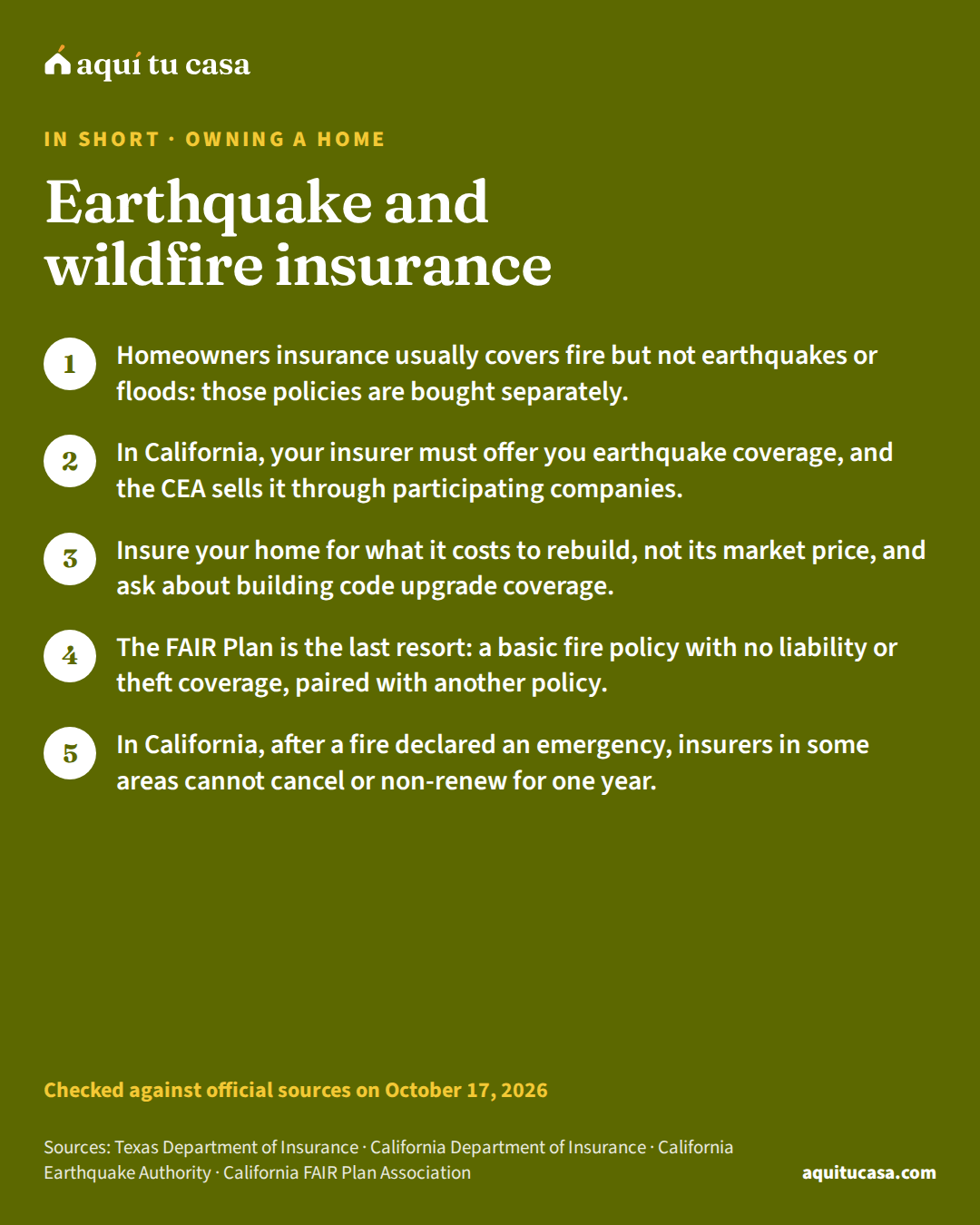
- Homeowners insurance usually covers fire but not earthquakes or floods: those policies are bought separately.
- In California, your insurer must offer you earthquake coverage, and the CEA sells it through participating companies.
- Insure your home for what it costs to rebuild, not its market price, and ask about building code upgrade coverage.
- The FAIR Plan is the last resort: a basic fire policy with no liability or theft coverage, paired with another policy.
Is this for you?
This guide is for you if…
- You own a home in an area at risk of earthquakes or wildfires and want to know what your policy covers.
- Your insurer will not renew you because of wildfire risk and you do not know what options are left.
- You live in California or Texas and were offered an earthquake policy or the FAIR Plan.
Get direct help first if…
- Your problem is water: flood insurance is separate; start with the flood insurance (NFIP) guide.
- You rent and want to protect your belongings: start with the renters insurance guide.
- You just had a fire and are in danger: call 911.
An earthquake or a wildfire can destroy a home in minutes, and many families find out too late that their policy did not cover what they thought. This guide is for anyone with a home in an at-risk area, especially in California or Texas: it explains what homeowners insurance does and does not cover, how earthquake policies work, how to insure well against fire and what to do if your insurer drops you.
What your homeowners insurance covers and what it does not
Homeowners insurancehomeowners insuranceHomeowners insurance pays for losses and damage to your property if something unexpected happens, like a fire or a burglary, and usually includes liability coverage if someone is hurt at your home. Lenders require it as long as you have a mortgage, because the home is their collateral, and almost always collect it inside your monthly payment through the escrow account. The price depends on the location, the rebuilding cost, the deductible and your history. A standard policy does not cover floods or, in many states, earthquakes: those risks are insured separately.See the full definition protects against certain risks, and each policy names them. The Texas Department of Insurance shows that most policies cover damage from fire and lightning, but not earthquakes, earth movement or floods; and it notes that coverages vary by company.1 California’s Department gives a similar list: fire and smoke are typically covered, while earthquake, flood, mold and earth movement are usually excluded.4
Those risks are covered by separate policies. In Texas, the Department says you can buy flood and earthquake policies through your agent, and that on the coast you also need a windstorm policy.2 Flooding has its own federal program, explained in the flood insurance guide.
Three different policies
The basic one
Homeowners insurance
Separate
Earthquake policy
In an at-risk area, you may need more than one of these policies at once.2
Earthquake insurance
The California Earthquake Authority (CEA) puts it plainly: in most cases, homeowners insurance does not cover earthquake damage, and in California a separate policy is needed.9 In California, the law requires the insurer that sells you homeowners coverage to offer earthquake coverage for an additional premiuminsurance premiumAn insurance premium is what you pay the insurance company in exchange for your policy's protection. It can be paid in one lump sum or, more often, in periodic installments for the life of the contract. Each company decides whether to sell you a policy and how much to charge. For home insurance it usually looks at the cost to rebuild the home, building materials, location, nearness to a fire station, your past claims and, at some companies, your credit score. Discounts can lower it. If you stop paying the premium, the company can cancel your policy.See the full definition. That coverage can come from your own insurer, another insurer or the CEA.4
The CEA policy is catastrophe insurance, meant to cover the most important things you own. You buy it through your home insurance company or agent, only if your home is insured by a participating company, and you can add it at any time without waiting for renewal.9 It is not only for owners: the CEA also works with mobilehome and condo owners, and with renters.10
What does it cover? According to the CEA, the house and attached structures, like the garage; your personal property; and the cost of living elsewhere during repairs, coverage that never has a deductible. It includes $10,000 for building code upgrades, and emergency repairs have no deductible for the first $1,500.9
The deductibledeductibleA deductible is the part of an insurance claim you pay yourself. When you have a covered loss, the insurance company subtracts the deductible from the claim amount and pays you the rest. You may have a different deductible for each type of coverage. You will find it on the first page of your policy, called the declarations page, along with your coverages and limits. In taxes, the word "deductible" means something else: an expense that can lower the taxes you owe.See the full definition works differently than on homeowners insurance: it is a percentage. The CEA offers 5%, 10%, 15%, 20% or 25%. Homes with a dwelling limit above $1,000,000, or built before 1980 on a raised foundation without a verified retrofit, can only choose 15%, 20% or 25%.9
The price depends on the home’s age, foundation, construction and roof type, and location risk such as proximity to a fault and soil type. The CEA has a calculator on its site, gives discounts of up to 25% to properly retrofitted older houses, and grants help pay for that retrofit through the Earthquake Brace + Bolt and Earthquake Soft-Story programs.9
Wildfires and your policy
Unlike earthquakes, fire is usually covered.1 The risk lies elsewhere: after past California wildfires, the Department of Insurance found two major problems. Many homes were insured for less than it cost to rebuild them, and construction costs rose because rebuilding must meet new codes.4
That is why the way your dwelling limit is set matters. The Department explains that it should be what it would cost to rebuild your home, which may have nothing to do with the purchase price or market value, because homeowners insurance generally does not cover the land. Setting it means thinking about labor and materials.4

Three questions for your agent:
- Does my policy pay replacement cost? The Texas Department of Insurance says that to be fully protected your policy should have replacement costreplacement costReplacement cost is a way a home insurance policy pays for damage: it gives you the money to repair or rebuild your home, or replace your belongings, with materials of similar quality at today's prices, without subtracting what they lost in value from age or use (depreciation). It is different from actual cash value, which does subtract depreciation. Many insurers pay these claims in two checks: the first one minus depreciation, and the second, for the amount held back, when you finish the repair. Your policy says which of the two methods it uses.See the full definition coverage, which pays at current prices. Actual cash valueactual cash value (ACV)Actual cash value (ACV) is a way a homeowners or renters insurance policy pays for damage: it gives you what it costs to repair or replace what was damaged minus depreciation, meaning the value it lost from age, use or wear. That is why it usually pays less than replacement cost, and you cover the difference. Many policies pay for your personal belongings this way unless you buy replacement cost coverage. And if you have that coverage, the first check on your claim is often for the actual cash value.See the full definition pays the cost minus depreciation.1
- Do I have building code upgrade coverage? Adding that endorsement can greatly add to your protection, because rebuilding must meet the new code.4
- How much will I get to live elsewhere? Additional living expenses (ALE) pay for rent, food and other costs while your home is repaired, but may be limited to 10% to 20% of the dwelling coverage.1
Also make an inventory of your belongings, with photos or video, in case you file a claim.3 The California Department of Insurance offers a guide for it.4 The home insurance guide explains how to read your policy and compare offers.

If no one will insure you: the FAIR Plan
In high fire-risk areas, some families get a non-renewal notice. First, the California Department of Insurance recommends shopping the market and comparing prices, service and coverage.54
If you find nothing, there is the California FAIR Plan. It is an association of all insurers licensed in the state, designed to provide insurance to people who have trouble getting it because their property is considered high risk. It offers a basic fire policy for the house and contents, with no liability or theft coverage.4 The FAIR Plan itself says it is an insurer of last resort, and that if coverage is available in the traditional market, it is not right for you.11
Any licensed agent or broker registered with the FAIR Plan can help you apply, at no additional cost, and can also help you find a Difference in Conditions policy to get the equivalent of comprehensive homeowners coverage.11 The Department warns that it is illegal or improper for a broker to charge you a fee for placing coverage solely with the FAIR Plan. The FAIR Plan’s phone number is (800) 339-4099.4
Texas has the Texas FAIR Plan Association. The Texas Department of Insurance explains that it sells basic home insurance if you cannot find a Texas-licensed company and at least two companies turned you down, and that its coverage, like that of surplus lines insurers, costs more than a standard company’s. Its number is 800-979-6440.1

After a wildfire in California: the moratorium
If the Governor declares a state of emergency for a fire, a California law (Insurance Code section 675.1) bars insurers from canceling or non-renewing residential policies for one year in certain areas within or next to the fire perimeter. The protection lasts one year from the declaration and applies even if you had no loss; those with a total loss have additional protections.6
The Department of Insurance publishes the ZIP codes included. If your ZIP code is on the list and you got a cancellation or non-renewal notice for wildfire risk, ask your insurer to reinstate the policy; if it refuses, you can ask the Department for help.6 For questions or disputes with your insurer, the Department’s line is 1-800-927-4357.8
Protecting your home can also lower your premium
In California, the Safer from Wildfires program says every protective action qualifies you for an insurance discount. They include a Class A fire-rated roof, a 5-foot ember-resistant zone around the house (including fencing), ember- and fire-resistant vents and complying with defensible space rules.7 The FAIR Plan also discounts the wildfire portion of the premium if you harden your property.5
One afternoon to review your protection
1. Find your declarations page
Today
Write down the dwelling limit and compare it with what it would cost to rebuild, not with the home's price.4
2. Ask about replacement cost
This week
To be fully protected, the policy should pay at current prices.1
3. Get a price for an earthquake policy
This week
In California, your insurer must offer it; you can add it without waiting for renewal.9
4. Clear 5 feet around the house
One weekend
Remove anything that can burn, trim branches over the roof and clean the gutters.3
5. Make your inventory
One weekend
Photos or video of your belongings, stored outside the house, in case you file a claim.3
6. Ask for your discounts
At renewal
Tell your insurer which projects you did: in California, every action in the program earns a discount.7
In Texas, the Department of Insurance recommends similar projects: removing anything flammable within 5 feet of the house, trimming branches over the roof and clearing leaves and pine needles from the gutters. For questions, its line is 800-252-3439.3
If this is you
Common situations
You own a home in California and never bought earthquake coverage
Your insurer must offer it, and you can add it at any time.9 Ask for prices with different deductibles.9
Your home is older and retrofitting costs money
Without a retrofit, a pre-1980 home on a raised foundation only qualifies for 15% to 25% deductibles.9 Retrofits earn discounts and grants help pay for them.9
You got a non-renewal notice over wildfire risk
In California, check whether your ZIP code is under a moratorium.6 If not, shop the market before turning to the FAIR Plan.5
You rent in an earthquake area
The CEA also works with renters; ask the company that carries your renters insurance.10

Costly mistakes
Mistake: Assuming homeowners insurance covers earthquakes.
Instead: In most cases it does not: ask for a separate policy.9
Mistake: Insuring the home for its purchase or market price.
Instead: Insure it for what it costs to rebuild, with labor and materials.4
Mistake: Not asking about building code upgrade coverage.
Instead: Rebuilding must meet the new code: that endorsement can make a big difference.4
Mistake: Going straight to the FAIR Plan when you are dropped.
Instead: Shop the market first; the FAIR Plan is the last resort.11
Mistake: Keeping only the FAIR Plan's basic policy.
Instead: Ask about a Difference in Conditions policy for what it does not cover.4
Mistake: Waiting until a claim to make an inventory.
Instead: Do it today, with photos or video stored outside the house.3
What to do this week
- Find your declarations page and write down the dwelling limit, the deductibles and whether your policy pays replacement cost.1
- Ask your agent what it would cost to rebuild your home and whether you have building code upgrade coverage.4
- If you live in California, get a price for an earthquake policy with different deductibles.9
- Make an inventory of your belongings and store it outside the house.3
- Pick one wildfire protection project for this month and keep photos to ask for the discount.7
- If you got a non-renewal notice, check the moratorium and call your state’s Department of Insurance: in California, 1-800-927-4357; in Texas, 800-252-3439.83 If insurance raises your monthly payment, the guide on why your escrow payment went up explains what happens to your escrow accountescrow accountAn escrow account is an account set up by your mortgage lender to pay certain property-related expenses on your behalf, mainly property taxes and homeowners insurance. The money comes from a portion of your monthly mortgage payment: each month you contribute a share and the loan servicer pays the bills when they come due. That is why your payment is higher than principal and interest alone, and why it can change when taxes or the insurance premium go up. In some states the word also names the period between the offer and the closing.See the full definition.
Your numbers
Starts at the typical home value in the United States. Change it to the price you have in mind.
That is $11,645 (3.5% of the price). The usual minimum for this loan is 3.5%.
This week's average ± a quarter or half point.
National average as of November 5, 2026 (Freddie Mac); your rate may be different.
Adjust advanced details
Let's do the math
Estimated monthly payment
National figure$2,759
at 7.18% · 30 years
- Loan amount
- $326,673
- Total interest
- $470,006
- Paid off in
- November 2056
Includes $5,618 FHA upfront mortgage insurance premium.
Does it fit the income?
Comfortable
up to $1,884 a month
Tight
$1,884 to $2,422 a month
Hard
more than $2,422 a month
Your payment · 41%
Compared with the typical household income in the United States ($80,734 a year). Reference: HUD calls paying more than 30% of income for housing a cost burden.
| Principal & interest | $2,213 |
|---|---|
| Property tax | $261 |
| Home insurance | $139 |
| FHA mortgage insurance (MIP) | $147 |
How does it compare with incomes?
For this payment to be 28% of your income, you'd need to earn about $118,260 a year. With your other debts, to stay under 36%: about $91,980 a year.
You need at least $11,645 for the down payment, plus closing costs.
This is an estimate to give you an idea, not a loan offer. Your real payment depends on your rate, your credit, and the insurance and taxes on the home you buy.
Total monthly payment $2,759; principal and interest $2,213.
Ready to see the numbers? Find your county here
See how this applies in your county: its loan limits, prices and rents, from the official data.
Printable checklist
Frequently asked questions
Does my homeowners insurance cover earthquakes?
In most cases, no. The California Earthquake Authority and the California and Texas Departments of Insurance explain that earthquake and earth movement are usually excluded and that a separate policy is needed. In California, your insurer must offer it when it sells you homeowners coverage.
Does my homeowners insurance cover a wildfire?
Fire is usually covered by home policies, and so is smoke, according to the California Department of Insurance. The most common problem after past fires was being insured for less than it cost to rebuild, so check your limit and whether your policy pays replacement cost.
What is the California FAIR Plan?
It is an insurer of last resort for people who cannot get insurance in the traditional market. It offers a basic fire policy for the house and contents, with no liability or theft coverage. For what is missing, you buy a supplemental policy called Difference in Conditions. A licensed broker helps you apply.
Can my insurer cancel me after a wildfire in California?
After the Governor declares a state of emergency for a fire, the law gives one year of protection from cancellations and non-renewals in certain areas within or next to the fire perimeter. The Department of Insurance publishes the ZIP codes included. If you got a notice and your area is included, ask your insurer to reinstate the policy.
How much does earthquake insurance cost?
It depends on your home. The CEA says its price depends on the home's age, foundation, construction and roof type, and location risk such as proximity to a fault. It has a calculator on its site and deductibles from 5% to 25%. Ask your insurer for a quote.
Can I pay less for this coverage?
Sometimes. The CEA gives discounts of up to 25% to retrofitted older homes, and grants help pay for retrofits. In California, every action under Safer from Wildfires qualifies for a discount, and the FAIR Plan also discounts the wildfire portion if you harden your home.
What if I live in Texas?
The Texas Department of Insurance says you can buy separate earthquake and flood policies through your agent. If no company will insure you and at least two turned you down, the Texas FAIR Plan sells basic home insurance, which costs more than a standard company's.
I rent. Can I buy earthquake insurance?
In California, the CEA says it works with homeowners, condo-unit owners and renters, and sells its policies through participating companies. Ask the company that carries your renters insurance.
Sources
Every figure in this guide comes from one of these official sources. The number next to a sentence leads to the source behind it.
Each source on one line: who publishes it, its title, its address and the date we read it.
- 1. Texas Department of Insurance · Homeowners insurance guide · tdi.texas.gov · Accessed October 17, 2026
- 2. Texas Department of Insurance · Five things your home policy won't cover · tdi.texas.gov · Accessed October 17, 2026
- 3. Texas Department of Insurance · Wildfire risks: Projects to help you protect your home · tdi.texas.gov · Accessed October 17, 2026
- 4. California Department of Insurance · Residential Property Insurance Guide · insurance.ca.gov · Accessed October 17, 2026
- 5. California Department of Insurance · California FAIR Plan · insurance.ca.gov · Accessed October 17, 2026
- 6. California Department of Insurance · Mandatory One-Year Moratorium on Non-Renewals · insurance.ca.gov · Accessed October 17, 2026
- 7. California Department of Insurance · Safer from Wildfires · insurance.ca.gov · Accessed October 17, 2026
- 8. California Department of Insurance · Earthquakes · insurance.ca.gov · Accessed October 17, 2026
See the other 3 sources
- 9. California Earthquake Authority · California Homeowners Earthquake Insurance Policies · earthquakeauthority.com · Accessed October 17, 2026
- 10. California Earthquake Authority · California Earthquake Authority: Earthquake Insurance, Preparedness & Risk Reduction · earthquakeauthority.com · Accessed October 17, 2026
- 11. California FAIR Plan Association · California FAIR Plan · cfpnet.com · Accessed October 17, 2026
Keep reading
Related guides
If this guide helped, these follow the same path.
Owning a home 13 minute read
Flood insurance (NFIP): who needs it and what it covers
Why home insurance does not cover floods, when you must buy NFIP coverage, what it covers, the 30-day wait, flood zones and how to file a claim.
- Most homeowners and renters policies do not cover floods; flood insurance is bought separately.
- If your home is in zone A or V and your mortgage is federally backed, it is required for the life of the loan; in other zones it is recommended.
- An NFIP homeowner policy covers up to $250,000 for the building and up to $100,000 for contents, with separate deductibles; it does not cover belongings in a basement, cars or temporary housing.
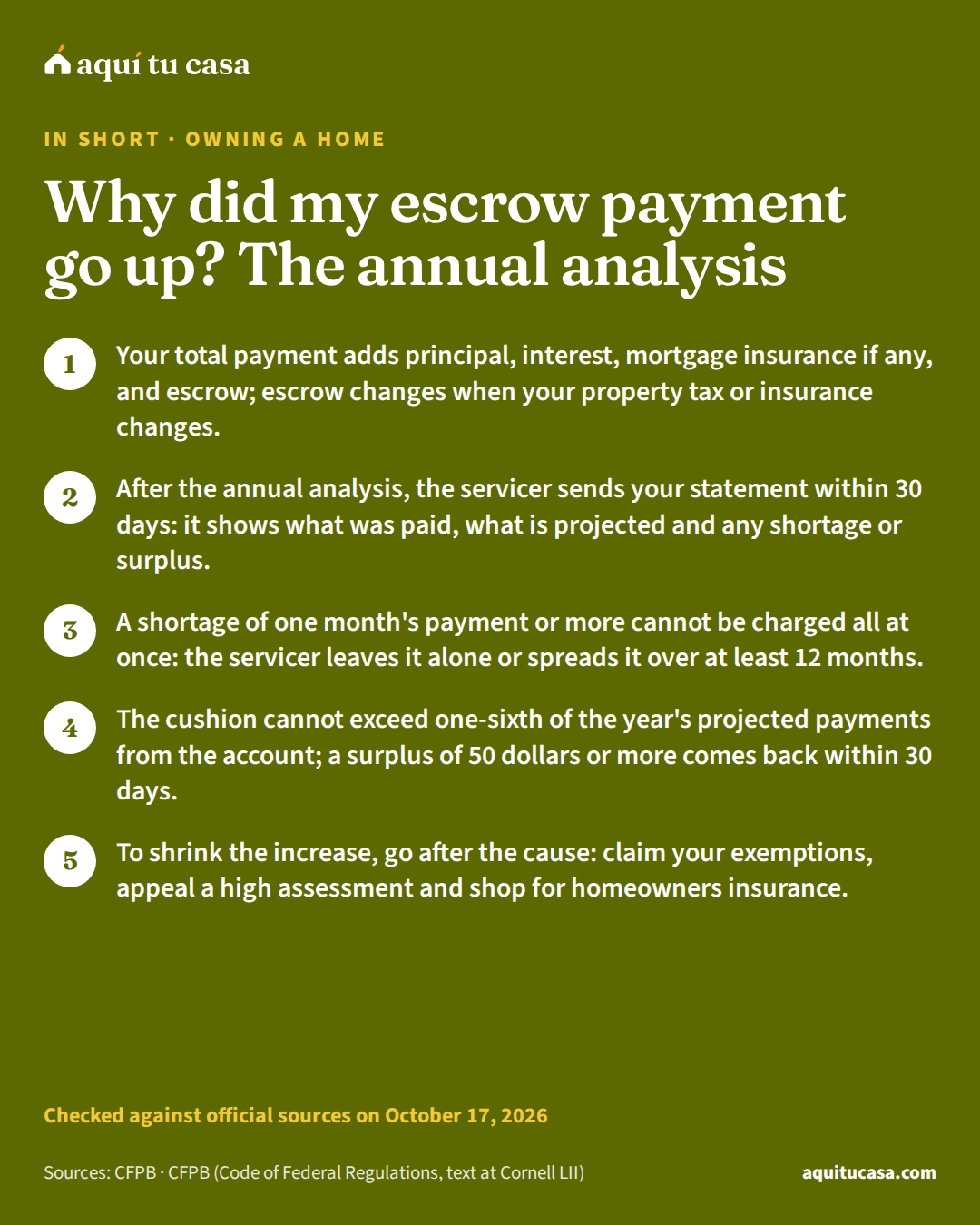
- Owning a home Why did my escrow payment go up? The annual analysis Why your payment changes with escrow even at a fixed rate: the annual analysis, shortages, deficiencies, the cushion and how to dispute an error. 12 minute read
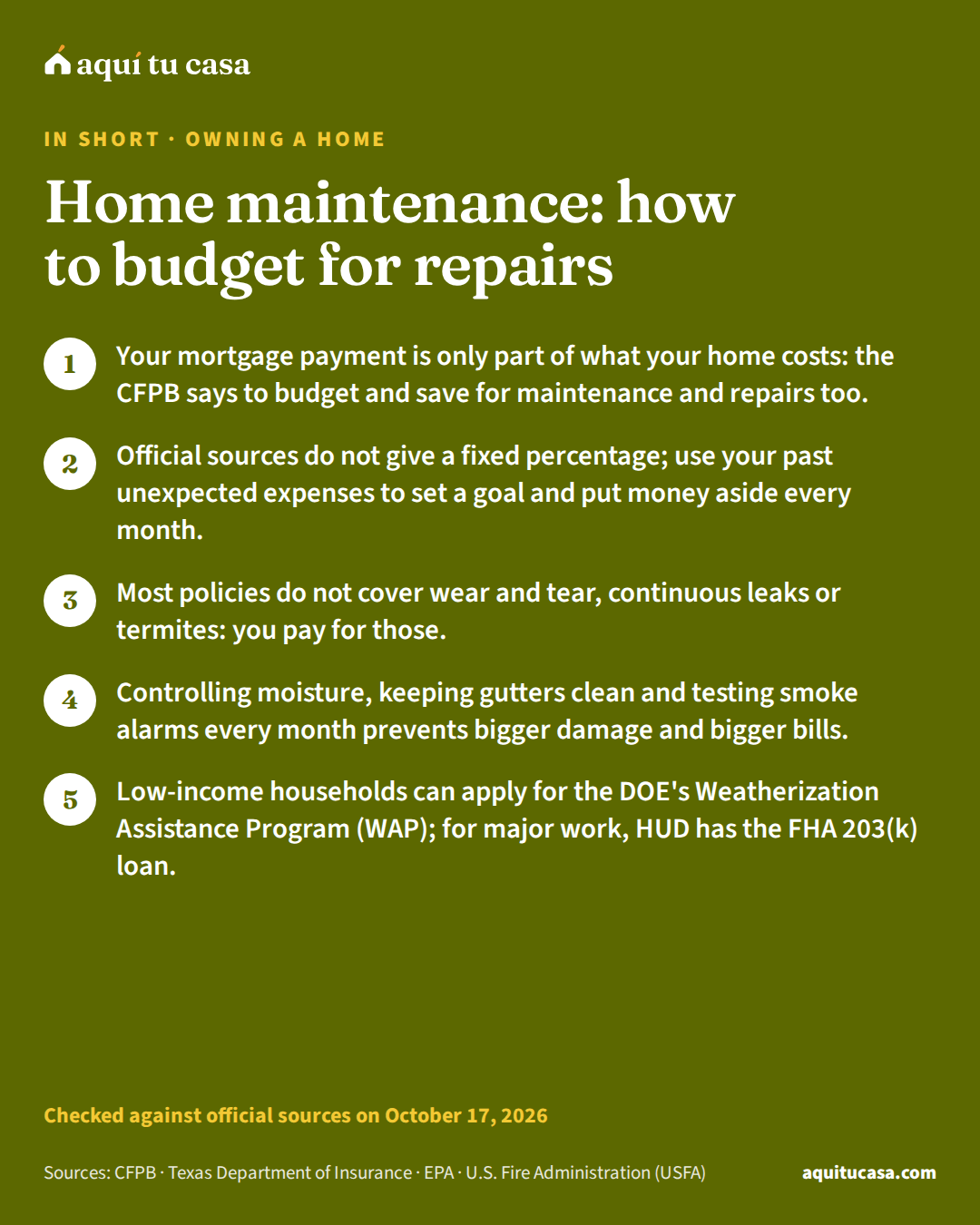
- Owning a home Home maintenance: how to budget for repairs How to plan and save for home maintenance and repairs: what insurance does not cover, what the IRS says and what help exists to fix up your home. 13 minute read
Tools for this topic
Was this guide useful?
Thank you. Your answer stays in your browser; nothing is sent.