Land surveys, property lines and easements
What a land survey is, where to find yours, who can mark your property lines, what an easement is and what to do if you disagree with a neighbor.
Verified against official sources on October 31, 2026 4 official sources

Show contents
In short
What you need to know
Quick answer
A land survey is the work of a licensed land surveyor who measures your land and marks where its property lines and any easements are. An easement is someone else's right to use part of your land for a specific purpose, such as power lines or a driveway. Not every home has a survey; if one was recorded, you can look for it at your county. Online maps and topographic maps are not legal proof of your property lines. If you disagree with your neighbor, the step is to hire a licensed land surveyor.
What matters most
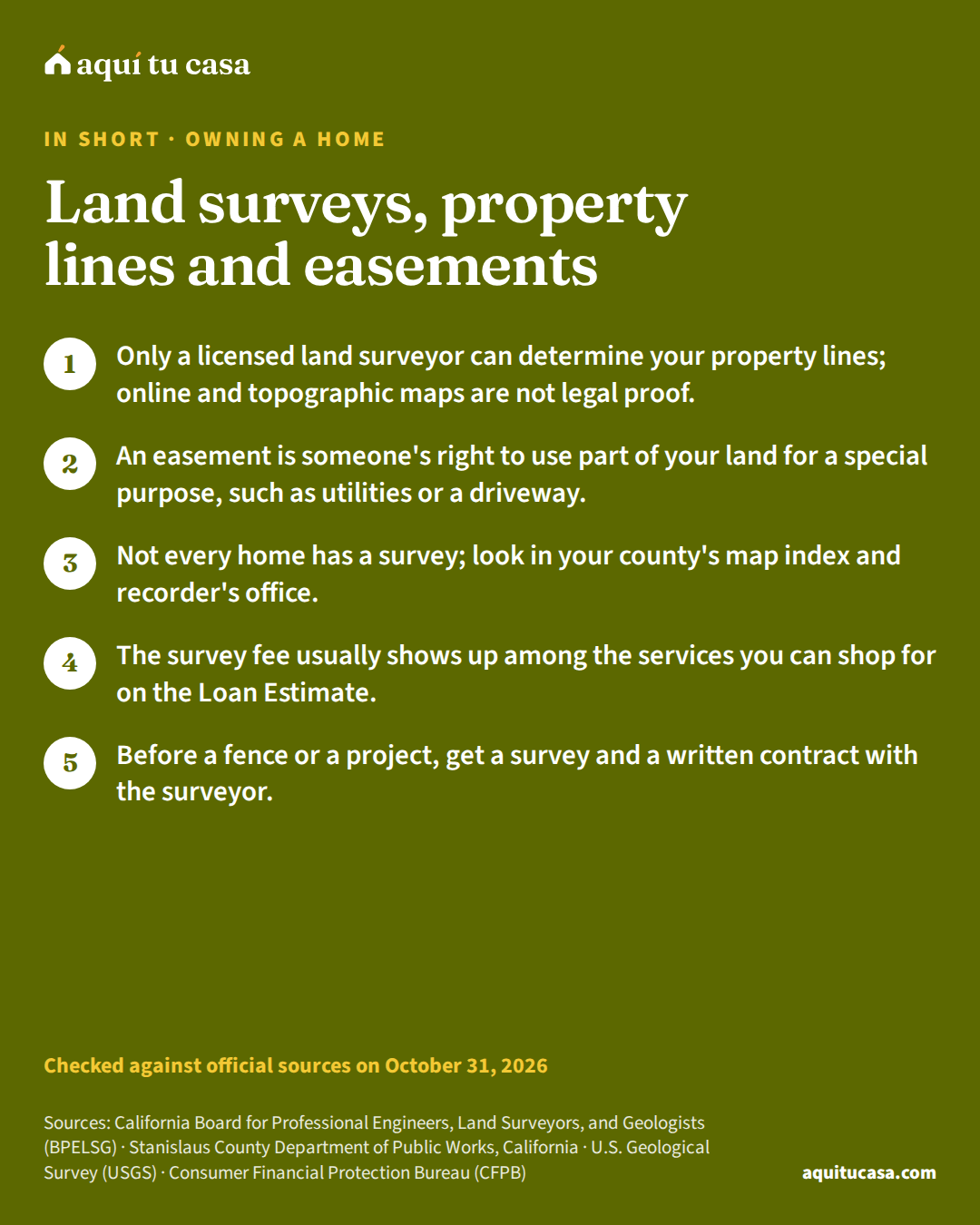
- Only a licensed land surveyor can determine your property lines; online and topographic maps are not legal proof.
- An easement is someone's right to use part of your land for a special purpose, such as utilities or a driveway.
- Not every home has a survey; look in your county's map index and recorder's office.
- The survey fee usually shows up among the services you can shop for on the Loan Estimate.
Is this for you?
This guide is for you if…
- You want to put up a fence or build something and do not know exactly where your land ends.
- You are buying a home and a survey fee shows up on your Loan Estimate.
- Your neighbor says your fence or driveway is on their land.
Get direct help first if…
- Someone forged a deed to take your home: read «Deed theft and title fraud».
- You have no papers proving the home is yours: read «Proving you own your home without a formal title».
Where does your land end? It sounds like a simple question, but many people do not know for sure until they want to put up a fence, add a room or a neighbor says something is on their side. This guide explains what a land surveyproperty surveyA property survey is a drawing of your property that shows where the lot, the house and any other structures are, along with any improvements on the land. In a purchase with a mortgage, it ties into title insurance. For example, Fannie Mae will not buy a loan if the title policy has a survey exception. Where surveys are not commonly required, the lender must provide a special endorsement to the title policy (ALTA 9) instead.See the full definition is, where to find yours, what an easementeasementAn easement is a person's or company's right to use or control land owned by someone else, or the space above or below it, for a specific, limited purpose. One example is a utility company's right to run lines or pipes on a lot. Another is an agreement between neighbors to share a driveway. Easements can show up as exceptions in a title insurance policy. Fannie Mae accepts certain common easements under conditions, such as not running under the house or interfering with the use of the property.See the full definition is and what to do if there is a disagreement. It uses as examples what California agencies and one county in that state say; in your state, the rules and offices may differ.12
What a survey is and who can do it
A survey is done by a land surveyor. In California, for example, it is unlawful to do or offer that work without a license, with an exception for certain civil engineers with older licenses.1
According to the California guide, a licensed land surveyor can, among other things:1
- Retrace property lines for a fence or other purposes.
- Replace lost corners and set markers or monuments on them.
- Locate easements and rights-of-way.
- Determine discrepancies between property lines, for example between what a deed says and what is on the ground.
- Prepare legal descriptions for deeds and maps for dividing land.
A survey that does not look for property lines, such as one for landscaping, does not need a licensed land surveyor.1 But if the question is “where does my land end?”, it does.
Online maps are not enough. County maps online or topographic maps help you get your bearings, but they are not legal proof of your property lines. USGS, for example, says its US Topo maps are not legal documents and that the section and township lines they show are not legally authoritative.3
Where to find your home’s survey
Not every home has a survey. Some properties were created with just the deeddeedA deed is the legal document the seller uses to transfer ownership of the home to you. The seller signs it at closing, it lists the names of all the buyers and you receive a copy. Afterward, the settlement agent records it with the county records office; that recording puts the public on notice that you are now the owner. There are several types: a warranty deed gives the most promises about the title, and a quitclaim deed promises nothing. Do not confuse it with a deed of trust, which is the mortgage document.See the full definition description.2 These are places to look, according to the county surveyor’s office of Stanislaus County, California:2
- The county’s recorded map index, if a survey of your property was recorded.
- The county recorder’s office, where deeds are kept.
- Your closing papers, if you bought with a loan; ask the title company whether a survey was done.
The corners. They may be marked with various kinds of monuments, or nothing at all. If no survey was ever done, there are probably no markers.2 If you find a marker, do not move it; ask a surveyor first.
The county surveyor does not measure your land. The Stanislaus office says that, because it is an agency paid with public funds, it cannot survey private land; for that you hire a private licensed land surveyor.2
Easements: when someone else can use part of your land
An easement is a legal or equitable right to use someone else’s land for a special purpose, such as utilities or a driveway.2 Common examples: a utility company’s lines or pipes, or the path a neighbor uses to reach their home.
Why it matters. An easement can limit where you build, where you put a fence or what you plant on top. So it is worth knowing whether your land has one before any project. A surveyor can locate them on the ground.1 Your title insurancetitle insuranceTitle is the legal right of ownership of the home, and title insurance protects you if, after closing, someone claims a right to it: an old debt, an heir, an error in the records. There are two policies. Most lenders require a lender's policy, which protects the amount they lent. The owner's policy is optional, paid once at closing, and protects you for as long as you own the home, including the legal costs of defending your right. You can shop for a title company; the price varies by state.See the full definition policy and your deed may also mention them; the title insurance guide explains how to read it.

When you buy a home
If your lender or the title company asks for a survey before closing, check what it costs. On the CFPB’s sample Loan Estimate, the survey fee appears in section C, the services you can shop for.4 That means you can compare prices. The closing costs guide explains the other sections, and the guide on how to compare Loan Estimates helps you review offers.
If you are buying land alone or a home in the country, the survey matters even more. The guide on buying land or a manufactured home explains other points to check.
What each paper gives you
Who owns it
The deed
- Says who owns the land and describes it
- Kept at the county recorder's office
- Some properties have only this description
Where the lines are
The survey
- Done by a licensed land surveyor
- Locates lines, corners and easements
- Carries the surveyor's signature and seal
Orientation only
The online map
- Helps you find your way
- Is not legal proof of your lines
- Does not replace a survey
For a fence, a project or a disagreement, what counts is a licensed surveyor's survey.
How to hire a surveyor
The California guide gives several tips for hiring well:1
- Check the license on your state board’s site, along with any complaints or discipline.
- Ask for references on similar jobs and call past clients.
- Ask what the price includes, whether it covers permits or recording fees, and what could raise it.
- Sign a written contract. In California the law requires one, and it must describe the services, how fees are charged, the surveyor’s name and license number, how extra work is handled and how the contract ends.
- Review the final plat: it must carry the signature, seal and license expiration date of whoever did it.
After a disaster. If your home was damaged by an earthquake, flood or fire, a survey may be needed to relocate the property lines before repairs. Ask at your county’s building department and surveyor’s office.1
Example with real numbers
A family that wants to put up a fence
An example in words, not a real case, of how to avoid a problem with the neighbor.
- What they thought
- That the line was where the grass ends
- What they looked for
- A recorded survey in the county map index; there was none
- What they did
- Hired a licensed land surveyor, with a written contract
- What the surveyor found
- The corners and a power company easement along the back
- The result
- They put the fence inside their line and outside the easement
The steps in the example follow what the California guide and Stanislaus County say.12
Before a fence, a project or a purchase
3. Hire a licensed land surveyor
If there is no survey or there are doubts
Check the license and sign a written contract.1
5. Check permits and zoning
Before you build
Ask your city or county which permits you need.

Questions for the surveyor
Before you hire, ask for written answers:
- What kind of survey do I need for what I want to do: a fence, a project or a purchase?
- Will you set markers at the corners? What kind?
- Will the plat show easements and rights-of-way?1
- How much will it cost in total? Does it include permits or recording fees?1
- When will the work be done and when will I get the signed and sealed plat?1
- Will you record the survey with the county?
If you are planning a unit for your family, the guide on building an ADU for your family explains permits and other steps. Knowing your lines from the start avoids redrawing plans later.
If you disagree with your neighbor
A boundary disagreement can become costly and draining. These steps help keep it calm:
- Talk with your neighbor calmly and share what you have: deeds, surveys and photos of the markers. Bring copies and keep the originals at home. Ask your neighbor to look for their papers too. Write down the date and what you agreed, even if it is not much.
- Hire a licensed land surveyor. That is the step Stanislaus County recommends when there is a disagreement.2
- Look for mediation. Some counties offer free mediation; Stanislaus, for example, has a mediation center.2 Ask whether yours does.
- If you cannot settle it, get advice from free legal aidlegal aidLegal aid is the free civil legal help that nonprofit organizations and their lawyers provide to low-income people in civil, not criminal, matters. In housing, that includes representing families facing eviction or foreclosure, alongside matters such as custody, child support, protection from domestic violence and access to benefits. In the United States, the Legal Services Corporation, created by Congress, funds a nationwide network of these organizations; its finder points you to the one in your area. Each sets its own income limits.See the full definition. The free legal aid guide explains how to find it.
If this is you
You want to put up a fence
A licensed land surveyor can retrace your lines for the fence.1
You want to build a room or an ADU
Locate the lines and easements first; they can limit where you build.12
You are buying a home
If a survey is required, it is a service you can shop for and compare.4
Your home was damaged in a disaster
A survey may be needed to locate your lines before repairs.1
You inherited an old home with no plans
Some properties have only the deed description; a surveyor can help.2

Costly mistakes
Mistake: Putting the fence where the grass "always" was.
Instead: Have a licensed land surveyor retrace the line first.1
Mistake: Using the county's online map as proof.
Instead: Maps such as US Topo are not legal documents.3
Mistake: Hiring someone without a license to mark lines.
Instead: In California it is unlawful; check the license and sign a contract.1
Mistake: Building on top of an easement without knowing it.
Instead: Ask that the survey locate the easements.1
Mistake: Moving or removing a corner marker.
Instead: If you find a marker, leave it where it is and ask a surveyor.2
What to do this week
- Ask for a copy of your deed at your county recorder’s office.2
- Check whether a survey of your property was recorded.2
- If you plan to build or put up a fence, get quotes from two licensed land surveyors.1
- Check your title insurance policy for any easements.
- If you are buying, compare the survey fee with the closing costs calculator.4
Ready to see the numbers? Find your county here
See how this applies in your county: its loan limits, prices and rents, from the official data.
Printable checklist
Frequently asked questions
What is a land survey?
It is the work of a licensed land surveyor who measures your land and locates its property lines, corners and any easements. In California, for example, the law says only licensed land surveyors can do that work.
Where do I find my home's survey?
Not every home has one. In Stanislaus County, California, for example, recorded surveys are found in the county's map index, and deeds are at the county recorder's office. Ask at yours.
Can I use my county's online map or a topographic map?
Not as legal proof. USGS says its US Topo maps are not legal documents. To know exactly where your property lines are, you need a licensed land surveyor.
What is an easement?
It is a legal or equitable right to use someone else's land for a special purpose, such as utilities or a driveway. It can affect where you can build or put up a fence.
Can the county surveyor measure my land?
Usually not. The Stanislaus County office, for example, says it cannot survey private land because it is an agency paid with public funds; you hire a private licensed land surveyor.
What do I do if my neighbor says my fence is on their land?
Hire a licensed land surveyor to locate the line. Some counties offer free mediation, such as Stanislaus in California. If you cannot settle it, free legal aid can advise you.
Do I have to pay for a survey when I buy a home?
It depends on the lender and the area. If one is required, on the CFPB's sample Loan Estimate that fee appears among the services you can shop for, so you can compare prices.
Sources
Every figure in this guide comes from one of these official sources. The number next to a sentence leads to the source behind it.
Each source on one line: who publishes it, its title, its address and the date we read it.
- 1. California Board for Professional Engineers, Land Surveyors, and Geologists (BPELSG) · Consumer Guide to Professional Engineering and Professional Land Surveying · bpelsg.ca.gov · Accessed October 31, 2026
- 2. Stanislaus County Department of Public Works, California · Surveying FAQ · stancounty.com · Accessed October 31, 2026
- 3. U.S. Geological Survey (USGS) · Are Public Land Survey System (PLSS) section lines on US Topo maps a legal record? · usgs.gov · Accessed October 31, 2026
- 4. Consumer Financial Protection Bureau (CFPB) · Sample Loan Estimate (adjustable-rate loan) · files.consumerfinance.gov · Accessed October 31, 2026
Keep reading
Related guides
If this guide helped, these follow the same path.

Buying a home 10 minute read
Title insurance and your home's title: what they protect
What your home's title is, the difference between the lender's and the owner's title insurance, where they appear on the Loan Estimate and how to compare.
- The deed shows the seller transferred the home's title to you; title insurance protects against claims from before your purchase.
- The lender's policy is almost always required and protects only the lender; the owner's policy is usually optional and protects your investment.
- Title services sit in section B or C of your Loan Estimate; you can shop for section C yourself, and the owner's policy sits in H marked '(optional).'
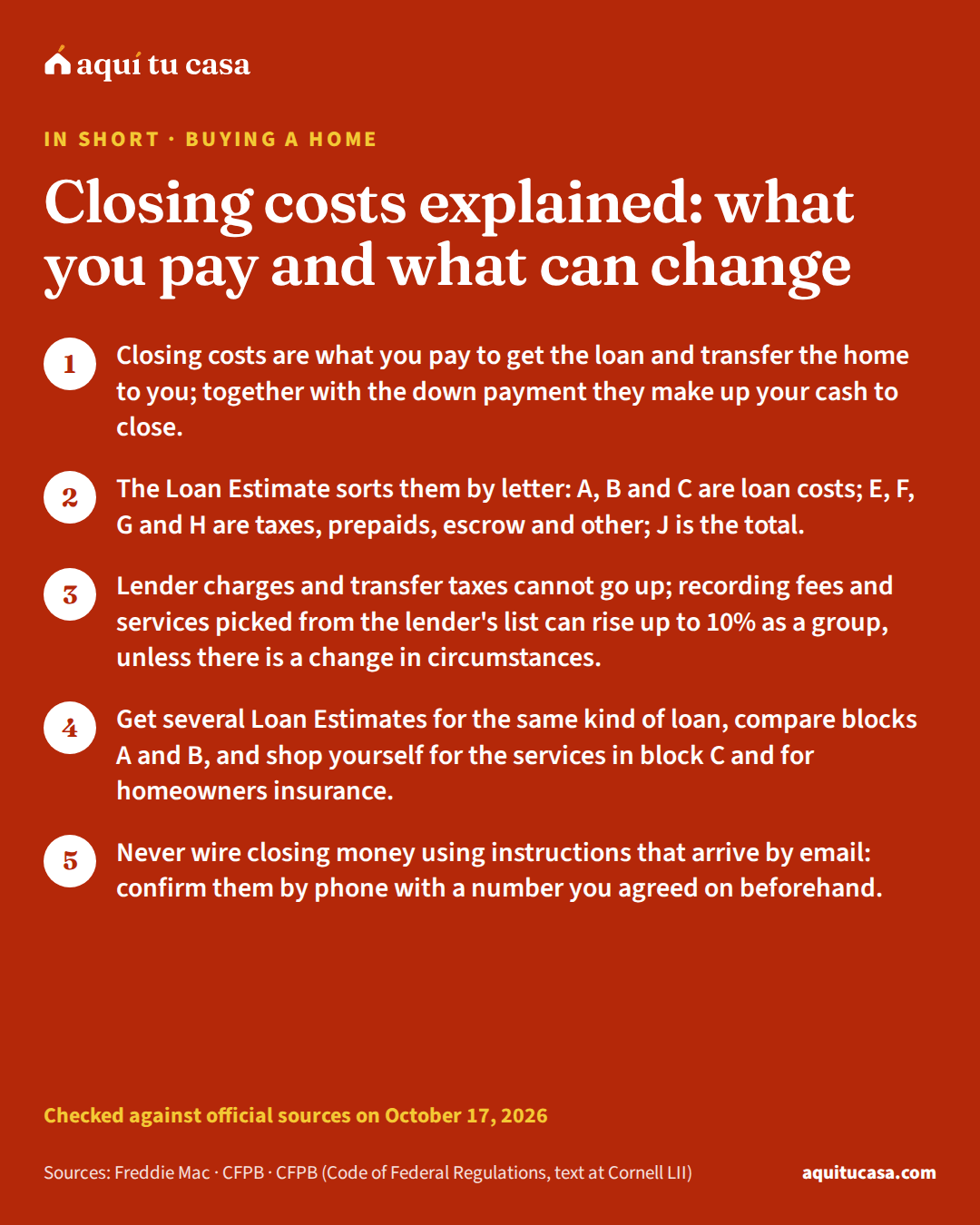
- Buying a home Closing costs explained: what you pay and what can change What closing costs are, how to read them on your Loan Estimate, which charges cannot go up before closing and how to compare offers to pay less. 14 minute read
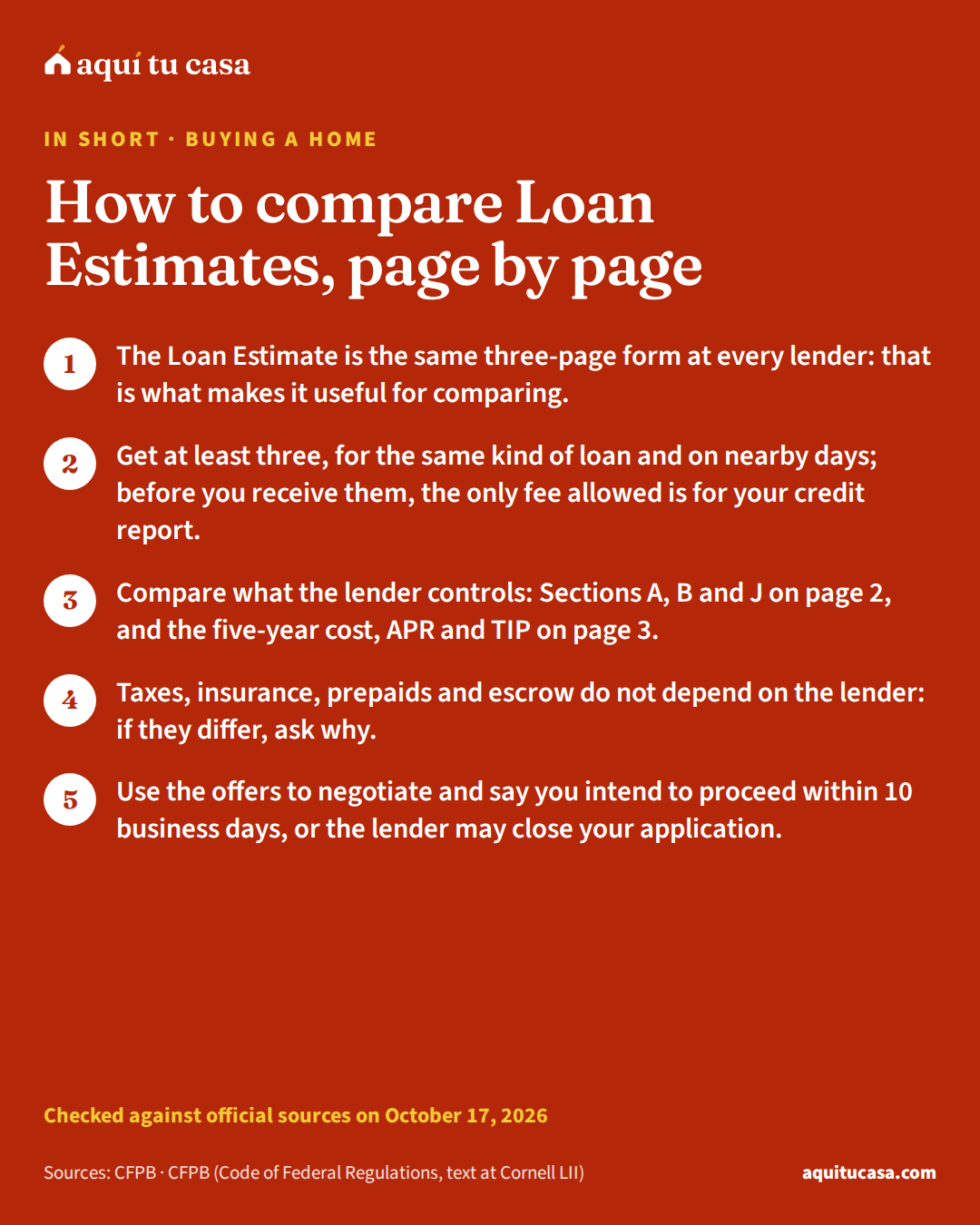
- Buying a home How to compare Loan Estimates, page by page How to read and compare two or three Loan Estimates side by side: what to check on each page, what can change and how to negotiate with lenders. 16 minute read
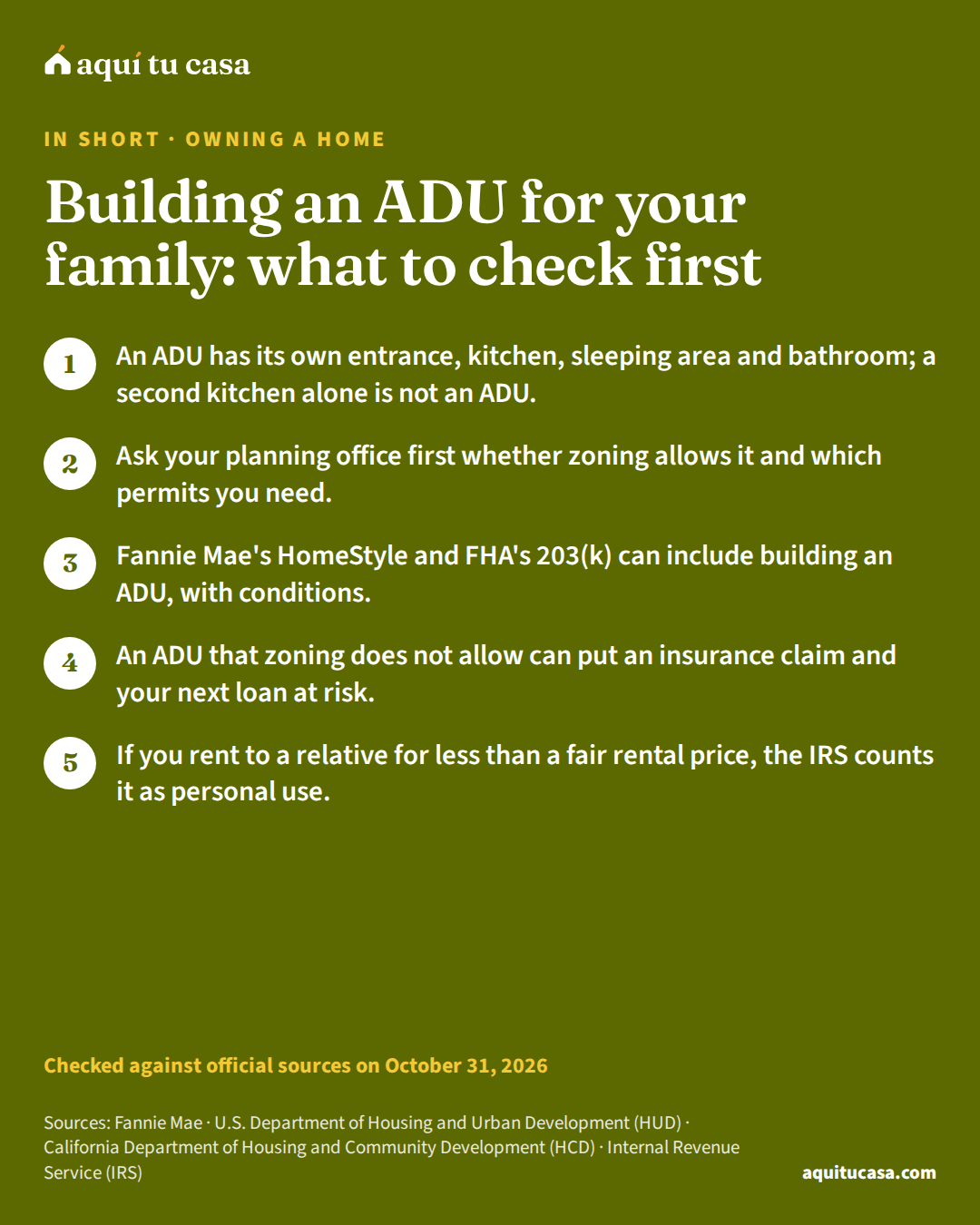
- Owning a home Building an ADU for your family: what to check first Before you build an ADU for your parents or children: permits, your city's rules, how to pay for it, taxes and what FHA and Fannie Mae require. 10 minute read
Tools for this topic
Was this guide useful?
Thank you. Your answer stays in your browser; nothing is sent.