Foundation cracks: what to check and who to call
What the EPA, the USGS and insurance laws say about cracks, moisture, radon and sinkholes, and which programs help you strengthen your home's foundation.
Verified against official sources on November 6, 2026 7 official sources

Show contents
In short
What you need to know
Quick answer
A foundation crack isn't always serious, but it is a way in for water and radon. The EPA says radon, a gas that causes lung cancer, enters through cracks and holes in the foundation, and that all homes should be tested; at 4 pCi/L or higher, it recommends fixing the home. Make the ground slope away from the foundation and fix leaks early. We found no official source with a measurement that says when a crack is serious: get written estimates from licensed contractors. Where sinkholes or earthquakes happen, there are specific insurance rules and programs.
What matters most
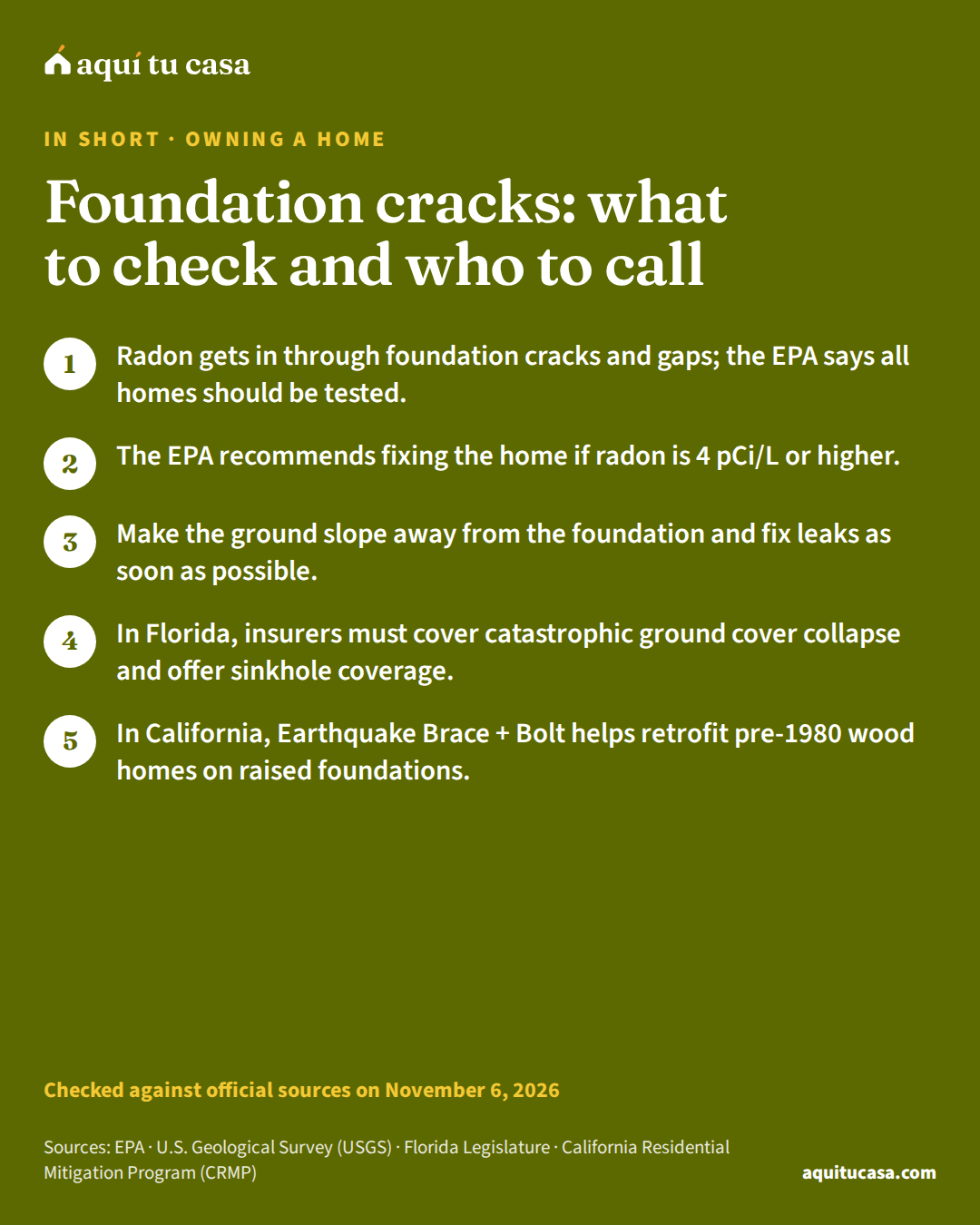
- Radon gets in through foundation cracks and gaps; the EPA says all homes should be tested.
- The EPA recommends fixing the home if radon is 4 pCi/L or higher.
- Make the ground slope away from the foundation and fix leaks as soon as possible.
- In Florida, insurers must cover catastrophic ground cover collapse and offer sinkhole coverage.
Is this for you?
This guide is for you if…
- You own your home and see cracks in the floor, the walls or the foundation.
- Water or dampness comes in through the basement or from under the house.
- You live where sinkholes or earthquakes happen and want to protect the house.
Get direct help first if…
- You rent: the foundation is the landlord's job; the renters' repairs guide explains your rights.
- Your home flooded: the flood insurance guide explains what it covers.
A crack in a basement wall or a garage floor is scary, but not all cracks are alike. Some are small and never change; others let in water, dampness or a gas you can’t see. This guide is for you if you own your home and see cracks in the foundation, the floor or the walls, or if you live where sinkholes or earthquakes happen. It explains what the EPA, the U.S. Geological Survey (USGS) and some state laws say, and which programs help pay.
Why cracks matter: water and radon
Foundation cracks are an open door. According to the EPA, radon is a radioactive gas that comes from the natural decay of uranium found in nearly all soils. It typically moves up through the ground and into the home through cracks and other holes in the foundation: cracks in solid floors, construction joints, cracks in walls, gaps in suspended floors and gaps around service pipes. Any home can have radonradonRadon is a natural radioactive gas that comes from the breakdown of uranium in soil, rock and water. You cannot see or smell it. It usually moves up from the ground into a home through cracks and other holes in the foundation, and the home can trap it inside. Any home can have it, new or old, with or without a basement, and it is a leading cause of lung cancer. Testing is the only way to know the level. If you are buying, EPA recommends asking the seller for test results or having the home tested, and high levels can be reduced.See the full definition, new or old, with or without a basement.1
Water is the other problem. The EPA recommends that the ground slope away from the foundation, so water doesn’t enter or collect around the house. It also says to fix leaks as soon as possible, and that if wet materials are dried within 24 to 48 hours, in most cases mold will not grow.3
If water already got into the basement
When water comes in through a crack, mold follows quickly. The EPA says absorbent materials such as ceiling tiles and carpet may have to be thrown away if they become moldy. If the moldy area is less than about 10 square feet, in most cases you can clean it yourself following its guidelines. And don’t paint or caulk a moldy surface: clean it and dry it first.3 The lead, mold and pests guide has more on mold at home.
What to check yourself
We found no official source with a measurement that says when a crack is serious in any home. What you can do is watch and document, so you can explain the problem well to a contractor and compare estimates.
Check your home step by step
1. Photograph each crack
Today
With a ruler or a coin beside it and the date, to see whether it grows.7
2. Watch where the water goes
When it rains
The ground should slope away from the foundation, according to the EPA.3
4. Get written estimates
If the crack grows or water gets in
From licensed and insured contractors; compare the work, materials, date and price.7
Write down what you see with the date: whether the crack grows from one month to the next, whether water gets in when it rains or whether you notice changes in doors and windows. Those notes help a contractor understand your case. If someone offers a free inspection and then scares you into buying an expensive repair today, be wary: the FTC says scammers knock on your door because they’re “in the area,” push you to decide immediately and ask for everything up front or only cash.7

The radon test
The EPA says you can’t see or smell radon, that testing is the only way to know your level, and that all homes should be tested.2 There are low-cost do-it-yourself kits you can get by mail and in some hardware stores. If you’d rather have someone else do it, your state radon office has lists of qualified testers. Short-term tests stay in the home for two to 90 days, depending on the device.1
Radon is measured in picocuries per liter of air (pCi/L). The EPA recommends fixing the home if the level is 4 pCi/L or higher.1 The method mainly used is a vent pipe with a fan that pulls radon from beneath the house, and it doesn’t require major changes. Sealing foundation cracks and other openings makes that system more effective and cost-efficient.1 In other words, if you’re going to fix the cracks, test for radon first.
One short-term test isn’t always enough. The EPA explains that radon varies from day to day and season to season, so a short-term test is less likely than a long-term one to show your year-round average. If you need results quickly, a short-term test followed by a second short-term test may be used to decide whether to fix your home.1
Seal cracks or install a radon system
Helps
Seal the cracks
Test for radon before you decide.2
Sinkholes
In some areas the problem is under the house. According to the USGS, sinkholes are common where the rock below the surface is limestone, carbonate rock, salt beds or other rocks that groundwater can dissolve. The land can stay intact for a while, until the underground spaces get too big and the surface collapses suddenly. The most damage tends to occur in Florida, Texas, Alabama, Missouri, Kentucky, Tennessee and Pennsylvania.4
Insurance varies a lot by state. In Florida, section 627.706 of the Statutes says every property insurer must cover catastrophic ground cover collapse, and must make available, for an additional premium, coverage for sinkhole losses. The insurer may require an inspection first, and the policy may carry a sinkhole deductible of 1, 2, 5 or 10 percent of the dwelling limits.5 Read your policy and the home insurance guide to understand your deductibledeductibleA deductible is the part of an insurance claim you pay yourself. When you have a covered loss, the insurance company subtracts the deductible from the claim amount and pays you the rest. You may have a different deductible for each type of coverage. You will find it on the first page of your policy, called the declarations page, along with your coverages and limits. In taxes, the word "deductible" means something else: an expense that can lower the taxes you owe.See the full definition.

Earthquakes: strengthening the foundation
In earthquake country, a wood house on a raised foundation can shift off its base. In California, Earthquake Brace + Bolt (EBB) helps strengthen it: the retrofit bolts the foundation to the frame of the house and, where there are cripple walls in the crawl space, braces them with plywood, to help keep the house from sliding or toppling off its foundation in an earthquake.6
EBB offers up to $3,000 for that retrofit, and income-eligible homeowners can apply for an additional grant of up to $7,000. It is only done on wood-framed homes built before 1980 on a raised foundation, and registration opens for a limited time each year.6 The earthquake and wildfire insurance guide covers the other half: insuring the home.
Example with real numbers
A basement crack that lets water in
An example in words of the order of the steps.
- First
- Dated photos of the crack with a ruler beside it
- Outside
- Check that the ground slopes away from the foundation
- Test
- Low-cost radon kit or qualified tester
- Estimates
- Two or more, in writing, from licensed contractors
- If radon is 4 pCi/L or higher
- Also ask for an estimate for a radon system
The steps come from the EPA and the FTC.317 Plan the cost in your family budget.
Run it with your numbersFamily budgetHow to choose who to hire
The Federal Trade Commission (FTC) recommends considering only licensed and insured contractors and confirming the license with your state or county government. Get multiple estimates: a written one should include a description of the work, the materials, the completion date and the price. Don’t automatically choose the lowest, and ask for an explanation if there’s a big difference among them.7 The guide to what a repair quote must include explains each part and where to look up a license in your state.
If this is you
You see a new crack in the basement floor
Photograph it with the date and test for radon before sealing it.11
You have children and the house was never tested for radon
The EPA says all homes should be tested; there are low-cost kits.21
Someone offers you a free foundation inspection
Don't decide today or pay cash; get several written estimates.77
You live in Florida and a hole opened near the house
Notify your insurer: Florida law requires coverage for catastrophic ground cover collapse.5
Costly mistakes
Mistake: Painting over the crack and forgetting it.
Instead: Photograph it with the date to see whether it grows, and test for radon; don't paint over mold.13
Mistake: Letting rainwater fall right next to the house.
Instead: Make the ground slope away from the foundation.3
Mistake: Thinking a new house can't have radon.
Instead: Any home can; get it tested.1
Mistake: Accepting the repair sold at your door.
Instead: Get several written estimates from licensed contractors.77
Mistake: Assuming your insurance covers sinkholes.
Instead: Check your policy; in Florida, sinkhole coverage is offered for an additional premium.5
What to do this week
- Photograph each crack with a ruler beside it and the date.
- Check that the ground and gutters carry water away from the foundation.3
- Buy a radon test kit or ask your state radon office for its list of testers.1
- If the crack grows or water gets in, get two or more written estimates from licensed contractors.7
- Read your policy to see what it says about sinkholes, earthquakes and floods; the flood insurance guide explains that coverage.5
- Add the cost to your family budget.
Your household this month
Let's do the math
Left each month
Enter what at least one person takes home to see the result.
What helps
- Pay savings first: set the goal aside the day the money arrives, before flexible spending.
- Add up the bills that come every few months (car insurance, school) and divide by twelve.
- If income changes, plan on a low month and save the extra from good months.
- A HUD-approved housing counselor can go over the budget with you, often for free.
This is a planning tool with your numbers, not a credit evaluation or an approval. The split reference is only a guide.
Ready to see the numbers? Find your county here
See how this applies in your county: its loan limits, prices and rents, from the official data.
Printable checklist
Frequently asked questions
When is a crack serious?
We found no official source that gives one measurement for every home. What we know from the EPA is that cracks let water and radon in. If you're worried, note whether it grows or lets water through, and get several written estimates from licensed contractors.
What does radon have to do with cracks?
According to the EPA, radon moves up through the ground and into the home through cracks and other holes in the foundation, such as cracks in floors and walls and gaps around pipes. Any home can have radon, new or old.
How do I test for radon?
The EPA says there are low-cost do-it-yourself kits you can get by mail and in some hardware stores. Short-term tests stay in the home for two to 90 days. Your state radon office has lists of qualified testers.
Does sealing cracks get rid of radon?
It helps, but it isn't enough by itself. The EPA says the method mainly used is a pipe and fan that pulls radon from under the house, and that sealing cracks makes that system more effective and cost-efficient.
Does my insurance cover a sinkhole?
It depends on your state and your policy. In Florida, the law says every insurer must cover catastrophic ground cover collapse and offer, for an additional premium, coverage for sinkhole losses, with a deductible of 1, 2, 5 or 10 percent of the dwelling limits.
Is there help retrofitting a home for earthquakes?
In California, Earthquake Brace + Bolt offers up to $3,000 to retrofit wood homes built before 1980 on raised foundations, and up to $7,000 more for income-eligible homeowners. Registration is open for a limited time each year.
Someone offered me a free foundation inspection. What should I do?
Be careful with anyone who knocks on your door and pushes you to decide today: the FTC says that's a scammer's tactic. Get several written estimates and look up each contractor's license on your state's page.
Sources
Every figure in this guide comes from one of these official sources. The number next to a sentence leads to the source behind it.
Each source on one line: who publishes it, its title, its address and the date we read it.
- 1. EPA · A Citizen’s Guide to Radon · epa.gov · Accessed November 6, 2026
- 2. EPA · Radon · epa.gov · Accessed November 6, 2026
- 3. EPA · A Brief Guide to Mold, Moisture and Your Home · epa.gov · Accessed November 6, 2026
- 4. U.S. Geological Survey (USGS) · Sinkholes · usgs.gov · Accessed November 6, 2026
- 5. Florida Legislature · Florida Statutes §627.706, Sinkhole insurance; catastrophic ground cover collapse · leg.state.fl.us · Accessed November 6, 2026
- 6. California Residential Mitigation Program (CRMP) · EBB Retrofit: Brace & Bolt Raised-Foundation Homes · crmp.org · Accessed November 6, 2026
- 7. Federal Trade Commission (FTC) · How To Avoid a Home Improvement Scam · consumer.ftc.gov · Accessed November 6, 2026
Keep reading
Related guides
If this guide helped, these follow the same path.

Owning a home 10 minute read
What a repair quote must include
What a repair estimate and contract should say according to the FTC and ENERGY STAR, and where to look up a contractor's license in your state.
- A written estimate states the work, materials, completion date and price, according to the FTC.
- The contract adds the contractor's details and license, the dates, spoken promises and your right to cancel.
- Don't sign anything with blank spaces, and put every change in writing, with its price.
- Owning a home Earthquake and wildfire insurance What your homeowners policy leaves out, how earthquake policies work, what the FAIR Plan is and what to do if your insurer drops you over wildfire risk. 11 minute read
- Owning a home Flood insurance (NFIP): who needs it and what it covers Why home insurance does not cover floods, when you must buy NFIP coverage, what it covers, the 30-day wait, flood zones and how to file a claim. 13 minute read
- Owning a home Home insurance explained: what it covers, how much to buy What home insurance covers, why the lender requires it, how to choose the amount and the deductible, why flood is separate and what happens if it lapses. 13 minute read



Tools for this topic
Was this guide useful?
Thank you. Your answer stays in your browser; nothing is sent.