Lead, mold and pests in the home you rent or buy
What you must be told about lead paint before you rent or buy, how to handle mold and bed bugs, and what to do if your home is making your family sick.
Verified against official sources on October 31, 2026 10 official sources

Show contents
In short
What you need to know
Quick answer
If a home was built before 1978, it may have lead paint, and for children there is no safe level of lead in the blood. Under federal law, before you sign to rent or buy, you must get an EPA pamphlet and be told about any known lead in the home; if you buy, you have 10 days for an inspection. Paid work that disturbs the paint must be done by someone certified. For mold, EPA says the key is controlling moisture and drying everything within 24 to 48 hours. If there are bed bugs in an apartment, tell the landlord.
What matters most
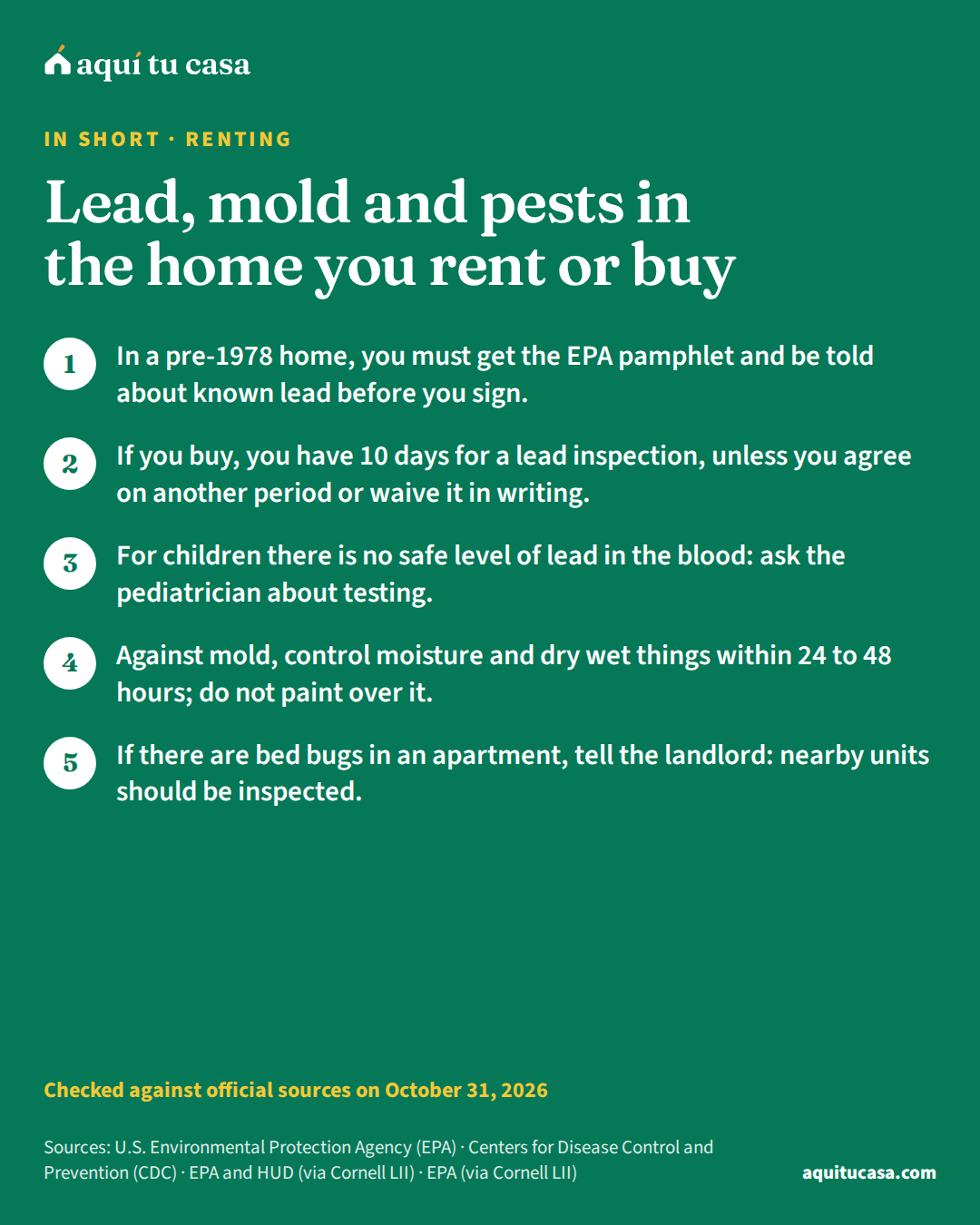
- In a pre-1978 home, you must get the EPA pamphlet and be told about known lead before you sign.
- If you buy, you have 10 days for a lead inspection, unless you agree on another period or waive it in writing.
- For children there is no safe level of lead in the blood: ask the pediatrician about testing.
- Against mold, control moisture and dry wet things within 24 to 48 hours; do not paint over it.
Is this for you?
This guide is for you if…
- You are about to rent or buy a home built before 1978 and you have young children or are pregnant.
- There is mold, dampness or bed bugs in your home and you do not know what to do or whom to tell.
- Your child has lead in their blood and you rent with a Section 8 voucher.
Get direct help first if…
- Your landlord will not make basic repairs (water, heat, roof): read «Repairs and housing conditions», which explains how to request them step by step.
- Your home flooded or burned: read «After a hurricane, flood or fire» first.
Your home should be a safe place for your family. But three problems can make children and adults sick without being obvious at first: lead paint in older homes, mold from dampness and pests such as bed bugs. This guide explains what you must be told before you rent or buy, what to do if you already have them at home and where to get help, according to EPA, the CDC and HUD.
Why lead is a risk in older homes
In 1978 the federal government banned the sale of lead-based paint for homes. But EPA estimates that about three-quarters of U.S. homes built before that year still have some lead-based paint. Children can live safely in those homes as long as the paint and surfaces are in good condition and kept clean. The danger starts when the paint peels or when renovation, repair or painting work creates lead dust.1
The CDC explains how lead reaches children: through peeling paint in homes built before 1978 and through dust they swallow when they put toys or dirt in their mouths. For children there is no safe level of lead in the blood.2 That is why federal law requires a warning that lead poisoning in young children can cause permanent neurological damage, such as learning, behavior and memory problems, and that it is a particular risk for pregnant women.6
Before you rent or buy: what you must be told
If the home was built before 1978, the federal lead-based paint disclosurelead-based paint disclosureThe lead-based paint disclosure is the information federal law requires you to get before you sign to buy or rent most homes built before lead-based paint was banned for use in homes. The seller, landlord, real estate agent or property manager must give you a pamphlet about lead, disclose what they know about lead-based paint in the home, hand over any reports they have and include a lead warning statement in the contract or lease. If you are buying, you get 10 days to have a lead paint inspection; the parties can change that in writing, or you can waive it. Peeling or cracking lead-based paint is a hazard.See the full definition rule protects you. Before you sign the contract to rent or buy, the seller or landlord must:3
- Give you EPA’s pamphlet “Protect Your Family From Lead in Your Home” (or an approved equivalent).
- Tell you about any lead-based paint or lead hazards it knows of in the home, with whatever information it has on where they are and their condition.
- Give you any lead records or reports it has, including for the building’s common areas.
If it gives you that information after your offer, it must do so before accepting the offer and let you review it and change your offer.3 The leaseleaseA lease, or rental agreement, is the contract in which the owner or landlord gives you the right to live in and use a property for a set period of time in exchange for payment, usually rent. While the lease lasts you have possession, but the landlord still owns the property. The lease says how much you pay and when, who handles maintenance and how the agreement can end. Your rights as a tenant are usually spelled out in the lease and in your state and local laws. Before complaining to the landlord, it helps to read the lease and make sure you are also following the rules you agreed to.See the full definition must also include a lead warning saying that before renting pre-1978 housing the landlord must disclose what it knows and the tenant must get the federal pamphlet.6
Be clear about what the rule does not do: it does not require the seller or landlord to test or remove lead. It only requires them to tell you what they know.3 And some cases are exempt, such as foreclosure sales, leases of homes a certified inspector found lead-free, short leases of 100 days or less with no renewal and some lease renewals.4 Our guide Your lease explained covers other parts of the lease.
If you rent or buy a pre-1978 home
Before you sign
If you rent
- You must get EPA's lead pamphlet
- You must be told about known lead and given any reports
- The lease must include the lead warning
- This rule does not require the landlord to test
Before you are bound
If you buy
- The same disclosures and the EPA pamphlet
- You have 10 days for a lead risk assessment or inspection
- You can agree on another period in writing, or waive it in writing
- The contract's warning recommends inspecting before you buy
Get everything in writing and do not sign without the pamphlet and the disclosure.
If you buy: your chance to inspect
If you buy a home built before 1978, the seller must give you 10 days to do a lead risk assessment or inspection before you are bound by the contract. You can agree in writing on a different period, and you can waive it in writing.5 The warning in the purchase contract recommends doing that assessment or inspection before you buy.6
This is not the same as the general home inspection. Ask your inspector whether they are certified to assess lead, or find someone who is. If lead hazards are found, you can negotiate with the seller, and your contract can depend on the results. Our Home inspection guide explains how the home inspectionhome inspectionA home inspection is a review of the property's physical condition by an inspector before you finish buying: roof, foundation, plumbing, electrical, heating and cooling, signs of moisture or pests. It is often part of the home buying process and you pay for it, not the lender; unlike the appraisal, it does not say what the home is worth but what problems it has. With the report you can ask for repairs, negotiate the price or walk away if your contract includes an inspection contingency. Some assistance programs require one.See the full definition works and what to check.
Renovations: who may disturb old paint
Sanding, scraping or breaking old paint raises lead dust. That is why EPA’s Renovation, Repair and Painting (RRP) Rule requires that anyone who is paid to do work that disturbs painted surfaces in a pre-1978 home be certified and that their employees be trained in lead-safe work practices.1 No more than 60 days before starting, the firm must give a pamphlet to the owner and, if the owner does not live there, also to an adult who lives in the home.7
If you rent and work is planned in your apartment, that pamphlet is your sign that the firm knows the rule. If you own, the rule generally does not apply when you do the work yourself in your own home, but it does if you rent out all or part of the home, run a home childcare or buy, renovate and sell homes. EPA recommends hiring a lead-safe certified contractor.1 Our contractor scams guide explains how to check whom you hire.

If your child has lead in their blood and you have a Section 8 voucher
If you rent with a Housing Choice VoucherHousing Choice Voucher (Section 8)The Housing Choice Voucher, the program almost everyone calls Section 8, is the country's largest federal rental assistance. HUD pays rental subsidies so eligible families can afford decent, safe and sanitary housing. Local public housing agencies administer it with HUD funds. The family finds its own home on the private market; if the agency approves the unit and the tenancy, it contracts with the owner to pay part of the rent, and the family pays the rest. Waiting lists are usually long and open for limited periods.See the full definition (Section 8) and the doctor or health department says your child under 6 has an elevated blood lead level, HUD’s rule sets deadlines:8
- Within 15 days of the medical report, an environmental investigation of the unit must be done.
- Within 30 days of that investigation’s report, the owner must reduce the lead hazards found.
Tell your public housing agencypublic housing agency (PHA)A public housing agency (PHA) is a state, county, municipal or other governmental entity or public body authorized to operate public housing or rental assistance programs. These are the agencies that locally administer the Housing Choice Vouchers (Section 8) and public housing with HUD funds: they open and manage the waiting lists, review eligibility and income, inspect units and pay the owner its share of the rent. Each county usually has one or several; your page shows the ones serving your area with their phone numbers.See the full definition in writing as soon as you know the result, and keep a copy. Our guide Section 8 and mixed-status families explains how the voucher works.
If you suspect lead in your home
1. Check the year the home was built
Today
If it was built before 1978, it may have lead-based paint.1
3. Ask for the papers
This week
Ask the landlord or seller for the lead disclosure and any reports they have.3
4. Give notice in writing
As soon as you see it
If paint is peeling, tell the landlord in writing and keep a copy.1
5. If there will be work, ask for the pamphlet
Before it starts
The firm must give you the RRP pamphlet if the owner does not live there.7
6. If you have a voucher and your child has lead
The day you get the result
Tell your housing authority: there are deadlines to investigate and repair.8
Mold: moisture is the key
Mold grows where there is moisture. EPA sums it up: the key to mold control is moisture control. Dry water-damaged areas and items within 24 to 48 hours to keep mold from growing. Mold can cause allergic reactions, asthma attacks in people who are allergic, and irritation of the eyes, skin, nose, throat and lungs.9
If you already have mold, EPA says you must clean it up and fix the water problem; otherwise it will come back. If the area is less than about 10 square feet (roughly a 3-by-3-foot patch), in most cases you can clean it yourself. If there was a lot of water damage or the mold covers more, it needs more careful cleanup. And three safety rules: do not paint or caulk over mold, ventilate well and never mix bleach with products that contain ammonia.9
Do not pay for a mold test if you can already see it. EPA explains that if mold is visible, in most cases sampling is unnecessary, and that there are no federal limits for mold, so a sample does not prove a building “violates” a federal standard.9 If you rent and the mold comes from a leak or a pipe, ask for the repair in writing: our guide Repairs and housing conditions explains how, and your state’s warranty of habitabilitywarranty of habitabilityThe warranty of habitability is a tenant's right to a livable, safe and sanitary home. The rules depend on the state. In New York, according to the Attorney General's office, this right is implied in every written or oral residential lease, and a lease clause that waives it is void; it is breached, for example, when heat or hot water is not provided regularly. In California, the landlord must keep plumbing, heating, electrical equipment and locks in working order and keep the unit free of pests. In Arizona, the law requires keeping the home in a fit and habitable condition.See the full definition may protect you.
Bed bugs and other pests
Bed bugs are hard to get rid of. EPA says treating them is complex and can take weeks to months.10 These are its main steps:10
- Confirm what it is. An extension agent (from your state’s university) can identify the pest at no cost.
- If you live in an apartment, tell your landlord. Nearby units should be inspected, and landlords may have a responsibility to take part in treatment.
- Encase the mattress. Covers that seal the mattress and box spring trap bed bugs inside.
- Use heat or cold. A clothes dryer on high heat works. A freezer only works if it is at 0 °F and you leave items in a sealed bag for three days.
- Be careful with pesticides. Use only EPA-registered pesticides that list bed bugs on the label, and follow the label. Foggers (bug bombs) should be used with extreme care: misused, they can harm your health or cause a fire.
Tell your landlord in writing, with the date, and keep photos. If after your notice you are threatened with a rent increase or eviction, that may be landlord retaliationlandlord retaliationLandlord retaliation happens when the landlord punishes you for using a legal right. For example, the landlord tries to evict you because you complained in good faith to a government office about health or safety problems in the home, or because you organized with other tenants. Not every state recognizes it, and each one defines and proves it differently. In addition, the federal Fair Housing Act prohibits retaliating against a person for filing a housing discrimination complaint or taking part in that process.See the full definition: read our landlord retaliation guide.
Example with real numbers
A family renting a 1965 apartment
An example in words, not a real case, of how to use the rules in this guide.
- Before signing
- They ask for the EPA pamphlet and the lead disclosure, and get it signed
- They see peeling paint on a window
- They take dated photos and tell the landlord in writing
- Their 2-year-old daughter
- They take her to the pediatrician and ask about a lead test
- Mold appears in the bathroom from a leak
- They dry the area, ask for the repair in writing and clean without mixing bleach and ammonia
- What they keep
- A folder with the disclosure, the photos and every written notice
The rules come from EPA and the CDC.329 Check the tenant rights tool for what your state's law says about repairs.
Run it with your numbersTenant rights by stateIf this is you
You have children under 6
Ask the pediatrician about a lead test if the home was built before 1978.2
You are about to sign a lease
Ask for the EPA pamphlet and the lead disclosure before you sign.3
You are buying an older home
Use your 10 days for a lead inspection; do not waive it without thinking.5
You rent with a Section 8 voucher and your child has lead
Tell your housing authority: there are 15 days to investigate the unit.8
You will renovate your pre-1978 home
Hire someone certified in lead-safe work practices.1
Your bathroom or basement flooded
Dry everything within 24 to 48 hours so mold does not grow.9

Mistakes that cost you
Mistake: Signing the contract without the pamphlet or the lead disclosure.
Instead: In a pre-1978 home you must get them before you sign.3
Mistake: Waiving the lead inspection without thinking it through.
Instead: You have 10 days to inspect; if you waive it, it must be in writing.5
Mistake: Sanding or scraping old paint without protection.
Instead: That creates lead dust; EPA recommends a certified contractor.1
Mistake: Painting over mold.
Instead: Clean it, dry the surface and fix the moisture source before you paint.9
Mistake: Mixing bleach with other cleaners.
Instead: Never mix bleach with products that contain ammonia.9
Mistake: Setting off several foggers against bed bugs.
Instead: Use them with extreme care and only if the label lists bed bugs; they do not reach cracks.10
Mistake: Telling the landlord only by word of mouth.
Instead: Give notice in writing, with the date and photos, and keep a copy.
What to do this week
- Find out the year your home was built; if it is before 1978, ask for the lead disclosure.3
- If you have young children, make a pediatrician appointment to ask about a lead test.2
- Check your home: peeling paint, damp stains, a musty smell, bites or stains on the mattress.9
- Take dated photos and tell the landlord in writing what you found.10
- If you are buying, write down the deadline for your 10-day lead inspection.5
- If the landlord does not respond, check your rights in the tenant rights by state tool and look for free legal aidlegal aidLegal aid is the free civil legal help that nonprofit organizations and their lawyers provide to low-income people in civil, not criminal, matters. In housing, that includes representing families facing eviction or foreclosure, alongside matters such as custody, child support, protection from domestic violence and access to benefits. In the United States, the Legal Services Corporation, created by Congress, funds a nationwide network of these organizations; its finder points you to the one in your area. Each sets its own income limits.See the full definition with our free legal aid guide.
Your household this month
Let's do the math
Left each month
Enter what at least one person takes home to see the result.
What helps
- Pay savings first: set the goal aside the day the money arrives, before flexible spending.
- Add up the bills that come every few months (car insurance, school) and divide by twelve.
- If income changes, plan on a low month and save the extra from good months.
- A HUD-approved housing counselor can go over the budget with you, often for free.
This is a planning tool with your numbers, not a credit evaluation or an approval. The split reference is only a guide.
Ready to see the numbers? Find your county here
See how this applies in your county: its loan limits, prices and rents, from the official data.
Printable checklist
Frequently asked questions
How do I know whether my home has lead paint?
If it was built before 1978, it may: EPA says about three-quarters of pre-1978 homes still have some. The way to know is an inspection or risk assessment by someone certified. Ask the seller or landlord whether they have reports.
Does the landlord have to remove the lead?
The federal disclosure rule does not require testing or repairs; it requires the landlord to tell you what it knows and give you the pamphlet before you sign. But if you have a Section 8 voucher and your child under 6 has an elevated blood lead level, there are deadlines to investigate and fix. Your state may have more rules.
Can I waive the lead inspection when I buy?
Yes, in writing. The rule gives you 10 days to inspect, or the period you agree on in writing, and you can waive it. If you have young children or are pregnant, think carefully before waiving it.
What do I do if my child has lead in their blood?
Follow your child's doctor and the health department. If you rent with a Section 8 voucher, tell your housing authority: under HUD's rule, an environmental investigation of the unit must be done within 15 days of the medical report.
Do I need to pay for a mold test?
Usually not. EPA says that if mold is visible, in most cases sampling is unnecessary, and that there are no federal limits for mold. What matters is cleaning it up and fixing the moisture source.
Can I clean up mold myself?
If the area is less than about 10 square feet, EPA says in most cases yes. Wear gloves and protection, do not paint over it and never mix bleach with products that contain ammonia. If it is larger or there was a lot of water damage, it needs more careful cleanup.
I have bed bugs in my apartment. Who pays?
EPA says to tell your landlord, because nearby units should be inspected, and that landlords may have a responsibility to take part in treatment. Who pays depends on your lease and your state's law; ask legal aid if you cannot agree.
Sources
Every figure in this guide comes from one of these official sources. The number next to a sentence leads to the source behind it.
Each source on one line: who publishes it, its title, its address and the date we read it.
- 1. U.S. Environmental Protection Agency (EPA) · Lead Renovation, Repair and Painting Program · epa.gov · Accessed October 31, 2026
- 2. Centers for Disease Control and Prevention (CDC) · About Childhood Lead Poisoning Prevention · cdc.gov · Accessed October 31, 2026
- 3. EPA and HUD (via Cornell LII) · 40 CFR §745.107, Disclosure requirements for sellers and lessors · law.cornell.edu · Accessed October 31, 2026
- 4. EPA and HUD (via Cornell LII) · 40 CFR §745.101, Scope and applicability · law.cornell.edu · Accessed October 31, 2026
- 5. EPA and HUD (via Cornell LII) · 40 CFR §745.110, Opportunity to conduct an evaluation · law.cornell.edu · Accessed October 31, 2026
- 6. EPA and HUD (via Cornell LII) · 40 CFR §745.113, Certification and acknowledgment of disclosure · law.cornell.edu · Accessed October 31, 2026
- 7. EPA (via Cornell LII) · 40 CFR §745.84, Information distribution requirements (RRP) · law.cornell.edu · Accessed October 31, 2026
- 8. HUD (via Cornell LII) · 24 CFR §35.1225, Child with an elevated blood lead level · law.cornell.edu · Accessed October 31, 2026
See the other 2 sources
- 9. U.S. Environmental Protection Agency (EPA) · A Brief Guide to Mold, Moisture and Your Home · epa.gov · Accessed October 31, 2026
- 10. U.S. Environmental Protection Agency (EPA) · Do-it-yourself Bed Bug Control · epa.gov · Accessed October 31, 2026
Keep reading
Related guides
If this guide helped, these follow the same path.

Renting 13 minute read
Repairs as a renter: how to ask and what to do
Which repairs fall on the landlord, how to request them in writing, when to call your city's code inspectors and the risks of withholding rent.
- According to the CFPB, your landlord cannot refuse necessary repairs or endanger your health and safety; each state's law details what must be maintained.
- Request repairs in writing, document with photos and video, and keep copies of everything; in Texas, for example, trackable mail counts.
- If repairs don't happen, your city's code enforcement office or health department can inspect; with a Section 8 voucher, the housing agency inspects at no cost to you.
- Renting Landlord retaliation: what protects you and how to prove it If your rent went up, a service was cut or your landlord wants you out because you complained: what state laws say and how to keep proof. 12 minute read
- Buying a home Home inspection: what it covers and when to get it What a home inspection is, how it differs from the appraisal, when to get it under a contingency, radon and lead tests, and what to do with the report. 12 minute read
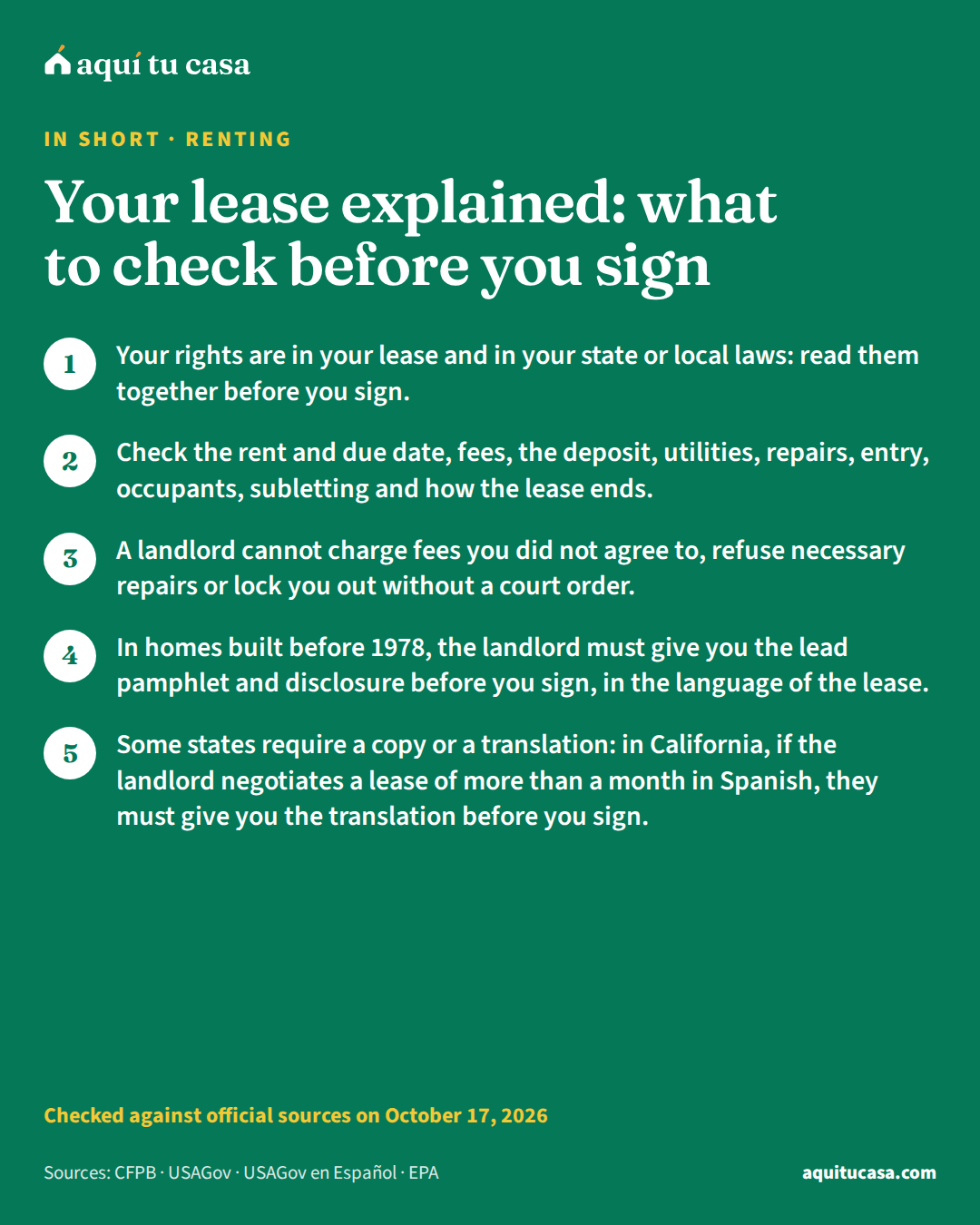
- Renting Your lease explained: what to check before you sign What a lease is, which clauses to read before you sign, the lead paint disclosure, your fair housing rights and where to get free help. 15 minute read
Tools for this topic
Was this guide useful?
Thank you. Your answer stays in your browser; nothing is sent.