Selling your home: net proceeds, taxes and disclosures
How to get your mortgage payoff amount, negotiate with your agent, figure what you keep, what to disclose to the buyer and the IRS home sale exclusion.
Verified against official sources on October 31, 2026 9 official sources

Show contents
In short
What you need to know
Quick answer
Before you sell, ask in writing for the exact amount to pay off your mortgage: the servicer must provide it within seven business days. What you keep is the sale price minus that payoff, the agent's commission, your closing costs and other charges; the commission is not set by law and is negotiable. If your home was built before 1978, federal law requires you to disclose what you know about lead-based paint, and some states, such as Texas, require a notice about the home's condition. And if you lived there at least 2 of the last 5 years, the IRS lets you exclude up to $250,000 of gain ($500,000 for a married couple filing jointly).
What matters most
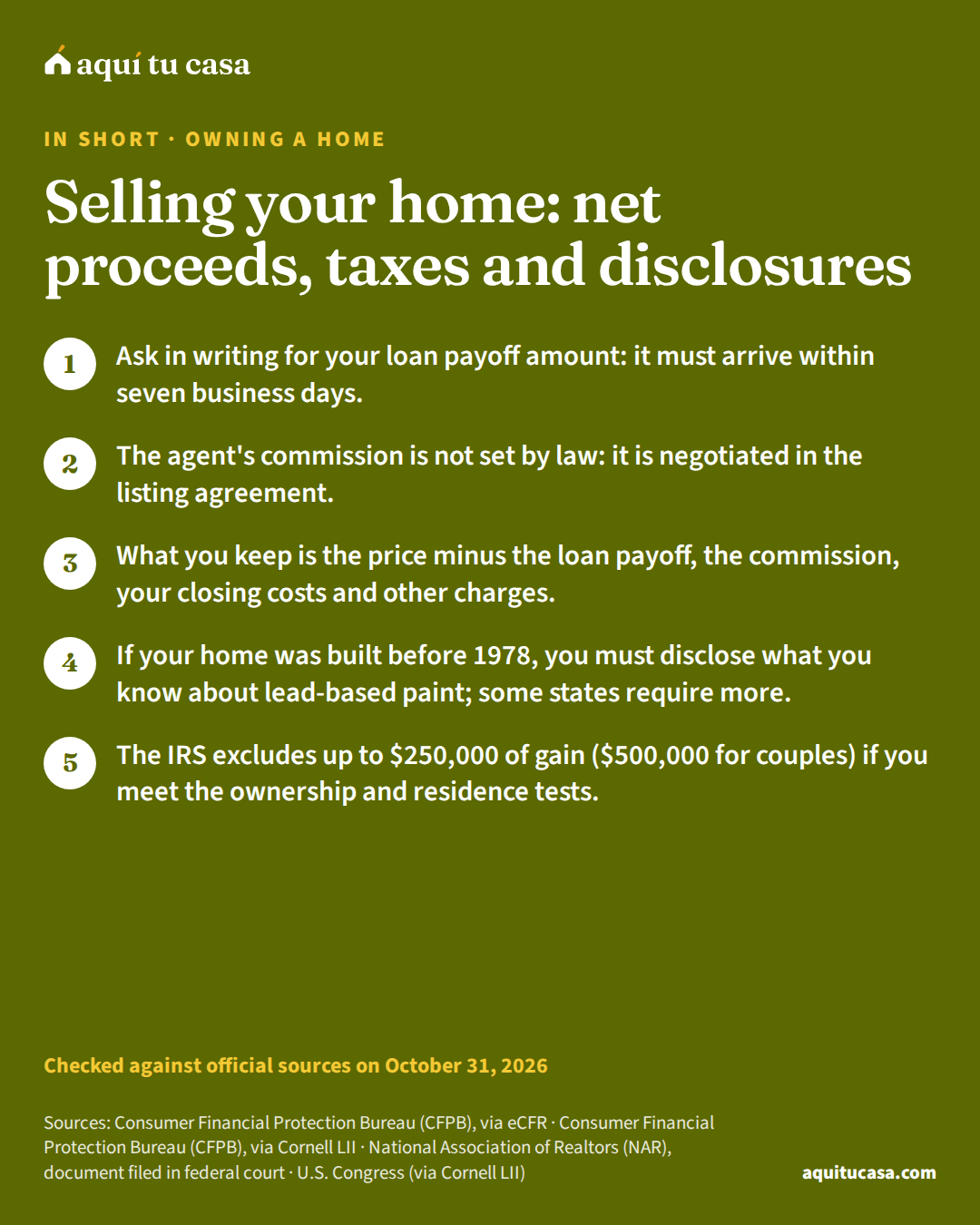
- Ask in writing for your loan payoff amount: it must arrive within seven business days.
- The agent's commission is not set by law: it is negotiated in the listing agreement.
- What you keep is the price minus the loan payoff, the commission, your closing costs and other charges.
- If your home was built before 1978, you must disclose what you know about lead-based paint; some states require more.
Is this for you?
This guide is for you if…
- You are thinking of selling your home and want to know how much you will keep after paying everything.
- You are about to sign with an agent to list your home and want to know what to negotiate.
- You want to know what you have to tell the buyer about the home's condition.
Get direct help first if…
- You are a nonresident foreign seller worried about FIRPTA withholding: read «Taxes when you sell your home and FIRPTA».
- You owe more than the home is worth or are behind on payments: read «If you can't pay your mortgage» first.
Selling your home can be the largest transaction of your life, and it is often the step to your next home. Before the sign goes up, it helps to know how much you will keep, what to negotiate with your agent, what to tell the buyer and what the IRS says about the gain. This guide covers it in order. Our guide Taxes when you sell your home and FIRPTA explains the IRS exclusion and the rules for foreign sellers in detail.7
Before you sell: what you really owe
Your monthly statement does not tell you exactly how much you need to pay off the loan on closing day, because interest keeps running. Ask your loan servicerloan servicerThe loan servicer is the company that sends you your mortgage statements and handles the day-to-day tasks of the loan: it processes your payments, answers your questions, keeps track of principal and interest paid and manages your escrow account, if you have one. It can also offer options if you fall behind and, in certain cases, start a foreclosure. It may be the same company that lent you the money or a different one, and it is common for another company to take over the loan after closing.See the full definition in writing for a payoff statement. The law says it must give you an accurate statement of the total balance to pay off the loan on a specific date, within a reasonable time and never more than seven business days after your written request, or that of someone acting for you, such as the title company.1
Also ask:
- Are there other loans on the home? For example, a home equity line of credithome equity line of credit (HELOC)A home equity line of credit (HELOC) lets you borrow again and again against the equity in your home: what the home is worth minus what you owe on your mortgage. During the draw period you can take out money up to your credit limit, usually with special checks or a card. When that period ends you can no longer borrow and you enter the repayment period, when payments are often much higher; sometimes the whole balance is due at once. It usually has a variable interest rate. If you do not repay it, you could lose your home.See the full definition or a second mortgage. They are paid off at the sale too.
- Does your loan have a prepayment penaltyprepayment penaltyA prepayment penalty is a fee some lenders charge if you pay off all or part of your mortgage early. Not every mortgage has one; if yours does, you agreed to it at closing. According to the CFPB, it usually applies if you pay off the whole balance within a certain number of years, for example when you sell or refinance, and sometimes if you pay a large amount at once; it does not normally apply to small extra principal payments. Many states limit these penalties. The Loan Estimate says whether the loan has one, and the details may be in the note or an addendum.See the full definition? Check your loan papers.
- What happens to your escrow account? When you pay off the loan in full, the servicer must return what is left in your escrowescrow accountAn escrow account is an account set up by your mortgage lender to pay certain property-related expenses on your behalf, mainly property taxes and homeowners insurance. The money comes from a portion of your monthly mortgage payment: each month you contribute a share and the loan servicer pays the bills when they come due. That is why your payment is higher than principal and interest alone, and why it can change when taxes or the insurance premium go up. In some states the word also names the period between the offer and the closing.See the full definition within 20 days, not counting holidays or weekends.2
Choosing an agent and negotiating the commission
You can sell with a real estate agentreal estate agentA real estate agent (often called a realtor) is the professional who helps you buy or sell a home. There are buyer's agents and seller's agents (listing agents). A buyer's agent helps you find homes that fit your needs and budget, gives you information about neighborhoods and property taxes, prepares and presents your offer, negotiates with the seller and guides you to closing. Their commission is negotiable and not set by law; it is written into the agreement you sign with your agent. On the Closing Disclosure, the agent appears in the contact table, usually with a state license number.See the full definition or on your own. If you use an agent, you sign a listing agreement that says how much you pay and what services you get.
The commission is negotiable. Under the National Association of Realtors (NAR) settlement, its agents must tell you in conspicuous language in the listing agreement that commissions are not set by law and are fully negotiable. Also, offers of payment to the buyer’s agent and your agent’s commission can no longer be posted on the MLSmultiple listing service (MLS)A multiple listing service (MLS) is a database that cooperating real estate brokers create and use to share information about homes for sale. According to the National Association of REALTORS (NAR), it is a local marketplace used by both buyers' agents and listing agents. Much of its information is public, but full access, with details such as the seller's contact information, is limited to licensed agents who pay for a subscription. Under the NAR settlement, a seller can still offer to pay your agent, but that offer cannot be posted on the MLS.See the full definition.3 Before you sign, ask:
- How much do you charge and what services are included (photos, ads, showings, negotiation)?
- How long does the agreement last and how is it ended?
- Will you offer payment to the buyer’s agent? Who decides?
Our guide How to choose a real estate agent explains how to check a license and what to ask.
The Fair Housing Act applies to sellers too. It is illegal to publish an ad about the sale of a home that shows a preference, limitation or discrimination based on race, color, religion, sex, disability, familial status or national origin. There is a limited exemption for a private owner selling a house without an agent or broker, but it never covers discriminatory ads.4 If you use an agent, the law applies fully. The Fair Housing ActFair Housing ActThe Fair Housing Act is the federal law that makes it illegal to refuse to sell or rent a dwelling, or to discriminate in its terms, because of race, color, religion, sex, familial status (having children), national origin or disability. It applies to landlords, real estate agents and managers, and also to banks and lenders when their practices make housing or credit unavailable for those reasons. National origin covers your language and the country you come from, regardless of immigration status. If you believe you were discriminated against, you can file a complaint with HUD at no cost; many states add protections.See the full definition protects every buyer.
What you keep: your net sheet
What you keep when you sell is, in words: the sale price, minus the payoff of your loan (and any other loan on the home), minus the agent’s commission, minus your closing costs as seller (such as the title company, the transfer taxtransfer taxA transfer tax is a state or local government charge on a home sale or a mortgage that is based on the sale price or the loan amount. That sets it apart from recording fees, which depend on the type of document or how many pages it has. State or local law decides whether the seller or the buyer pays it, and the local name does not matter: if it is computed that way, the federal forms show it as a transfer tax. The Loan Estimate shows only the part you pay; the seller's part appears on the Closing Disclosure.See the full definition if your state charges it to sellers and other charges), plus or minus the prorationsprorationProration is the split, as of the closing date, of home expenses that cover a period of time, such as property taxes, homeowners association (HOA) dues or utilities the seller used. If the seller already prepaid part of a period when you will be the owner, you reimburse the seller at closing. If the seller owes taxes for their time that you will pay later, the seller gives you a credit at closing. The Closing Disclosure shows each prorated amount along with the dates it covers.See the full definition of property taxes and other costs for the year. The seller net sheet does that math with your state’s data.
For the IRS, the math is similar but not the same. Your gain is the selling price minus your selling expenses (that is the amount realized), minus your adjusted basis. Selling expenses are the costs directly tied to selling: the commission, advertising, legal fees and points or other loan charges you paid that would normally have been the buyer’s.7
Example with real numbers
A family selling to move to another city
An example in words, not a real case, of how what they keep adds up.
- The sale price
- What the buyer agrees to pay in the contract
- What gets paid first
- The payoff balance on their mortgage, as of closing day
- The costs of selling
- The commission they negotiated and their closing costs as sellers
- The adjustments
- The property tax proration for the year
- What they receive
- The rest, plus what was left in their escrow, returned within 20 days
The payoff deadline and the escrow refund come from Regulations Z and X.12 Use the seller net sheet for your numbers.
Run it with your numbersHow much will I keep when I sell?
What you must tell the buyer
Lead-based paint, if the home was built before 1978. The federal rule applies to most housing built before 1978. Before the buyer signs the contract, you and your agent must:5
- give the “Protect Your Family From Lead in Your Home” pamphlet;
- tell the buyer what you know about lead-based paint or its hazards in the home, and provide any reports you have;
- include a lead warning statement in the contract;
- give the buyer 10 days for an inspection or risk assessment, a period you can change in writing or that the buyer can waive.
Keep a signed copy of the disclosurelead-based paint disclosureThe lead-based paint disclosure is the information federal law requires you to get before you sign to buy or rent most homes built before lead-based paint was banned for use in homes. The seller, landlord, real estate agent or property manager must give you a pamphlet about lead, disclose what they know about lead-based paint in the home, hand over any reports they have and include a lead warning statement in the contract or lease. If you are buying, you get 10 days to have a lead paint inspection; the parties can change that in writing, or you can waive it. Peeling or cracking lead-based paint is a hazard.See the full definition for three years after the sale. The rule does not apply, among other cases, to homes built after 1977 or to foreclosure sales.5 Our guide Lead, mold and pests explains lead risks.
The notice about the home’s condition, depending on your state. Some states require the seller to state in writing what they know about the home’s condition. One example: in Texas, a seller of a single-unit home must give the buyer a written notice about the property’s condition. That notice is not a warranty and does not replace inspections. You fill it out to the best of your knowledge and belief, and if you do not know something, you say so. You must deliver it by the time the contract binds the buyer; if not, the buyer may terminate the contract for any reason within seven days of receiving it. The law has exceptions, such as court-ordered or foreclosure sales and transfers between co-owners or to a spouse or direct relative.6 Ask your agent or the title company which form your state uses.

From the decision to closing, as the seller
1. Ask for your payoff statement
Before you set a price
In writing; it must arrive within seven business days.1
2. Build your net sheet
Before you sign with an agent
Price, minus the loan, the commission and closing costs.7
Try it with your numbersHow much will I keep when I sell?3. Negotiate the listing agreement
Before you sign
The commission is not set by law; get it in writing with the services.3
4. Prepare your disclosures
Before you get offers
Lead-based paint if the home was built before 1978, and your state's notice.5
5. Confirm how you will receive the money
Before closing
By phone with the title company, at the number you saved; never by email.
6. Keep your papers
After closing
Records of your home's basis, until three years after your tax return.7
Taxes: the IRS exclusion in brief
Many families pay no tax on the gain from selling their main home. If you qualify for the exclusion, up to $250,000 of your gain is tax free, or up to $500,000 if married filing jointly. To qualify, you generally must meet two tests:7
- Ownership. You owned the home at least 24 months of the 5 years before the sale. For a married couple filing jointly, one spouse meeting it is enough.
- Residence. You lived in it as your main homeprincipal residenceYour principal residence is the home where you live permanently and spend most of the year. According to FHA, a person can have only one principal residence at a time. Lenders tell it apart from a second home, which you occupy in addition to your principal residence but for less than most of the year, and from an investment property, which you own but do not live in. Fannie Mae buys loans on all three, but it applies a loan-level price adjustment (LLPA) to loans on investment properties.See the full definition at least 24 months of those 5 years, not necessarily in a row. For a couple, each spouse must meet it for the full exclusion.
Reporting the sale. You must report it if you have gain you cannot fully exclude or if you received a Form 1099-S, even with no taxable gain. And keep the records of your home’s basis, such as your purchase Closing Disclosure and improvement receipts, until three years after the due date of your return for the year you sold.7 Our guide on taxes when you sell explains the partial exclusion and FIRPTA withholding for foreign sellers. The IRS’s VITA and TCE programs prepare basic returns for free for people who qualify.8
On closing day, protect your money. What you receive from the sale may be a lifetime of savings, and scammers target sellers too. Confirm by phone, with the title company and at a number you already knew, how you will receive your money. Our guide Closing wire fraud and email scams explains how to protect yourself.
If this is you
You are selling to buy another home
Ask for your payoff statement and build your net sheet before you bid on the next one.1
You have lived in the home for many years
If you meet the ownership and residence tests, you can exclude up to $250,000 of gain ($500,000 for couples).7
Your home was built before 1978
Give the buyer the pamphlet, what you know about lead and 10 days to inspect.5
You want to pay less commission
The commission is not set by law; ask for several proposals and compare the services.3
You prefer to read your papers in Spanish
Ask for the listing agreement and the disclosure to be explained before you sign; keep a copy of everything.5
Mistakes that cost you
Mistake: Figuring what you keep from the balance on your monthly statement.
Instead: Ask for the payoff statement in writing, with the closing date.1
Mistake: Thinking the commission is fixed.
Instead: It is not set by law and is fully negotiable; get it in writing.3
Mistake: Not disclosing lead-based paint on a home built before 1978.
Instead: It is required; give the pamphlet, your reports and 10 days to inspect.5
Mistake: Filling out the condition notice with guesses.
Instead: Write what you know and mark what you do not, as Texas law requires.6
Mistake: Not reporting the sale because there was no gain.
Instead: If you received a 1099-S, you must report it anyway.7
Mistake: Throwing away improvement receipts.
Instead: Keep them: they help figure your home's basis.7

Free help
A HUD-approved housing counselorHUD-approved housing counselorA HUD-approved housing counselor works at an agency HUD has approved to provide housing counseling: independent, expert advice customized to your situation about buying a home, renting, a missed mortgage payment, a foreclosure or credit problems. The agencies usually charge little or nothing; many serve in Spanish and offer the homebuyer education course several assistance programs require. They are not lenders or real estate agents and sell you nothing. Your county page lists the official agencies with phone numbers.See the full definition can advise you for free or at low cost if you are selling because you cannot keep up, or if you want to compare selling with other options; search by ZIP code on the CFPB’s website.9 Our guide HUD-approved housing counselors explains what they do. If you are moving to another state, our Moving to another state checklist helps with the rest.
What to do this week
- Ask in writing for the payoff statement on your mortgage and any other loan on the home.1
- Build your net sheet with the seller net sheet.7
- Ask two or three agents for proposals and compare the commission and services.3
- Check the year your home was built and look for any lead reports you have.5
- Gather your purchase Closing Disclosure and receipts for major improvements.7
Your numbers
That is $11,645. The minimum for this loan is 3.5%.
It changes the result the most.
Adjust advanced details
These are example scenarios, not data: no one knows how much a home will rise.
Real data: in the United States, according to the FHFA House Price Index, prices changed by 6.3% a year on average in the 10 years through 2025. The past does not tell you how much they will rise.
Example assumption; change it.
Repairs and upkeep. Example assumption.
What the money you do not put into the home would earn. Example assumption.
Commissions and taxes when selling. Example assumption.
Let's do the math
If you stay 7 years
Renting comes out ahead by about $90,044
With these assumptions, buying does not come out ahead within 30 years.
- Cost of buying per month (first year)
- $3,037
- Rent per month (first year)
- $1,413
- Cash up front to buy
- $21,626
- What you keep when selling in year 7
- $86,049
Buying's advantage, year by year
Above the dashed line buying is better; below it, renting. The dot marks the years you stay.
Under other scenarios (7 years)
| Appreciation | Break-even | In 7 years |
|---|---|---|
| Low (1%) | Never | Rent +$135,484 |
| Medium (3%) | Never | Rent +$90,044 |
| High (5%) | Year 17 | Rent +$38,767 |
This rests on assumptions
We use the place's typical tax (0.94% of value), an example insurance (0.5% of value a year) and example closing costs (3% of price). Appreciation, rent increases and returns are examples: change them and watch how the result moves.
An educational estimate, not a recommendation. It does not include tax deductions or rate changes.
Ready to see the numbers? Find your county here
See how this applies in your county: its loan limits, prices and rents, from the official data.
Printable checklist
Frequently asked questions
How do I know how much I owe on my mortgage to sell?
Ask your servicer in writing for a payoff statement. The law says it must give you the exact balance to pay off the loan on a specific date within seven business days. Your monthly statement does not show that exact number.
Is the agent's commission a fixed percentage?
No. Under the NAR settlement, its agents must tell you in writing, in the listing agreement, that commissions are not set by law and are fully negotiable. Ask what services are included and negotiate before you sign.
What do I have to tell the buyer about the home?
If the home was built before 1978, federal law requires you to disclose what you know about lead-based paint and give a pamphlet and time for an inspection. Some states also require a notice about the home's condition; in Texas, for example, it is required for a single-unit home.
Do I pay tax on the gain when I sell?
Often not. If you owned and lived in the home at least 24 months of the last 5 years, you can exclude up to $250,000 of gain, or $500,000 if married filing jointly. If you gain more, or do not meet the tests, part may be taxable.
Do I have to report the sale to the IRS if I made no gain?
If you received a Form 1099-S, yes: you must report the sale even with no taxable gain. IRS VITA sites prepare basic returns for free for people who qualify.
Do I get the money in my escrow account back?
Yes. When you pay off your loan in full at the sale, the servicer must return what is left in your escrow account within 20 business days.
Can my ad say whom I prefer to sell to?
Not based on race, color, religion, sex, disability, familial status or national origin. The Fair Housing Act prohibits ads showing those preferences, even if you sell without an agent.
Sources
Every figure in this guide comes from one of these official sources. The number next to a sentence leads to the source behind it.
Each source on one line: who publishes it, its title, its address and the date we read it.
- 1. Consumer Financial Protection Bureau (CFPB), via eCFR · 12 CFR §1026.36, Prohibited acts or practices and certain requirements (Regulation Z) · ecfr.gov · Accessed October 31, 2026
- 2. Consumer Financial Protection Bureau (CFPB), via Cornell LII · 12 CFR §1024.34, Timely escrow payments and treatment of escrow account balances (Regulation X) · law.cornell.edu · Accessed October 31, 2026
- 3. National Association of Realtors (NAR), document filed in federal court · Settlement Agreement (Case 4:19-cv-00332-SRB, Doc. 1458-1) · nar.realtor · Accessed October 31, 2026
- 4. U.S. Congress (via Cornell LII) · 42 U.S.C. §§3603–3604, Fair Housing Act: effective dates, exemptions and discrimination in sales · law.cornell.edu · Accessed October 31, 2026
- 5. U.S. Environmental Protection Agency (EPA) · Real Estate Disclosures about Potential Lead Hazards · epa.gov · Accessed October 31, 2026
- 6. Texas Legislature · Texas Property Code, Chapter 5, Conveyances (§5.008, Seller's Disclosure of Property Condition) · tcss.legis.texas.gov · Accessed October 31, 2026
- 7. Internal Revenue Service (IRS) · Publication 523, Selling Your Home · irs.gov · Accessed October 31, 2026
- 8. Internal Revenue Service (IRS) · Free tax return preparation for qualifying taxpayers · irs.gov · Accessed October 31, 2026
See the other 1 sources
- 9. Consumer Financial Protection Bureau (CFPB) · Find a housing counselor · consumerfinance.gov · Accessed October 31, 2026
Keep reading
Related guides
If this guide helped, these follow the same path.

Owning a home 21 minute read
Taxes when you sell your home and FIRPTA withholding
When you owe no tax on the gain from selling your home (the $250,000 exclusion), Form 1099-S, forgiven mortgage debt and FIRPTA withholding.
- The $250,000 exclusion ($500,000 on a joint return) applies to your main home if you owned it and lived in it for 24 months of the last 5 years; only once every 2 years.
- If you receive a Form 1099-S at closing, you report the sale on Form 8949 even if the whole gain is excludable.
- Mortgage debt forgiven in a short sale, foreclosure or modification is generally taxable income; the special exclusion only covers written agreements made before January 1, 2026.
- Buying a home Closing costs explained: what you pay and what can change What closing costs are, how to read them on your Loan Estimate, which charges cannot go up before closing and how to compare offers to pay less. 14 minute read
- Protect yourself from scams Mortgage closing wire fraud and real estate email scams How criminals steal closing money by email, the warning signs, how to confirm an account before you pay and what to do in the first hours after a wire. 11 minute read
- Buying a home How to choose a real estate agent to buy a home What a real estate agent does, who they represent, how to check their license in your state, what to ask them and your fair housing rights. 10 minute read


Tools for this topic
Was this guide useful?
Thank you. Your answer stays in your browser; nothing is sent.