Mortgage closing wire fraud and real estate email scams
How criminals steal closing money by email, the warning signs, how to confirm an account before you pay and what to do in the first hours after a wire.
Verified against official sources on October 31, 2026 9 official sources

Show contents
In short
What you need to know
Quick answer
Criminals get into the email of someone involved in your purchase or sale, watch the dates and, right before the payment, send a real-looking email with a "new" account. If you wire there, the money can disappear within hours. To protect yourself, pick two trusted people, save their numbers ahead of time and confirm the account name and number by phone; never follow instructions that arrive by email. If you already wired, call your bank right away to ask for a recall and file a complaint at ic3.gov the same day.
What matters most
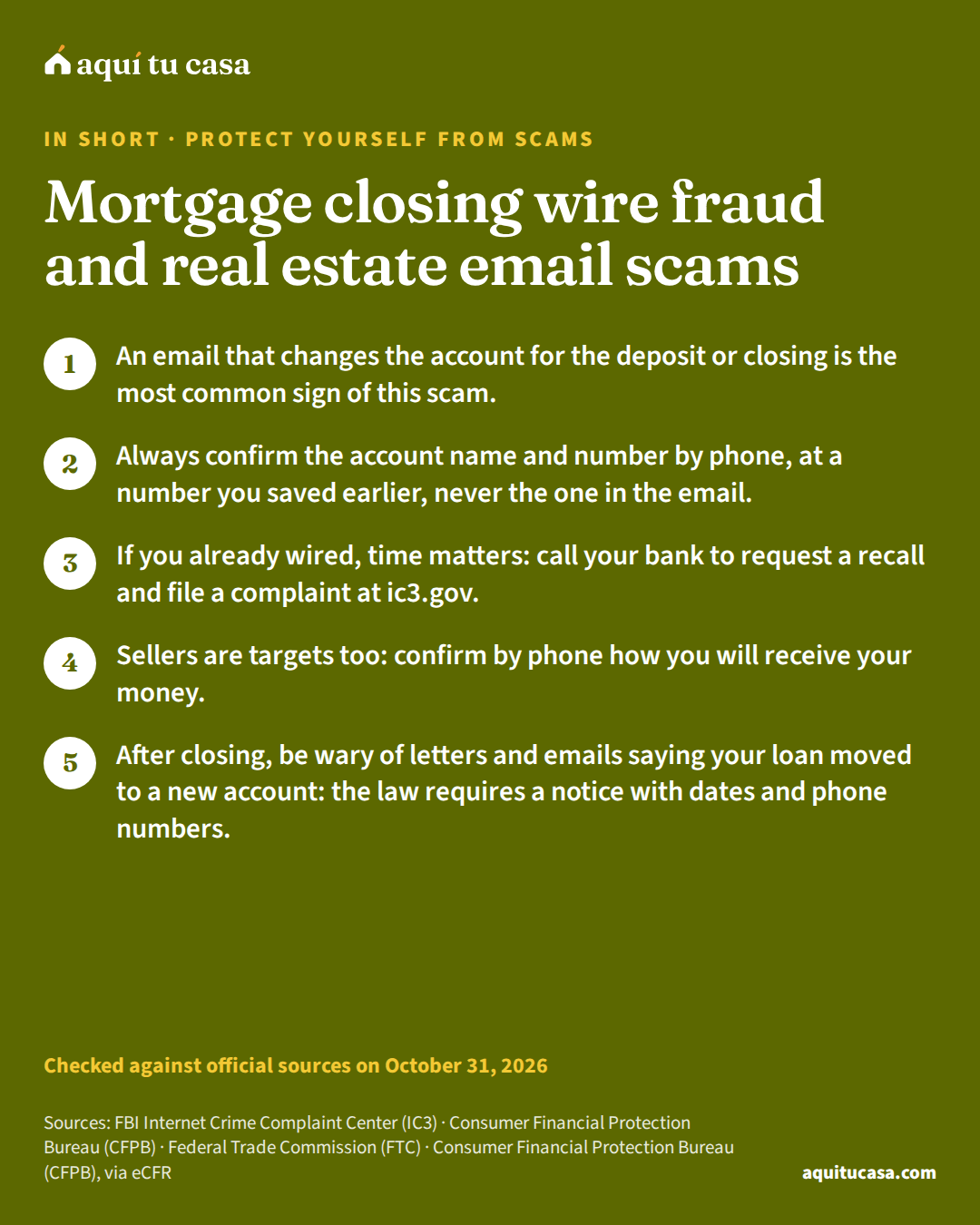
- An email that changes the account for the deposit or closing is the most common sign of this scam.
- Always confirm the account name and number by phone, at a number you saved earlier, never the one in the email.
- If you already wired, time matters: call your bank to request a recall and file a complaint at ic3.gov.
- Sellers are targets too: confirm by phone how you will receive your money.
Is this for you?
This guide is for you if…
- You are buying or selling a home and will send or receive money by wire.
- You got an email or message changing the account for the deposit, the closing or your mortgage payment.
- You already sent money and think it went to a fake account.
Get direct help first if…
- You are being told you will lose your home and asked to pay to save it: read «Loan modification and foreclosure rescue scams».
- Someone changed the deed to your home without your permission: read «Deed theft and title fraud».
Buying or selling a home moves a lot of money in a few days, almost always by wire transferwire fraud at closingThis is a scam aimed at people about to close on a home. Days before closing, the scammer sends an email that looks like it comes from your real estate agent or settlement agent with "new" instructions to wire or electronically transfer your down payment or closing costs to a different account. If it works, getting the money back can be very hard. The CFPB recommends writing down two trusted contacts ahead of time, confirming any instructions with them using only those numbers, and not using phone numbers or links in the email. If it happens to you, call your bank right away to stop or reverse the transfer.See the full definition. Scammers know it. They do not need to break into your bank: it is enough to send you an email that looks like it comes from your agent or the title companytitle companyA title company is a company, or its authorized agent, that is qualified to issue title insurance. It searches public records for problems with the home's title (a title search), prepares the title commitment and issues the lender's and owner's policies. In most states, the fee for conducting your closing is also part of its charges. If title services are listed in section C of your Loan Estimate, you can shop for them yourself. Under the federal Real Estate Settlement Procedures Act (RESPA), a seller may not require you to buy title insurance from a particular company.See the full definition with a “new” account. This guide explains how the scam works, how to confirm an account before you pay and what to do in the first hours if you already wired.1
How the scam works
The FBI calls it business email compromise (BEC). In a home purchase, it targets everyone: buyers, sellers, attorneys, title companies and agents. This is how it happens, according to the FBI:1
- They get into an email account. Criminals gain access to the email of someone involved in the purchase.
- They watch. They read the messages and learn the dates, amounts and names.
- They send the request at the right moment. Just before the payment, an email arrives asking to change the payment type (often from check to wire) or to switch to an account they control.
- They move the money. Then they pass it on to another account, in the U.S. or abroad.
The CFPB adds that they can closely copy your agents’ email address, phone number and writing style.4 That is why the email does not “look wrong”. The FTC sums it up: if an email that looks like it comes from your loan officer or another real estate professional asks you to wire closing costs to a different account because of a last-minute change, it is a scam.6
The problem is large. In 2025, the FBI’s Internet Crime Complaint Center (IC3) received 24,768 business email compromise complaints, with losses of $3,046,598,558. In the real estate fraud category, which includes investments, rentals and timeshares, there were 12,368 complaints and $275,110,419 in losses.2
Warning signs
No single sign proves a scam, but any of these is a reason to stop and call:
- A change of account or bank at the last minute, by email or text.6
- Rush. “It has to go out today” or “otherwise the closing falls through.”
- A link or attachment you are asked to open to see “the new instructions”. The CFPB recommends not opening them without confirming.4
- An email address that is almost the same, with one letter changed. The FBI recommends checking who sent the email, especially on a phone, and that the link belongs to the business it claims to be.1
- A call asking you to confirm personal or account information. The CFPB warns it can be hard to tell whether a call is real.4
- A phone number inside the email. If you call that number, you may reach the same scammer. Use only numbers you saved earlier.4

How to confirm an account before you pay
Protection costs nothing, but you have to set it up before the first payment, which is often the earnest money deposit. The CFPB recommends:4
- Pick two trusted people, such as your agent and the settlement agentsettlement agentThe settlement agent (also called a closing agent) is the person or company that coordinates the closing so that everything the contract requires is accounted for. Depending on the location, it may be a title company, an escrow company (in most western states) or a closing attorney (in some eastern states). It collects the money from the lender and from you, pays the seller, distributes the closing costs and records the documents with the county. It works for all the parties; it is not your personal representative. Ask it how to pay the money you need to bring to closing.See the full definition. Talk with them in person or by phone about how you will pay. Write down their names and main phone numbers.
- Create a code phrase only you and they know, if you want one more way to confirm who is who.
- Confirm every payment instruction with them, in person or at the phone number you agreed on. Confirm the account name and number.
- Do not email financial information. Email is never a secure way to send it.
The FBI adds two habits: use another channel, or two-factor authentication, to verify any request to change an account, and do not give passwords or personal information by email.1 Turn on two-step verification in your own email: your account can be the way in too.
Before every wire
1. Save two trusted numbers
When you sign the offer
Get the numbers from your agent and the settlement agent in person or from their official website.4
2. Talk through the payment plan
Before the deposit
Agree on how you will pay and that they will never change the account by email.4
4. If a change arrives, stop
At any time
Do not wire; call your trusted people and tell them about the email.6
Example with real numbers
A buyer who gets an email with a new account
An example in words, not a real case, of how the scam gets stopped.
- Two days before closing
- An email arrives, with her settlement agent's name, saying they changed banks
- What she does not do
- She does not call the phone number in the email or open the attached instructions
- What she does
- She calls the number she saved when she signed the offer
- What she is told
- That they never changed banks and the email is fake
- The result
- She wires only to the account confirmed by phone and reports the fake email
The steps in this example are the ones the CFPB and the FTC recommend.46 Use the closing costs calculator to know ahead of time how much you will wire.
Run it with your numbersClosing costsIf you already wired: the first hours
If you think you sent money to a fake account, do not wait until you are sure. The FBI says time is of the essence.1
- Call your bank right now. Ask for a wire recall and what documents it needs. Each bank has its own policies.1 If you used a money transfer company, call that company.7
- File a complaint at ic3.gov the same day, whatever the amount lost. Include all the transaction details.1
- Tell your agent and the title company at the numbers you already knew, so they can check their email and warn the others.
- Report it to the FTC too at ReportFraud.ftc.gov.7
- Change your passwords and check your accounts often.1
Does reporting quickly help? In 2025, the IC3 recovery team, which works with banks to freeze funds, acted on 3,900 incidents with $1,163,919,846 in attempted theft and froze $679,013,183, a 58% success rate.2 There is no guarantee you will get your money back, but waiting almost always makes it harder.
Keep the suspicious emails without deleting them, and the wire receipt. Our guide I was scammed, what now? explains the next steps, and Identity theft and credit freezes helps if they also took your personal information.
What a real professional does and what a scammer does
Can be confirmed
A real professional
- Lets you confirm by phone at the number you already had
- Does not change the account by email at the last minute
- Does not rush you to skip confirming
- Gives you time to read your papers
Rushes you
A scammer
- Sends a new account by email or text
- Gives you a phone number inside the same email
- Says the closing falls through if you do not pay today
- Asks for your information or passwords to confirm
If you cannot confirm the account at the number you saved earlier, do not wire.
If you are the seller
The FBI says this scam targets sellers too.1 What you will receive from the sale, often a lifetime of savings, can end up in another account if someone sends fake instructions to the title company in your name. Confirm by phone, with the title company and at the number you already knew, how you will receive your money, and do not change your account by email. The seller net sheet helps you know what amount to expect.
If you are buying land. The FBI warns about criminals who pose as owners of vacant land to sell it without the real owner knowing. The signs: a “seller” who only writes by email or text and will not meet in person, rushes the sale or lowers the price, lacks papers such as the surveyproperty surveyA property survey is a drawing of your property that shows where the lot, the house and any other structures are, along with any improvements on the land. In a purchase with a mortgage, it ties into title insurance. For example, Fannie Mae will not buy a loan if the title policy has a survey exception. Where surveys are not commonly required, the lender must provide a special endorsement to the title policy (ALTA 9) instead.See the full definition or tax information, and asks for payment to an account under another name or in another place. The FBI recommends sending a certified letter to the address on the property’s tax record to confirm.3 Our guide Deed theft and title fraud explains how to protect your own home.

After closing: mail “from your lender”
When you close, your deed and loan details go into the public record, with your name, lender, loan amount and address. The CFPB warns that some companies use that data to send you ads or scams, sometimes with your lender’s name at the top, your details and phrases like “urgent message”.5
A common trick is to say your loan “was sold” and that you should pay a different account. The company that collects your loan, the loan servicerloan servicerThe loan servicer is the company that sends you your mortgage statements and handles the day-to-day tasks of the loan: it processes your payments, answers your questions, keeps track of principal and interest paid and manages your escrow account, if you have one. It can also offer options if you fall behind and, in certain cases, start a foreclosure. It may be the same company that lent you the money or a different one, and it is common for another company to take over the loan after closing.See the full definition, can change. But the law requires written notice: the old servicer tells you at least 15 days before and the new one no more than 15 days after, or both together at least 15 days before. The notice has the transfer date, the name, address and a phone number for both, and the dates when one stops taking payments and the other starts. And for 60 days, a payment that reaches the old servicer on time does not count as late.8 Before paying anyone else, call the servicer you already know, at the number on your statement.
If this is you
You are about to pay your first deposit
Save your agent's and settlement agent's numbers today, and confirm the account before you wire.4
You are selling the home you lived in for years
Confirm by phone how you will receive your money; this scam targets sellers too.1
You are told your loan moved to a new account
Look for the notice with dates and phone numbers the law requires, and call your current servicer.8
You are buying land to build on
Be wary of a seller who will not meet in person; send a letter to the address on the tax record.3
You already wired and nobody answers
Call your bank now to request a recall and file a complaint at ic3.gov today.1
Mistakes that cost you
Mistake: Trusting an email because it comes from your agent's address.
Instead: Scammers can copy it closely; always confirm by phone.4
Mistake: Calling the phone number in the email to confirm.
Instead: Use only the number you saved earlier or got in person.4
Mistake: Waiting a day to see whether the money shows up.
Instead: Call your bank right away; time is of the essence to recover it.1
Mistake: Not filing a complaint because the amount is small.
Instead: The FBI asks for a complaint at ic3.gov whatever the amount lost.1
Mistake: Emailing your account numbers or your ID.
Instead: Email is never secure for your financial information.4
Mistake: Paying a new account because a letter says your loan was sold.
Instead: Check for the notice the law requires and call the servicer you already know.8

Where to report and free help
- FBI: file your complaint at ic3.gov as soon as possible.1
- FTC: report the scammer at ReportFraud.ftc.gov.7
- CFPB: if you have a problem with a bank, lender or servicer, you can file a complaint with the CFPBConsumer Financial Protection Bureau (CFPB)The CFPB (Consumer Financial Protection Bureau) is the federal agency that implements and enforces federal consumer financial law. It supervises banks, lenders and large nonbank companies, such as credit reporting agencies and debt collectors. It takes consumer complaints and sends them to companies for a response. It also enforces laws that outlaw discrimination in consumer finance, provides financial education materials and works to make credit card, mortgage and other loan disclosures clearer.See the full definition.9
If you lost money in a purchase or sale and do not know what to do about the contract, look for free legal aidlegal aidLegal aid is the free civil legal help that nonprofit organizations and their lawyers provide to low-income people in civil, not criminal, matters. In housing, that includes representing families facing eviction or foreclosure, alongside matters such as custody, child support, protection from domestic violence and access to benefits. In the United States, the Legal Services Corporation, created by Congress, funds a nationwide network of these organizations; its finder points you to the one in your area. Each sets its own income limits.See the full definition: our guide Free legal aid explains how to find it. Our Housing scams complete guide covers the other scams to know, and Final walk-through and closing day helps you prepare for closing step by step.
What to do this week
- Get your agent’s and settlement agent’s numbers in person and save them in your phone.4
- Agree with them that they will never change the account by email.6
- Turn on two-step verification in your email and change weak passwords.1
- Save your bank’s number so you can call right away if something goes wrong.1
- If you already have a mortgage, find your servicer’s phone number on your statement and save it.8
Ready to see the numbers? Find your county here
See how this applies in your county: its loan limits, prices and rents, from the official data.
Printable checklist
Frequently asked questions
How do scammers know when my closing is?
The FBI explains that they get into the email account of someone involved in the purchase, such as an agent, a title company or the buyer, and watch the messages. That way they know the dates and send the account-change request at just the right moment.
The email comes from my agent's address. Can it be fake?
Yes. The CFPB warns that scammers can closely copy your agents' email address, phone number and writing style. That is why you never follow instructions from an email: call a number you saved earlier.
I already wired the money. What do I do first?
Call your bank right away and ask for a wire recall. Then file a complaint at ic3.gov with all the details. The FBI says time is of the essence: its recovery team works with banks to freeze funds.
Will I get my money back?
There is no guarantee. Each bank has its own policies. In 2025, the IC3 recovery team froze about 58% of the money at stake in the cases it acted on. The faster you report, the better your chances.
I am the seller. Can I be targeted too?
Yes. The FBI says this scam targets both buyers and sellers. Confirm by phone with the title company how you will receive your money, and do not change your account by email.
I got a letter saying my mortgage was sold and to pay a different account. Is it real?
It may be. If your servicer changes, the law requires a notice with the transfer date and the name, address and a phone number for both the old and new servicer. Call the servicer you already know, at the number on your statement, before paying anyone else.
Where do I report the scam?
At ic3.gov, the FBI's site, and at ReportFraud.ftc.gov, the FTC's. If the problem is with a financial company, you can also file a complaint with the CFPB.
Sources
Every figure in this guide comes from one of these official sources. The number next to a sentence leads to the source behind it.
Each source on one line: who publishes it, its title, its address and the date we read it.
- 1. FBI Internet Crime Complaint Center (IC3) · Business Email Compromise: The $50 Billion Scam (PSA I-060923-PSA) · ic3.gov · Accessed October 31, 2026
- 2. FBI Internet Crime Complaint Center (IC3) · 2025 IC3 Annual Report · ic3.gov · Accessed October 31, 2026
- 3. FBI Internet Crime Complaint Center (IC3) · Protect Your Property from Illegal Sales Through Parcel Owner Impersonation (PSA I-061626-PSA) · ic3.gov · Accessed October 31, 2026
- 4. Consumer Financial Protection Bureau (CFPB) · Mortgage closing scams: How to protect yourself and your closing funds · consumerfinance.gov · Accessed October 31, 2026
- 5. Consumer Financial Protection Bureau (CFPB) · After closing · consumerfinance.gov · Accessed October 31, 2026
- 6. Federal Trade Commission (FTC) · Shopping for a Mortgage FAQs · consumer.ftc.gov · Accessed October 31, 2026
- 7. Federal Trade Commission (FTC) · What To Do if You Were Scammed · consumer.ftc.gov · Accessed October 31, 2026
- 8. Consumer Financial Protection Bureau (CFPB), via eCFR · 12 CFR §1024.33, Mortgage servicing transfers (Regulation X) · ecfr.gov · Accessed October 31, 2026
See the other 1 sources
- 9. Consumer Financial Protection Bureau (CFPB) · Submit a complaint · consumerfinance.gov · Accessed October 31, 2026
Keep reading
Related guides
If this guide helped, these follow the same path.

Buying a home 11 minute read
Final walk-through and closing day: what to bring and check
How to do the final walk-through, what to bring to closing, what to ask before you sign, when you can stop the closing and what to keep afterward.
- Do the final walk-through before you sign: check the agreed repairs and what the seller was supposed to leave.
- Ask for your Closing Disclosure and the other documents early, and compare them with your Loan Estimate.
- Bring your ID, the cashier's check or proof of wire for the exact amount and your Closing Disclosure.
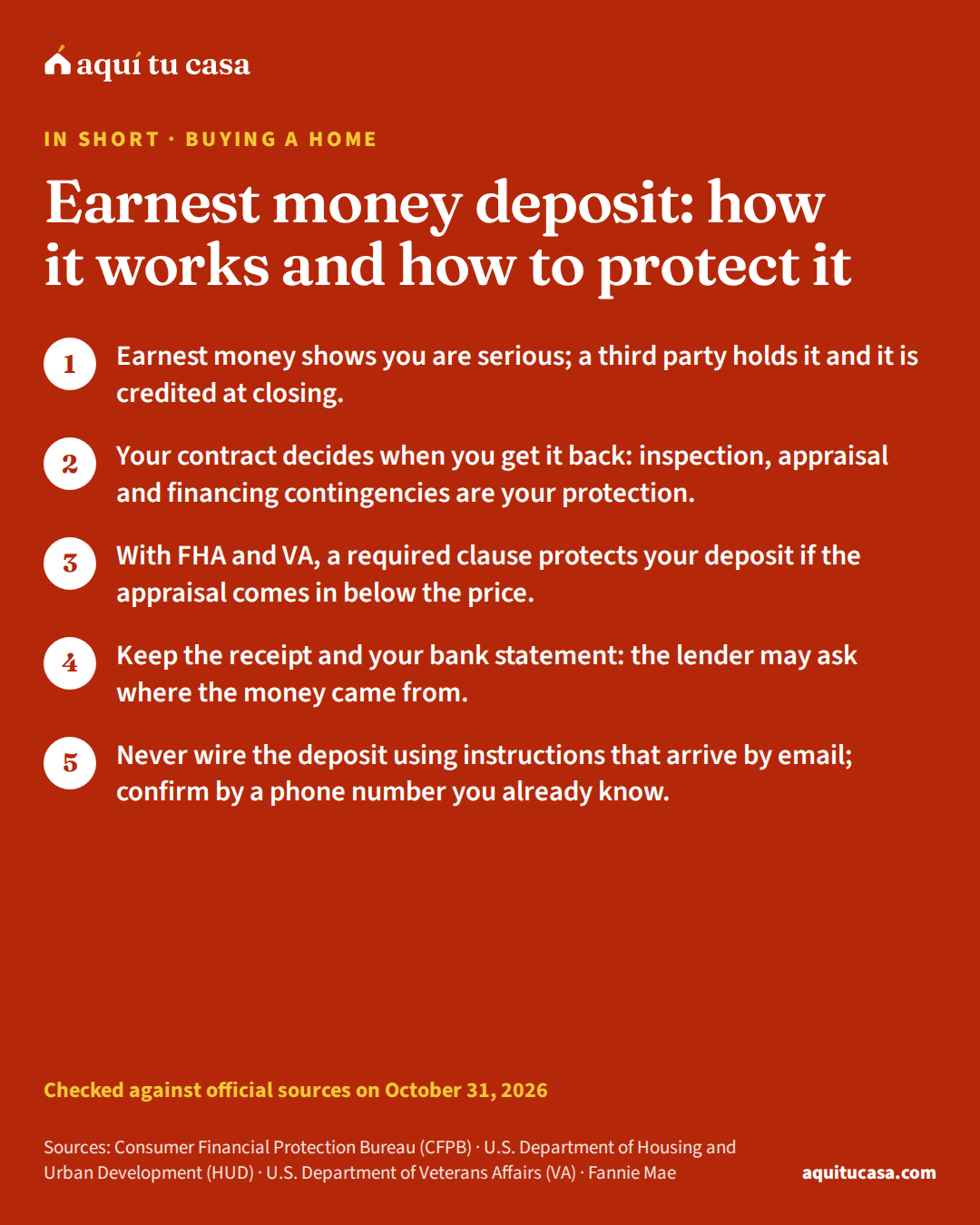
- Buying a home Earnest money deposit: how it works and how to protect it What the earnest money deposit is when you make an offer on a home, who holds it, when you get it back, when you can lose it and how to avoid wire fraud. 12 minute read
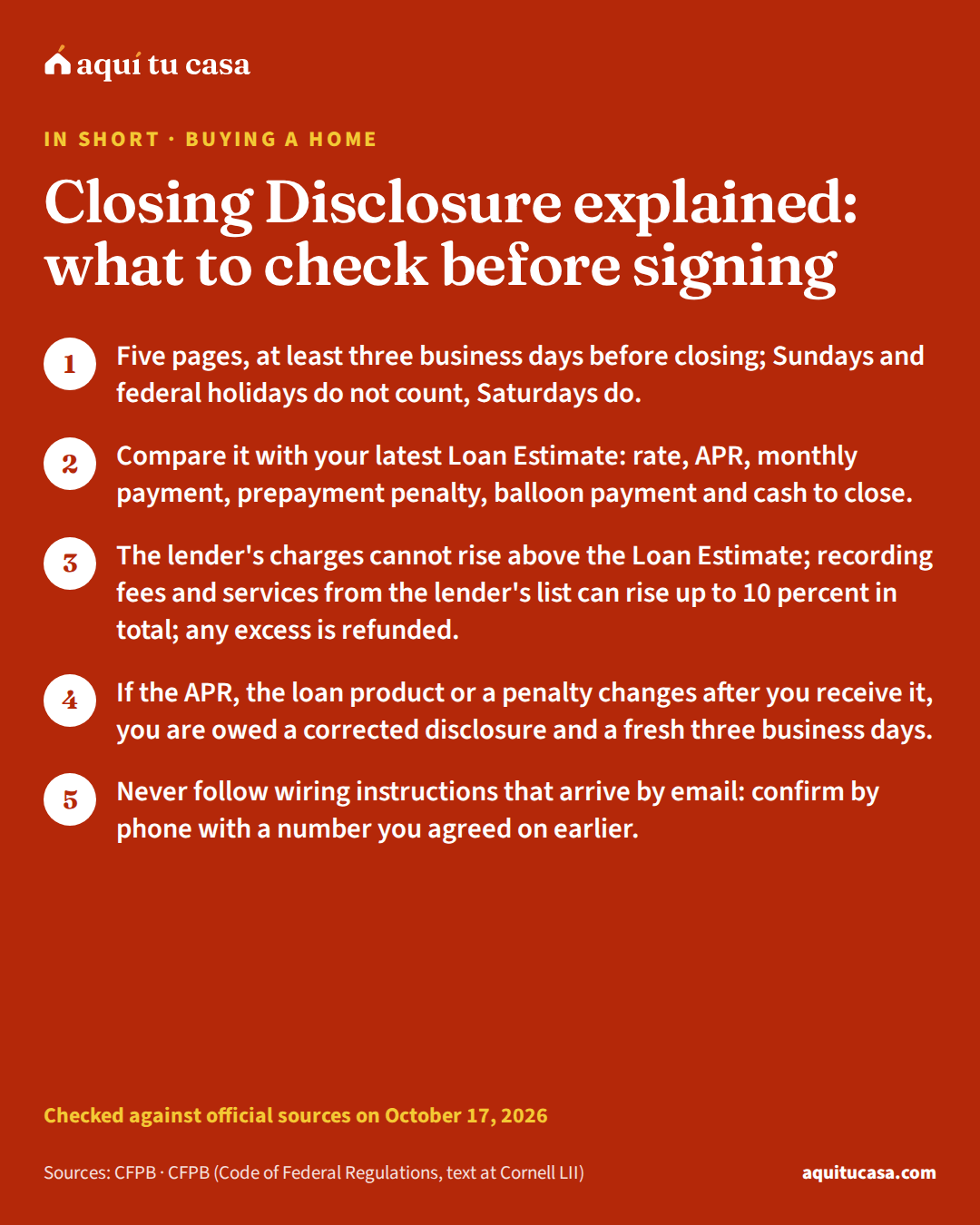
- Buying a home Closing Disclosure explained: what to check before signing What the Closing Disclosure is, when it must reach you, what to check on each of its five pages and which closing costs are not allowed to go up. 18 minute read
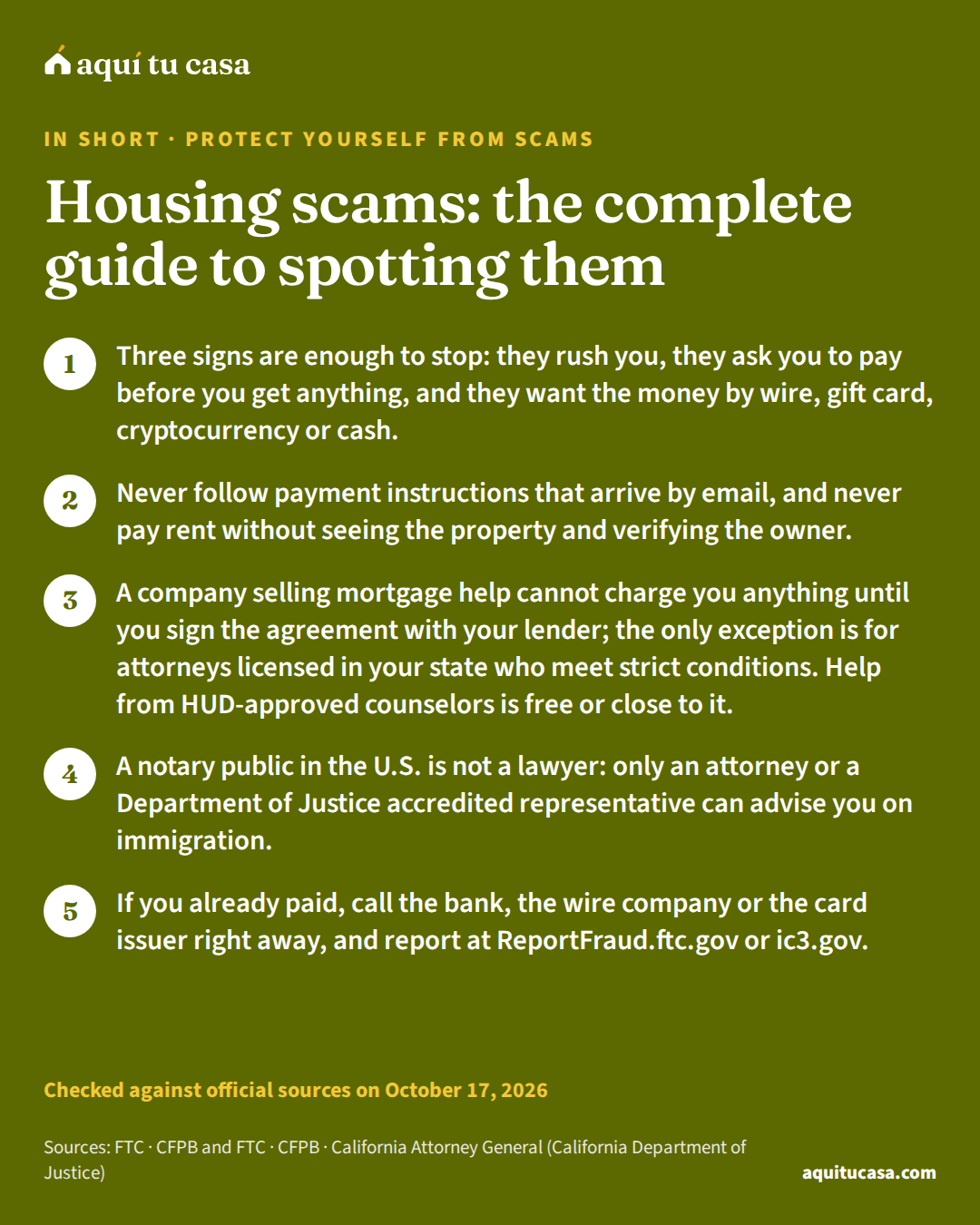
- Protect yourself from scams Housing scams: the complete guide to spotting them The rental, mortgage, title, contractor, credit and moving scams families run into most: how to spot them, what to do and where to report them. 17 minute read
Tools for this topic
Was this guide useful?
Thank you. Your answer stays in your browser; nothing is sent.