Final walk-through and closing day: what to bring and check
How to do the final walk-through, what to bring to closing, what to ask before you sign, when you can stop the closing and what to keep afterward.
Verified against official sources on October 31, 2026 7 official sources

Show contents
In short
What you need to know
Quick answer
On closing day you sign the papers that obligate you to repay the loan and give the lender the right to take back the house if you do not pay. Before you sign, do the final walk-through to confirm the agreed repairs were made and the seller left what was promised. Bring your ID, the cashier's check or proof of wire transfer and your Closing Disclosure. Take all the time you need, never sign anything blank and, if something does not add up, stop the closing. Never wire money using instructions that came by email: confirm them by phone.
What matters most
- Do the final walk-through before you sign: check the agreed repairs and what the seller was supposed to leave.
- Ask for your Closing Disclosure and the other documents early, and compare them with your Loan Estimate.
- Bring your ID, the cashier's check or proof of wire for the exact amount and your Closing Disclosure.
- You have the right to read everything calmly and to stop the closing, although walking away can cost your deposit.
Is this for you?
This guide is for you if…
- You have a closing date for your home purchase and want to arrive prepared.
- Your final walk-through is coming up and you are not sure what to check.
- You want to know which documents you sign, what to bring and what to keep afterward.
Get direct help first if…
- You are still comparing loan offers: read «How to compare Loan Estimates» first.
- You already sent money to an account you got by email and nobody answers: call your bank today and read «I was scammed, what now?».
You have reached the last step. On closingclosingClosing, also called settlement, is the last step in buying and financing a home: the moment when you and the other parties sign the necessary documents. Once you sign, you are responsible for repaying the mortgage. The lender sends the loan money to the settlement agent, who pays the seller and distributes the closing costs; the seller signs the deed that makes you the owner, and the documents are recorded with the county. Depending on the state, everyone signs together at a table or signatures are collected separately, sometimes online. Before you sign, read everything and ask about anything you do not understand.See the full definition day you sign the documents that obligate you to repay the loan and give the lender the right to take back the house if you do not make the payments.1 That is why it pays to arrive prepared: look at the home one last time, read the papers early and know what to do if something does not add up. This guide takes you from the week before to the day after.
The week before: ask for your papers and confirm the details
By law, your Closing DisclosureClosing DisclosureThe Closing Disclosure is a required five-page form with the final details of the mortgage you selected: the loan terms, your monthly payment, every closing cost and how much cash you must bring on signing day. The lender must give it to you at least three business days before closing, so you can compare it with your Loan Estimate and ask about any change. If an important number changes, the three-day period starts again. Keep it: you will need it for your taxes.See the full definition must reach you three business days before closing. The CFPB recommends calling your lender or settlement agentsettlement agentThe settlement agent (also called a closing agent) is the person or company that coordinates the closing so that everything the contract requires is accounted for. Depending on the location, it may be a title company, an escrow company (in most western states) or a closing attorney (in some eastern states). It collects the money from the lender and from you, pays the seller, distributes the closing costs and records the documents with the county. It works for all the parties; it is not your personal representative. Ask it how to pay the money you need to bring to closing.See the full definition at least a week before to find out who will send it and how: by email, by mail or on a website. Ask them to send the other key documents at the same time: the promissory notepromissory noteThe promissory note (or simply the note) is the document you sign at closing to promise you will repay the loan to the lender. It describes what you are agreeing to: how much you owe, the interest rate, the payment dates, the total you will pay, the length of the loan, whether the payments can change and where to send them. It is separate from the mortgage or deed of trust, the document that gives the lender the right to take the home if you do not pay. Some terms, such as a prepayment penalty, may be in an addendum to the note. You can ask for copies of the documents before closing to review them.See the full definition, the mortgage or deed of trustdeed of trustThe deed of trust is, along with the "mortgage," one of the most common names for the security instrument you sign at closing. With it, the home becomes collateral for the loan: if you do not make the payments or break the agreement, the lender can take the home and sell it to pay off the loan. Your signature on this document must be notarized. It is separate from the promissory note, which is your promise to pay. In some states, the lender can foreclose without going to court by following the notices in a "power of sale" clause in this document.See the full definition and the deeddeedA deed is the legal document the seller uses to transfer ownership of the home to you. The seller signs it at closing, it lists the names of all the buyers and you receive a copy. Afterward, the settlement agent records it with the county records office; that recording puts the public on notice that you are now the owner. There are several types: a warranty deed gives the most promises about the title, and a quitclaim deed promises nothing. Do not confuse it with a deed of trust, which is the mortgage document.See the full definition.2
Keep your latest Loan EstimateLoan EstimateThe Loan Estimate is a three-page form you receive from the lender within days of applying for a mortgage. In the same format at every bank, it sums up the terms of the loan being offered: amount, interest rate, whether the payment can change, the estimated monthly payment with taxes and insurance, the itemized closing costs and how much cash you need at closing. Because every lender uses the same form, it lets you compare offers side by side. It commits you to nothing: requesting one is not accepting the loan.See the full definition at hand to compare. Our guide Closing Disclosure explained goes page by page through what to check in those three days.
Before closing, ask the person conducting it:3
- What do I need to bring?
- How much will I pay, and how? By cashier’s check or by wire.
- Will I owe the seller anything if I decide not to close?
Also pick two trusted people, such as your agent and the settlement agent. Talk with them in person or by phone about how you will pay, and save their numbers.6 That way, if an email arrives with an account change, you know whom to call.
The final walk-through: what to check
The final walk-throughfinal walk-throughThe final walk-through is your last visit to the home you are buying, shortly before closing and before you sign the documents. It is how you confirm that the repairs you agreed on with the seller were made, that the home is in the condition the contract describes, that whatever the seller promised to leave is still there and that the seller has moved out. If something is wrong, the CFPB recommends contacting the seller right away. Remember that you are not committed until you sign the closing documents.See the full definition is your last visit to the home before you sign. The CFPB puts it before any paper: confirm that everything you and the seller agreed would be repaired was repaired and that what the seller agreed to leave is in place. If not, contact the seller right away.1
Bring your contract and the list of agreed repairs. Check calmly:
- The repairs. One by one, those in your contract or in the agreement after the inspectionhome inspectionA home inspection is a review of the property's physical condition by an inspector before you finish buying: roof, foundation, plumbing, electrical, heating and cooling, signs of moisture or pests. It is often part of the home buying process and you pay for it, not the lender; unlike the appraisal, it does not say what the home is worth but what problems it has. With the report you can ask for repairs, negotiate the price or walk away if your contract includes an inspection contingency. Some assistance programs require one.See the full definition. Ask for receipts if the seller hired someone.
- What stays. Appliances, light fixtures, curtains or whatever the contract says.
- The basics. Doors and windows open and close, there is hot water, the lights, heat or air work, and there is no new damage since your last visit.
- The home is empty, if the contract says the seller hands it over that way.
If something is missing, do not let it slide. Things sometimes change in the last few days: instead of making a repair, the seller may give you money toward your closing costsclosing costsClosing costs are all of the costs you pay on closing day on top of the down payment: lender fees, the appraisal, the credit report, title insurance, the closing agent's fees, any transfer taxes your state or county charges and the first deposits into the escrow account. The lender must itemize them on the Loan Estimate within days of your application and confirm them on the Closing Disclosure before you sign. Some can be paid by the seller, and several state programs help cover them.See the full definition, called a seller credit.1 If you agree on a change like that, get it in writing and make sure it shows up in your papers before you sign.
Example with real numbers
A couple on their final walk-through
An example in words, not a real case, of what to do if a repair is missing.
- What they agreed
- The seller would replace the water heater before closing
- What they find
- The old water heater is still there and there is no work receipt
- What they do
- They tell the seller right away, through their agent
- The fix they agree on
- A seller credit toward their closing costs, in writing
- Before they sign
- They check that the credit appears on their Closing Disclosure
The options in this example come from the CFPB.1 Use the closing costs calculator to see how your cash to close changes.
Run it with your numbersClosing costs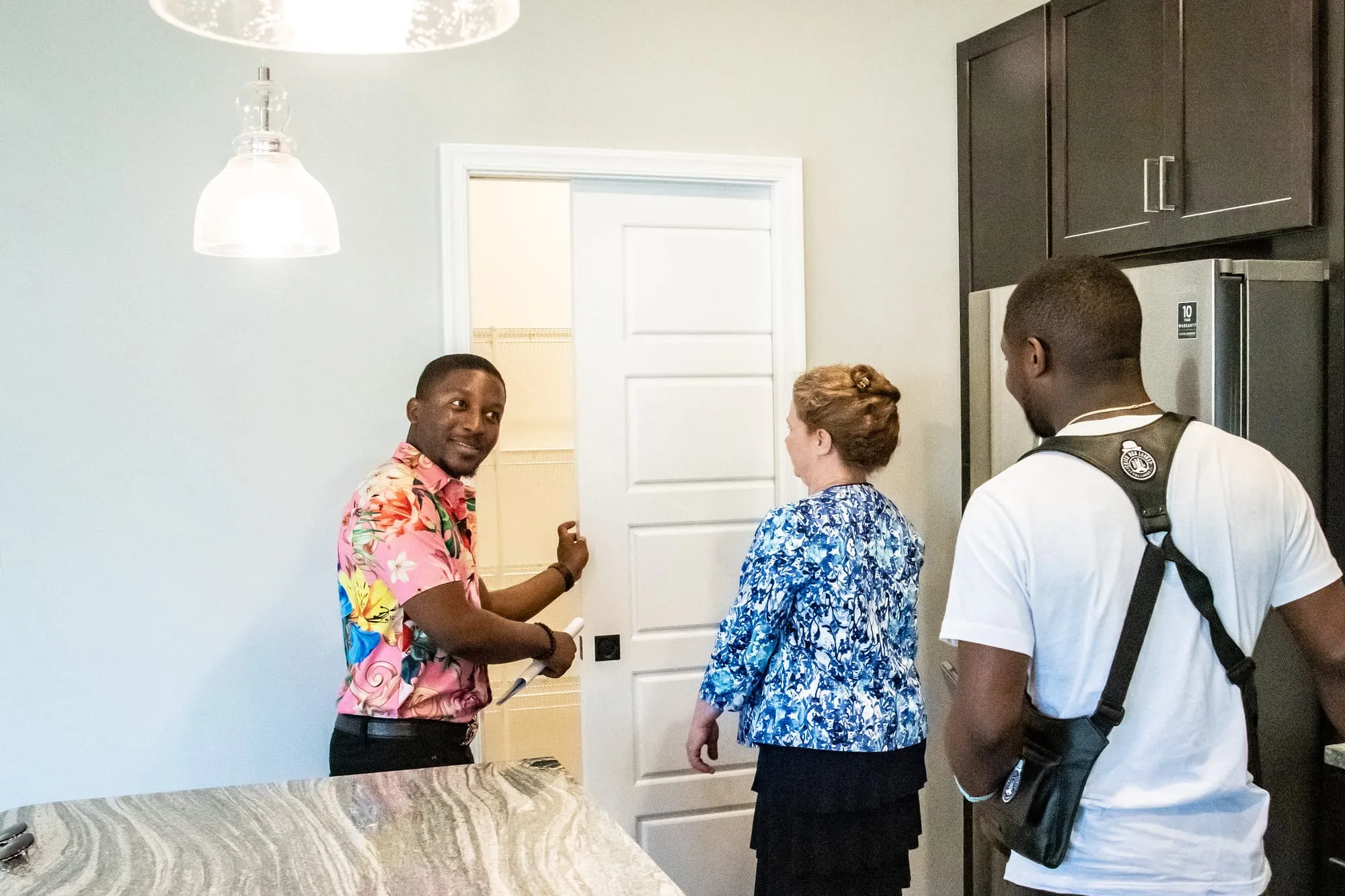
What to bring to closing
The CFPB’s list for closing day includes things and people:3
- A cashier’s check or proof of wire transfer for the exact amount you need to close.
- Your ID, such as a driver’s license.
- Your Closing Disclosure, to compare one more time with the final papers.
- The list of people to call that you prepared earlier.
- Your checkbook, in case of a last-minute change.
- Your co-borrowerco-borrowerA co-borrower is a person who applies for the mortgage with you, signs the note and is responsible for the debt just as you are. On an FHA loan, all borrowers and co-borrowers, whether or not they will live in the home, must take title in their own name or a living trust, be obligated on the note and sign the security documents. It is not the same as a co-signer: according to Fannie Mae, a co-signer signs the note and is liable for the debt but has no ownership interest on the title. Co-borrowers who will not live in the home have their own rules.See the full definition or the person co-signing the loan with you.
- A trusted friend, advisor or lawyer, if you want someone on your side at the table.
The closing costs calculator helps you see how much cash you need, and the document checklist helps you gather your papers.
From the walk-through to the keys
1. Ask for your documents
A week before
Ask who sends the Closing Disclosure and ask for the note, the mortgage and the deed too.2
2. Confirm the payment by phone
Before you send money
Call your two trusted people at the numbers you saved; never use the ones in an email.6
3. Do the final walk-through
Before you sign
Check the agreed repairs and what the seller was supposed to leave.1
4. Read every document
At the closing table
Compare the numbers with your Closing Disclosure; ask about anything you do not understand.1
5. Ask the final questions
Before you leave
Where you send payments, how taxes and insurance are paid, and whom to call afterward.3
6. Keep your packet
The same day
Check that you have the Closing Disclosure, the note, the mortgage and the deed.4
At the table: read, ask and, if needed, stop
A closing has many documents. The lender requires some and the law requires others. Whoever requires them, you have the right to review them all calmly. Do not sign until you are sure they say what you expected.1
Whom do you ask? If your question is about the sale, ask your real estate agentreal estate agentA real estate agent (often called a realtor) is the professional who helps you buy or sell a home. There are buyer's agents and seller's agents (listing agents). A buyer's agent helps you find homes that fit your needs and budget, gives you information about neighborhoods and property taxes, prepares and presents your offer, negotiates with the seller and guides you to closing. Their commission is negotiable and not set by law; it is written into the agreement you sign with your agent. On the Closing Disclosure, the agent appears in the contact table, usually with a state license number.See the full definition or the settlement agent (the title companytitle companyA title company is a company, or its authorized agent, that is qualified to issue title insurance. It searches public records for problems with the home's title (a title search), prepares the title commitment and issues the lender's and owner's policies. In most states, the fee for conducting your closing is also part of its charges. If title services are listed in section C of your Loan Estimate, you can shop for them yourself. Under the federal Real Estate Settlement Procedures Act (RESPA), a seller may not require you to buy title insurance from a particular company.See the full definition, escrow officer or attorney). If it is about the loan, ask your lender. If the answers do not add up, the CFPB says do not be afraid to stop the closing.1
If the numbers changed. Some costs can change a little. If something important about your loan changes, you get a new Closing Disclosure.1 Regulation Z says when you get a new waiting period: if the APRannual percentage rate (APR)The annual percentage rate (APR) is a broader measure of the cost of borrowing money than the interest rate. Besides the interest, it includes certain loan charges, such as discount points and some lender fees, spread over the life of the loan and expressed as a yearly percentage. That is why the APR is almost always a little higher than the interest rate. It is useful for comparing offers: if two loans have the same interest rate but a different APR, the one with the higher APR charges more in fees.See the full definition becomes inaccurate, if the loan product changes or if a prepayment penalty is added.5 For other changes, the lender gives you the corrected version at or before closing, and must let you inspect it during the business day before closing.5 Ask to see it that day.
Never sign anything blank. Do not sign a paper that says something different from what you agreed to, either.1
If you decide to walk away. You are not committed until you sign. But walking away has a cost: you might lose the earnest moneyearnest moneyEarnest money is a deposit the buyer pays when signing the purchase contract to show good faith that the offer is serious. The seller does not keep it: a neutral third party (the title company or a closing agent) normally holds it, and at closing it is applied to your down payment or closing costs. If you back out for a reason the contract allows, such as an inspection or financing contingency, you get it back; if you back out without a valid reason, you can lose it.See the full definition you gave, face other consequences for breaking the contract and lose application or appraisal fees you already paid.1 That is why the CFPB recommends knowing what your contract says before you arrive. Our guide Earnest money deposit explains when you get it back.
Sign or stop: what weighs on each side
You are bound
You sign
- You agree to repay the loan
- The lender can take back the house if you do not pay
- You receive the deed to your home
- You take home your packet of documents
It can cost you
You stop the closing
- You are not committed until you sign
- You might lose your deposit
- Breaking the contract can have consequences
- You might lose application or appraisal fees
If something important does not add up, ask first; if the answers make no sense, stopping may be better than signing a bad deal.
Protect the closing money
Closing money is a favorite target for scammers. The CFPB warns that they send fake emails posing as your agent, the settlement agent or your lawyer, with false instructions for wiring the money.6 This kind of wire fraudwire fraud at closingThis is a scam aimed at people about to close on a home. Days before closing, the scammer sends an email that looks like it comes from your real estate agent or settlement agent with "new" instructions to wire or electronically transfer your down payment or closing costs to a different account. If it works, getting the money back can be very hard. The CFPB recommends writing down two trusted contacts ahead of time, confirming any instructions with them using only those numbers, and not using phone numbers or links in the email. If it happens to you, call your bank right away to stop or reverse the transfer.See the full definition can take all your savings.
If you already sent the money to a fake account, call your bank right away and ask for a wire recall. Then file a complaint with the FBI at ic3.gov.6 Our guide Closing wire fraud and email scams explains how this scam works and what to do in the first hours.
If this is you
It is your first closing
Ask for the documents a week ahead and bring your Closing Disclosure to compare at the table.2
You are buying with a relative
Your co-borrower must come to closing with you, with ID.3
You prefer to read in Spanish
Bring someone you trust to the table and ask for time to read; you have the right to review everything calmly.1
The seller did not make a repair
Tell them right away; sometimes a credit toward your closing costs is agreed instead of the repair.1
You got an email with a new account
Do not wire anything; call your trusted people at the numbers you saved.6

After closing: keep, update and watch
You have your keys. Now, three things:
- Keep your whole packet in a safe place. Check that the four key documents are there: the Closing Disclosure, the promissory note, the mortgage or deed of trust and the deed. Your Closing Disclosure helps with taxes, refinancing and when you sell.4
- Change your address with your banks and cards, the Department of Motor Vehicles, your insurance, your other bills and the Postal Service. Adjust your budget for HOA dues and, if you do not have an escrowescrow accountAn escrow account is an account set up by your mortgage lender to pay certain property-related expenses on your behalf, mainly property taxes and homeowners insurance. The money comes from a portion of your monthly mortgage payment: each month you contribute a share and the loan servicer pays the bills when they come due. That is why your payment is higher than principal and interest alone, and why it can change when taxes or the insurance premium go up. In some states the word also names the period between the offer and the closing.See the full definition account, for property taxes and insurance.3
- Be wary of “urgent” mail. Your deed and loan details go into the public record, with your name, lender, loan amount and address. Some companies use that data to send you ads or scams, sometimes with your lender’s name at the top.4 If the company you pay (your loan servicerloan servicerThe loan servicer is the company that sends you your mortgage statements and handles the day-to-day tasks of the loan: it processes your payments, answers your questions, keeps track of principal and interest paid and manages your escrow account, if you have one. It can also offer options if you fall behind and, in certain cases, start a foreclosure. It may be the same company that lent you the money or a different one, and it is common for another company to take over the loan after closing.See the full definition) changes, you will get a notice in advance.3
Our guide Your first year as a homeowner explains what comes next.
Mistakes that cost you
Mistake: Skipping the final walk-through because you already had an inspection.
Instead: It is your only chance to confirm the repairs and what the seller was supposed to leave before you sign.1
Mistake: Seeing the documents for the first time at the closing table.
Instead: Ask for the Closing Disclosure and the other documents early so you can review them at home.2
Mistake: Signing quickly because people are waiting.
Instead: You have the right to read everything calmly; if something does not add up, ask or stop the closing.1
Mistake: Signing a blank paper to be filled in later.
Instead: Never sign blank documents or ones that say something different from what you agreed to.1
Mistake: Wiring the money using instructions from an email.
Instead: Confirm the account name and number by phone, at the number you saved earlier.6
Mistake: Walking out of the closing without knowing what is at stake.
Instead: Read your contract first: walking away can cost your deposit and other fees.1

If you need help
If you do not understand a document, or something changed and you do not know why, a HUD-approved housing counselorHUD-approved housing counselorA HUD-approved housing counselor works at an agency HUD has approved to provide housing counseling: independent, expert advice customized to your situation about buying a home, renting, a missed mortgage payment, a foreclosure or credit problems. The agencies usually charge little or nothing; many serve in Spanish and offer the homebuyer education course several assistance programs require. They are not lenders or real estate agents and sell you nothing. Your county page lists the official agencies with phone numbers.See the full definition can help you with the purchase for free or at low cost; search by ZIP code on the CFPB’s website.7 Our guide HUD-approved housing counselors explains what they do. If you have a problem with the contract or the seller, look for free legal aidlegal aidLegal aid is the free civil legal help that nonprofit organizations and their lawyers provide to low-income people in civil, not criminal, matters. In housing, that includes representing families facing eviction or foreclosure, alongside matters such as custody, child support, protection from domestic violence and access to benefits. In the United States, the Legal Services Corporation, created by Congress, funds a nationwide network of these organizations; its finder points you to the one in your area. Each sets its own income limits.See the full definition: our guide Free legal aid explains how to find it.
What to do this week
- Call your lender or settlement agent and ask who will send your Closing Disclosure and when.2
- Ask for the promissory note, the mortgage and the deed too, so you can read them ahead of time.2
- Write down the names and numbers of your two trusted people and save them in your phone.6
- Make a list of the agreed repairs for the final walk-through.1
- Ask what to bring, how much you will pay and how, and whether you would owe the seller anything if you do not close.3
Your numbers
Starts at the typical home value in the United States. Change it to the price you have in mind.
That is $11,645 (3.5% of the price). The usual minimum for this loan is 3.5%.
This week's average ± a quarter or half point.
National average as of November 5, 2026 (Freddie Mac); your rate may be different.
Adjust advanced details
Let's do the math
Estimated monthly payment
National figure$2,759
at 7.18% · 30 years
- Loan amount
- $326,673
- Total interest
- $470,006
- Paid off in
- November 2056
Includes $5,618 FHA upfront mortgage insurance premium.
Does it fit the income?
Comfortable
up to $1,884 a month
Tight
$1,884 to $2,422 a month
Hard
more than $2,422 a month
Your payment · 41%
Compared with the typical household income in the United States ($80,734 a year). Reference: HUD calls paying more than 30% of income for housing a cost burden.
| Principal & interest | $2,213 |
|---|---|
| Property tax | $261 |
| Home insurance | $139 |
| FHA mortgage insurance (MIP) | $147 |
How does it compare with incomes?
For this payment to be 28% of your income, you'd need to earn about $118,260 a year. With your other debts, to stay under 36%: about $91,980 a year.
You need at least $11,645 for the down payment, plus closing costs.
This is an estimate to give you an idea, not a loan offer. Your real payment depends on your rate, your credit, and the insurance and taxes on the home you buy.
Total monthly payment $2,759; principal and interest $2,213.
Ready to see the numbers? Find your county here
See how this applies in your county: its loan limits, prices and rents, from the official data.
Printable checklist
Frequently asked questions
What is the final walk-through?
It is your last visit to the home before you sign. The CFPB recommends using it to confirm that everything you and the seller agreed would be repaired was repaired and that what the seller agreed to leave is still there. If something is missing, tell the seller right away.
What if the walk-through shows a repair was not made?
Contact the seller right away, through your agent. Sometimes, instead of making the repair, the seller gives you money toward your closing costs, called a seller credit. Get any change in writing before you sign.
What do I need to bring to closing?
Per the CFPB checklist: your ID, a cashier's check or proof of wire transfer for the exact amount, your Closing Disclosure, the list of people to call, your checkbook in case of changes and your co-borrower. Ask the person running the closing whether you need anything else.
Can I walk out of the closing without signing?
Yes. The CFPB says you are not committed until you sign. But you might lose your deposit, face other consequences for breaking the contract and lose fees you already paid the lender. Read your contract beforehand to know what is at stake.
Can the numbers change on closing day?
Some costs can change slightly. If something important changes, you get a new Closing Disclosure. If the APR rises beyond what is allowed, the loan product changes or a prepayment penalty is added, the law gives you a new waiting period before closing.
I got an email with a new account for the closing money. What do I do?
Do not wire anything. Call your agent or settlement agent at the number you saved earlier, not the one in the email. The CFPB says never follow instructions contained in an email. If you already sent the money, call your bank right away and file a complaint at ic3.gov.
Which papers should I keep after closing?
The whole packet. The CFPB says to check that you have the Closing Disclosure, the promissory note, the mortgage or deed of trust and the deed. The Closing Disclosure helps with taxes, refinancing and when you sell.
Sources
Every figure in this guide comes from one of these official sources. The number next to a sentence leads to the source behind it.
Each source on one line: who publishes it, its title, its address and the date we read it.
- 1. Consumer Financial Protection Bureau (CFPB) · Close the deal · consumerfinance.gov · Accessed October 31, 2026
- 2. Consumer Financial Protection Bureau (CFPB) · Review documents before closing · consumerfinance.gov · Accessed October 31, 2026
- 3. Consumer Financial Protection Bureau (CFPB) · Your mortgage closing checklist · files.consumerfinance.gov · Accessed October 31, 2026
- 4. Consumer Financial Protection Bureau (CFPB) · After closing · consumerfinance.gov · Accessed October 31, 2026
- 5. Consumer Financial Protection Bureau (CFPB), via eCFR · 12 CFR §1026.19, Certain mortgage and variable-rate transactions (Regulation Z) · ecfr.gov · Accessed October 31, 2026
- 6. Consumer Financial Protection Bureau (CFPB) · Mortgage closing scams: How to protect yourself and your closing funds · consumerfinance.gov · Accessed October 31, 2026
- 7. Consumer Financial Protection Bureau (CFPB) · Find a housing counselor · consumerfinance.gov · Accessed October 31, 2026
Keep reading
Related guides
If this guide helped, these follow the same path.

Buying a home 18 minute read
Closing Disclosure explained: what to check before signing
What the Closing Disclosure is, when it must reach you, what to check on each of its five pages and which closing costs are not allowed to go up.
- Five pages, at least three business days before closing; Sundays and federal holidays do not count, Saturdays do.
- Compare it with your latest Loan Estimate: rate, APR, monthly payment, prepayment penalty, balloon payment and cash to close.
- The lender's charges cannot rise above the Loan Estimate; recording fees and services from the lender's list can rise up to 10 percent in total; any excess is refunded.
- Buying a home Closing costs explained: what you pay and what can change What closing costs are, how to read them on your Loan Estimate, which charges cannot go up before closing and how to compare offers to pay less. 14 minute read
- Buying a home Earnest money deposit: how it works and how to protect it What the earnest money deposit is when you make an offer on a home, who holds it, when you get it back, when you can lose it and how to avoid wire fraud. 12 minute read
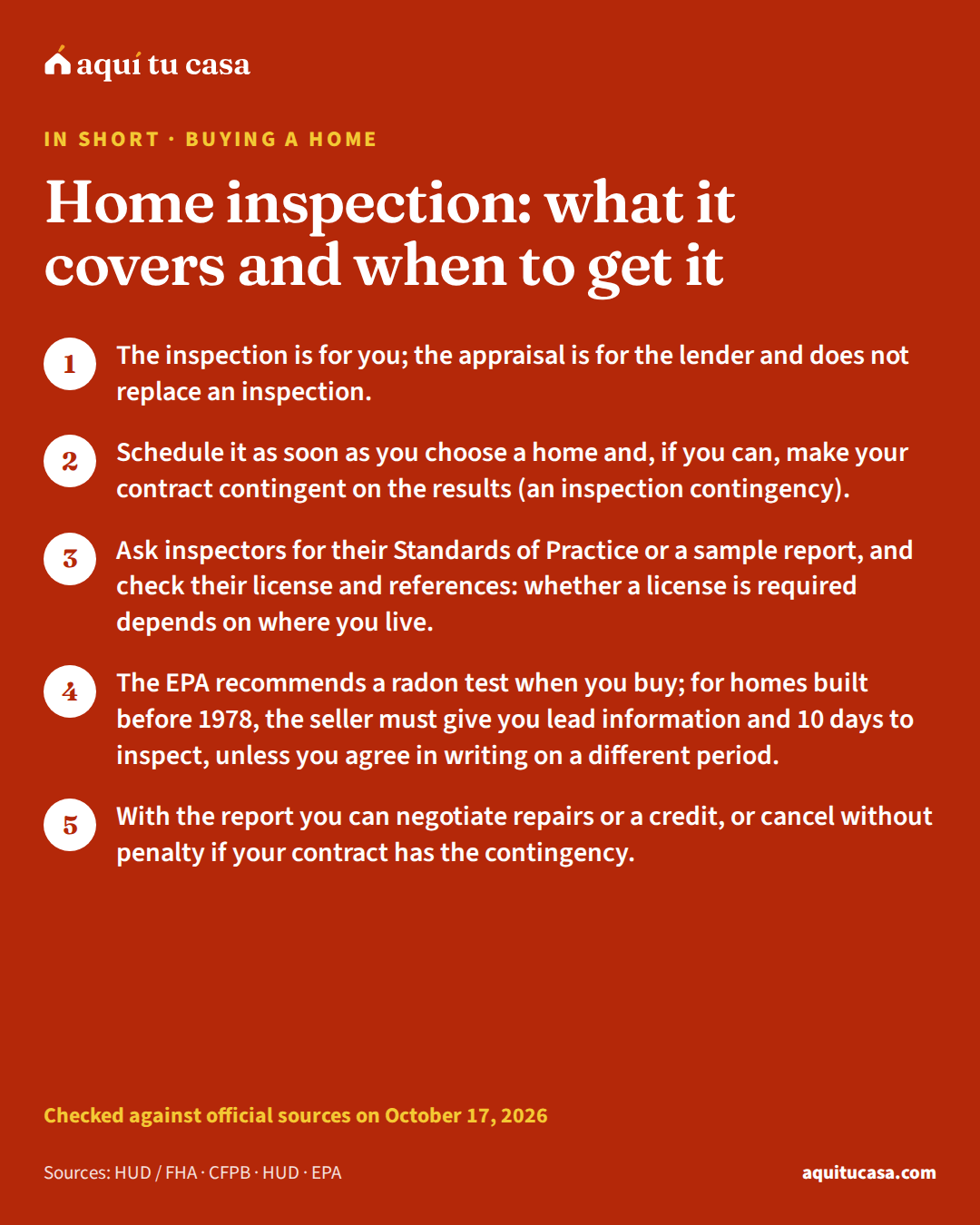
- Buying a home Home inspection: what it covers and when to get it What a home inspection is, how it differs from the appraisal, when to get it under a contingency, radon and lead tests, and what to do with the report. 12 minute read
Tools for this topic
Was this guide useful?
Thank you. Your answer stays in your browser; nothing is sent.