Home insurance claims: adjusters, denials and complaints
How to file and document a home insurance claim, what each kind of adjuster does, the check with your lender and what to do if you are denied or underpaid.
Verified against official sources on October 31, 2026 5 official sources

Show contents
In short
What you need to know
Quick answer
After damage, protect your home from more damage, tell your company as soon as possible, document everything with photos and a list, and do not make permanent repairs until the adjuster sees it. The company assigns an adjuster; a public adjuster is different: you hire them and they charge a fee. If you have a mortgage, the check for the structure usually comes in your name and your lender's, and the lender releases the money as repairs are done. If you disagree or are denied, ask for the reasons in writing, check the appraisal clause and complain to your state insurance department.
What matters most
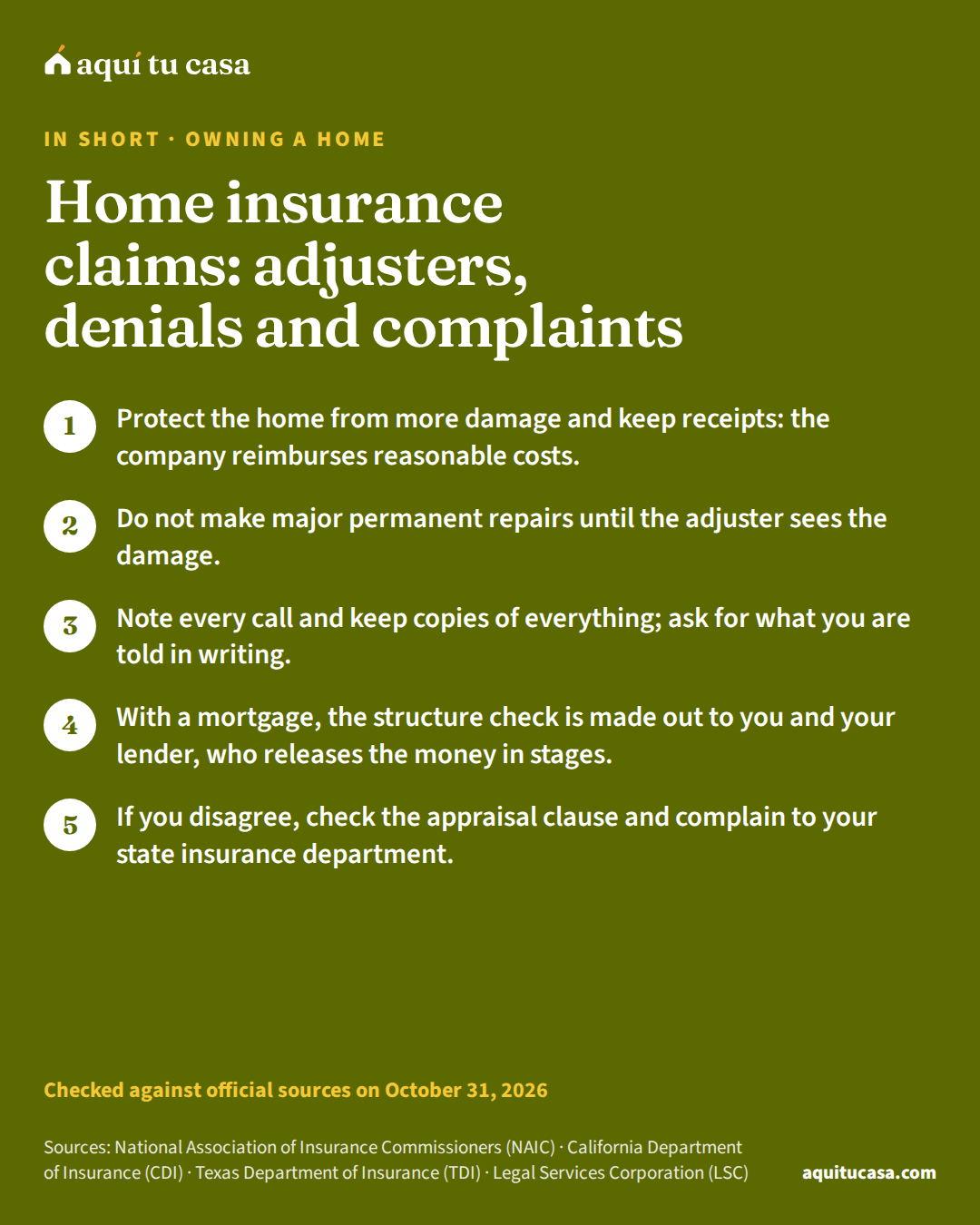
- Protect the home from more damage and keep receipts: the company reimburses reasonable costs.
- Do not make major permanent repairs until the adjuster sees the damage.
- Note every call and keep copies of everything; ask for what you are told in writing.
- With a mortgage, the structure check is made out to you and your lender, who releases the money in stages.
Is this for you?
This guide is for you if…
- Your home was damaged (storm, fire, water, theft) and you are going to file an insurance claim.
- You already filed and disagree with what the company offers, or your claim was denied.
- An insurance check arrived in your name and your mortgage company's and you do not know what to do.
Get direct help first if…
- You do not have insurance yet or want to understand what a policy covers: read «Home insurance: what it covers, what it doesn't and how much to insure».
- The damage came from a flood: homeowners insurance generally does not cover it; read «Flood insurance and the NFIP».
Damage to your home is stressful, and the insurance claim can feel like one more problem. But what you do in the first days matters a lot for how much you are paid. This guide explains how to file and document a claim on your homeowners insurancehomeowners insuranceHomeowners insurance pays for losses and damage to your property if something unexpected happens, like a fire or a burglary, and usually includes liability coverage if someone is hurt at your home. Lenders require it as long as you have a mortgage, because the home is their collateral, and almost always collect it inside your monthly payment through the escrow account. The price depends on the location, the rebuilding cost, the deductible and your history. A standard policy does not cover floods or, in many states, earthquakes: those risks are insured separately.See the full definition, what each type of adjuster does, what happens to the check if you have a mortgage and what to do if you disagree. Our guide Home insurance explained covers what a policy pays for.1
Before you file: think about the deductible and your history
The NAIC explains that how many claims you file, and what kind, can affect your premiuminsurance premiumAn insurance premium is what you pay the insurance company in exchange for your policy's protection. It can be paid in one lump sum or, more often, in periodic installments for the life of the contract. Each company decides whether to sell you a policy and how much to charge. For home insurance it usually looks at the cost to rebuild the home, building materials, location, nearness to a fire station, your past claims and, at some companies, your credit score. Discounts can lower it. If you stop paying the premium, the company can cancel your policy.See the full definition and whether the company renews your policy. If the repair costs little more than your deductible, you might prefer to pay yourself. Most companies report your claims to private nationwide databases, such as CLUE, that other insurers check.1
That does not mean you should not file for major damage: that is what you pay insurance for. It means doing the math before you file for small damage.
The first days: protect, report and document
1. Protect your home from more damage. It is your obligation. The NAIC gives examples: boarding it up or cleaning up water.1 California’s guide adds covering the roof, walls, doors and windows with plastic sheeting or plywood. The policy may not cover damage that follows if you did not take reasonable steps, and the company reimburses reasonable costs if you keep the receipts. Watch out for contractors who encourage you to spend a lot on temporary repairs, and do not make major permanent repairs until the adjuster has seen the damage.2 Our guide Contractor and home repair scams explains the warning signs.
2. Tell your company as soon as possible and ask which forms or documents you need.1 Ask these questions: does my policy cover this damage? how long will the claim take? do I need repair estimates? what is my deductible?2
3. Document everything. Take photos and video of the damage. List your damaged belongings with brands and model numbers.2 Keep a log of every call and copies of all correspondence.2
4. If you cannot live in your home, keep receipts for housing, food, clothing, extra transportation, moving and storage. They may be covered by the loss-of-use part of your policy, also called additional living expensesadditional living expenses (ALE)Additional living expenses (ALE) is a home insurance coverage that pays the extra you spend when you have to leave your home while damage the policy covers is repaired. According to the Texas Department of Insurance (TDI), it includes rent, food and other costs you would not have if you were still in your home. Puerto Rico's Office of the Insurance Commissioner (OCS) explains that it does not pay all your expenses, only what goes above normal: for example, a hotel, but not your mortgage. The coverage has a dollar limit and, in some policies, a time limit too. Keep all your receipts.See the full definition. The company usually advances money for those costs, and what it advances counts toward the final payment.2
From damage to payment
1. Protect the home
The same day, if it is safe
Temporary repairs, such as plastic or plywood, and keep the receipts.2
2. Tell your company
As soon as possible
Ask what is covered, how long it will take, which documents you need and your deductible.1
3. Document the damage
Before repairing
Photos, video and a list of damaged items with brands and models.2
4. Meet the adjuster
When the company sends one
Go with them, show them everything and note the date and what they said.2
5. Fill out the proof of loss
If you are asked
A formal statement of what you lost; review it before you sign.2
The company’s adjuster and the proof of loss
The company assigns an adjuster to review the damage and decide the payment. They may be an employee of the company or an independent contractor, and you should cooperate with their investigation.1 Try to be home when they come, show them all the damage and write down what they say.
Sometimes the adjuster first does a brief review of the damage, called a scope of loss, with the type of damage, the quality of materials and measurements, and comes back later to complete the estimate. The company may also send you a proof of lossproof of lossA proof of loss is your signed, sworn statement of how much money you are claiming from your insurance for a loss. In the standard National Flood Insurance Program (NFIP) policy for homes, it includes the date and cause of the loss, anyone else with an interest in the property, other insurance that may cover the loss, repair estimates and the list of damaged items. You decide the amount and justify it. You must send it within the policy's deadline, even if the adjuster does not give you the form. In Texas, the Department of Insurance (TDI) explains that your home insurance company may ask for a signed, notarized proof of loss form.See the full definition form: a formal statement of what you lost.2 Read it calmly and do not sign anything you do not understand.
Replacement cost or actual cash value. If your policy pays the replacement costreplacement costReplacement cost is a way a home insurance policy pays for damage: it gives you the money to repair or rebuild your home, or replace your belongings, with materials of similar quality at today's prices, without subtracting what they lost in value from age or use (depreciation). It is different from actual cash value, which does subtract depreciation. Many insurers pay these claims in two checks: the first one minus depreciation, and the second, for the amount held back, when you finish the repair. Your policy says which of the two methods it uses.See the full definition of your belongings, you normally have to replace them before you are paid that cost. If you decide not to replace something, you are paid its actual cash valueactual cash value (ACV)Actual cash value (ACV) is a way a homeowners or renters insurance policy pays for damage: it gives you what it costs to repair or replace what was damaged minus depreciation, meaning the value it lost from age, use or wear. That is why it usually pays less than replacement cost, and you cover the difference. Many policies pay for your personal belongings this way unless you buy replacement cost coverage. And if you have that coverage, the first check on your claim is often for the actual cash value.See the full definition. The company usually gives you several months to replace things; ask how many.2

The check and your mortgage company
If you have a mortgage, the payment has one more step. According to the California Department of Insurance, you usually get separate checks for the structure, your belongings and additional living expenses. The check to repair the structure is made out to you and your lender, who must endorse it. Lenders usually put that money in an account and release it as the work is done. Show your lender your contractor’s bid and how much they want up front; the lender may want to inspect the work before the final payment.2
Call your loan servicerloan servicerThe loan servicer is the company that sends you your mortgage statements and handles the day-to-day tasks of the loan: it processes your payments, answers your questions, keeps track of principal and interest paid and manages your escrow account, if you have one. It can also offer options if you fall behind and, in certain cases, start a foreclosure. It may be the same company that lent you the money or a different one, and it is common for another company to take over the loan after closing.See the full definition as soon as you know a large payment is coming and ask what papers it needs and how it releases the money. And keep paying your mortgage on time while the claim is resolved. If the damage makes payments hard, our guide If you can’t pay your mortgage explains your options.
Example with real numbers
A family after a storm
An example in words, not a real case, of how the payments arrive.
- The damage
- Wind tears off part of the roof and water gets into a bedroom
- What they do first
- They put plastic on the roof, keep the receipt and tell their company
- During repairs
- They stay with relatives and keep receipts for food and extra transportation
- The roof check
- It comes in their name and their lender's, and the lender releases the money in stages
- What they get separately
- A check for their damaged belongings and another for additional living expenses
The steps in this example come from the NAIC and the California Department of Insurance.12 Use the family budget to plan costs while repairs last.
Run it with your numbersFamily budgetIf you disagree or your claim is denied
1. Talk to your company first. The NAIC recommends trying to resolve it with the company and not feeling pressured to accept something you are not comfortable with; it may help to have your contractor meet with you and the adjuster.1 The Texas Department of Insurance says the same: explain why you disagree and send documents, such as a contractor’s estimate.3 In California, the state’s guide suggests talking to the claims manager and sending a letter with copies to the claims executive at headquarters.2
2. Ask for the denial in writing. In California, the fair claims rules set deadlines for the company to respond and pay, and a denial must be in writing, with the reasons, and tell you the Department of Insurance can review it.2 Even if you live elsewhere, always ask for the reasons in writing.
3. Check the appraisal clause. If the disagreement is about the value of the claim, see whether your policy has an appraisal clause.1
4. Consider a public adjuster, carefully. A public adjusterpublic adjusterA public adjuster is a licensed person you can hire to represent you in your claim with your insurance company. They work for you, not the insurer, and charge fees or a commission under the contract. In Puerto Rico, they need a license from the Office of the Insurance Commissioner (OCS), the contract must be in writing, and they may not settle without your knowledge and consent or lead you to believe you can only file through them. In Texas, they need a license from the Department of Insurance (TDI) and cannot give legal advice or do the repairs. Hiring one is optional: you can file a claim on your own.See the full definition is not a lawyer or a government employee: you hire them and they charge you, and not every state allows them.1 In Texas they must be licensed and can charge up to 10% of the total the company pays, not just the amount you dispute. You can ask for the fee in dollars in the contract. Even if the company does not raise its offer, you might still owe them, and you still pay your deductible. In Texas they cannot act as your contractor, knock on your door seeking business during a disaster or after 9 p.m., give legal advice or keep you from talking with your company.4
5. Complain to your state insurance department. It has staff who help resolve disagreements with your company.1 In Texas, the department contacts the company, which has 15 days to answer and can ask for 10 more. But it cannot make a company pay unless not paying violates the law or the policy, or decide facts such as whether damage came from a storm or wear and tear, and it does not handle complaints about mortgage companies or contractors.3 In California, the department can open a claims review or refer you to a mediation program that is free for you.2 The NAIC website lists each state department’s website,1 and your state’s page on this site gathers information for your state.
The company's adjuster or a public adjuster
Assigned by your insurer
The company's adjuster
- You do not pay them
- May be an employee or an independent contractor
- Reviews the damage and proposes a payment
- You should cooperate with the investigation
You hire them
Public adjuster
- Charges you, in Texas up to 10% of the total
- Must be licensed where allowed
- Negotiates with the company for you
- Can charge you even if the offer does not go up
Before you hire a public adjuster, check their license and get the fee in writing.
If this is you
The damage is small
Compare the cost with your deductible; claims can affect your premium and renewal.1
You have to live somewhere else
Keep receipts; loss of use can cover housing, food and extra transportation.2
A contractor knocks on your door after the storm
Do not sign in a rush; in Texas, public adjusters cannot go door to door for business during a disaster.4
The check includes your lender
Call your servicer: it endorses the check and releases the money in stages.2
You prefer to talk in Spanish
Ask for the offer to be explained in writing and log every call with date and name.2

Mistakes that cost you
Mistake: Waiting to tell the company.
Instead: Report it as soon as possible and ask which documents you need.1
Mistake: Making permanent repairs before the adjuster comes.
Instead: Only temporary repairs, with receipts, until they have seen the damage.2
Mistake: Not protecting the home from more damage.
Instead: It is your obligation; the policy may not cover damage that follows.2
Mistake: Throwing away hotel and food receipts.
Instead: Additional living expenses are paid with receipts.2
Mistake: Signing with a public adjuster without reading the fee.
Instead: Ask for the fee in dollars and check the license; in Texas, up to 10% of the total.4
Mistake: Accepting a denial over the phone.
Instead: Ask for the reasons in writing and, if it is not resolved, complain to your state.2
Free help
Your state insurance department helps with questions and complaints about your claim, at no cost.1 If you are thinking of suing or the claim is large and complicated, the LSC funds civil legal aidlegal aidLegal aid is the free civil legal help that nonprofit organizations and their lawyers provide to low-income people in civil, not criminal, matters. In housing, that includes representing families facing eviction or foreclosure, alongside matters such as custody, child support, protection from domestic violence and access to benefits. In the United States, the Legal Services Corporation, created by Congress, funds a nationwide network of these organizations; its finder points you to the one in your area. Each sets its own income limits.See the full definition for low-income people; its website finds the nearest organization, and LawHelp.org has free information.5 If the damage came from a hurricane, flood or fire, our guide After a hurricane, flood or fire explains government help, and Flood insurance and the NFIP covers that separate claim.

What to do this week
- Find your policy and write down your policy number, deductible and claims phone number.1
- If damage has already happened, take photos and video before any repair.2
- Start a call log: date, name and what you were told.2
- Call your loan servicer and ask how it handles insurance checks.2
- If you disagree with the offer, ask for the reasons in writing and look up your state insurance department.3
Your household this month
Let's do the math
Left each month
Enter what at least one person takes home to see the result.
What helps
- Pay savings first: set the goal aside the day the money arrives, before flexible spending.
- Add up the bills that come every few months (car insurance, school) and divide by twelve.
- If income changes, plan on a low month and save the extra from good months.
- A HUD-approved housing counselor can go over the budget with you, often for free.
This is a planning tool with your numbers, not a credit evaluation or an approval. The split reference is only a guide.
Ready to see the numbers? Find your county here
See how this applies in your county: its loan limits, prices and rents, from the official data.
Printable checklist
Frequently asked questions
Is it always worth filing a claim?
Not always. The NAIC explains that how many claims you file can affect your premium and whether your policy is renewed, and that if repairs cost little more than your deductible, you might prefer to pay yourself. Most companies report your claims to databases such as CLUE.
Can I fix the damage before the adjuster comes?
Make temporary repairs to prevent more damage, such as boarding windows or putting plastic on the roof, and keep the receipts. But do not make major permanent repairs until the adjuster has seen the damage.
What is the difference between the company's adjuster and a public adjuster?
The company's adjuster is assigned by your insurer; they may be an employee or an independent contractor. A public adjuster is someone you hire to negotiate with the company, and they charge you. In Texas they must be licensed and can charge up to 10% of the total the company pays.
Why is the check made out to me and my mortgage company?
Because the lender has an interest in getting the home repaired. According to the California Department of Insurance, the lender must endorse the check, usually puts the money in an account and releases it as the work progresses.
Will I be paid if I have to live elsewhere during repairs?
Many policies have loss-of-use or additional living expense coverage. Keep receipts for housing, food, extra transportation and moving. The company usually advances money, which counts toward the final payment.
My claim was denied. What do I do?
Ask for the reasons in writing. Talk to the claims manager and send your documents. Check whether your policy has an appraisal clause. If it is not resolved, complain to your state insurance department and look for legal help.
Can the insurance department make the company pay?
Not always. In Texas, for example, the department cannot make a company pay unless not paying violates the law or the policy, or decide whether damage came from a storm or wear and tear. But it does contact the company and ask for a response.
Sources
Every figure in this guide comes from one of these official sources. The number next to a sentence leads to the source behind it.
Each source on one line: who publishes it, its title, its address and the date we read it.
- 1. National Association of Insurance Commissioners (NAIC) · A Consumer's Guide to Home Insurance · content.naic.org · Accessed October 31, 2026
- 2. California Department of Insurance (CDI) · Residential Property Claims Guide · insurance.ca.gov · Accessed October 31, 2026
- 3. Texas Department of Insurance (TDI) · How to get help with a homeowners or renters insurance complaint · tdi.texas.gov · Accessed October 31, 2026
- 4. Texas Department of Insurance (TDI) · Public insurance adjusters · tdi.texas.gov · Accessed October 31, 2026
- 5. Legal Services Corporation (LSC) · I Need Legal Help · lsc.gov · Accessed October 31, 2026
Keep reading
Related guides
If this guide helped, these follow the same path.

Owning a home 13 minute read
Home insurance explained: what it covers, how much to buy
What home insurance covers, why the lender requires it, how to choose the amount and the deductible, why flood is separate and what happens if it lapses.
- It covers damage to the house and your belongings, living expenses if you cannot live there and your liability toward others; the policy's face amount is the cap.
- Insure for replacement cost (rebuilding) and, per the NAIC, for at least 80 percent of that value; a higher deductible lowers the premium but comes out of your pocket on every claim.
- Flood and earthquake are not in the typical policy: flood insurance is separate, typically takes 30 days to take effect and is mandatory in high-risk areas with a federally backed mortgage.
- Owning a home Flood insurance (NFIP): who needs it and what it covers Why home insurance does not cover floods, when you must buy NFIP coverage, what it covers, the 30-day wait, flood zones and how to file a claim. 13 minute read
- Owning a home Earthquake and wildfire insurance What your homeowners policy leaves out, how earthquake policies work, what the FAIR Plan is and what to do if your insurer drops you over wildfire risk. 11 minute read
- Money problems After a hurricane, flood or fire: what to do What to do after a disaster: your home, flood or renters insurance claim, federal disaster aid, your mortgage and how to avoid scams. 16 minute read


Tools for this topic
Was this guide useful?
Thank you. Your answer stays in your browser; nothing is sent.