Heating and air conditioning: when to repair and when to replace
When to think about replacing your AC or furnace, the upkeep ENERGY STAR recommends, how to hire a technician and which public help pays for the repair.
Verified against official sources on November 6, 2026 11 official sources
Show contents
In short
What you need to know
Quick answer
According to the Department of Energy, think about replacing the equipment if your air conditioner or heat pump is more than 10 years old, if your furnace or boiler is more than 15, if it keeps failing and your bills keep rising, or if some rooms stay too hot or too cold. First, get it checked: ENERGY STAR recommends a check-up every year, cooling in spring and heating in fall, and checking the ducts and air leaks. Get detailed written estimates. If your income is low, your state's weatherization or energy assistance program may help.
What matters most
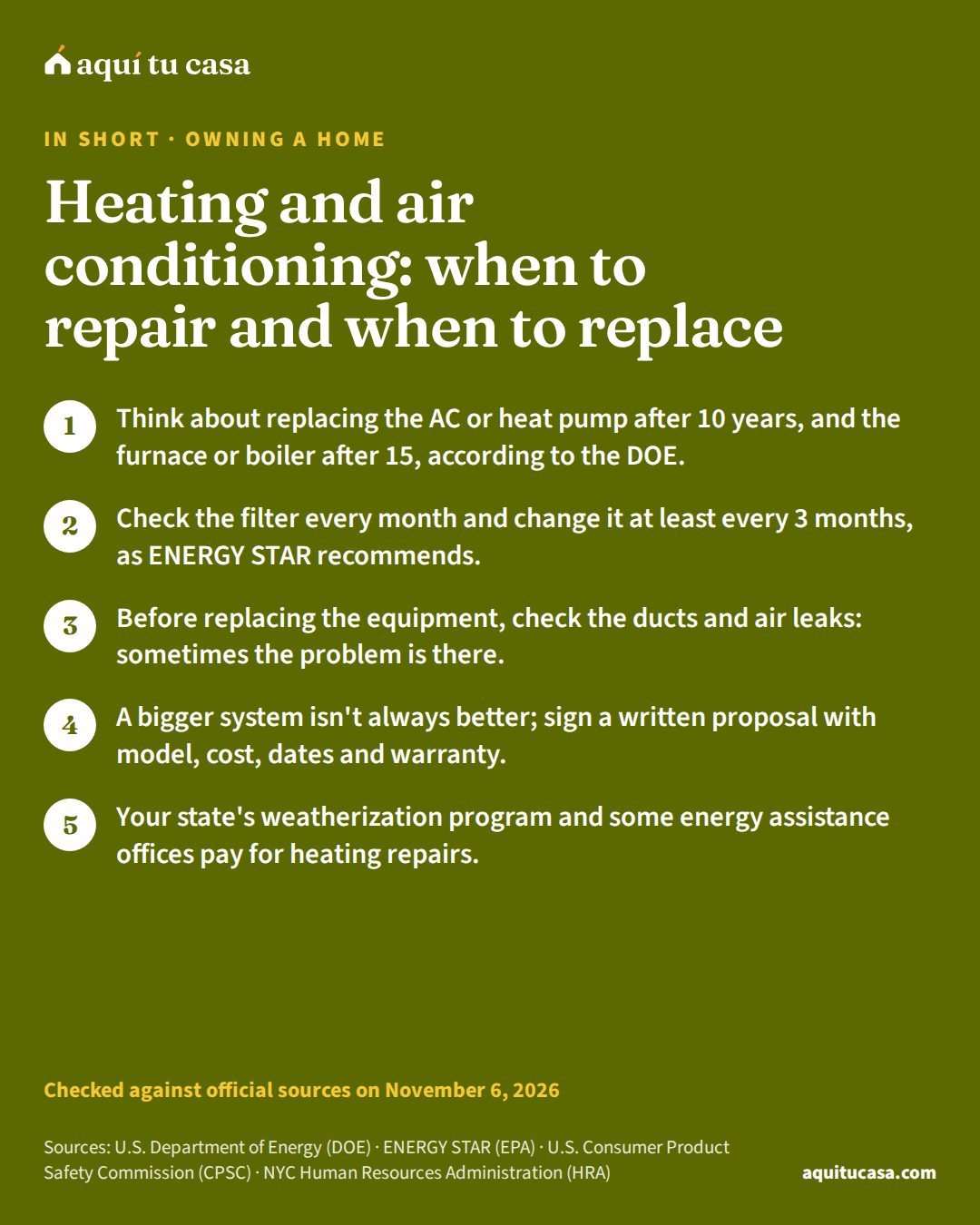
- Think about replacing the AC or heat pump after 10 years, and the furnace or boiler after 15, according to the DOE.
- Check the filter every month and change it at least every 3 months, as ENERGY STAR recommends.
- Before replacing the equipment, check the ducts and air leaks: sometimes the problem is there.
- A bigger system isn't always better; sign a written proposal with model, cost, dates and warranty.
Is this for you?
This guide is for you if…
- You own your home and your air conditioner, furnace or heat pump is failing or getting old.
- You were quoted a price to replace the equipment and want to know what to ask.
- Your income is low and you need help repairing the heat or the air conditioning.
Get direct help first if…
- You rent: the repair is usually the landlord's job; the renters' repairs guide explains your rights.
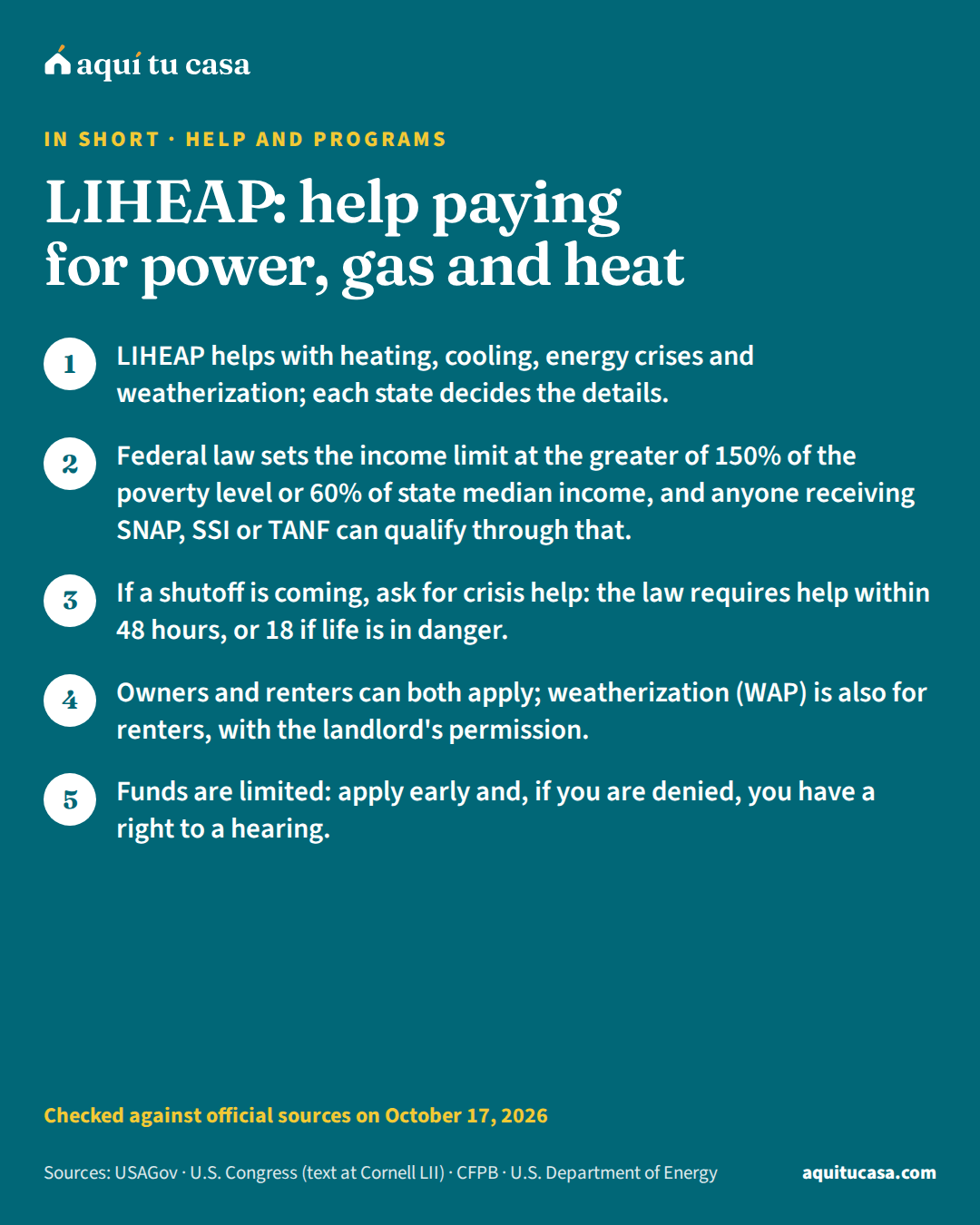
- You only need help paying the electric or gas bill: the LIHEAP guide covers it.
When the air conditioning quits in July or the furnace won’t start in January, the house becomes hard to live in, especially for children and older relatives. This guide is for you if you own your home and your heating or cooling equipment is failing, costing a lot or getting old. It explains when to think about replacing it, what upkeep ENERGY STAR recommends, how to hire a technician and what public help exists if your income is low.
Signs it’s time to think about replacing it
The Department of Energy (DOE) Energy Saver Guide says to consider replacing your system if any of these is true: your heat pump or air conditioner is more than 10 years old; your furnace or boiler is more than 15 years old; the equipment needs frequent repairs and your energy bills are going up; or some rooms in the house are too hot or too cold.1
Reaching that age doesn’t mean you must replace it today. The DOE also says your contractor should give you information on the safety and cost effectiveness of repair versus replacement, and on the heating and cooling options available.1 Ask for that information in writing.
ENERGY STAR adds something important: before investing in a new system, fix the big air leaks in the house and the ducts, because sometimes they are the real problem and not the equipment.3 A new air conditioner hooked up to leaky ducts still cools poorly.
The upkeep ENERGY STAR recommends
ENERGY STAR recommends having a contractor do a check-up every year before each season: cooling in the spring and heating in the fall, because contractors get busy in summer and winter.2 A good reminder is to do it when the clocks change.
What a typical check-up includes, according to ENERGY STAR
1. Thermostat and electrical connections
Every year
Check the thermostat, tighten connections and lubricate moving parts.2
2. Drain and air conditioning coils
In spring
Check the condensate drain, clean the coils and measure the refrigerant.2
3. Gas, burner and heat exchanger
In fall
On gas or oil equipment: an improperly operating connection is a fire hazard.2
The filter is the easiest part to care for yourself. ENERGY STAR says to check it every month, especially in winter and summer; if it looks dirty after a month, change it, and at a minimum every 3 months. A dirty filter makes the system work harder and can lead to expensive maintenance or early failure.3
Ducts matter too. According to ENERGY STAR, nearly half the energy used in a home goes to heating and cooling, and sealing and insulating ducts can improve efficiency by as much as 20 percent, and sometimes much more.3
How to hire the technician
ENERGY STAR gives this advice for hiring a heating and cooling contractor: find out your state’s license and insurance requirements; know your system’s model and maintenance history; ask for references from other customers and call them.4
The contractor should look over your home carefully. ENERGY STAR says a bigger system isn’t always better, and that size is figured from your house, insulation and windows.4 If someone quotes you a price over the phone without seeing the house, get another opinion.
Get written, itemized estimates, and compare cost, efficiency and warranties. Before work starts, sign a written proposal that states the cost, the model numbers, the job schedule and the warranty.4 ENERGY STAR also warns that improper installation can cut system efficiency by up to 30 percent.3 The guide to what a repair quote must include helps you check each point.
Repair or replace the equipment
Younger equipment
Repair
What should happen when the technician visits
A quick visit isn’t enough. ENERGY STAR says the contractor should spend significant time inspecting your current system and your home. A good contractor inspects the ducts, if there are any, for air leaks and insulation, and measures airflow to make sure it meets the manufacturer’s specifications.4
If they propose new equipment, ask them to show you the savings calculations: ENERGY STAR says contractors should be able to do that for equipment with its label. It also recommends checking for rebates on certified efficient equipment before you buy.4
While the technician works, write down what they find and ask them to put it in the estimate: which part is failing, what they recommend and why. If you get a second opinion later, the other contractor can compare the same problem and not a different one. Keep these notes with your service invoices: they show how many times the equipment has failed, which is one of the signs the DOE names.1
The heat pump as an option
An air source heat pump heats in winter and cools in summer. ENERGY STAR says that, in most zones, it can go in as a drop-in replacement when the central air conditioner or the furnace needs replacing, and that its cold-climate certification requires performance testing down to 5 °F.5 If your winters are very cold, ask the contractor for a model certified for cold climates and whether you need back-up heat. Ask, too, how the new unit will connect to the ducts you already have, and whether they need sealing first, since leaky ducts waste part of what any new system produces.3
The federal tax credit the IRS gave for heat pumps covered improvements made through December 31, 2025.11 If a seller tells you today that “the government pays part of it,” ask them to show you the rule in writing.
Example with real numbers
A family with a 12-year-old air conditioner
An example in words of how the rules apply; prices change with your area.
- The equipment
- 12-year-old central AC; two rooms stay hot
- What the DOE says
- Over 10 years and rooms too hot: time to think about replacing it
- Before deciding
- Check the filter, ducts and air leaks
- Estimates
- Two or more, written and itemized
- What you sign
- A proposal with cost, models, dates and warranty
The signs come from the DOE;1 the ducts, leaks and proposal, from ENERGY STAR.34 Plan the cost in your family budget.
Run it with your numbersFamily budget
Public help repairing heating or cooling
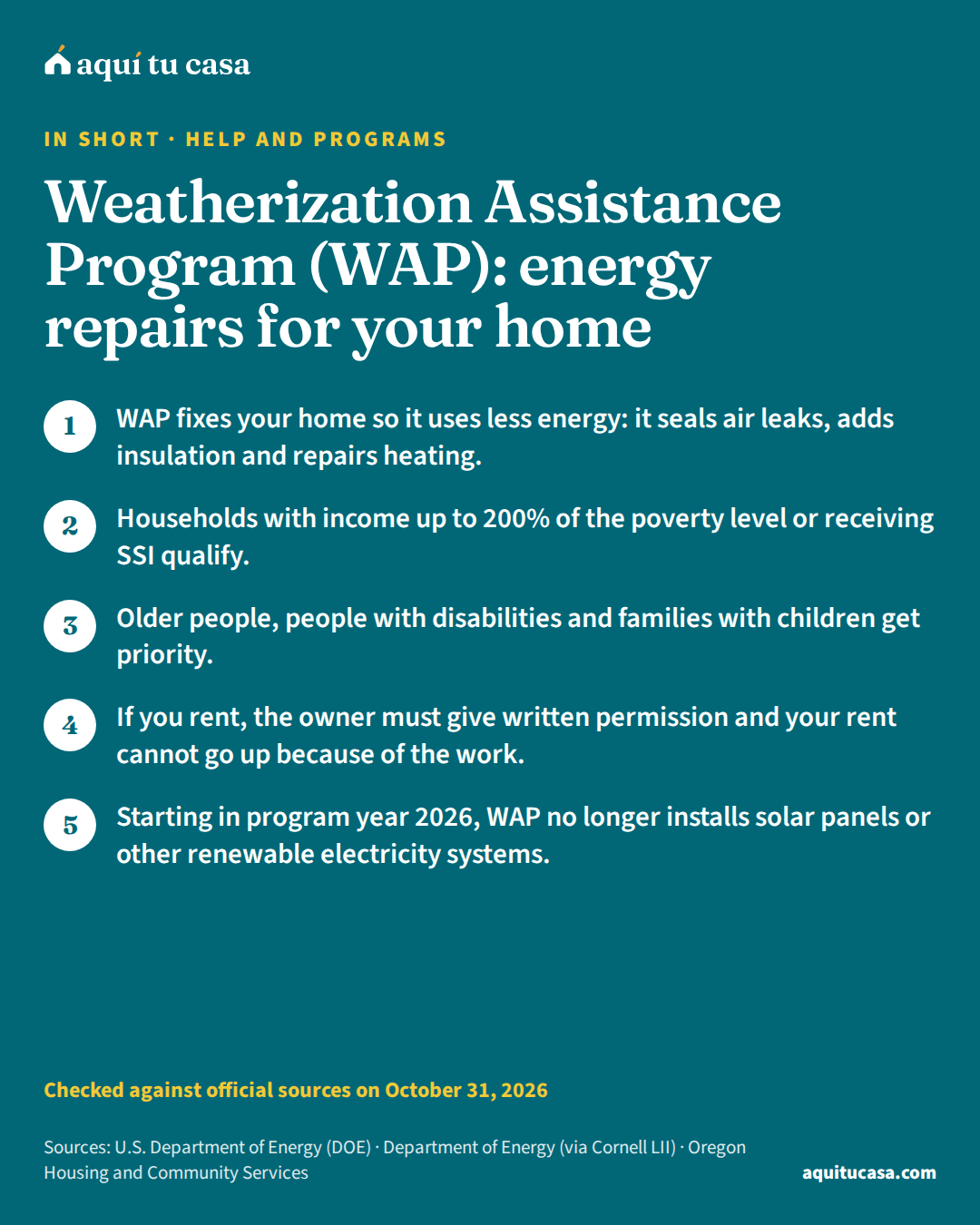
The weatherizationweatherizationWeatherization means improvements that make your home more energy efficient, such as sealing doors and windows or making the furnace work better. The U.S. Department of Energy's Weatherization Assistance Program (WAP) makes these improvements in low-income homes to lower their energy costs while protecting their health and safety. States and local organizations run it. Both homeowners and renters can apply; if you rent, the provider gets your landlord's permission before work begins. If you are income eligible, you are placed on a waitlist.See the full definition program, the Weatherization Assistance Program (WAP), is run in each state. According to the DOE, households at or below 200% of the federal poverty guidelines, or that receive SSI, qualify under its rules, and states may use LIHEAP’s limit of 60% of state median income. Homeowners and renters can apply, and if you qualify you are placed on a waitlist.9 Many programs repair or replace equipment: Missouri’s, for example, says its typical measures include heating and cooling system repair or replacement.10
Some LIHEAPLIHEAP (Low Income Home Energy Assistance Program)LIHEAP (the Low Income Home Energy Assistance Program) is a federally funded program that helps with home energy costs, such as heating and cooling. According to the Administration for Children and Families (ACF), it can help with bills, energy crises, preventing shutoffs or reconnecting service, weatherization and minor energy-related repairs. It targets low-income households with a high energy burden or with members who are elderly, disabled or young children. You apply through your local LIHEAP office, and the program does not charge a fee for help.See the full definition offices, the federal energy assistance program, also pay for repairs. In New York City, the HERR benefit helps eligible homeowners repair or replace the furnace, boiler or other heating equipment; it pays the actual cost up to $4,000 for a repair and $8,000 for a replacement, only once every ten years, and the 2026-2027 benefit opened October 1, 2026.7 In New Jersey, energy assistance includes emergency heating system services.8
Read the weatherization and LIHEAP guides to learn how to apply, and look up your state’s agency in our list of repair-help programs.
If this is you
You live with an older relative and the heat went out
Call your county's energy assistance office and ask about emergency help for the heat.87
Your income is low and the equipment is old
Your state's weatherization program may repair or replace it; there is almost always a waitlist.910
You got only one estimate
Get another one, written and itemized, and compare cost, efficiency and warranty.4
Someone feels dizzy near the furnace
Get outside and call 911, as the CPSC recommends.6
Costly mistakes
Mistake: Waiting for the equipment to fail in the middle of summer or winter.
Instead: Get the yearly check-up: cooling in spring, heating in fall.2
Mistake: Forgetting the filter for months.
Instead: Check it monthly and change it at least every 3 months.3
Mistake: Buying the biggest unit thinking it cools better.
Instead: Ask for sizing based on your house, insulation and windows.4
Mistake: Replacing the equipment without checking the ducts.
Instead: Check the ducts and air leaks first.3
Mistake: Starting work on a handshake.
Instead: Sign a proposal with cost, models, dates and warranty.4

What to do this week
- Look at the filter: if it’s dirty, change it.3
- Write down your equipment’s brand, model and age, and when it was last serviced.4
- If your equipment is past the 10 or 15 years the DOE names, get two detailed written estimates.14
- Test the carbon monoxide alarms on every level.6
- If your income is low, call your county’s weatherization or energy assistance agency and ask whether there is a waitlistwaiting list (public housing and Section 8)The waiting list is where a public housing agency (PHA) places families who qualify for public housing or a Section 8 voucher when it cannot help them right away. When your name comes up, the PHA contacts you. Because more families need help than there are resources, long waits are common and a PHA may close its list. Each PHA can give preference to certain groups under its written policies. In the voucher program, a PHA may remove you if you do not answer its requests for information, but if that was because of a family member's disability, it must put you back in your place.See the full definition.9
- Add the cost to your family budget and read the contractor scams guide before you sign.
Your household this month
Let's do the math
Left each month
Enter what at least one person takes home to see the result.
What helps
- Pay savings first: set the goal aside the day the money arrives, before flexible spending.
- Add up the bills that come every few months (car insurance, school) and divide by twelve.
- If income changes, plan on a low month and save the extra from good months.
- A HUD-approved housing counselor can go over the budget with you, often for free.
This is a planning tool with your numbers, not a credit evaluation or an approval. The split reference is only a guide.
Ready to see the numbers? Find your county here
See how this applies in your county: its loan limits, prices and rents, from the official data.
Printable checklist
Frequently asked questions
How many years does an air conditioner or furnace last?
The DOE doesn't give an exact life, but it says to think about replacing your system if the heat pump or air conditioner is more than 10 years old, or the furnace or boiler is more than 15 years old.
How often should I have it serviced?
ENERGY STAR recommends a contractor check-up every year before each season: cooling in the spring and heating in the fall. Check the filter every month and change it at least every 3 months.
Should I get a bigger unit?
Not necessarily. ENERGY STAR says a bigger system isn't always better, and that the contractor should size it based on your house, insulation and windows.
What is a heat pump, and would it work for me?
It's equipment that heats in winter and cools in summer. According to ENERGY STAR, in most zones it can go in when the central air conditioner or the furnace needs replacing. If your winters are very cold, ask about a model certified for cold climates.
Is there help repairing the heat if my income is low?
Yes, in many places. Your state's weatherization program may repair or replace heating and cooling equipment; Missouri's, for example, says so on its page. In New York City, the HERR benefit pays up to $4,000 for a repair and $8,000 for a replacement of heating equipment. In New Jersey, energy assistance includes emergency heating system services.
Is there still a tax credit for a heat pump?
The IRS says the energy efficient home improvement credit, which covered heat pumps, could be claimed for improvements made through December 31, 2025.
I smell gas or someone feels dizzy. What do I do?
If you suspect carbon monoxide poisoning, the CPSC says to get outside to fresh air right away and call 911. Put carbon monoxide alarms on every level of the home and outside sleeping areas.
Sources
Every figure in this guide comes from one of these official sources. The number next to a sentence leads to the source behind it.
Each source on one line: who publishes it, its title, its address and the date we read it.
- 1. U.S. Department of Energy (DOE) · Energy Saver Guide: Tips on Saving Money and Energy at Home (2022) · energy.gov · Accessed November 6, 2026
- 2. ENERGY STAR (EPA) · Maintenance Checklist · energystar.gov · Accessed November 6, 2026
- 3. ENERGY STAR (EPA) · Heat & Cool Efficiently · energystar.gov · Accessed November 6, 2026
- 4. ENERGY STAR (EPA) · 10 Tips for Hiring a Heating and Cooling Contractor · energystar.gov · Accessed November 6, 2026
- 5. ENERGY STAR (EPA) · Air Source Heat Pumps · energystar.gov · Accessed November 6, 2026
- 6. U.S. Consumer Product Safety Commission (CPSC) · Carbon Monoxide Information Center · cpsc.gov · Accessed November 6, 2026
- 7. NYC Human Resources Administration (HRA) · Energy Assistance (HEAP) · nyc.gov · Accessed November 6, 2026
- 8. New Jersey Department of Community Affairs · Low Income Home Energy Assistance (LIHEAP) · nj.gov · Accessed November 6, 2026
See the other 3 sources
- 9. U.S. Department of Energy (DOE) · How to Apply for Weatherization Assistance · energy.gov · Accessed November 6, 2026
- 10. Missouri Department of Natural Resources · Weatherization · dnr.mo.gov · Accessed November 6, 2026
- 11. IRS · Energy Efficient Home Improvement Credit · irs.gov · Accessed November 6, 2026
Keep reading
Related guides
If this guide helped, these follow the same path.

Owning a home 10 minute read
Water heater: when to repair it and when to replace it
How long a water heater lasts, how to care for it, what to check before replacing it, which types save energy and which public help can pay for the repair.
- A storage water heater lasts 10 to 15 years, according to the Department of Energy; a tankless one, more than 20.
- Set it to 120 °F and drain a little water from the tank every 3 months, following the manufacturer's directions.
- Before replacing it, get several written estimates and don't choose on the lowest price alone.
- Owning a home What a repair quote must include What a repair estimate and contract should say according to the FTC and ENERGY STAR, and where to look up a contractor's license in your state. 10 minute read
- Help and programs Weatherization Assistance Program (WAP): energy repairs for your home How DOE's Weatherization Assistance Program (WAP) works: who qualifies, what gets fixed in your home, how to apply and what protects renters. 10 minute read
- Help and programs LIHEAP: help paying for power, gas and heat What LIHEAP is, who qualifies, how to apply in your state, crisis help when a shutoff is coming and free weatherization (WAP) to lower your bills. 10 minute read

Tools for this topic
Was this guide useful?
Thank you. Your answer stays in your browser; nothing is sent.