FHA 203(k) loan: buy and repair a home with one loan
How FHA's Standard and Limited 203(k) loans work: which repairs they pay for, the consultant, the draws, the deadlines and the dates on HUD's rules.
Verified against official sources on October 31, 2026 3 official sources

Show contents
In short
What you need to know
Quick answer
A 203(k) is an FHA loan that pays for buying (or refinancing) a home and its repairs in one loan. There are two types. The Standard is for big projects, from $5,000 in repairs, and needs an FHA-approved consultant. The Limited is for minor, nonstructural work of up to $75,000, with no required consultant. The repair money sits in an account and is paid to the contractor in parts, as the work is done. The work has a deadline: up to 12 months on the Standard and nine on the Limited.
What matters most
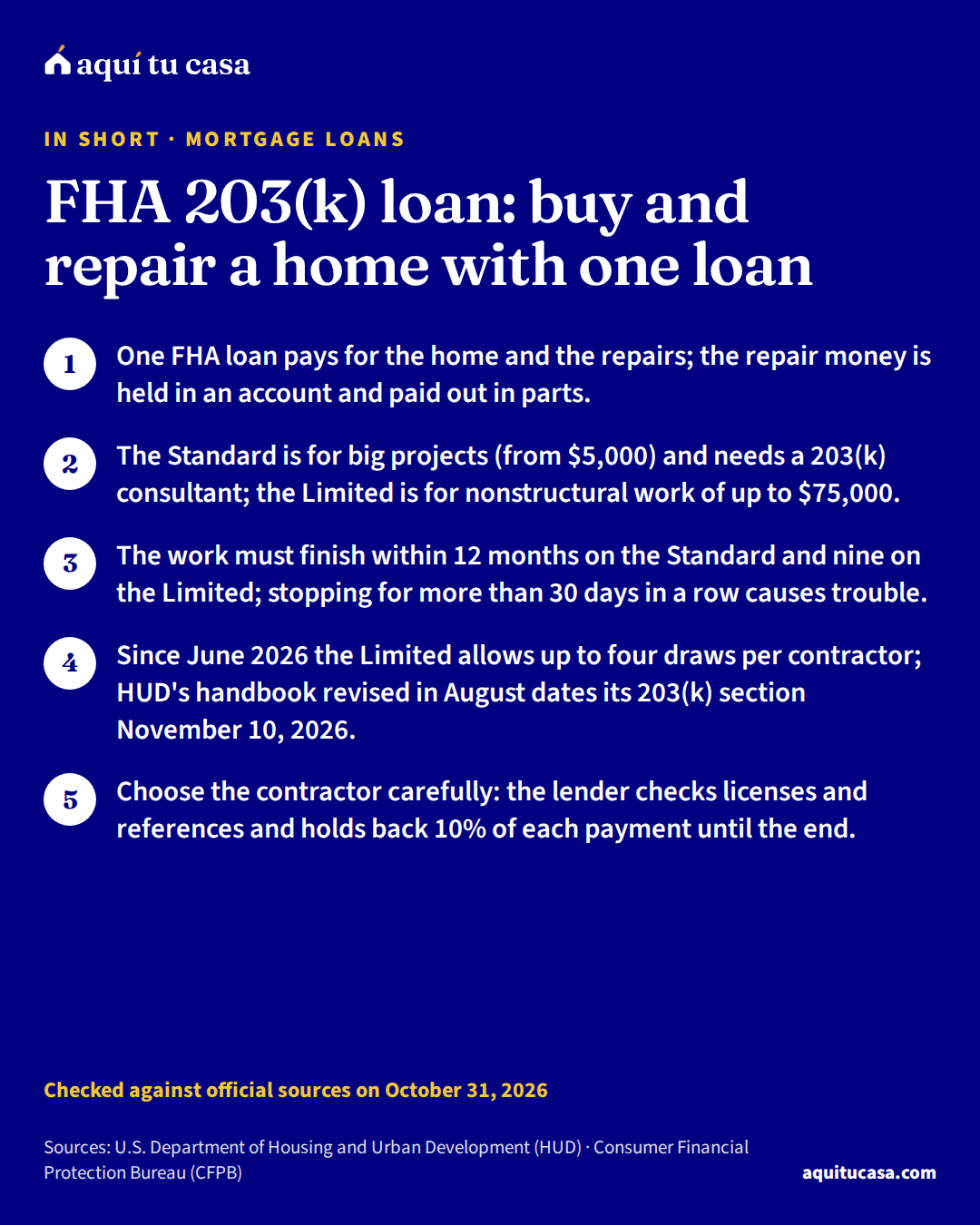
- One FHA loan pays for the home and the repairs; the repair money is held in an account and paid out in parts.
- The Standard is for big projects (from $5,000) and needs a 203(k) consultant; the Limited is for nonstructural work of up to $75,000.
- The work must finish within 12 months on the Standard and nine on the Limited; stopping for more than 30 days in a row causes trouble.
- Since June 2026 the Limited allows up to four draws per contractor; HUD's handbook revised in August dates its 203(k) section November 10, 2026.
Is this for you?
This guide is for you if…
- You found a home that needs repairs and you do not have separate money to fix it.
- You already own a home with a loan and want to refinance to pay for major repairs.
- You were offered a 203(k) loan and want to understand the consultant, the draws and the deadlines.
Get direct help first if…
- You only want to understand a regular FHA loan: read «FHA loan».
- The repairs are from a disaster and you are looking for help you do not repay: read «After a hurricane, flood or fire».
Many homes people can afford need work: an old roof, a furnace that does not run or a kitchen with no appliances. The problem is that a regular loan pays for the home but not the work. The FHA 203(k) loan puts both together: one FHA loanFHA loanAn FHA loan is a mortgage made by a private lender and insured by the Federal Housing Administration (FHA), an agency of the U.S. government. That insurance protects the lender if you stop paying, which is why the lender can accept a lower down payment and a less-than-perfect credit history than on a conventional loan. Federal law sets the minimum cash investment at 3.5% of the property's value and caps the loan amount at the FHA limit, which changes by county. In exchange for the insurance you pay a mortgage insurance premium.See the full definition that pays for the purchase (or refinance) and the repairs.1 This guide explains the two types, what each pays for, how the repair money is handled and which dates on HUD’s rules you should know.
What a 203(k) is for
According to HUD, a 203(k) can be used to:1
- Buy and repair a one- to four-unit home.
- Repair the home you already own and refinance what you owe.
- Repair the interior of a condominium unit, not the areas the association is responsible for.
The home must have been completed at least one year before the lender asks for the case number. And here is a big advantage: a home that does not qualify for a regular FHA loan because of health or safety problems can qualify with a 203(k) if the work fixes those problems.1 It also works for manufactured homes when the work does not touch their structure, for mixed-use properties with at least 51% living area and for HUD homes marked as eligible. If you buy one of the HUD homes, check that it is marked as 203(k)-eligible; investors cannot use it for those homes.1
Standard or Limited: which one fits
There are two types of 203(k). The main difference is the size of the project:11
The two types of 203(k)
Big projects
Standard 203(k)
- From $5,000 in repairs
- Can include structural changes, foundations and additions
- Needs an FHA-approved 203(k) consultant
- Up to 12 months of work and up to five draws
Smaller fixes
Limited 203(k)
- Up to $75,000 in rehabilitation costs
- Nonstructural repairs only
- No required consultant, though you can use one
- Up to nine months of work and four draws per contractor
If the work touches the structure or the foundation or adds rooms, it is Standard.
What the Standard pays for. Almost anything that makes the home safe, usable and up to date: foundation and structural repairs, turning the home into one with an accessory dwelling unit (ADU)accessory dwelling unit (ADU)An accessory dwelling unit (ADU) is a living space, separate from the main house, on the same lot. It can be attached to the house, inside it or detached. According to Fannie Mae, it must have its own entrance, kitchen, sleeping area and bathroom, and be smaller than the main house. If it can only be reached through the main house, or it is open to it with no privacy, it does not count as an ADU. A second kitchen alone does not make one either. Fannie Mae allows only one per lot, and not with a two- to four-unit home.See the full definition or into two to four units, finishing an attic or basement, plumbing, heating, air and electrical, roofing, energy savings, accessibility for a person with a disability and new kitchen appliances. Everything must meet HUD’s minimum requirements and local codes.1 If the home was built before 1978, it can also pay for lead-based paint stabilization; the guide on lead, mold and pests explains that risk.
What neither one pays for. Luxuries and things that are not permanent: new pools, exterior hot tubs or saunas, barbecue pits, tennis courts, satellite dishes or gazebos. An existing pool can be repaired or removed.1
When the Limited falls short. FHA treats as “major” work that takes more than nine months, needs more than four draws per contractor, requires a consultant or plans, or keeps you out of the home for more than 30 days in total. It also does not pay for room additions, foundations or landscaping. If your project falls there, you need the Standard.1
The consultant, the contractor and the work plan
With the Standard, your lender picks a 203(k) consultant from FHA’s roster. The consultant inspects the home and writes up the work, repair by repair, with its cost. Before closing, the lender confirms you hired a qualified contractor who signed on to do that work, for that price and within that time. To do that, it checks the contractor’s experience, references, licenses and bonding.1
With the Limited, you provide the work plan. You can write it yourself or with help from a contractor or consultant, in no special format. Each contractor gives you a written proposal with the cost of each job, split into labor and materials, and it must say which jobs need a building permitbuilding permitA building permit is the approval a local government gives to start a construction project. Not every area of the country requires one. If you renovate with an FHA 203(k) loan, the program requires all building permits to be obtained before work starts and posted on site. Freddie Mac also recommends working with your contractor to get any permits you need before a renovation begins.See the full definition and that the repairs are nonstructural. The lender checks that the prices are normal and may ask for more estimates.1
If you do part of the work yourself, you can sign a self-help agreement, but you are not paid for your labor.1

The contract, the appraisal and how much you can borrow
The purchase contract. It must say you applied for a 203(k) and that the purchase depends on loan approval and on your accepting any extra improvements the lender asks for. The lender also gives you form HUD-92700-A, which explains your responsibilities.1
The appraisalhome appraisalAn appraisal is a written document that gives a professional appraiser's opinion of how much a property is worth. The lender orders it before approving the mortgage, because the home is the loan's collateral and the lender does not want to lend more than it is worth. If the appraisal comes in below the price you agreed, the bank bases the loan on the lower value and you will have to cover the difference, renegotiate the price or walk away if your contract allows it. An appraisal is not an inspection: it measures value, not the home's condition.See the full definition. You always need an appraisal by an FHA roster appraiser that says what the home will be worth after the improvements. The lender also works out the home’s as-is value; in a purchase, that is the lesser of the price (minus seller inducements) and the as-is appraised value, if one was ordered.1
The maximum loan. On a purchase, FHA insures the lesser of these amounts: FHA’s loan-to-value ratio applied to the lesser of the as-is value plus the cost of the work and 110% of the after-improved value (100% for condominiums), or FHA’s mortgage limits.1 If the work costs more than it raises the home’s value, the loan may fall short. The guide on what happens if the appraisal comes in low explains the options.
The Standard’s reserves. Depending on the home’s age, the loan includes a contingency reserve for surprises, 10% to 20% of the cost of the work; it is required in homes 30 years or older, and in newer homes with termite damage. It can also include up to 12 months of mortgage payments if you cannot live in the home during the work.1
Example with real numbers
A home over 30 years old with an old roof and plumbing
An example in words, not a real case, of how a Standard 203(k) comes together.
- The home
- It is over 30 years old, so the contingency reserve is required
- The work
- Roof, plumbing and kitchen; the consultant writes up the work and its cost
- The reserve
- Between 10% and 20% of the cost of the work, for surprises
- If they cannot live there
- The loan can include up to 12 months of mortgage payments
- The deadline
- Up to 12 months to finish, from when the loan is funded
The rules in the example come from HUD Handbook 4000.1.11 Work out your monthly payment with your own numbers.
Run it with your numbersMortgage calculatorHow the work gets paid: the account and the draws
At closing, the repair money is not handed to you. It goes into an interest-bearing escrowescrow accountAn escrow account is an account set up by your mortgage lender to pay certain property-related expenses on your behalf, mainly property taxes and homeowners insurance. The money comes from a portion of your monthly mortgage payment: each month you contribute a share and the loan servicer pays the bills when they come due. That is why your payment is higher than principal and interest alone, and why it can change when taxes or the insurance premium go up. In some states the word also names the period between the offer and the closing.See the full definition account, and the interest is yours. The lender pays only for finished work that meets the codes, with its permits and inspections, and gets lien waiverslien waiverA lien waiver is a document in which a contractor, subcontractor or materials supplier states that it has been paid and gives up its right to place a lien on your home to collect for that work. The CFPB recommends asking your contractors for one at the start and at each stage of a repair. In Texas, the law says a waiver is valid only if it substantially follows one of the official forms and is signed by the person claiming payment. A conditional waiver takes effect when the bank pays the check, and no one may require an unconditional waiver without having paid that amount.See the full definition so no one can claim the home for unpaid work. It holds back 10% of each payment until the end, releases the money within five business days and makes the checks out to you and the contractor together, unless you authorize in writing paying the contractor directly.1
How many draws. On the Standard, up to five: four intermediate and one final. On the Limited, up to four per contractor: the initial one at closing, no more than two intermediate and the final one. If the Limited work costs $15,000 or less, receipts or your letter that it is finished are enough; above that, an inspection is needed.1
What changed in 2026. The Limited used to allow only two draws. Mortgagee Letter 2026-06, dated June 23, 2026 and effective immediately, raised it to four per contractor. The same letter notes that in 2024 the Limited maximum rose from $35,000 to $75,000 and the time limit from six to nine months.2
The deadline for the work. It starts when the loan is funded: up to 12 months on the Standard and nine on the Limited. Work must start within 30 days and cannot stop for more than 30 days in a row; otherwise the lender can treat the loan as in default. If you need more time, ask for an extension with documents; you get it only if your payments are current. If repair money is left over and you are not behind, it goes to your balance.1
From the plan to finished work
1. Find a lender that does 203(k) loans
Before you make an offer
Ask whether it offers the Standard, the Limited or both, and what it charges.1
2. Add the 203(k) clause to the contract
When you make the offer
The purchase must depend on loan approval and on your accepting the improvements.1
3. Put together the plan and the estimates
Before the appraisal
With a consultant on the Standard, or with your plan and contractors' proposals on the Limited.1
5. Start the work on time
Within 30 days of closing
If work stops for more than 30 days in a row, the loan can go into default.1
6. Request each draw for finished work
During the project
The lender holds back 10% of each payment until the end.1
If this is you
You found a cheap home that needs a lot
If it has safety problems that keep it out of regular FHA, a 203(k) can fix them.1
You want a room or a unit for your parents
Adding an ADU or converting the home into more units is Standard work, not Limited.1
You need ramps or an accessible bathroom
Accessibility for persons with disabilities is among the improvements a 203(k) pays for.1
You already own a home and want to fix it
A 203(k) can also repair the home and refinance what you owe.1
You plan to do part of the work yourself
You can, with a self-help agreement, but the loan pays only for materials.1

Costly mistakes
Mistake: Choosing the Limited for work that touches the structure.
Instead: Foundations, additions and structural changes belong to the Standard.1
Mistake: Paying the contractor up front outside the account.
Instead: The loan pays only for finished work, with 10% held back until the end.1
Mistake: Letting the work stop for a month or more.
Instead: If it stops for more than 30 days in a row, the lender can treat the loan as in default.1
Mistake: Falling behind on the mortgage during the work.
Instead: Without current payments, the lender cannot give you a deadline extension.1
Mistake: Planning a new pool or hot tub with the loan.
Instead: HUD does not pay for luxuries; focus on safety, systems and what adds value.1
Free help and other options
A HUD-approved housing counselorHUD-approved housing counselorA HUD-approved housing counselor works at an agency HUD has approved to provide housing counseling: independent, expert advice customized to your situation about buying a home, renting, a missed mortgage payment, a foreclosure or credit problems. The agencies usually charge little or nothing; many serve in Spanish and offer the homebuyer education course several assistance programs require. They are not lenders or real estate agents and sell you nothing. Your county page lists the official agencies with phone numbers.See the full definition can go over whether a 203(k) makes sense for you and compare lenders’ offers, often for free or at low cost.3 The guide to HUD-approved housing counselors explains how to find one. If your goal is to lower your power and gas bills, a 203(k) can be combined with an energy efficient mortgage, and on the Limited those improvements can go on top of the $75,000 limit.1 The energy efficient mortgages guide explains it. And to see what you would pay each month, use the mortgage calculator.

What to do this week
- Ask two or three lenders whether they do Standard 203(k), Limited 203(k) or both.1
- Make a list of the repairs and mark which ones touch the structure.1
- Get written proposals from licensed contractors, with labor and materials listed separately.1
- Check with your agent that the contract has the 203(k) clause.1
- Ask your lender which version of FHA’s handbook applies to your loan.1
Your numbers
Starts at the typical home value in the United States. Change it to the price you have in mind.
That is $11,645 (3.5% of the price). The usual minimum for this loan is 3.5%.
This week's average ± a quarter or half point.
National average as of November 5, 2026 (Freddie Mac); your rate may be different.
Adjust advanced details
Let's do the math
Estimated monthly payment
National figure$2,759
at 7.18% · 30 years
- Loan amount
- $326,673
- Total interest
- $470,006
- Paid off in
- November 2056
Includes $5,618 FHA upfront mortgage insurance premium.
Does it fit the income?
Comfortable
up to $1,884 a month
Tight
$1,884 to $2,422 a month
Hard
more than $2,422 a month
Your payment · 41%
Compared with the typical household income in the United States ($80,734 a year). Reference: HUD calls paying more than 30% of income for housing a cost burden.
| Principal & interest | $2,213 |
|---|---|
| Property tax | $261 |
| Home insurance | $139 |
| FHA mortgage insurance (MIP) | $147 |
How does it compare with incomes?
For this payment to be 28% of your income, you'd need to earn about $118,260 a year. With your other debts, to stay under 36%: about $91,980 a year.
You need at least $11,645 for the down payment, plus closing costs.
This is an estimate to give you an idea, not a loan offer. Your real payment depends on your rate, your credit, and the insurance and taxes on the home you buy.
Total monthly payment $2,759; principal and interest $2,213.
Ready to see the numbers? Find your county here
See how this applies in your county: its loan limits, prices and rents, from the official data.
Printable checklist
Frequently asked questions
What is the difference between the Standard and the Limited 203(k)?
The Standard is for big projects, even structural ones, and requires at least $5,000 in repairs and an FHA-approved 203(k) consultant. The Limited is for minor, nonstructural work, up to $75,000 in total, and does not require a consultant.
Can I do part of the work myself?
Yes, under a self-help agreement. But according to HUD you cannot be reimbursed for your own labor: the loan pays only for the materials of the work you do.
How long do I have to finish the work?
Up to 12 months on the Standard and up to nine on the Limited, counted from when the loan is funded. If you fall behind schedule you can ask for an extension, which the lender grants only if your payments are current.
Can I use a 203(k) for a pool or a hot tub?
Not a new one. HUD does not allow paying for luxury items such as new pools, exterior hot tubs or saunas, tennis courts or gazebos. You can repair or remove a pool that already exists.
Do I need a special appraisal?
Yes. You always need an appraisal by an FHA roster appraiser that says what the home will be worth after the improvements. The maximum loan depends on that value and on the home's as-is value.
Did the 203(k) rules change in 2026?
Yes. HUD Mortgagee Letter 2026-06, dated June 23, 2026 and effective immediately, raised Limited draws to four per contractor. The FHA handbook revised August 12, 2026 dates its 203(k) section November 10, 2026. Ask your lender which version applies to your loan.
Can I buy a HUD home with a 203(k)?
Yes, if the HUD home is identified as 203(k)-eligible in the contract. Investors cannot use a 203(k) to buy HUD homes.
Sources
Every figure in this guide comes from one of these official sources. The number next to a sentence leads to the source behind it.
Each source on one line: who publishes it, its title, its address and the date we read it.
- 1. U.S. Department of Housing and Urban Development (HUD) · Handbook 4000.1, FHA Single Family Housing Policy Handbook · hud.gov · Accessed October 31, 2026
- 2. U.S. Department of Housing and Urban Development (HUD) · Mortgagee Letter 2026-06, Increase in the Maximum Number of Draw Requests for Limited 203(k) Rehabilitation Mortgage Insurance Program · hud.gov · Accessed October 31, 2026
- 3. Consumer Financial Protection Bureau (CFPB) · Find a housing counselor · consumerfinance.gov · Accessed October 31, 2026
Keep reading
Related guides
If this guide helped, these follow the same path.

Buying a home 11 minute read
HUD homes and Good Neighbor Next Door: how to buy one
How HUD sells its homes on HUD Homestore, the priority period for buyers who will live in the home and the rules of the Good Neighbor Next Door discount.
- HUD sells its homes as-is, without repairs or warranties: you pay for and decide on the inspection.
- You can bid only through a HUD-registered broker, and buyers who will live in the home get priority.
- Good Neighbor Next Door gives 50% off to certain full-time workers who serve that locality.
- Mortgage loans Energy efficient mortgages: FHA EEM and HomeStyle Refresh How to add energy-saving improvements to your loan: FHA's EEM, Fannie Mae's HomeStyle Refresh, the energy audit and what happened to HomeStyle Energy. 10 minute read
- Buying a home Home inspection: what it covers and when to get it What a home inspection is, how it differs from the appraisal, when to get it under a contingency, radon and lead tests, and what to do with the report. 12 minute read

Tools for this topic
Was this guide useful?
Thank you. Your answer stays in your browser; nothing is sent.