Energy efficient mortgages: FHA EEM and HomeStyle Refresh
How to add energy-saving improvements to your loan: FHA's EEM, Fannie Mae's HomeStyle Refresh, the energy audit and what happened to HomeStyle Energy.
Verified against official sources on October 31, 2026 4 official sources

Show contents
In short
What you need to know
Quick answer
An energy efficient mortgage lets you add to your loan the cost of improvements that lower your energy bill, such as insulation or a new heating system. With FHA it is called an EEM: you need an energy audit, the improvements must save more than they cost and the amount is capped. Fannie Mae no longer has a program called HomeStyle Energy; today those improvements go through HomeStyle Refresh, with a maximum of 15% of the as-completed value and 180 days to finish the work. VA allows energy improvements in an IRRRL.
What matters most
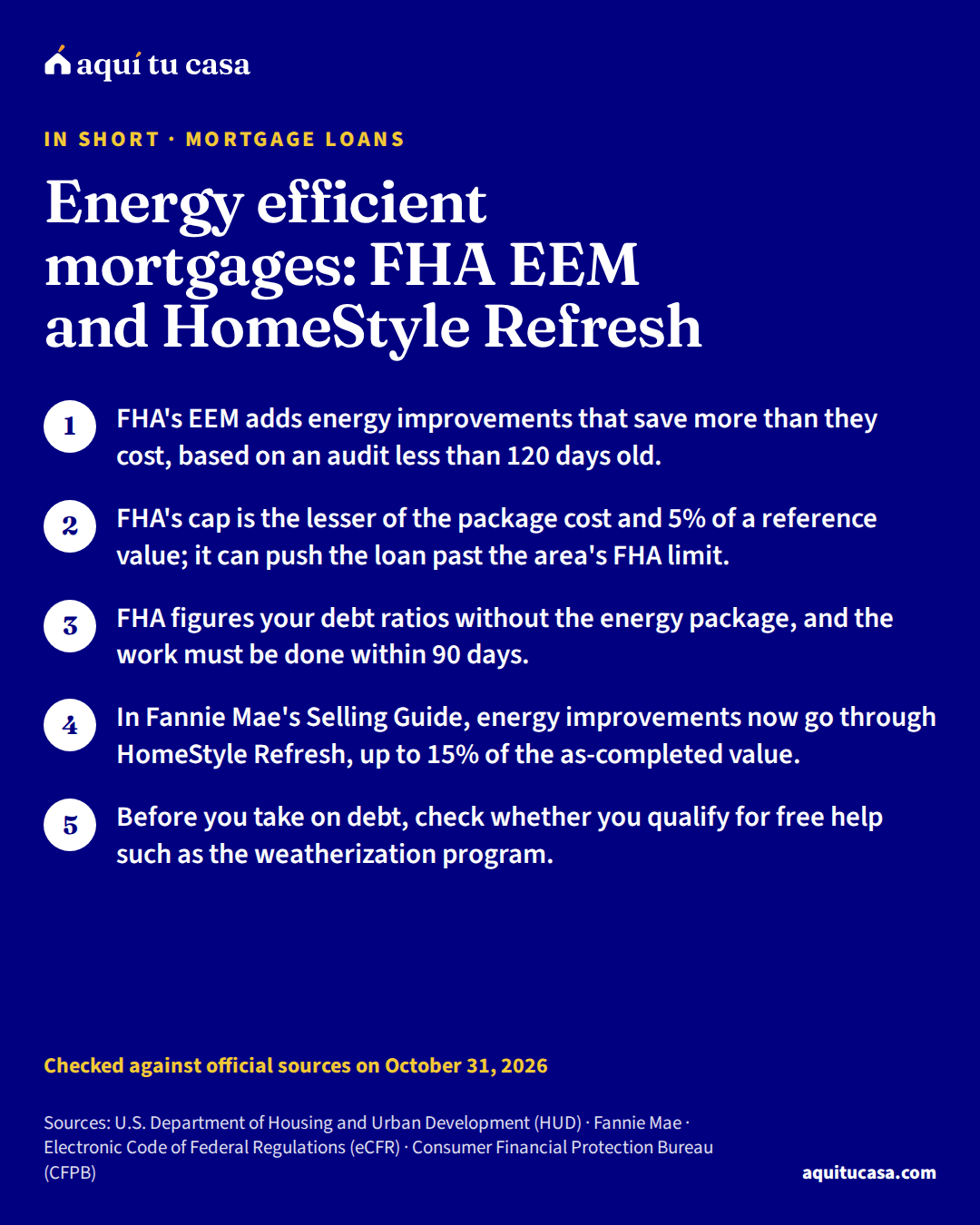
- FHA's EEM adds energy improvements that save more than they cost, based on an audit less than 120 days old.
- FHA's cap is the lesser of the package cost and 5% of a reference value; it can push the loan past the area's FHA limit.
- FHA figures your debt ratios without the energy package, and the work must be done within 90 days.
- In Fannie Mae's Selling Guide, energy improvements now go through HomeStyle Refresh, up to 15% of the as-completed value.
Is this for you?
This guide is for you if…
- You are buying or refinancing and want to add windows, insulation or a more efficient heating system to the loan.
- You heard about FHA's energy efficient mortgage (EEM) and want to know how it works.
- You were looking for Fannie Mae's HomeStyle Energy program and cannot find it.
Get direct help first if…
- You need free help paying for power or gas: read «LIHEAP: help with utility bills».
- You were offered solar panels paid through your property tax bill: read «Solar panels and PACE loans: risks».
A home with old windows, no insulation or a heater that burns a lot of fuel can cost you every month on your power and gas bills. An energy efficient mortgage lets you add the cost of improvements that cut that spending to your loan, instead of paying for them out of pocket. This guide explains FHA’s EEM, Fannie Mae’s option for conventional loans and what happened to the HomeStyle Energy program.12
FHA’s EEM: what it is for
The EEM is part of an FHA loan. According to HUD Handbook 4000.1, it finances cost-effective energy efficiency improvements to an existing home when you buy or refinance it, or upgrades beyond the building code in a new home.1
Which homes. New or existing one- to four-unit homes, one-unit condominiums and manufactured homes.1
Which loans. A 203(b) FHA loanFHA loanAn FHA loan is a mortgage made by a private lender and insured by the Federal Housing Administration (FHA), an agency of the U.S. government. That insurance protects the lender if you stop paying, which is why the lender can accept a lower down payment and a less-than-perfect credit history than on a conventional loan. Federal law sets the minimum cash investment at 3.5% of the property's value and caps the loan amount at the FHA limit, which changes by county. In exchange for the insurance you pay a mortgage insurance premium.See the full definition for a purchase or no cash-out refinance, a 203(h) for disaster victims and a Standard or Limited 203(k)FHA 203(k) loanThe FHA 203(k) loan is an FHA-insured mortgage that combines, in a single loan, the purchase of a home (or the refinance of yours) and the cost of repairing or renovating it. You get it through an FHA-approved lender. Part of the money pays the seller or the old mortgage, and the rest goes into an escrow account and is released when the work is completed. There are two types: Standard, for major or structural repairs, and Limited, for smaller, non-structural work. Eligible properties include one- to four-unit homes, townhomes and certain condominium units, among others.See the full definition.1 If the home also needs repairs, the FHA 203(k) loan guide explains how to combine everything; on the Limited, energy improvements can go on top of the $75,000 limit.1
What the package includes. The set of improvements you agree to based on an energy rater’s recommendations. It can include energy-saving equipment and solar or wind technology, with materials, labor, inspections and the audit itself, and even a project manager if you want one. In a new home, only improvements above the strictest energy code that applies count.1
The energy audit
You cannot pick the improvements at random. You need a whole-home energy assessment by someone qualified:1
- A Building Performance Institute (BPI) Building Analyst Professional or Home Energy Professional Energy Auditor.
- A RESNET Home Energy Rater.
- Or a rater who meets your state’s or locality’s training, licensing and insurance requirements.
The report recommends improvements, with how much each one saves and whether it is cost-effective. It must show the rater’s credential and can be no more than 120 days old when your lenderlenderThe lender is the financial institution that lends you the money for your mortgage. The mortgage is the agreement that gives the lender the right to take your home if you do not repay what it lent you. After closing, it is common for another company, the loan servicer, to collect your payments and keep track of the loan; it may be the same company that lent you the money or a different one. On the Loan Estimate, the lender's name appears on the first page, and the last page lists it as "Lender" with its NMLS or license number.See the full definition uses it.1 If the work changes after closing, you need a change order and a new audit; if the new work is no longer cost-effective, that money goes to pay down the loan.1
How much you can add with FHA and how it affects approval
The cap. The most you can add to the base loan is the lesser of the cost of the cost-effective package from the audit and 5% of the lowest of these three values:1
- The home’s adjusted value.
- 115% of the median price of a single-family home in your area.
- 150% of the national conforming loan limit.
That amount is added to the maximum base loan, and it can push your loan above your area’s FHA limit.1
Your approval. The lender figures your debt ratiosdebt-to-income ratio (DTI)Your debt-to-income ratio (DTI) is all your monthly debt payments divided by your gross monthly income, that is, income before taxes. If you pay a certain amount each month across a car, cards, student loans and the mortgage you are asking for, and you earn three times that, your DTI is one third. Lenders use it to measure whether you can manage the payment; each loan type and lender sets its own limit, and assistance programs usually publish theirs. Paying down debt before applying improves your DTI.See the full definition with the loan without the energy package, and FHA accepts the payment increase without re-underwriting. The appraisalhome appraisalAn appraisal is a written document that gives a professional appraiser's opinion of how much a property is worth. The lender orders it before approving the mortgage, because the home is the loan's collateral and the lender does not want to lend more than it is worth. If the appraisal comes in below the price you agreed, the bank bases the loan on the lower value and you will have to cover the difference, renegotiate the price or walk away if your contract allows it. An appraisal is not an inspection: it measures value, not the home's condition.See the full definition does not have to include the value of the improvements.1 Even so, your monthly payment does go up: run the numbers with the mortgage calculator before you decide.
The money and the deadline. You get no cash; any excess goes to the balance. If the work is not done at closing, the money is held in an escrowescrow accountAn escrow account is an account set up by your mortgage lender to pay certain property-related expenses on your behalf, mainly property taxes and homeowners insurance. The money comes from a portion of your monthly mortgage payment: each month you contribute a share and the loan servicer pays the bills when they come due. That is why your payment is higher than principal and interest alone, and why it can change when taxes or the insurance premium go up. In some states the word also names the period between the offer and the closing.See the full definition account that cannot pay for your own labor. Outside a 203(k), the improvements must be installed within 90 days of disbursement; otherwise, that money is used to prepay the loan. Someone may inspect the installation, and you may be charged for it.1
Example with real numbers
A family buying a home with old windows
An example in words, not a real case, of how an FHA EEM comes together.
- The audit
- A certified rater recommends windows, insulation and a new heater
- The test
- All three improvements save more than they cost over their useful life
- The cap
- The lesser of the cost and 5% of the lowest reference value
- Approval
- Their debt ratios are figured without the energy package
- The deadline
- 90 days after disbursement to install everything
The rules come from HUD Handbook 4000.1.11 Check what you spend today on power and gas with the utility costs tool.
Run it with your numbersElectricity and gas costsFannie Mae: from HomeStyle Energy to HomeStyle Refresh
If you are looking for HomeStyle Energy, you will not find it under that name. In Fannie Mae’s Selling Guide published October 7, 2026, the section where it used to be is called HomeStyle Refresh Mortgages, and the old address says the content has moved.2
What HomeStyle Refresh is. It is a Fannie Mae option for conventional loansconventional loanA conventional loan is any mortgage that is not insured or guaranteed by the federal government: it is not FHA, VA or USDA. The lender, or the companies that buy the loans (Fannie Mae and Freddie Mac), carry the risk. When the amount is within the conforming loan limit the loan is called "conforming"; above it, it is a "jumbo" loan. It usually asks for a higher credit score than an FHA loan and, if your down payment is less than 20% of the price, you are normally required to buy private mortgage insurance (PMI) until you build enough equity in the home.See the full definition that adds smaller improvements to an existing home: energy or water efficiency, asbestos, lead, mold or radon remediation, disaster protection or repair, and also kitchen or bath updates or adding an accessory unit. It can be used with HomeReady, with down payment assistance or with community land trusts. It works for existing one- to four-unit properties and for manufactured homes if the improvements are not structural.2
The limits. There is no minimum. The maximum for renovations is 15% of the home’s as-completed value, on a purchase or a limited cash-out refinance. The improvements must be finished no later than 180 days after the note is signed, and the lender can advance up to 50% of the cost at closing. You need an appraisal with an inside and outside inspection and, at the end, a certification that the work was completed.2
If you have a PACE loan. A limited cash-out refinance can pay off a PACE loanPACE loanA PACE loan is financing for home repairs or improvements, such as energy-efficiency upgrades, that you repay through your property taxes. According to the CFPB, the payment is added to your property tax bill each year until it is paid off, and if you do not pay you risk losing your home in a tax sale. Most lenders will not refinance your mortgage or lend to a buyer while the home has an unpaid PACE loan. Under Regulation Z, the lender must evaluate whether you can repay it, and a PACE loan cannot be a qualified mortgage.See the full definition or other debt that paid for energy improvements. If the loan combines new improvements and that debt, the total cannot exceed 15%.22 The guide on solar panels and PACE loans explains why that debt can be a problem.
FHA EEM and Fannie Mae HomeStyle Refresh
FHA loan
FHA EEM
- Only cost-effective improvements from an audit
- Cap: the lesser of the cost and 5% of a reference value
- Debt ratios figured without the package
- 90 days to install, outside a 203(k)
Conventional loan
Fannie Mae HomeStyle Refresh
- Energy, water, disasters, kitchens, baths and ADUs
- Up to 15% of the as-completed value, no minimum
- Can pay off a PACE loan in a refinance
- 180 days to finish the work
Ask your lender for both options in writing and compare the monthly payment.
With VA. If you have a VA loan, the regulation allows an IRRRL payment to go up if the increase comes from including energy efficiency improvements.3 The VA funding fee and IRRRL guide explains that refinance.
How to add energy improvements to your loan
1. Gather your energy bills
Before the audit
They show where you spend the most and help you compare with the rater's estimates.
2. Get a whole-home audit
Before you apply for the loan
With a BPI or RESNET rater, or one who meets your state's rules.1
3. Choose the cost-effective improvements
With the report
Only the part that saves more than it costs can be financed with FHA.1
4. Ask your lender for an EEM or HomeStyle Refresh
When you apply
Ask about each option's cap and how your payment changes.1
If this is you
You are buying your first home and it is old
An FHA EEM adds cost-effective improvements without changing the debt ratios you are approved on.1
You already own and want to refinance
FHA's EEM works on a no cash-out refinance; HomeStyle Refresh, on a limited cash-out one.12
You have a VA loan
You can add energy improvements to an IRRRL, even if the payment goes up.3
Your budget is very tight
Check free weatherization help first; borrowing raises your monthly payment.1
Your home was damaged in a disaster
HomeStyle Refresh includes disaster repairs and resiliency improvements.2
Questions for the rater and the lender
Arriving with clear questions helps you avoid paying for improvements that do not make sense for you.
For the energy rater:
- Which certification do you hold: BPI, RESNET or another your state requires? That credential must appear on the report.1
- How much does each improvement save per year and how long does it last? That decides whether it is cost-effective.1
- Which improvements would you do first if the money does not cover all of them?
For the lender:
- Do you offer FHA’s EEM, HomeStyle Refresh or both?
- What is the energy package cap in my case and how much does my monthly payment go up?1
- Who pays for the inspection of the work and when is the money released?12
- What happens if the contractor does not finish on time?

Costly mistakes
Mistake: Using an audit more than four months old.
Instead: For FHA, the report can be no more than 120 days old.1
Mistake: Including improvements that do not pay for themselves.
Instead: FHA finances only the cost-effective part of the package.1
Mistake: Putting off the installation.
Instead: With FHA you have 90 days; otherwise the money is used to prepay the loan.1
Mistake: Asking for HomeStyle Energy and giving up when it does not exist.
Instead: Ask about HomeStyle Refresh, where Fannie Mae's energy improvements go now.2
Mistake: Expecting extra cash.
Instead: With FHA's EEM you get no cash; any excess goes to the balance.1
Free help and other options
Before you borrow, check whether you qualify for help you do not repay. The weatherization program can make energy improvements for free for households that qualify, and LIHEAP helps pay power and gas bills. A HUD-approved housing counselorHUD-approved housing counselorA HUD-approved housing counselor works at an agency HUD has approved to provide housing counseling: independent, expert advice customized to your situation about buying a home, renting, a missed mortgage payment, a foreclosure or credit problems. The agencies usually charge little or nothing; many serve in Spanish and offer the homebuyer education course several assistance programs require. They are not lenders or real estate agents and sell you nothing. Your county page lists the official agencies with phone numbers.See the full definition can compare loan options with you, often for free or at low cost.4 The guide to HUD-approved housing counselors explains how to find one.

What to do this week
- Gather your power and gas bills for the last 12 months.
- Find a certified energy rater and ask for a whole-home audit.1
- Ask two lenders whether they offer FHA’s EEM or HomeStyle Refresh.12
- Ask them to show you the monthly payment with and without the improvements.1
- Write down the work deadline: 90 days with FHA or 180 with HomeStyle Refresh.12
Your numbers
Starts at the typical home value in the United States. Change it to the price you have in mind.
That is $11,645 (3.5% of the price). The usual minimum for this loan is 3.5%.
This week's average ± a quarter or half point.
National average as of November 5, 2026 (Freddie Mac); your rate may be different.
Adjust advanced details
Let's do the math
Estimated monthly payment
National figure$2,759
at 7.18% · 30 years
- Loan amount
- $326,673
- Total interest
- $470,006
- Paid off in
- November 2056
Includes $5,618 FHA upfront mortgage insurance premium.
Does it fit the income?
Comfortable
up to $1,884 a month
Tight
$1,884 to $2,422 a month
Hard
more than $2,422 a month
Your payment · 41%
Compared with the typical household income in the United States ($80,734 a year). Reference: HUD calls paying more than 30% of income for housing a cost burden.
| Principal & interest | $2,213 |
|---|---|
| Property tax | $261 |
| Home insurance | $139 |
| FHA mortgage insurance (MIP) | $147 |
How does it compare with incomes?
For this payment to be 28% of your income, you'd need to earn about $118,260 a year. With your other debts, to stay under 36%: about $91,980 a year.
You need at least $11,645 for the down payment, plus closing costs.
This is an estimate to give you an idea, not a loan offer. Your real payment depends on your rate, your credit, and the insurance and taxes on the home you buy.
Total monthly payment $2,759; principal and interest $2,213.
Ready to see the numbers? Find your county here
See how this applies in your county: its loan limits, prices and rents, from the official data.
Printable checklist
Frequently asked questions
What is an FHA EEM?
It is an FHA mortgage that adds the cost of cost-effective energy efficiency improvements, on a purchase or a no cash-out refinance. It can be used with 203(b), 203(h) and 203(k) loans.
Do I need an energy audit?
Yes. FHA requires a whole-home assessment by a qualified rater (for example, BPI or RESNET, or one who meets your state's rules). The report cannot be more than 120 days old.
How much can I add to the loan with an EEM?
The lesser of the cost of the cost-effective package and 5% of the lowest of three values: the home's adjusted value, 115% of the area median price or 150% of the national conforming loan limit.
Does an EEM make approval harder?
Not because of the package. FHA figures your debt ratios with the loan without the energy package and accepts the payment increase without re-underwriting.
What happened to Fannie Mae's HomeStyle Energy?
In the Selling Guide published October 7, 2026, the section where it used to be is called HomeStyle Refresh. Energy or water efficiency improvements go there now, up to 15% of the as-completed value.
Can I pay off a PACE loan with HomeStyle Refresh?
According to Fannie Mae, a limited cash-out refinance can pay off a PACE loan or other debt that financed energy improvements. If it combines new improvements and that debt, the total cannot exceed 15%.
Can I add energy improvements to a VA IRRRL?
Yes. VA's regulation allows the IRRRL payment to go up if the increase comes from including energy efficiency improvements.
Sources
Every figure in this guide comes from one of these official sources. The number next to a sentence leads to the source behind it.
Each source on one line: who publishes it, its title, its address and the date we read it.
- 1. U.S. Department of Housing and Urban Development (HUD) · Handbook 4000.1, FHA Single Family Housing Policy Handbook · hud.gov · Accessed October 31, 2026
- 2. Fannie Mae · Selling Guide B5-3.3-01, HomeStyle Refresh for Improvements on Existing Properties · selling-guide.fanniemae.com · Accessed October 31, 2026
- 3. Electronic Code of Federal Regulations (eCFR) · 38 CFR §36.4307, Interest rate reduction refinancing loan · ecfr.gov · Accessed October 31, 2026
- 4. Consumer Financial Protection Bureau (CFPB) · Find a housing counselor · consumerfinance.gov · Accessed October 31, 2026
Keep reading
Related guides
If this guide helped, these follow the same path.

Mortgage loans 14 minute read
FHA loan: down payment, insurance, limits and who qualifies
How an FHA loan works: the down payment and credit score HUD requires, MIP mortgage insurance, your county limit, the home and the residency rules.
- FHA does not lend the money: it insures loans from private lenders, and you pay for that insurance (MIP).
- With a score of 580 or higher you put down as little as 3.5%; from 500 to 579, at least 10%; below 500 there is no FHA loan.
- The annual premium lasts 11 years if you put 10% or more down, and the life of the loan if you put down less.
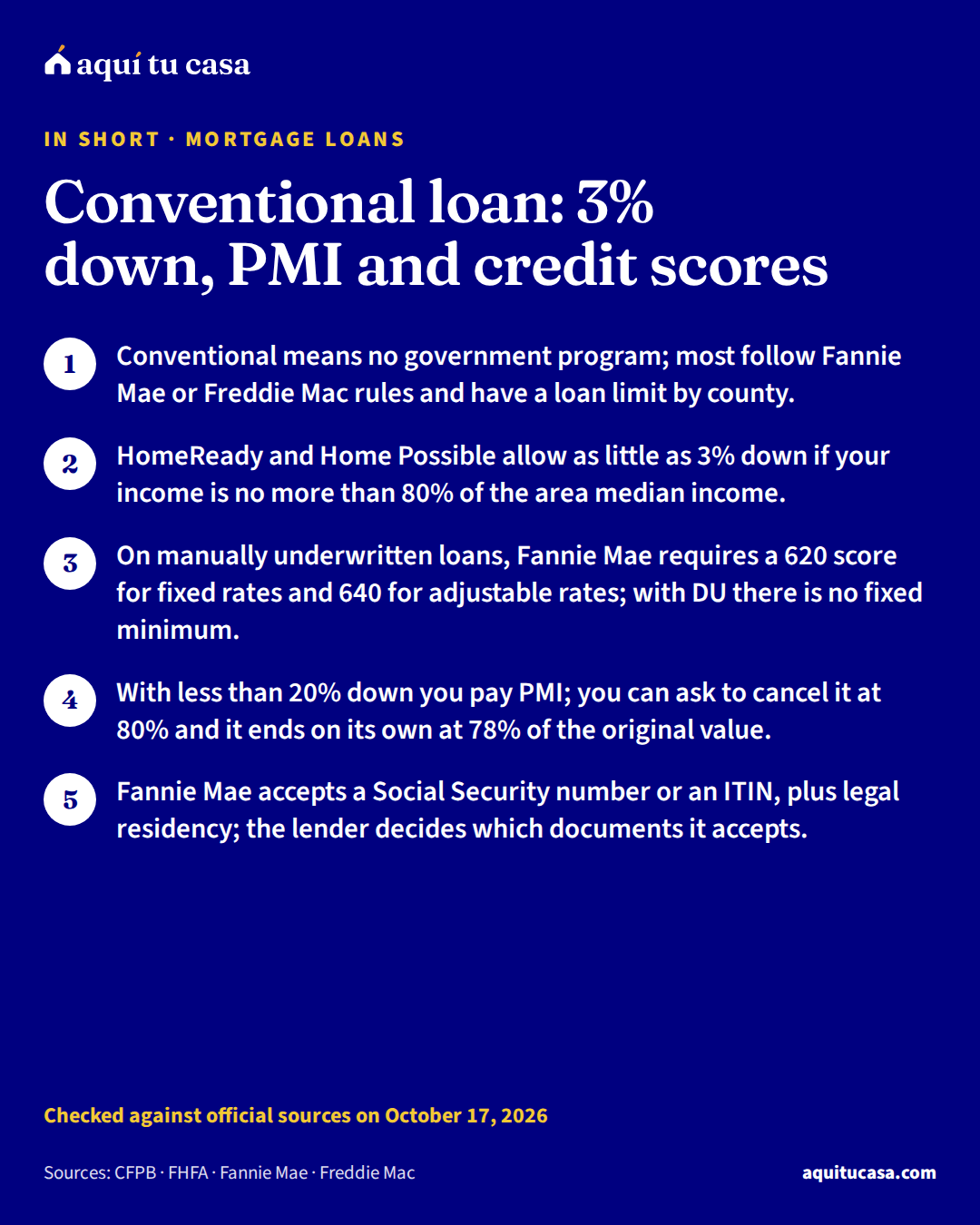
- Mortgage loans Conventional loan: 3% down, PMI and credit scores How a conventional loan works: HomeReady and Home Possible from 3% down, the credit score Fannie Mae requires, PMI and when the law ends it. 12 minute read
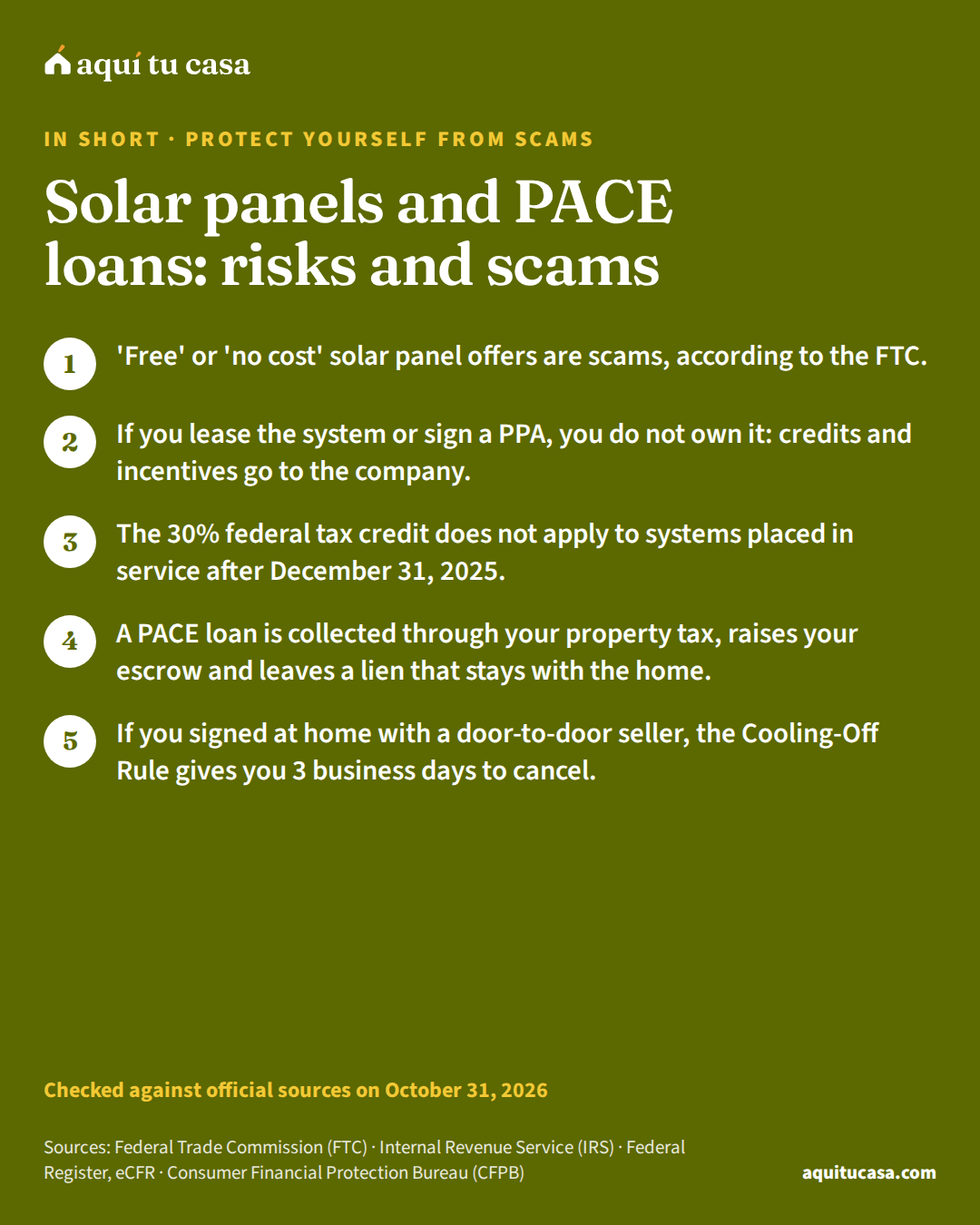
- Protect yourself from scams Solar panels and PACE loans: risks and scams Before you sign for solar panels or a PACE loan: buying, leasing or a PPA, the tax credit that ended, the lien on your property tax and scam warning signs. 11 minute read
Tools for this topic
Was this guide useful?
Thank you. Your answer stays in your browser; nothing is sent.